Report
UK Covid-19 Inquiry, Modules 2, 2A, 2B, 2C: Core decision-making and political governance
¶UK Covid-19 Inquiry
¶Modules 2, 2A, 2B, 2C: Core decision-making and political governance
Volume I: Introduction and key events from
¶January 2020 to May 2022
¶A report by The Rt Hon the Baroness Hallett DBE Chair of the UK Covid-19 Inquiry
¶November 2025
¶UK Covid-19 Inquiry Modules 2, 2A, 2B, 2C: Core decision-making and political governance
Volume I: Introduction and key events from
¶January 2020 to May 2022
¶A report by The Rt Hon the Baroness Hallett DBE Chair of the UK Covid-19 Inquiry
¶Presented to Parliament pursuant to section 26 of the Inquiries Act 2005 Ordered by the House of Commons to be printed 20 November 2025
¶HC 1436-I
¶© Crown copyright 2025 This publication is licensed under the terms of the Open Government Licence v3.0 except where otherwise stated. To view this licence, visit nationalarchives.gov.uk/doc/open-government-licence/version/3. Where we have identified any third party copyright information you will need to obtain permission from the copyright holders concerned. This publication is available at www.gov.uk/official-documents. Any enquiries regarding this publication should be sent to contact@covid19.public-inquiry.uk ISBN 978-1-5286-5449-4 E03296643 11/25 Version 1.1 Printed on paper containing 40% recycled fibre content minimum Printed in the UK by HH Associates Ltd. on behalf of the Controller of His Majesty's Stationery Office
CORRECTION SLIP
¶Title: UK Covid-19 Inquiry
¶Modules 2, 2A, 2B, 2C: Core decision-making and political governance
Volume I: Introduction and key events from January 2020 to May
¶A report by The Rt Hon the Baroness Hallett DBE Chair of the UK Covid-19 Inquiry
¶Session: 2024–26
¶HC 1436-I
¶ISBN: 978-1-5286-5449-4
¶Ordered by the House of Commons to be printed 20 November 2025
¶Corrections:
¶Text currently reads (Chapter 2, para 41): In Scotland, on 24 January 2020, Ms Sturgeon received a briefing from Health Protection Scotland incorrectly stating: "We now know that people carrying the virus are only infectious to other people when experiencing symptoms." Ms Sturgeon challenged the view that asymptomatic transmission was not possible. The following day she received further advice from Health Protection Scotland, which explained that "it is likely that person to person transmission, when it does occur, mostly involves transmission of virus from people with symptoms" and that:
¶Text should read:
¶In Scotland, on 24 January 2020, Ms Sturgeon received a briefing from the Scottish Government's Health Protection Policy Team incorrectly stating: "We now know that people
-
¶
-
carrying the virus are only infectious to other people when experiencing symptoms." — 104
-
Ms Sturgeon challenged the view that asymptomatic transmission was not possible. The — 105
¶following day she received advice from Health Protection Scotland, which explained that "it is likely that person to person transmission, when it does occur, mostly involves transmission of virus from people with symptoms" and that:
¶Date of correction: 16 January 2026
¶Text currently reads (Chapter 3, para 16): Richard Pengelly, Permanent Secretary to the Department of Health (Northern Ireland) from July 2014 to April 2022, had written to the Chief Executives of health and social care trusts on 1 March 2020, warning them that:
¶Text should read: Richard Pengelly, Permanent Secretary to the Department of Health (Northern Ireland) from July 2014 to April 2022, had written to the Chief Executives of health and social care trusts on 26 March 2020, warning them that:
¶Date of correction: 16 January 2026
iiiContents
Volume I: Introduction and key events from January 2020 to May
¶Introduction by The Rt Hon the Baroness Hallett DBE xiii Voices xvii
-
¶
-
Executive summary — 1
-
Key events from January 2020 to May 2022 — 2
-
Key themes — 8
-
Key lessons for future emergencies — 13
-
Specific recommendations — 14
¶Chapter 1: The context for pandemic decision-making – key structures and concepts 16 Introduction 17
-
¶
-
Key structures — 17
-
Key scientific concepts — 21
¶Chapter 2: The emergence of Covid-19 (January and February 2020) 32 Introduction 33
-
¶
-
January 2020: Emerging understanding — 33
-
The situation at the end of January 2020 — 53
-
February 2020: The spread of the virus — 57
-
Border controls and restrictions — 78
-
The situation at the end of February 2020 — 80
-
Lost time — 91
-
Chapter 3: The first 12 days of March 2020 — 92
¶Introduction 93
-
¶
-
1 to 3 March 2020 — 94
-
The initial plan for the response — 104
-
4 to 12 March 2020 — 119
¶The move from 'contain' to 'delay' and self-isolation advice 137
-
¶
-
The end of community testing and tracing contacts — 144
-
The situation on 12 March 2020 — 147
Chapter 4: Realisation and lockdown (13 to 23 March 2020)
¶Introduction 149
-
¶
-
Public health data and NHS capacity at 13 March 2020 — 149
-
13 March 2020: New data and a dawning realisation — 153
-
The weekend of 14 and 15 March 2020 — 159
-
The situation on 15 March 2020 — 169
-
16 March 2020: An 'advisory' lockdown — 170
-
17 March 2020 — 177
-
18 March 2020: Closing schools and London lockdown — 179
-
19 and 20 March: Additional restrictions — 184
-
The weekend of 21 and 22 March 2020 — 191
-
The lockdown decision: 23 March 2020 — 194
-
Decision-making leading to the lockdown decision — 199
-
The inevitability of a lockdown — 213
-
Chapter 5: Exit from lockdown (April to early July 2020) — 214
-
Introduction — 215
-
Plans for reviewing lockdown — 217
-
April 2020: Reviews of lockdown — 220
-
May 2020: Planning for lifting lockdown — 234
-
June 2020: Reopening — 247
-
Further easing of restrictions in July 2020 — 259
-
The divergence of approaches across the UK — 265
¶Chapter 6: The second wave (mid-July to early December 2020) 266 Introduction 267
-
¶
-
July and August 2020 — 268
-
The situation at the end of August 2020 — 280
-
September 2020 — 281
-
The situation at the end of September 2020 — 297
-
Local restrictions: England and Scotland — 299
-
Circuit breakers in Wales and Northern Ireland — 307
-
A second lockdown in England — 319
-
November and early December 2020 — 329
-
¶
- Chapter 7: Further lockdowns (December 2020 to April 2021) — 333
¶Introduction 334
-
¶
-
December 2020 to early January 2021 — 334
-
February to April 2021 — 362
-
The situation by the end of April 2021 — 372
-
Winter lockdowns and exit plans — 374
¶Chapter 8: Learning to live with Covid-19 (May 2021 to May 2022) 376 Introduction 377
-
¶
-
May to July 2021 — 377
-
The situation at the end of July 2021 — 396
-
August to October 2021 — 399
-
The situation at the end of October 2021 — 406
-
Omicron: November and December 2021 — 408
-
The situation at the end of December 2021 — 427
-
January to May 2022 — 430
-
The situation at the end of May 2022 — 436
-
A new normal — 438
¶Volume II: Key themes, lessons and recommendations Voices vii
-
¶
-
Chapter 9: Scientific and technical advice — 1
-
Introduction — 2
-
Scientific advice — 2
-
Economic advice — 47
-
Support for advisers — 53
-
Chapter 10: Vulnerabilities and inequalities — 59
-
Introduction — 60
-
Consideration of particularly vulnerable people — 61
-
Consideration of indirect harms — 80
-
Impact assessments, including the public sector equality duty — 85
-
Identification of vulnerable groups — 90
-
¶
-
Chapter 11: Government decision-making — 97
-
Introduction — 98
-
Emergency decision-making — 98
-
A framework for emergency decision-making — 122
-
The role of leaders — 138
-
Chapter 12: Public health communications — 158
-
Introduction — 159
-
Communications campaigns during the Covid-19 pandemic — 159
-
Complexity and change — 170
-
Optimism versus caution — 174
-
Clarity of geographic scope in messaging — 177
-
Delivering the message: Press conferences — 179
-
Accessibility — 184
-
Chapter 13: Legislation and enforcement — 191
-
Introduction — 192
-
The legal framework for health emergencies in early 2020 — 192
-
The legislative response to the Covid-19 pandemic — 195
-
The clarity of the rules — 209
-
Enforcing the law — 216
-
Legislative planning for future emergencies — 224
-
Chapter 14: Intergovernmental working — 226
-
Introduction — 227
-
Engagement with local and regional authorities — 227
-
Intergovernmental working during Covid-19 — 234
-
Chapter 15: Key lessons for future emergencies — 261
-
Introduction — 262
-
The importance of planning — 262
-
The importance of an unambiguous strategy — 265
-
The importance of acting quickly — 266
-
The importance of working together — 267
-
The importance of data — 268
-
Applying these lessons — 270
Appendix 1: The background to this module and the Inquiry's methodology
-
¶
-
Background — 272
-
Modules 2, 2A, 2B and 2C — 273
-
Terminology and references — 293
-
Appendix 2: Glossary — 296
-
Appendix 3: List of recommendations — 314
-
Chapter 9: Scientific and technical advice — 315
-
Chapter 10: Vulnerabilities and inequalities — 316
-
Chapter 11: Government decision-making — 317
-
Chapter 12: Public health communications — 319
-
Chapter 13: Legislation and enforcement — 320
-
Chapter 14: Intergovernmental working — 321
List of figures
Volume I: Introduction and key events from January 2020 to May
¶Figure 1: Message from Mr Hancock to Mr Cummings, 25 January 2020 44 Figure 2: Reported cases in selected European countries in
-
¶
-
February 2020 — 80
-
Figure 3: Daily confirmed cases from 1 to 12 March 2020 across the UK — 93
-
Figure 4: Exchange of messages between Mr Cummings and Mr Gove on 4 March 2020 — 121
-
Figure 5: Exchange of messages between Mr Cummings and Mr Gove on 11 March 2020 — 132
-
Figure 6: Daily confirmed cases from 7 February to 13 March 2020 across the UK — 153
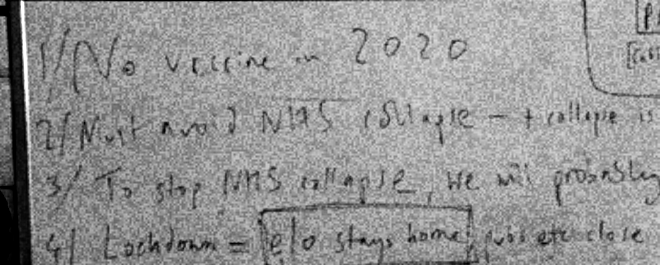
¶Figure 7: Notes on a whiteboard during the meeting at
-
¶
- 10 Downing Street on 13 March 2020 — 157
¶Figure 8: Notes on a whiteboard during the meeting at
-
¶
- 10 Downing Street on 14 March 2020 — 161
¶Figure 9: Message from Mr Cummings to Mr Johnson on 14 March 2020 163 Figure 10: Message from Mr Cummings to Mr Johnson on 15 March 2020 166 Figure 11: Notes on a whiteboard during a ministerial meeting on
-
¶
- 15 March 2020 — 168
¶Figure 12: Daily confirmed cases from 1 to 23 March 2020 across the UK 194 Figure 13: Daily confirmed cases from 1 March to 30 April 2020 across the UK 215 Figure 14: Daily deaths per 100,000 population by date of death from
-
¶
-
23 March to 13 July 2020 across the UK — 216
-
Figure 15: Five tests for adjusting the lockdown, 16 April 2020 — 226
-
¶
- Figure 16: UK government steps of adjustment to current social distancing measures — 241
¶Figure 17: Daily deaths per 100,000 population by date of death from
-
¶
-
6 July to 28 December 2020 across the UK — 267
-
Figure 18: Increase in infections in Northern Ireland from 1 September to 1 October 2020 — 314
-
Figure 19: Alert levels in Wales, December 2020 — 342
-
Figure 20a: Tiers in England from 20 December 2020 — 347
-
Figure 20b:Tiers in England from 26 December 2020 — 347
-
Figure 20c: Tiers in England from 31 December 2020 — 348
-
Figure 21: Revised rules for Christmas 2020 — 351
-
Figure 22: UK Covid-19 statistics at 31 December 2020 — 356
-
Figure 23: Estimated percentage of the population testing positive for Covid-19 from 5 December 2020 to 16 January 2021 — 358
-
Figure 24: UK Covid-19 statistics at 15 February 2021 — 364
¶Figure 25: Steps in the COVID-19 Response – Spring 2021 roadmap,
¶February 2021 366 Figure 26: Extract from Moving Forward: The Executive's Pathway out of Restrictions 368
-
¶
-
Figure 27: Vaccine doses across the UK, as at 21 February 2021 — 369
-
Figure 28: Step 3, COVID-19 Response – Spring 2021 roadmap — 379
-
Figure 29: Estimated percentage of the population testing positive for Covid-19 from 1 May to 31 July 2021 across the UK — 389
-
Figure 30: Step 4, COVID-19 Response – Spring 2021 roadmap — 392
-
Figure 31: Alert levels in Wales in the summer of 2021 — 393
¶Figure 32: Estimated percentage of the population testing positive for Covid-19 from 1 August to 31 October 2021 across the UK 399
x¶Figure 33: Estimated percentage of the population testing positive for
¶Covid-19 from 31 October to 31 December 2021 across the UK 408 Figure 34: Daily deaths per 100,000 population by date of death from
-
¶
-
31 October to 31 December 2021 across the UK — 409
-
Figure 35: Plan B measures announced on 8 December 2021 — 416
¶Figure 36: Estimated percentage of the population testing positive for
-
¶
- Covid-19 from 1 December 2021 to 1 June 2022 across the UK — 430
¶Figure 37: Daily deaths per 100,000 population by date of death from
-
¶
- 1 December 2021 to 1 June 2022 across the UK — 431
¶Figure 38: Cumulative daily deaths per 100,000 by date of death from
-
¶
- May 2021 to May 2022 across the UK — 436
¶Volume II: Key themes, lessons and recommendations
-
¶
-
Figure 39: Organogram showing SAGE and its sub-groups — 10
-
Figure 40: 'Stay Home, Protect the NHS, Save Lives', 30 April 2020 — 164
-
Figure 41: 'Stay Alert, Control the Virus, Save Lives', 17 July 2020 — 164
-
Figure 42: FACTS infographic, June 2020 — 166
-
Figure 43: 'Hands, Face, Space', September 2020 — 168
-
Figure 44: 'Hands, Face, Space, Fresh Air', March 2021 — 168
-
Figure 45: 'Avoid the Three Cs' — 173
List of tables
Volume I: Introduction and key events from January 2020 to May
-
¶
- Table 1: Summary of potential response strategies — 28
¶Table 2: Interventions considered by SAGE (presented by the
-
¶
-
Cabinet Secretariat to COBR on 12 March 2020) — 139
-
Table 3: The rule of six by nation, September 2020 — 285
-
Table 4: Combined estimate of R and the growth rate in the UK, four nations and English NHS regions, 23 September 2020 — 297
¶Volume II: Key themes, lessons and recommendations Table 5: Summary of penalties across the four jurisdictions at the start
-
¶
-
of lockdowns in March 2020 and January 2021 — 221
-
Table 6: Module 2 Core Participants — 276
-
Table 7: Module 2A Core Participants — 277
-
Table 8: Module 2B Core Participants — 277
-
Table 9: Module 2C Core Participants — 278
¶Table 10: Summary of evidence requested and obtained in Modules 2,
-
¶
-
2A, 2B and 2C — 279
-
Table 11: Expert witnesses — 281
-
Table 12: Modules 2A, 2B and 2C additional expert witnesses — 282
-
Table 13: Module 2 witnesses from whom the Inquiry heard evidence — 283
¶Table 14: Module 2A witnesses from whom the Inquiry heard evidence 287 Table 15: Module 2B witnesses from whom the Inquiry heard evidence 289 Table 16: Module 2C witnesses from whom the Inquiry heard evidence 291
-
¶
- Table 17: Modules 2, 2A, 2B and 2C Counsel teams — 293
Introduction by The Rt Hon the Baroness Hallett DBE
xiv¶The Covid-19 virus spread around the world rapidly and caused untold misery and suffering. The number of deaths across the UK for which the virus was responsible – calculated by whether Covid-19 is mentioned on the death certificate – is now over 230,000. This appalling loss of life resulted from the virus spreading across the UK in three successive waves. The devastating socio-economic consequences resulted both from the virus and from the decisions taken to respond to it.
¶This, the second report of the UK Covid-19 Inquiry, focuses on those decisions.
¶As democratically elected leaders, politicians were entitled to draw their own conclusions as to how to balance the ethical, public health, social and economic challenges posed by Covid-19. In this Report, I have considered whether their decisions were reasonable and justifiable in light of the information that was then known, or which ought to have been known, to determine if things could have been done better and to learn lessons for the future.
¶In doing so, I bear very much in mind that, in trying to stem the spread of the virus, politicians in the UK government and the devolved administrations were faced with unenviable choices. There were few, if any, easy decisions for them to make. The decisions to impose stringent social restrictions, including most obviously the lockdown decisions, gave rise to agonising dilemmas and were highly controversial. They were also taken under conditions of extreme pressure and often without access to data or a full understanding of the epidemiological position. Such an understanding is vital to any response to a pandemic.
¶Most importantly, politicians across the UK found themselves having to take decisions in the context of the UK lacking resilience and being ill prepared.
¶In its first report, relating to Module 1 on the resilience and preparedness of the UK, the Inquiry examined the state of the UK's central structures and procedures for pandemic emergency preparedness, resilience and response. It concluded that the UK was ill prepared for dealing with a catastrophic emergency, let alone the coronavirus pandemic that actually struck. In particular, it found that there were fatal strategic flaws underpinning the assessment of the risks faced by the UK. The UK government's sole pandemic strategy, from 2011, was outdated and lacked adaptability.
¶As a result, there was a damaging absence of focus on the measures, interventions and infrastructure required in the event of a pandemic – in particular, a system that could be scaled up to test, trace and isolate. The Inquiry recommended fundamental reform of the way in which the UK government and the devolved administrations prepare for whole-system civil emergencies.
¶Such reform is vital. Had the UK been better prepared, fewer lives would have been lost, the socio-economic costs would have been substantially reduced and some of the decisions politicians had to take would have been far more straightforward.
xv¶The decisions that politicians were forced to take were further complicated by the UK devolution settlements. This was primarily a health emergency and health is a devolved matter, but three of the nations of the UK form a single epidemiological unit (Great Britain). The other, Northern Ireland, forms an epidemiological unit with the Republic of Ireland. Whatever steps each government took, they were bound to be affected by the decisions taken elsewhere in the UK and by constant cross-border travel. In addition, the devolved administrations were generally reliant on the UK government for funding to support their emergency response.
¶Initially, the UK government and the devolved administrations followed the same path in responding to the pandemic but, in the summer of 2020, they began to diverge. This might not have been surprising, given the devolution settlement and the different characteristics of the four nations, but it did lead to difficulties for the people of the UK as they sought to comply with restrictions that varied around the UK – and it caused political controversy. This Report will examine those differences in approach and, where appropriate, compare them.
¶Some past public inquiries have provided definitive accounts of every aspect of the particular disaster, tragedy, other momentous event or government policy into which they were charged to inquire. However, as I observed in the Introduction to the Inquiry's first report, the Covid-19 pandemic – and the response to it from the UK government and the devolved administrations – was the most complex and multi-layered emergency to have struck the UK in peacetime. No inquiry, however large or however long, could possibly or sensibly inquire into every part of it. This Report does not seek to address every relevant decision or provide a historical record of everything that happened. It is focused on the key issues and decisions taken during the almost two and a half years of the pandemic, in order to identify the critical lessons to be learned for future pandemics or other civil emergencies.
¶Other modules of this Inquiry and their reports will consider specific aspects of the governments' response in more detail. At the time of publication of this Report, there have been public hearings in Module 3 (Impact of the Covid-19 pandemic on healthcare systems in the four nations of the UK), Module 4 (Vaccines and therapeutics), Module 5 (Procurement), Module 6 (Care sector), Module 7 (Test, trace and isolate) and Module 8 (Children and young people). Hearings will take place shortly in relation to Module 9 (Economic response) and Module 10 (Impact on society, which has a particular focus on key workers, the most vulnerable, the bereaved, mental health and wellbeing).
¶The speed and thoroughness with which the momentous events and decisions have been examined, from the emergence of Covid-19 in January 2020 until the final restrictions were lifted in May 2022, reflect a mammoth undertaking for the Module 2 (UK government), 2A (Scottish Government), 2B (Welsh Government) and 2C (Northern Ireland Executive) teams.
xvi¶During the investigation phase, there was an extensive and complex process of obtaining more than 2 million potentially relevant documents from a wide range of sources. This material was then examined by the Inquiry team and in excess of 180,000 documents were deemed to be relevant. These were disclosed to the 53 Core Participants to assist them in their preparation for the public hearings, which took place over 69 days and during which 166 witnesses were examined.
¶This reflects the enormously hard work of a large number of people, and I wish to express my gratitude to all those who have given so much of their time and resources to assisting the Inquiry. In particular, I am very grateful to the Core Participants and their legal teams, especially the groups representing bereaved people, for their helpful contributions to the Inquiry process. I would also like to thank the teams (both secretariat and legal) in Modules 2, 2A, 2B and 2C, without whose hard work, diligence and dedication the hearings and this Report would not have been possible.
¶Finally, I should like to thank those who have given evidence and those who have contributed to the Inquiry's listening exercise, Every Story Matters, and to the moving films played at each hearing about the impact of the Covid-19 pandemic on them and their loved ones. They have shown great courage. Their accounts not only help me and inform the Inquiry's work, but also serve as a constant reminder of why the work of this Inquiry is so important.
¶The Rt Hon the Baroness Hallett DBE
¶20 November 2025
Voices
xviii¶" Five days after Daddy went into hospital we had to get the police to break into my mum's house because she was unconscious in bed. She was rushed to the same hospital and she would test positive when she got there. My dad died on the 10th of May. The day we buried Daddy, we were waiting for a phone call because that was the day they thought Mummy was going to die. But she died the next day. So we buried them three days apart."1 UK Covid-19 Inquiry, Module 2C Hearing AM, 30 April 2024, module opening impact film, 14:16-14:54 (https://webarchive.nationalarchives.gov.uk/video/UC9eFdKVwD1ARs3j9BSoGndw/dP1iAC3Khug)
¶Fiona Humphries, Northern Ireland Covid-19 Bereaved Families for Justice
¶" I feel that my mother was getting more and more nervous going into the second lockdown. I feel the Government were on TV every day talking about all these different things and there was no equality for her as an elderly lady. The elderly were not considered. It was a case of 'keep away from the elderly and vulnerable to protect them' meanwhile other people were in and out of each other's bubbles and houses. There was no consideration for the elderly. I feel they were just numbers. My mum caught covid and died in the hospital."2 INQ000279972_0006 para 32
¶Member of Scottish Covid Bereaved
¶" [My mother] said 'No I'm too afraid to go to the hospital, you know, if i haven't got it and it's just a really, really bad flu, then I'm going to end up with it, I don't want to be on my own' she said. So she was too afraid to go to the hospital."3 Amanda Provis 28 February 2024 29/7-13
¶Amanda Provis, Covid-19 Bereaved Families for Justice Cymru, whose mother died the following day
¶" I think I immediately found it very difficult to grieve. Not in the traditional sense, in terms of the funeral, obviously that was not available to us but I found it very hard emotionally to feel the – to go through the natural emotional process of grieving, because I think what was blocking me was that I felt very strongly that his death was not an inevitability."4 Joanna Goodman 4 October 2023 116/13-19
¶Joanna Goodman, co-founder of Covid-19 Bereaved Families for Justice
Executive summary
2¶This Report concerns the core political and administrative decision-making across the UK in response to the Covid-19 pandemic, drawing on the work of four of the Inquiry's modules: Module 2 (UK), Module 2A (Scotland), Module 2B (Wales) and Module 2C (Northern Ireland). This has provided the Inquiry with the opportunity to compare and contrast the different choices made by the four governments in responding to the same emergency and to identify the most important lessons for responding to future UK-wide emergencies.
¶The Inquiry finds that the response of the four governments repeatedly amounted to a case of 'too little, too late'. The failure to appreciate the scale of the threat, or the urgency of response it demanded, meant that – by the time the possibility of a mandatory lockdown was first considered – it was already too late and a lockdown had become unavoidable. That these same mistakes were repeated later in 2020 is inexcusable. While the nationwide lockdowns of 2020 and 2021 undoubtedly saved lives, they also left lasting scars on society and the economy, brought ordinary childhood to a halt, delayed the diagnosis and treatment of other health issues and exacerbated societal inequalities. The Covid-19 lockdowns only became inevitable because of the acts and omissions of the four governments. They must now learn the lessons of the Covid-19 pandemic if they are to avoid lockdowns in future pandemics.
Key events from January 2020 to May 2022
The emergence of Covid-19 (Chapter 2)
¶The initial response to the pandemic was marked by a lack of information and a lack of urgency. When the first cases of Covid-19 had been confirmed outside China, the significant degree of scientific uncertainty – in particular, whether there was sustained person-to-person transmission and whether the virus could be transmitted by individuals without symptoms (asymptomatic transmission) – meant that the level of risk that the virus posed was not fully appreciated.
¶Once the scientific community and the scientific advisers for each nation became aware that the virus had spread from China, and that it was causing substantially more cases of moderate or severe respiratory illness in China than were being officially reported, the tempo of the response should have been increased and threat levels raised.
¶By the end of January 2020, when thousands of cases had been identified outside China and the first few cases of Covid-19 had been confirmed in the UK, it should have been clear that the virus posed a serious and immediate threat. However, the limited testing capacity in the UK and a lack of adequate surveillance mechanisms, combined with a failure to assume that there was asymptomatic transmission, meant that decision-makers did not appreciate the extent to which the virus was spreading undetected.
¶The political system across the four nations lacked urgency and treated the emerging threat as predominantly a health issue. The obviously escalating nature of the crisis made it surprising that COBR, the UK government's crisis coordination committee, was not chaired by the Prime Minister, Boris Johnson MP, until 2 March 2020 and that neither COBR nor the UK Cabinet met during the half-term holidays in mid-February 2020. Mr Johnson should have appreciated sooner that this was an emergency that required prime ministerial leadership to inject urgency into the response. Mr Johnson's own failure to appreciate the urgency of the situation was due to his optimism that it would amount to nothing, his scepticism arising from earlier UK experiences of infectious diseases, and, inevitably, his attention being on other government priorities. This was compounded by the misleading assurances he received from the Cabinet Office and the Department of Health and Social Care that pandemic planning was robust, as well as the widely held view that the UK was well prepared for a pandemic. As the pandemic unfolded, the Secretary of State for Health and Social Care, Matt Hancock MP, gained a reputation among senior officials and advisers at 10 Downing Street for overpromising and underdelivering.
3¶The devolved administrations similarly failed to engage with the threat posed to their nations and were overly reliant on the UK government to lead the response. Covid-19 received no attention in Welsh Cabinet meetings before 25 February 2020. After the first case was identified in Wales on 28 February, the First Minister of Wales, Mark Drakeford MS, chose to attend St David's Day celebrations in Brussels rather than the Welsh Cabinet meeting on 4 March 2020. In Northern Ireland and in Scotland, Covid-19 was only discussed under 'any other business' in meetings as late as 24 and 25 February respectively. It should have been equally apparent to the First Ministers and deputy First Ministers of the devolved administrations that, by this point, Covid-19 was the most pressing issue facing their governments.
¶Ministers and officials in the UK government had been given clear advice that, in the reasonable worst-case scenario, up to 80% of the population would be infected – with a very significant loss of life – but did not appreciate the increasing likelihood of this scenario materialising. At the same time, it was clear that the test and trace system was inadequate for a pandemic. The lack of urgency on the part of all four governments, and the failure to take more immediate emergency steps, are inexcusable.
¶The spread of the virus globally and, in particular, the escalating crisis in Italy were clear warning signs, which should have prompted urgent planning across the four nations. Instead, the governments did not take the pandemic seriously enough until it was too late. February 2020 was a lost month.
The first UK-wide lockdown (Chapters 3 and 4)
4¶This approach was expected to lead to a degree of population immunity (otherwise known as 'herd immunity'), where the spread of the virus through the population reduced its vulnerability to further infections. Despite a lack of clarity in media appearances, the UK government's strategy was not to encourage the spread of the virus with the aim of achieving population immunity sooner – rather, population immunity was seen as the eventual outcome of an inevitable and widespread wave of infections.
¶At this stage, the Scientific Advisory Group for Emergencies (SAGE) was advising the UK government that restrictions should not be introduced until the spread of the virus was nearer its peak. This was driven partly by concerns about the negative social and economic consequences of introducing restrictions and wanting to minimise the amount of time such restrictions were in place, but also by concerns expressed by Professor (later Sir) Christopher Whitty (Chief Medical Officer for England) and Professor Sir Patrick Vallance (later Lord Vallance of Balham), Government Chief Scientific Adviser, that the public would not maintain compliance with restrictions over a long period. This concept of 'behavioural fatigue' had no grounding in behavioural science and proved damaging, given the imperative to act more decisively and sooner.
¶The lack of testing capacity had, by this point, resulted in the stopping of community testing. This meant that the UK government and the devolved administrations had no real understanding of the spread of the virus in the community. Some scientists – and some civil servants and advisers within the UK government – were increasingly alarmed by the lack of urgency and the failure to act more robustly. It became clear that any opportunity to get on top of Covid-19 had been lost.
¶Friday 13 March 2020 was a watershed moment in the UK's response. SAGE had concluded that the number of cases was several times higher than its previous estimates and that there were potentially thousands of cases occurring each day. The pandemic was moving faster than previously anticipated, and modelling indicated that the capacity of the NHS would be overwhelmed by the scale of infection, even if self-isolation and social distancing measures were introduced. If NHS capacity were to become overwhelmed, then far higher numbers of people would die from being unable to access medical treatment, both for Covid-19 and for other medical conditions. The plan to wait to implement restrictions until nearer the peak of the virus was no longer sustainable.
¶Over the next few days, decision-makers concluded that stringent measures were needed to reverse the growth of the virus. The focus remained on a package of advisory measures including self-isolation, household quarantine and social distancing. The advisory measures came into effect from 16 March 2020 and became increasingly stringent in the subsequent days, with the closure of schools and hospitality businesses from 20 March.
5¶By 23 March 2020, SAGE estimated that the number of cases was doubling every three to four days and intensive care units in London were on track to reach capacity within ten days. Almost 300 people had died, with more than 100 of those deaths occurring in the previous two days. The situation was rapidly escalating and it was not clear that the advisory measures in place would be sufficient to prevent the NHS from being overwhelmed. A mandatory lockdown had become unavoidable.
¶The measures announced on Monday 16 March 2020, and strengthened through the week with the closure of schools and hospitality, should have been implemented much sooner. Had more stringent restrictions, short of a 'stay at home' lockdown, been introduced earlier than 16 March – when the number of Covid-19 cases was lower – the mandatory lockdown that was imposed might have been shorter or conceivably might not have been necessary at all. At the very least, there would have been time to establish what effect the restrictions had on levels of incidence and whether there was a sustained reduction in social contact. However, with measures not introduced sooner, a mandatory lockdown was the only viable option left.
¶The Inquiry recognises that the lockdown decision was as difficult a decision as any UK government or devolved administration has ever had to make. However, the Inquiry accepts the consensus of the evidence before it that the mandatory lockdown should have been imposed one week earlier. Had a mandatory lockdown been imposed on or immediately after 16 March 2020, modelling has established that the number of deaths in England in the first wave up until 1 July 2020 would have been reduced by 48% – equating to approximately 23,000 fewer deaths.
¶However, the Inquiry rejects the criticism that the four governments were wrong, in principle, to impose a lockdown. In any event, the UK government and the devolved administrations had received clear and compelling advice by this time that the exponential growth in transmission would, in the absence of a mandatory lockdown, likely lead to loss of life on a scale that was unconscionable and unacceptable. No government, acting in accordance with its overarching duty to preserve life, could ignore such advice or tolerate the number of deaths envisaged. The governments acted rationally in taking the ultimate step, a mandatory lockdown, in the genuine and reasonable belief that it was required. Nevertheless, it was only through their own acts and omissions that the four governments had made such a lockdown inevitable.
Exiting the first lockdown (Chapter 5)
¶Upon entering the first lockdown, neither the UK government nor the devolved administrations had a strategy for when or how they would exit the lockdown. These considerations should have been at the forefront of decision-makers' minds from the moment imposing a lockdown was contemplated. Up until this stage, the four governments had acted in unison, with the same measures applying across the whole of the UK, but they each devised their own approaches to ending the lockdown.
6¶The easing of the majority of restrictions in England took place on 4 July 2020, despite Mr Johnson being informed by scientific advisers that this was an inherently high-risk approach as it would create an environment where infections could grow more quickly and overwhelm the ability of test and trace systems to control further outbreaks. A more cautious approach should have been taken by the UK government. Mr Johnson acknowledged that a second lockdown would be a disaster, but the approach to releasing restrictions increased the risk of this being necessary.
¶In contrast, the governments of Wales, Scotland and Northern Ireland adopted a more gradual approach to the relaxation of restrictions throughout the summer of 2020. This more cautious approach was taken in the context of different epidemiological circumstances, but created a greater prospect of further lockdowns not being necessary or, if they were, of them not being necessary for so long. However, as there was nothing to prevent people resident in England from travelling across the internal borders of the UK, the approach adopted by the UK government risked undermining the effectiveness of the more cautious responses of the devolved administrations.
¶Nonetheless, in each of the four governments, insufficient attention was given to the prospect of a second wave of the virus, with only limited contingency planning in place for reintroducing restrictions if a second wave emerged.
The second wave (Chapters 6 and 7)
¶In the autumn of 2020, infection rates varied significantly across the UK, leading to more significant divergence in approach as all four governments tried to manage the increasing case rates at a local level. The UK government, Welsh Government and Northern Ireland Executive had all failed to learn from the experiences of the first lockdown. Local restrictions were introduced too late, were not in place for long enough or were too weak to control the spread of the virus.
¶Ministers are required to weigh up all competing factors in their decision-making and do not always need to follow scientific advice. However, the reasons for rejecting scientific advice – and the implications of doing so – must be clearly understood.
¶Throughout September and October 2020, Mr Johnson repeatedly changed his mind on whether to introduce tougher restrictions and failed to make timely decisions. For those restrictions that were introduced, such as the 'rule of six', SAGE had warned that they were unlikely to be effective, but Mr Johnson continued to reject SAGE's advice to implement a 'circuit breaker' lockdown. The weakness of the restrictions used and Mr Johnson's oscillation enabled the virus to continue spreading at pace, and ultimately resulted in a four‑week lockdown from 5 November 2020.
7¶Mr Johnson should have ordered the imposition of a circuit breaker lockdown in late September or early October 2020. Had a circuit breaker been utilised at that time, the second lockdown in England could have been reduced in length and severity – and might conceivably have been avoided altogether. In the event – with the opportunity to regain control having been lost – the second lockdown should have been imposed more quickly. Unlike the circuit breaker or 'firebreak' restrictions in Wales and the circuit breaker restrictions in Northern Ireland, the second England-wide lockdown was not timed to coincide with the school half-term holidays. Schools did, however, remain open.
¶The Welsh Government's approach of targeted local restrictions was ultimately unsuccessful and led to the imposition of the firebreak. Despite receiving clear advice on 5 October 2020 that the reproduction number (the average number of people that one person with a disease infects) was above 1 and that further restrictions were needed to avoid hospital capacity being exceeded, modelling of the proposed firebreak was not sought until 11 October and the firebreak was not implemented until 23 October. From August to December 2020, Wales had the highest age-standardised mortality rate of the four nations. It is likely that this was the result of a combination of failed local restrictions, imposing the firebreak too late and the decision to relax measures more quickly than scientists advised.
¶Notwithstanding the imposition of circuit breaker restrictions, the decision-making in Northern Ireland was chaotic. Despite having been advised that a six-week intervention was required, the Northern Ireland Executive Committee opted for a four-week circuit breaker, which commenced on 16 October 2020. This ultimately proved inadequate. In the weeks that followed, Executive Committee meetings were deeply divided along political lines and beset by leaks, leading to an incoherent approach in which the circuit breaker restrictions were extended for one week, then lapsed for one week, before being reintroduced for two further weeks – with the one-week lapse in restrictions correlating with a 25% increase in cases.
¶The number of cases in Scotland in the autumn of 2020 did not reach the peaks experienced in the rest of the UK. By swiftly using stringent, locally targeted measures to deal with outbreaks, case numbers grew much more gradually and the need for a nationwide lockdown in the autumn was avoided.
¶Although it was not formally identified until December 2020, the more transmissible Alpha variant emerged in Kent during the autumn and drove a rapid rise in cases. The emergence of a more transmissible variant was entirely foreseeable, but all four governments failed to take decisive action in response. Rather than recognising the threat early on and introducing measures to control the virus, the governments continued to press on with plans for relaxing measures over Christmas while cases grew rapidly, only to change course on 19 December when levels of infection became critical. The mistakes of February and March 2020 were repeated – the failure to take sufficiently decisive and robust action in response had created a situation in which a return to lockdown restrictions had once again become unavoidable.
8The vaccination rollout and Delta and Omicron variants (Chapters 7 and 8)
¶In December 2020, the UK was the first country in the world to approve a vaccine and commence a vaccination programme for Covid-19. On 2 December, temporary authorisation was granted by the Medicines and Healthcare products Regulatory Agency for the Pfizer/ BioNTech vaccine and the vaccine rollout commenced on 8 December. Authorisation for the Oxford/AstraZeneca vaccine swiftly followed on 30 December and the Moderna vaccine on 8 January 2021. This was a remarkable achievement and a decisive turning point in the pandemic.
¶This development enabled the four governments to take a different approach in their plans to exit their respective lockdowns, balancing the scale of infection against the additional protection from serious illness now being offered by vaccines. Plans were led by data rather than fixed dates and when the Delta variant emerged in March 2021, all four governments sensibly heeded the scientific advice to delay the planned relaxation of restrictions to allow time for the vaccine rollout to progress further. In this respect, the four governments had learned from the experience of earlier lockdowns.
¶Although the Omicron variant that emerged in the winter of 2021 was a less severe variant, it was much more transmissible and an estimated 5 million people in the UK were infected at the peak of the Omicron wave. Despite the enhanced protection offered by the vaccine rollout, the sheer volume of cases still led to more than 30,000 people dying with Covid-19 in the UK between November 2021 and June 2022. By the time the Omicron variant was identified, all adults had been offered two doses of the vaccine and the programme of booster doses was sensibly accelerated to offer further protection against serious illness and hospitalisation.
¶The approach of all four governments in the second half of 2021 carried with it an element of risk. The potential for a variant that escaped the immunity conferred by prior infection or by vaccination had been repeatedly identified as the biggest strategic risk. The sheer number of infections demonstrates that, if the vaccines had been less effective or the Omicron variant as severe as previous variants in terms of morbidity and mortality, the consequences would have been disastrous.
Key themes
Scientific and technical advice (Chapter 9)
¶SAGE provided high-quality scientific advice at extreme pace throughout the pandemic, but some aspects of its operation were strained by the breadth and duration of the response. There was no systematic process in place to ensure that it provided sufficient breadth of scientific expertise: participants were recruited through existing networks and professional connections, relying on people who were able to free up time from their normal jobs. Initially, there was also no clear process for the devolved administrations to gain access to SAGE discussions and advice. As the pandemic progressed, the devolved administrations used their own existing advisory scientific committees or set them up. These fed information into SAGE while applying their advice to their own local circumstances.
9¶The effectiveness of SAGE's advice was also constrained by the limited information provided by the UK government on its overall objectives when advice was commissioned, which made it harder for SAGE to place its advice in the right context. This lack of clearly stated objectives contributed to the conservatism of SAGE's advice in early 2020, with participants not believing that lockdowns would be a palatable policy response and, therefore, not modelling its implications until mid-March 2020.
¶More significant concerns were raised about the quality of economic modelling during the pandemic. Although structures for providing economic advice were set up in Wales and Scotland, there was little evidence in each of the four nations of substantive economic modelling and analysis being provided to decision-makers. This inevitably hampered the ability of decision-makers to assess and balance relative harms.
Vulnerabilities and inequalities (Chapter 10)
¶Although the pandemic affected everyone in the UK, the impact was not shared equally. Older people, disabled people and some ethnic minority groups faced a higher risk of dying from Covid-19. For example, when taking into account age, people from a Black African and Black Caribbean background had the highest rates of mortality during the first wave of the pandemic. From the second wave onwards, the highest mortality rates were among people of an Asian or Asian British background. The increased risk of harm was also strongly influenced by socio-economic factors, with people living in overcrowded housing or working in low-paid employment at higher risk. This often overlapped with other factors such as ethnicity.
¶Vulnerable groups were also affected by the restrictions introduced to control the virus. The vast majority of children were not at risk of serious direct harm from Covid-19, but suffered greatly from the closure of schools and requirement to stay at home, and the consequent loss of interaction with friends and family and limited access to play. Children were not always prioritised. No government in the UK was adequately prepared for the sudden and enormous task of educating most children in their homes and failed sufficiently to consider the consequences of school closures for children's education and physical and mental health. Module 8 is examining these issues in more detail.
10¶Despite this harm being foreseeable, the impact on vulnerable groups had not been adequately considered in pandemic planning, and the existing mechanisms for assessing the impact of decisions were largely applied retrospectively. Decision-makers consequently had little understanding of the impact of restrictions on vulnerable groups.
Government decision-making (Chapter 11)
¶COBR is designed to deal with acute emergencies and proved inadequate for responding to a prolonged pandemic. While the COBR mechanism is appropriate for assessing the initial UK-wide response to an emergency, a clearer plan for how each government will make key decisions in a prolonged emergency is needed.
¶The UK Cabinet was largely sidelined in decision-making, albeit that as the pandemic progressed the coordination of advice and decision-making improved and became more formalised through the Covid-19 Strategy Committee (Covid-S) and Covid-19 Operations Committee (Covid-O) and the supporting Covid-19 Taskforce. Mr Johnson's hospitalisation in April 2020 also exposed the lack of formal arrangements for covering the absence of a Prime Minister.
¶By contrast, the Welsh Cabinet was fully engaged throughout the pandemic, with decisions mostly being made through consensus. Mr Drakeford was recognised by his ministers as a careful and considered leader. He maintained positive relationships throughout the response.
¶The power-sharing arrangements in Northern Ireland are designed to ensure that each department has a significant degree of operational independence and individual ministers are afforded significant autonomy. This weakened the ability of the Northern Ireland Executive to coordinate the pandemic response and there was no one sufficiently empowered to hold departments to account. The Department of Health (Northern Ireland), which was the lead government department with responsibility for the response at the outset of the pandemic, largely operated in a silo – especially in the early stages of the response. The Northern Ireland Executive had only recently re-formed in January 2020, following a three-year period during which power-sharing was suspended, and it is unclear how decisions usually subject to ministerial approval would have been made in Northern Ireland had power-sharing still been suspended when lockdown decisions were taken.
11¶The distinct power-sharing arrangements in Northern Ireland offered the opportunity to demonstrate that decisions were being made by all parties collectively for the greater good. Instead, however, on multiple occasions decision-making was marred by political disputes between Democratic Unionist Party and Sinn Féin ministers. The attendance of the deputy First Minister of Northern Ireland, Michelle O'Neill MLA, at the funeral of Bobby Storey in June 2020, and her initial refusal to apologise for this, contributed to tensions in the Northern Ireland Executive Committee. The four-day Executive Committee meeting from 9 to 12 November 2020 represented a low point in Northern Ireland politics during the pandemic. The confidentiality of discussions was undermined by leaks and there was inappropriate instigation of cross-community votes to make political points by the First Minister of Northern Ireland, Arlene Foster MLA (later Baroness Foster of Aghadrumsee).
¶The pandemic response also exposed wider cultural issues. The very least the public should be entitled to expect is that those making the rules will abide by them. Instances where ministers and advisers appeared to break Covid-19 rules caused huge distress to the public. This was especially the case for people who had endured huge personal costs to stick to the rules, with many bereaved people unable to be with their loved ones when they died. Instances where rule-breaking was not swiftly addressed also undermined public confidence and increased the risk of people not complying with the rules designed to protect them.
¶Decision-making was particularly affected by cultural problems in the UK government and Northern Ireland Executive. There was a toxic and chaotic culture at the centre of the UK government during the pandemic, with the Inquiry hearing evidence about the destabilising behaviour of a number of individuals – including Dominic Cummings, an adviser to the Prime Minister. By failing to tackle this chaotic culture – and, at times, actively encouraging it – Mr Johnson reinforced a culture in which the loudest voices prevailed and the views of other colleagues, particularly women, often went ignored, to the detriment of good decision-making.
Public health communications (Chapter 12)
¶Communication with the public is a critical aspect of a pandemic response, since controlling the virus is dependent on members of the public understanding the risk they face and acting accordingly. The 'Stay Home' communications campaign was effective at maximising compliance with the first lockdown, at a time when this was the understandable priority. However, the simplicity of the message meant that the intended nuances in the regulations were poorly understood, with the focus on 'protecting the NHS' potentially discouraging people from seeking medical treatment for non-Covid-19 conditions or from seeking help when they needed it. The balance between simplicity and detail became increasingly difficult to strike as the regulations and guidance became more complex. The introduction of localised restrictions made it difficult for members of the public to understand what rules applied to them in different places and situations, and their confusion was compounded by variations in rules across the four nations.
12¶In focusing on how to get messages across to the whole population, the needs of vulnerable groups were sometimes lost. In particular, the UK government and Northern Ireland Executive initially failed to provide British Sign Language interpretation for press conferences or to provide key guidance in alternative formats. These are not secondary considerations. Everyone should be able to understand the action their government is asking them to take, and improvements made later in the pandemic serve to highlight the difference that proper and timely consideration of accessibility issues can make.
Legislation and enforcement (Chapter 13)
¶The legal response to the pandemic laid bare the limits of the UK's legislative framework and the practical consequences of devolution. Faced with a public health crisis, the UK government relied on older public health legislation and bespoke emergency laws, rather than the Civil Contingencies Act 2004. While this enabled rapid action, it came at the cost of fragmented decision-making, reduced parliamentary scrutiny and caused public confusion.
¶Ministers relied on secondary legislation to implement many of the most far-reaching restrictions in modern UK history, with little or no parliamentary oversight. Across all four nations, ministers routinely used a procedure allowing laws to come into effect before they had been approved by the legislatures. While this approach was understandable in the earliest days of the pandemic, the approach continued throughout the pandemic, even when there was ample time for parliamentary scrutiny. This weakened democratic safeguards – the use of emergency regulations must be subject to greater scrutiny in future emergencies.
¶Frequent, complex changes to the law fuelled confusion, misunderstanding and – at times – incorrect enforcement. Police were asked to enforce unclear, shifting regulations, often issued at the last minute with little guidance. Fixed penalty notices were issued inconsistently across the UK. In England and Wales, some individuals faced £10,000 fines; in Scotland, most fines were just £60. Disproportionate impacts on certain groups were evident, especially in England, Scotland and Wales. In some cases, enforcement was practically impossible or legally uncertain – as seen in Northern Ireland during the controversy over the size of crowds at the funeral of Bobby Storey.
¶Time and again, public messaging failed to reflect the actual laws in place. Ministers made statements suggesting legal obligations where none existed, or vice versa. The public – and even the police – struggled to distinguish between government advice and binding legal restrictions, and there was no single, easily accessible source that clearly laid out the rules applying in each area. The resulting confusion undermined trust and compliance, particularly as legal rules diverged across the UK.
13Intergovernmental working (Chapter 14)
¶A lack of trust between the Prime Minister and First Ministers of the devolved nations coloured the approach to involving the devolved administrations in UK government decision-making throughout the pandemic. Although the devolved administrations were invited to COBR meetings, they perceived that the decisions had already been effectively made beforehand by the UK government. COBR meetings were largely discontinued after May 2020 and intergovernmental discussions were thereafter led by the Chancellor of the Duchy of Lancaster and Minister for the Cabinet Office – Michael Gove MP (later Lord Gove). The devolved administrations had a positive view of Mr Gove and felt that he was genuine in his efforts to understand their perspectives, but ultimately these meetings were limited in what they could practically achieve without Mr Johnson in attendance. Clearer structures for intergovernmental relations during an emergency, led collectively by the Prime Minister, First Ministers and deputy First Ministers, are necessary to facilitate better informed decision-making across the four nations.
¶Devolution has been a feature of the UK's constitutional arrangements for over 25 years and the public is used to the devolved administrations taking different decisions from the UK government. An effective, four-nations response to a pandemic should be capable of accommodating differences in response between the nations, and it is incumbent on politicians to work collectively in the public interest in any future emergency.
Key lessons for future emergencies
¶In Chapter 15, in Volume II, the Inquiry presents the key lessons that should inform the response in a future pandemic. Ten lessons have been identified across five themes and these should be considered in the development of future pandemic preparedness strategies (see the Inquiry's Module 1 Report, Recommendation 4).
Multiple scenario planning
¶Firstly, planning both before and during an emergency must anticipate multiple scenarios and consider the short term and long term in parallel. While no plan will ever be 100% comprehensive, the more potential scenarios that are considered in advance, the better placed decision-makers will be to react quickly and decisively.
Better strategy
¶Secondly, there must be an unambiguous strategy with clear objectives and a framework to guide how decisions are considered and support faster decision-making. The potential impact of those decisions should be understood in advance of them being implemented.
14Acting quickly and decisively
¶Thirdly, when faced with a virus with the potential for exponential growth, interventions must be imposed earlier and 'harder' than might be considered ideal. Even where the available evidence is sub-optimal, decisions still need to be made – putting off decisions until later is in itself a decision not to intervene.
Constructive working
¶Fourthly, leaders must work constructively within their own governments and across the four nations. Political differences should not be a consideration at a time of national emergency. Leaders should accept responsibility for their decisions and explain clearly to the public if and when they change their mind.
The importance of data
¶Finally, as part of pandemic preparedness, governments must understand what data they are likely to need during a pandemic and identify how these will be collected. The limitations of data should be understood and clearly explained to decision-makers, and consideration should be given to how front-line experiences can sit alongside quantitative data.
Specific recommendations
¶Across this Report, the Inquiry also makes a series of recommendations aimed at improving the end-to-end decision-making process during emergencies across the four nations of the UK. Although each recommendation is important in its own right, all the recommendations must be implemented in concert – both with each other and with the recommendations from the Inquiry's Module 1 Report – to produce the changes that the Inquiry judges to be necessary. In summary, the Inquiry recommends:
-
¶
- Broadening participation in SAGE: Open recruitment of potential experts and representation of the devolved administrations would ensure that advice to decision-makers draws on a wide range of expertise. The Inquiry also recommends extending the principles of transparency of scientific advice to other forms of technical advice provided to governments, so that the public can understand the range of factors beyond scientific advice that influence decision-making during an emergency.
- Improving the routine consideration of the impact that decisions might have on those most at risk in an emergency: This includes extending to England and Northern Ireland the implementation of the socio-economic duty within the Equality Act 2010 and the use of child rights impact assessments. These changes should aim to identify, during the planning phase, any risks to which vulnerable groups are likely to be exposed during a future pandemic and to ensure that those assumptions are revisited at the outset of an emergency, that the assumptions remain valid and that adequate mitigations are in place.
-
¶
- Reforming and clarifying the structures for decision-making during emergencies within each nation: Clear arrangements for synthesising advice from across governments and presenting it to decision-makers should be in place from the outset of any future pandemic. Specific recommendations are made in relation to the arrangements in Northern Ireland to avoid a potential vacuum of decision-making powers, should an emergency occur during a period where power-sharing arrangements are suspended.
- Ensuring that decisions and their implications are clearly communicated to the public: The laws and guidance in place should be easily understood, including by having clear plans for making key messages available in accessible formats such as British Sign Language.
- Enabling greater parliamentary scrutiny of the use of emergency powers through safeguards such as 'sunset clauses' and regular reporting on the use of powers: The role of the Civil Contingencies Act 2004 should also be re-examined to identify if, when and how it could be used in future emergencies – particularly during the initial phase. Communication of the regulations to the public should also be improved through the creation of a central repository of regulations and guidance.
- Establishing structures to improve the communication between the four nations during an emergency: These structures should aim to minimise the risk of confusion caused by similar, but different, rules being implemented in each nation, seeking alignment of approaches where desirable and providing a clear rationale for differences in approach where they are necessary.
¶A full list of the Inquiry's recommendations for Modules 2, 2A, 2B and 2C is included in Appendix 3, in Volume II, to this Report.
16Chapter 1: The context for pandemic decision-making – key structures and concepts
17Introduction
¶1.1. This chapter provides the context for the decisions that were taken during the coronavirus (Covid-19) pandemic – namely, the complex devolutional structures and the key scientific concepts.
Key structures
Devolution in the UK
¶1.2. The UK has a complex structure of government. The Prime Minister is the leader of the UK government and is ultimately responsible for all policy it implements and decisions it takes. The Prime Minister is supported by the UK Cabinet, which is made up of the senior members of government. Government departments and their agencies are responsible for putting government policy into practice. While some departments (such as the Foreign, Commonwealth and Development Office and the Ministry of Defence) cover the whole of the UK, others do not. This is because some aspects of government are devolved to the Scottish Government, the Welsh Government and the Northern Ireland Executive (also referred to in this Report as the Executive Committee). The UK Parliament typically does not legislate on devolved matters without the consent of the relevant devolved legislatures: the Scottish Parliament, the Welsh Parliament and the Northern Ireland Assembly.1 The Sewel Convention is a constitutional principle stating that the UK Parliament will not normally legislate on matters within devolved competence without the consent of the relevant devolved legislature.
¶1.3. The devolved administrations are responsible for many domestic policy issues and their legislatures have law-making powers for those areas. For example, the Scottish Government, the Welsh Government and the Northern Ireland Executive are responsible for education, culture, the environment and transport in their respective nations. Critically for this Inquiry, they are also responsible for policy and laws in relation to health.2 INQ000083096
¶1.4. In the UK, powers that are not specifically reserved to the UK Parliament and UK government are devolved as follows:
-
¶
- In Scotland and Wales, the devolution model follows a 'reserved powers' approach, where all powers are devolved unless explicitly reserved to the UK Parliament.
- In Northern Ireland, powers that are retained by the UK government, such as foreign policy and defence, are categorised as 'excepted'. 'Reserved' powers in Northern Ireland have a different meaning from elsewhere in the UK. These are areas (such as firearms and telecommunications) where legislative authority generally rests with the UK Parliament, but the Northern Ireland Assembly may legislate with the consent of the UK government's Secretary of State for Northern
¶Ireland. Powers that are fully devolved are categorised as 'transferred' – this is where the Northern Ireland Assembly has full legislative competence and is equivalent to 'devolved matters' in Scotland and Wales.
¶Professor Ailsa Henderson, expert witness on devolution and the UK's response to Covid-19, told the Inquiry that the differing degrees of autonomy among the devolved legislatures stemmed from their distinct origins, varying public appetite for devolution and the ad hoc, reactive changes to the devolution settlements over time.3 INQ000269372_0010 para 26
¶1.5. The arrangements for the governance of Northern Ireland are distinct because they bring together politicians of different parties who are in opposition to each other (in terms of their designation as nationalist or unionist), along with politicians who are not aligned in this way. Together, they form an Executive Committee. This is a form of coalition government – but it is a multi-party, 'coerced' coalition.4 INQ000472398_0006 Because of the way power is shared among the political parties, there is no unified government of the day. Each Executive Department operates with significant autonomy, and individual ministers have authority to determine policy and operations within their departments without needing to maintain a collective Cabinet position. These power-sharing arrangements are not merely a framework for devolved governance but are fundamental to sustaining peace in Northern Ireland. They hold the highest constitutional significance, stemming from the Belfast Agreement of 1998 (also known as the Good Friday Agreement) and endorsed through referendums. This Inquiry does not seek to question or critique these arrangements, their structure or their rationale.
Local services
¶1.6. Local services are the responsibility of local councils and local authorities, as well as a number of directly elected regional mayors in England who chair combined authorities (ie groups of local councils) with specified functions and budgets. As set out in the Inquiry's Module 1 Report, this includes regional and local activities related to civil emergencies such as pandemics.5 Module 1: The resilience and preparedness of the United Kingdom, UK Covid-19 Inquiry, July 2024, Chapter 2 (https://covid19.public-inquiry.uk/documents/module-1-full-report)
Understanding the implications for a public health emergency
¶1.7. In a public health emergency, relevant powers span both reserved and devolved areas. For example, emergency powers, air transport and immigration are reserved to the UK government, while policing and justice are reserved in Wales but devolved in Northern Ireland and Scotland.6 For full lists of reserved matters, see Schedule 5 of the Scotland Act 1998 (https://www.legislation.gov.uk/ukpga/1998/46/ contents); Schedules 2 and 3 of the Northern Ireland Act 1998 (https://www.legislation.gov.uk/ukpga/1998/47/contents); and Schedule 7A of the Government of Wales Act 2006 (https://www.legislation.gov.uk/ukpga/2006/32/contents). Key public services in Scotland, Wales and Northern Ireland affected by the pandemic – in particular, public health services and education – are the responsibility of the devolved administrations.
19¶1.8. However, some devolved policy areas relevant to public health emergencies (such as health) may overlap with reserved policy areas (such as UK border control). Professor Daniel Wincott (expert witness on Welsh Government core political and administrative decision-making) referred to this overlap as the "jagged edges of devolution",7 INQ000411927_0020 para 44 while Professor Paul Cairney (expert witness on Scottish Government core decision-making and political governance) noted that the boundaries between reserved and devolved responsibilities are "blurry" and "overlaps are inevitable when problems transcend individual policy sectors".8 INQ000274154_0005 para 1
¶1.9. In addition to this overlap, the legal powers to deal with the spread of infection are set out in different pieces of legislation for the four nations of the UK. The decision to use pre-existing public health legislation and the bespoke Coronavirus Act 2020, which was passed with the consent of the devolved legislatures – rather than the UK-wide Civil Contingencies Act 2004 – meant the response to Covid-19 followed devolved responsibilities rather than being managed more centrally.9 Coronavirus Act 2020 (https://www.legislation.gov.uk/ukpga/2020/7/contents); Civil Contingencies Act 2004 (https://www.legislation.gov.uk/ukpga/2004/36/contents) As considered in more detail in Chapter 13: Legislation and enforcement, in Volume II, this had advantages and disadvantages. However, the pandemic necessitated shared responsibility between the UK government and devolved administrations.
¶1.10. The UK government relied on a range of decision-making structures and bodies to address the crisis, including:
-
¶
- COBR: convened to manage crises and coordinate responses across government departments, it acted as the central hub for decision-making in emergency scenarios;
- the UK Cabinet and the Cabinet Office: responsible for overseeing the pandemic's strategic direction, ensuring consistency across departments and managing the broader implications of policy decisions;
- Ministerial Implementation Groups: tasked with translating high-level policy decisions into operational plans and ensuring their timely execution; and
- the Covid-19 Operations Committee (Covid-O) and Covid-19 Strategy Committee (Covid-S): Cabinet sub-committees that were created to streamline and coordinate the pandemic response, focusing on specific aspects of crisis management and ensuring alignment between government departments.
¶1.11. In parallel, each devolved administration established its own mechanisms to manage health and emergency responses, reflecting the devolved nature of public health responsibilities. This was done as follows:
-
¶
- The Scottish Government led the pandemic response in Scotland, with scientific and technical advice provided by the Covid-19 Advisory Group and oversight from the Scottish Parliament.
- In Wales, the Welsh Government coordinated efforts through the Welsh Cabinet, with scientific and technical advice provided by the Technical Advisory Cell and the Technical Advisory Group.
- The Department of Health (Northern Ireland) was the lead department for the response to the pandemic, and many of the operational issues that arose fell within its remit. However, the power-sharing arrangements require matters that are cross-cutting, significant or controversial to be referred to the Northern Ireland Executive Committee. Many of the important decisions taken during the pandemic fell within these categories. For that reason, the Northern Ireland Executive Committee, albeit with significant input and advice from the Department of Health, had a central role in determining the response to the pandemic in Northern Ireland.
¶1.12. Each of the devolved administrations has a Chief Medical Officer. The Scottish and Welsh governments also each have a Chief Scientific Adviser. During the Covid-19 pandemic, the Northern Ireland Executive did not have a cross-government adviser but had two departmental Chief Scientific Advisers. They worked with Professor (later Sir) Christopher Whitty (Chief Medical Officer for England from October 2019) and Professor Sir Patrick Vallance (later Lord Vallance of Balham), Government Chief Scientific Adviser from April 2018 to March 2023, to provide coordinated advice to government departments in all four nations.
¶1.13. There are a number of expert scientific advisory groups at UK level to advise the Chief Medical Officers for the four nations, health authorities and the devolved administrations directly. During the Covid-19 pandemic, these included the following:
-
¶
- the Scientific Advisory Group for Emergencies (SAGE): comprising leading scientists and experts, SAGE provided evidence-based advice that informed the UK government's key decision-making throughout the pandemic;
- the Scientific Pandemic Influenza Group on Modelling (which became the Scientific Pandemic Infections Group on Modelling in 2022) (SPI-M): a sub-group of SAGE that provided expert advice to the UK government on Covid-19, based on infectious disease modelling and epidemiology; and
- the New and Emerging Respiratory Virus Threats Advisory Group (NERVTAG): an expert committee of the Department of Health and Social Care that advised the Chief Medical Officer for England and, through them, ministers and government departments.
¶1.14. Although effective coordination between the UK government and devolved administrations was essential, established mechanisms for intergovernmental relations, such as the Joint Ministerial Committee – a set of committees that comprises ministers from the UK government and devolved administrations – were not used. Instead, at the outset of the Covid-19 pandemic, intergovernmental coordination was intended to function through COBR meetings and regular ministerial discussions. Ad hoc mechanisms were also introduced, including regular meetings chaired by Michael Gove MP (later Lord Gove), Chancellor of the Duchy of Lancaster from July 2019 to September 2021 and Minister for the Cabinet Office from February 2020 to September 2021, with the First Ministers of Scotland and Wales, as well as both the First Minister and deputy First Minister of Northern Ireland.
¶1.15. The pandemic therefore revealed both the strengths and challenges of the UK's devolved system. While devolution enabled tailored responses to local circumstances, it also exposed the limitations of ad hoc coordination and the lack of institutionalised mechanisms for intergovernmental cooperation during a national crisis. Divergent approaches, overlapping responsibilities and inconsistencies in communication highlighted the need for clearer frameworks to balance flexibility with unity. Future public health emergencies will require strengthened intergovernmental structures to ensure both effective collaboration and the ability to address regional needs.
Key scientific concepts
¶1.16. Initial information about new viruses is always limited. Covid-19 was initially identified as pneumonia, but within a few days the World Health Organization announced that the cause of an outbreak in Wuhan in the Hubei province of China had been identified as a novel or new coronavirus.10 INQ000236523_0001 As summarised in the Inquiry's Module 1 Report, coronaviruses are a large family of respiratory viruses.11 Module 1: The resilience and preparedness of the United Kingdom, UK Covid-19 Inquiry, July 2024, Chapter 1 (https://covid19.public-inquiry.uk/documents/module-1-full-report) They cause a diverse range of illnesses, from the common cold to life-threatening conditions such as severe acute respiratory syndrome (SARS) and the highly deadly Middle East respiratory syndrome (MERS). Some coronaviruses transmit easily from person to person, while others do not.12 INQ000236523_0001
¶1.17. In order to assess the threat posed by any new and rapidly growing epidemic, it is vital to understand as quickly as possible some key aspects of how the virus is transmitted between people and how severe the illness it causes can be.13 This was recognised in the UK Influenza Pandemic Preparedness Strategy 2011, Department of Health, 10 November 2011 (https://assets.publishing.service.gov.uk/media/5a7c4767e5274a2041cf2ee3/dh_131040.pdf; INQ000022708)
22Understanding transmissibility
¶1.18. In order to assess the risk posed by an emerging virus, it is essential to know how contagious it is (ie whether and how easily it is transmitted between people).
¶1.19. Evidence of person-to-person transmission is "the critical tell-tale sign of a potential pandemic".14 INQ000232194_0024 para 95 Some viruses are only capable of transmitting between a small number of people who are in close contact with each other – such as in a family, care or work setting – before dying out. This is referred to as 'limited' person-to-person transmission. Other viruses may be able to continue spreading with ease from one person to the next within the wider community. This is known as 'established' or 'self‑sustaining' person-to-person transmission. At SAGE's first meeting to discuss the outbreak on 22 January 2020, it was not known whether sustained transmission was occurring.15 INQ000061509_0003 para 7
The speed of transmission
¶1.20. Transmissibility is affected by:
-
¶
- the extent to which an infection is transmitted without symptoms;
- the route of transmission;
- the incubation period (ie the period of time between infection with a disease and the appearance of symptoms, which is often linked to when a person becomes infectious to others);16 INQ000270553_0008 para 4.3 and
- the generation time (ie the period between a person becoming infected and when they infect another person).17 INQ000270553_0009 para 4.6
¶1.21. The transmissibility of a virus is measured by the reproduction number (ie the average number of people that one person with a particular disease infects). The reproduction number is also known variously as the 'R number', the 'R value', 'R0' (R zero), 'Rt' or just 'R'.
¶1.22. References to the reproduction number in the evidence considered by the Inquiry – and references to it in this Report – are generally references to Rt. This is the average number of people that a single infected person passes the virus on to at a particular time point, taking into account current levels of immunity and the extent of social mixing.18 INQ000252450_0013 para 2.15 Whenever Rt is above 1, an epidemic is still growing. Whenever it is below 1, the epidemic is shrinking.19 INQ000251645_0057 para 5.41 It is Rt that interventions such as social distancing were intended to reduce.
23¶1.23. Less commonly, there are references to 'R0', which represents the average number of people that one infected person would pass the virus to in a population with normal mixing behaviour and no prior immunity.20 INQ000252450_0013 para 2.14 R0 can be used to estimate the proportion of a population that will eventually become infected. On 28 January 2020, R0 for Covid-19 was estimated by SAGE to be between 2 and 3 during the first outbreak in Wuhan.21 INQ000061510_0003 para 11 If replicated in the UK, this would have translated to about 80% of the population becoming infected.22 INQ000119430_0001 para 5
¶1.24. Rt and R0 can be used together to inform estimates of the 'doubling time' (ie how long it will take for the total number of cases to double). A doubling time of one week means that the number of cases will be twice the current size after one week, four times that size after two weeks and eight times that size after three weeks. Estimates of the doubling time of Covid-19 in the UK remained highly uncertain, given the lack of testing and concerns about the extent to which cases were not being identified.
¶1.25. The transmissibility of a virus is also informed by identifying when people become infectious and the period for which they remain infectious:
-
¶
- At its meeting on 22 January 2020, SAGE identified the incubation period for Covid-19 as "within 5 to 10 days" and, by 3 March 2020, had refined this to an average of 5 days, within a range of 1 to 11 days.23 INQ000174700_0002 para 8; INQ000074987_0001 This estimate remained broadly accurate, although the average incubation period of the later Delta and Omicron variants was thought to be shorter.24 INQ000251645_0055 para 5.31
- The 'duration of infectivity' measures the length of time an infected individual remains able to transmit a virus.25 INQ000251645_0055 para 5.33 By 4 February 2020, SAGE estimated it to be "around 2 weeks" for Covid-19, with an average of 7 days. By 26 February 2020, SAGE refined this to 14 days as an upper limit, with peak infectivity "probably around the start of symptom onset, average 2-6 days, then falling off rapidly".26 INQ000074896_0001; INQ000051925_0002 para 17
¶Taken together, the incubation period and duration of infectivity are important for informing the design of the response – particularly the length of self-isolation for infected individuals and their contacts.27 INQ000251645_0056 para 5.39 The upper estimates of an incubation period for Covid-19 of about 11 days, and a duration of infectivity of 14 days, informed the initial recommendation of a 14-day isolation period for contacts of people testing positive.28 INQ000251645_0055 para 5.32
¶1.26. Increased testing of suspected cases is vital to understanding the true extent of transmissibility, and this was echoed in a message from the World Health
24¶Organization on 16 March 2020 imploring all countries to "test, test, test".29 INQ000512530 The data used to estimate growth also need to cover a sufficiently long period – ideally at least two weeks – to account for factors such as the typical delay in obtaining test results at weekends.30 INQ000249526_0083-0084 para 258
Routes of transmission
¶1.27. Alongside understanding how quickly a disease is spreading, it is important to understand how the disease spreads from person to person. The five main routes of transmission capable of sustaining a pandemic or major epidemic are: respiratory (eg influenza); sexual and blood-borne (eg human immunodeficiency virus); oral – from water or food (eg cholera); vector transmission from insects or arachnids (eg malaria); and touch (eg Ebola virus disease).31 INQ000248853_0088 para 6.2 Respiratory viruses can also transmit via objects or surfaces (known as fomites) that are contaminated by droplets or aerosols exhaled by someone infected, then transferred to people whose hands touch the contaminated surface and then their eyes, nose or mouth.32 INQ000236261_0056 para 10.27
¶1.28. Covid-19 was understood from an early stage to transmit predominantly via respiratory routes.33 INQ000248853_0099 para 6.51 However, there was considerable uncertainty about the extent of transmission at closer range (typically one to two metres) via larger respiratory droplets and through very small airborne aerosols that can remain in the air for long periods of time and infect at greater distances. In the early stages of the pandemic, scientists thought most transmission was likely to be via droplets, with some fomite transmission and less aerosol spread.34 INQ000238826_0112 para 339 Initial advice from the World Health Organization in December 2019 suggested that the virus spread "mainly" through droplets or shorter-range aerosols, but by July 2020 there was a growing body of evidence supporting the importance of airborne transmission.35 INQ000236522_0004; see also INQ000203978_0001; INQ000236261_0049-0050 para 10.9 Over the course of the pandemic, there was only a small amount of epidemiological evidence showing that a significant amount of Covid-19 was transmitted by fomites, and advice given by scientists shifted from a strong focus on cleaning surfaces and washing hands to a greater emphasis on ventilation.36 INQ000236261_0057 paras 10.33-10.34
¶1.29. It is also important to understand the extent to which an individual who does not display symptoms (someone with an 'asymptomatic infection') can infect others. This is known as 'asymptomatic transmission'.37 There is also 'presymptomatic transmission', where the infection is passed on by someone who was not displaying symptoms at the time but who goes on to develop symptoms of illness later. In the absence of mass diagnostic testing, it is not possible to calculate the spread of a virus if symptoms are not detectable. If infected people do not show symptoms, it means that they will not know to self-isolate before they infect others. As explained by Professor Sir Michael McBride (Chief Medical Officer for Northern Ireland from September 2006):
25" [T]here is a very different response required for planning for and responding to a pandemic which has asymptomatic transmission."38 Michael McBride 10 May 2024 68/19-21
¶1.30. With a reliable test, it is possible to measure the proportion of asymptomatic infections by testing a sample of the population. In February 2020, modellers from Imperial College London used data from repatriation flights from China to estimate that one-third of infections of Covid-19 were asymptomatic.39 Neil Ferguson 17 October 2023 134/7-20; see also the SAGE meeting on 10 September 2020, which noted that a review of 22 studies put the figure at 28%, albeit with very wide confidence intervals (INQ000061564_0005 para 31)
¶1.31. However, measuring the proportion of onward asymptomatic transmission is more complex, as people without symptoms will not generally be tested and the chain of transmission is unlikely to be identified unless they are tested by chance.40 INQ000251645_0053-0054 para 5.25 At its meeting on 28 January 2020, SAGE noted that there was "limited evidence of asymptomatic transmission" but that early indications implied "some is occurring".41 INQ000061510_0003 para 16 A Public Health England study carried out in six care homes across London during April 2020 identified that almost 40% of residents had tested positive for Covid-19, of whom nearly 45% were asymptomatic.42 INQ000089681_0003 It concluded that "symptom-based screening alone is not sufficient for outbreak control".43 INQ000089681_0004 Mr Hancock told the Inquiry that this study formed the basis for adopting an assumption that asymptomatic transmission was occurring.44 INQ000232194_0083 para 346
¶1.32. Understanding the extent of asymptomatic transmission is critical to the design of the response to a virus.45 INQ000252450_0015 para 2.25 The significant proportion of asymptomatic transmission during the Covid-19 pandemic, for example, increased the importance of contact tracing to monitor the spread of the virus and meant that personal protective equipment (PPE) needed to be used in a much wider range of settings.
Understanding severity
¶1.33. It is also critical to understand the severity of a new disease in the early stages of any pandemic to understand how many people might die as a result of infection.46 The case fatality ratio and infection fatality ratio only measure the direct severity of the virus itself and do not account for deaths indirectly related to the spread of the virus, such as those that might arise from healthcare systems being unable to treat other health conditions. Estimates of fatality ratios are "fundamental to determining policy strategy".47 INQ000249526_0040 para 126; INQ000310090_0003 para 19 Severity can be measured by the case fatality ratio and the infection fatality ratio.
26¶1.34. The case fatality ratio is the proportion of those with a recognised case of infection who die from it. At its simplest, the case fatality ratio can be calculated as the total number of recognised deaths divided by the total number of recognised cases. However, this does not take into account unrecognised cases – particularly those where individuals have mild or no symptoms. If the recognition of cases improves (eg through more testing) then the case fatality ratio will often be corrected downwards, which would also reduce the overall expected death toll of the pandemic. At a meeting on 11 February 2020, SAGE reported an uncertain case fatality ratio of 2% to 3%.48 INQ000061514_0003 para 9
¶1.35. The infection fatality ratio is the true proportion of all infected individuals, including those without symptoms, who die because of the infection. Estimates of the infection fatality ratio attempt to correct for biases in testing and errors in attribution of the cause of death. The true underlying number can decrease significantly over time due to natural immunity, vaccines and therapeutics, but can increase significantly if pressure on healthcare systems means infected people are not receiving timely or effective treatment. In a February 2020 report, Imperial College London estimated an infection fatality ratio for Covid-19 of approximately 1%.49 Report 4: Severity of 2019-Novel Coronavirus (nCoV), Imperial College London, 10 February 2020, p1 (https://www.imperial.ac.uk/ media/imperial-college/medicine/sph/ide/gida-fellowships/Imperial-College-COVID19-severity-10-02-2020.pdf; INQ000236277) As Professor Neil Ferguson (Mathematical Epidemiologist at Imperial College London) explained:
¶" 80% of the population being infected translates into approximately 500 thousand deaths in the UK."50 INQ000249526_0040 para 126
¶However, the infection fatality ratio for Covid-19 varied significantly by age. On 4 March 2020, SAGE endorsed assumptions of a rate for people aged 19 and under of 0.01%, and for those aged 80 and over of 8.76%.51 INQ000074987_0002
Understanding potential responses to a pandemic
¶1.36. In the early stages of the pandemic, one of the main priorities was to establish the likely impact of Covid-19 if it arrived in the UK in order to design a response.
¶1.37. In advance of sufficient data, a reasonable worst-case scenario was used as a tool for planning purposes to illustrate the worst manifestations of the risk that could reasonably be expected.52 See also Module 1: The resilience and preparedness of the United Kingdom, UK Covid-19 Inquiry, July 2024, Chapter 3 (https://covid19.public-inquiry.uk/documents/module-1-full-report) It was not a prediction of what would happen, but the worst that could reasonably happen if no countermeasures were put in place.
27¶1.38. It was agreed in January 2020 that the reasonable worst-case scenario for pandemic influenza should be used for government planning for Covid-19 until sufficient data emerged.53 INQ000061510_0004 para 27 As a result, plans proceeded on the basis of:
¶" the reasonable worst-case scenario … similar to a medium flu pandemic (with the added challenge of no vaccine)".54 INQ000233747_0002
¶Although it was not a prediction of what would happen, it was calculated that as many as 820,000 people in the UK might die.55 INQ000232194_0038 para 159; INQ000320718_0002 This would, of course, shape the response.
Strategies
¶1.39. There are three key strategies that can be adopted in response to a pandemic (see Table 1), although the distinctions between these approaches continued to evolve during the course of the Covid-19 pandemic.
¶1.40. Under a 'mitigation' strategy, the spread of the virus is seen as inevitable. Any interventions in response are aimed at reducing or slowing the spread of the virus to reduce its peak – rather than reversing its growth – and are therefore relatively minor, such as advising people to minimise contact with others. Rt would be reduced but would remain above 1 and the epidemic would continue to grow. The pandemic would peak at a lower level over a longer period, rather than there being a higher peak of infections over a comparatively shorter period.56 INQ000249526_0048 para 150(b) A mitigation strategy reduces the number of people infected with the virus at any one time and therefore also reduces pressure on the healthcare system, while providing some time to research effective treatments or develop vaccines. However, although peak cases would be lower, a similar number of people overall would still eventually be infected. There might be efforts to protect groups likely to be more clinically vulnerable to the virus, rather than applying to the population as a whole – for example, the provision of PPE in hospitals or restrictions on visitors to care homes. The UK Influenza Pandemic Preparedness Strategy 2011 is an example of a mitigation strategy, which had the following as its premise:
¶" It will not be possible to stop the spread of, or to eradicate, the pandemic
28influenza virus, either in the country of origin or in the UK, as it will spread too rapidly and too widely."57 UK Influenza Pandemic Preparedness Strategy 2011, Department of Health, 10 November 2011, p15 (https://assets.publishing.service.gov.uk/media/5a7c4767e5274a2041cf2ee3/dh_131040.pdf; INQ000022708)
¶1.41. A 'suppression' strategy aims to deploy more stringent or widespread interventions that bring Rt below 1 to reverse the growth of the epidemic. Strict interventions such as physical distancing and legally backed 'stay at home' orders can be used to substantially reduce the transmission of cases and bring Rt below 1. The benefit of a suppression strategy is that, since the number of infections in circulation should decline, fewer people will be infected with the virus while the measures are in place. However, a suppression strategy does not bring the epidemic to an end; it will return to growth once interventions are released. As a result, interventions might need to be reintroduced periodically, unless an effective system is in place to test, trace and isolate any new infections or until medical countermeasures become available that can halt transmission of the virus or significantly reduce its severity.
¶1.42. An 'elimination' strategy aims to deploy strict interventions until there is no transmission of cases in the community. Under this approach, strict interventions are introduced and not released until the virus has stopped circulating in the community. Although an elimination strategy aims to reduce cases to effectively zero, the risk of new cases of the virus being reintroduced – particularly through international travel – means that at least some action may be required until such time as effective medical countermeasures are available. Countries that pursued an elimination strategy – often referred to as a 'zero Covid' strategy – during the pandemic were generally geographically isolated islands, such as New Zealand, that were able to apply strict restrictions at international borders to reduce the risk of importing new cases.
¶Table 1: Summary of potential response strategies
¶Strategy Aims Potential public health interventions Mitigation • Slow the rate of virus • Advisory interventions to minimise
transmission, but with Rt contacts remaining above 1 • Measures focused on the protection of • Protect clinically vulnerable clinically vulnerable people, such as people from infection restrictions in care homes
¶Suppression • Reduce the rate of virus • Measures to reverse growth of cases,
transmission until Rt is potentially including lockdowns below 1 • Testing, contact tracing and self-isolation • Prevent healthcare systems • Shielding for vulnerable groups from being overwhelmed
¶Elimination • Eliminate community • Stringent measures, including
29transmission maintaining lockdowns until community • Identify and stop chains of transmission is halted transmission • Tight border restrictions and quarantine of arrivals • Testing at scale, with strict isolation of cases and contacts
Interventions (also known as non-pharmaceutical interventions)
¶1.43. Interventions or measures adopted in response to a pandemic (excluding vaccines, drugs or other medical interventions) may seek to:
-
¶
- Prevent someone acquiring the infection: For a virus that transmits through droplets or aerosols, interventions such as physical distancing and encouraging meeting outdoors can help to reduce the risk of transmission.
- Prevent individuals passing on the infection: Interventions such as face coverings and encouraging handwashing can help to reduce the risk that an infected person transmits the virus to someone else.
- Identify and isolate infected people: Testing to identify infected people, tracing people who have come into contact with infected people and getting infected people and their contacts to self-isolate are all critical to preventing onward transmission of the virus.
- Limit transmission: Restrictions on settings where large numbers of people from different households meet, such as schools or hospitality businesses, can help to reduce how widely an infection spreads.
- Reduce risk for vulnerable people: Interventions such as shielding can help reduce the risk of catching the virus for those who are particularly clinically vulnerable.58 Technical Report on the Covid-19 Pandemic in the UK, Department of Health and Social Care, 1 December 2022, pp234-235 (https://www.gov.uk/government/publications/technical-report-on-the-covid-19-pandemic-in-the-uk; INQ000101642)
¶1.44. It can be difficult to measure the effectiveness of individual interventions. Many common research methods such as randomised controlled trials (eg shielding only part of the clinically vulnerable population) would not be feasible or ethical to conduct during an emergency. The way an intervention is implemented (eg how it is communicated) can also impact its effectiveness. Behavioural responses can also obscure the effect of an intervention, such as people choosing to avoid settings that they perceive to be high risk even when they are not subject to restrictions.59 Technical Report on the Covid-19 Pandemic in the UK, Department of Health and Social Care, 1 December 2022, pp239-240 (https://www.gov.uk/government/publications/technical-report-on-the-covid-19-pandemic-in-the-uk; INQ000101642)
¶1.45. It is also critical to note that interventions can have significant downsides, such as the economic harm caused by forcing businesses to remain closed, the social harm caused by closing schools, or the health harm caused by missed screening and treatment of other health conditions.60 Technical Report on the Covid-19 Pandemic in the UK, Department of Health and Social Care, 1 December 2022, p235 (https://www.gov.uk/government/publications/technical-report-on-the-covid-19-pandemic-in-the-uk; INQ000101642) Decision-makers therefore need to balance the potential for an intervention to reduce the direct harm of the virus against the potential for it to increase harms elsewhere.
30Anticipating and reacting to variants
¶1.46. Variants of a virus will appear regularly, but not all will change the behaviour of the virus or become significant problems.61 INQ000251645_0155-0156 para 8.93 Early detection and notification of variants is of the utmost importance in any pandemic response. As a new variant is identified, key factors such as its transmissibility, the severity of illness it causes and its potential for 'escaping' the immunity conferred by prior infection or vaccines have to be reassessed.
¶1.47. During the Covid-19 pandemic, three 'variants of concern' became dominant at different stages – Alpha, Delta and Omicron. Each of these was more transmissible than previous strains. Omicron in particular exhibited significantly different characteristics from the original strain of the virus. For example, its generation time of between 1.5 and 3.2 days was far shorter than the 6 to 7 days of previous variants, which made Omicron more difficult to contain with test, trace and isolate procedures.62 INQ000213239_0003-0004 para 9
Immunity
¶1.48. Understanding the nature of immunity following infection or indeed vaccination is critical to understanding how an epidemic might come to an end.
¶1.49. Where a population achieves protection from an infectious disease, either through immunity developed from having previously been infected or through vaccination, this is known as 'population immunity' (or 'herd immunity'). It results in fewer people to infect and the spread of the virus gradually slows to a halt. Population immunity provides protection for the whole of a population, including people who have not themselves caught the disease or received a vaccine. The percentage of the population that needs to be infected or vaccinated to achieve population immunity depends on the transmissibility of the disease, with a higher rate of transmission requiring a higher threshold for population immunity.63 INQ000248853_0091 para 6.15 For example, the basic reproduction number for measles is estimated to be between 10 and 20 (ie a single child with measles will infect between 10 and 20 others), and therefore the World Health Organization has a target of 95% vaccine coverage to achieve and maintain measles elimination.64 See Risk Assessment for Measles Resurgence in the UK, UK Health Security Agency, July 2023 (www.gov.uk/government/publications/measles-risk-assessment-for-resurgence-in-the-uk; INQ000548395)
¶1.50. However, population immunity is not an inevitable endpoint for an epidemic. Many diseases never reach this threshold, or only do so temporarily. Immunity might weaken over time to the point that it no longer prevents people from being reinfected, or variants of the virus may emerge that escape prior immunity.65 INQ000252450_0017 para 2.35 Understanding the level of protection offered by vaccination or previous infection is therefore critical to understanding whether population immunity can be achieved.66 INQ000252450_0017 para 2.36 Vaccination or prior infection may also reduce the severity of any subsequent infection.67 INQ000252450_0017 para 2.34 That knowledge will be inherently uncertain in the early stages of an epidemic, when case numbers are small – and especially uncertain for a novel virus.
31Complications or resulting conditions
" Some very severe diseases rarely have post infection syndromes whilst other relatively trivial infections can have quite common and prolonged ones."70 INQ000251645_0207 para 12.2
¶1.52. While the potential for long-term illnesses to occur is predictable, the scale and characteristics of those illnesses vary from virus to virus and cannot be predicted.71 INQ000273807_0169 para 12.1 The long-term illnesses arising from Covid-19 are commonly described as Long Covid. Over 200 symptoms of Long Covid have been reported, though it often involves fatigue, breathlessness and 'brain fog', impacting on both mental and physical function and leading to disability and impaired health.72 INQ000280198_0011-0012 para 1.14-1.16 Much remains unknown about the mechanisms causing Long Covid.73 INQ000280198_0016 para 3.4 The percentage of those who go on to develop it following infection with Covid-19 also remains unknown – the World Health Organization has estimated that between 10% and 20% of infected people will develop Long Covid.74 INQ000280198_0019 para 4.1-4.2; see also INQ000271436_0075, 0077-0079 paras 231-232, 238-247
32Chapter 2: The emergence of Covid-19 (January and February 2020)
33Introduction
¶2.1. As Covid-19 emerged in early 2020, the UK government and devolved administrations were facing a number of pressing matters. These included: the setting up of a new administration under Boris Johnson MP (Prime Minister from July 2019 to September 2022) following the December 2019 General Election; the resumption of power-sharing in Northern Ireland on 11 January 2020 after a prolonged period of suspension; the departure of the UK from the European Union (EU) on 31 January 2020; widespread flooding in Wales in February 2020; and preparations for the UK government budget in March 2020.
¶2.2. This chapter examines how, against this backdrop, the systems and personnel within the UK government and devolved administrations responded to the developing crisis in the first two months of 2020. The decisions that were made during this early and fast-moving phase of the Covid-19 pandemic had a significant impact on the effectiveness of the UK's response. The chapter considers whether the scientific, administrative and political arms of government properly understood the threat and reacted appropriately and with sufficient speed on learning of the emergence of the virus.
January 2020: Emerging understanding
¶2.3. When Covid-19 first emerged, there was a great deal that was unknown, including some of the key characteristics of the virus, as set out in Chapter 1: The context for pandemic decision-making, in this volume. In particular, the nature and extent of its transmission were not understood, including the degree to which it could be transmitted through contact or respiratory routes.1 Technical Report on the Covid-19 Pandemic in the UK, Department of Health and Social Care, 1 December 2022, p55, para 10 (https://www.gov.uk/government/publications/technical-report-on-the-covid-19-pandemic-in-the-uk; INQ000101642)
Initial awareness
¶2.4. On 2 January 2020, Professor (later Sir) Jonathan Van-Tam, Deputy Chief Medical Officer for England from October 2017 to March 2022, received an email notification from a publicly available system reporting infectious disease outbreaks. It referred to a "mystery viral pneumonia outbreak" in the city of Wuhan, China, which had led to the hospitalisation of 27 people – the majority of whom were stallholders at a live animal 'wet market'.2 INQ000151286_0002 Professor Van-Tam forwarded the email to colleagues in the Department of Health and Social Care, including Professor (later Sir) Christopher Whitty, Chief Medical Officer for England from October 2019. He commented that the outbreak was "one we should watch (no more than that)".3 INQ000151286_0001 Over the next few days, he sought to obtain further information from multiple sources, including Professor (later Sir) Peter Horby (Professor of Emerging Infectious Diseases and Global Health at the University of Oxford), the World Health Organization and the US Centers for Disease Control and Prevention.4 INQ000151286_0001; INQ000151289_0001; INQ000151291_0001 On 3 January 2020, Professor Sir Patrick Vallance (later Lord Vallance of Balham), Government Chief Scientific Adviser from April 2018 to March 2023, activated the internal Scientific Advisory Group for Emergencies (SAGE) team to monitor the outbreak.5 INQ000238826_0024 para 63
34¶2.5. On 5 January 2020, Professor Whitty identified three "triggers" which, if met, would "mean we should start taking a close interest and considering risk to the UK".6 INQ000047484_0001 These triggers were:
-
¶
- healthcare workers dying ("often the early warning that a new infection is both severe and transmissible");
- evidence of person-to-person (or human-to-human) transmission; and
- geographical spread.7 INQ000047484_0001
¶Professor Whitty said that "much of the next 2 weeks were spent trying to ascertain if the triggers were met".8 INQ000251645_0071 para 7.10
¶2.6. Professors Whitty and Vallance met on 7 January 2020 and discussed the outbreak in Wuhan. At this stage, their view aligned with that of Professor Van-Tam and:
¶" would have been that this was something to keep a close eye on rather than something which was definitely going to turn into a pandemic".9 INQ000251645_0071 para 7.12
¶2.7. On 8 January 2020, Professor Van-Tam advised the Department of Health and Social Care that there remained "no known [person-to-person] transmission" in relation to the new emerging virus.10 INQ000151293_0001
¶2.8. Public health agencies across the UK shared information. On 7 January 2020, Public Health England provided a briefing note on the known cases in Wuhan, along with clinical advice and advice on implications and recommendations for onward distribution to the NHS, private health providers and the devolved administrations.11 INQ000147248 Each devolved administration subsequently produced its own briefing.12 INQ000235212_0024-0025 paras 81-82; INQ000147237; INQ000188992_0001; INQ000147248; INQ000425573 Public Health England also began work on adapting its First Few Hundred Protocol, which functioned as both a scientific study (to gather and publish data on all early UK cases of a new outbreak) and a relatively small-scale test and contact tracing system for initial cases.13 INQ000251906_0149 paras 656-667. The protocol was published later in January 2020 (INQ000061497) with analyses being reported in daily Situation Reports (SitReps) from 13 February; see for example INQ000223365.
35¶2.9. On 9 January 2020, Public Health England assessed that the current threat level to the UK population was "Very Low".14 INQ000119453_0003. This was endorsed by NERVTAG on 13 January 2020 (INQ000023107_0006). However, the purpose of this and other risk assessments was:
¶" not to assess the risk at some theoretical future point but rather the risk at that point in time [ie on that day]".15 INQ000251645_0075 para 7.33
¶Professor Whitty told the Inquiry that, with China having "reported 41 cases and the first case outside of China had just been reported", in the circumstances as they then stood, the 'very low' threat was "a rational assessment".16 INQ000251645_0075 para 7.33
¶2.10. Professor Van-Tam also emailed Professor Whitty, noting that there had been no reported deaths to date but that the reported severity of the disease and hospitalisation rates were such that, in his view:
¶" established person-to-person transmission would cause serious hospital surge pressures on a par with a severe panflu virus".17 INQ000151296_0002
¶2.11. Also on 9 January 2020, Matt Hancock MP, Secretary of State for Health and Social Care from July 2018 to June 2021, received his first written briefing by email from the Department of Health and Social Care, which stated:
¶" [T]he assessed risk to people in Wuhan is low to moderate, and the risk to the
¶UK is low. There is no evidence of human to human transmission."18 INQ000233737_0001; see also INQ000232194_0024-0025 paras 92-97
¶Mr Hancock informed Mr Johnson of the outbreak.19 INQ000232194_0025 para 98; INQ000255836_0010 para 20 Recalling their exchange, Mr Johnson told the Inquiry that he:
¶" could tell he was serious. I said that I understood his concern but could see no
reason to panic. I felt that I was familiar with zoonotic diseases and the public health scares they can cause."20 INQ000255836_0010 para 20. Zoonotic diseases are those caused by pathogens that originated from animals other than humans.
¶Those "scares" included "things like SARS [severe acute respiratory syndrome] and MERS [Middle East respiratory syndrome] and swine flu [the 2009 to 2010 H1N1 influenza pandemic]", which had had an impact in Asia in particular, but, as Mr Johnson observed, "ultimately were relatively, if not wholly benign in the UK".21 Boris Johnson 6 December 2023 51/1-7
36¶2.12. On the same day, the World Health Organization reported that Chinese authorities had stated that the coronavirus did "not transmit readily between people".22 'WHO statement regarding cluster of pneumonia cases in Wuhan, China', World Health Organization, 9 January 2020, p1 (https://www.who.int/hongkongchina/news/detail/09-01-2020-who-statement-regarding-cluster-of-pneumonia-cases-in-wuhan-china; INQ000236523); see also INQ000183385 It made no recommendations for any specific measures for travellers and advised against the application of any travel or trade restrictions with China.
¶2.13. On 13 January 2020, Thailand reported the first case imported from Wuhan.23 INQ000023107_0005 para 3.7 The National Incident Management Team of Health Protection Scotland (which facilitated the flow of advice and information to the Scottish Government) also met for the first time.24 INQ000360968_0006 para 2.6; INQ000339576_0010 para 1.4.4
¶2.14. Similarly, that day, the New and Emerging Respiratory Virus Threats Advisory Group (NERVTAG) met formally for the first time to consider the outbreak.25 NERVTAG is an expert committee with a specific focus on novel respiratory illnesses and its members have a variety of expertise, including clinical, epidemiology, virology and behavioural sciences (INQ000248853_0053 para 5.164). It noted:
¶" [I]t has been stated that there has been no 'significant' human to human
transmission, which implies there may be some evidence of limited human to human transmission which has not yet been made available. Given that the onset dates are over a period of almost one month, and now the case in Thailand, we should be cautious at this point in making conclusions about the absence [of] human to human transmission."26 INQ000023107_0003 para 3.2. It also stated that "[w]ith the evidence that is currently available, the novel virus does not look to be very transmissible" (INQ000023107_0003 para 3.3).
¶2.15. Professor Van-Tam attended the meeting and reported to the Civil Contingencies Secretariat in the Cabinet Office that NERVTAG was:
¶" watching closely; remain cautious that it is too early to rule out all person to person [transmission] but it so far looks very low or absent".27 INQ000269203_0032-0033 para 6.18
¶" Although such transmission cannot yet be ruled out there does not appear to be
a significant risk of human to human transmission at this time."28 INQ000047493_0002; see also INQ000269203_0034-0035 para 6.22 (emphasis in original)
¶2.16. On 14 January 2020, the World Health Organization announced:
37¶However, it informed the media that:
¶" [f]rom the information that we have it is possible that there is limited human-to-human transmission, potentially among families, but it is very clear right now that we have no sustained human-to-human transmission".30 INQ000151316_0002-0003
¶2.17. Professor Van-Tam emailed Professor Whitty on 16 January 2020, after identification of a confirmed case in Japan, stating:
¶" [T]his does give me increased worry that the footprint of infections in Wuhan is far larger and more dispersed than we are being told and no longer market focused. And to note the interval between symptom onset and hospitalisation (assumed on clinical grounds) is 10 days – quite long. It does also reinforce that there is some form of P2P [person-to-person] transmission even if relatively inefficient. Do you agree?"31 INQ000047501_0001
¶Professor Whitty agreed.32 INQ000047501_0001
¶2.18. That day, Professors Whitty, Vallance and Van-Tam received an email attaching a report from Professor Neil Ferguson, Mathematical Epidemiologist at Imperial College London. Professor Ferguson estimated that:
¶" between 189 and 3500 cases have occurred by 6th January, with a central estimate of 1149. Our analysis does not directly address transmission routes, but past experience with SARS and MERS-CoV [Middle East respiratory syndrome coronavirus] outbreaks of similar scale suggests currently self-sustaining human-to-human transmission should not be ruled out."33 INQ000151324_0002; INQ000183386_0002
¶This was significantly higher than the official figure of 41 confirmed cases in Wuhan. The full report, published the following day, stated:
¶2.19. Professor Van-Tam said that, by 16 January 2020, it was:
¶" fairly clear that human to human transmission was occurring, and my view was that this would be a significant pandemic".35 INQ000269203_0076 para 6.109
38¶He recalled articulating his view to colleagues and ministers shortly after this, and that Professor Whitty agreed that "the situation may well escalate but for now we needed to wait and monitor developments closely".36 INQ000269203_0042 para 6.34; see also Jonathan Van-Tam 22 November 2023 178/8-10
¶2.20. By mid-January 2020, Oxford University scientists had heeded the warnings and adapted a MERS-CoV vaccine research programme into a severe acute respiratory syndrome coronavirus 2 (SARS-CoV-2, the virus that causes Covid-19) research programme.37 INQ000474401_0015 para 5.1 A number of other countries and territories had also introduced entry screening at airports of arrivals from China.38 INQ000119453 However, in Europe, as noted in a permanent secretary meeting on 20 January 2020, attended by Professors Whitty and Van-Tam, both Italy and France had received direct flights from Wuhan and their governments had "currently not instigated port of entry screening".39 INQ000106057_0002
¶2.21. In a briefing provided on 17 January 2020 to the Scottish Government, NHS boards and others, Health Protection Scotland stated that there had been no confirmed cases outside China, Thailand and Japan but advised that the possibility of person-to-person transmission could not be excluded.40 INQ000291499_0002-0003 This was the first briefing sent to Nicola Sturgeon MSP, First Minister of Scotland from November 2014 to March 2023. Although it was "an issue that was increasingly central to our thinking" by the end of January, Ms Sturgeon said that it was only one of a number of issues before her.41 INQ000339033_0061 para 158 There was also a lack of scientific consensus as to the significance of the virus at that stage.
¶2.22. However, there was growing awareness of the possibility of asymptomatic transmission. Sir Jeremy Farrar, Director of the Wellcome Trust from October 2013 to February 2023, alerted Professor Whitty on 19 January 2020 to an unpublished scientific paper that, in his view, suggested "transmission in absence of material symptoms".42 INQ000047509_0002 Professor Whitty considered that it would be "actively unhelpful" to "do anything at a government level".43 INQ000047509_0002 In forwarding this to Professor Van-Tam, Professor Whitty agreed that "it provides reasonable additional evidence of onward transmission", although he was:
" less convinced it shows people who are asymptomatic are infectious (which would be a major issue, so important not to jump the gun)".44 INQ000047509_0002
¶Professor Van-Tam's view was that the data showed "a possibility of asymptomatic transmission".45 INQ000269203_0041 para 6.32
39An increasing threat
¶2.23. On 20 January 2020, in London, the first Wuhan Novel Coronavirus Officials' meeting took place.46 INQ000269203_0042 para 6.36 It was chaired by Sir Christopher Wormald (Permanent Secretary to the Department of Health and Social Care from May 2016 to December 2024) and attended by Professors Whitty and Van-Tam.47 INQ000106057_0001 Sir Christopher Wormald stated that his personal involvement in the response "escalated" from this point.48 INQ000280628_0035 para 69
¶2.24. By this time, both Professors Whitty and Van-Tam were "increasingly concerned", although Professor Whitty stated that he:
" did not at this stage think it necessarily would become a significant threat to the UK, but thought the potential was increasing. The tempo of our response therefore increased from 20 January 2020 onwards."49 INQ000251645_0072 para 7.17
¶Mr Hancock said that, by 20 January 2020, Professor Whitty had advised him that there was "a 50/50 chance of the virus going global and becoming a pandemic".50 INQ000232194_0005 para 16
¶2.25. On 21 January 2020, Professor Vallance raised the emerging novel virus with Sir Mark Sedwill (later Lord Sedwill), Cabinet Secretary and Head of the Civil Service from October 2018 to September 2020.51 INQ000250229_0021 para 78; INQ000182321_0002 That same day, NERVTAG concluded that it was clear that at least some person-to-person transmission was occurring, but that "the extent of transmissibility between people is not clear".52 INQ000023119_0003 para 2.5 It remained unknown whether sustained transmission in the community was taking place in Wuhan.53 INQ000023119_0003 para 2.5
¶2.26. On 21 January 2020, at a meeting of the NHS Wales Executive Board (which brought together the Chief Executives of NHS Wales), Dr (later Sir) Frank Atherton (Chief Medical Officer for Wales from August 2016) stated:
" [C]olleagues need to think about their plans for isolation and ambulances if it does come to the UK … This area would become of increasing importance."54 INQ000262076_0003
¶However, Dr Andrew Goodall (Director General of Health and Social Services in the
¶Welsh Government and Chief Executive of NHS Wales from June 2014 to November 2021) confirmed that work was not initiated at this stage, although Dr Atherton's comments raised "awareness" of the problem that might come.55 Andrew Goodall 5 March 2024 47/5-13
40¶2.27. Professor Mark Woolhouse (Professor of Infectious Disease Epidemiology at the University of Edinburgh) also emailed Dr Catherine Calderwood (Chief Medical Officer for Scotland from April 2015 to April 2020) on 21 January 2020. Professor Woolhouse set out his concerns that Scotland was not preparing for a pandemic that reflected the World Health Organization's latest estimates and currently available evidence.56 INQ000103352_0005-0006. Dr Calderwood did not give evidence on these issues due to having been excused on medical grounds. He noted that there were some instructive parallels with H1N1 influenza, with "a widespread epidemic fuelled by mild cases but with mortality among vulnerable patients".57 INQ000103352_0005 He warned that such an epidemic would be "difficult to track" and that the Scottish Government needed to put in place an "integrated surveillance set up that combines clinical surveillance, genomic surveillance, and serological surveillance [the study of bodily fluids as part of the monitoring and analysis of public health]" (noting that the latter required an appropriate test) in advance of the arrival of the virus.58 INQ000103352_0006 He cautioned that, in relation to H1N1 influenza, "we were slow off the mark", and hoped that "history won't repeat itself" here.59 INQ000103352_0006 Later that same day, Dr Calderwood replied to Professor Woolhouse. She noted his "fears that this might develop into a potential pandemic" and reassured him that "response plans are in place".60 INQ000103352_0005-0006
¶2.28. Professor Whitty requested that SAGE meet, on a precautionary basis, to discuss the Covid-19 outbreak.61 INQ000047510; see also Chapter 9: Scientific and technical advice, in Volume II That meeting took place on 22 January 2020. SAGE recorded:
¶" 7. There is evidence of person-to-person transmission. It is unknown whether transmission is sustainable.
¶…
- There is no evidence yet on whether individuals are infectious prior to showing symptoms.
- There is no evidence that individuals are more infectious when symptoms are more severe, but that is likely."62 INQ000061509_0003 paras 7-13
¶It also noted that the incubation period "appears to be within 5 to 10 days".63 INQ000061509_0003 para 8 By 3 February 2020, the Scientific Pandemic Infections Group on Modelling, Operational sub-group (SPI-M-O) estimated it to be an average of 5 days (with a range of 1 to 11 days), which was "approximately twice as long as for influenza".64 INQ000074895_0002 para 15
41¶2.29. In its Report 2: Estimating the Potential Total Number of Novel Coronavirus (2019‑nCoV) Cases in Wuhan City, China, published on 22 January 2020, Imperial College London estimated that there were 4,000 cases in Wuhan by 18 January 2020. It concluded it was likely that the outbreak had "caused substantially more cases of moderate or severe respiratory illness than have currently been detected and reported".65 Report 2: Estimating the Potential Total Number of Novel Coronavirus (2019-nCoV) Cases in Wuhan City, China, Imperial College London, 22 January 2020, pp2-4 (https://www.imperial.ac.uk/mrc-global-infectious-disease-analysis/disease-areas/covid-19/ report-2-update-case-estimates-covid-19; INQ000236275) That same day, Public Health England raised the current threat level to the UK population (ie the risk on that day, not future risk) from 'very low' to 'low' on the basis of "the emerging evidence regarding case numbers, potential sources and human to human transmission".66 INQ000223314_0003; 'DHSC and PHE statement on coronavirus', Department of Health and Social Care and Public Health England, 22 January 2020 (https://www.gov.uk/government/news/dhsc-and-phe-statement-on-coronavirus; INQ000051719_0002) It was recorded that two of Professor Whitty's triggers had been met:
¶"• Some healthcare workers are infected
- Sustained human-to-human transmission (i.e. long chains of transmission within a community) may be occurring."67 INQ000056148_0006
¶2.30. At this point, the UK had "good centralised diagnostic capacity" and was days away from developing a scalable test for deployment across the UK in weeks, having successfully developed an initial diagnostic test within three days of China publishing the genetic code.68 INQ000061509_0004 para 23 Although a test was developed, scaling up the ability to test was to prove challenging because of inadequate infrastructure and testing capacity (discussed further below). As noted in the Inquiry's Module 1 Report, one of the recommendations from Exercise Alice (a February 2016 exercise to assess the challenges of a large-scale outbreak of MERS-CoV in England) was the development of a diagnostic test procedure, including a plan to scale up capacity – but it, like others, was not implemented.69 Module 1: The resilience and preparedness of the United Kingdom, UK Covid-19 Inquiry, July 2024, Chapter 5 (https://covid19.public-inquiry.uk/documents/module-1-full-report); see also INQ000238826_0031-0032, 0047 paras 89-90, 140 The UK government and devolved administrations could and should have invested in this infrastructure in advance of the Covid-19 pandemic, but had not done so.70 See Module 1: The resilience and preparedness of the United Kingdom, UK Covid-19 Inquiry, July 2024, Chapter 5 (https://covid19.public-inquiry.uk/documents/module-1-full-report) It is unsurprising therefore that testing remained a problem for a prolonged period, as is being examined in Module 7: Test, trace and isolate.
¶2.31. Criteria for testing and advice for healthcare workers on testing were being developed, along with plans for both isolation of the infected and contact tracing. Public Health England announced that health officials at Heathrow Airport would meet people returning on direct flights from Wuhan to ask "if they were feeling OK and handing out advice leaflets".71 INQ000232194_0029 para 117 Mr Hancock was "concerned that this was too little but accepted the expert advice".72 INQ000232194_0029 para 117 Both Public Health England and NERVTAG, as well as officials at the Department of Health and Social Care, considered that port-of-entry screening was neither efficient nor effective.73 INQ000106057_0002; INQ000023107_0008 para 5.8; INQ000051708_0005 This reflected the "relatively long" incubation period, which increased the risk of a passenger infected with Covid-19 showing no symptoms.74 INQ000023107_0007-0008 para 5.6 It was also noted that screening passengers from Wuhan on arrival in the UK would detect relatively few people and potentially only detect those who became unwell during a flight. Providing information to passengers and screening travellers attending healthcare settings was considered likely to be a better option.75 INQ000023119_0005 paras 4.4, 4.9; see also INQ000061509_0003-0004 paras 18-20, 25 Mr Hancock did, however, request expansion of the enhanced monitoring from Heathrow Airport to all airports with direct arrivals from China.76 INQ000232194_0027, 0029 paras 105, 117
42¶2.32. Also on 22 January 2020, a briefing was provided to Robin Swann MLA (Minister of Health for Northern Ireland from January 2020 to October 2022 and from February to May 2024) which explained that there was evidence to suggest that some limited person-to-person spread might be occurring.77 INQ000103626_0002 para 5 Public Health Wales invoked its Emergency Response Plan at enhanced level and queried when the Welsh Government would stand up the Emergency Coordination Centre (Wales), responsible for:
" information gathering and keeping Welsh Ministers and the UK Government informed of the implications of emergencies in Wales".78 INQ000267867_0006, 0014 paras 26, 56; INQ000107119_0016 para 3.1
¶2.33. In Northern Ireland, this period coincided with the re-establishment of power-sharing and there was little by way of government activity in relation to Covid-19. On 22 January 2020, it was noted that the Civil Contingencies Policy Branch of The Executive Office, which had responsibility for civil contingencies arrangements:
43" was allocated responsibility for taking forward the sector resilience element of Pandemic flu preparations a few years ago … However, no work had commenced on it … This has resulted in Northern Ireland being more than 18 months behind the rest of the United Kingdom in terms of ensuring sector resilience to any Pandemic flu outbreak."80 INQ000092712_0001-0002 para 3
¶A submission dated 23 January 2020, sent to Chris Stewart (Director at The Executive
¶Office of Northern Ireland with responsibilities for civil contingencies), stated that there was "a critical lack of resources" in the Civil Contingencies Policy Branch.81 INQ000183632_0001 para 1 Silver
¶(Tactical) Command Structures involving the Public Health Agency, Health and Social
¶Care Board and Business Services Organisation, however, were instituted.82 INQ000411550 0033 para 83
¶2.34. On 23 January 2020, the World Health Organization's Situation Report confirmed that "there is now more evidence that [Covid-19] spreads from human-to-human and also across generations of cases".83 INQ000573860_0001 A briefing note prepared by Public Health Wales for the Welsh Government confirmed that:
" Due to the enlarging geographic area affected, and evidence of human to human transmission, it is increasingly likely that suspected cases … will be identified in the UK, including Wales."84 INQ000147265_0001
¶2.35. On the same day, Mr Hancock made the first statement to the UK Parliament about Covid-19.85 INQ000232194_0030 para 122 At this point, public transport (including outbound trains and flights) was suspended in Wuhan.86 INQ000279874_0002 However, a coach trip of tourists from Wuhan landed in England and drove unimpeded around the UK and into the Republic of Ireland. In Scotland, one of the party developed respiratory symptoms but tested negative for Covid-19. The tour group crossed over into Northern Ireland on about 25 January.87 INQ000398416_0001 No steps were taken to prevent this group from entering Northern Ireland and travelling on to the Republic of Ireland.88 Michael McBride 10 May 2024 55/20-56/16; INQ000398416_0001 A government official in Northern Ireland noted, at the time, that the "CMO [Chief Medical Officer] is not concerned".89 Michael McBride 10 May 2024 55/11-13 Richard Pengelly, Permanent Secretary to the Department of Health (Northern Ireland) from July 2014 to April 2022, recorded that, as the individual tested negative for Covid-19 and other passengers were asymptomatic:
" NO action required. To do so would have been contrary to national and international protocols. We would have had no powers to insist."90 INQ000398416_0001
¶2.36. Two days later, Dominic Cummings, Adviser to the Prime Minister from July 2019 to November 2020, asked Mr Hancock in a WhatsApp message, "To what extent have you investigated preparations for something terrible like Ebola or a flu pandemic?"91 INQ000048313_0005 Mr Hancock responded that there were "full plans up to & including pandemic levels regularly prepped and refreshed" (see Figure 1).
44¶Figure 1: Message from Mr Hancock to Mr Cummings, 25 January 2020 register and we had an SR bid even before this -
¶Source: Extract from INQ000129180_0001
¶2.37. Mr Hancock's reassurance was likely to be a reference to the UK Influenza Pandemic Preparedness Strategy 2011 because, as set out in the Inquiry's Module 1 Report, no UK-wide contingency plan for SARS, MERS or any other high consequence infectious disease was disclosed by the UK government.92 See UK Influenza Pandemic Preparedness Strategy 2011, Department of Health, 10 November 2011 (https://assets.publishing.service.gov.uk/media/5a7c4767e5274a2041cf2ee3/dh_131040.pdf; INQ000022708) The Inquiry is not therefore satisfied that such plans ever existed.93 Module 1: The resilience and preparedness of the United Kingdom, UK Covid-19 Inquiry, July 2024, Chapter 3 (https://covid19.public-inquiry.uk/documents/module-1-full-report) Based on the UK Influenza Pandemic Preparedness Strategy 2011, the UK remained in the first 'detection' phase as there were no recognised cases in the UK. The second 'assessment' phase would occur when there were isolated cases and clusters, traceable with no "sustained community transmission" with an aim of containment.94 UK Influenza Pandemic Preparedness Strategy 2011, Department of Health, 10 November 2011, p27, para 3.13 (https://assets.publishing.service.gov.uk/media/5a7c4767e5274a2041cf2ee3/dh_131040.pdf; INQ000022708) For both phases, the primary action was enhanced surveillance, undertaken as set out above by Public Health England. Other actions included intelligence gathering, development of new tests, public health guidance and communications.
¶2.38. On 24 January 2020, COBR met for the first time to discuss Covid-19.95 INQ000056214; see also INQ000279876 This meeting was chaired by Mr Hancock (as the Secretary of State for the lead government department responsible for pandemic preparedness, response and recovery) and was attended by health ministers from the devolved administrations.96 INQ000092893_0014 para 2.28; INQ000273841_0024-0025 para 43 Professor Whitty informed COBR that, in Wuhan, there were:
" around 850 confirmed cases and 25 confirmed deaths, however the true number was likely higher with modelling indicating between 1,000 – 10,000 cases. There was no clear evidence of sustained transmission (infectious spread across communities and not just within households) outside of Wuhan."97 INQ000056214_0004 para 2
¶COBR was also informed that at least 2,500 people had travelled from Wuhan to the UK over the previous fortnight.98 INQ000056214_0005 para 9 Professor Whitty relayed the SAGE advice that "an infected person was likely to be infectious before the onset of symptoms, and very infectious when seriously ill".99 INQ000056214_0004 para 4 His advice was:
45¶" that an individual case in the UK is likely at some point. The NHS is already well
prepared to identify and treat infectious disease cases such as WN-CoV. In the case of a sustained human to human transmissions, we would explore surge measures in healthcare and public containment steps."100 INQ000279876_0001
¶2.39. The UK's four Chief Medical Officers also met on 24 January 2020. They agreed:
¶" [T]he risk to the UK public remains low, but there may well be cases in the UK at some stage."101 INQ000237557_0002
¶2.40. Sir Frank Atherton recalled that it was "from around this time that Covid-19 was discussed as a real potential threat to the UK".102 INQ000391115_0011 para 41 Professor Sir Michael McBride (Chief Medical Officer for Northern Ireland from September 2006) reflected that, by this time, he too became:
¶" fully aware of the potential gravity of the outbreak of Covid-19 in China, although the degree of uncertainty around this still remained very high".103 INQ000421704_0106 para 229
¶2.41. In Scotland, on 24 January 2020, Ms Sturgeon received a briefing from the Scottish Government's Health Protection Policy Team incorrectly stating: "We now know that people carrying the virus are only infectious to other people when experiencing symptoms."104 INQ000339033_0055 para 147 Ms Sturgeon challenged the view that asymptomatic transmission was not possible.105 INQ000339033_0056 para 149(b) The following day she received advice from Health Protection Scotland, which explained that "it is likely that person to person transmission, when it does occur, mostly involves transmission of virus from people with symptoms" and that:
¶" infected people with symptoms (e.g., someone who is coughing) are much more
likely to spread virus around than someone who is infected but free of symptoms".106 INQ000292534_0001
¶2.42. In Wales, Mark Drakeford MS (First Minister of Wales from December 2018 to March 2024) was briefed about the COBR meeting. He recalled that Sir Frank Atherton told him on 24 January 2020 "that there was a significant risk the virus would arrive in Wales".107 INQ000371209_0023-0024 paras 72, 74; Mark Drakeford 13 March 2024 52/16-54/21 The Welsh Government confirmed that it was:
46China … We are treating this as an enhanced public health incident and we are working very closely with the other UK Nations."108 INQ000227810_0001
¶2.43. Based on a study of the first 41 patients admitted to hospital in Wuhan, published in The Lancet on 24 January 2020, the percentage of people diagnosed with Covid-19 who died from it (the case fatality ratio) appeared to be close to 3%.109 'A novel coronavirus outbreak of global health concern', C. Wang, P.W. Horby, F.G. Hayden, G.F. Gao, The Lancet (2020), 395(10223), 470-473 (https://doi.org/10.1016/S0140-6736(20)30185-9; INQ000222003_0003) The article noted that 66% of those patients had been exposed to a wet market, that some healthcare workers had been infected and that several exported cases had been confirmed in other provinces in China and other countries.110 'Clinical features of patients infected with 2019 novel coronavirus in Wuhan, China', C. Huang, Y. Wang, X. Li, L. Ren, J. Zhao, Y. Hu, et al., The Lancet (2020), 395(10223), 497-506 (https://www.doi.org/10.1016/S0140-6736(20)30183-5; INQ000408060_0001) An accompanying commentary piece, co-authored by Professor Horby (who was Chair of NERVTAG), warned there was:
" no room for complacency … the increasing number of cases and widening geographical spread of the disease raise grave concerns about the future trajectory of the outbreak … every effort should be given to understand and control the disease, and the time to act is now".111 'A novel coronavirus outbreak of global health concern', C. Wang, P.W. Horby, F.G. Hayden, G.F. Gao, The Lancet (2020), 395(10223), 470-473 (https://doi.org/10.1016/S0140-6736(20)30185-9; INQ000222003_0003-0005)
¶2.44. The following day Imperial College London published its third report, Transmissibility of 2019-nCoV. It stated that self-sustaining person-to-person transmission was "the only plausible explanation of the scale of the outbreak in Wuhan".112 Report 3: Transmissibility of 2019-nCoV, Imperial College London, 25 January 2020, p1 (https://www.imperial.ac.uk/mrc-global- infectious-disease-analysis/disease-areas/covid-19/report-3-transmissibility-of-covid-19; INQ000236276). This was published on 25 January 2020 but shared with the UK government and the World Health Organization two days earlier (INQ000249526_0039 para 122). It also concluded that R0 of the new virus (the basic reproduction number, based on the number of secondary infections generated from one initial case) was above 1 and most likely in the range of 2 to 3 (ie one person could infect two to three people).113 INQ000249526_0039 para 122; Report 3: Transmissibility of 2019-nCoV, Imperial College London, 25 January 2020, p1 (https://www.imperial.ac.uk/mrc-global-infectious-disease-analysis/disease-areas/covid-19/report-3-transmissibility-of-covid-19; INQ000236276)
¶2.45. In emails with Professor Ferguson and Sir Jeremy Farrar that day, Professor Woolhouse noted:
" The 2 key numbers reported in the WHO [World Health Organization] statement on Thursday are R0=2 and case fatality rate = 4%. Plus we can estimate or make a reasonable guess at the generation time.
I f we take those numbers at face value we quickly get a ballpark estimate of almost half the people in the UK (and many other countries) getting this infection over a year or so, at least a doubling of the gross mortality rate (much more during epidemic peak), and a completely overwhelmed health system.
47I know that, you both know that, anyone in the infectious disease modelling community knows that, PHE [Public Health England] must surely know that, and my undergraduate class could work it out with a pocket calculator."114 INQ000103233_0002
¶Professor Ferguson agreed, noting that he and Sir Jeremy Farrar had said "the same to Patrick Vallance and Chris Whitty last night".115 INQ000103233_0001
¶2.46. On 25 January 2020, Professor Woolhouse again contacted Dr Calderwood. He noted that Dr Calderwood's reply to his earlier email of 21 January 2020 "did not give any indication that here in Scotland we are preparing" for a pandemic at this scale, where over the course of a year:
¶" at least half the population will become infected, the gross mortality rate will
triple (more at the epidemic peak) and the health system will become completely overwhelmed".116 INQ000103352_0004
¶Professor Woolhouse said it was now his hope rather than expectation that the outbreak could be contained.117 INQ000103352_0004 Dr Calderwood subsequently shared this with the Chief Medical Officers for England, Wales and Northern Ireland and others.118 INQ000047559_0002 Reflecting on his reaction to Professor Woolhouse's email of 25 January 2020 during his evidence to the Inquiry, Professor McBride said that this email "raised a level of concern". However, he also said:
¶" [A]t that time it had the potential not to be so significant, and I think that, you know, planning and preparing in uncertainty is extremely difficult."119 Michael McBride 10 May 2024 54/1-8, 61/19
¶2.47. Professor Woolhouse also contacted Dr Calderwood the following day, reiterating the need for public health measures. He explained that case isolation, infection control and contact tracing would be "the mainstay of any control effort for this virus" and they became "more difficult to implement as the numbers of cases rise and resources are stretched".120 INQ000103352_0003 He also emphasised the importance of public messaging and social distancing.121 INQ000103352_0001-0002
¶2.48. That same day, Dr Atherton met with Public Health Wales to agree strategic aims and actions, including monitoring and assessing the risk to the public, facilitating detection, case management and isolation, developing a diagnostic pathway for the virus (a route from a person presenting symptoms to being diagnosed), developing guidance for health professionals and facilitating communication across different partners in Wales.122 INQ000267867_0007-0008 para 31 Regular meetings continued.123 INQ000235212_0055-0056 para 181; Quentin Sandifer 6 March 2024 6/4-23
48¶2.49. On 27 January 2020, the UK government advised that arrivals from Wuhan should self-isolate for 14 days.124 'Wuhan coronavirus: Health Secretary's statement to Parliament', Department of Health and Social Care and Matt Hancock, 27 January 2020 (https://www.gov.uk/government/speeches/wuhan-coronavirus-health-secretarys-statement-to-parliament; INQ000237587_0002) A few days later, the Welsh Government extended its self‑isolation guidance to arrivals from all of mainland China who developed flu-like symptoms.125 'Statement from the Chief Medical Officer for Wales about Coronavirus (2019-nCoV)', Welsh Government, 31 January 2020 (https://www.gov.wales/statement-chief-medical-officer-wales-about-coronavirus-2019-ncov; INQ000048722) Guidance was updated throughout January and February.126 INQ000068530_0001; INQ000068531_0001; INQ000087249_0001; INQ000068537_0001
¶2.50. Health Protection Scotland initiated its Incident and Emergency Response Plan on 27 January 2020 as part of the planned response to an emergency where the scale of the actual or potential public health concern was deemed to be beyond normal response capabilities.127 INQ000300280_0020 para 2.4 Similarly, the Department of Health (Northern Ireland) activated its Emergency Operations Centre, which managed the flow of information through the department as part of its Emergency Response Plan.128 INQ000411550_0015, 0033 paras 29, 82
¶2.51. On 28 January 2020, Professor Whitty emailed William Warr, Special Adviser to the Prime Minister for Health, Social Care, Life Sciences and Technology, about the possible scenarios that might develop in terms of the impact on the UK.129 INQ000146557_0001-0002 He explained that only two of four potential scenarios were "probably worth considering for planning at this point".130 INQ000146557_0001 One was a major outbreak in China that was brought under control, with any cases seeded in other countries, including the UK, not leading to "sustained onward transmission".131 INQ000146557_0001 The other "opposite end of the risk scale" was that the virus could, within the next few weeks, "become widespread and turn into a significant pandemic relatively quickly".132 INQ000146557_0002 He said that this was the "reasonable worst case scenario for which plans are also being developed", using the influenza pandemic plans as "a base case", without the benefit of a vaccine or antivirals.133 INQ000146557_0001-0002 Professor Whitty noted:
" [T]he economic consequences of over-calling can be substantial, but the mortality and social consequences of under-calling are even more substantial."134 INQ000146557_0002 para 3
¶Professor Vallance agreed.135 INQ000146557_0001 Professor Whitty also explained:
49" The main aim of current UK planning in public health terms is [to] ensure we do not have outbreaks from index travellers, so that if the epidemic is brought under control it has had minimal impact on the UK."136 INQ000146557_0001 para 1
¶This reflected the approach set out in the UK Influenza Pandemic Preparedness Strategy 2011.137 UK Influenza Pandemic Preparedness Strategy 2011, Department of Health, 10 November 2011 (https://assets.publishing.service.gov.uk/media/5a7c4767e5274a2041cf2ee3/dh_131040.pdf; INQ000022708)
¶2.52. At a meeting on 28 January 2020, SAGE set out its understanding of a number of important features of Covid-19, including:
-
¶
- "limited evidence of asymptomatic transmission, but early indications imply some is occurring";
- the case fatality ratio was "estimated to be lower than SARS" (which was around 9.7%), although it was recognised that "many uncertainties remain"; and
- R was estimated to be 2 to 3 and the doubling rate was estimated to be 3 to 4 days.138 INQ000061510_0003 paras 10-12, 16; see also Module 1: The resilience and preparedness of the United Kingdom, UK Covid-19 Inquiry, July 2024, Chapter 1 (https://covid19.public-inquiry.uk/documents/module-1-full-report)
¶This meant that Covid-19 was likely to spread quickly. At the meeting, the Scientific Pandemic Influenza Group on Modelling (a pre-existing standing science advisory group convened by the Department of Health and Social Care) was formally redeployed as SPI-M-O (a sub-group of SAGE). SPI-M-O was asked by SAGE to "advise on actions the UK could take to slow down the spread of the outbreak domestically, even if widespread globally".139 INQ000061510_0004 In the early stages of the pandemic, one of SAGE's main priorities was to establish the likely impact of Covid-19 if it arrived in the UK. The ability of the scientific advisory groups to do this was hampered by a lack of data at the time, which meant that a reasonable worst-case scenario could not easily be formulated. (As set out in Chapter 1: The context for pandemic decision-making, in this volume, a reasonable worst-case scenario is a tool used in risk assessment processes to prepare for "a challenging yet plausible manifestation of the risk".)140 INQ000147775_0004 footnote 3; INQ000147768_0009; INQ000147770_0005 At the end of January 2020, SAGE agreed that the reasonable worst-case scenario for pandemic influenza where no vaccine or specific treatment is available – which anticipated 820,000 excess deaths – should be used for government planning purposes until sufficient data had emerged.141 INQ000061510_0004 para 27
¶2.53. Professor Van-Tam described SAGE's decision to base the reasonable worst-case scenario on pandemic influenza planning as:
" a perfectly reasonable approach to adopt. There was no other respiratory virus that had hitherto caused a known human pandemic that could reasonably direct our response."142 INQ000269203_0074 para 6.105
¶2.54. SAGE considered that the triggers which would require a change in the UK government's approach were "sustained human-to-human transmission outside China and or a severe UK case".143 INQ000061510_0004 para 28 It also advised that "[p]andemic influenza infection control guidance should be used as a base case and adapted".144 INQ000061510_0003 para 20
50¶2.55. Testing capacity across the UK was exceptionally limited in January and February 2020. For example, the SAGE minutes from 28 January recorded that there would only be capacity to "run 400 to 500 tests per day" by the end of the week in the UK.145 INQ000061510_0003 para 8 SAGE described this capacity as "limited" and noted that it could not "be substantially increased during this winter influenza season".146 INQ000051925_0003 para 26
¶2.56. Covid-19 was discussed by the Scottish Cabinet for the first time on 28 January 2020. It was noted that there was some evidence of pre-symptomatic transmission from China, which was considered "alarming".147 INQ000238707_0005 para 17; INQ000273956_0029 para 136 The Scottish Government Resilience Room was activated on 29 January, following discussions between government officials and Jeane Freeman MSP (Cabinet Secretary for Health and Sport in the Scottish Government from June 2018 to May 2021) becoming aware that it was likely that the first positive case had reached the UK.148 INQ000257364; INQ000339033_0061 para 160
¶2.57. On 28 January 2020, NERVTAG advised that there was "no evidence to support that the wearing of face masks by the general public reduces transmission", noting a risk that advising the public to do so "may add to fear and anxiety".149 INQ000047820_0008 para 4.1
¶2.58. That same day, Professor McBride noted in a WhatsApp group including the Chief Medical Officers for England, Wales and Scotland and Professor Van-Tam that reports appeared "to be consistent with asymptomatic transmission during the incubation period".150 INQ000282744_0002 Professor Whitty agreed that it was:
" [c]ompatible, probable but not conclusive … But we should now assume it may be happening."151 INQ000282744_0002-0003 (Professor Whitty was listed as "the owner of the cell phone")
¶Professor Whitty advised Mr Hancock and officials from the Department of Health and Social Care that there was:
" now credible evidence of asymptomatic transmission within Germany (resulting from the timings of the transmission)".152 INQ000233747_0002
¶2.59. Mr Hancock told the Inquiry that, on 29 January 2020, Professor Whitty proposed four elements to the plan: contain outbreaks, delay spread, mitigate the effects on the population and, throughout, research treatments and a vaccine.153 INQ000232194_0036 para 147; see also INQ000251645_0077-0078 para 7.43; Chapter 1: The context for pandemic decision- making, in this volume; Module 1: The resilience and preparedness of the United Kingdom, UK Covid-19 Inquiry, July 2024, Chapter 4 (https://covid19.public-inquiry.uk/documents/module-1-full-report) Professor
51¶Whitty described this strategy, which began to be identified in late January 2020, as being based on a "contain, delay, research and mitigate" framework.154 INQ000251645_0077-0078 para 7.43
¶2.60. At a COBR meeting on 29 January 2020, Professor Whitty stated:
" There were two scenarios to be considered. The first was that the spread was confined within China, the second was that the spread was not limited to China and there would be a pandemic like scenario, with the UK impacted. The second scenario was plausible but it may take weeks to months."155 INQ000056226_0005 para 3
¶He described "a 10 per cent likelihood" (a 1 in 10 chance) of the reasonable worstcase scenario occurring, but stated that this had not been agreed by SAGE.156 INQ000056226_0005 para 4
¶2.61. On the same day, an article was published by the Chinese 2019-nCoV Outbreak Joint Field Epidemiology Investigation Team. It estimated, based on research of the first 425 cases, that R0 was 2.2 (ie one person would infect, on average, 2.2 others) and stated that there was evidence that person-to-person transmission had occurred among close contacts since mid-December 2019.157 'Early transmission dynamics in Wuhan, China, of novel coronavirus-infected pneumonia', Q. Li, X. Guan, P. Wu, X. Wang, L. Zhou, Y. Tong, et al., The New England Journal of Medicine (2020), 382(13), 1199-1207 (https://doi.org/10.1056/NEJMoa2001316; INQ000308705_0002) The article concluded:
" Considerable efforts to reduce transmission will be required to control outbreaks if similar dynamics apply elsewhere. Measures to prevent or reduce transmission should be implemented in populations at risk."158 'Early transmission dynamics in Wuhan, China, of novel coronavirus-infected pneumonia', Q. Li, X. Guan, P. Wu, X. Wang, L. Zhou, Y. Tong, et al., The New England Journal of Medicine (2020), 382(13), 1199-1207 (https://doi.org/10.1056/NEJMoa2001316; INQ000308705_0002)
¶2.62. On 30 January 2020, the World Health Organization declared a Public Health Emergency of International Concern – recognising Covid-19 as an extraordinary event that constituted a public health risk through the international spread of disease and could require immediate international action.159 INQ000238826_0028-0029 para 80 That day, the UK risk level was raised from 'low' to 'moderate' by the UK's four Chief Medical Officers.160 'Statement from the 4 UK Chief Medical Officers on novel coronavirus', Department of Health and Social Care, 30 January 2020 (https://www.gov.uk/government/news/statement-from-the-four-uk-chief-medical-officers-on-novel-coronavirus; INQ000203938_0002) NHS England also declared a Level 4 Major Incident (the highest category of emergency under the NHS England Emergency Preparedness, Resilience and Response Framework), requiring NHS England National Command and Control to support the NHS response in England.161 INQ000269892; INQ000269973; INQ000087445; INQ000116811_0005 para 11 As a result, NHS England was required to apprise the Department of Health and Social Care (as the lead government department) and ministers of progress and impact.162 INQ000116811_0031 para 110 The following day, the Department of Health and
52¶2.63. Also on 30 January 2020, a briefing note to Arlene Foster MLA (later Baroness Foster of Aghadrumsee), First Minister of Northern Ireland from January 2016 to January 2017 and from January 2020 to June 2021, and Michelle O'Neill MLA (deputy First Minister of Northern Ireland from January 2020 to February 2022) provided an update from COBR. It noted that the Department of Health (Northern Ireland), "as the lead government department", was closely monitoring the rapidly evolving situation.164 INQ000391226_0003; Michelle O'Neill 14 May 2024 146/13-147/25 It also explained that the clinical effects of Covid-19 "range from asymptomatic to a relatively mild illness through to pneumonia" and that the elderly and those with existing health conditions would be disproportionately affected.165 INQ000391226_0003; Michelle O'Neill 14 May 2024 146/13-147/25
¶2.64. On 31 January 2020, Covid-19 was discussed for the first time at a meeting of the UK Cabinet. The advance briefing for Mr Johnson advised that COBR had agreed to:
" use the reasonable worst case for pandemic flu to guide planning, and build on the existing work that is continuously underway for pandemic flu".166 INQ000056142_0009
¶Mr Hancock indicated to the Cabinet that if China "did not grip the situation it could become global. That would be very serious, including for the UK."167 INQ000056125_0011 Mr Hancock told the Inquiry that he had informed the Cabinet that as many as 820,000 people in the
¶UK might die in the reasonable worst-case scenario, although this was not recorded in the minutes.168 INQ000056125; INQ000232194_0038 para 159
¶2.65. By the end of January 2020, in addition to the 9,826 cases reported around the world across 18 countries, the first case of Covid-19 had been confirmed in the UK – a 23-year-old Chinese student who had travelled to York from Hubei province in China.169 INQ000223324_0018 On 31 January, it was announced that the student and his mother had tested positive for Covid-19.170 INQ000237635_0002 There were also four cases in both France and Germany.171 'CMO confirms cases of coronavirus in England', Department of Health and Social Care, 31 January 2020 (https://www.gov.uk/ government/news/cmo-confirms-cases-of-coronavirus-in-england; INQ000056166_0002) That same day, China imposed regional lockdowns and travel restrictions.
53The situation at the end of January 2020
¶2.66. By the end of January 2020, it was clear that a fatal respiratory disease – more severe and lethal than H1N1 influenza ('swine flu') – was spreading across the world, transmitted person to person and possibly asymptomatically. It had reached the UK. There was, as yet, no drug to alleviate the disease and no vaccine to prevent it.
¶2.67. Although the existing procedures for the identification and testing of high consequence infectious diseases had revealed the first two confirmed cases of Covid-19, test and trace capacity was still limited throughout the UK.172 INQ000061510_0003 para 8 Professor Whitty acknowledged:
¶" Scale-up was our great weakness in our response at the start of the pandemic;
we had significant scientific capability, but little scale-up capacity to meet the needs of an exponentially rising epidemic."173 INQ000251645_0231 para 16.26
¶It is difficult to see, therefore, how the UK would be able to identify or contain a rapidly spreading disease.
¶2.68. The limited testing capacity, combined with a lack of adequate surveillance mechanisms, also meant that decision-makers did not appreciate the extent to which the virus was capable of spreading – and was indeed spreading – undetected.
¶2.69. This was compounded by uncertainty that lingered over the degree of asymptomatic transmission.174 INQ000057492_0002 para 16; INQ000047820_0002-0004 paras 2.4-2.13 As Mr Johnson said, this uncertainty:
¶" bedevilled our handling of the virus, certainly in the early weeks, and probably caused us to underestimate the speed with which it was seeding in the UK".175 INQ000255836_0011 para 30
¶His approach at this point was recorded in the Cabinet meeting minutes on 31 January 2020:
¶" [T]he tone of the Government should be reassurance, given the low mortality rate. People should not panic."176 INQ000056125_0011
¶Mr Johnson further explained:
¶" Initially, we completely misunderstood asymptomatic transmission and,
54as a result, it did not impact our decision making in relation to NPIs [non-pharmaceutical interventions]. However, by early April 2020 we did understand that Covid could be transmitted in the early stages of contracting the virus and we took that into account thereafter."177 INQ000255836_0194 para 667
¶2.70. Mr Hancock told the Inquiry:
" [T]he scientific consensus, reflected in the global scientific advice from the WHO until April 2020, was that there was no asymptomatic transmission … despite anecdotal feedback from January 2020 that the virus could pass from people who showed no symptoms."178 INQ000232194_0009-0010 para 37
¶Mr Hancock said that he "challenged the scientific advice on a number of occasions" but that he "could not simply over-rule this global scientific consensus on a lack of asymptomatic transmission".179 INQ000232194_0010 paras 37, 39 With hindsight, he regretted not acting on the basis of asymptomatic transmission prior to April 2020.180 INQ000273833_0008 para 32
¶2.71. Ms Sturgeon also said that there was a "significant degree of uncertainty in the advice being provided" in this period about the likely severity of the situation in the UK and the key characteristics of the virus.181 INQ000339033_0056 para 149 She noted that the understanding about asymptomatic transmission – although reflective of scientific consensus – turned out to be "wrong".182 INQ000339033_0058 para 150 Professor McBride suggested that, in the absence of evidence, it would have been "premature" to assume that there was asymptomatic transmission.183 Michael McBride 10 May 2024 69/9-10 He said:
" [A]t this stage, there was a high level of uncertainty, and I think it would have been not appropriate to proceed on the basis of what we think … And at this point in time, NERVTAG, SAGE were not saying that there is asymptomatic transmission. But we were alert to the fact that we needed to keep this under review to see if there was or there wasn't."184 Michael McBride 10 May 2024 70/17-71/1
¶2.72. According to Mr Drakeford, "during January and February there was some limited and preliminary evidence which suggested the possibility of asymptomatic spread", but it was not "well-understood" until late April 2020.185 INQ000371209_0027 para 83 Mr Swann told the Inquiry that "acceptance of asymptomatic transmission came about May of 2020".186 Robin Swann 13 May 2024 179/20-21
¶2.73. However, as set out above, there were clear signs by late January 2020 that suggested asymptomatic transmission was taking place.187 INQ000233747_0002; INQ000282744 Mr Hancock had been informed by a number of advisers, including the Chief Medical Officer for England, that there were indications that asymptomatic transmission was occurring in Europe. He himself opened a meeting on 27 January:
55" by outlining his concern upon hearing the update from the Chinese government that the virus is transmissible when patients are asymptomatic".188 INQ000106067_0001
¶On 28 January, Mr Hancock was further informed of:
" now credible evidence of asymptomatic transmission within Germany (resulting from the timings of the transmission)".189 INQ000233747_0002
¶2.74. This, coupled with the discussion on the same date between the four Chief Medical Officers of the UK, in which it was noted that they should "assume it may be happening", ought to have led the four governments to adopt the default assumption that asymptomatic transmission was occurring and was a potentially significant factor in how the virus was spreading.190 INQ000282744_0002-0003
¶2.75. Although there were difficulties caused by the lack of data and more precise knowledge of the characteristics of the disease, the absence of accurate data was not sufficient justification for the failures to prepare for a potentially significant health emergency. There was significant geographical spread beyond China, which gave a strong indication of sustained person-to-person transmission – one of Professor Whitty's three triggers. There was emerging evidence that asymptomatic transmission could be taking place. In the absence of scaled-up test and trace capacity, there were no practical means available in the UK to prevent the spread of the virus. The virus therefore posed a serious and immediate threat.
¶2.76. UK government scientific advisory bodies had been convened in good time. Professors Whitty and Vallance also took appropriate steps to warn the UK government that, if Covid-19 turned into a pandemic, there was likely to be very significant loss of life in the UK. Some officials in the UK government and devolved administrations had been warned that, if the reasonable worst-case scenario materialised, there was likely to be very significant loss of life, but action was limited. At meetings on 28 January and 4 February 2020, UK ministers were told – and clearly understood in some cases – that the UK was "looking at the risk of an epidemiological human catastrophe on a scale not seen in the UK for a century".191 INQ000232194_0034-0035 para 142 However, the chances of that risk materialising were not sufficiently appreciated.
¶2.77. Mr Hancock said that he called Mr Johnson directly on at least four occasions during January 2020 to warn him of the risk and "to try and impress upon him my concerns as to the potential impact from the virus".192 INQ000232194_0027 para 107 He also said he was astonished that others did not seem interested.193 Matt Hancock 30 November 2023 86/22-87/13 For his part, Mr Johnson stated that he "did not minimise the possibility that this virus could be dangerous" and asked Mr Hancock to keep him updated.194 INQ000255836_0010 para 22 The emergence of a novel coronavirus was only "one of many issues crossing the Prime Minister's desk" in January 2020.195 INQ000302484_0018 para 64 Lee Cain, Director of Communications at 10 Downing Street from July 2019 to November 2020, told the Inquiry that Covid-19:
56¶" was a low priority at this time due to the uncertain nature of the threat combined
with reassurance from the Cabinet Office and Department for Health that 'pandemic planning' was robust if required … While Covid was monitored in Downing Street in January 2020 it was not considered as the most pressing issue … or even in the top five."196 INQ000252711_0004 paras 16, 18
¶2.78. For their part, the devolved administrations failed to escalate consideration of the emerging crisis to their highest levels of government (Cabinets in Scotland and Wales and the Northern Ireland Executive Committee) with sufficient speed. It was only on 28 January 2020 that Humza Yousaf MSP, Cabinet Secretary for Justice in the Scottish Government from June 2018 to May 2021, suggested "significant alarm was raised in relation to the potential effect Covid-19 would have".197 INQ000273956_0029 para 136; INQ000238707_0004-0005 Neither the Welsh Cabinet nor the recently reconstituted Northern Ireland Executive addressed Covid-19 during January 2020.198 INQ000129852; INQ000371209_0025 para 77; INQ000255838_0005 para 17 Instead, in Wales, the Cabinet focus was primarily on arrangements for the UK's exit from the EU, budget concerns and adverse weather, with no Covid-19 cases reported in Wales. Mr Drakeford told the Inquiry that "at that point it is happening elsewhere".199 Mark Drakeford 13 March 2024 46/19-24 However, given the warning sounded by Dr Atherton on 24 January 2020 and the clear signs of the virus's growing threat, the Welsh Government should have recognised the potential danger in late January 2020.
¶2.79. Although it was understandable that directing the response to the outbreak was not yet the absolute priority of the leaders of the four nations, there was insufficient attention paid to the emerging crisis at the highest levels of the government machinery. The multitude of meetings and papers failed to translate into immediate action.
¶2.80. It should also have been more quickly appreciated by all four governments – in light of the emerging knowledge about the virus's reproduction number, incubation period, severity and ability to transmit asymptomatically – that an approach based on the UK Influenza Pandemic Preparedness Strategy 2011 was flawed and reliance upon it was misplaced.200 UK Influenza Pandemic Preparedness Strategy 2011, Department of Health, 10 November 2011 (https://assets.publishing.service.gov.uk/media/5a7c4767e5274a2041cf2ee3/dh_131040.pdf; INQ000022708) It was clear by the end of January 2020 that the UK was facing a virus with different characteristics from the one for which it had planned. The knowledge about the precise degree of difference might still have been evolving, but enough was known to indicate that plans would have to be revised, with a proper consideration of a centrally led, cross-government strategy and response, including the identification of potential interventions.
57February 2020: The spread of the virus
¶2.81. By 1 February 2020, about 12,000 cases of Covid-19 had been confirmed worldwide, 132 of which were in 23 countries outside China – 259 deaths had been reported.201 2019 Novel Coronavirus (2019‑nCoV): Strategic Preparedness and Response Plan, World Health Organization, 4 February 2020, p6 (https://www.who.int/publications/i/item/strategic-preparedness-and-response-plan-for-the-new-coronavirus; INQ000087457) Assessments of key features of the virus had also developed further. In an email to Professor Whitty on 2 February, Professor Ferguson gave a central estimate of the case fatality ratio as "1.5-1.8%".202 INQ000047653_0001 This would mean that, for every 100 diagnosed cases of a disease, 1.5 to 1.8 people would die. SAGE advised that "[s]ustained community transmission outside China should be expected", although there was not yet "definitive evidence of a sustained outbreak/epidemic elsewhere".203 INQ000051883_0002 para 13; INQ000051925_0003 para 27
¶2.82. A UK-wide public information campaign was launched on 2 February 2020 by the Department of Health and Social Care, advising the population to adopt respiratory and hand-hygiene measures.204 'Coronavirus public information campaign launched across the UK', Department of Health and Social Care, 2 February 2020 (https://www.gov.uk/government/news/coronavirus-public-information-campaign-launched-across-the-uk; INQ000237306)
¶2.83. In early February 2020, travel restrictions were considered again by scientific advisers, but the consensus was that these would achieve only a limited delay.205 INQ000212206_0001 SPI‑M-O concluded that "the average delay expected to result from a 90% reduction of travel from China may be up to two weeks".206 INQ000051882_0001 SAGE noted that "draconian and coordinated measures" would be required to sufficiently reduce the number of imported infections and that "direct flights from China [were] not the only route for infected individuals to enter the UK".207 INQ000061511_0003 para 3 Professor Whitty relayed this advice to COBR shortly afterwards.208 INQ000056215_0005 para 6
¶2.84. On 3 February 2020, NERVTAG advised that people with Covid-19 symptoms should wear a face covering, but again stated that the precautionary use of face coverings by people without symptoms was not recommended.209 INQ000119615_0009 paras 3.40-3.42 This was based on its view that the evidence for the use of face coverings by the general public was "near nil", that risk of exposure in the community was hard to predict and it was likely that compliance would be poor.210 INQ000119615_0008-0009 paras 3.29, 3.37 The following day, SAGE considered NERVTAG's advice that there was "limited to no evidence of the benefits of the general public wearing facemasks as a preventative measure".211 INQ000051925_0004 para 40 SAGE endorsed NERVTAG's advice that face coverings should only be worn by people with Covid-19 symptoms and by health and social care workers who were visiting people who might be infectious.212 INQ000051925_0004 paras 40-42 SAGE also provided advice on mass gatherings on 4 February.213 INQ000061512_0003 para 5
58¶It advised there was little evidence that cancelling or banning mass gatherings would have a significant effect in reducing transmission of the virus. It reiterated this advice on 13 and 27 February.214 INQ000052045_0003 para 8; INQ000061519_0004 paras 14-15
¶2.85. In its Strategic Preparedness and Response Plan of 4 February 2020, the World Health Organization issued guidance recommending:
"[s]caling up country preparedness and response operations, including strengthening readiness to rapidly identify, diagnose and treat cases; identification and follow-up of contacts when feasible (with priority given to high‑risk settings such as healthcare facilities); infection prevention and control in healthcare settings; implementation of health measures for travelers; and awareness raising in the population though [sic] risk communication and community engagement".215 2019 Novel Coronavirus (2019‑nCoV): Strategic Preparedness and Response Plan, World Health Organization, 4 February 2020, p8 (https://www.who.int/publications/i/item/strategic-preparedness-and-response-plan-for-the-new-coronavirus; INQ000087457)
¶2.86. At a departmental performance meeting on 4 February 2020 between the Prime Minister and the Department of Health and Social Care, Professor Whitty briefed Mr Johnson on Covid-19 for the first time.216 INQ000251645_0080 para 7.52 He informed Mr Johnson that a major pandemic with 100,000 to 300,000 deaths in the UK was possible.217 INQ000251645_0011 para 2.10 Mr Johnson was "in listening mode", according to Sir Christopher Wormald.218 INQ000280628_0040 para 80 Following a discussion over possible fatality numbers, Mr Johnson noted that high fatality figures had been given for bovine spongiform encephalopathy (BSE, often referred to as 'mad cow disease' and causing variant Creutzfeldt–Jakob disease in humans) and swine flu. His demeanour was described as "concern mixed with a level of scepticism".219 INQ000280628_0040 para 80
¶2.87. According to Professor Whitty:
" My principal aim in this meeting was to ensure that the Prime Minister understood that if COVID-19 turned into a pandemic there was likely to be very significant loss of life in the UK. He heard the advice and in my view understood it; I have no way of telling whether he believed it. It was a relatively brief discussion."220 INQ000251645_0080-0081 para 7.53
¶2.88. Mr Johnson accepted generally that he did not take warnings seriously enough:
59" [ W]hen you read that an Asiatic pandemic is about to sweep the world … you think you've heard it before, and that was the problem."221 Boris Johnson 6 December 2023 71/16-18
¶He explained that he had:
" a basic confidence that things would turn out all right, on the fallacious inductive logic that we'd had Asian zoonotic scares before, and they had turned out all right".222 INQ000255836_0020 para 80
¶Mr Johnson also acknowledged that he had been lulled into a false sense of security by his belief that earlier outbreaks had been "exaggerated":223 INQ000255836_0010 para 22
" I think that in that period, January really to the end of February, towards the end of February, Covid was pretty much like a cloud on the horizon, no bigger than a man's hand, and you didn't know whether it was going to turn into a typhoon or not."224 Boris Johnson 6 December 2023 45/24-46/3
¶2.89. On 4 February 2020, the Scottish Cabinet met in accordance with its usual schedule. Covid-19 received little attention at the meeting. It was noted that the virus had reached the UK, although no positive cases in Scotland had been identified. The Scottish Government Resilience Room continued to "monitor the situation" and preparations were said to be "in hand, based on a reasonable worst case scenario of a situation similar to an influenza pandemic".225 INQ000238704_0004 para 19 An accompanying paper referred to directorates "planning, in the first instance, to stand up pandemic flu plans".226 INQ000348708_0004
¶2.90. The following day, Professor Woolhouse sought the involvement of Professor Dame Sally Davies, Chief Medical Officer for England from June 2010 to October 2019, telling her to "get Catherine [Calderwood] to listen to me, because she's not listening".227 Mark Woolhouse 24 January 2024 30/24-25; INQ000352401 Professor Davies then emailed Dr Calderwood to "introduce" Professor Woolhouse and suggested that Dr Calderwood might "benefit" from having a conversation with him, particularly in relation to Scotland's preparedness.228 INQ000103215_0004 Although Dr Calderwood sought to reassure Professor Woolhouse that adequate steps were being taken, he was concerned by what he saw as her lack of engagement.229 INQ000103352_0004-0005; INQ000352401_0001-0002
¶2.91. In Wales, Reg Kilpatrick, Director in the Welsh Government with responsibility for civil contingencies from 2013, convened a meeting of the Civil Contingencies Group (Wales) on 4 February 2020, in accordance with the Pan-Wales Response Plan, to allow officials to "begin to plan".230 Reg Kilpatrick 6 March 2024 153/11-154/19; INQ000321239 He told the Inquiry that it:
60" seemed to me at the end of January we were in the position where there was a potential for coronavirus to come to the UK and therefore to come to Wales".231 Reg Kilpatrick 6 March 2024 151/12-22
¶However, there was some confusion even in the latter part of February about the extent of the operations of the Emergency Coordination Centre (Wales) and whether it "was ready to 'stand up' if and when required".232 INQ000321228_0003; INQ000129852_0006 para 5.4 While Dr Quentin Sandifer,
¶Executive Director for Public Health Services and Medical Director at Public Health
¶Wales from October 2012 to December 2020, was informed that the Emergency
¶Coordination Centre (Wales) had been stood up, he "didn't recognise its functions in terms of the Pan Wales Response plan".233 INQ000267867_0036 para 148 Mr Kilpatrick accepted that "we should have been clearer".234 Reg Kilpatrick 6 March 2024 158/21-159/1 The triggers for the establishment of the Emergency
¶Coordination Centre (Wales) must be reviewed – something which the Welsh
¶Government has acknowledged.235 INQ000187578_0019; Reg Kilpatrick 6 March 2024 158/15-159/1
¶2.92. The Northern Ireland Executive Committee was first briefed by the Minister of Health "on protection measures against the Coronavirus" at its meeting of 3 February 2020, although its first substantive discussion did not take place until 2 March 2020.236 INQ000048442_0004; INQ000048441_0002; Robin Swann 13 May 2024 104/24-105/13 David Sterling (later Sir David Sterling), Head of the Northern Ireland Civil Service and Permanent Secretary to The Executive Office from June 2017 to August 2020, attended a 'Wednesday Morning Colleagues' meeting in the Cabinet Office on 5 February, at which Professor Whitty gave an update on Covid-19. Sir David Sterling recalled Professor Whitty saying that "in his view the Chinese government had not got to grips with this and that it would almost certainly become a global pandemic".237 INQ000449440_0037 para 115
¶2.93. On 5 February 2020, the daily commonly recognised information picture (CRIP, a summary of information from the Civil Contingencies Secretariat made available to COBR) stated that two of Professor Whitty's triggers had "been met, resulting in the increase in risk assessment on 21 January".238 INQ000056148_0006
¶2.94. COBR met again on 5 February 2020.239 INQ000056215 The health ministers and Chief Medical Officers for the devolved administrations were in attendance and were provided with the CRIP. COBR was informed that the case fatality ratio was estimated to be 2% to 3% and that the two most high-risk groups appeared to be the elderly and those with pre-existing illnesses.240 INQ000056215_0005 para 2; INQ000056148 Mr Hancock also noted that "there were no legal powers in place to force nationals into isolation" and COBR decided not to close the borders for arrivals from China.241 INQ000056215_0005 para 5 It also resolved to develop plans for an emergency bill to support the UK's pandemic response, with an action item for all departments and devolved administrations to finalise their policy inputs for the proposed legislation.242 INQ000056215_0008 para 9 The first coronavirus laws – the Health Protection (Coronavirus) Regulations 2020 – were introduced in the UK Parliament a few days later under the Public Health (Control of Disease) Act 1984.243 The Health Protection (Coronavirus) Regulations 2020 (https://www.legislation.gov.uk/uksi/2020/129/contents); Public Health (Control of Disease) Act 1984 (https://www.legislation.gov.uk/ukpga/1984/22/contents) This enabled the Secretary of State to declare an emergency and activate emergency powers, which Mr Hancock did on 10 February.244 The Health Protection (Coronavirus) Regulations 2020 (https://www.legislation.gov.uk/uksi/2020/129/contents). As discussed in Chapter 13: Legislation and enforcement, in Volume II, these regulations were subsequently revoked by the Coronavirus Act 2020, which largely replicated their provisions.
61¶2.95. On 6 February 2020, SAGE advised of a third UK case of a person testing positive for Covid-19.245 INQ000061513_0003 para 5 It stated that "[i]n light of new evidence of human-to-human transmission beyond China … the UK geographical case definition should be widened" to include individuals who were showing possible symptoms and had travelled from a number of other countries, including Thailand, Japan and the Republic of Korea.246 INQ000061513_0002 paras 2-3 This evidence of transmission occurring outside China was the third of Professor Whitty's three triggers. That same day, Mr Cummings sent a message to a 10 Downing Street WhatsApp group saying that the "Chief Scientist" had told him that "it's prob out of control now and will sweep world".247 INQ000236371_0037
¶2.96. At a Cabinet meeting on 6 February 2020, Mr Johnson observed:
¶" [C]onfidence was also contagious, and it was important that the Government
remain measured in its response … Often the significant economic damage of a crisis came from political overreaction rather than the problem itself. This had been true of Bovine spongiform encephalopathy (BSE)."248 INQ000056137_0007
¶Mr Hancock was similarly reassuring, stating:
¶" Whilst the virus spread easily, it was better news that the mortality rate was only
around 2 per cent … The central point to make was that the Government had a plan to deal with this illness, and this was guided by science."249 INQ000056137_0006
¶As set out above, the only 'plan' was the UK Influenza Pandemic Preparedness Strategy 2011, and it was inadequate to cope with the threat of the new virus.250 UK Influenza Pandemic Preparedness Strategy 2011, Department of Health, 10 November 2011 (https://assets.publishing.service.gov.uk/media/5a7c4767e5274a2041cf2ee3/dh_131040.pdf; INQ000022708)
¶2.97. That same day, Liz Redmond, Director of Population Health, advised The Executive Office that it was not necessary to activate the contingency arrangements for civil emergencies (Northern Ireland Central Crisis Management Arrangements, known as NICCMA) "unless or until" Covid-19 appeared in Northern Ireland.251 INQ000218470_0002 This was despite the NICCMA Protocol anticipating that, where there was a UK-wide risk and COBR was activated, Northern Ireland would convene an equivalent body.252 INQ000092739_0006-0007 para 13
62¶2.98. Also on 6 February 2020, Professor McBride advised all Northern Ireland government departments and public authorities to ensure that staff were acquainted with contingency plans for responding to infectious diseases, but that otherwise no action was required at that stage.253 INQ000254430_0003 paras 20-21 An aide-memoire prepared for Mr Pengelly set out:
" I do not consider it necessary to activate [NICCMA] at this time, however, this is an evolving situation and preparedness across NI [Northern Ireland] is critical."254 INQ000185378_0003
¶As a result, the Department of Health (Northern Ireland) remained the lead government department for the response to the pandemic at this time.255 INQ000469468; INQ000212916_0002 para 6
¶2.99. On 7 February 2020, Public Health England announced the rollout of Covid-19 testing to 12 laboratories across the country.256 'PHE novel coronavirus diagnostic test rolled out across UK', Public Health England, 7 February 2020 (https://www.gov.uk/ government/news/phe-novel-coronavirus-diagnostic-test-rolled-out-across-uk; INQ000582848) A joint letter from Public Health England, the National Medical Director, NHS England and Professor Whitty was also issued to NHS organisations implementing the earlier SAGE advice on travellers:
" [A]ll travellers who develop relevant symptoms, however mild, within 14 days of returning from mainland China, Thailand, Japan, Republic of Korea, Hong Kong, Taiwan, Singapore, Malaysia or Macau should self-isolate at home immediately and call NHS 111 [the non-emergency NHS helpline]."257 INQ000087249_0001
¶Similar advice was issued in Wales, Scotland and Northern Ireland.258 INQ000048723; INQ000357279; INQ000254430
¶2.100. On 10 February 2020, Imperial College London published Report 4: Severity of 2019-Novel Coronavirus (nCoV), which gave an overall case fatality ratio for "all infections (asymptomatic or symptomatic) of approximately 1%".259 Report 4: Severity of 2019-Novel Coronavirus (nCoV), Imperial College London, 10 February 2020, p1 (https://www.imperial.ac.uk/ media/imperial-college/medicine/sph/ide/gida-fellowships/Imperial-College-COVID19-severity-10-02-2020.pdf; INQ000236277) A 1% case fatality ratio in all infections, as opposed to just in confirmed cases, represented a serious degree of lethality (the comparable rate for swine flu was approximately 0.01% to 0.02%).260 INQ000207453_0001 That same day, SPI-M-O advised that it was a realistic probability that outbreaks outside China could not be contained by isolation and contact tracing. If a high proportion of asymptomatic cases were infectious, then, it stated, containment was unlikely to be achieved through those policies alone.261 INQ000237386_0001-0002 para 7
¶2.101. That same day, following discussions with Mr Cummings, Professor Vallance met Mr Johnson for the specific purpose of briefing him on the pandemic and to ensure that Mr Johnson "understood how important and dangerous this was".262 INQ000238826_0039 para 113 Professor Vallance said:
63¶" I think the Prime Minister expressed a view that he thought the problem would be contained but there was no doubt that Mr Cummings and the No. 10 team understood the level of concern."263 INQ000238826_0039 para 114
¶2.102. Despite this, Mr Johnson told the Inquiry that, by mid-February:
¶" I think it would be fair to say that the scientific community within Whitehall at that stage was not telling us, I was not being informed, that this was something that was going to require urgent and immediate action."264 Boris Johnson 6 December 2023 70/2-71/23
¶Mr Cain also said that Mr Johnson was:
¶" receiving assurances that … everything actually is being well prepared and we are in a good situation to handle things … nobody's sort of setting up the warning flares to him or to the core team".265 Lee Cain 31 October 2023 11/16-21
¶Stuart Glassborow, Deputy Principal Private Secretary to the Prime Minister from May 2019 to May 2022, told the Inquiry:
¶" I do not believe the Prime Minister was advised at this early stage as to the likely scale of the impending challenge."266 INQ000302484_0018-0019 para 65
¶If Professor Vallance did advise the Prime Minister of the danger facing the UK – as seems likely – not enough was done in response.
¶2.103. On 10 February 2020, Mr Hancock commissioned "a coronavirus version" of the UK Influenza Pandemic Preparedness Strategy 2011 to be prepared.267 INQ000106107; Matt Hancock 30 November 2023 111/17-18; UK Influenza Pandemic Preparedness Strategy 2011, Department of Health, 10 November 2011 (https://assets.publishing.service.gov.uk/media/5a7c4767e5274a2041cf2ee3/dh_131040.pdf; INQ000022708)
¶2.104. By 11 February 2020, the UK had "8 confirmed cases, all of whom acquired the virus overseas".268 INQ000075784_0002 para 5
¶2.105. An estimate provided by SPI-M-O to the meeting of SAGE on 11 February 2020 suggested that the number of confirmed cases in China was 10 times higher than the number currently confirmed. SPI-M-O reiterated its earlier advice and stated:
¶" It is a realistic probability that there is already sustained transmission in the UK, or that it will become established in the coming weeks."269 INQ000237386_0001-0002 paras 1, 13
64¶SAGE noted that it was "important to understand hospital bed requirements" and identified that SPI-M-O should:
¶" work with NHSE [NHS England] and others on modelling the impact of the
pandemic influenza reasonable worst case on the NHS, including the number of people requiring respiratory support".270 INQ000075784_0004 para 33
¶SAGE advised that the UK government should continue to plan using the influenza pandemic assumptions, but again identified important differences between the viruses. In checking its understanding of Covid-19 against planning assumptions, it expressly compared characteristics of influenza viruses with those of Covid-19 in the form of a table. This table:
¶" was adapted and updated repeatedly in February and March, with the intention
of checking what was known about the virus against the planning assumptions that underlay the pandemic influenza [reasonable worst-case scenario], and hence assessing the extent to which planning for pandemic influenza served as a useful guide".271 INQ000238826_0041 para 117; INQ000320718
¶SAGE confirmed that asymptomatic transmission "cannot be ruled out". Its working assumptions were that Covid-19 had a longer incubation period than pandemic influenza, a similar case fatality ratio, a longer duration of illness and potentially a longer average duration of infectivity to others (the length of time an infected individual remains able to transmit a virus).272 INQ000249526_0039 para 123; INQ000320718 A longer incubation period was potentially significant because it would increase the window of opportunity for tracing people who had been in close contact with infected individuals before they became infectious themselves.
¶2.106. Mr Kilpatrick forwarded the table to officials within the Welsh Government, noting:
¶2.107. On 12 February 2020, a ministerial table top exercise – Exercise Nimbus – was held. Representatives of the health departments in the devolved administrations also attended.274 INQ000232194_0044-0045 para 187 It imagined a fictional COBR meeting taking place in April 2020 in order to test decision-making processes and strategies.275 INQ000052022; INQ000273915 Ms Freeman (who did not attend the exercise herself) understood that the purpose of the exercise was to:
65¶" update or double check planning against the flu pandemic … which had informed most of government planning prior to Covid-19".276 Jeane Freeman 29 January 2024 168/5-9, 167/23
¶2.108. It is, however, unclear whether any practical benefits were achieved. Dr Ben Warner, Special Adviser to the Prime Minister from December 2019 to May 2021:
¶" did not think this exercise had stress tested the Government's overall pandemic response in any meaningful way".277 INQ000269182_0012 para 38; see also Robin Swann 13 May 2024 91/6-17; Vaughan Gething 11 March 2024 61/4-62/11
¶In particular, reflecting the UK Influenza Pandemic Preparedness Strategy 2011, Exercise Nimbus focused on health impacts and managing the large numbers of deaths that 'occurred' under the assumed reasonable worst-case scenario, rather than on controlling the spread of the virus or preventing deaths.278 INQ000052022; UK Influenza Pandemic Preparedness Strategy 2011, Department of Health, 10 November 2011 (https://assets.publishing.service.gov.uk/media/5a7c4767e5274a2041cf2ee3/dh_131040.pdf; INQ000022708)
¶2.109. Mr Swann, who attended Exercise Nimbus on behalf of Northern Ireland, had no memory of it, which he thought was because it had no impact.279 Robin Swann 13 May 2024 90/19-91/17 Vaughan Gething MS, Minister for Health and Social Services in the Welsh Government from May 2016 to May 2021, said:
¶" We never got to the point that Operation Nimbus envisaged. So the choices that
ministers were being asked to envisage there, I think it was a[s] real as it could have been, to have been helpful."280 Vaughan Gething 11 March 2024 61/4-62/11
¶Its utility was also limited by the absence of many relevant decision-makers. According to Mr Hancock, "most Government Departments had sent junior ministers, many of whom were about to be moved" in any event due to a reshuffle.281 INQ000232194_0044-0045 para 187. The same was true of Scotland (INQ000320642_0002 paras 7-8).
¶2.110. SAGE met again on 13 February 2020, noting:
¶" SAGE and wider HMG [Her Majesty's Government] should continue to work on the assumption that China will be unable to contain the epidemic."282 INQ000106109_0002 para 5
¶2.111. The UK Cabinet met the following day, on 14 February 2020. Mr Johnson warned that "the government and the country needed to be ready for the coronavirus situation to get worse".283 INQ000056138_0006 This was the first occasion on which Professor Whitty briefed the Cabinet directly on Covid-19. He told them:
66" If the virus spread beyond China to its neighbours and across the world, then the UK would not be immune. Either the whole world would be affected, or the virus would be effectively restricted to China. There was no in-between scenario."284 INQ000056138_0006; INQ000248853_0039 para 5.125
¶Professor Whitty also advised:
" [T]he spread of the virus would not be stopped by the suspension of flights from China. If the UK suspended flights, the modelling showed that it would only slow the spread of the virus by a maximum of five days. If the whole of the EU suspended flights from China then the virus may be slowed by two to four weeks."285 INQ000056138_0008; INQ000106109_0002 para 1
¶This reflected the consistent advice given by scientists, that:
" completely closing borders would achieve very little in the way of epidemiological protection; it would only delay and there were other reasons why it did not seem advisable at the time, for example, making sure we had access to supplies from overseas and the need to repatriate UK nationals".286 INQ000255836_0083-0084 para 315
¶Professor Whitty said that, if the virus became widespread in the UK, "[t]he plans that were already in place to tackle an influenza epidemic would be needed".287 INQ000056138_0007 While it was possible that the virus would die out naturally as the seasons changed, if it did not, Professor Whitty expected up to 50% of the population to be affected with symptoms. Mr Hancock reiterated that "the Government had a plan, informed by science".288 INQ000056138_0007
¶2.112. That same day, NHS Supply Chain (a body that procures healthcare products for NHS trusts and healthcare organisations) was provided with delegated authority to conduct significant spending on the open market for items of PPE that were of most concern. This followed earlier instructions by the Department of Health and Social Care to purchase additional volumes of PPE.289 INQ000144792_0066 para 204. (The Inquiry is considering procurement of healthcare-related supplies in Module 5: Procurement.)
¶2.113. The World Health Organization published guidance on 14 February 2020, which stated:
" There is ample evidence that mass gatherings can amplify the spread of infectious diseases … Such infections can be transmitted during a mass gathering, during transit to and from the event, and in participants' home communities upon their return."290 INQ000087520
¶However, no decision was yet taken on cancelling mass gatherings throughout the UK.
67¶2.114. The UK Cabinet was not convened between 14 and 25 February 2020. There was also no COBR between 19 and 26 February 2020. It was school half-term holidays and parliamentary recess. Mr Johnson, staying at Chevening House (a country residence used by Foreign Secretaries), continued to receive box notes and sent three returns back to 10 Downing Street.291 Boris Johnson 6 December 2023 81/20-82/13 It does not appear that he was briefed, at all or to any significant extent, on Covid-19 and he received no daily updates.292 Martin Reynolds 30 October 2023 71/18-72/2; INQ000273872_0030 para 149; INQ000226185_0038-0042
¶2.115. Mr Cummings observed that his general view of the Cabinet Office and the Department of Health and Social Care at this time was that they "weren't banging alarm bells at this point. Far from it, they were going skiing."293 Dominic Cummings 31 October 2023 167/22-24
¶2.116. On 17 February 2020, SPI-M-O noted:
" There were differing views within the group about the likelihood of sustained transmission in the UK both currently and in the near future. Some believe it is a realistic possibility that sustained transmission in the UK will become established in the coming weeks while others believe this likelihood is higher and that there may already be sustained transmission."294 INQ000310090_0002 para 16
¶2.117. John Swinney MSP, Deputy First Minister of Scotland from November 2014 to March 2023, chaired a Scottish Government Resilience Room meeting on 17 February 2020 to review the current situation.295 INQ000233531 The Scottish Cabinet met the following day, noting that "extensive work" was under way to prepare for any outbreak in Scotland, including an assessment of the vulnerability of the social care sector.296 INQ000238703_0004 para 16 Analysis prepared in advance of the Cabinet meeting included one scenario involving a 12 to 15-week pandemic, with a mortality rate of 2.5%, or 68,000 people.297 INQ000362666_0003 The note of the Cabinet meeting does not record whether this potential scenario was specifically discussed, although Ms Sturgeon introduced the briefing paper (which covered a number of topics).298 INQ000238703
¶2.118. At its eighth meeting, on 18 February 2020, SAGE noted that Public Health England could cope with only five new Covid-19 cases per week (requiring isolation of 800 contacts), although:
68" Modelling suggests this capacity could be increased to 50 new cases a week (8,000 contact isolations) but this assumption needs to be stress tested with PHE operational colleagues."299 INQ000052098_0002-0003 para 7
¶2.119. Professor Yvonne Doyle, Medical Director at Public Health England from June 2019 to October 2021, explained to the Inquiry that this was not correct. The five cases were references to new cases imported into the country with the capacity to trace the chain of transmission generated from these, amounting to about 2,000 onward contacts for each case imported into the UK. The underlying point was that this "would rapidly get out of control".300 Yvonne Doyle 2 November 2023 200/2-202/22; INQ000273878_0010 para 28 It was correct that Public Health England had limited capacity – it was "not remitted to", nor was it:
" set up – in manpower capacity, workforce, facilities or funding – to address a pandemic of the scale of COVID-19 and mass population-level testing".301 INQ000273878_0009-0010 paras 26-27
¶2.120. The London School of Hygiene & Tropical Medicine had concluded earlier in February 2020 that "60-80% of contacts must be traced (and transmission stopped) in order to achieve control in most scenarios, and more for some characteristics".302 'Feasibility of controlling COVID-19 outbreaks by isolation of cases and contacts', J. Hellewell, S. Abbott, A. Gimma, N.I. Bosse, C.I. Jarvis, T.W. Russell, et al., The Lancet Global Health (2020), 8(4), E488-E496 (https://doi.org/10.1016/S2214-109X(20)30074-7; INQ000092645_0001) The UK did not have the ability to do so. Demand would rapidly outpace Public Health England's capacity. Nonetheless, Public Health England retained responsibility for testing and tracing until early April.
¶2.121. A meeting of COBR was also held on 18 February 2020 (chaired by Mr Hancock but attended for the first time by the leader of a devolved administration, Mr Drakeford). Professor Whitty stated:
" Both escalation to a global pandemic, and isolation of the majority of cases to China remained realistic possibilities."303 INQ000056227_0005 para 2
¶A legislative policy paper presented to COBR confirmed that a "full response to an outbreak of Covid-19 in the UK will require additional UK legislation".304 INQ000049396_0001 Mr Drakeford stated that his "very clear impression" was that the choice of legislation under which emergency powers would be exercised would be a decision for the UK government.305 Mark Drakeford 13 March 2024 33/19-21 Ms Sturgeon agreed.306 INQ000339033_0196 para 615 (This is considered further in Chapter 13:
¶Legislation and enforcement, in Volume II.) The Civil Contingencies Secretariat also provided an update on planning, noting:
69" [T]here was work to be done to create a clear plan of activity (across the UK Government) from the moment of sustained transmission to its estimated peak, which was likely to be a period of three months."307 INQ000056227_0007 para 17
¶2.122. At its meeting on 20 February 2020, SAGE noted that individual cases in England could already have been missed.308 INQ000061517_0004 para 11 The minutes highlighted that, before consideration of measures to reduce the spread could be meaningfully undertaken by SAGE, it was essential to:
" understand the objectives behind seeking to manage the epidemiological curve (for example flattening the peak, spreading the duration, avoiding winter) informed by key challenges the NHS is seeking to mitigate. Once there is clarity on those issues, SAGE should review all potential methods to limit spread (schools, travel, large gatherings, home working), including their likely relative effectiveness."309 INQ000061517_0003 paras 8-9
¶2.123. NHS England was also given the task of providing SPI-M-O with "a list of precise and essential criteria upon which NHS planning depends", for example "an estimate of the percentage of patients needing respiratory support, and for how long", in order for SPI-M-O to model these in different outbreak scenarios.310 INQ000061517_0003 The UK government had not, by this point, communicated to SAGE in sufficient detail – if at all – the objectives of its plan for responding to the virus.
¶2.124. SAGE again discussed the need for a UK-wide surveillance study, proposals for which were to be drafted by Public Health England in conjunction with the devolved administrations.311 INQ000061517; INQ000238826_0047 paras 139-140 Professor Vallance said that, by this point:
" [I]t had already become apparent to me and to others on SAGE that we were struggling, and would continue to struggle to collect, share, and analyse the data that we needed to inform our response to the pandemic. This was true for NHS data and for community infection data."312 INQ000238826_0047 paras 139-140
¶2.125. Nonetheless, no action was taken until April 2020, when a UK-wide surveillance programme led by the Office for National Statistics was introduced.313 INQ000238826_0018 para 45b That became the Office for National Statistics-led Coronavirus (Covid-19) Infection Survey.
¶2.126. On 20 February 2020, for the first time, there was a meeting of the Civil Contingencies Group (Northern Ireland), which brought officials together.314 INQ000023220 Dr Naresh Chada, Deputy Chief Medical Officer for Northern Ireland from 2019, advised:
70" Departments should consider pandemic influenza planning as a starting point to rapidly advance planning for the reasonable worst case scenario for COVID-19. The elderly and those with existing health conditions will be disproportionately affected. These planning assumptions predict excess deaths, massive impacts across government, school closures, rail and road transport issues, and huge costs."315 INQ000425536_0016 (emphasis in original)
¶There was discussion on, for example, the lack of isolation facilities in Northern
¶Ireland, the need to consider storage facilities in relation to excess deaths, and the need to review business continuity plans in light of reasonable worst-case scenario parameters.316 INQ000023220 NICCMA had still not been instituted – an aide-memoire prepared for
¶Mr Pengelly on 21 February repeated that it was not necessary to do so at this time.317 INQ000425535 NICCMA was not ultimately activated until mid-March 2020.318 David Sterling 1 May 2024 180/15-20
¶2.127. At a NERVTAG meeting on 21 February 2020, it was noted that "the evidence suggests that 40% of virologically confirmed cases are asymptomatic".319 INQ000119469_0006 para 3.4 This was an alarmingly high percentage and suggested that official case numbers in China (and likely internationally) were a significant underestimate of the true spread of the virus.
¶2.128. Professor John Edmunds, Professor of Infectious Disease Modelling at the London School of Hygiene & Tropical Medicine and a member of NERVTAG from 2014 to 2022, advocated for the risk level to be raised from 'moderate' to 'high' as there was evidence of ongoing transmission in China, Korea, Japan and Singapore. Unfortunately, NERVTAG did not support this view.320 INQ000119469_0005 paras 2.4-2.5 At the time, Professor Edmunds felt:
" [S]tating that the risk was 'moderate' when all indications suggested that we were about to experience a very severe epidemic could be misconstrued and could lead to complacency amongst decision-makers."321 INQ000273553_0053 para 8.26
¶2.129. Also on 21 February 2020, NHS England noted that it needed to raise with the Department of Health and Social Care that its initial modelling suggested:
" [E]ven with continued mitigation work, the NHS would be overwhelmed well before the peak without significant interventions to flatten the curve."322 INQ000116811_0042, 0226-0227 paras 6-9, 152
¶2.130. Later that day, a situation update noted a cluster of cases in northern Italy, with 7 out of 16 new cases in intensive care. None involved travel to China and the reports indicated that five were healthcare workers. Cases were also reported in Iran, Canada and Lebanon. Fatality and severity indicated that there were substantially more cases. Professor Ferguson told Professor Whitty:
71" [T]he epidemiological data – while patchy – suggests that we should be acting on the assumption that sustained transmission is happening now in the UK."323 INQ000148969_0003
¶Professor Ferguson also called for systematic surveillance to be established, with de‑escalation only if that demonstrated sustained transmission was not occurring.324 INQ000148969_0003-0004
¶2.131. By 21 February 2020, Professor Ferguson said that he:
" felt it was a matter of when rather than if local community transmission would be discovered in the UK, and thus that the UK should move away from its stated 'containment' strategy (i.e. focussing on border measures, which in my view were ineffective) to an evidence-based mitigation strategy (i.e. targeted, layered use of NPIs to reduce transmission). Chris Whitty disagreed regarding the inevitability of local spread and felt it was premature to talk about ending containment. Overall, I felt there was insufficient urgency in government planning at that time, a view shared by John Edmunds and Jeremy Farrar."325 INQ000249526_0055 para 175
¶2.132. Professor Ferguson sent a number of emails to Professors Whitty and Vallance and others in government, expressing his concerns and setting out his:
" initial analysis of the potential impact of a variety of non-pharmaceutical interventions (NPIs) on COVID-19 spread".326 INQ000216096_0001
¶He emphasised the most important conclusion of the analysis, which was:
" [A] package combining multiple measures could likely have a major effect. Social distancing which reduces community contacts outside the household and school/workplace might have the single largest impact, if practical and affordable. Akin to the measures in operation in parts of China, Italy and South Korea now."327 INQ000216096_0001
¶2.133. UK passengers from a cruise ship, the Diamond Princess, arrived back in the UK on 22 February 2020, having been quarantined by the Japanese government after a passenger tested positive for Covid-19. Of some 2,600 passengers and 1,000 crew, over 600 people became infected with Covid-19.328 'Estimating the infection and case fatality ratio for coronavirus disease (COVID-19) using age-adjusted data from the outbreak on the Diamond Princess cruise ship, February 2020', T.W. Russell, J. Hellewell, C.I. Jarvis, K. van Zandvoort, S. Abbott, R. Ratnayake, et al., Euro Surveillance (2020), 25(12), 2000256 (https://doi.org/10.2807/1560-7917.ES.2020.25.12.2000256; INQ000262586_0001) Early reports showed that about 50% of the people infected had no symptoms when they tested positive. Using data from passengers on board, Professor Edmunds and his team initially estimated the overall case fatality ratio and infection fatality ratio to be about 1.1% and 0.5% respectively.329 'Estimating the infection and case fatality ratio for coronavirus disease (COVID-19) using age-adjusted data from the outbreak on the Diamond Princess cruise ship, February 2020', T.W. Russell, J. Hellewell, C.I. Jarvis, K. van Zandvoort, S. Abbott, R. Ratnayake, et al., Euro Surveillance (2020), 25(12), 2000256 (https://doi.org/10.2807/1560-7917.ES.2020.25.12.2000256; INQ000262586_0001) The infection fatality ratio was estimated to be more than 7% in those over 70 years old.330 INQ000273553_0048 para 8.17; 'Estimating the infection and case fatality ratio for coronavirus disease (COVID-19) using age-adjusted data from the outbreak on the Diamond Princess cruise ship, February 2020', T.W. Russell, J. Hellewell, C.I. Jarvis, K. van Zandvoort, S. Abbott, R. Ratnayake, et al., Euro Surveillance (2020), 25(12), 2000256 (https://doi.org/10.2807/1560-7917.ES.2020.25.12.2000256; INQ000262586_0003) These were significant levels of lethality for a virus that could infect up to 80% of the population.331 INQ000310090_0001 para 6
72¶2.135. That same day, the Italian government imposed a lockdown in 11 municipalities following outbreaks of Covid-19.333 INQ000303288_0007 This followed the confirmation of the first two Covid-19 cases on 31 January (as in the UK) and subsequently the first death on 22 February, with a further six deaths by 24 February. It included strict containment measures: prohibition of leaving the area, closure of schools at all levels and suspension of all events, museums and public offices, commercial and work/business activities, with the exception of essential services. This was in response to the threat of hospitals being overwhelmed, with a shortage of beds, ventilators and health professionals.
¶2.136. On 24 February 2020, Imran Shafi, Private Secretary to the Prime Minister for public services from March 2018 to March 2021, emailed Professor Vallance, Ms Hammond and senior officials and key advisers to Mr Johnson. He stated:
" At some point soon, I'd like to start exposing the PM to the potential decisions he might have to take in short order on this – at the moment it's been fairly abstract with him I think."334 INQ000136744_0001
¶2.137. On 24 February 2020, Scottish Government Resilience Room (Officials) met.335 INQ000233292 Derek Grieve, Deputy Director to the Health Protection Division, recorded that the Chief Medical Officer gave "everyone both barrels on the impact of COVID19. Felt like a few were starting to appear interested."336 INQ000346137_0013 This was one of many examples of Mr Grieve's growing frustration at the slow pace of the Scottish Government's response to the virus during this period. On 26 February 2020, he recorded in his notebook that he had attended a COBR meeting with Ms Freeman and that it was "clear all [departments] in UK Govt are fully engaged [and] mobilised in a way that the [Scottish Government] simply isn't".337 INQ000346137_0014 On 27 February 2020, he recorded that he had attended a meeting of senior officials within the Scottish Government and there was "still no real engagement. They then spent 20 mins talking about internal SG [Scottish Government] comms. Completely amazed!"338 INQ000346137_0014
73¶2.138. The concern that departments were not engaged and mobilised also applied to Northern Ireland. The Executive Committee continued to be briefed on the pandemic but had yet to have a substantive discussion about it. At a meeting on 24 February 2020, Mr Swann "briefed the Executive on the COVID 19 (Coronavirus)" under "Any Other Business".339 INQ000048445_0005; INQ000065693_0009-0010 Although the substance of this is unclear, a briefing note prepared for Mr Swann in advance of the meeting contained details of the Cabinet Office's reasonable worst-case scenario planning and advised that the working assumption at the time was:
¶" [T]he first wave of the pandemic will last approximately 15 weeks with over 50%
of the population falling ill and up to 20% off work during the peak weeks. This would lead to a huge surge in demand for health and social care services which would have a knock-on impact on current provision."340 INQ000425518_0004 para 12
¶The note highlighted:
¶" Besides very severe levels of stress on [the health and social care system], the
level of excess deaths would stretch capacity within organisations involved in the management of deaths."341 INQ000425518_0004 para 13
¶However, these planning assumptions do not appear to have been shared with the Executive Committee at this time. The speaking note provided to Mr Swann for the meeting made no reference to the reasonable worst-case scenario planning assumptions, nor were they recorded in the handwritten notes of the meeting.342 INQ000425518_0008-0012
¶2.139. At the weekly Scottish Cabinet on 25 February 2020, Ms Sturgeon stated that she would chair the Scottish Government Resilience Room meeting later that day, with a fuller discussion at the following week's Cabinet. A brief discussion of the virus took place under "Any Other Business".343 INQ000238705_0009 para 44
¶2.140. At a meeting between Mr Johnson, Mr Hancock, Dominic Raab MP (Secretary of State for Foreign and Commonwealth Affairs and First Secretary of State from July 2019 to September 2021), Professors Vallance and Whitty, and others on 25 February 2020, Mr Cummings stated:
74" No10 [10 Downing Street] should see all the plans for what the UK would do in a worst case scenario, including comms plans. The Health Secretary confirmed that there would be a discussion on this with No10 the following day, and that all these plans would be shared."344 INQ000146565_0001
¶A note highlighting "the most significant choices should a pandemic occur in the UK" was to be shared by 28 February.345 INQ000146565_0001
¶2.141. Covid-19 was not included on the formal agenda for the UK government Cabinet meeting on 25 February 2020. Mr Johnson acknowledged that its absence was "a measure of the focus we then had on other things".346 INQ000255836_0019 para 70 Notwithstanding this, Covid-19 was raised during the meeting. Mr Hancock reported that case numbers had risen in northern Italy and that Professor Vallance had changed his advice, suggesting:
" [T]hose with symptoms returning from the region North of Pisa should self-isolate for 14 days. Those returning from areas now quarantined should self-isolate regardless of symptoms."347 INQ000056140_0004
¶2.142. The Welsh Government did not discuss Covid-19 in the Welsh Cabinet until 25 February 2020.348 INQ000129852_0006 Mr Drakeford told the Inquiry that the signal to start discussing matters in Cabinet was:
" the moment when chief medical officers advised that the risk level to the United Kingdom and to Wales has moved from low to moderate. Right until the point at which the Cabinet begins to discuss things, the advice from our chief medical officers is the risk to Wales is low, and when that is your primary signal it doesn't read to me like a signal that we need to start mobilising in that purposeful way."349 Mark Drakeford 13 March 2024 50/1-9
¶As noted above, however, the Chief Medical Officers' assessment of risk had in fact changed from 'low' to 'moderate' on 30 January 2020.
¶2.143. Work had been ongoing in SAGE with regard to potential interventions. At its meeting on 27 February 2020, SAGE:
" reviewed a table summarising the impacts of non-pharmaceutical interventions – to be finalised at its next meeting".350 INQ000106129_0003 para 10
¶SAGE discussed a report from Imperial College London regarding potential interventions, as well as modelling and examination of a 'flattening the peak' strategy. It also endorsed planning assumptions of an overall 1% infection fatality ratio and that 80% of the UK population could become infected.351 INQ000106129_0002-0003 This reflected "deaths as a direct result of infection, not those related to NHS overload or other [secondary] effects".352 INQ000106129_0002 para 9 A report before SAGE confirmed that, without action, demand on NHS beds would overtake supply before the peak was reached.353 INQ000409251_0078 para 321
75¶2.144. Consequently, SAGE noted two action points in relation to NHS England. Firstly, it should confirm to SPI-M-O "the variables for which it needs numbers in order to model NHS demand".354 INQ000106129_0002-0003 Secondly, UK academic modelling groups and NHS England planners should organise a working group to analyse key clinical variables for reasonable worst-case scenario planning for the NHS, which would then be reviewed by SPI-M-O and discussed at SAGE.355 INQ000106129; INQ000116811_0045 para 163 This working group met on 1 March 2020 (see Chapter 3: The first 12 days of March 2020, in this volume).
¶2.145. The delay between Imperial College London making available the first estimate of the infection fatality ratio on 10 February 2020, its accepted use by SAGE at its 27 February 2020 meeting for planning purposes, and its eventual sign-off in early March was described by Professor Ferguson as "understandable given the magnitude of the decisions", but:
" frustrating for me at the time and clearly regrettable in retrospect. It is difficult for me to establish a clear cause, other than the caution felt by SAGE in accepting estimates with a high level of uncertainty until that uncertainty (slightly) declined. The further delay until broad government acceptance that the RWCS [reasonable worst-case scenario] was a likely rather than just a 'worst case' scenario was even more regrettable."356 INQ000249526_0047 para 146
¶2.146. At COBR on 26 February 2020, Mr Hancock noted:
" [T]he reasonable worst case planning assumptions looked close to becoming the reasonable planning assumptions … [and] all departments should step up preparations."357 INQ000056216_0006 para 11
¶2.147. Internationally, case numbers indicated sustained person-to-person transmission, including in Italy – which received a high number of travellers to and from the UK.358 INQ000056216_0005 para 1 COBR also discussed the UK's legislative response. An emergency bill was deemed the appropriate legislative vehicle to address the pandemic.359 INQ000056216_0006 para 11 However, Mr Drakeford's impression from this meeting was that the proposed emergency bill would largely mirror the framework of the Civil Contingencies Act 2004, with primary decision-making power remaining with the UK government and implemented by the devolved administrations.360 Civil Contingencies Act 2004 (https://www.legislation.gov.uk/ukpga/2004/36/contents); INQ000273747_0008 para 23 This was not to be the case. Instead, as discussed in Chapter 13: Legislation and enforcement, in Volume II, public health legislation was used to enforce restrictions in each nation, enabling each government to make its own decisions about the appropriate response in its nation.
76¶2.148. On 27 February 2020, Mr Johnson stated that he was "keen to really step up activity on Coronavirus".361 INQ000136747_0002 That same day, Northern Ireland identified its first case of Covid‑19.362 INQ000411550_0046-0047 para 124
¶2.149. Following the meeting between Mr Johnson, Mr Hancock and others three days earlier, the Civil Contingencies Secretariat circulated 'Covid-19: The UK's preparedness' on 28 February 2020. This had been drafted in consultation with Mr Hancock and Professors Whitty and Vallance.363 INQ000146569; INQ000221567_0017 para 52 A draft of what would become the Coronavirus: Action Plan, published on 3 March 2020, was also shared.364 INQ000174667_0003; INQ000182332; Coronavirus: Action Plan: A Guide to What You Can Expect Across the UK, Department of Health and Social Care, 3 March 2020 (https://assets.publishing.service.gov.uk/media/5e5e2e91e90e071110454391/Coronavirus_ action_plan_-_a_guide_to_what_you_can_expect_across_the_UK.pdf; INQ000182380)
¶2.150. The paper acknowledged: "Covid-19 looks increasingly likely to become a global pandemic, although this is not yet certain."365 INQ000146569_0001 para 1 It further stated:
" Based on existing assumptions for a severe pandemic flu outbreak, in a reasonable worst case scenario about half of the UK's population would become ill (many with mild symptoms), and up to 520,000 people could die as a direct result of Covid-19."366 INQ000146569_0001 para 2
¶It went on to explain:
" [I]n the reasonable worst case scenario, the risk of Covid-19 to the UK is similar to that of a severe pandemic flu outbreak, although it may well be less severe than this."367 INQ000146569_0002 para 6
¶2.151. The paper noted that the UK's tactical aims were to "contain the infection if possible, delay the peak if not" (emphasis in original).368 INQ000146569_0002 para 8 It explained that the response would proceed through the phases if the outbreak escalated, and stated:
77" The triggers for moving between phases will be provided by the Chief Medical Officers, informed by an assessment of the Scientific Advisory Group for Emergencies (SAGE) and the World Health Organization … we cannot wait until there is sustained transmission in the UK before taking steps to protect the UK. Once the outbreak spreads here we will not have time to both prepare and respond."369 INQ000146569_0003, 0005 paras 11, 20
¶2.152. Mr Johnson believed that the first time he saw the "containment, delay, mitigation" sequence was in this paper (which is considered further in Chapter 3: The first 12 days of March 2020, in this volume).370 INQ000255836_0024 para 104; INQ000146569 He also told the Inquiry that he was "puzzled" after reading the briefing:371 INQ000255836_0024 para 102
" Which was it? Half a million deaths or a bad flu epidemic? I remember asking my team – and no one seemed to be sure."372 INQ000255836_0024 para 102
¶2.153. At a meeting between Mr Johnson, Mr Hancock, Mr Raab, Rishi Sunak MP (Chancellor of the Exchequer from February 2020 to July 2022), Professor Whitty and others to discuss the paper on 28 February 2020, it was concluded:
" We need a major ramp-up of OGD [other government department] activity on domestic preparedness – and we should use the COBR meeting on Monday to land this point with Secretaries of State."373 INQ000136750_0002
¶However, Mr Shafi's notes recorded Mr Johnson as saying:
" What's the strategy. – When are we going to take big decisions, of what evidence. – biggest damage done by overreaction."374 INQ000146636_0021
¶2.154. On the same day, Wales confirmed its first positive case of Covid-19 and the World Health Organization raised its alert to 'very high' (its highest level of alert).375 INQ000371209_0025 para 79; 'Coronavirus: WHO issues "highest alert" over coronavirus', BBC News, 28 February 2020 (https://www.bbc.co.uk/news/live/world-51669434; INQ000573842)
¶2.155. Between the end of February and the beginning of March 2020, four cases had been detected through GP surveillance in the UK, one of which was in intensive care.376 This was one of two surveillance systems launched in late February in an effort to understand the prevalence of Covid-19 infections (INQ000273553_0045 para 8.13). None were linked to foreign travel. Professor Ferguson viewed this as:
78" the first definitive evidence indicating that community transmission was ongoing in the UK".377 INQ000249526_0079 para 240
Border controls and restrictions
¶2.156. By this time, despite the confirmation of cases of infection in the UK, the UK government had no effective border controls in place. Historically, the restriction of movement across borders has been a longstanding practice in the control of communicable diseases. However, in the modern era, the closure or restriction of borders is immensely complex, politically divisive and difficult to put into practice.
¶2.157. In order to be effective, border restrictions must be stringent and accompanied by a system of quarantine. There are economic, trade, diplomatic and legal implications, as well as various harmful consequences, including for the importation of food and supplies. This is both particularly relevant and particularly challenging for the UK, which has extensive international travel and trade links. It is also made more complex because the UK comprises England, Scotland and Wales (which have a common outer border) and Northern Ireland (which borders the Republic of Ireland and, therefore, the EU), with borders crossed daily by people who work and live on either side of them.
¶2.158. A number of countries introduced port-of-entry measures in response to Covid-19, including border closures, travel restrictions, temperature screening and diagnostic testing (when available). For example, in early January 2020, the Chinese government implemented exit screening for international flights leaving its major airports. Thermal scanning was used to identify passengers with a fever, who could then be tested for Covid-19 before boarding.378 'Effectiveness of airport screening at detecting travellers infected with novel coronavirus (2019-nCoV)', B.J. Quilty, S. Clifford, CMMID nCoV working group, S. Flasche, R.M. Eggo, Euro Surveillance (2020), 25(5), 2000080 (https://doi.org/10.2807/1560-7917.ES.2020.25.5.2000080; INQ000255395_0004) By mid-January, it was reported that a number of other countries and territories – including Hong Kong, Taiwan, Thailand and Singapore – had introduced entry screening at airports of arrivals from China.379 INQ000023107
¶2.159. UK decision-makers therefore faced public and political pressure to restrict international travel from affected countries to control the spread, or even the influx, of Covid-19. Mr Johnson said that "the public believed that we had to close the borders and, politically, closing borders was seen as a panacea".380 INQ000255836_0083 para 315
¶2.160. The scientific and public health advice, however, was that such measures were ineffective. The focus from January and into February 2020 was on self-isolation for those arriving from China and other affected countries.381 'Wuhan coronavirus: Health Secretary's statement to Parliament', Department of Health and Social Care and Matt Hancock, 27 January 2020 (https://www.gov.uk/government/speeches/wuhan-coronavirus-health-secretarys-statement-to-parliament; INQ000237587_0002); 'Statement from the Chief Medical Officer for Wales about Coronavirus (2019-nCoV)', Welsh Government, 31 January 2020 (https://www.gov.wales/statement-chief-medical-officer-wales-about-coronavirus-2019-ncov; INQ000048722); INQ000254430_0002 para 12 Professor Whitty told the Inquiry that, from a public health perspective:
79" unless we closed borders to all nations for a prolonged period we would at best have delayed by a short period the onset of Covid-19".382 INQ000251645_00181 para 9.20
¶As explained to Mr Johnson in late February, "not everyone with Coronavirus will have a temperature, and not everyone with a temperature will have Coronavirus".383 INQ000146564_0002
¶2.161. Other countries tried, with varying degrees of success, to impose mandatory border restrictions.384 INQ000232194_0027 para 108; INQ000269203_0117 para 8.9; INQ000183899_0001; INQ000106058_0002; INQ000091660_0008-0009 para 22 A range of border controls was subsequently utilised in the UK. This included bans on travel from specified countries (such as South Africa in December 2020) and provisions for mandatory quarantine.385 'Travel ban implemented to protect public health following South Africa COVID-19 outbreak', Department for Transport, 23 December 2020 (https://www.gov.uk/government/news/travel-ban-implemented-to-protect-public-health-following-south-africa- covid-19-outbreak; INQ000054383); 'Government confirms mandatory hotel quarantine to be introduced from 15 February', Department of Health and Social Care, 5 February 2021 (https://www.gov.uk/government/news/government-confirms-mandatory- hotel-quarantine-to-be-introduced-from-15-february; INQ000054610) Permitted travel corridors were suspended in January 2021, following the identification of a new Covid-19 variant in Brazil.386 INQ000216567
¶2.162. Early in the pandemic, the UK government itself had no detailed plans in place, let alone developed procedures, for imposing stringent border controls such as mandatory quarantine. A more effective system of restrictions or closures would have to have been in place, at the latest by mid-February, to attempt to control the spread of Covid-19 – and would likely have gained the UK only a short breathing period. In May 2020, the UK government and devolved administrations agreed in principle to a joint approach to international travel.387 INQ000216505; INQ000216513 This underlines the practical and legal impediments during the early months of the Covid-19 pandemic. Having the tools in place (including for a coordinated approach across all four nations), in the event that travel restrictions are required in the future, should be part of the UK's pandemic preparedness.
80The situation at the end of February 2020
¶Figure 2: Reported cases in selected European countries in February 2020
¶Source: Our World in Data, World Health Organization (https://ourworldindata.org/coronavirus)
¶2.163. By the end of February 2020, the number of confirmed cases globally had risen to more than 83,000, with more than 4,500 outside China.388 INQ000251645_0086 para 7.76 Almost 3,000 deaths had been confirmed globally, of which 73 had occurred outside mainland China.389 INQ000049464_0002-0003; INQ000237603_0001 The total number of confirmed cases in the UK had increased to 23.390 INQ000049470_0006
¶2.164. According to Professor Edmunds:
" [T]he risk for an individual in this country in February was very, very low … So could you take national restrictive measures, would people come along with that? … I think that would be difficult. I think it would be a hard sell … you're kind of jumping to the nuclear option."391 John Edmunds 19 October 2023 53/23-54/9
¶The Inquiry considers that the answer lies in adequate planning, ensuring the available options are clearly understood by decision-makers and, when the time comes, preparing the public for the threat on the basis of considered advice.
¶2.165. The available data might not have shown many confirmed cases but, given the lack of testing capacity, the potential scale of asymptomatic infection and delays in receiving accurate data, there was a real possibility that the data were masking the real picture. Indeed, genomic analysis published in 2021 showed Covid-19 had been circulating undetected in Scotland one to two weeks before the first detected cases.392 Incident Management Team Report Conference Outbreak – March 2020, Public Health Scotland, 5 October 2021, p31 (https://publichealthscotland.scot/media/9575/incident-management-team-report-conference-outbreak-march-2020-oct21-english.pdf; INQ000147544) It is now also understood that widespread importation of cases from Spain,
81¶Italy and France into the UK had occurred from mid-February 2020.393 INQ000251645_0086 para 7.76 As Professor
¶Van-Tam observed in relation to the first two confirmed cases of community transmission in the UK on 28 February 2020, "it was inevitable and … this was just the beginning".394 INQ000269203_0058 para 6.72
The adequacy of plans
¶2.166. The lack of planning for issues concerning border control is unsurprising given that, at the end of February 2020, the plan for the response to Covid-19 was still being developed. Mr Hancock had nevertheless emphasised to the UK Cabinet "time and time again" that the UK was well equipped to respond to Covid-19.395 INQ000273841_0020 para 32(vii); INQ000056137_0006; INQ000056138_0007 As considered in the Inquiry's Module 1 Report, this was likely in part as a consequence of assurances and reassurance he had received that the UK was well prepared – for example, by virtue of the existence of the UK Influenza Pandemic Preparedness Strategy 2011, by the World Health Organization or by the UK's ranking on the 2019 Global Health Security Index.396 Module 1: The resilience and preparedness of the United Kingdom, UK Covid-19 Inquiry, July 2024, Chapter 4 (https://covid19.public-inquiry.uk/documents/module-1-full-report); UK Influenza Pandemic Preparedness Strategy 2011, Department of Health, 10 November 2011 (https://assets.publishing.service.gov.uk/media/5a7c4767e5274a2041cf2ee3/dh_131040.pdf; INQ000022708)
¶2.167. Helen MacNamara, Deputy Cabinet Secretary from January 2019 to February 2021, understood Mr Hancock to mean that he was well versed with the plans. She:
" assumed he'd seen them and been through them and thought they were adequate. I thought that's what he was saying."397 Helen MacNamara 1 November 2023 27/2-4
¶2.168. Any confidence that there were detailed and carefully considered procedures in place was misplaced. As Mr Cummings explained:
" [I]n the course of February we realised gradually, as we pushed and probed and asked questions for these plans, that they fundamentally didn't exist."398 Dominic Cummings 31 October 2023 159/24-160/2
¶2.169. Such departmental plans that existed had not been shared with the Civil Contingencies Secretariat and the Cabinet Office.399 INQ000272142; INQ000048313_0009 There was no overarching plan beyond the UK Influenza Pandemic Preparedness Strategy 2011.400 UK Influenza Pandemic Preparedness Strategy 2011, Department of Health, 10 November 2011 (https://assets.publishing.service.gov.uk/media/5a7c4767e5274a2041cf2ee3/dh_131040.pdf; INQ000022708) The work that was under way was predominantly approached as a health issue, with limited if any planning across other departments. Professor Whitty described the UK Influenza
82¶Pandemic Preparedness Strategy 2011 as "woefully deficient" – it did not give him
¶"much that was of any great use".401 Christopher Whitty 22 June 2023 95/7-10; Christopher Whitty 21 November 2023 121/1-7; UK Influenza Pandemic Preparedness Strategy 2011, Department of Health, 10 November 2011 (https://assets.publishing.service.gov.uk/media/5a7c4767e5274a2041cf2ee3/dh_131040.pdf; INQ000022708)
¶2.170. It is likely that Mr Johnson, acting in accordance with his own optimistic disposition, was content to accept the assurances of others, in particular those of Mr Hancock, that all reasonable precautions were being taken. The Inquiry saw no evidence that Mr Johnson challenged the assurances that he was receiving.
¶2.171. The response from the devolved governments was also inadequate.
¶2.172. There was an absence of any real strategy pursued by the Welsh Government in January and February 2020. Dr Goodall told the Inquiry that, although he did not recall the Welsh Government:
" specifically deciding to formally trigger the Pan Wales Response Plan, this plan did inform and form the basis of much of our action during this initial phase".402 INQ000396878_0081-0082 para 318
¶Dr Sandifer did "not recall being informed that the Pan Wales Response Plan had been activated, if that was the case".403 INQ000267867_0036 para 150 Mr Drakeford said there was "no plan to prevent the virus from spreading into Wales" and it was from 25 February that there were "very practical things being discussed about how we would respond to coronavirus when it arrives".404 Mark Drakeford 13 March 2024 61/19-62/25
¶2.173. In Northern Ireland, there was no cross-government strategy in January and February 2020. This period coincided with the restoration of power-sharing and there was little meaningful, cross-governmental coordination in relation to Covid-19. The Department of Health (Northern Ireland) was leading on the response, and its general approach in these early months is perhaps best encapsulated in Professor McBride's email to Professor Whitty on 25 January 2020, in which Professor McBride noted:
" As ever you are/will be doing a lot of the heavy lifting for us and providing much appreciated expert advice."405 INQ000047559_0004
¶2.174. In Scotland, Ms Sturgeon said:
83" Between January and March, a considerable amount of work was done to ensure that Scotland was as prepared as possible for the situation that was developing."406 INQ000339033_0058 para 151
¶The Scottish Government Resilience Room had been activated. However, in this early period, there appears to have been no real strategy other than monitoring the situation.
¶2.175. The devolved administrations failed adequately to conduct their own planning with regard to the implications of Covid-19. Although the Inquiry acknowledges that they were entitled to rely upon advice and assistance from the UK government in combatting an unknown common threat, the devolved administrations became too dependent on the UK government response, which resulted in each devolved administration being significantly underprepared for what was to come.
Lack of leadership
¶2.176. Mr Hancock had chaired the first five COBR meetings in January and February 2020, in accordance with guidance that COBR may be chaired by the Prime Minister or any minister (or indeed by a civil servant whose brief is most directly affected). Mr Johnson described Mr Hancock as "the right chair for the job" and neither Mr Johnson nor his advisers suggested that Mr Johnson chair COBR until the end of February.407 INQ000255836_0010-0011, 0021 paras 25, 85; INQ000136747_0001
¶2.177. Mr Johnson stated that, on 27 February 2020, he asked to chair a full COBR meeting in person.408 INQ000255836_0021 para 84 Mr Glassborow responded on the same day, agreeing and noting that this would "signal your active involvement on this issue", although they proposed that Mr Hancock should afterwards resume chairing.409 INQ000136747_0001 Mr Hancock said that he contacted Mr Johnson directly on 28 February, telling him that he "had to show that he was engaged on this and that he had to chair a COBR meeting".410 INQ000232194_0053 para 222
¶2.178. While it was not wrong for Mr Hancock to chair initial COBR meetings, the fact that it met so regularly, together with the obviously escalating nature of the crisis, made it surprising that COBR was not chaired by the Prime Minister until early March 2020. Alex Thomas, expert witness on political and administrative decision-making, told the Inquiry that, had the Prime Minister chaired an earlier COBR meeting, it would have sent a signal that:
" this required a whole-government response, the Prime Minister was personally engaged in that, and that all departments needed to give their maximum possible attention to this crisis".411 Alex Thomas 13 October 2023 30/5-16
¶Mr Johnson should have been advised – and should himself have appreciated earlier – that this was an emergency that required prime ministerial leadership. At the latest, he should have chaired COBR on 18 February 2020. The chairmanship and authority of the Prime Minister would have conveyed how serious the matter was and would likely have added greater impetus to the UK government's response.
84¶2.179. The leaders of the devolved administrations also did not attend all the COBR meetings.
¶2.180. The Welsh Government was represented by Mr Gething at the first three COBR meetings.412 INQ000391237_0038 para 152 Mr Drakeford did not attend until 18 February 2020 because the "meetings focused on health-related issues and that was [Mr Gething's] portfolio".413 INQ000273747_0007 para 20 Sir Frank Atherton reflected more generally that, in Wales, Covid-19 was "managed too long as a health issue rather than as a cross-government issue".414 Frank Atherton 4 March 2024 27/15-18
¶2.181. Ms Sturgeon did not attend a COBR meeting on behalf of Scotland until 2 March 2020. She stated:
" The attendance of my Health Secretary at the first five COBR meetings was considered appropriate as these meetings were chaired by her counterpart, the UK Health Secretary and attended by relevant Health Ministers of the other devolved governments … In my judgement, this has no impact on the effectiveness of governments' response to risks and threats."415 INQ000235213_0006 para 18
¶2.182. Ms Foster and Ms O'Neill also did not attend COBR until the Prime Minister first chaired it – an assumption having been made that Mr Swann should attend because Mr Hancock, his equivalent, would chair.416 Michelle O'Neill 14 May 2024 42/2-17 Mr Swann told the Inquiry that the attendance from the outset of the Prime Minister and the First Minister and deputy First Minister of Northern Ireland would have created a stronger sense of cohesion.417 INQ000412903_0069 para 217; Michelle O'Neill 14 May 2024 41/23-42/17; INQ000317453 Given the obviously escalating nature of the crisis, in addition to the Prime Minister, all the First Ministers (including the deputy First Minister of Northern Ireland) should also have attended COBR by the middle of February 2020 – only Mr Drakeford did. The attendance of the senior leadership of all four nations would have signified the importance of dealing with the crisis and facilitated lines of discussion. It could potentially have prompted an earlier recognition of the need for a robust cross-government response, in particular for Northern Ireland, which might then have activated NICCMA earlier.
Lack of urgency
¶2.183. The highest levels of the UK government failed to respond with sufficient urgency in early and mid-February 2020. As the chronology above demonstrates, there was an element of drift and a failure to take control of the emerging crisis. There were, for example, no COBR meetings between 6 and 17 February (during the school half-term holidays) and Covid-19 was not officially on the agenda for the Cabinet meeting of
85¶25 February. According to Mr Cain, this lack of political engagement reflected "the perceived importance of Covid-19 from those inside Downing Street".418 INQ000252711_0005 para 21
¶2.184. Mr Glassborow recalled that it was "business as usual" in 10 Downing Street until late February 2020.419 INQ000302484_0017 para 62(a) Ms MacNamara became "increasingly concerned about the confidence of the tone of any discussion about the virus".420 INQ000273841_0014 para 26 She described the atmosphere of the Prime Minister's morning meetings as "confident and macho".421 INQ000273841_0015 para 27 Professor Edmunds agreed that the UK government:
" did not really take the pandemic very seriously until March, by which time it was very late. Much of the lead time had been wasted."422 INQ000273553_0103-0104 para 16.5
¶2.185. Mr Johnson suggested that, in January 2020, there was "no loud klaxon of scientific alarm, certainly not in the heart of government", and that even by the middle of February 2020 this was still not being communicated.423 INQ000255836_0015 para 48; Boris Johnson 6 December 2023 70/2-71/23 However, Mr Hancock, as well as Professors Whitty and Vallance, had sought to impress upon Mr Johnson the gravity of the situation; Mr Johnson's advisers had received briefings to similar effect; and Professor Whitty had advised that the country was looking realistically at two scenarios, one of which had the potential to spiral rapidly in weeks into a pandemic. The threat level to the UK population had been raised to 'medium', NHS England had already declared the highest level of emergency and the first cases of Covid-19 had been detected in England. There was evidence of sustained transmission in China and Italy and credible estimates of the case and infection fatality ratios, along with the potential for 80% of the population to be infected. This, accompanied by the experience of lockdown in Italy, should have prompted a far higher level of concern and action.
¶2.186. Nonetheless, Mr Johnson maintained that the scientific community had not made the risks clear.424 Boris Johnson 6 December 2023 70/2-71/23 He said: "I am afraid at that stage there were just too many things we did not understand or underestimated." However, he accepted that:
" It is clear that we were far too complacent about what might happen, and about the state of our national preparedness. It was not the case that I was somehow distracted by other things."425 INQ000255836_0020 paras 78-79
¶2.187. Mr Johnson's failure to appreciate the nature of the impending crisis was, in part, because of his optimism that it would amount to nothing, his scepticism arising from earlier UK experiences of infectious diseases and, inevitably, his attention being on other government priorities – with Covid-19 not even being in the top five issues crossing his desk in early to mid-February 2020. This was most likely exacerbated by the assurances he was receiving that plans were in place.
86¶2.188. That said, even as late as 28 February 2020, Mr Johnson was being advised by the Civil Contingencies Secretariat that "Covid-19 looks increasingly likely to become a global pandemic, although this is not yet certain."426 INQ000146569_0001 para 1 The focus on certainty was reflected in and compounded by the nature of the scientific advice. Professor Edmunds stated that SAGE's advice "attempted to be neutral".427 INQ000273553_0102 para 16.2 It did not generally recommend interventions but advised on efficacy. For example, on 27 February 2020, SAGE noted that modelling suggested "earlier and or combined interventions will have more significant impact".428 INQ000061519_0004 para 13 As Professor Edmunds remarked, this "implies that a package of interventions should be introduced quickly but falls short of actually recommending it".429 INQ000273553_0102 para 16.2 SAGE's advice was also tempered by an anticipation that "certain measures would be unpalatable or difficult to implement".430 INQ000273553_0102 para 16.2 Professor Edmunds observed:
" The neutral (scientific) tone of the advice from SAGE met with this optimistic outlook, may well have led to significant delays to effective action taking place."431 INQ000273553_0102 para 16.2
¶In the view of Professor Dame Angela McLean (Chief Scientific Adviser to the
¶Ministry of Defence from 2019 to 2023 and Government Chief Scientific Adviser from
¶April 2023), "advisers should err on the side of giving unequivocal advice earlier in the context of advising on time-sensitive matters".432 INQ000309529_0038-0039 para 129
¶2.189. The Inquiry acknowledges the expertise and skill of SAGE. Its advice was – and must remain – evidence-based, measured and objective, providing "a unified, rounded statement of scientific advice" as described by Dame Deirdre Hine in her July 2010 review of the UK response to the swine flu pandemic.433 INQ000238826_0015-0016 para 35; The 2009 Influenza Pandemic: An Independent Review of the UK Response to the 2009 Influenza Pandemic, Dame Deirdre Hine, para 4.49, recommendation 10 (https://assets.publishing.service.gov.uk/ media/5a7975f1ed915d0422068a10/the2009influenzapandemic-review.pdf; INQ000022705_0077) However, the advice given to the UK government by SAGE, although making clear the available information and the risks posed by the virus, failed to reflect the need for immediate action. In part, this could have been due to the constraints on SAGE's own functions – SAGE did not regard itself as empowered to recommend specific actions.434 Christopher Whitty 21 November 2023 48/16-49/3, 57/10-59/23; INQ000251645_0020 para 2.42
¶2.190. This resulted in a disconnect between the way in which SAGE's advice was imparted and the way in which it was received. With regard to the latter, this might have been because, as Professor Whitty stated, the system underplayed "relative to other threats … natural threats, including health threats" – with these not being understood to be as tangible or 'real' as, for example, threats to national security.435 Christopher Whitty 21 November 2023 163/1-164/24
87¶Nevertheless, the overarching system under which ministers received technical and scientific advice – and acted accordingly in light of all the available information – failed to lead to sufficiently speedy and robust action being taken to respond to the virus. This had extremely serious consequences.
¶2.191. Similarly, the communication of risk might also have contributed to a false sense of security and affected some decision-makers, who suffered from what Professor Woolhouse described as "optimism bias".436 INQ000250231_0020 para 105
¶2.192. Risk levels rose from 'very low' at the outset of the pandemic in January through to 'moderate' in February 2020. Professor Van-Tam told the Inquiry:
" [ W]here the risk assessment system has failed us … is that it relates to the current moment and that, unfortunately, when you then try to say, 'Oh, what does it mean for the future?' you get into massive uncertainty … I think it's very unfortunate that this can be read as 'Oh, well, it's low, just forget about it'."437 Jonathan Van-Tam 22 November 2023 173/4-25
¶2.193. The nature of the reasonable worst-case scenario also remained elusive for those who were not experts and resulted in a similar discounting of risk. In the Cabinet Office, it was not understood that the reasonable worst-case scenario was a scenario that was to be planned for, rather than a possible projection. Lord Sedwill told the Inquiry:
" I think we wouldn't have understood that to be inevitable … this was a discussion of the reasonable worst-case scenario and in late January, early February, I think Cabinet, for example, the Chief Medical Officer, gave that around a 1 in 10 probability, and by the end of February I think it was about 1 in 5."438 Mark Sedwill 8 November 2023 30/1-9
¶He also noted:
" [T]he scientific advice is essentially suggesting that the worst-case scenario is unlikely, is indeed very unlikely, and so that undoubtedly will have informed the way ministers were thinking about this."439 Mark Sedwill 8 November 2023 48/6-9
¶2.194. The low statistical likelihood appears to have given false reassurance. Mr Johnson said that, by mid-February 2020, the UK government was "not yet believing that the [reasonable worst-case scenario] or anything like it [was] going to happen".440 Boris Johnson 6 December 2023 76/1-3 Sir Simon Stevens, Lord Stevens of Birmingham, Chief Executive of NHS England from April 2014 to July 2021, told the Inquiry:
88" There was too much ambiguity about what the status of this reasonable worst-case scenario was during the course of February and the first part of March and the probability that the reasonable worst case was actually going to become the case … there needs to be much greater clarity about what is the probability that is being assigned to these different potentials, so that policymakers can understand what exactly they're being told."441 Simon Stevens 2 November 2023 39/17-21, 40/7-10
¶2.195. Professor Whitty acknowledged that the reasonable worst-case scenario is a "slippery concept".442 Christopher Whitty 21 November 2023 187/2-3 It was insufficiently clear. As he explained, efforts to communicate its meaning to "people who are not used to it" can cause considerable confusion, because "they will say: well, how likely is that? To which the answer is: extraordinarily unlikely, and then everyone relaxes."443 Christopher Whitty 21 November 2023 184/11-13, 183/9-12 It led to differing understandings of what was actually meant and contributed to governments failing to act with sufficient urgency. The emphasis on the 'worst-case' scenario was an unhelpful distraction. As set out in Recommendation 3 of the Inquiry's Module 1 Report, there must be a better approach to risk assessment, including the communication of risk.
¶2.196. The lack of understanding of the risks posed, the neutral tone adopted and the focus on certainty in a situation beset with uncertainties and imperfect data are likely to have contributed to the UK government's – and in particular Mr Johnson's – failure to appreciate the urgency of the situation.
¶2.197. In Scotland, throughout February 2020, Professor Woolhouse continued to contact Dr Calderwood to offer assistance and advice, including meeting with her and providing briefing papers regarding developments.444 INQ000103216; INQ000352140; INQ000352261 Professor Sir Gregor Smith (interim Chief Medical Officer for Scotland from April to December 2020 and Chief Medical Officer for Scotland from December 2020) told the Inquiry that the advice Professor Woolhouse was giving was "straight out of the health protection playbook".445 Gregor Smith 22 January 2024 111/15-112/14 Professor Woolhouse's impression was that Dr Calderwood had not engaged adequately with his concerns.446 Mark Woolhouse 24 January 2024 30/24-31/21 Although Dr Calderwood shared Professor Woolhouse's concerns with the Chief Medical Officers for England, Wales and Northern Ireland – and eventually met Professor Woolhouse – Dr Calderwood did not herself advise the Scottish Government to implement the type of actions that Professor Woolhouse was recommending. Although steps were being taken to ensure that health boards across Scotland were making immediate preparations, Covid-19 received insufficient or no attention in Scottish Cabinet meetings. The Scottish Government's approach during this period was broadly one of monitoring the situation and resting on the existing plans for an influenza pandemic.447 INQ000238704_0004 para 19; INQ000339033_0059 para 153
89¶2.198. Mr Drakeford, Mr Gething and the Welsh Government also failed to sufficiently engage with the risk until late February 2020. Although a Technical Advisory Cell was established (which evolved later into a coordination function and an expert advisory group), the risk was not discussed at Cabinet before 25 February and Public Health Wales was not adequately consulted at a ministerial level.448 INQ000129852; Mark Drakeford 13 March 2024 57/14-25 Given the warning sounded by Dr Atherton on 24 January 2020 and the clear signs of the virus's growing threat, this was too late. Discussing Covid-19 at a Welsh Cabinet level might have led to a quicker cross-government response, and Mr Drakeford, as First Minister, should have brought Covid-19 to official meetings of the Cabinet prior to the final week of February.
¶2.199. Both Mr Drakeford and Mr Gething relied significantly upon the UK government and on UK-wide risk assessments, without adequately considering the specific circumstances in Wales. Mr Drakeford told the Inquiry that his belief throughout the period from 1 January "right up until 20 March" 2020 was predicated on the basis that:449 Mark Drakeford 13 March 2024 38/15-16
" the essential decisions would remain in the hands of the UK Government and that devolved governments would be implementers of those decisions".450 Mark Drakeford 13 March 2024 38/15-19
¶He said that the virus had no direct impact in Wales in January and February 2020 and that "as we entered March 2020, Covid-19 and its seriousness became more apparent".451 INQ000273747_0006 para 16; Mark Drakeford 13 March 2024 46/19-24
¶2.200. Mr Drakeford's belief that "the response to Covid-19 would be a UK response and the decisions would be taken by the UK Government" is not surprising.452 INQ000273747_0007-0008 para 22 The central structures of the UK government, including COBR and SAGE, could only be activated by the UK government and were better equipped to respond to an emergency that would potentially impact the entirety of the UK. However, this did not mean that the Welsh Government should not have recognised the severity of the situation in January and February 2020 and taken its own steps to prepare for the arrival of Covid-19 in Wales. Mr Gething and Mr Drakeford were aware of the growing risks from Covid-19. Mr Gething attended the first three meetings of COBR and the outcome of those meetings was reported back to Mr Drakeford. Mr Drakeford chose to attend the next meeting of COBR because "the situation escalated".453 INQ000371209_0024 para 74
¶2.201. The ability of the Northern Ireland Executive to respond to the emerging virus was undoubtedly and obviously impacted significantly by the prolonged period without a functioning government. As Sir David Sterling suggested, the absence of political direction in Northern Ireland between 2017 and 2020 had left public services in a state of "decay and stagnation".454 INQ000449440_0003-0004 para 4 The depletion in the capacity of the Civil Contingencies Policy Branch – which was responsible for the regular review of plans prepared by individual departments and public authorities – was part of that stagnation. It had "a critical staff resources, experience and skills deficit" and was impacted by "EU exit preparations".455 INQ000183597_0001; INQ000183632; INQ000092712_0001-0002 para 3 Its lack of capacity was not remedied prior to the end of February 2020. As accepted by Mr Stewart, the Northern Ireland Executive "ought not to have been 18 months behind in our planning for an influenza pandemic".456 Chris Stewart 2 May 2024 53/23-54/11
90¶2.202. Despite the gravity of the situation, by the end of February 2020 only one meeting of the Civil Contingencies Group (Northern Ireland) had taken place and the need for any central civil contingency arrangements was yet to be declared. This was, plainly, inadequate. A number of senior officials suggested that this was because they were not needed at this stage or that their instigation would have required too many officials being taken from other departments.457 David Sterling 1 May 2024 103/10-24, 150/12-20 The reality is that neither ministers nor officials comprehended the risk that Covid-19 posed to Northern Ireland. There was little or no concept that responding to a prospective pandemic would require cross-government planning, encompassing every government department.
¶2.203. In part, this absence of cross-government response from January until the end of February 2020 reflected the fact that Northern Ireland government departments operate with a significant degree of autonomy and operational independence. This, compounded by its role as lead government department, meant that the Department of Health (Northern Ireland) had very substantial control over the initial response to the pandemic in Northern Ireland and that there was very little meaningful oversight or interrogation as to what its preparations for the pandemic were. On the other hand, the fact that the Department of Health (Northern Ireland) was the lead government department gave licence to other ministers to view the pandemic as a health crisis that required a health response. As such, this failure is not that of the Department of Health (Northern Ireland) alone. The risks of Covid-19 to Northern Ireland ought to have been apparent to all ministers. Ms Foster and Ms O'Neill, as well as the Northern Ireland Executive Committee, ought to have led a robust, coordinated response to the situation that was developing throughout February. They should have interrogated advisers as to what arrangements were being made (eg for testing) as the pandemic gathered momentum. While it is recognised that the Executive Committee had just recently been re-established and was therefore in the process of agreeing a Programme for Government and establishing working relationships, the Executive Committee ought to have considered, at the earliest point, how it was going to discharge its responsibilities to the people of Northern Ireland in light of these risks and how it was going to oversee the cross-government preparations (including those of the Department of Health (Northern Ireland)) and response to the pandemic.
91Lost time
¶2.204. The Inquiry accepts that when the novel coronavirus first emerged in 2020, there was good reason to maintain a 'watching brief'. There were dangers to overreacting as well as to under-reacting.
¶2.205. However, the Inquiry does not accept that the UK government and devolved administrations can rely on a lack of certainty about the characteristics of the new virus to justify their failure to take effective action from mid-February 2020. By that time, it was known that the virus was spreading around the world and had reached Europe and the UK. There was likely sustained community transmission in the UK. Yet it was clear that the test and trace system was inadequate for a pandemic. There was a lack of adequate diagnostic capacity and an inability to scale up manufacturing and laboratory capacity.458 See Module 1: The resilience and preparedness of the United Kingdom, UK Covid-19 Inquiry, July 2024, Chapter 5 (https://covid19.public-inquiry.uk/documents/module-1-full-report) This meant that by 27 February, only approximately 2,100 tests were being undertaken per day.459 INQ000273878_0012 para 35 In Northern Ireland, as at 10 February, it stood at 40 tests a day.460 Michael McBride 10 May 2024 73/6-7 By the middle of February:
" Wales had the capacity to carry out 100 tests a day … it clearly was not going to be sufficient to meet a mass testing regime."461 Mark Drakeford 13 March 2024 52/7-14
¶In Scotland, only 350 tests could be carried out each day.462 INQ000346190; Nick Phin 19 January 2024 192/12-193/9 Moreover, the known extent of asymptomatic infection and potential for significant asymptomatic transmission meant that the verified cases could only be the 'tip of the iceberg' of undetected infections.
¶2.206. The four governments knew enough to spur them into action. Accordingly, the Inquiry finds that the lack of urgency (particularly during the mid-February school half-term holidays) and the failure of the four governments to take a grip of the situation and make adequate preparations are inexplicable. They failed to anticipate the scale and speed of the oncoming pandemic and to act accordingly.
¶2.207. As the Independent Panel for Pandemic Preparedness and Response (established by the World Health Organization) reported in May 2021, February 2020 was "a lost month".463 COVID-19: Make it the Last Pandemic, The Independent Panel for Pandemic Preparedness and Response, 17 September 2020, p29 (https://theindependentpanel.org/wp-content/uploads/2021/05/COVID-19-Make-it-the-Last-Pandemic_final.pdf; INQ000183545) This was certainly the case in the UK.
92Chapter 3: The first 12 days of March
93Introduction
¶3.1. By 1 March 2020, it was clear that Covid-19 had reached the UK and was a dangerous virus that potentially transmitted asymptomatically, and that sustained community transmission had likely occurred. In the absence of a scaled-up system for test, trace and isolate, the number of cases could not be calculated with any accuracy. The testing capacity in England was limited to only 2,100 samples per day.1 INQ000223394_0001 Additional testing was being carried out in the devolved nations, but this was also limited.2 INQ000223394_0001
¶3.2. During the first 12 days of March 2020, it became apparent that containment of the virus had been lost. Community testing was ended and the next phase of the response commenced. This chapter examines the approach pursued by the UK government and devolved administrations to attempt to slow the growth of the virus during those crucial few days as it – and its appalling impact – spread around the UK.
¶Figure 3: Daily confirmed cases from 1 to 12 March 2020 across the UK
-
¶
-
20 20 20 20 20 — 20
-
20 20 20 20 20 — 20
¶h ch h h ar h ar c ar ar c ar c ch ar c
¶M M M M M M
-
¶
- 2 4 6 8 10 — 12
¶Source: UK Health Security Agency Covid-19 data dashboard archive (https://ukhsa-dashboard.data.gov.uk/covid-19-archive-data-download)
941 to 3 March 2020
¶3.3. On 1 March 2020, Professor (later Sir) Christopher Whitty, Chief Medical Officer for England from October 2019, announced that a further 12 people had tested positive for Covid-19 in England. This brought the total number of confirmed cases to 33 in England and 35 across the UK, including those previously reported in Northern Ireland and Wales.3 'CMO for England announces 12 new cases of novel coronavirus: 01 March 2020', Department of Health and Social Care, 1 March 2020 (https://www.gov.uk/government/news/cmo-for-england-announces-12-new-cases-of-novel-coronavirus-01-march-2020; INQ000237298) Jeane Freeman MSP, Cabinet Secretary for Health and Sport in the Scottish Government from June 2018 to May 2021, confirmed the first positive test in Scotland from someone who had recently travelled from northern Italy.4 'Coronavirus (COVID-19) confirmed in Scotland', Scottish Government, 1 March 2020 (https://www.gov.scot/news/coronavirus-covid-19; INQ000591896)
¶3.4. On the same day, the UK government announced that a public health information campaign and "battle plan" for Covid-19 would be published later that week.5 'Health Secretary sets out government "battle plan" for COVID-19', Department of Health and Social Care, 1 March 2020 (https://www.gov.uk/government/news/health-secretary-sets-out-government-battle-plan-for-covid-19; INQ000237297_0003) Covid-19 would be:
" a standing item on the weekly Cabinet agenda, with the PM [Prime Minister] continuing to oversee the government approach".6 'Health Secretary sets out government "battle plan" for COVID-19', Department of Health and Social Care, 1 March 2020 (https://www.gov.uk/government/news/health-secretary-sets-out-government-battle-plan-for-covid-19; INQ000237297_0004)
¶The battle plan was also stated to be:
" based on the government's existing contingency plans for responding to a pandemic flu outbreak, but has been adapted to take account of the differences between COVID-19 and pandemic influenza".7 'Health Secretary sets out government "battle plan" for COVID-19', Department of Health and Social Care, 1 March 2020 (https://www.gov.uk/government/news/health-secretary-sets-out-government-battle-plan-for-covid-19; INQ000237297_0003)
¶3.5. Modelling groups from Imperial College London, Oxford University and the London School of Hygiene & Tropical Medicine met with NHS England clinical leaders and planners at Imperial College London on 1 March 2020.8 INQ000249526_0045 para 141 The purpose of this meeting was "to test whether the emerging view that the NHS would not have sufficient capacity to cope was correct".9 INQ000116811_0044-0046 paras 161-168 NHS England explained that the meeting established:
95" a shared ground and common set of model parameters in modelling upon which to work out what would need to be done for the NHS to be able to cope. A key omission in the initial SPI-M-O [Scientific Pandemic Infections Group on Modelling, Operational sub-group] work that was resolved in this workshop, was that it did not include accurate model parameters about the length of stay; the correction of which rapidly increased some of the concerns about lack of capacity."10 INQ000116811_0046 para 168
¶The subsequent modelling estimated:
¶" that under a [reasonable worst-case] scenario, the NHS would be unable to meet
all demands placed on it, with demand on beds being likely to overtake supply well before the peak was reached".11 INQ000116811_0047 para 169
¶3.6. This modelling, which was presented at a meeting of the Scientific Advisory Group for Emergencies (SAGE) on 3 March 2020 (see below), should have been available well before 1 March.12 INQ000116811_0047 para 169 SPI-M-O was responsible for producing modelling to inform UK government decision-making about implementing restrictions.13 INQ000116811_0060 para 222 However, its ability to produce robust modelling was contingent on information being provided to it by NHS England to ensure that modelling parameters were accurate.14 INQ000116811_0046-0047 paras 168-169 Professor Graham Medley (Professor of Infectious Disease Modelling at the London School of Hygiene & Tropical Medicine and Co-Chair of SPI-M-O from January 2020 to February 2022) explained that the modelling variables required clinical input from NHS colleagues.15 Graham Medley 12 October 2023 131/22-132/16 SAGE had therefore noted as an action point on 20 and 27 February 2020 the need for NHS England to provide information to enable SPI‑M-O to carry out robust modelling on the impact of Covid-19 on the NHS.16 INQ000061517_0005; INQ000106129_0003 NHS England, in turn, required input from SAGE and SPI-M-O in terms of agreed parameters and assumptions to work to.17 INQ000151506
¶3.7. SPI-M-O modellers and NHS England met on 1 March 2020.18 INQ000249526_0045 para 140; INQ000116811_0046 para 168 It was only when they did so that they reached a consensus on modelling parameters necessary to enable SPI-M-O to produce robust modelling on NHS England capacity in the reasonable worst-case scenario.19 INQ000116811_0046-0047 paras 168-169 NHS England explained that the correction of model parameters relating to length of hospital stay at this meeting "rapidly increased some of the concerns about lack of capacity".20 INQ000116811_0046 para 168
¶3.8. It is clear that efforts were made by all parties to achieve agreement on these parameters and assumptions to inform the modelling from mid to late February 2020, including the attendance of NHS England at a SPI-M-O meeting on 26 February, where it presented NHS modelling.21 INQ000228664; INQ000151506; INQ000233672 Further, all were working in a period of uncertainty and with incomplete and evolving data. However, it is likely that the model presented to SAGE on 3 March 2020 would have been available sooner had there been swifter coordination and discussion between the parties about what was required.
96¶3.9. Helen MacNamara (Deputy Cabinet Secretary from January 2019 to February 2021) described the tone of meetings in early March 2020 with Boris Johnson MP (Prime Minister from July 2019 to September 2022) as "jovial" and told the Inquiry there was a general view that "in implementing containment measures and suspending work and schooling, the Italians were overreacting".22 INQ000273841_0015 para 29 Edward Udny-Lister, Lord Udny-Lister (Chief Strategic Adviser to the Prime Minister from July 2019 to November 2020 and Chief of Staff to the Prime Minister from November 2020 to February 2021), said that there was a sense that the UK would not be as badly impacted by Covid-19 as Italy:
" [T]here was a feeling that we are going to do better than this, it's not going to be as bad as that."23 Edward Udny-Lister 7 November 2023 148/23-24
¶3.10. The Northern Ireland Executive Committee held its first substantive discussion about Covid-19 on the morning of 2 March 2020.24 INQ000065694 Professor (later Sir) Michael McBride, Chief Medical Officer for Northern Ireland from September 2006, advised that most people would experience minor illness, with about 5% of cases requiring hospital care and a case fatality ratio of 2% to 3%. He advised that the peak could last up to 15 weeks but that a widespread pandemic was not inevitable and planning should consider all eventualities.25 INQ000065694_0003-0004
¶3.11. Robin Swann MLA (Minister of Health for Northern Ireland from January 2020 to October 2022 and from February to May 2024) accepted that, as at 2 March 2020, the message that the Department of Health (Northern Ireland) was conveying to ministers in Northern Ireland was that Covid-19 would not necessarily become a pandemic.26 Robin Swann 13 May 2024 113/1-18 He conceded:
" [T]he failure may have been in the level of the alert or the seriousness that was moved up … I'm not sure as each level went up that we were ringing the bell loud enough as it went on, for other departments, other ministers in other areas actually to take up their actions and their responsibilities as well."27 Robin Swann 13 May 2024 107/6-17
¶3.12. COBR met on the morning of 2 March 2020.28 INQ000255836_0025 para 111; INQ000056217 This was the first COBR meeting about Covid-19 chaired by Mr Johnson. His involvement signalled to UK government departments that the crisis was a whole-system civil emergency and required a whole-of-government response. As a result, the role of the Department of Health and Social Care as lead government department fell away, with key decisions and overall policy responsibility taken over by 10 Downing Street and the Cabinet Office.29 INQ000144792_0033 para 72 This meeting was attended by the First Ministers and deputy First Ministers of the devolved nations, health ministers and Chief Medical Officers. Professor Whitty advised COBR that:
97" contact tracing for the source of infection for the last two cases in the UK had not been successful and that in both France and Germany there was now sustained community transmission … the aim for the DELAY phase, if CONTAIN failed, was to delay the peak of infections, to reduce the peak, and to minimise loss of life".30 INQ000056217_0005 para 2
¶Professor Whitty also noted that SAGE was "looking at measures for social distancing" and "this advice would be ready in the following few days".31 INQ000056217_0005 para 3 COBR agreed that parliamentary time would be allocated for new legislation (discussed further in Chapter 13: Legislation and enforcement, in Volume II) as well as the primary response document of the four governments, the Coronavirus: Action Plan, discussed below.32 INQ000056217_0005-0007 paras 5-13, decision 2; see also INQ000215035_0024 para 95; Coronavirus: Action Plan: A Guide to What You Can Expect Across the UK, Department of Health and Social Care, 3 March 2020 (https://assets.publishing.service.gov.uk/ media/5e5e2e91e90e071110454391/Coronavirus_action_plan_-_a_guide_to_what_you_can_expect_across_the_UK.pdf; INQ000182380)
¶3.13. Vaughan Gething MS, Minister for Health and Social Services in the Welsh Government from May 2016 to May 2021, recalled that, at the meeting, Mr Johnson said "people should go about business and lives in normal manner".33 INQ000391237_0041 para 167 Mark Drakeford MS, First Minister of Wales from December 2018 to March 2024, said that Mr Johnson's views created "a certain inhibition on some of the advice being taken as seriously as I think it was being proposed to us".34 Mark Drakeford 13 March 2024 72/22-25
¶3.14. Following the COBR meeting, Nicola Sturgeon MSP (First Minister of Scotland from November 2014 to March 2023) chaired a ministerial-led Scottish Government Resilience Room meeting.35 INQ000233559 There was a discussion about measures such as social distancing at this meeting, but this was not "in relation to any immediate concern" in Scotland.36 INQ000233559_0003 Dr Catherine Calderwood, Chief Medical Officer for Scotland from April 2015 to April 2020, said that it was not expected that Scotland would need to move from the containment phase for a number of months, as there was only one positive case in Scotland.37 INQ000591923_0001 However, she noted that it was necessary to have in place "a clear exit strategy from Social Distancing" before Scotland moved to the 'delay' phase and started to implement restrictions.38 INQ000591923_0001
98¶3.15. Mr Drakeford updated the Welsh Cabinet about COBR discussions and confirmed that a Welsh Cabinet sub-group would be formed (known as the Covid-19 Core Group), including ministers and key officials involved in the response.39 INQ000048787. The Covid-19 Core Group met weekly to share information until 14 September 2020. See INQ000371209_0014-0015 para 42. On 2 March 2020, the Chair and the Chief Executive of Public Health Wales wrote a joint letter to Mr Gething, advising him that Public Health Wales continued to operate at an "enhanced" emergency response level and was mobilising as if it was in a major incident.40 INQ000147277_0001
¶3.16. Richard Pengelly, Permanent Secretary to the Department of Health (Northern Ireland) from July 2014 to April 2022, had written to the Chief Executives of health and social care trusts on 26 March 2020, warning them that:
" In the weeks and months ahead, it will be more important than ever for Trusts to implement effective discharge arrangements for patients as soon as they are well enough to leave hospital in order to release beds for newly admitted patients. Trusts should also work to maximise and utilise all spare capacity in residential, nursing, and domiciliary care."41 INQ000103691_0002
¶3.17. On 2 March 2020, Professor Sir Patrick Vallance (later Lord Vallance of Balham), Government Chief Scientific Adviser from April 2018 to March 2023, advised Matt Hancock MP (Secretary of State for Health and Social Care from July 2018 to June 2021) and officials in the Department of Health and Social Care and 10 Downing Street that there was a "1 in 5 chance" of the reasonable worst-case scenario materialising.42 INQ000102697_0005
¶3.18. On the same day, Health Protection Scotland was notified that a delegate who had attended a conference at a central Edinburgh hotel between 25 and 27 February 2020 had tested positive for Covid-19 while overseas.43 INQ000339033_0078 para 210 On 3 March, Health Protection Scotland recorded a further positive case in Scotland of an individual who had also been at the conference.44 INQ000273984_0030 para 132 A multi-agency Incident Management Team was activated and tracing of the delegates was undertaken. Of the 71 delegates at the conference, 23 subsequently tested positive for the virus – there were also 16 secondary cases among people who had direct contact with delegates.45 Incident Management Team Report Conference Outbreak – March 2020, Public Health Scotland, 5 October 2021, p6 (https://publichealthscotland.scot/media/9575/incident-management-team-report-conference-outbreak-march-2020-oct21-english. pdf; INQ000147544) Subsequent genomic sampling of the virus as part of investigations into the outbreak determined that hundreds of viral strains had been introduced into Scotland in February and March 2020.46 Incident Management Team Report Conference Outbreak – March 2020, Public Health Scotland, 5 October 2021, p27 (https://publichealthscotland.scot/media/9575/incident-management-team-report-conference-outbreak-march-2020-oct21-english. pdf; INQ000147544) The Incident Management Team later found that it was likely that:
99¶" [T]he first introductions of SARS-CoV-2 in Scotland dated back as far as
19 February. This indicates that community transmission was likely to have occurred undetected up to 1–2 weeks earlier than the first detected cases."47 Incident Management Team Report Conference Outbreak – March 2020, Public Health Scotland, 5 October 2021, p31 (https://publichealthscotland.scot/media/9575/incident-management-team-report-conference-outbreak-march-2020-oct21-english. pdf; INQ000147544)
¶Although Ms Sturgeon was in favour of disclosing the link between the conference and the first positive cases in Scotland to the public, she was ultimately persuaded not to by Dr Calderwood due to concerns about patient confidentiality.48 INQ000225995_0001; Elizabeth Lloyd 25 January 2024 59/12-24; INQ000273978_0089 para 356; INQ000339033_0078-0079 para 211
¶3.19. At a press conference on 2 March 2020, Mr Drakeford described Wales and the UK more generally as "well prepared":
¶" We have implemented our planned response and we have robust infection control measures in place to protect public health."49 INQ000227479_0001
¶3.20. SAGE met on 3 March 2020.50 INQ000052319 It considered a paper from SPI-M-O, whose advice had developed significantly since February 2020. SPI-M-O now agreed that it was "highly likely" that there was sustained transmission of Covid-19 in the UK.51 INQ000119430_0001 para 1 It was no longer only a "realistic possibility" but "almost certain" that sustained transmission would become established in the UK in the coming weeks.52 INQ000119430_0001 para 1; INQ000310090_0002 para 16 The doubling time (the length of time that it would take for the number of new Covid-19 infections to double) was estimated to be four to six days.53 INQ000119430_0001 paras 4-5
¶3.21. This was a critically important measure for understanding how much time remains before a wave of infections will become large enough to overwhelm resources and reach its natural peak, although it is unclear whether or when SPI-M-O's advice about the high likelihood of sustained transmission in the UK reached decision-makers. It was likely that transmission had outpaced the UK's test and trace capacity by 3 March 2020 and therefore that containment had already been lost. SAGE was also hindered by a lack of knowledge about how many infections there were within the UK at this time, as a result of the limited number of tests available.
¶3.22. SAGE also considered a paper produced by modellers from the London School of Hygiene & Tropical Medicine in collaboration with NHS England following the meeting on 1 March 2020, which advised that an unmitigated epidemic, in which people did not change behaviour, could:
100" result in 570,000 deaths … in England and result in a peak demand of 990,000 non-ICU [intensive care unit] beds … and 130,000 ICU beds … at peak".54 'The effect of social distance measures on deaths and peak demand for hospital services in England', London School of Hygiene & Tropical Medicine, 12 June 2020 [considered at SAGE 3 March 2020] (https://www.gov.uk/government/publications/the-effect-of- social-distance-measures-on-deaths-and-peak-demand-for-hospital-services-in-england-3-march-2020; INQ000212223)
¶This was many times greater than the estimated 3,654 intensive care unit beds in England at the end of January 2020 (of which 83.3% were then occupied). In any event, not all of these beds would have been capable of providing invasive mechanical ventilation.55 INQ000474255_0057 para 147; see also INQ000048089_0001-0002
¶3.23. On 3 March 2020, SAGE discussed the impact of potential behavioural and social interventions on the spread of a Covid-19 epidemic in the UK.56 INQ000052319_0002 para 1 In a paper presented to COBR the following day, it advised:
" In the event of a severe epidemic, the NHS will be unable to meet all demands placed on it. In the reasonable worst-case scenario, demand on beds is likely to overtake supply well before the peak is reached."57 INQ000056158_0001 para 3
¶The paper proposed implementing restrictions to change the curve (ie the number of new cases over time), "making the response of the NHS and other sectors more sustainable",58 INQ000056158_0001 para 5 but stated:
" It should be noted that whatever the reduction in peak NHS bed demand achieved by these interventions, in the reasonable worst-case scenario demand will still greatly exceed supply."59 INQ000056158_0003 para 14
¶Discussions within SAGE therefore focused on "non-clinical interventions to reduce and delay Covid-19 transmission", to be implemented during the delay phase of the response, including social distancing for over-65s.60 INQ000119719_0002 paras 4, 6 It also remained of the view that there was no evidence that banning very large gatherings would reduce transmission.61 INQ000119719_0002 para 7
¶3.24. This followed advice on the use of behavioural and social interventions from the Scientific Pandemic Insights Group on Behaviours (SPI-B), which noted that the UK government "should advise against greetings such as shaking hands … as a signal about the importance of hand hygiene".62 INQ000129014_0002 SPI-B also warned that "the efficacy of each intervention will be reliant on peoples' willingness to adhere, as well as the practicality of adhering to each measure" and that:
101" A number of measures will require Government to rethink existing financial arrangements, e.g. home isolation for those on zero hours contracts who are ineligible for sick pay, people who are in receipt of universal credit or job seekers allowance unable to present themselves at job centres."63 INQ000129014_0001-0002
¶SPI-M-O's advice to SAGE was that restrictions reducing contact would flatten the peak. Stringent measures would be expected to have greater impact but "a large increase in cases would be expected" once they were lifted.64 INQ000119430_0001 paras 8-9 The London School of Hygiene & Tropical Medicine's advice included an assessment of a range of measures, including closing schools, 'cocooning' the elderly, social distancing measures and case isolation (as well as combinations of these).65 'The effect of social distance measures on deaths and peak demand for hospital services in England', London School of Hygiene & Tropical Medicine, 12 June 2020 [considered at SAGE 3 March 2020], p2 (https://www.gov.uk/government/publications/the-effect-of- social-distance-measures-on-deaths-and-peak-demand-for-hospital-services-in-england-3-march-2020; INQ000212223) It stated that the restrictions needed to be implemented near the peak for maximum effect.66 'The effect of social distance measures on deaths and peak demand for hospital services in England', London School of Hygiene & Tropical Medicine, 12 June 2020 [considered at SAGE 3 March 2020], p2 (https://www.gov.uk/government/publications/the-effect-of- social-distance-measures-on-deaths-and-peak-demand-for-hospital-services-in-england-3-march-2020; INQ000212223)
¶3.25. During Scottish Cabinet discussions on 3 March 2020, it was noted that "there was little evidence of community transmission in the UK, and new cases tended to be in 'clusters'" and a "relatively slow increase in the number of cases" of the virus was foreseen.67 INQ000232901_0004 para 19 Although only two positive cases had been detected in Scotland by this time, this reflected a lack of testing rather than a genuine absence of cases. In early March, Scotland had capacity for just 350 daily tests.68 'Testing expansion', Scottish Government, 1 May 2020 (https://www.gov.scot/news/testing-expansion; INQ000357884_0003); INQ000273984_0064 para 280 Although community sampling programmes were being implemented, just 914 people had been tested for the virus in Scotland by 3 March.69 INQ000189140; INQ000137447_0001 The Scottish Cabinet recognised that the response would move to the delay phase in the "near future".70 INQ000232901_0004 para 15
¶3.26. At a UK Cabinet meeting on 3 March 2020, Mr Hancock said that there were 39 Covid-19 cases in the UK and the number was expected to rise.71 INQ000056139_0004 He explained that "the scientific advice was that a global pandemic could be averted but that was increasingly unlikely".72 INQ000056139_0004 Mr Hancock confirmed that the Coronavirus: Action Plan would set out how the government might respond and that public health messaging would emphasise the importance of good hygiene, but "other than that, it was business as usual".73 INQ000056139_0004 Mr Johnson confirmed that the UK was still in the 'contain' phase.74 INQ000056139_0004
102¶3.27. The first 10 Downing Street press conference was held on 3 March 2020.75 'Prime Minister's statement on coronavirus (COVID-19): 3 March 2020', Prime Minister's Office and Boris Johnson, 3 March 2020 (https://www.gov.uk/government/speeches/pm-statement-at-coronavirus-press-conference-3-march-2020; INQ000086761_0002) Mr Johnson stressed that the country was "extremely well prepared" and that "for the vast majority of the people of this country, we should be going about our business as usual".76 'Prime Minister's statement on coronavirus (COVID-19): 3 March 2020', Prime Minister's Office and Boris Johnson, 3 March 2020 (https://www.gov.uk/government/speeches/pm-statement-at-coronavirus-press-conference-3-march-2020; INQ000086761_0003) His confident announcement failed to reflect the gravity of the situation.
¶3.28. Mr Johnson also stated that he:
" was at a hospital the other night where I think there were actually a few coronavirus patients and I shook hands with everybody … and I continue to shake hands".77 INQ000231042_0009
¶On 3 March 2020, SPI-B advised SAGE that:
" [T]he Government should advise against greetings such as shaking hands and hugging, given existing evidence about the importance of hand hygiene."78 INQ000196743_0002
¶Mr Johnson told the Inquiry that this advice had not reached him by the time of the press conference.79 Boris Johnson 6 December 2023 102/3-10 Nonetheless, it was unwise of him to have shaken hands with people and then to have publicly spoken about it.
¶3.29. Dominic Cummings (Adviser to the Prime Minister from July 2019 to November 2020) and James Slack (Director of Communications from November 2020 to March 2021) were concerned that Mr Johnson had not struck the appropriate tone at the press conference on 3 March 2020 and that he would need to be "forcibly stopped" from saying it was business as usual.80 INQ000093223_0006 In a message on the same day to Lee Cain (Director of Communications at 10 Downing Street from July 2019 to November 2020), Mr Cummings said that Mr Johnson:
" doesn't think it's a big deal … his focus is elsewhere, he thinks it'll be like swine flu and he thinks his main danger is talking economy into a slump".81 INQ000048313_0068. The reference to 'swine flu' was the 2009 to 2010 H1N1 influenza pandemic.
¶3.30. Following the COBR meeting on 2 March 2020, Mr Gething asked for his diary to be cleared. Mr Drakeford said this was to allow Mr Gething to "focus exclusively on coronavirus".82 INQ000320806_0005; Mark Drakeford 13 March 2024 68/5-13 However, on 3 March, an official who led the Resilience Team (the group within the Welsh Civil Service responsible for leading the response to civil emergencies in Wales) described the Emergency Coordination Centre (Wales) (discussed in Chapter 2: The emergence of Covid-19, in this volume) as "operating in support of the health agenda".83 INQ000255778_0001 It was not considered "a civil emergency situation".84 INQ000255778_0001 Dr Quentin Sandifer, Executive Director for Public Health Services and
103¶Medical Director at Public Health Wales from October 2012 to December 2020, was:
" astonished at this. I mean, we're at the beginning of March, and Welsh Government resilience team were telling us that they didn't think we were approaching, if we weren't already there, a civil emergency."85 Quentin Sandifer 6 March 2024 54/24-55/3
¶3.31. When asked when Covid-19 became the most significant matter on the Welsh Government's priority list, Mr Drakeford said:
" probably 4 March … we are now meeting every week as a Cabinet specifically on this matter, so our core group is established".86 Mark Drakeford 13 March 2024 68/5-8
¶The Inquiry notes that Mr Drakeford did not attend the Welsh Cabinet meeting on
¶4 March 2020, having travelled to Brussels as part of St David's Day celebrations.87 INQ000273747_0009 para 28; INQ000216456_0002 para 1.1
¶The first case of Covid-19 had been announced in Wales just days earlier. It is unfortunate that Mr Drakeford was not in attendance, particularly as the response to
¶Covid-19 was, at this stage, by Mr Drakeford's admission, the Welsh Government's priority.88 INQ000227479_0001
¶3.32. It was only on 3 March 2020 that the Scottish Cabinet appears to have prioritised discussion of Covid-19 in its meetings.89 For example, the discussion of Covid-19 at the previous Cabinet meeting on 25 February 2020 had taken place under "any other business" (INQ000238705_0009 para 44). It was agreed at this meeting that the Covid-19 outbreak should "continue to be treated as an urgent priority across all portfolios".90 INQ000232901_0006 para 20
¶3.33. A briefing note prepared by the Civil Contingencies Policy Branch of The Executive Office, Northern Ireland on 3 March 2020 advised that "[a]s the preparations move beyond the health space there is an increasing need for co-ordination of the wider non-health work".91 INQ000145786_0004 para 5 It recommended that the First Minister and deputy First Minister "note the escalating position in relation to Covid-19 and the need to make preparation for dealing with a potential outbreak of the disease" in Northern Ireland.92 INQ000145786_0006 para 13 It suggested: "The Executive may wish to meet to consider the impacts of an outbreak of Covid-19 in NI."93 INQ000145786_0004 para 8 Nevertheless, The Executive Office did not, at that time, seek formally to initiate a coordinated, cross-governmental civil contingencies response. Consequently, the Department of Health (Northern Ireland) remained the lead government department and the Northern Ireland Executive Committee continued to have a relatively limited role.
104¶3.34. The gravity of the situation was yet to be fully appreciated by the UK government and devolved administrations or reflected in their actions.
The initial plan for the response
¶3.35. Having been agreed by COBR the previous day, the Coronavirus: Action Plan was published on 3 March 2020.94 Coronavirus: Action Plan: A Guide to What You Can Expect Across the UK, Department of Health and Social Care, 3 March 2020 (https://assets.publishing.service.gov.uk/media/5e5e2e91e90e071110454391/Coronavirus_action_plan_-_a_guide_to_what_you_ can_expect_across_the_UK.pdf; INQ000182380); INQ000106107; Matt Hancock 30 November 2023 111/17-18 It set out in extremely high-level terms the plan that the four nations of the UK intended to follow in their responses to the virus, including the following phases:
¶" Contain: detect early cases, follow up close contacts, and prevent the disease taking hold in this country for as long as is reasonably possible
¶Delay: slow the spread in this country, if it does take hold, lowering the peak impact and pushing it away from the winter season
¶Research: better understand the virus and the actions that will lessen its effect on the UK population; innovate responses including diagnostics, drugs and vaccines; use the evidence to inform the development of the most effective models of care
¶Mitigate: provide the best care possible for people who become ill, support hospitals to maintain essential services and ensure ongoing support for people ill in the community to minimise the overall impact of the disease on society, public services and on the economy."95 Coronavirus: Action Plan: A Guide to What You Can Expect Across the UK, Department of Health and Social Care, 3 March 2020, p10, para 3.9 (https://assets.publishing.service.gov.uk/media/5e5e2e91e90e071110454391/Coronavirus_action_plan_-_a_guide_to_ what_you_can_expect_across_the_UK.pdf; INQ000182380)
¶This reflected the "contain, delay, research and mitigate" framework that began to be identified in late January 2020, as discussed in Chapter 2: The emergence of Covid-19, in this volume, although Mr Johnson believed that the first time he saw this sequence was in a briefing presented on 28 February 2020.96 INQ000251645_0077-0078 para 7.43; Christopher Whitty 21 November 2023 124/5-7; INQ000255836_0024 para 104; INQ000146569
105Contain phase: Stopping the spread of the virus through test and trace
¶3.37. This was an entirely sensible approach to take. However, containment of any virus is heavily reliant upon the ability to test and to detect cases and trace close contacts, as well as on the generation time of the virus being long enough for contact tracing efforts to keep pace. Two diseases with the same reproduction number (R) can spread at different speeds, depending on the generation time. As explained by Professor John Edmunds (Professor of Infectious Disease Modelling at the London School of Hygiene & Tropical Medicine), viruses with a short generation time, such as pandemic influenza, move so fast that "it's really impossible to keep up with it with contact tracing" (identifying the source and contacts linked to a confirmed case of an infectious disease).98 John Edmunds 19 October 2023 46/23-47/8
Three available options, should containment fail
¶3.38. In the event that test and trace capacity was outpaced by the spread of the virus and its spread could therefore no longer be prevented through that means, the contain phase would be over.
¶3.39. At that point there were, on the Inquiry's analysis, three distinct options available to the four governments for the next immediate phase of their response:
-
¶
- Option 1: No restrictions and allow the virus to spread at its natural pace;
- Option 2: Some restrictions to slow the spread of the virus; or
- Option 3: Stringent restrictions to stop the spread of the virus.
Option 1: No restrictions and allow the virus to spread at its natural pace
¶3.40. Governments could choose to put no restrictions in place and allow the virus to spread through the population (sometimes known as 'unmitigated spread'). In this approach, R would not be affected and the virus would therefore spread exponentially through the population over a relatively short period of time.
106¶3.41. The perceived benefit of this approach is that the population would become infected with the virus and most would recover over a relatively short period of time. A potential consequence of this is that it may create a degree of immunity in the population among people who have been infected with the virus (known as population immunity or 'herd immunity') relatively quickly. Population immunity is a complex scientific concept.99 For a detailed explanation of the scientific concept of population immunity, see INQ000252450_0016-0018 paras 2.33-2.38; INQ000238826_0073 para 233; INQ000251645_0106-0108 paras 7.144-7.149. In general terms, it refers to the point where there is a large number of people in the population who have some immunity to the virus (either through infection or vaccination), there are fewer people able to be infected and, as a result, the amount of the virus in circulation begins to decline until it dies out and the pandemic comes to an end.
¶3.42. Any such immunity would reduce the risk of the population being severely impacted by a second wave of infections. However, this consequence is not guaranteed, as some viruses do not lead to population immunity through infection. This can be the case if reinfection is possible because individual immunity is not particularly high or does not last a long time. In those circumstances, as Professor Whitty explained, population immunity "will fail to control the virus, which will continue to spread in the community".100 INQ000251645_0108 para 7.148 It was not known in March 2020 whether population immunity through infection was in fact possible in relation to Covid-19.
¶3.43. The obvious downside of this approach is that large numbers of people may die and become ill with the virus. Additionally, this is likely to happen over a short period of time, therefore creating a severe strain on health services as well as other public services and the economy, as large numbers of people become too ill to work.
Option 2: Some restrictions to slow the spread of the virus (a mitigation strategy)
¶3.44. Governments could put in place some restrictions to slow down the spread of the virus among the population (known as a mitigation strategy). Examples of relevant restrictions include advising people with virus symptoms to self-isolate and advising everyone to limit their social contacts.
¶3.45. The effect of these restrictions is that R is reduced, but it would remain above 1. The epidemic would continue to grow, but not as quickly as it otherwise would have.
¶3.46. The benefit of implementing restrictions to slow the spread of the virus is that it prevents as many people becoming infected with the virus at the same time as would have been the case in the absence of restrictions. This creates some time for effective treatments to be developed and reduces the strain on the health service as a result of an infection over a longer period of time. The downside of the approach of slowing the spread is that it still allows the number of infections to grow and therefore a significant number of people will still become infected with the virus.
107¶3.47. As explained above, a possible consequence of this may be that, when the restrictions are lifted, there is a degree of population immunity, thereby reducing the population's vulnerability to any future waves of the virus. However, this is far from guaranteed, since infection may not lead to immunity. Further, even if immunity through infection were possible, there is a possibility that the public would voluntarily start to reduce its social contact out of fear of the virus, thereby reducing the possibility of population immunity being achieved through this approach.
Option 3: Stringent restrictions to stop the spread of the virus (a suppression strategy)
¶3.48. The final option would be to put in place stringent restrictions – such as a mandatory 'stay at home' order or 'lockdown' – to stop the spread of the virus (known as a suppression strategy).
¶3.49. The effect of these stringent restrictions is that R is reduced below 1, so that the number of people infected with the virus begins to decline. The benefit of this approach is that there will be fewer infections and deaths than under either of the other approaches. However, the downside is that stringent restrictions come with significant social and economic impacts. This is particularly so if the restrictions remain in place for a prolonged period of time. A suppression strategy is also not a solution in itself. The number of infections will quickly start to grow again once restrictions are lifted, as the population will not have any immunity to the virus (known as an 'exit wave').
¶3.50. An exit strategy from the stringent restrictions therefore needs to be put in place to prevent or reduce the impact of this exit wave of infections. The exit strategy could involve the development of effective treatments or a vaccine, or driving down infections to a level that can be contained within test and trace capacity. However, this may take considerable time and, as a result, restrictions may need to be periodically reintroduced until effective countermeasures are available.
Delay phase: Slowing the spread of the virus through restrictions
¶3.51. On the Inquiry's analysis, the three options above were available to the four governments for the next phase of their response after the contain phase was over. They pursued a mitigation strategy of imposing some restrictions to slow the spread of the virus (Option 2). This was known as the delay phase.
108¶"flattening the curve", "a one peak strategy" and "squashing the sombrero".102 INQ000238826_0073, 0079 paras 233, 244; 'UK Prime Minister Boris Johnson holds a press conference on coronavirus', YouTube, 12 March 2020 (https://www.youtube.com/live/cAE8-e5_EKY; INQ000231053_0004-0005, 0008); INQ000056221_0005 para 2; INQ000056217_0005 para 2; INQ000255836_0040 para 168; INQ000252711_0006 para 25; INQ000215035_0011 para 43
¶Mr Johnson told the Inquiry that this approach was based on Professor Whitty's advice that:
" [A]t a certain number of cases, the NHS becomes overwhelmed and collapses. The consequences would be catastrophic and therefore, as the curve increases, we have to flatten it."103 INQ000255836_0039 para 165
¶3.53. It is clear from statements made by Professors Whitty and Vallance in mid-March 2020 that the intended purpose of the delay phase was to slow the spread of the virus in order to reduce the number of cases at any one time, rather than to stop its spread entirely. Professor Whitty told COBR on 9 March that the delay response was intended to change "the shape of the virus curve, as opposed to suppressing it".104 INQ000056219_0007 para 8; see also INQ000056221_0005 para 2 Similarly, at a COBR meeting on 12 March, Professor Vallance explained that the aim of implementing the interventions under consideration "was not to completely suppress the spread of the disease".105 INQ000056221_0005 para 2 He explained:
"[N]ot only was this not possible, but it would likely lead to a larger second peak later in the year when the NHS may be under increased pressure."106 INQ000056221_0005 para 2
¶3.54. Even if it was practically possible, it was probably politically impossible for the UK government and devolved administrations to choose to do nothing in response to the virus (Option 1). On 5 March 2020, during a TV interview, Mr Johnson stated:
" [P]erhaps you could take it on the chin, take it all in one go and allow the disease, as it were, to move through the population, without taking as many draconian measures."107 INQ000548398
¶3.55. Media reporting of Mr Johnson's comments gave rise to public concern that this was the intention.108 'The government's herd immunity plan is callous and dangerous', The Guardian, 15 March 2020 (https://www.theguardian.com/ world/2020/mar/15/the-governments-herd-immunity-plan-is-callous-and-dangerous; INQ000625218) However, Mr Johnson clarified during the interview that the plan for the UK government's response was to "take all the measures that we can now to stop the peak of the disease being as difficult for the NHS as it might be".109 INQ000548398 Indeed, the Inquiry heard from a number of witnesses that it was never the UK government's plan to take no action at all and to allow the virus to spread through the population unchecked.110 INQ000255836_0040 para 170; INQ000232194_0089 para 370; INQ000251645_0083, 0104 paras 7.63, 7.135; INQ000238826_0048, 0062 paras 144, 193
109¶3.56. There was, however, a discussion at a meeting chaired by Mr Johnson on 12 March 2020 about whether it was possible to shield older people and the vulnerable while allowing the virus to spread among the rest of the population. At this meeting, Sir Mark Sedwill (later Lord Sedwill), Cabinet Secretary and Head of the Civil Service from October 2018 to September 2020, suggested that members of the public could be told it was better for them to catch the virus and get it over with, using an analogy of 'chickenpox parties' to spread the virus.111 Dominic Cummings 31 October 2023 192/11-193/3; INQ000237819_0008-0009 para 21; INQ000269182_0030 para 103; see also INQ000279901 Lord Sedwill told the Inquiry that he was seeking to explore whether there was a way of managing it spreading through those people:
" for whom the disease was likely to be unpleasant rather than dangerous, and that we could quarantine and shield those for whom it would be dangerous".112 Mark Sedwill 8 November 2023 76/14-19. This is akin to population segmentation strategies subsequently proposed by some scientists, for example in the Great Barrington Declaration published in October 2020. This is discussed further in Chapter 6: The second wave, in this volume.
¶Mr Johnson confirmed that this formed part of:
" a free-flowing discussion … to assess whether it might be sensible to allow the vast majority of younger people to get the disease (and therefore become immune) while protecting the elderly".113 INQ000255836_0043 para 178
¶But Mr Johnson said that the idea was "immediately dispensed with".114 INQ000255836_0043 para 178 Lord Sedwill explained that he dropped the 'chickenpox parties' analogy because he realised that it was causing confusion as to whether he had misunderstood the seriousness of Covid-19.115 Mark Sedwill 8 November 2023 75/16-24 In any event, it ultimately became clear that the capabilities were not in place to make this approach a viable option in March 2020.116 Mark Sedwill 8 November 2023 81/12-17
¶3.57. However, the Inquiry heard that no proper debate took place prior to the publication of the Coronavirus: Action Plan about whether it was appropriate to attempt to stop the spread entirely rather than simply slow it (Option 3). Dr Ben Warner, Special Adviser to the Prime Minister from December 2019 to May 2021, said that he was:
" not aware of any meeting where the Prime Minister was asked to choose between a mitigation or suppression strategy".117 INQ000269182_0029 para 99
¶Imran Shafi, Private Secretary to the Prime Minister for public services from March 2018 to March 2021, told the Inquiry:
110" I don't think there was a proper discussion in February about suppress [stopping the spread] or mitigate [slowing the spread]."118 Imran Shafi 30 October 2023 143/8-15, 144/8-10
¶3.58. The approach of slowing, rather than stopping, the spread of the virus pursued in the first half of March 2020 (Option 2) had its origins in the UK Influenza Pandemic Preparedness Strategy 2011. This was intended to be adaptable to another type of virus.119 UK Influenza Pandemic Preparedness Strategy 2011, Department of Health, 10 November 2011, para 2.21 (https://assets.publishing.service.gov.uk/media/5a7c4767e5274a2041cf2ee3/dh_131040.pdf; INQ000022708) It stated:
" [I]t almost certainly will not be possible to contain or eradicate a new virus in its country of origin or on arrival in the UK. The expectation must be that the virus will inevitably spread and that any local measures taken to disrupt or reduce the spread are likely to have very limited or partial success at a national level and cannot be relied on as a way to 'buy time'."120 UK Influenza Pandemic Preparedness Strategy 2011, Department of Health, 10 November 2011, para 2.12 (https://assets. publishing.service.gov.uk/media/5a7c4767e5274a2041cf2ee3/dh_131040.pdf; INQ000022708); see also Module 1: The resilience and preparedness of the United Kingdom, UK Covid-19 Inquiry, July 2024, Chapter 4 (https://covid19.public-inquiry.uk/documents/ module-1-full-report)
¶It explained that to attempt to stop the spread of a new pandemic influenza virus
¶"would be a waste of public health resources and capacity".121 UK Influenza Pandemic Preparedness Strategy 2011, Department of Health, 10 November 2011, p28 (https://assets.publishing.service.gov.uk/media/5a7c4767e5274a2041cf2ee3/dh_131040.pdf; INQ000022708) Instead, it suggested that the spread should be slowed through limited measures, such as advising those infected with the virus to stay at home, minimising close contacts and adopting hygiene practices.122 UK Influenza Pandemic Preparedness Strategy 2011, Department of Health, 10 November 2011, pp36-37 (https://assets.publishing.service.gov.uk/media/5a7c4767e5274a2041cf2ee3/dh_131040.pdf; INQ000022708)
¶3.59. The approach to a response to a pandemic therefore long anticipated that – in the absence of scaled-up test, trace and isolate capacity – the spread of a virus would have to be managed, as any measures intended to stop the spread would not be successful.
¶3.60. Sir Christopher Wormald (Permanent Secretary to the Department of Health and Social Care from May 2016 to December 2024) told the Inquiry that, in the Department of Health and Social Care, "the presumption was that we would be following, basically, the flu plan".123 Christopher Wormald 2 November 2023 108/10-11 Similarly, Mr Shafi explained:
" I think the system, Number 10 [Downing Street] included, defaulted into accepting that the pandemic flu … approach, which is more of a mitigate approach [slowing the spread] rather than a suppress [stopping the spread] approach, was the right way forward."124 Imran Shafi 30 October 2023 143/8-15, 144/8-10
¶3.61. Mr Hancock understood that the UK government's approach, as set out in the Coronavirus: Action Plan, was "predicated, explicitly, on the inevitability of global spread".125 INQ000048399_0005 Lord Sedwill explained that "the scientific advice was … not that the virus could be stopped, but that its spread and serious incidence could only be managed".126 Mark Sedwill 8 November 2023 55/18-21 Mr Cain said:
111" [I]t was felt that a widespread Covid-19 infection could not realistically be stopped so government planning needed to focus on how it could be managed."127 INQ000252711_0006 para 26
" [I]t may be that widespread exposure in the UK is inevitable; but slowing it down would still nonetheless be beneficial."128 Coronavirus: Action Plan: A Guide to What You Can Expect Across the UK, Department of Health and Social Care, 3 March 2020, p18, para 4.42 (https://assets.publishing.service.gov.uk/media/5e5e2e91e90e071110454391/Coronavirus_action_plan_-_a_guide_to_ what_you_can_expect_across_the_UK.pdf; INQ000182380)
¶3.63. There was also a widely held view that putting in stringent restrictions to stop the spread of the virus would only lead to a wave of infections later in the year when the restrictions were lifted. This was articulated in a SPI-M-O consensus statement of 2 March 2020, a London School of Hygiene & Tropical Medicine paper of 3 March, a Civil Contingencies Secretariat paper of 6 March, by Professor Vallance at COBR on 12 March, on the BBC Radio 4 Today programme on 13 March, by SAGE on 13 March and in a WhatsApp message to Mr Johnson on 14 March.129 INQ000119430_0001 para 9; 'The effect of social distance measures on deaths and peak demand for hospital services in England', London School of Hygiene & Tropical Medicine, 12 June 2020 [considered at SAGE 3 March 2020], p2 (https://www.gov.uk/ government/publications/the-effect-of-social-distance-measures-on-deaths-and-peak-demand-for-hospital-services-in-england-3- march-2020; INQ000212223_0002); INQ000151558_0003; INQ000056221_0005 para 2; INQ000064580_0002-0003; INQ000048399_0003; INQ000236391_0002 para 24
¶3.64. Professor Whitty explained this concern to the Inquiry:
" If you go for a suppression strategy [of stopping the spread], for however long you do it … at a certain point you will have to release it, and then the pandemic is still with you and then you will have what is called in epidemiology an exit wave … So essentially the wave comes at the point you choose to release the measures … So this is trying to make clear to people: if you go for suppression, don't think that that's your problem done, you just have to suppress for a bit and you're done. At some point you're going to have to face this, and the question is: at what point do you want to? … But the idea that you can, absent an extremely effective vaccine, suppress and then not have an exit wave, is not realistic."130 Christopher Whitty 21 November 2023 212/10-25, 213/1-3, 214/21-25
¶3.65. A severe exit wave could only be avoided if stringent restrictions were maintained until an effective vaccine or treatment was widely available. This was not considered to be a realistic prospect because of concerns that the public might not be able to comply with stringent restrictions for a long time. Mr Cain told the Inquiry that the UK government had been advised that "a suppression strategy wouldn't work, people could only sort of undergo … 12 weeks of this kind of … hard measures".131 Lee Cain 31 October 2023 23/3-6; see also INQ000273872_0034
112¶3.66. It was also likely to be politically unpalatable to have stringent restrictions in place for such a long time, given their social and economic downsides. It was therefore understood that, as Professor Vallance advised COBR on 12 March 2020, attempting to stop the spread of Covid-19 in the initial months of 2020 would simply postpone a wave of infections, potentially to a time when the NHS was already under strain from seasonal illnesses like influenza.132 INQ000056221_0005 para 2
¶3.67. The possibility of population immunity arising as a result of slowing rather than stopping the spread was seen as a welcome potential by-product of this approach.133 INQ000238826_0074 para 236; INQ000280628_0053 para 99; Boris Johnson 6 December 2023 110/15-20; INQ000048399_0003; INQ000102697_0019-0020 At the COBR meeting on 12 March 2020, Professor Vallance described:
" a good outcome being that by September 2020 herd [population] immunity would be established".134 INQ000056221_0005 para 2
¶3.68. At a 10 Downing Street press conference the same day, Professor Vallance explained that, in the context of the response during the delay phase:
" It's not possible to stop everybody getting it. And it's also actually not desirable because you want some immunity in the population. We need to have immunity to protect ourselves from this in the future."135 'UK Prime Minister Boris Johnson holds a press conference on coronavirus', YouTube, 12 March 2020 (https://www.youtube.com/ live/cAE8-e5_EKY; INQ000231053_0002)
¶Professor Vallance made similar comments in the media on 13 March 2020 and estimated that 60% of the population would need to have some immunity to Covid-19 for population immunity to be achieved.136 INQ000064580_0003; INQ000231021_0002 He told the Inquiry that he had been trying to explain that "an increased level of immunity in the population was a by-product of the policy of 'flattening the curve'".137 INQ000238826_0074 para 236
¶3.69. It was not known in early 2020 whether a vaccine could be developed. The plan to slow the spread of the virus was premised on an assumption that imposing some restrictions to keep the spread of Covid-19 more manageable would offer the most likely exit strategy from the pandemic in the absence of effective treatments, a vaccine or scaled-up test and trace. It was thought that it would enable population immunity through natural infection to be built up and therefore reduce the risk of waves of infection occurring later in the year when the NHS might be under more strain from seasonal influenza. However, this was not guaranteed, since it was not known in March 2020 whether people could be infected more than once. The risk of reinfection and the mutation of the virus into new variants could have meant population immunity would not be achieved through infection.
113¶3.70. The intention for the response to Covid-19 during the delay phase was therefore to slow the spread of the virus, based on an assumption that population immunity was an important potential, if not guaranteed, consequence of adopting this approach.
¶3.71. However, some in the UK government did not appreciate that being infected with Covid-19 would not necessarily give rise to immunity from the virus subsequently.138 INQ000273841_0031 para 59; Edward Udny-Lister 7 November 2023 160/25-161/1-2; INQ000251645_0110 para 7.159 Professor Whitty told the Inquiry that, while population immunity was discussed by some at the centre of the UK government, he was "not certain that they had always fully understood it".139 INQ000251645_0110 para 7.159 For example, Ms MacNamara explained:
" [I]n March 2020 our working assumption was that getting immunity was a once‑and-done event, at least for the foreseeable future. There was no discussion I remember about the risk of being re-infected or that the virus might mutate so rapidly."140 INQ000273841_0031 para 59
¶Similarly, Lord Udny-Lister said there was a belief in the UK government that "the quicker we actually all caught it, the quicker we would have immunity from it".141 Edward Udny-Lister 7 November 2023 160/25-161/1-2
Objectives of the delay phase
¶3.72. The delay phase had two high-level objectives, which were implied in the Coronavirus: Action Plan:
-
¶
- Reduce pressure on the NHS by reducing the number of people infected with the virus at any one time and, therefore, the number of severe cases requiring hospital treatment. The approach sought to lower and delay the onset of the peak until the summer months, when it was assumed that the NHS would be less busy and under less pressure from seasonal illnesses such as influenza.142 Coronavirus: Action Plan: A Guide to What You Can Expect Across the UK, Department of Health and Social Care, 3 March 2020, pp10, 15, 18, paras 3.9, 4.26, 4.42 (https://assets.publishing.service.gov.uk/media/5e5e2e91e90e071110454391/Coronavirus_action_ plan_-_a_guide_to_what_you_can_expect_across_the_UK.pdf; INQ000182380); INQ000056221_0005 para 2; Boris Johnson 6 December 2023 110/13-15; 'UK Prime Minister Boris Johnson holds a press conference on coronavirus', YouTube, 12 March 2020 (https://www.youtube.com/live/cAE8-e5_EKY; INQ000231053_0003); INQ000232901_0004 para 16
- Protect those who would be at most risk from serious illness and death, such as older people and people with certain pre-existing medical conditions, by shielding as the virus circulated among the wider population.143 Coronavirus: Action Plan: A Guide to What You Can Expect Across the UK, Department of Health and Social Care, 3 March 2020, p18, para 4.46 (https://assets.publishing.service.gov.uk/media/5e5e2e91e90e071110454391/Coronavirus_action_plan_-_a_guide_to_ what_you_can_expect_across_the_UK.pdf; INQ000182380); INQ000056221_0005 para 2; 'UK Prime Minister Boris Johnson holds a press conference on coronavirus', YouTube, 12 March 2020 (https://www.youtube.com/live/cAE8-e5_EKY; INQ000231053_0002)
Restrictions to be implemented during the delay phase to achieve objectives
" population distancing strategies (such as school closures, encouraging greater home working, reducing the number of large scale gatherings)".146 Coronavirus: Action Plan: A Guide to What You Can Expect Across the UK, Department of Health and Social Care, 3 March 2020, p18, para 4.45 (https://assets.publishing.service.gov.uk/media/5e5e2e91e90e071110454391/Coronavirus_action_plan_-_a_guide_to_ what_you_can_expect_across_the_UK.pdf; INQ000182380)
¶3.75. Given the plan was only to slow the spread of the virus rather than to stop it, no mention was made in the Coronavirus: Action Plan of more stringent restrictions, such as a stay at home order or other forms of lockdown. However, it stated:
" [O]ur experts are considering what other actions will be most effective in slowing the spread of the virus in the UK, as more information about it emerges."147 Coronavirus: Action Plan: A Guide to What You Can Expect Across the UK, Department of Health and Social Care, 3 March 2020, pp14, 18, paras 4.25, 4.45 (https://assets.publishing.service.gov.uk/media/5e5e2e91e90e071110454391/Coronavirus_action_plan_- _a_guide_to_what_you_can_expect_across_the_UK.pdf; INQ000182380)
¶3.76. Indeed, the day before its publication, Professor Whitty had advised COBR that SAGE was preparing advice on options for social distancing.148 INQ000056217_0005 para 3 The plan for the response during the delay phase was therefore far from fully formed when the Coronavirus: Action Plan was published. Mr Hancock told the Inquiry that, on reflection, there were "not nearly as much" action points in the Coronavirus: Action Plan as he wished there had been.149 Matt Hancock 30 November 2023 138/1-2
The timing of implementation of restrictions during the delay phase
115¶3.78. However, prior to mid-March 2020, scientific advice was provided on the timing of the implementation of the restrictions during the delay phase. Professors Whitty and Vallance advised that the implementation of restrictions should be delayed so that they were in place during the peak of infections and for the shortest time necessary to reduce the strain on the NHS. For example, on 2 March 2020, Professor Whitty advised COBR: "The interventions to delay the spread of the virus must not be implemented too early in order to ensure maximum effectiveness."151 INQ000056217_0005 para 3
¶3.79. In March 2020, a number of UK government scientific advisers privately and publicly explained that restrictions should not be implemented too early in order to limit the period of time during which they were in place.152 Christopher Whitty 22 November 2023 26/20-23; INQ000255836_0022 paras 88-89; INQ000056219_0005 para 6; 'Watch again: Boris Johnson says government is moving towards "delay phase" of coronavirus', YouTube, 9 March 2020 (https://www.youtube.com/watch?v=Yc1alOEjDVA; INQ000223088_0004-0005); INQ000273807_0057-0058 para 7.65; 'UK Prime Minister Boris Johnson holds a press conference on coronavirus', YouTube, 12 March 2020 (https://www.youtube.com/live/cAE8-e5_EKY; INQ000231053_0002-0004) It was critical to have high compliance with the restrictions over the peak, and scientific advisers made clear on a number of occasions that restrictions should not therefore be implemented too soon, due to the perceived risk of 'behavioural fatigue'.153 INQ000056219_0005 para 6; 'Watch again: Boris Johnson says government is moving towards "delay phase" of coronavirus', YouTube, 9 March 2020 (https://www.youtube.com/watch?v=Yc1alOEjDVA; INQ000223088_0004-0005); INQ000273807_0057- 0058 para 7.65 This was most clearly put by Professor Whitty at a 10 Downing Street conference on 12 March, when he said:
" [I]f people go too early, they become very fatigued. This is going to be a long haul. It is very important we do not start things in advance of need … an important part of the science on this is actually the behavioural science. What that shows is probably common sense to everybody … which is that people start off with the best of intentions, but enthusiasm at a certain point starts to flag … So we do need to do it at the last point which is reasonable so that people maintain their energy and enthusiasm to get through what will be quite difficult things to do."154 'UK Prime Minister Boris Johnson holds a press conference on coronavirus', YouTube, 12 March 2020 (https://www.youtube.com/live/cAE8-e5_EKY; INQ000231053_0003-0004)
¶The impact of the notion of behavioural fatigue on the timing of the implementation of restrictions in the initial months of 2020 is discussed in detail in Chapter 4: Realisation and lockdown, in this volume.
¶3.80. At the time these comments were made, it was already clear from NHS modelling that, if the reasonable worst-case scenario did materialise, the NHS in England would be overwhelmed, even if the restrictions of self-isolation, household isolation and shielding were implemented.155 INQ000146571_0001
116¶3.81. On 13 March 2020, in light of comments made concerning the risk of behavioural fatigue, SAGE felt it necessary to assert that this notion was not an appropriate basis on which to delay the intervention of restrictions:
" There is no strong evidence for public compliance rates during a major emergency … Difficulty maintaining behaviours … should not be taken as a reason to delay implementation where that is indicated epidemiologically."156 INQ000236391_0003 paras 29-30; INQ000146572_0001
The trigger for moving from 'contain' to 'delay'
" The decision to step up the response from Contain to Delay and then Mitigate will be taken on advice from the UK's [Chief Medical Officers], taking into account the degree of sustained transmission and evident failure of measures in other countries to reduce spread."157 Coronavirus: Action Plan: A Guide to What You Can Expect Across the UK, Department of Health and Social Care, 3 March 2020, p17, para 4.36 (https://assets.publishing.service.gov.uk/media/5e5e2e91e90e071110454391/Coronavirus_action_plan_-_a_guide_to_ what_you_can_expect_across_the_UK.pdf; INQ000182380)
¶The UK Influenza Pandemic Preparedness Strategy 2011 contained a similar trigger of "evidence of sustained community transmission of the virus" for moving on from its initial response stage of 'detection'.158 UK Influenza Pandemic Preparedness Strategy 2011, Department of Health, 10 November 2011, p27, para 3.13 (https://assets.publishing.service.gov.uk/media/5a7c4767e5274a2041cf2ee3/dh_131040.pdf; INQ000022708)
The Coronavirus: Action Plan
¶3.84. As outlined in Chapter 2: The emergence of Covid-19, in this volume, the Coronavirus: Action Plan was commissioned by Mr Hancock on 10 February 2020 as "a coronavirus version" of the UK Influenza Pandemic Preparedness Strategy 2011.159 INQ000106107; Matt Hancock 30 November 2023 111/17-18
117¶Professor Whitty described it as "the best account of policy planning undertaken in
¶February 2020".160 INQ000251645_0083 para 7.62
" At the time the Plan was written it seemed to me to be an accurate reflection of the assessments made by the people best placed to understand the data and respond to it."165 INQ000273747_0009 para 27
¶The Scottish Government anticipated that there might be a need for a "differential
¶Scottish approach", reflecting "potential differences" between Scotland and the rest of the UK, including "distinctive features" (such as its remote, rural and island communities), but ministers also recognised that "a consistent, simple message covering all of the UK would be preferable".166 INQ000238822_0002-0004 paras 12-15
¶3.86. It took more than three weeks to draft and publish the Coronavirus: Action Plan.167 Coronavirus: Action Plan: A Guide to What You Can Expect Across the UK, Department of Health and Social Care, 3 March 2020, p11, para 4.5 (https://assets.publishing.service.gov.uk/media/5e5e2e91e90e071110454391/Coronavirus_action_plan_-_a_guide_to_ what_you_can_expect_across_the_UK.pdf; INQ000182380) This was despite it being thought that the UK Influenza Pandemic Preparedness Strategy 2011 was sufficiently adaptable to deal with other respiratory diseases. As discussed in the Inquiry's Module 1 Report, its approach was described as "ready for flu, ready for anything".168 UK Influenza Pandemic Preparedness Strategy 2011, Department of Health, 10 November 2011, p15 (https://assets.publishing. service.gov.uk/media/5a7c4767e5274a2041cf2ee3/dh_131040.pdf; INQ000022708); see also Module 1: The resilience and preparedness of the United Kingdom, UK Covid-19 Inquiry, July 2024, Chapter 4 (https://covid19.public-inquiry.uk/documents/ module-1-full-report)
¶3.87. Having taken too long to produce, the Coronavirus: Action Plan came too late and failed to reflect the spread of Covid-19 as known at the time of publication. When it was published, the UK was said still to be in the contain phase, but containment had effectively been lost. Professor Whitty told the Inquiry that "the contain stage of things was near or at its end pretty well at the point that this document hit the printing presses".169 Christopher Whitty 21 November 2023 198/20-23; see also Frank Atherton 4 March 2024 35/24-25; Vaughan Gething 11 March 2024 77/12-17 As was subsequently understood, there had also been "a huge influx from Spain, France and Italy over half term and beyond", which Professor
118¶Vallance acknowledged "meant that we probably had lost control".170 Patrick Vallance 20 November 2023 52/14-16 A study subsequently published on 11 June 2020 by the COVID-19 Genomics UK Consortium
¶(a UK-wide collaborative network for Covid-19 genomics research and training) showed that the introduction of Covid-19 to the UK following the end of the February school half-term holidays was highly significant.171 Report 8: 11th June 2020 – COVID-19 Genomics UK (COG-UK) Consortium, COVID-19 Genomics UK (COG-UK) Consortium, 12 June 2020 (https://webarchive.nationalarchives.gov.uk/ukgwa/20201203114610/https://www.cogconsortium.uk/news_item/ report-8-11th-june-2020-covid-19-genomics-uk-cog-uk-consortium; INQ000230987); INQ000238826_0195 para 594
¶3.88. Mr Cain told the Inquiry that the Coronavirus: Action Plan "had little detail and was clearly only useful as a communications device", commenting that it was a "strange document for people to be referring to as an actual government plan".172 INQ000252711_0007 para 30; Lee Cain 31 October 2023 16/10-12 Dr Warner also described it at the time as a "comms [communications] plan".173 INQ000269182_0018 para 62 He told the Inquiry that he had assumed there would be "a much more detailed internal document that addressed the complexity of the problem".174 INQ000269182_0018 para 62; INQ000195879 Ms MacNamara described the Coronavirus: Action Plan as:
119" an extraordinary document, given that so many of the assertions about how well prepared we were would turn out to be wrong only weeks later … much of what was in the document had not been adequately tested or just was not true for the circumstances we were in".175 INQ000273841_0016 para 30
4 to 12 March 2020
¶3.90. On 4 March 2020, the UK government launched a public health information campaign that focused on the importance of handwashing.177 'Public information campaign focuses on handwashing', Department of Health and Social Care, 4 March 2020 (https://www.gov.uk/government/news/public-information-campaign-focuses-on-handwashing; INQ000618208)
¶3.91. On the same day, COBR met again. It was chaired by Mr Hancock and attended by health ministers from the devolved administrations.178 INQ000056218_0001-0003
¶3.92. A SAGE paper prepared for the meeting stated: "In the event of a severe epidemic, the NHS will be unable to meet all demands placed on it."179 INQ000056158_0003 para 3 It also outlined the scientific evidence for a number of proposed interventions (not including a stay at home order, since this was not in contemplation at this stage).180 INQ000056158 As outlined above, it highlighted, even with these interventions:
" [ W]hatever the reduction in peak NHS bed demand achieved by these interventions, in the reasonable worst-case scenario demand will still greatly exceed supply."181 INQ000056158_0003 para 14
¶However, the minutes of the COBR meeting do not contain any discussion of this.182 INQ000056218
¶3.93. The SAGE paper also explained that any interventions implemented would need to be government policy for a significant duration, since relaxing them too early could "result in further peaks and potentially extend transmission of the virus into Winter 2020".183 INQ000056158_0001 para 6 It noted that, the following day, SAGE would consider the optimal combination of interventions, the optimal point at which they should be implemented and the duration for which they should be in place to delay the peak (mitigation) or to contain the outbreak (suppression).184 INQ000056158_0001 para 7 Dr Stuart Wainwright, Director of the Government Office for Science from December 2019 to June 2023, informed COBR that combinations of the interventions in the SAGE paper had not yet been modelled and this would be done in the coming days.185 INQ000056218_0008 para 17 Mr Hancock stated that "the science was guiding them towards self isolation".186 INQ000056218_0009 para 19
¶3.94. COBR noted that analysis of the economic impact of the interventions had been completed, but analysis of the social impacts – noted by SAGE as potentially affecting society, individuals, the workforce and businesses, as well as the operation of government and public services – was still being undertaken.187 INQ000056218_0008 para 18 The Cabinet Office was asked to ensure that analysis of social distancing measures took into account their social and economic impact.188 INQ000056218_0011 para 10 UK government departments – and the devolved administrations – were asked to provide information on the impacts, challenges, cross-government interdependencies and societal impacts of various restrictions (giving the closure of schools as an example).189 INQ000425601 This was work that the Cabinet Office regarded as likely to be already taking place in departments.
120¶3.95. The Welsh Government responded to the request on 7 March 2020 and subsequently discussed provision of further information, including comparative data on the "demographic differences between England and Wales".190 INQ000352956_0001-0010; INQ000352955_0001-0013; INQ000352957_0001-0008 In Northern Ireland, Bernie Rooney, Deputy Director at The Executive Office from September 2019 to September 2020, contacted the Department of Health (Northern Ireland) but was told that it had not planned to reply.191 INQ000258367_0002 Professor McBride said:
¶" [ W]e simply do not have the modelling capability to replicate and provide such
granularity and have not previously sought to provide same. Given the unrealistic time frames it is not possible to provide any meaningful analysis."192 INQ000309229_0003
¶Professor McBride considered that timeframes were being driven by the rapidly changing epidemic curve (or epicurve, a visual representation of the number of cases over time) and the need for imminent implementation of behaviour interventions in England. Notwithstanding evidence of community transmission in the Republic of Ireland, he thought Northern Ireland "was probably some few weeks behind".193 INQ000309229_0003 The Inquiry saw no evidence that the Scottish Government responded to this request.
¶3.96. The Top Management Group within the Department of Health (Northern Ireland) had agreed to the full activation of the health Gold Command to provide strategic direction and advice (although only on 4 March 2020).194 INQ000103631_0001 para 1; INQ000421704_0125 para 279 This was not a cross-government coordination body. Ms Rooney also advised Chris Stewart (Director at The Executive Office with responsibilities for civil contingencies) of "strong views" about the need for an "NI Hub [a coordination centre for Northern Ireland] to be established as a matter of priority", as well as a:
¶" [l]ack of structures and staff to respond to Cabinet Office requests – particularly the legislative requests for input to emergency Bill".195 INQ000218494_0002
¶3.97. Derek Baker (Permanent Secretary to the Department of Education (Northern Ireland) from February 2017 to November 2020) enquired about 'standing up' the NI Hub but was advised by David Sterling (later Sir David Sterling), Head of the Northern Ireland Civil Service and Permanent Secretary to The Executive Office from June 2017 to August 2020, that, at that time, this "would be premature".196 INQ000398439_0001 para 4
121¶3.98. The Welsh Cabinet met on 4 March 2020. It noted:
¶" [T]he Welsh Government and partners had plans in place to deal with pandemic flu, which would now be tested."197 INQ000216456_0004 para 3.4
¶The Cabinet was briefed about a new operating model that "outlined cross-government activities and support for Ministers and Cabinet", including "specific issues, such as dealing with excess deaths, proposed emergency legislation and communications", and that it would take "around three to four weeks to build the necessary capacity to support the structure".198 INQ000216456_0004 para 3.5 (See Chapter 11: Government decision-making, in Volume II, regarding the establishment of the Covid-19 Project Team.) The minutes of the meeting reflected the lack of urgency among ministers in the Welsh Government, stating that ministers would "have a further opportunity to discuss developments at its regular meeting the following Tuesday", which was six days later.199 INQ000216456_0005 para 5.2
¶3.99. In contrast to their ministerial counterparts, following a meeting of officials within the Civil Contingencies Group (Wales), it was confirmed that:
¶" [ W]hat was clear to us all this morning is that our work on COVID-19 must now pick-up pace and intensity."200 INQ000281647_0001
¶3.100. On 4 March 2020, in a message to Mr Cummings, Michael Gove MP (later Lord Gove), Chancellor of the Duchy of Lancaster from July 2019 to September 2021 and Minister for the Cabinet Office from February 2020 to September 2021, raised concerns about the Cabinet Office's ability to deliver on government priorities and to deal with Covid-19 (see Figure 4).
¶Figure 4: Exchange of messages between Mr Cummings and Mr Gove on 4 March 2020
¶Source: INQ000275436_0003
122¶3.101. On 5 March 2020, the first death of a patient with Covid-19 in England was reported.201 'CMO for England announces first death of patient with COVID-19', Department of Health and Social Care, 5 March 2020 (https://www.gov.uk/government/news/cmo-for-england-announces-first-death-of-patient-with-covid-19; INQ000237343) A further 25 cases in England were identified, bringing the total number of cases in the UK to 115.202 'CMO for England announces 25 new cases of coronavirus (COVID-19): 5 March 2020', Department of Health and Social Care, 5 March 2020 (https://www.gov.uk/government/news/cmo-for-england-announces-25-new-cases-of-coronavirus-covid-19-5- march-2020; INQ000237341)
¶3.102. At a meeting of COBR COVID-19 (Officials) that day, chaired by Mr Johnson, Professor Whitty stated that:
" the prohibition of mass gatherings was not considered necessary from a scientific standpoint, and that widespread school closures were not yet necessary in the current phase of the outbreak".203 INQ000183959_0003
¶Professor Whitty confirmed that the UK was "still in the containment phase but actively preparing for delay".204 INQ000216492_0002 He also explained that there would be a "need to move to the Delay phase in the next seven to 14 days".205 INQ000391237_0045 para 180
¶3.103. Also on 5 March 2020, SAGE recommended implementation of self-isolation and household isolation within one to two weeks, followed roughly two weeks later by shielding of those aged over 65 and those with underlying medical conditions.206 INQ000106152_0002 paras 2-3 It reiterated that there was no evidence that banning very large gatherings would reduce transmission.207 INQ000119719_0002 para 7; INQ000106152_0002 para 14
¶3.104. SAGE concluded that the UK remained in the containment phase, noting that "there are currently no scientific grounds to move away from containment efforts in the UK".208 INQ000106152_0002 paras 1, 6 However, earlier on 5 March 2020, Professor Vallance had advised Mr Johnson that SAGE was close to advising a move from the contain phase to the delay phase.209 INQ000047950_0001 As outlined above, this move was required even before the Coronavirus: Action Plan was published on 3 March. Professor Neil Ferguson, Mathematical Epidemiologist at Imperial College London, recalled:
" (quite possibly imperfectly) … that Chris Whitty was uncomfortable with the idea that the UK would be the first European country to abandon containment".210 INQ000249526_0061-0062 para 200
¶3.105. On 6 March 2020, a Cabinet Secretariat briefing prepared for a later COBR meeting stated that the advice from SAGE was "that our response will soon need to move from contain to delay" and that containment was "now unlikely to be achievable".211 INQ000056179_0001-0002
123¶It also advised on the possibility of an exit wave if stringent restrictions were implemented:
" [ V]ery stringent social and behavioural interventions (such as those in China) have the potential to prevent a major epidemic establishing but risks a large epidemic re-establishing when lifted."212 INQ000151558_0003
¶3.106. The same day, the New and Emerging Respiratory Virus Threats Advisory Group (NERVTAG) discussed how to explain "why facemasks were acceptable for healthcare staff but not the general public".213 INQ000087540_0004 para 2.6 It noted that members of the public were not trained to use face coverings and that it was the use of face coverings alongside other personal protective equipment (PPE) that made face coverings effective at preventing contamination in a healthcare setting.214 INQ000087540_0004 paras 2.7-2.9
¶3.107. Also on 6 March 2020, Dr Rob Orford (Chief Scientific Adviser (Health) for Wales from January 2017) shared the eighth update from the Technical Advisory Cell with Dr (later Sir) Frank Atherton (Chief Medical Officer for Wales from August 2016) and Dr Andrew Goodall (Director General of Health and Social Services in the Welsh Government and Chief Executive of NHS Wales from June 2014 to November 2021), which attached simple modelling for the projected demands on health services in Wales.215 INQ000252311; INQ000252096; INQ000252095. Dr Orford's updates to the Chief Medical Officer for Wales became labelled as Technical Advisory Cell updates from 2 March 2020. See INQ000390618_0032, 0039 paras 92, 115. The cell was established during the pandemic to provide coordination of scientific and technical advice to support Welsh Government decision-makers during emergencies – see Chapter 9: Scientific and technical advice, in Volume II. It projected that:
" Adjusting the model assumptions by simple scaling down [of the reasonable worst-case scenario] gives lower demand – but even with a 25% scaling, demand will exceed supply."216 INQ000252311_0001 point 4
¶With interventions, the peak Covid-19 case load in Wales would still require almost
¶5,000 additional beds and over 1,400 additional intensive care beds.217 INQ000252311_0008
¶3.108. In considering when it became clear that the NHS in Wales would be overwhelmed without taking action, Dr Goodall said that there was "definitely a switch from the last week of February into that first week of March".218 Andrew Goodall 5 March 2024 57/13-21
¶3.109. On 9 March 2020, a protocol for the move from 'contain' to 'delay' was agreed across the four nations on a draft basis, although advice remained that there were no scientific grounds for moving away from containment.219 INQ000255779; INQ000049539 It stated that the decision to move to the delay phase must be based on scientific advice and "jointly recommended" by the UK Chief Medical Officer (the Chief Medical Officer for England) and the Government Chief Scientific Adviser, "working in concert with the
124¶[Chief Medical Officers] of Scotland, Wales and Northern Ireland".220 INQ000049539_0001 para 3.a
¶3.110. On 8 March 2020, a Six Nations rugby match between Scotland and France went ahead in Edinburgh. Dr Calderwood and Health Protection Scotland had recommended the match be allowed to proceed on the basis that "there is no clear scientific evidence that cancelling the event would lessen the risk of exposure to coronavirus".221 INQ000292536_0002 para 14 The first recorded death of a person with Covid-19 in Scotland was a French national who had visited Scotland to watch the game.222 INQ000339033_0077 para 207 It was understood that he had contracted the virus prior to travelling to Scotland.223 INQ000292579_0001-0002 When the Scottish Government announced this first death on 13 March, Dr Calderwood described the deceased as being an older person with underlying health conditions who was being treated by Lothian Health Board.224 'First death of patient from Coronavirus (COVID-19)', Scottish Government, 13 March 2020 (https://www.gov.scot/news/first-death-of-patient-from-coronavirus-covid-19; INQ000357783_0002) The Scottish Government did not disclose to the public at the time that he had attended the rugby match in Edinburgh.
¶3.111. On 8 March 2020, the Department of Health and Social Care reported that there had been more than 80,000 cases and more than 3,000 deaths in China and almost 6,000 cases and more than 200 deaths in Italy.225 INQ000049540_0003 That same day, a number of northern provinces in Italy were placed into an effective lockdown – this was extended to the whole of the country on 9 March.226 'Coronavirus: Northern Italy quarantines 16 million people', BBC News, 8 March 2020 (https://www.bbc.co.uk/news/world-middle- east-51787238; INQ000591899); 'Coronavirus: Italy extends emergency measures nationwide', BBC News, 10 March 2020 (https://www.bbc.co.uk/news/world-europe-51810673; INQ000573840)
¶3.112. In the UK, the total number of Covid-19 cases had increased to 273, including 244 cases in England, 18 in Scotland, 4 in Wales and 7 in Northern Ireland. There had been two deaths.227 INQ000049540_0008
¶3.113. Data from systematic NHS surveillance (initiated in late February 2020) became available around 8 March 2020.228 INQ000273553_0045-0047 para 8.13. S-COVER was a respiratory intensive care network under which, from 29 February 2020, 11 pilot trusts were asked to submit samples from adult patients admitted to intensive care with an acute community-acquired respiratory infection (see INQ000251906_0168 para 724). (This was later replaced by the COVID-19 Hospitalisation in England Surveillance System, known as CHESS.) In addition, the Royal College of General Practitioners' sentinel surveillance system tested a random sample of patients attending GP practices for acute respiratory illness (see INQ000273553_0045-0047 para 8.13). This was added to Public Health England's First Few Hundred or FF100 datasets. Professor Edmunds told the Inquiry that positive cases were found through this surveillance "almost immediately".229 INQ000273553_0045-0047 para 8.13 According to Professor Edmunds, given the sensitivity of those surveillance systems, the identification of any cases might "indicate a large underlying epidemic".230 INQ000273553_0045-0047 para 8.13 Professor Edmunds explained that the data were, however, "very difficult to analyse" because there were delays of five to seven days between onset of cases and "confirmation and entry onto the database" – although "some cases were taking up to 3 weeks to be recorded".231 INQ000273553_0045-0047 para 8.13 There were significant caveats to, and uncertainties in, the data available.
125¶3.114. Mr Cain raised concerns on 8 March 2020 that the Department of Health and Social Care appeared to be overwhelmed and unable – or unwilling – to support the Cabinet Office work on interventions and the coordination of the response.232 INQ000273841_0030 para 56; INQ000285993
¶3.115. Modelling from NHS England on 9 March 2020 indicated that:
" NHS demand will greatly exceed supply before the peak of the virus is reached in a Reasonable Worst Case scenario (RWCS), meaning the NHS will be unable to meet the demands placed on it."233 INQ000146571_0001
¶It also noted that NHS beds and critical care capacity would still be overwhelmed in the reasonable worst-case scenario, even if self-isolation, household isolation and social distancing for over-65s were implemented.234 INQ000146571_0001
¶3.116. The same day, Professor Steven Riley, Professor of Infectious Disease Dynamics at Imperial College London, sent a paper to Professor Medley. It advised that measures akin to lockdown should immediately be implemented to avoid the NHS being overwhelmed.235 Steven Riley 17 October 2023 28/11-30/14; INQ000269365 In his reply, Professor Medley made the point that the present approach being pursued by the four governments was based on:
" the assumption that herd immunity will develop after one infection … if we need multiple infections to develop immunity … then we are really in trouble".236 INQ000269365_0001
¶3.117. There was a growing recognition in the UK government and devolved administrations that the move from the contain phase to the delay phase was fast approaching. For example, at a COBR meeting for officials on 5 March 2020, chaired by Mr Johnson and attended by an official from the Welsh Government, Professor Whitty noted that the UK "will need to trigger Delay within the next week or fortnight".237 This was not recorded in the minutes of the meeting (INQ000183959_0003), but was set out in a note taken by the Welsh Government at the meeting (INQ000216492_0001). Mr Gething told the Inquiry that he was informed of the discussion at the meeting and he therefore understood at this point that there would be a "need to move to the Delay phase in the next seven to 14 days".238 INQ000391237_0045 para 180 On the same day, Professor Vallance advised Mr Johnson that SAGE was close to advising a move from contain to delay.239 INQ000047950_0001 The Scottish Cabinet recognised on 3 March that it was likely that the response would move to the delay phase in the "near future".240 INQ000232901_0004 para 15
126¶3.118. On the evening of 8 March 2020, Mr Stewart told colleagues at The Executive Office of Northern Ireland: "The UK is approaching (but has not yet reached) the transition point from 'contain' to 'delay'."241 INQ000255049_0001 He explained that a COBR meeting the following day would:
¶" focus on those measures that will need to be adopted and maintained when that transition point is reached (soon)".242 INQ000255049_0001 (emphasis in original)
¶3.119. COBR met on 9 March 2020, again chaired by Mr Johnson. It was attended by the First Minister and deputy First Minister of Northern Ireland and the First Ministers of Scotland and Wales, as well as their health ministers and Chief Medical Officers.243 INQ000056219 Sir Christopher Wormald explained that, by the time of this meeting, "it was widely expected … we would move from contain to delay".244 INQ000280628_0049 para 92 The purpose of the meeting was therefore to agree which restrictions to slow the spread should remain in development and what the priority should be for work on them.245 INQ000056190_0001 Mr Johnson was briefed that he should ask Professors Whitty and Vallance to confirm at the meeting that they still expected to advise on or around 11 March that the triggers for moving from 'contain' to 'delay' had been met.246 INQ000056190_0003
¶3.120. A paper presented at the meeting stated "advice from SAGE is that our response will soon need to move from contain to delay".247 INQ000056179_0001; INQ000056178_0002 It also explained that SAGE had considered the effectiveness of these interventions against different objectives, including containing the outbreak so that it did not become an epidemic and slowing the spread (mitigation).248 INQ000056179_0002 The paper noted that containing the outbreak through the use of restrictions was "now unlikely to be achievable".249 INQ000056179_0002 It is clear from the fact that SAGE was considering the effectiveness of potential restrictions to achieve different objectives that, even at this point, the UK government had still not made clear to SAGE its objectives for the response.
¶3.121. COBR considered "planned interventions to delay the virus' peak" in three stages:
¶" 1. Self isolation of symptomatic individuals.
- Full house-hold isolation where one individual is symptomatic.
- A series of currently undetermined measures to safeguard the elderly and
¶vulnerable individuals."250 INQ000056219_0005 paras 4-5
127¶3.122. Professor Vallance explained that these interventions aimed to reduce "the peak of the virus to enable the NHS to cope with demand and to reduce the mortality rate".251 INQ000056219_0005 para 4 SAGE had advised that both individual self-isolation (for those with "mild respiratory symptoms") and household isolation ("for all individuals living in the same household as someone who is 'symptomatic'") should be implemented by 13 March 2020 to maximise effectiveness, with a decision on these measures to be made by 11 March.252 INQ000056179_0001. This included high-level analysis of the likely societal and economic impacts of Covid-19 and interventions that had been collated by the Cabinet Office (as discussed above). COBR recognised that Scotland, Wales and Northern Ireland were not at the same stage as England and that the island of Ireland faced the additional challenge of having two separate jurisdictions with different public messaging.253 INQ000056219_0005-0006 para 7
¶3.123. Professor Whitty advised COBR that the public should be reminded to self-isolate for serious, influenza-like symptoms and that this was not a change in medical advice. He confirmed that the next step would be for mildly symptomatic people to self-isolate and that this should be communicated within the next 10 days.254 INQ000056219_0007 para 8 Professor Whitty also said that scientific advice supported early implementation of self-isolation, although household isolation and measures for vulnerable people and the elderly could be triggered later.255 INQ000056219_0005-0006 paras 6, 8 He warned COBR that "the timing of implementation of measures was crucial" because measures might "be in place for months and public compliance or despondence was heavily dependent on timing".256 INQ000056219_0005 para 6; see also INQ000056221_0005 para 4
¶3.124. No decision was made at the COBR meeting on 9 March 2020 about implementing the three restrictions of self-isolation, household isolation or shielding, although an action was raised for SAGE to "set out the thresholds for triggering each of the three interventions".257 INQ000056219_0010 The delay phase was imminent. COBR should have asked SAGE to identify the trigger points for the implementation of restrictions during the delay phase long before this point.
¶3.125. COBR decided to "advise people with serious flu-like symptoms to stay at home today, in line with existing medical advice" and that it should consider at a meeting on 11 March 2020 whether to advise people with mild symptoms to do the same.258 INQ000056219_0010; INQ000056179_0005; see also 'Watch again: Boris Johnson says government is moving towards "delay phase" of coronavirus', YouTube, 9 March 2020 (https://www.youtube.com/watch?v=Yc1alOEjDVA; INQ000223088_0014) Ms Sturgeon and Mr Drakeford had raised their concerns at the meeting that advising only people with serious influenza-like symptoms to self-isolate – and not those with mild symptoms – did not reflect the restriction outlined in SAGE's paper for their consideration.259 INQ000216493; INQ000273747_0011-0012 para 33 Mr Johnson stated that the next COBR meeting would discuss self-isolation for people with mild symptoms, household isolation and shielding.260 INQ000056219_0007 para 9 The issue of whether the implementation of restrictions was timely is analysed in detail in Chapter 4: Realisation and lockdown, in this volume.
128¶3.126. On 10 March 2020, Mr Drakeford updated the Welsh Cabinet about COBR discussions, stating that the timing of the implementation of restrictions was critical, since if they:
" were used prematurely it would likely lead to the population being less receptive to messages at a time when the spread of the virus was more virulent".261 INQ000129909_0002 para 2.1
¶3.127. The Top Management Group within the Department of Health (Northern Ireland) met on 9 March 2020 but, even at this late stage, was only considering the possibility of invoking Northern Ireland Central Crisis Management Arrangements (known as NICCMA) to involve The Executive Office further. This was to be discussed further with the Chief Medical Officer.262 INQ000433481_0002 action 1 Further, the Department of Health (Northern Ireland) was still debating whether to advise that these civil contingency arrangements should be initiated in Northern Ireland.263 Richard Pengelly 7 May 2024 55/5-60/5 While the Department of Health (Northern Ireland) did provide updates to officials in other departments, the Executive Committee (through the Minister of Health) and The Executive Office – and provided strategic public health advice – it fundamentally underestimated the scale of Covid-19 and the risk it presented in Northern Ireland and failed to appreciate the need for urgent, ministerially sponsored, whole-of-government action.
¶3.128. SAGE met again on 10 March 2020.264 INQ000109125 By this date, there were 319 confirmed cases in the UK, but SAGE advised there were likely to be as many as 5,000 to 10,000 cases and transmission was "underway in community and nosocomial (i.e. hospital) settings".265 INQ000109125_0002 paras 5-6; INQ000249526_0083 para 255 These estimates were based on approximations by Professors Medley and Ferguson, who had sought to gain an understanding of the degree to which cases in the UK had been underestimated. However, as Professor Ferguson told the Inquiry:
" [I]n retrospect that range was almost certainly a substantial underestimate, given [various data limitations and connected issues] … it is highly likely that many (if not most) COVID-related deaths were missed in the UK prior to 11th March 2020."266 INQ000249526_0084-0085 para 262
¶3.129. Professor Ferguson told the Inquiry that, at this meeting, he asked the 10 Downing Street officials present "if they knew what an epidemic with 4000-6000 deaths per day would feel like".267 INQ000249526_0063 para 206 He later emailed Dr Warner in 10 Downing Street, stating that he would like Mr Johnson to see graphs in an Imperial College London paper that indicated the NHS would be overwhelmed under the interventions being considered and deaths would still likely peak at 4,000 to 6,000 a day.268 INQ000196055; INQ000149009 Professor Ferguson told Dr Warner:
129" While this got called the reasonable worst case until today, this is my Centre's best estimate of what might happen. Even allowing for uncertainty, we will still see at least half of those numbers …
So long as the PM and Cabinet accept and understand this is what is likely to happen and are still happy to proceed with current plans, then there is a rational basis to that decision which I would say the science supports …
But what would be the worst outcome – in my opinion – would be to go for mitigation (the policy package currently being discussed) and for the health, social and political cost to be judged later to be unacceptable – necessitating a policy pivot in the midst of what will already be a national crisis."269 INQ000196055_0002
¶Professor Ferguson later told the Inquiry that he would not have sent these emails had he been satisfied that his views were being properly reflected in SAGE and communicated to the UK government through Professors Whitty and Vallance.270 Neil Ferguson 17 October 2023 191/21-192/2
¶3.130. The Cheltenham Festival took place from 10 to 13 March 2020.271 'Cheltenham Festival 2020: Race schedule and BBC radio coverage times', BBC Sport, 4 March 2020 (https://www.bbc.co.uk/sport/horse-racing/51592290; INQ000591894) On 11 March, a Champions League football match took place in Liverpool.272 'Champions League: Atletico score three as Liverpool knocked out – reaction', BBC Sport, 11 March 2020 (https://www.bbc.co.uk/sport/live/football/51468477; INQ000591893) SAGE had advised on 10 March that "public gatherings pose a relatively low but not zero public risk … But it acknowledged the importance of advice in this area and agreed to review it."273 INQ000109125_0004 para 37 A paper was therefore provided by the London School of Hygiene & Tropical Medicine on 11 March, which concluded the following:
" Banning sporting events has a negligible impact on the epidemic. Reducing all leisure contact, which mainly occurs in pubs/bars, restaurants and cinemas would have a much larger (though still modest) impact on the epidemic."274 INQ000151575_0003
¶3.131. On 10 March 2020, Mr Shafi suggested the NHS England modelling dated 9 March should be included in the papers for the COBR meeting on 12 March and stated that it was "frightening that even if we pull all levers we are still overwhelmed".275 INQ000146572_0001 Even at this stage, decision-makers in the UK government had failed to understand that there was a real risk the reasonable worst-case scenario would materialise and, as a result, the NHS in England would be overwhelmed. This was despite, as outlined above, an NHS England modelling paper being provided to COBR on 4 March, which indicated that, in a severe epidemic where the reasonable worst-case scenario materialised, the NHS would be overwhelmed before the peak was reached, regardless of the interventions put in place.276 INQ000056158
130¶3.132. Mr Johnson told the Inquiry that, following his review of the daily update contained in his ministerial red box on 10 March 2020, "the potential consequences were becoming ever clearer".277 INQ000255836_0031 para 130 The update advised that 8% of those diagnosed with the virus in the Lombardy region of Italy had died, due to its older population.278 INQ000183880_0002; INQ000255836_0029 para 129 Mr Johnson explained that this figure disturbed him, as Britain also had an elderly population.279 INQ000255836_0031 para 130 There were others with concerns. Mr Gove asked Mr Hancock and Mr Cummings probing questions about aspects of the UK government's response, including about the provision of PPE, respirators and ventilators.280 INQ000263380 As the Inquiry is examining in detail in Module 5: Procurement, the Department of Health and Social Care was working on the issue but, by this stage, it was known that procurement in a global pandemic would be a challenge.281 INQ000536350_0014-0015 paras 65-70 Mr Gove told the Inquiry that he sent this email as he was concerned the UK government "needed more challenge" to its assessment.282 INQ000259848_0018-0019 para 31
¶3.133. On 10 March 2020, the Scottish Cabinet discussed Covid-19 at length. Its conclusions suggest that the matter was discussed in far greater detail than on previous occasions and the tone of the record suggests a broader recognition of the gravity of the situation.283 INQ000238706_0003 para 10 The Cabinet was now considering the closure of schools and the cancellation of mass gatherings for behavioural reasons because it might:
" be a problem with the credibility of a public message advising significant restrictions of personal behaviour while allowing a 'business as usual' approach for large events".284 INQ000238706_0003 para 10
¶It noted that the spread of the outbreak in Scotland was not out of proportion with that elsewhere in the UK and that:
" [T]here was no current reason to depart from a concerted, UK-wide approach, guided by the evidence provided by the Scientific Advisory Group for Emergencies [SAGE] … the only reason for a departure from a UK-wide approach would be if the evidence suggested that there would be an advantage for the Scottish population in following a different course from the rest of the UK."285 INQ000238706_0003 para 9
¶Its conclusions record the need for a cross-government response.286 INQ000238706_0004 para 15(a) The overall objective was said to be "to do everything possible to keep the number of severe cases to a minimum".287 INQ000238706_0004 para 15(d)
131¶3.134. On 10 March 2020, the Northern Ireland Executive Committee was briefed that there was no government advice to cancel large events but that organisers had called off various large gatherings, including various St Patrick's Day parades.288 INQ000425540_0004 By this point, there were 16 cases of Covid-19 in Northern Ireland and 21 cases in the Republic of Ireland.289 INQ000065695_0001 In the meeting, Michelle O'Neill MLA, deputy First Minister of Northern Ireland from January 2020 to February 2022, said: "[Executive] approach needs to kick in – all need to contribute."290 INQ000065695_0002 Arlene Foster MLA (later Baroness Foster of Aghadrumsee), First Minister of Northern Ireland from January 2016 to January 2017 and from January 2020 to June 2021, was noted to have asked: "Civil Contingencies – have we got plans to handle?"291 INQ000065695_0002-0003 These comments capture the Executive Committee's belated realisation that responding to the pandemic would require a ministerially sponsored, cross-governmental response. Mr Swann agreed that, at that time, there was no real cross-departmental response to Covid-19 in Northern Ireland.292 Robin Swann 13 May 2024 121/2-24
¶3.135. In an exchange with Professor Whitty, Professor McBride noted that he needed "to secure an all Ireland approach aligned with the UK".293 INQ000282777_0003 An all-Ireland approach was, within days, to prove unrealistic.
¶3.136. On 11 March 2020, with more than 118,000 cases in 114 countries and 4,291 deaths, the World Health Organization declared Covid-19 to be a pandemic.294 'WHO Director-General's opening remarks at the media briefing on COVID-19 – 16 March 2020', World Health Organization, 16 March 2020 (https://www.who.int/director-general/speeches/detail/who-director-general-s-opening-remarks-at-the-media-briefing- on-covid-19---16-march-2020; INQ000237407) It had deep concern over the "alarming levels of spread and severity, and by alarming levels of inaction". The World Health Organization further stated:
" [ W]e have called every day for countries to take urgent and aggressive action. We have rung the alarm bell loud and clear."295 'WHO Director-General's opening remarks at the media briefing on COVID-19 – 20 March 2020', World Health Organization, 20 March 2020 (https://www.who.int/director-general/speeches/detail/who-director-general-s-opening-remarks-at-the-media- briefing-on-covid-19---20-march-2020; INQ000052458_0001)
¶3.137. That morning, Professor Whitty sent an email to Professor David Hunter, Professor of Epidemiology and Medicine at the University of Oxford, concerning the timing of the implementation of restrictions. Professor Whitty explained that "my main concern at the moment is sustainability if we go too early".296 INQ000048039_0001
¶3.138. On 11 March 2020, Mr Cummings sent a message to Mr Gove expressing his frustration that, contrary to assurances, the Cabinet Office did not have a plan for responding to Covid-19 (see Figure 5).
132¶Figure 5: Exchange of messages between Mr Cummings and Mr Gove on 11 March 2020
¶Source: Extract from INQ000275436_0003
¶3.139. Mr Cummings also sent a message to a WhatsApp group of 10 Downing Street and Department of Health and Social Care advisers and officials, Mr Hancock and Professors Vallance and Whitty. He stressed that it was necessary for senior people to understand and discuss with Mr Johnson that "all sensible people can see the trajectory and how social distancing will be needed to flatten curve".297 INQ000102697_0017 Mr Cummings referred to the fact that some were saying the risks of implementing restrictions too late were higher than those of going too soon and that "extremely clear scientific justification" would be needed if the introduction of social distancing was to be delayed for a further week.298 INQ000102697_0017
¶3.140. The UK Cabinet met on the morning of 11 March 2020. Mr Johnson explained that:
" [E]pidemiologists were clear that the timing of [the] introduction of [further interventions] was key to their effectiveness. Measures would be deployed only when the time was right."299 INQ000056132_0006
¶Mr Hancock advised the UK Cabinet that:
" [T]he key symptoms were a dry cough and a temperature. Without these symptoms, it was highly unlikely that someone was suffering from coronavirus."300 INQ000056132_0004
¶Mr Hancock's statement was incorrect. As outlined in Chapter 2: The emergence of Covid-19, in this volume, there was clear evidence (including reports from the Diamond Princess cruise ship) by February 2020 that someone could have Covid-19 and be asymptomatic.
¶3.141. The first case of community transmission of Covid-19 was reported in Wales on 11 March 2020.301 INQ000273747_0013 para 35 That same day, Public Health Wales identified Covid-19 as a potential "major (health) incident".302 INQ000147246_0002 para 1; INQ000267867_0014 para 56 It noted that:
133" Objectively the demographic characteristics of the Welsh population and specifically the age profile of the population over 65/75, health and economic status, and dependency responsibilities are such that Wales may experience disproportionate levels of impact from Covid-19."303 INQ000147246_0005 para 2
¶3.142. Public Health Wales recommended early implementation of home isolation, household quarantine and cocooning (or shielding) of vulnerable people, commending "urgent attention directed at the elderly population cared for in residential and nursing homes in Wales".304 INQ000147246_0006 The Inquiry is considering the decisions affecting the adult social care sector in Module 6: Care sector.
¶3.143. Public Health England was also active at this time. It was still trying to develop an effective test and trace system, and it established the Covid-19 Hospitalisation in England Surveillance System (known as CHESS) to collect data relating to people hospitalised with the virus and provide real-time data on the utilisation of hospitals by these patients.305 INQ000119666; INQ000251906_0169-0179 paras 727-730
¶3.144. SPI-M-O met on 11 March 2020. It discussed the paper dated 9 March from Professor Riley, which set out reasons for the UK not to delay closing schools, to move to working from home and to implement any other possible social distancing, with a suggested initial three-week duration of additional interventions.306 INQ000269367; see also INQ000269365; INQ000233674_0001 para 5 He also suggested that the perceived benefits of slowing the spread of the virus might not be achieved if NHS critical care was overwhelmed and the public voluntarily began to socially distance as a result. He said there was:
" strong evidence with which to abandon mitigation strategies, justified in any way by the possibility of a short epidemic … we suggest that the first step is to adopt stringent fixed-term social distancing".307 INQ000269367_0004
¶Professor Riley proposed an immediate switch to a suppression strategy of stopping the spread of the virus and discussed the possibility of using adaptive or repeated lockdown policies. It was agreed at the meeting that these scenarios should be modelled.308 INQ000233674_0001 para 6 This would be the first time that a lockdown, as it became known, had been "seriously considered" as a possible intervention.309 INQ000273553_0059 para 9.8
¶3.145. SPI-M-O also produced a consensus statement on the matter of mass gatherings on 11 March 2020. It advised that stopping mass gatherings would only have a low impact on the spread of Covid-19, noting that "the risk to an individual from attending large events is generally no higher than in smaller events".310 INQ000195883_0001 Cancelling mass gatherings could either lead to more epidemiologically risky displacement activities or, by contrast, could send a message to people that would lead them to change their behaviour and potentially slow the spread of the virus. However, it noted that:
134" [I]t is not possible to quantify either of these effects. The impact of stopping all leisure activities, including public gatherings such as at bars and restaurants, would be expected to have a much larger effect on the population-level spread of the epidemic."311 INQ000195883_0001
¶The following day, the Technical Advisory Cell advised that "only a modest reduction in the infection related deaths (2%) is predicted for restricting mass gatherings".312 INQ000271613_0002 However, a Welsh Covid-19 Core Group meeting the same day recorded that "it would be difficult to justify not cancelling events".313 INQ000215171 para 9
¶3.146. On the afternoon of 11 March 2020, Mr Hancock chaired a COBR meeting, attended by the First Minister of Northern Ireland, the Deputy First Minister of Scotland and the Director of Local Government in the Welsh Government.314 INQ000056220_0001-0003, 0007 para 12 The purpose of this meeting was to agree a coronavirus bill, as it was intended that the following day COBR would discuss the move from 'contain' to 'delay' and interventions to slow the spread (despite SAGE having previously advised that a decision on interventions was required by 11 March).315 INQ000056192_0001, 0006
¶3.147. Professor Whitty advised COBR that cases in the UK were rising, with an estimated 5,000 to 10,000 cases present. If no significant actions were taken to mitigate the upward trajectory, the peak would arrive in 10 to 14 weeks, with cases increasing rapidly from 6 weeks. It was believed that the UK was 4 to 6 weeks behind Italy, which was still some weeks away from its peak.316 INQ000056220_0005 para 1 Sir Simon Stevens (later Lord Stevens of Birmingham), Chief Executive of NHS England from April 2014 to July 2021, advised COBR that, in the reasonable worst-case scenario, NHS services would be under extreme pressure, but that:
" [I]n the event of a lower infection rate than in Lombardy, lower, but nonetheless high, pressure would still be experienced."317 INQ000056220_0008 para 15
¶Sir Simon Stevens explained that elective surgery would need to be postponed to release 30,000 beds.318 INQ000056220_0008 para 15 COBR agreed that NHS England should liaise with its counterparts in the devolved administrations on decisions that might be required to surge health and care facilities, including cancellation of elective treatments.319 INQ000056220_0009 para 10
135¶3.149. On 11 March 2020, Professor (later Dame) Jenny Harries (Deputy Chief Medical Officer for England from July 2019 to March 2021) publicly stated that it would be detrimental for people without Covid-19 symptoms to wear a face covering:
" If a healthcare professional hasn't advised you to wear a face mask, it's usually quite a bad idea. People tend to leave them on, they contaminate the face mask and then wipe it over something. So it's really not a good idea and doesn't help."325 'PM and Deputy CMO on Coronavirus', Facebook, 11 March 2020 (https://www.facebook.com/borisjohnson/videos/pm-and- deputy-cmo-on-coronavirus/227850301597915; INQ000548399)
¶3.150. The Irish government followed the example of other countries such as Italy by announcing a package of measures that were to take effect from 18:00 on 12 March 2020 and remain in place until 29 March. These included the closure of schools, colleges and childcare facilities, the cancellation of all indoor mass gatherings of 100 people and outdoor gatherings of over 500 people, the closure of cultural institutions and the implementation of social distancing in restaurants and cafes. People were also advised to continue to work if they could, but to work from home where possible.326 INQ000083097_0002 This took ministers in Northern Ireland by surprise and showed Professor McBride's hope of securing an all-Ireland approach that aligned with the UK to be unrealistic. Ms O'Neill said that the Irish government:
136" took that decision and didn't tell us. That wasn't good enough, because that actually led and fed into that confusion and put us all in a very difficult spot."327 Michelle O'Neill 14 May 2024 90/8-11
¶3.151. On 12 March 2020, Ms Foster and Ms O'Neill met with Mr Sterling, who advised that there was "no medical/scientific evidence" to support the measures announced by the Irish government.328 INQ000232525_0001 A note of the meeting records that Ms O'Neill referred to "one island and two approaches – need to identify which approach is right and which isn't".329 INQ000232525_0002
¶3.152. The same day, at a further meeting attended by all Northern Ireland Executive ministers and permanent secretaries in Northern Ireland, Ms Foster explained:
" [T]he urgency of this meeting was driven by the statement this morning by the Taoiseach. DFM [deputy First Minister] referred to public confusion. While we continue to follow the science and medical advice, we are now in a difficult position given RoI [Republic of Ireland] approach."330 INQ000289859_0001
¶Professor McBride advised that there was a risk in creating a peak too early and then inviting an additional peak. Conor Murphy MLA, Minister of Finance from January 2020 to October 2022, pointed to a need to understand why the advice in the Republic of Ireland was different. Ms Foster and Ms O'Neill subsequently took different positions publicly on the issue of school closures.331 INQ000083098_0002 The Northern Ireland Office noted that "cracks" were beginning to emerge in the Northern Ireland Executive, with Sinn Féin "wanting to follow Irish government particularly re school closures".332 INQ000083098_0003 The impact of this is explored in greater detail in Chapter 11: Government decision-making, in Volume II.
¶3.153. On the morning of 12 March 2020, Ms Sturgeon decided that mass gatherings of more than 500 people should be cancelled from 16 March 2020.333 INQ000339033_0010 para 23 Although Dr Calderwood's view was that cancelling mass gatherings, particularly those outdoors, would not have a significant impact on transmission, Ms Sturgeon made the decision for three reasons: (i) mass gatherings carried a risk of potential outbreaks that would be better avoided at this time; (ii) the impact of mass gatherings on the resources of the emergency services; and (iii) the risk that negative public perceptions about mass gatherings continuing might undermine the general public health advice.334 INQ000339033_0072-0074 paras 194-197 Ms Sturgeon told the Scottish Parliament at noon that day that she was minded to cancel mass gatherings in Scotland, subject to the views of the other three governments at the COBR meeting that afternoon.335 INQ000339033_0010 para 23
137The move from 'contain' to 'delay' and self-isolation advice
¶3.154. On the morning of 12 March 2020, Mr Cummings messaged Mr Johnson, warning him:
" We got big problems coming. CABOFF [Cabinet Office] is terrifyingly shit, no plans, totally behind the pace … We must announce TODAY – not next week – 'if feel ill with cold/flu stay home' … overwhelming danger here is being late and the nhs implodes … not being a week early."336 INQ000048313_0022-0023
¶3.155. On 12 March 2020, SPI-B produced a consensus statement that expressed concern about displacement activities if mass gatherings were cancelled.337 INQ000214048_0002 However, it highlighted that the public expected mass gatherings to be banned in the UK – as they had been in other countries – and therefore advised that failing to ban them could risk the public viewing the government's actions:
" as incompetent or not in the public's best interests. It may also be taken as signifying that the situation is not expected to be severe for the UK. This could have knock-on implications for public attitudes to other recommendations made by Government."338 INQ000214048_0001
¶3.156. That same day, the UK Chief Medical Officers raised the risk level to the UK from 'moderate' to 'high'.339 'COVID-19: Government announces moving out of contain phase and into delay', Department of Health and Social Care, 12 March 2020 (https://www.gov.uk/government/news/covid-19-government-announces-moving-out-of-contain-phase-and-into-delay; INQ000052485_0002) Professor Whitty explained that this was in response to the clear increase in transmission.340 INQ000251645_0091 para 7.94
¶3.157. By 12 March 2020, containment had already failed.341 INQ000061522_0003 para 5 The Chief Medical Officers, along with SAGE, should have advised that the four governments move to the delay phase much earlier – around the time the Coronavirus: Action Plan was published at the latest. The evidence indicates that a move was not advised earlier because scientific advisers were unaware of how widely seeded the virus was in the UK and how short the doubling time had become. However, there was also evidence that Professor Whitty did not wish the UK to be the first country to abandon containment and felt it was best to wait until the World Health Organization had accepted that Covid-19 was a pandemic and, therefore, there was an international consensus that containment was not achievable.342 Christopher Whitty 21 November 2023 207/4-208/4; INQ000236382_0002; Neil Ferguson 17 October 2023 158/6-160/1 This was the wrong approach, given the extent of the spread of the virus within the UK before the World Health Organization declared Covid-19 to be a pandemic on 11 March.
138¶3.158. A COBR meeting was convened on the afternoon of 12 March 2020.343 INQ000056221 It was chaired by Mr Johnson and attended by Ms Foster and Ms O'Neill, Ms Sturgeon and Mr Drakeford, as well as their health ministers and Chief Medical Officers. Professor Vallance explained that there were an estimated 5,000 to 10,000 cases in the UK and that the UK was approximately four weeks behind Italy.344 INQ000056221_0005 para 1 A paper prepared for the meeting explained that SAGE had considered a number of "possible social and behavioural interventions to delay the outbreak" (see Table 2).345 INQ000056209_0001 Professor Vallance told COBR that the aim of implementing these interventions:
139" was not to completely suppress the spread of the disease, not only was this not possible, but it would likely lead to a larger second peak later in the year when the NHS may be under increased pressure. Instead, Government interventions should seek to change the shape of the epicurve, ideally delaying the peak until summer when transmission may be lower (although they noted the scientific basis for this is uncertain) and flattening the peak so as not to completely swamp NHS resources."346 INQ000056221_0005 para 2
¶Table 2: Interventions considered by SAGE (presented by the Cabinet Secretariat to COBR on 12 March 2020)
Potential effectiveness in reducing total Degree of Potential Potential number of cases
¶Measure confidence Primary effectiveness effectiveness and deaths and/or in the objective in delaying in reducing (excluding excess combination effectiveness of the the peak of an the peak of an deaths caused by lack of measures SAGE advice of the measure measure outbreak outbreak of NHS capacity)
¶(1) Home Advised for Low Delay 2–3 weeks' Reduction in Modest impact (<5%) isolation of consideration confidence delay to peak peak symptomatic now incidence of cases maybe 20% (individuals (uncertainty stay at home) range at least
¶15–25%)
¶(2) Whole- Advised for Medium Delay 2–3 weeks' Reduction in Modest impact (<10%) household consideration confidence delay to peak peak isolation now incidence of (household maybe 25% stays at (uncertainty
home) range at least 20–30%)
¶(3) Most Advised for vulnerable consideration Currently being modelled by SAGE stay at home now
¶(effect of peak including incidence, those with reduction of chronic health c.20–35% in conditions deaths and being peak hospital modelled by bed demand
¶SAGE) (5) Closing May be High Delay No more than c.10–20% Modest (<5%) schools appropriate at confidence 3 weeks' delay reduction in
a later stage to peak and peak hospital possibly much demand with less closures of 8–13 weeks (if children have similar role in transmission as in pan flu)
in some up to 50–60% circumstances
¶(7) Stopping Not advised Very low Very little on Very little on Very little on its own large events confidence its own its own
¶Source: Based on INQ000056209_0003
140¶3.159. The Cabinet Secretariat recommended that COBR agree:
" to implement intervention 1 ([symptomatic] individuals staying at home) now; and interventions 3 and 4 (protection for the most vulnerable groups; and social distancing for the over 70s and those with chronic conditions) in 1–3 weeks' time".347 INQ000056209_0002
¶However, even with self-isolation and household isolation being implemented, it was anticipated that, at the peak of the epidemic, demand for NHS beds would outstrip supply by 328,000 beds in England, 37,000 in Scotland and 24,000 in Wales.348 INQ000056209_0006. No figures were provided for Northern Ireland.
¶3.160. Professor Vallance advised COBR that self-isolation for symptomatic people should be implemented and potentially household isolation.349 INQ000056221_0005 para 3 He also said that SAGE felt there was a strong argument not to begin household isolation or shielding of vulnerable or elderly people immediately, as:
" [T]here was a risk of starting too early in the epicurve, with people's resilience subsequently flagging during the peak weeks when it is most important for them to isolate."350 INQ000056221_0005 para 4
¶Professor Vallance also described "a good outcome being that by September 2020 herd immunity would be established".351 INQ000056221_0005 para 2; see also INQ000273747_0014 para 37; INQ000280628_0053 para 99
¶3.161. A debate took place at COBR over the timing of interventions. Mr Hancock suggested that the implementation of self-isolation should be delayed until 16 March 2020, due to challenges in providing operational support for NHS 111, the non‑emergency NHS helpline.352 INQ000056221_0007 para 10
¶3.162. Mr Johnson echoed Professor Vallance's advice and stated that the timing of the implementation of the restrictions was critical, since:
" [T]here were downsides to implementing the interventions too early, but if applied too late the most vulnerable may be exposed to the virus during the peak. The timing of the interventions was therefore key to minimising the number of deaths and it was very important to communicate this to the public. Another objective of the interventions would be to minimise the gap in NHS capacity to respond to the outbreak during the peak weeks."353 INQ000056221_0007 para 8
¶3.163. COBR decided that an announcement would be made that day (12 March 2020) advising those with mild Covid-19 symptoms to stay at home for seven days from 13 March, reflecting scientific advice about the duration.354 INQ000056221_0008 para 14 This was to be advisory rather than legally enforceable since, as Mr Johnson explained, it was thought that advice would be enough and "it would have taken longer to enact the legislation".355 INQ000255836_0036 para 149 It was agreed that COBR would revisit whether and when to implement household isolation the following week and that no school closures would be implemented.356 INQ000056221_0010 paras 3, 6 Household isolation and shielding were to be communicated to the public shortly, with an indication that these policies would come in the next few weeks.357 INQ000056221_0008 para 15; INQ000255836_0037 para 154; INQ000412903_0026 para 67
141¶3.164. Professor Vallance told COBR that it was still thought possible that delaying the peak would avoid swamping the NHS.358 INQ000056221_0005 para 2 However, as discussed above, Professors Vallance and Whitty, the Department of Health and Social Care, and 10 Downing Street advisers were aware by this time that NHS modelling indicated a level of deaths and hospitalisations that would, in the absence of stringent interventions, be likely to overwhelm the NHS before the peak was reached in the reasonable worst-case scenario. This was not reflected in the COBR minutes, which stated only that:
" the NHS would not find this crisis easy to deal with and that there was still significant work to be done to increase its capacity to respond".359 INQ000056221_0006
¶3.165. Mr Johnson told the Inquiry that, with hindsight, it was clear from the graphs in the paper presented to COBR that:
" [ W]e were at risk of some incoherence. The measures envisaged did not seem to lower the epicurve enough to stop the NHS from being overwhelmed."360 INQ000255836_0036 para 150
¶3.166. The decision to advise people with mild Covid-19 symptoms to self-isolate was the first intervention to be implemented as part of the delay phase of the Coronavirus: Action Plan. In the Inquiry's view, this intervention was too little, too late.
¶3.167. COBR also discussed the issue of mass gatherings and decided to keep its policy regarding mass gatherings under review.361 INQ000056221_0010 The Scottish Government explained that it was minded to advise against gatherings of more than 500 people to ensure emergency workers could prioritise the Covid-19 response.362 INQ000056221_0006 Following the COBR meeting, Ms Sturgeon publicly announced that all gatherings over 500 people in Scotland would be cancelled from 16 March 2020.363 'First Minister announces large events to be cancelled', Scottish Government, 12 March 2020 (https://www.gov.scot/news/first-minister-announces-large-events-to-be-cancelled; INQ000249326)
¶3.168. Mr Johnson told the Inquiry that the move from 'contain' to 'delay' was agreed at this COBR meeting by all four nations.364 INQ000255836_0037 para 154; INQ000056221; INQ000421704_0040 para 94; INQ000391237_0048-0049 para 196; INQ000339033_0070 para 188 While this was not explicitly recorded in the minutes of the meeting, it was implicit in the decision taken by the UK government and devolved administrations to start implementing restrictions to slow the spread of the virus – beginning with self-isolation advice.365 'COVID-19: Government announces moving out of contain phase and into delay', Department of Health and Social Care, 12 March 2020 (https://www.gov.uk/government/news/covid-19-government-announces-moving-out-of-contain-phase-and-into-delay; INQ000052485) A Northern Ireland Office Situation Report (SitRep) produced on the evening of 12 March 2020 stated that "COBR (M) today took the decision to move from Contain to Delay" and a UK government press release indicated that the decision had been taken that day.366 INQ000083097_0002; 'COVID-19: Government announces moving out of contain phase and into delay', Department of Health and Social Care, 12 March 2020 (https://www.gov.uk/government/news/covid-19-government-announces-moving-out-of-contain- phase-and-into-delay; INQ000052485)
142¶3.169. After the COBR meeting, Mr Johnson and Mr Hancock met with Sir Simon Stevens to discuss "how the NHS would best manage in this situation".367 INQ000215035_0014 para 56; INQ000146636_0054 Sir Simon Stevens explained that NHS England planned to "free up 30k beds" by "stopping non-urgent operations" and "being more assertive on long stays".368 INQ000146639_0001 NHS England slides were presented to Mr Johnson outlining the potential impact of Covid-19 on the NHS. Mr Shafi explained that these slides demonstrated:
" [I]n a reasonable worst-case scenario with over 80% infected and if no restrictions, with no mitigation, we would need 800,000 beds versus total capacity of 100,000 and the ability to free up 30,000. Even if … measures … were introduced, 200,000 beds would be required … in a more benign scenario with only 20% of the country infected, implementing all the measures … would still lead to a total demand of 100,000 beds at peak."369 INQ000215035_0014 para 56
¶Mr Shafi told the Inquiry that the discussion between Mr Johnson and Sir Simon Stevens focused on how the NHS would best manage this situation and "the conversation did not turn to what the implication of this analysis was" for the government's plan of slowing the spread.370 INQ000215035_0014 para 56
¶3.170. The self-isolation advice that COBR had agreed to implement was announced on the evening of 12 March 2020 by the UK government at a 10 Downing Street press conference.371 'COVID-19: Government announces moving out of contain phase and into delay', Department of Health and Social Care, 12 March 2020 (https://www.gov.uk/government/news/covid-19-government-announces-moving-out-of-contain-phase-and-into-delay; INQ000052485); INQ000255836_0038 para 159; 'UK Prime Minister Boris Johnson holds a press conference on coronavirus', YouTube, 12 March 2020 (https://www.youtube.com/live/cAE8-e5_EKY; INQ000231053_0001) Mr Johnson explained that delaying the implementation of further restrictions was thought to be necessary: "We have to deploy these at the right time to maximise their effect."372 'UK Prime Minister Boris Johnson holds a press conference on coronavirus', YouTube, 12 March 2020 (https://www.youtube.com/live/cAE8-e5_EKY; INQ000231053_0001)
143¶3.171. Mr Johnson informed the public that the delay phase would now commence and that, from 13 March 2020, people with coronavirus symptoms would be advised to self-isolate at home for at least seven days.373 'UK Prime Minister Boris Johnson holds a press conference on coronavirus', YouTube, 12 March 2020 (https://www.youtube.com/ live/cAE8-e5_EKY; INQ000231053_0001); 'Prime Minister's statement on coronavirus (COVID-19): 12 March 2020', Prime Minister's Office and Boris Johnson, 12 March 2020 (https://www.gov.uk/government/speeches/pm-statement-on-coronavirus-12-march-2020; INQ000086751_0002-0003); INQ000255836_0038 para 159 He explained:
" [ W]e have a clear plan that we are now working through. We're now getting on to the next phase in that plan because this is now not just an attempt to contain the disease as far as possible, but to delay its spread and thereby minimise the suffering … From tomorrow, if you have coronavirus symptoms, however mild, either a new continuous cough or a high temperature, then you should stay at home for at least seven days to protect others and help slow the spread of the disease."374 'Prime Minister's statement on coronavirus (COVID-19): 12 March 2020', Prime Minister's Office and Boris Johnson, 12 March 2020 (https://www.gov.uk/government/speeches/pm-statement-on-coronavirus-12-march-2020; INQ000086751_0002-0003)
¶Mr Johnson explained that it was likely in the coming weeks that it would be necessary to go further and implement household isolation, so that "if someone in a household has those symptoms, we will be asking everyone in that household to stay at home".375 'UK Prime Minister Boris Johnson holds a press conference on coronavirus', YouTube, 12 March 2020 (https://www.youtube.com/live/cAE8-e5_EKY; INQ000231053_0001) Household isolation was ultimately introduced on 16 March 2020.
¶3.172. Professor David Halpern, Chief Executive of the Behavioural Insights Team (formerly known as the 'Nudge Unit') from 2014, sent an email to Mr Hancock, Sir Christopher Wormald, Professors Vallance and Whitty, and others, expressing his concern at the limitations of SAGE modelling.376 INQ000129046 He recommended that there should be concrete advice on general social distancing. Professor Halpern told the Inquiry that he was "puzzled as to why SAGE was not recommending stronger action".377 INQ000188738_0015 para 70
¶3.173. Professor Edmunds was also alarmed by the lack of urgency. On 12 March 2020, Sir Jeremy Farrar, Director of the Wellcome Trust from October 2013 to February 2023, asked Professors Edmunds and Ferguson whether they were "comfortable with the plans UKG [UK government] have got in place, the pace of actions and the changes they are making".378 INQ000212037_0002 Professor Edmunds said that he was not:
" 1. The data are crap and hopelessly out of date, so we have little situational awareness. The daily figures are a joke and the guestimate of 5–10,000 cases is probably too low.
- The measures just announced will do very little. Not quite sure just how
¶many cases will escape, but I suspect a fair few.
144
- We will have to do a lot more to manage this epidemic. The current plans
¶will overwhelm the NHS almost straight away. We need much more stringent control measures if we want to slow it down. Not necessarily now, but soon. Very soon.
- There is an obsession with not getting an autumn / winter epidemic later
¶this year. This seems to be the tail wagging the dog. We are going to get a massive epidemic in the summer with hundreds of thousands of deaths."379 INQ000212037_0001
The end of community testing and tracing contacts
¶3.174. Testing is a vital tool in responding to a pandemic, yet the UK government and devolved administrations were forced to abandon community testing at an early stage of the Covid-19 pandemic. At COBR on 12 March 2020, Professor Whitty stated:
" [O]nce the policy of seven day self-isolation was in place the plan would be to stop all testing of people entering into self-isolation and to stop all contact tracing from other geographical areas."380 INQ000056221_0007-0008 para 12
¶3.175. That day, the UK government announced that it would stop community testing and contact tracing in order to prioritise testing capacity for healthcare settings.381 INQ000109142_0004 para 33; 'UK Prime Minister Boris Johnson holds a press conference on coronavirus', YouTube, 12 March 2020 (https://www.youtube.com/live/cAE8-e5_EKY; INQ000231053_0003) Mr Hancock confirmed to the Inquiry that "the problem at this point was that we didn't have enough tests for community testing".382 Matt Hancock 30 November 2023 152/2-3 Neither did the devolved administrations. It takes time to increase test and trace capacity. The Inquiry is exploring the approach to testing, tracing and isolation in Module 7: Test, trace and isolate.
¶3.176. A similar decision was confirmed in Wales on 13 March 2020.383 INQ000267867_0012 para 50; INQ000147243_0001-0002 Dr Tracey Cooper, Chief Executive of Public Health Wales from June 2014, said that, by 12 or 13 March, Public Health Wales and colleagues across the UK "didn't have the capacity to cope with all of the contact tracing".384 Tracey Cooper 5 March 2024 187/18-20 By mid-March, the Welsh Government had a lack of testing capacity and confirmed in a public statement on 21 March that "Public Health Wales now has capacity for over 800 tests per day".385 'Written Statement: Coronavirus (COVID-19) – update', Vaughan Gething, Minister for Health and Social Services, Welsh Government, 21 March 2020 (https://www.gov.wales/written-statement-coronavirus-covid-19-update; INQ000509418) Dr Goodall confirmed that:
145" [I]n hindsight, if testing capacity had been available, I believe that despite the extraordinary ask it would have represented, maintaining a universal contact tracing system may have more positively affected outcomes over the subsequent weeks of the pandemic."386 INQ000396878_0085 para 332
¶3.177. In Northern Ireland, testing also ended on 12 March 2020, although this was not the subject of a positive decision nor of any analysis specific to Northern Ireland by the Northern Ireland Executive Committee.387 Arlene Foster 15 May 2024 69/4-7; INQ000452486_0016 para 50; Richard Pengelly 7 May 2024 91/8-11 Professor McBride told the Inquiry that testing capacity at the time was insufficient to identify all cases that needed to be contact traced and that available tests needed to be prioritised for clinical care and settings with vulnerable people. He explained that this:
" in turn impacted the effectiveness of contact tracing, as only a limited proportion of cases in the community were being picked up through testing".388 INQ000421704_0137-0138 para 298; see also INQ000426790_0001; INQ000065689_0031
¶Mr Swann explained that, in Northern Ireland:
" The decision to pause testing and contact tracing at this stage in mid-March was integrally linked to the decisions to move to the delay phase and to introduce population wide lockdown measures."389 INQ000412903_0027-0028 para 72
¶Mr Pengelly told the Inquiry that the decision to cease testing and tracing in Northern
¶Ireland was:
" an issue that flowed from the COBR decision to move nationally from the contain to the delay phase, because there was – the UK-wide plan had been agreed, I think at COBR, a week before, and it included that – it included the point that when we move into the delay phase, the benefits of contact tracing were redundant, it would be stood down".390 Richard Pengelly 7 May 2024 89/19-25
¶3.178. The decision to stop testing was also seen as consistent with the delay phase of the Covid-19 response by Professor Harries. She told colleagues on 13 March 2020 that the decision to stop testing was "a planned change in approach as part of the move from containment to delay".391 INQ000151587_0001 It was seen as unnecessary to continue to test, trace and isolate during the delay phase. The Scottish Government also considered that it was not the best use of its resources to continue to test and trace once containment was no longer possible.392 INQ000273984_0029 para 124
¶3.179. However, just a few days later, Dr Tedros Adhanom Ghebreyesus, Director-General of the World Health Organization from July 2017, stated: "[W]e have a simple message to all countries – test, test, test."393 'WHO head: "Our key message is: test, test, test!"', BBC News, 16 March 2020 (https://www.bbc.co.uk/news/av/world-51916707; INQ000625219); INQ000625220
146¶3.180. At a 10 Downing Street press conference on 26 March 2020, Professor Harries explained that the World Health Organization guidance was:
" addressing all countries across the world with entirely different health infrastructures and particularly public health infrastructures, we have an extremely well developed public health system in this country and in fact our public health teams actually train others abroad … so the point there is that they are addressing every country including low and middle income countries so encouraging all countries to test of some type".394 INQ000273807_0145 para 10.18; INQ000587693_0002
¶Professor Harries added that, as the UK had moved to the delay phase, testing and contact tracing in the community was now "not an appropriate intervention" – although this would continue in high-risk settings such as care homes.395 INQ000273807_0145-0146 para 10.18; INQ000587693_0002 In her evidence to the Inquiry, Professor Harries accepted that the World Health Organization advice applied equally to the UK and explained she had intended to communicate that test and trace in the community was no longer an "appropriate intervention" when "the peak of the pandemic rises so quickly that it becomes unmanageable".396 Jenny Harries 28 November 2023 246/11-15 She confirmed that the decision to stop community testing was based on a need to prioritise the limited number of tests available for use in healthcare settings.397 INQ000273807_0146 paras 10.19-10.20; Jenny Harries 28 November 2023 244/8-15; see also INQ000236391_0003 para 33 While Professor Harries did not intend to mislead the public about the reason that test and trace had ended in the community, her statement that it was no longer an "appropriate intervention" had the potential to do so and was therefore unhelpful. Her statement gave rise to a risk that the public might have believed there was a principled reason that test and trace in the community had ended, rather than because there was insufficient testing capacity.
¶3.181. The Inquiry is satisfied that the decisions to stop test and trace across the UK reflected a lack of test and trace capacity. The limited remaining capacity was prioritised for hospitals and other healthcare settings. There was inadequate capacity because pandemic planning had focused solely on pandemic influenza, which spreads too quickly for test and trace procedures to be effective. Covid-19 has a longer generation time of six to seven days, which would have made test and trace procedures more viable had greater capacity existed.398 INQ000051883_0002 para 11
¶3.182. The consequences were dire. Community testing did not recommence in the UK until 18 May 2020.399 'Everyone in the United Kingdom with symptoms now eligible for coronavirus tests', Department of Health and Social Care, 18 May 2020 (https://www.gov.uk/government/news/everyone-in-the-united-kingdom-with-symptoms-now-eligible-for-coronavirus- tests; INQ000497453); INQ000232194_0097-0098 para 401 Until scientific advisers began to receive data from CHESS from 16 March, the UK government and devolved administrations were left without any effective means of monitoring the spread of Covid-19 in the community.400 INQ000249526_0081 para 250 However, as outlined in Chapter 4: Realisation and lockdown, in this volume, it was not until late March that CHESS was able to provide a more complete data picture.401 INQ000249526_0081 para 253 As a result, neither scientific advisers nor decision-makers had robust data on how many infections there were in the community. These data were essential to understanding how quickly NHS capacity might be overwhelmed.
147The situation on 12 March 2020
¶3.183. The situation by 12 March 2020 was little short of calamitous. The Coronavirus: Action Plan, which had taken three weeks to produce, was significantly out of date at the point of its publication. Containment had failed. Community testing had ceased and the UK government and devolved administrations had no real understanding of the spread of the virus. Any opportunity to get on top of the virus had been lost.
¶3.184. Mr Johnson told the Inquiry that "it was clear" by 12 March 2020 "that the UK was going to be badly hit by coronavirus".402 INQ000255836_0038 para 158 At the press conference that day, Mr Johnson warned the public:
" [T]he number of cases will rise sharply and indeed the true number of cases is higher – perhaps much higher – than the numbers of cases we have so far confirmed with tests.
I 've got to be clear, we've all got to be clear, that this is the worst public health crisis for a generation.
Some people compare it to seasonal flu. Alas, that is not right. Owing to the lack of immunity, this disease is more dangerous.
148And it's going to spread further and I must level with you, level with the British public, many more families are going to lose loved ones before their time."403 'Prime Minister's statement on coronavirus (COVID-19): 12 March 2020', Prime Minister's Office and Boris Johnson, 12 March 2020 (https://www.gov.uk/government/speeches/pm-statement-on-coronavirus-12-march-2020; INQ000086751_0002); 'UK Prime Minister Boris Johnson holds a press conference on coronavirus', YouTube, 12 March 2020 (https://www.youtube.com/live/cAE8-e5_EKY; INQ000231053_0001); INQ000255836_0038 paras 158-159
Chapter 4: Realisation and lockdown (13 to 23 March 2020)
149Introduction
¶4.1. The decision to announce a mandatory lockdown across the UK on 23 March 2020 was one of the gravest decisions that any government in the UK has had to make. Such intensive and widespread measures had not been adopted in Western Europe for more than a century.1 INQ000273553_0058 para 9.6 Similar decisions had already been taken across the world, including in Wuhan, China on 23 January 2020, in Italy on 9 March following regional measures across Lombardy and 14 northern provinces on 8 March, in France on 17 March and in large swathes of other parts of Europe.2 'Coronavirus: Italy extends emergency measures nationwide', BBC News, 10 March 2020 (https://www.bbc.co.uk/news/world-europe-51810673; INQ000573840) More than 100 countries had instituted a full or partial lockdown by the end of March.3 'Coronavirus: The world in lockdown in maps and charts', BBC News, 7 April 2020 (https://www.bbc.co.uk/news/world-52103747; INQ000573841)
¶4.2. Prior to mid-March 2020, it was considered "inconceivable" that such a step would be taken in the UK.4 Helen MacNamara 1 November 2023 40/4-19 This chapter examines the events that led to the UK government and devolved administrations finding themselves with no option but to contemplate the previously inconceivable.
Public health data and NHS capacity at 13 March 2020
¶4.3. By 13 March 2020, the UK government and the devolved administrations had moved to the 'delay' phase of their responses. They had stopped community testing and implemented the first restriction – the advice to self-isolate – with the objective of flattening the peak of infections to reduce the pressure on their healthcare systems. Time was quickly running out to prevent NHS capacity in England being overwhelmed. This would become apparent to decision-makers and their advisers in the following days. Professor Neil Ferguson, Mathematical Epidemiologist at Imperial College London, described 13 March 2020 as "pivotal in determining policy over the next 10 days".5 INQ000249526_0066 para 211
¶4.4. As noted in Chapter 3: The first 12 days of March 2020, in this volume, papers provided to COBR on 4 and 12 March made clear that, in the reasonable worst-case scenario, the NHS would be overwhelmed before the peak of the virus was reached.6 INQ000056209_0006; INQ000056158_0001 para 3. The reasonable worst-case scenario for Covid-19 estimated infection of "80% of the UK population, and up to 1% of this group will die as a direct result of the infection"; this was "up to 520,000 people" dying (INQ000146569_0001-0002).
¶4.5. Boris Johnson MP (Prime Minister from July 2019 to September 2022) and Matt Hancock MP (Secretary of State for Health and Social Care from July 2018 to June 2021) had also been told by NHS England on 12 March 2020 that, in the reasonable worst-case scenario and if no restrictions were put in place, it would "need 800,000 beds". This considerably exceeded the "total capacity of 100,000 and the ability to free up 30,000".7 INQ000215035_0014 para 56 Even if restrictions were introduced, 200,000 beds would be required and there would be a demand of 100,000 beds at peak.8 INQ000215035_0014 para 56 The same applied to the devolved administrations, with demand vastly outstripping the number of beds available.9 INQ000383739_0002-0003; INQ000425604; INQ000485979_0094 para 357
150¶4.6. NHS England had been placed on a Level 4 Major Incident emergency footing (on 30 January 2020) and discussions were taking place about discharge of patients and cancellation of elective treatments to increase NHS capacity. On 13 March 2020, Sir Simon Stevens (later Lord Stevens of Birmingham), Chief Executive of NHS England from April 2014 to July 2021, telephoned Mr Hancock. He proposed postponing all non-urgent operations from 15 April 2020 to free up 30,000 beds and that:
¶" frail, elderly patients who did not need urgent treatment would need to be discharged, either to their home or care homes".10 INQ000232194_0064 para 270
¶4.7. However, up-to-date data on NHS England capacity were still not readily available to decision-makers in mid-March 2020. Mr Johnson told the Inquiry that he:
¶" could not believe that in the first few weeks the NHS did not even know how many beds there were in the whole organisation".11 INQ000255836_0060 para 239; see also INQ000089005_0004
¶4.8. Dominic Cummings, Adviser to the Prime Minister from July 2019 to November 2020, described the data system for NHS updates to Mr Johnson as "me dragging the whiteboard in and scribbling tables" as Sir Simon Stevens spoke. Mr Cummings said that there were not "any real time data".12 INQ000273872_0053 para 232
¶4.9. According to Lord Stevens, statistics on bed availability were published from 2000.13 INQ000280647_0009 para 27 However, NHS England bed availability was recorded as statistics on a weekly basis, rather than as real-time data.14 INQ000283193 Lord Stevens recognised that, before the second half of March 2020, "it was not possible automatically to 'pipe' real time information on patient case mix and capacity" due to the nature of records and systems available. He attributed this to NHS England proposals to invest in more modern systems being "repeatedly rejected or scaled back" and noted that the lack of immediate access to data therefore "should not have come as a surprise to ministers".15 INQ000280647_0009 para 27, footnote 5 Data from the new NHS Covid Situation Report (SitRep) system became available on 16 March.16 INQ000249526_0082-0083 para 254 Professor Ferguson described this as a system "for monitoring COVID-19 related healthcare demand".17 INQ000249526_0081-0082 para 251 From this point, NHS England began to provide data on bed occupancy and availability, the number of ventilated beds available and occupied, hospital capacity, staffing numbers and deaths.18 INQ000144792_0036 para 85; see also INQ000252722_0007 para 16
151¶4.10. The devolved administrations also faced problems with real-time NHS data. Professor Sir Patrick Vallance (later Lord Vallance of Balham), Government Chief Scientific Adviser from April 2018 to March 2023, considered that there was generally a better understanding of hospital capacity in Scotland than in England, due to Scotland's well-developed electronic health data system.19 INQ000147810_0029-0030 para 90 However, Professor Andrew Morris (Professor of Medicine at the University of Edinburgh and Chair of the Scottish Government Covid-19 Advisory Group) noted that, at the start of the pandemic, Scotland was still "in the foothills" of being able to use healthcare data in a sufficiently agile and real-time way for rapid analysis generation of insights to inform decision-making, including difficulties with access to primary care data.20 Andrew Morris 23 January 2024 182/20-23; INQ000346264_0011 para 41
¶4.11. On 5 March 2020, Dr Andrew Goodall (Director General of Health and Social Services in the Welsh Government and Chief Executive of NHS Wales from June 2014 to November 2021) wrote to all Chief Executives of local health boards in Wales. He asked hospitals to review their critical care and high dependency capacity and consider how this could be increased.21 INQ000226148_0004 On 13 March, Vaughan Gething MS, Minister for Health and Social Services in the Welsh Government from May 2016 to May 2021, announced a "framework of actions, within which local health and social care providers can make decisions".22 INQ000226942_0001; see also Mark Drakeford 13 March 2024 90/4-5; INQ000147283_0001 The framework "switched off" large parts of the health service in Wales, including allowing the suspension of non-urgent work.23 Vaughan Gething 11 March 2024 56/16-20 In an update to the Permanent Secretary to the Welsh Government on 13 May, Dr Goodall confirmed that, as a result of modelling for NHS Wales by mid-March, which projected a necessity for 900 critical care and an additional 10,000 system-wide beds at the point of peak demand (which was anticipated to be over the next three to four weeks), "critical care beds were more than doubled from a normal level of 156 beds to over 400".24 INQ000182427_0007 By 3 April 2020, there were 353 critical care beds.25 'Written Statement: Critical care capacity and ventilation', Vaughan Gething, Minister for Health and Social Services, Welsh Government, 5 April 2020 (https://www.gov.wales/written-statement-critical-care-capacity-and-ventilation; INQ000182395) However, by 20 March, the Technical Advisory Cell (which coordinated scientific and technical advice to the Welsh Government) confirmed:
152" [T]here has not been a complete set of accurate data from all Health Boards that describes both ICU [intensive care unit] or Hospitalisations from COVID-19."26 INQ000083241_0004
¶This meant that:
" TAC [the Technical Advisory Cell] is currently not being provided with the data it needs to effectively provide timely and accurate advice."27 INQ000313127_0001
¶When these data were initially collated, it was "done by phone using an Excel Spreadsheet".28 INQ000356177_0022 para 77
¶4.12. Professor Sir Michael McBride, Chief Medical Officer for Northern Ireland from September 2006, observed that, at the outset of the pandemic, there was:
" more limited ICU capacity in NI [Northern Ireland] than in some other parts of the UK and Europe per head of the population. On 1 March 2020 there were 88 critical care beds in NI."29 INQ000421704_0019-0020 para 45
¶4.13. The Department of Health (Northern Ireland) announced on 13 March 2020 that health service activity would have to be significantly curtailed as resources needed to be diverted to care for Covid-19 patients. Affected services included non-urgent outpatient appointments, day cases and inpatient and diagnostic work.30 INQ000421704_0150-0152 para 326 The process of scaling back provision was phased in over days and weeks.31 INQ000421704_0150-0152 para 326 As this announcement was made prior to the Northern Ireland Executive Committee's meeting on 16 March, there can have been no advance scrutiny or examination of the decision to curtail health services by it. It was not until the end of April 2020 that reliable data on hospital admissions in Northern Ireland became available.32 Ian Young 7 May 2024 153/18-22; INQ000437430_0090 para 282; Joanne McClean 2 May 2024 120/17-121/22 The delay in these data becoming available was the result of Northern Ireland "relying largely on [a] paper-based records system".33 See Module 1: The resilience and preparedness of the United Kingdom, UK Covid-19 Inquiry, July 2024, recommendation 5 (https://covid19.public-inquiry.uk/documents/module-1-full-report); Covid-19 Inquiry: Resilience and preparedness (Module 1) Report. Executive response, The Executive Office, 16 January 2025, p14 (https://www.executiveoffice-ni.gov.uk/publications/executive- response-covid-19-module-1-report-jan-2025)
¶4.14. During a pandemic, real-time and accurate knowledge of data relating to NHS bed capacity and patient case mix (the mix of adult, paediatric and neonatal general and acute beds), bed occupancy and admissions is vital to understanding whether interventions may be required to prevent hospitals being overrun. Each of the four governments faced its own lack of real-time health data in mid-March 2020, which reflected a lack of planning by the UK government, Scottish Government, Welsh Government and the Department of Health (Northern Ireland).
15313 March 2020: New data and a dawning realisation
¶Figure 6: Daily confirmed cases from 7 February to 13 March 2020 across the UK
ry ry ry ry ch ch ua ua ua ua ar ar br br br br M M
-
¶
-
Fe Fe Fe Fe 6 — 13
-
7 14 21 — 28
¶Source: UK Health Security Agency Covid-19 data dashboard archive (https://ukhsa-dashboard.data.gov.uk/covid-19-archive-data-download)
¶4.15. On 13 March 2020, the Scientific Advisory Group for Emergencies (SAGE) stated:
" Owing to a 5-7 day lag in data provision for modelling, SAGE now believes there are more cases in the UK than SAGE previously expected at this point."34 INQ000109142_0002 para 1
¶4.16. Data on the spread of the virus had been commissioned in late February 2020.35 INQ000273553_0045-0047 para 8.13. As noted in Chapter 2: The emergence of Covid-19, in this volume, in late February 2020, two surveillance systems were put in place to get an estimate of prevalence of infection. Firstly, people in intensive care units with pneumonia were tested. Secondly, the Royal College of General Practitioners tested a random sample of patients attending GP practices for Covid-19. By mid-March 2020, some of these data had become available but the data received were "very difficult to analyse".36 INQ000273553_0045-0047 para 8.13 Professor John Edmunds, Professor of Infectious Disease Modelling at the London School of Hygiene & Tropical Medicine and a participant in the Scientific Pandemic Infections Group on Modelling (SPI-M), told the Inquiry:
154" [T]he delays between onset in cases to confirmation and entry onto the database were long, at about 5-7 days, but with a very long tail so that some cases were taking up to 3 weeks to be recorded … new cases registered on a given day were actually reflecting infections that might have occurred two weeks earlier … we were estimating that there were hundreds or perhaps thousands of cases occurring every day."37 INQ000273553_0045-0047 para 8.13
¶Professor Edmunds explained:
¶" [The] data revealed that there were significant delays to confirmation and
reporting of cases and that the scale of the epidemic was far larger than was being reported. Both of these had serious implications for the accuracy of the information being portrayed to decision-makers and the public (and even other SAGE members)."38 INQ000273553_0045-0047 para 8.13
¶4.17. The SAGE meeting of 13 March 2020 was "sometimes tense and heated", in part because "unease came to a head about the logistical, political and ethical feasibility of a mitigation strategy which would overwhelm NHS capacity".39 INQ000249526_0066 para 211 Professor Ferguson asked NHS England representatives:
¶" whether there was any way the NHS could cope with the numbers of
hospitalisations being envisaged under any of the mitigation scenarios previously reviewed by SAGE, even allowing for surging general bed and ICU capacity. This question got a very clear 'No' in response, which was the first time NHSE [NHS England] had stated this at any SAGE meeting."40 INQ000249526_0066 para 212
¶4.18. As Professor McBride explained, "We realised we were further into the pandemic than we knew … That caused significant concern."41 Michael McBride 10 May 2024 148/12-15 Professor Vallance told the Inquiry that this information "unambiguously showed that the pandemic was far more widespread and far bigger and moving faster than we had anticipated", which was "extremely worrying". He explained that, in light of this, "it was my view that we were in a position now where we had to move quickly" and introduce "much more stringent measures".42 Patrick Vallance 20 November 2023 45/4-21
¶4.19. Professor Dame Angela McLean (Chief Scientific Adviser to the Ministry of Defence from 2019 to 2023 and Government Chief Scientific Adviser from April 2023) described the analysis which showed that "ICU capacity was way below that which would be required if there was a wave of infections" as a "real wake-up call".43 INQ000309529_0034 para 114(b)
¶4.20. This realisation came too late. It was almost two months after Covid-19 had emerged, and 10 days after NHS England modelling had been presented to SAGE, which established that:
155" under a RWC [reasonable worst-case] scenario, the NHS would be unable to meet all demands placed on it, with demand on beds being likely to overtake supply well before the peak was reached".44 INQ000116811_0047 para 169
¶4.21. In a discussion on what could be done to limit the spread, most likely in response to the comments that had been made in the preceding days by Professor (later Sir) Christopher Whitty (Chief Medical Officer for England from October 2019) and Professor Vallance about the risk of 'behavioural fatigue', SAGE emphasised:
" [D]ifficulty maintaining behaviours should not … be taken as a reason to delay implementation where that is indicated epidemiologically."45 INQ000109142_0004 para 30
¶4.22. However, SAGE recorded that there was a real concern that the restrictions proposed – self-isolation, household isolation and social distancing – would not reduce NHS demand enough and that they might need to be coupled with more intensive actions to enable the NHS to cope.46 INQ000109142_0003 para 19 It therefore requested that the Scientific Pandemic Infections Group on Modelling, Operational sub-group (SPI-M-O) "investigate what kinds of interventions might be sporadically or continuously implemented to enable the NHS to meet demand".47 INQ000109142_0003 para 20 SAGE reiterated that measures that sought to completely suppress the spread of Covid-19 would cause a second peak.48 INQ000109142_0003 para 24 On the morning of 13 March 2020, Professor Vallance had publicly voiced similar concerns about the use of stringent measures, explaining in a media interview:
" [I]f you suppress something very, very hard. When you release those measures, it bounces back and it bounces back at the wrong time."49 INQ000064580_0002-0003
¶4.23. SAGE's advice on mass gatherings also began to shift at this meeting as organisers continued to take matters into their own hands and cancel events. It advised:
" Supporting social distancing measures that are taking place anyway (e.g. sporting events, working from home) may be useful and reinforce the notion that all measures the UK implements need to be taken seriously. Not doing so potentially undermines the other actions and trust."50 INQ000109142_0004 para 26
¶4.24. During the SAGE meeting, Professor David Halpern, Chief Executive of the Behavioural Insights Team (formerly known as the 'Nudge Unit') from 2014, wrote in his notebook "WE ARE NOT READY". Dr Ben Warner, Special Adviser to the Prime Minister from December 2019 to May 2021, "leaned over, crossed out 'NOT READY' and wrote 'Fucked!'".51 INQ000129100_0001; INQ000188738_0016 para 73; David Halpern 1 November 2023 177/5-21 Professor Halpern's impression, which he relayed to
156¶Mr Hancock later that day, was that "the penny had dropped at that meeting for several people in the room" and that "we really needed to do something about suppression and locking down".52 INQ000188738_0016 paras 74-75
¶4.25. Despite the 'penny dropping' and the 'wake-up call', SAGE concluded that "the UK remains on broadly the same epidemic trajectory and time to peak".53 INQ000236391_0001 paras 1, 7 It stated in the first version of the minutes that "household isolation and social distancing of the elderly and vulnerable should be implemented soon".54 INQ000109142_0002 para 2 On receipt of the minutes, Sir Jeremy Farrar (Director of the Wellcome Trust from October 2013 to February 2023 and a participant in SAGE) expressed concern that this language did not "convey the need for urgency that was palpable at the meeting".55 INQ000236389_0001 An amended version of the minutes was subsequently produced on 16 March 2020, which advised that those measures should instead be implemented "as soon as practical (i.e. they can be done well and equitably)".56 INQ000236391_0001 para 2; INQ000251645_0092-0093 para 7.97
¶4.26. Mr Hancock explained that, after the meeting, Professor Whitty informed him of SAGE's view that household isolation and shielding should "come in sooner rather than later" and that greater restrictions could be needed "to make sure case numbers stay within NHS capacity and they were examining options".57 INQ000232194_0063 para 267
¶4.27. Mr Hancock told the Inquiry that he had spoken to Mr Johnson and reinforced his view that "we needed to lock down immediately".58 INQ000232194_0063 para 267; Matt Hancock 30 November 2023 31/1-34/11 Mr Johnson said that he did not recall any such discussion.59 Boris Johnson 6 December 2023 122/2-6 Mr Hancock, in the event, was unsure whether he had called or emailed Mr Johnson. The Inquiry was not provided with any contemporaneous material to demonstrate that Mr Hancock had communicated such concerns to Mr Johnson on that day. Given the extraordinary significance of a communication in which the Secretary of State for Health purportedly informed the Prime Minister that an immediate lockdown was required, the fact that lockdown was not yet widely being considered as an option and the absence of any corroborative confirmation, it is likely that Mr Hancock's recollection was mistaken.
¶4.28. Immediately after the SAGE meeting of 13 March 2020, Professor Ferguson spoke to Dr Warner and Imran Shafi (Private Secretary to the Prime Minister for public services from March 2018 to March 2021). Mr Shafi said that he had raised "concerns about our overall approach … arguing that we needed to go further with our measures".60 INQ000215035_0015 para 59 Following the meeting, Professor Ferguson emailed Sir Jeremy Farrar and Professor Edmunds:
157" I think the message got across. I still think part of the issue is Chris [Whitty] hoping it won't be as bad as we say. I was amazed that Chris and Patrick [Vallance] haven't appeared to have previously asked the question … as to whether the NHS could cope with what the govt [government] policy would likely produce."61 INQ000149061_0001
¶4.29. That evening, a number of advisers and officials from 10 Downing Street, led by Mr Cummings, gathered to discuss SAGE's findings.62 INQ000273872_0044 paras 25-27; INQ000269182_0034 para 115 Dr Warner used NHS modelling data and a paper from Professor Ferguson to support his conclusion that the UK "needed to change strategy from mitigation to suppression".63 INQ000269182_0034 para 115; INQ000196056; INQ000149009 Dr Warner and Mr Cummings used a whiteboard to illustrate the problems with the current strategy and to explain the need for the UK government to implement stringent restrictions shortly.64 INQ000273872_0044 paras 25-26 The whiteboard (see Figure 7) explained that the difference between the mitigation approach to the response currently being pursued by the UK government and that outlined on the whiteboard was that the new approach required "> [more] aggressive [action] next week".65 INQ000273872_0044-0045 para 26 It further explained that "[we] [m]ust avoid NHS collapse … [t]o stop NHS collapse, we will probably have to 'lockdown'" and that this would mean that "e/o [everyone] stays home, pubs etc close".66 INQ000273872_0044-0045 para 26
¶Figure 7: Notes on a whiteboard during the meeting at 10 Downing Street on 13 March 2020
¶Source: INQ000273872_0045
158¶4.30. Mr Cummings told the Inquiry that it was clear that if the UK government continued to pursue its initial mitigation plan:
¶" not only would there be thousands of deaths but NHS projections were clear that there would effectively be no NHS at all for anything for a period".67 INQ000273872_0039
¶The advisers agreed that Mr Johnson must be advised to "change course and introduce a national lockdown as a matter of urgency".68 INQ000252711_0008-0009 para 34
¶4.31. Helen MacNamara, Deputy Cabinet Secretary from January 2019 to February 2021, described a "sense of foreboding" in 10 Downing Street on 13 March 2020.69 Helen MacNamara 1 November 2023 38/17-22 She had heard that the SAGE meeting had concluded that case numbers were rising faster than thought and was concerned that there was not sufficient urgency.70 INQ000273841_0032-0033 para 61 She became aware – including through discussions with Mark Sweeney, Director General of Domestic and Economic Affairs in the Cabinet Secretariat from November 2019 to September 2022, who was coordinating with the Department of Health – that there were gaps in the policy for interventions. Mr Sweeney told Ms MacNamara:
¶" I have been told for years that there is a whole plan for this. There is no plan.
¶We are in huge trouble."71 INQ000273841_0032-0033 paras 60-61
¶4.32. Ms MacNamara went into 10 Downing Street that evening and encountered Mr Cummings and others at their meeting. She gave a blunt assessment of the situation:
¶" We are absolutely fucked. I think this country is heading for a disaster."72 Helen MacNamara 1 November 2023 37/1-20; INQ000273841_0032 para 60; see also INQ000273872_0045 para 28
¶4.33. That evening, Mr Cummings sent a WhatsApp message to a group which included Mr Johnson, Mr Hancock, and Professors Whitty and Vallance, stating:
¶" [ W]e must talk on Monday through the full plan up to lockdown if necessary in
time to stop Italy style collapse. If we are 2-4 weeks behind Italy we may have to be more aggressive faster."73 INQ000048399_0002
¶Professor Vallance replied: "Yes."74 INQ000048399_0002
159¶4.34. Professor McBride told the Inquiry that, around 13 March 2020, it was "increasingly apparent" that there were:
" huge pressures on the health service, and particularly in London, and the health service and intensive care beds were about to be overwhelmed".75 Michael McBride 10 May 2024 148/4-11
¶He explained that the Chief Medical Officers for the four nations of the UK met that day to discuss the SAGE update and that "[m]inisters were and should have been fully aware of the way in which things were ramping up".76 INQ000421704_0152-0153 para 329
¶4.35. A briefing prepared by the Department of Health (Northern Ireland) on 13 March 2020, in advance of Northern Ireland Executive Committee and COBR meetings on 16 March, referred to the current high consequence infectious disease capacity in the UK having been exceeded. It noted the establishment of a planning sub-group to ensure an appropriate level of preparedness across the health and social care sector.77 INQ000425611_0003-0004 paras 8, 11 The briefing did not provide any detail of the ability of health services in Northern Ireland to cope, nor any detail of concerns that those services could be overwhelmed.
The weekend of 14 and 15 March 2020
¶4.36. In the early morning of Saturday 14 March 2020, a discussion took place on WhatsApp between Mr Johnson and Professor Vallance about the plan for responding to Covid-19. Mr Johnson expressed concern about the "terrifying … numbers of infections required for herd immunity to work if that is part of the strategy".78 INQ000048399_0002 Professor Vallance advised Mr Johnson:
" The primary reason for flattening the peak rather than trying to completely [suppress] it is the problem of a severe second wave of outbreak later if we suppress really hard now. Herd immunity is not the strategy, but is a consequence – as more people get infected (as they will), we will start to develop immunity and that will be part of bringing transmission down and bringing it to a halt."79 INQ000048399_0003
¶4.37. Shortly after this exchange, at about 08:00, Professor Vallance sent an email to colleagues which said, "I want to push for faster action."80 INQ000212052_0001 Professor Vallance told the Inquiry that he wanted to push for restrictions to be introduced earlier and that "they may need to be more extensive if the government's objective of safeguarding the NHS were to be achieved".81 INQ000238826_0081-0082 para 256 Professor Edmunds agreed and Professor Ferguson commented that "the policies will need to be more intense" and "go on for longer".82 INQ000228786_0001; INQ000212052_0001; see also INQ000048399_0006
160¶Later in the day, Professor Ferguson was asked to prepare a slide deck for Professor
¶Vallance that illustrated the potential healthcare demand resulting from mitigation measures (restrictions to slow the spread) versus suppression measures (restrictions to stop the spread) in a simple manner.83 INQ000119697
¶4.38. That morning, Mr Johnson met with Mr Hancock, Professors Vallance and Whitty and several senior officials including Sir Christopher Wormald (Permanent Secretary to the Department of Health and Social Care from May 2016 to December 2024). Professors Whitty and Vallance informed decision-makers of SAGE's advice from the previous day that the country was now further along the epidemic curve than had previously been understood.84 INQ000251645_0092 para 7.96 Mr Hancock explained that Professor Vallance:
" told everyone that while we had thought we were four weeks behind Italy on the epidemic curve, it was now thought that the UK was two weeks behind, which meant there was no time to lose … The data pointed to our reasonable worst-case scenario of over 500,000 deaths becoming a reality unless the Government stepped in hard and fast."85 INQ000232194_0064-0065 para 272
¶Professors Vallance and Whitty indicated that SAGE had advised:
" [T]he right time to implement measures in our plan might be sooner than previously envisaged given the latest analysis."86 INQ000136751_0001
¶4.39. Professor Whitty told the Inquiry that, at this meeting, it was made "clear to core decision makers that action was needed at speed, faster than had been previously anticipated".87 INQ000251645_0093 para 7.98 Michael Gove MP (later Lord Gove), Chancellor of the Duchy of Lancaster from July 2019 to September 2021 and Minister for the Cabinet Office from February 2020 to September 2021, explained that this meeting was "a turning point, where we really began to shift gears to a more robust response".88 INQ000259848_0019 para 32
¶4.40. Advice was to be provided by SAGE on a package of measures, to be discussed with Mr Johnson the following day, including "how we could implement further social distancing based on the epidemiology, with options ranging up to full lockdown".89 INQ000136751_0001 This was the first time that SAGE had been formally commissioned to consider a lockdown strategy. It was a marked departure from the initial plan set out in the Coronavirus: Action Plan published on 3 March.90 Coronavirus: Action Plan: A Guide to What You Can Expect Across the UK, Department of Health and Social Care, 3 March 2020 (https://assets.publishing.service.gov.uk/media/5e5e2e91e90e071110454391/Coronavirus_action_plan_-_a_guide_to_what_you_ can_expect_across_the_UK.pdf; INQ000182380) Restrictions to stop the spread of the virus were now under serious consideration in the UK government.
161¶4.41. Notes from the meeting record that the possibility of a London lockdown in the near future was discussed.91 INQ000146636_0064-0065 Mr Gove was recorded as saying "Go now!"92 INQ000146636_0065
¶4.42. Immediately after that meeting, Mr Johnson held a small group discussion with
members of the 10 Downing Street Private Office, including Mr Cummings, Dr Warner, Mr Shafi, Lee Cain (Director of Communications at 10 Downing Street from July 2019 to November 2020) and Stuart Glassborow (Deputy Principal Private Secretary to the Prime Minister from May 2019 to May 2022).93 INQ000232194_0065-0066 para 276
¶4.43. Dr Warner explained that he told Mr Johnson:
" [ W]ith the current plan, we would quickly overload the NHS. Once the NHS was broken, it would not be able to treat those with Covid, and therefore those with survivable Covid would die. In addition, people would not be able to get treatment for regular conditions such as heart attacks. This meant that the number of deaths that would occur would be significantly higher than just the infection fatality rate from Covid."94 INQ000269182_0038 para 134
¶Dr Warner used a whiteboard to brief Mr Johnson to this effect (see Figure 8).
¶Figure 8: Notes on a whiteboard during the meeting at 10 Downing Street on 14 March 2020
70,005 ! people We é
¶Source: INQ000196057
162¶4.44. Mr Johnson told the Inquiry: "It was absolutely clear by the Saturday that we had to act. We were out of time."95 Boris Johnson 6 December 2023 124/24-25; see also INQ000146636_0070 According to Mr Cain:
¶" [T]he collective agreement in the room was that a full lockdown was the only strategy which could suppress the spread of Covid-19, save the NHS from collapse, and ultimately buy the Government more time, and that 'flattening the curve' could only really work as an interim measure until full lockdown could be achieved."96 INQ000252711_0009 para 35
¶4.45. Mr Shafi told the Inquiry that Mr Johnson:
¶" agreed that he wanted to look at more aggressive measures, but did not decide in this smaller meeting on whether to implement them. He asked for the CMO [Chief Medical Officer] and CSA [Chief Scientific Adviser] – who were not present during this discussion – to validate the argument for firmer action presented in the room."97 INQ000215035_0016 para 64
¶4.46. Mr Cummings told the Inquiry that Mr Johnson "asked reasonable questions including 'why aren't Hancock, Whitty, Vallance telling me this?'".98 INQ000273872_0049 para 215
¶4.47. Mr Johnson said that, prior to the morning of Saturday 14 March 2020:
¶" [N]either SAGE, nor our scientific advisers had said that we were on the brink of a total lockdown. They may have begun to think it was possible, given the data we could all see. But they did not spell it out, or certainly not explicitly, as far as I can remember."99 INQ000255836_0047 para 198
¶However, he explained that, at the meeting that morning, "the picture changed, or certainly my assumptions changed", and "it was clear that on current trends we might very soon be obliged to lock down the whole country".100 INQ000255836_0047-0048 paras 199, 202 This would be "an immense undertaking and could not be done overnight".101 INQ000255836_0048 para 202
¶4.48. On the afternoon of Saturday 14 March 2020, Mr Cummings exchanged WhatsApp messages with Mr Johnson about flaws in the advice previously presented to him and failures within the Cabinet Office and the Department of Health and Social Care to appreciate the urgency of the situation (see Figure 9).
163¶Figure 9: Message from Mr Cummings to Mr Johnson on 14 March 2020
¶Source: INQ000048313_0007
¶4.49. Later that evening, Mr Cummings suggested in a WhatsApp group with Mr Johnson, Mr Hancock, Professors Whitty and Vallance and Mr Cain that, on Monday 16 March 2020, the public should be told that the UK government would do what was required to prevent the collapse of the NHS, "including extreme social distancing / lockdown".102 INQ000048399_0003-0004 This consisted of "social distancing, work from home, oldies shouldn't go to weddings etc, closing pubs and nightclubs etc".103 INQ000048399_0003-0004 He stated that this:
" means doing a bunch of stuff roughly 2-3 weeks (i think??) before we think the crunch point is cos there is a time lag on the effects and the cases already in the system feeding through to ICUs".104 INQ000048399_0003-0004
¶Professors Whitty and Vallance broadly agreed.105 INQ000048399_0004 Professor Vallance explained that the new modelling of further restrictions would be provided on 15 or 16 March for decision-makers to consider.106 INQ000048399_0004
¶4.50. The discussion on WhatsApp about the UK government's approach continued into the evening of 14 March 2020. Mr Hancock noted that the UK government's initial response was "predicated, explicitly, on the inevitability of global spread" and questioned whether that was, in fact, inevitable. Professor Vallance suggested that they should "discuss tomorrow live".107 INQ000048399_0005
¶4.51. The implications of SAGE's advice on 13 March 2020 were also considered in Wales on 14 March. Dr Rob Orford, Chief Scientific Adviser (Health) for Wales from January 2017, informed Dr (later Sir) Frank Atherton, Chief Medical Officer for Wales from August 2016, and Dr Goodall about the discussions at SAGE regarding NHS capacity. He queried if it was possible to determine whether the three sets of control measures would "reduce demand sufficiently for the re-aligned system to cope" in Wales.108 INQ000383721_0005 This was significant:
164" not just for ensuring the NHS is not overwhelmed but also as it might mean a change in the current population level approach towards more restrictive measures, which has a knock-on impact on herd immunity, potentially longer periods of measures and a more difficult winter".109 INQ000383721_0005
¶Officials within the Welsh Government then went on to consider venues that could be used for step-down care, isolation facilities and "nightingale type wards".
¶Dr Orford responded, stating "we need to throw the kitchen sink at it".110 INQ000383721_0001-0002
¶4.52. Some mass gatherings continued to go ahead. Two Stereophonics concerts went ahead in Cardiff on 14 and 15 March 2020. However, a Six Nations rugby match between Wales and Scotland, due to take place on 14 March, was called off by the Welsh Rugby Union the day before.111 INQ000221921_0002 The Welsh Government had powers under the Public Health (Control of Disease) Act 1984 to prohibit such gatherings.112 The Public Health (Control of Disease) Act 1984, section 45c (https://www.legislation.gov.uk/ukpga/1984/22) Public Health Wales had recommended, on 13 March, cancelling the match due to concerns about the number of people who would be travelling and "the impact of crowding in pubs and other venues".113 INQ000276282_0024 para 104 Mark Drakeford MS, First Minister of Wales from December 2018 to March 2024, said that the Welsh Government did not advise against it going ahead because the scientific advice did not justify interference and there was not an agreed four-nations approach.114 Mark Drakeford 13 March 2024 85/10-19
¶4.53. At about 00:30 on 15 March 2020, Professor Graham Medley (Professor of Infectious Disease Modelling at the London School of Hygiene & Tropical Medicine and Co‑Chair of SPI-M-O from January 2020 to February 2022) warned Professors Whitty and Vallance that his latest review of the data suggested:
" [T]ransmission is growing faster than all expectation … we are days away from facing NHS overall load in 3 weeks."115 INQ000228790_0001
¶However, he noted that this could be attributed to a problem with the data. Professor
¶Vallance replied and stated that he had "primed the politicians yesterday that this all looks closer than it did".116 INQ000228790_0001
¶4.54. Shortly before 04:00 on 15 March 2020, in an email marked 'Urgent' sent to Professors Whitty and Vallance, Professor Ferguson explained that the "minimum policy" required to avoid NHS England surge capacity being overwhelmed would involve:
165¶" closing schools and universities, home isolation of cases, and large-scale intensive social distancing – reducing all contacts outside the home and work by 75%+, preferably reducing work contacts by some extent".117 INQ000048089_0002
¶He explained that this policy was:
¶" basically suppressing transmission, so population immunity will build up slowly. In the absence of a vaccine, we'll still be doing it in over a year's time."118 INQ000048089_0002
¶Professor Ferguson also forwarded the email to Dr Warner, commenting:
¶" Even if we reduced the epidemic by ⅔ or more, it would still look very bad at the peak. What has changed is that NHSE has been more definitive at saying they are a long, long way away from coping with such levels of demand."119 INQ000195888_0001
¶4.55. Professor Ferguson told the Inquiry that this was the moment at which it became "clearly apparent that exceeding NHS capacity was a government red line" and that these were the policies that needed to be implemented in order to achieve this.120 Neil Ferguson 17 October 2023 175/4-13; see also INQ000263373_0005 para 11
¶4.56. Professor Edmunds also advised Professors Whitty and Vallance via email:
¶" [ W]e need a precautionary approach to our social distance policy. If the data are unreliable, then we need to step up our social distance measures much more rapidly than we might otherwise have thought necessary. I think we should immediately introduce HH [household] quarantine, banning of all social contacts (bars, restaurants, cinemas etc, in particular) and cocooning for the old and high risk groups. We might also want to flag up school closure."121 INQ000207029
¶4.57. Professor Vallance told the Inquiry that, by this point, it was his "clear view that more extensive NPIs [non-pharmaceutical interventions] would have to be introduced" to safeguard the NHS in England "as early as possible, meaning within the coming week at the latest".122 INQ000238826_0084-0085 paras 264-266
¶4.58. At 09:37 on 15 March 2020, Professor Vallance emailed Professor Whitty and outlined that the two aims of the response were now:
¶" 1. To ensure that the curve of the epidemic is flattened to a degree that allows the NHS to cope
- Protect lives through appropriate shielding of the elderly and vulnerable."123 INQ000048090_0001; INQ000238826_0085-0086 para 267
To achieve this, household isolation, shielding and enhanced social distancing should be implemented "as soon as it is practical to do so".124 INQ000238826_0085-0086 para 267
¶4.59. At about 10:30, Professor Vallance advised Mr Johnson they would need to "move to
the stricter quarantine and social distancing".125 INQ000048399_0006 A short time later, Mr Johnson responded: "Seeing what happened in Italy we simply have NO TIME."126 INQ000048399_0006
¶4.60. At 12:18, Mr Cummings informed Mr Johnson that Professor Vallance agreed that more stringent measures were now needed (see Figure 10).
¶Figure 10: Message from Mr Cummings to Mr Johnson on 15 March 2020
¶FYI vallance is on board with what will
measures as needed perhaps regionally -
¶Source: INQ000048313_0008
¶4.61. At about 13:00, Professor Ferguson emailed Professors Whitty and Vallance regarding a paper that his team was preparing to publish the following day. He explained:
" [ W]e will conclude that suppression is the only feasible strategy given how much hospital demand is likely to be exceeded."127 INQ000228799_0001
¶4.62. Professor Edmunds and Sir Jeremy Farrar also emailed during the afternoon urging the implementation of stringent restrictions.128 INQ000207029_0001; INQ000228800
167¶4.63. It appeared that there was some reluctance within the Cabinet Office and Department of Health and Social Care to adopt the new approach advised by scientific advisers.129 Helen MacNamara 1 November 2023 43/21-25, 44/1-4; INQ000238826_0088-0089 para 272; Patrick Vallance 20 November 2023 47/7-18; Dominic Cummings 31 October 2023 200/7-17 On the afternoon of 15 March 2020, a 'pre-meet' in preparation for a ministerial meeting with Mr Johnson was described by Ms MacNamara as "scratchy".130 INQ000273841_0035-0036 para 65 She explained that, by this, she meant that:
" it felt like we really were in slightly different places in terms of a group of us in the centre who had got much further on how bad this would be quite quickly, and a … concern from DHSC [the Department of Health and Social Care] who knew as well if not better than we did that the planning wasn't there to support this".131 Helen MacNamara 1 November 2023 43/21-25, 44/1-4
" to wait until the latest possible moment to tell people they had to stay at home whereas – based on the previous 24 hours – the Cabinet Office view was to follow the CMO's advice and lock down in 10 days at the latest and earlier if possible with every day helping to stem the tide".132 INQ000273841_0035-0036 para 65
¶4.64. A meeting chaired by Mr Johnson took place at 17:00 to discuss a further package of restrictions to be approved by COBR the following day.133 INQ000146579; INQ000106216 It was attended by Mr Hancock, Professors Whitty and Vallance, Sir Mark Sedwill (later Lord Sedwill), Cabinet Secretary and Head of the Civil Service from October 2018 to September 2020, and Mr Cummings as well as other advisers and civil servants. A SAGE paper was presented at the meeting which advised that approximately 5% of Covid-19 cases would require hospitalisation and, of those, 30% would need ventilation.134 INQ000119697_0004 These figures were now "NHS central case planning assumptions" as they were no longer a distant or unlikely possibility, but reality.135 INQ000119697_0004 The UK government's Covid-19 Dashboard (published for the first time on 15 March 2020, although it did not contain any data on hospitalisation rates or occupied intensive care beds) was also presented.136 INQ000174708; see also Covid-19 Dashboards for 17 March 2020 (INQ000055918), 18 March 2020 (INQ000056058), 19 March 2020 (INQ000055920) and 20 March 2020 (INQ000056076). The Covid-19 Dashboard was used to present data to decision-makers. Its role in decision-making is examined in Chapter 11: Government decision-making, in Volume II. It made clear that, if the restrictions that had been under consideration to date were implemented, surge critical care bed capacity in the NHS would still be overwhelmed "by 8-fold", and that remaining within NHS capacity would "require more intensive social distancing".137 INQ000174708_0005
¶4.65. At the meeting, Mr Cummings argued: "[W]e should accelerate everything and go further and accept the risks of suppression and future waves to buy time."138 INQ000273872_0051 para 229
168¶Professor Vallance suggested the need for "an urgent lockdown at this meeting".139 INQ000238826_0088-0089 para 272 He told the Inquiry he was later informed that Sir Christopher Wormald and Sir Mark Sedwill were "incandescent" with him for raising this in the meeting.140 INQ000238826_0088-0089 para 272; Patrick Vallance 20 November 2023 47/7-18 Sir Christopher Wormald told the Inquiry he did not recollect this and that the meetings in 10 Downing Street were "tense but business like".141 INQ000280628_0056 para 104; Christopher Wormald 2 November 2023 143/10-144/18 Slides were presented at the 15 March 2020 meeting that advised implementing various restrictions and outlined their potential impact.142 INQ000279910
¶Figure 11: Notes on a whiteboard during a ministerial meeting on 15 March 2020
¶Source: INQ000273872_0052-0053
¶4.66. Mr Johnson agreed to take a package of proposed measures to COBR the following day. These included immediate introduction of household isolation and advice that members of the public should socially distance, although this would be voluntary. Those aged over 70, pregnant women and people with particular health conditions would be advised to follow this advice more rigorously. The proposed measures also included the introduction of shielding for about 1.4 million clinically vulnerable people within a week.143 INQ000146579; INQ000215035_0016 para 65; INQ000280628_0057 para 106 Although SAGE had noted on 13 March 2020 that not cancelling mass gatherings "potentially undermines the other actions and trust", it was also agreed to advise but not mandate a cancellation of mass gatherings and to direct that no public services support would be provided to any such events.144 INQ000109142_0004 para 26
¶4.67. In Scotland, on 14 March 2020, Nicola Sturgeon MSP (First Minister of Scotland from November 2014 to March 2023) was said to be "uneasy" about the UK government's approach on the basis that it appeared to be out of step with other countries and the World Health Organization.145 INQ000245702_0001 She asked to discuss with Dr Catherine Calderwood (Chief Medical Officer for Scotland from April 2015 to April 2020) and others the "aggressive containment approach that many other countries appear to be taking versus the UK manage it / flatten curve approach". She was concerned that the public was "already so far ahead of SAGE approach" in its behaviour and queried whether this "must surely change all the assumptions" on which the scientific advice to wait to implement restrictions was based. She questioned whether, in light of this, further restrictions should now be implemented, including social distancing for everyone and shielding for the elderly and vulnerable.
169¶4.68. On 15 March 2020, there was a meeting of senior officials of the Scottish Government Resilience Room to discuss the advice that would be tendered to Scottish ministers in preparation for the COBR meeting the following day.146 INQ000233522_0001 Dr Calderwood noted that some measures might be in place for a significant length of time and, as such, it was important not to implement any restrictions too soon.147 INQ000233522_0002 She also made "very clear" that the scientific evidence did not justify any school closures.148 INQ000233522_0002
The situation on 15 March 2020
¶4.69. By the weekend of 14 and 15 March 2020, it had become apparent within the UK government that stringent measures were necessary. The NHS in England would not be able to provide care for the large number of people infected with Covid-19 who were likely to need hospital treatment, in particular those requiring intensive care.
¶4.70. Professor Vallance in particular played a key role in bringing about the change of direction over that weekend. He told the Inquiry:
¶" [I]t became very clear that much more stringent measures would be needed …
and they needed to be introduced quickly. I made my views known about that, that that was the view of the SAGE committee and the modellers, and it was my view that we were in a position now where we had to move quickly. That decision, I believe, was understood."149 Patrick Vallance 20 November 2023 45/12-19
¶Professor Vallance explained that, at the meeting on 15 March 2020, he was:
¶" unambiguous … that much more stringent measures would be needed now …
I also suggested on that day that London was so far ahead that it would be necessary to possibly lock down London."150 Patrick Vallance 20 November 2023 45/19-46/1
¶He said:
¶" [O]n that weekend an in principle decision was taken that lockdown would be required. It then took several more days to work that into a full mandatory process."151 Patrick Vallance 20 November 2023 46/2-6
170¶4.71. As it was, the delays in NHS data and modelling, the realisation that the reasonable worst-case scenario was likely to materialise and the emergence of new data indicating a higher level of cases combined to create the perfect storm. Nothing less than stringent restrictions to reduce the reproduction number (R) below 1 would now suffice to prevent the NHS in England being overwhelmed. The devolved nations were also facing a trajectory of increasing cases, the natural consequence of which would be similar unsustainable pressures on their NHS systems. The governments of the UK had left themselves no option other than to immediately implement stringent restrictions to stop the spread of the virus.
16 March 2020: An 'advisory' lockdown
¶4.72. On 16 March 2020, the Northern Ireland Executive Committee met to consider a paper concerning the phased activation of the Northern Ireland Central Crisis Management Arrangements (referred to as NICCMA). This was the first point at which consideration was given to initiating cross-government civil contingency arrangements and it was agreed that the activation point had been reached.152 INQ000086883 The Executive Committee also discussed planning, though at a rudimentary level, concluding that Executive departments "can prepare own plans but have to join up".153 INQ000065689_0017
¶4.73. New UK government decision-making structures came into effect on 16 March 2020.154 INQ000087163 These included:
-
¶
- the introduction of a daily Covid-19 Strategy Ministerial Group meeting at 09:15, chaired by Mr Johnson and attended by "a small group of Ministers and key advisers";155 INQ000182338_0002 para 4(a) and
- the creation of four Ministerial Implementation Groups in key areas – healthcare, public services, economic response and international issues – with "the status to agree collective decisions".156 INQ000250229_0024 para 94; INQ000182343; 'New government structures to coordinate response to coronavirus', Prime Minister's Office, 10 Downing Street, Cabinet Office, Department of Health and Social Care, Foreign and Commonwealth Office, HM Treasury, Department for Business, Energy and Industrial Strategy and Boris Johnson, 17 March 2020 (https://www.gov.uk/government/news/new-government-structures-to-coordinate-response-to-coronavirus; INQ000086849)
¶4.74. A meeting chaired by Mr Johnson on the morning of 16 March 2020 discussed the need to plan for a lockdown in London, due to a sharp rise in cases in the city.157 INQ000215035_0017 para 68; INQ000146636_0075-0078 Professor Vallance told the Inquiry that, at this meeting, he argued:
171" [A] lockdown for at least London would be required if the government's stated policy of protecting the NHS and the vulnerable was to be achieved."158 INQ000238826_0093-0094 para 287
¶4.75. The Covid-19 Dashboard published on 16 March 2020 did not contain data on hospitalisation. It stated:
¶" Data was collected on 16 March but is believed to be inaccurate. Processes are being improved and accurate data is promised from 17 March."159 INQ000183892_0005
¶These data on hospitalisation would not be provided in the UK government's Covid-19 Dashboard until 20 March.160 INQ000056076 However, on 16 March, data from the new NHS Covid SitRep system became available.161 INQ000249526_0082-0083 para 254 These set out the total daily numbers of patients who had been admitted to hospital or diagnosed with Covid-19, as well as data relating to bed occupancy and ventilator use. As a result, decision-makers in the UK government did not have an up-to-date understanding of NHS resources or the NHS's surge capacity until mid-March 2020. Data from the COVID-19 Hospitalisation in England Surveillance System (CHESS) concerning hospitalisation and intensive care unit cases also became available on 16 March. However, it was not until late March that CHESS was able to provide a more complete picture of these data.162 INQ000249526_0081-0082 paras 250, 253
¶4.76. SAGE met at 13:00 on 16 March 2020.163 INQ000238826_0092 para 284; INQ000075664 It recognised that the objective of implementing restrictions was now:
¶" to avoid critical cases exceeding NHS intensive care and other respiratory
support bed capacity. The figures for capacity are now clear but intensive care bed capacity will increase by 20% or more."164 INQ000075664_0002 para 10
¶4.77. As a result of the emergence of new infection data on 13 March 2020 and data on NHS critical care capacity, SAGE's advice "changed regarding the speed of the implementation of additional interventions".165 INQ000075664_0002 para 1 At its meeting on 16 March, SAGE recommended that:
be accompanied by a significant increase in testing and the availability of near real-time data flows to understand their impacts".166 INQ000075664_0002 paras 2-3
¶SAGE explained:
¶" [A]ntibody testing is particularly vital to address the central unknown question of the ratio of asymptomatic to symptomatic cases."167 INQ000075664_0003 paras 20
172¶Public Health England stated:
" [T]esting is being scaled up over the coming weeks to 10,000 per day – focused on intensive care units, hospital admissions and key workers."168 INQ000075664_0003 para 21
¶4.78. At this meeting, SAGE considered Imperial College London's Report 9: Impact of Non-Pharmaceutical Interventions (NPIs) to Reduce COVID-19 Mortality and Healthcare Demand, which advised that suppression was now "the preferred policy option".169 Report 9: Impact of Non-Pharmaceutical Interventions (NPIs) to Reduce COVID-19 Mortality and Healthcare Demand, Imperial College London, 16 March 2020, p1 (https://www.imperial.ac.uk/mrc-global-infectious-disease-analysis/disease-areas/covid-19/ report-9-impact-of-npis-on-covid-19; INQ000228166) The report concluded that restrictions designed only to slow the spread of Covid-19, such as self-isolation, household isolation and social distancing of the elderly and others at most risk of severe diseases (shielding), would be likely to lead to "emergency surge capacity limits of the UK … healthcare systems … being exceeded many times over" and about "250,000 deaths" in Great Britain.170 Report 9: Impact of Non-Pharmaceutical Interventions (NPIs) to Reduce COVID-19 Mortality and Healthcare Demand, Imperial College London, 16 March 2020, p16 (https://www.imperial.ac.uk/mrc-global-infectious-disease-analysis/disease-areas/covid-19/ report-9-impact-of-npis-on-covid-19; INQ000228166) However, it noted that implementing stringent restrictions designed to stop the spread of the virus would be challenging as they would need to be maintained until a vaccine was available to avoid an exit wave. This could be in 18 months or longer.171 Report 9: Impact of Non-Pharmaceutical Interventions (NPIs) to Reduce COVID-19 Mortality and Healthcare Demand, Imperial College London, 16 March 2020, p2 (https://www.imperial.ac.uk/mrc-global-infectious-disease-analysis/disease-areas/covid-19/ report-9-impact-of-npis-on-covid-19; INQ000228166)
¶4.79. Professor Vallance told the Inquiry that this report confirmed his view that:
" more extensive NPIs would have to be introduced earlier in order to meet the government's policy objectives".172 INQ000238826_0091 para 280
¶4.80. A SPI-M-O paper considered at the SAGE meeting advised that social distancing by the general public, school closures, self-isolation, household isolation and shielding should be "followed as soon as practical".173 INQ000119436_0001 para 3 SAGE explained that it could not be certain that the measures agreed by the UK government the previous day would be sufficient "to push demand for critical care below NHS capacity but they may get very close under the [reasonable worst-case] scenario".174 INQ000075664_0002 para 16 It emphasised, however, that "[c]ompliance with the measures by the public" would be "key" for the restrictions to have the intended effect and it would take "two to three weeks before the impacts of measures are observed (this needs to be monitored carefully)".175 INQ000075664_0002 paras 14-15
¶4.81. School closures were not part of the package of restrictions considered for immediate implementation. SAGE explained that, while closing schools was one of the less effective measures in reducing the peak, "it may nevertheless become necessary" to do so in future "in order to push demand for critical care below NHS capacity".176 INQ000075664_0002 para 17 Further modelling of school closures was therefore commissioned from
173¶SPI-M-O and this would be considered by SAGE at its next meeting.177 INQ000075664_0004 SAGE also raised an action point for the Department of Health and Social Care, NHS England and Public Health England:
" to urgently work with NHSX and GO-Science on a data strategy, ensuring there is access to real time data to track the UK epidemic".178 INQ000075664_0004. NHSX was a unit of NHS England and the Department of Health and Social Care, responsible for setting policy and developing best practice for NHS technology, digital and data, including data-sharing and transparency.
¶4.82. Professor Ferguson described this SAGE meeting as "a significant pivot towards advising rapid introduction of more intensive" interventions, driven by two factors:
-
¶
- The existing approach "would lead to overwhelming healthcare demand and … such an outcome was now viewed by government as unacceptable".
- "[P]reliminary surveillance data … suggested the epidemic was significantly more advanced in the UK than previously thought."179 INQ000249526_0072 para 221
¶Professor Whitty similarly told the Inquiry that SAGE's advice from 16 March 2020 was "extremely clear: that without action we were going to be in very deep trouble".180 Christopher Whitty 21 November 2023 26/2-7
¶4.83. Mr Johnson chaired the COBR meeting convened at 15:15 on 16 March 2020 to approve the package of further interventions to slow the spread of the virus that had been agreed at the UK government meeting he had chaired the previous day.181 INQ000056183_0001 It was attended by leaders from the devolved administrations as well as, for the first time, Sadiq Khan (later Sir Sadiq Khan), Mayor of London from May 2016. Professor Whitty advised that the UK:
" was now at the cusp of a fast upward swing of the infection curve. On the basis of the NHS capacity model, further action should be taken."182 INQ000056210_0004 para 1
¶4.84. A commonly recognised information picture (CRIP) presented to COBR advised the implementation of a package that had been worked up the previous day. The package consisted of household isolation and 'soft' social distancing for the whole population (through encouraging people to work from home and limit their social mixing), particularly for those aged over 70, those with long-term medical conditions and pregnant women.183 INQ000056184_0005 It also advised that shielding for the most vulnerable be implemented in England within the next week and that public services support should no longer be provided for mass gatherings, which would be advised not to go ahead.184 INQ000056184_0005; INQ000056210_0004 para 3 It advised "no change recommended for now" in respect of school closures.185 INQ000056184_0006 COBR approved the recommended package.186 INQ000056210_0004, 0008 paras 2, 3, 14; INQ000056184_0005
174¶4.85. That evening, at a 10 Downing Street press conference, Mr Johnson told the public:
¶" [ W]e need to go further, because according to SAGE, it looks as though we're
now approaching the fast growth part of the upward curve. And without drastic action, cases could double every 5 or 6 days."187 'Prime Minister's statement on coronavirus (COVID-19): 16 March 2020', Prime Minister's Office and Boris Johnson, 16 March 2020 (https://www.gov.uk/government/speeches/pm-statement-on-coronavirus-16-march-2020; INQ000052566_0002)
¶He announced the package of restrictions approved at COBR earlier that day, including:
-
¶
- household quarantine for 14 days when any member of a household had one of two symptoms – a high temperature or a new and continuous cough; and
- advice to the public to stop "non-essential contact with others and to stop all unnecessary travel" as well as working from home where possible and avoiding pubs, clubs, theatres and other such social venues.188 'Prime Minister's statement on coronavirus (COVID-19): 16 March 2020', Prime Minister's Office and Boris Johnson, 16 March 2020 (https://www.gov.uk/government/speeches/pm-statement-on-coronavirus-16-march-2020; INQ000052566_0002)
¶" the right moment, as we've always said, is to do it when it is most effective, when
we think it can make the biggest difference to slowing the spread of the disease, reducing the number of victims, reducing the number of fatalities".191 'Prime Minister's statement on coronavirus (COVID-19): 16 March 2020', Prime Minister's Office and Boris Johnson, 16 March 2020 (https://www.gov.uk/government/speeches/pm-statement-on-coronavirus-16-march-2020; INQ000052566_0003)
¶4.87. People in London – which was said to now be "a few weeks ahead" – were asked to "pay special attention" to the guidance about social distancing.192 'Prime Minister's statement on coronavirus (COVID-19): 16 March 2020', Prime Minister's Office and Boris Johnson, 16 March 2020 (https://www.gov.uk/government/speeches/pm-statement-on-coronavirus-16-march-2020; INQ000052566_0003) Mr Johnson also explained that, from 17 March 2020, mass gatherings would no longer be supported by the emergency services in England.193 'Prime Minister's statement on coronavirus (COVID-19): 16 March 2020', Prime Minister's Office and Boris Johnson, 16 March 2020 (https://www.gov.uk/government/speeches/pm-statement-on-coronavirus-16-march-2020; INQ000052566_0003) He stated:
175¶" [I]t is far more now than just washing your hands – though clearly washing your hands remains important."194 'Prime Minister's statement on coronavirus (COVID-19): 16 March 2020', Prime Minister's Office and Boris Johnson, 16 March 2020 (https://www.gov.uk/government/speeches/pm-statement-on-coronavirus-16-march-2020; INQ000052566_0003)
¶4.88. Similar announcements were made across the UK that day. Ms Sturgeon advised people to avoid crowded areas and gatherings, including hospitality settings, and to avoid public transport as much as possible.195 'People advised to limit social contact', Scottish Government, 16 March 2020 (https://www.gov.scot/news/people-advised-to-limit-social-contact; INQ000548030) Working from home was recommended wherever possible. In Northern Ireland, The Executive Office announced the package of measures.196 'Statement from the Executive on Covid-19 response', The Executive Office, 16 March 2020 (https://www.executiveoffice-ni.gov.uk/news/statement-executive-covid-19-response; INQ000114480) In Wales, Mr Drakeford announced these new restrictions on 17 March 2020, following the announcement of the first death in Wales due to Covid-19 on 16 March.197 INQ000271921; 'Chief Medical Officer for Wales announces death of first COVID-19 patient in Wales', Welsh Government, 16 March 2020 (https://www.gov.wales/chief-medical-officer-wales-announces-death-first-covid-19-patient-wales; INQ000048732_0001)
¶4.89. Professor Whitty told the Inquiry that he advised the UK government that SAGE was "strongly in favour" of this package of restrictions.198 INQ000251645_0094-0095 para 7.104 He explained that they represented:
¶" a very major policy shift and a substantial move away from the personal
philosophy of the Prime Minister … It was also a major departure from the assumed policy of the previous planning for an influenza pandemic."199 INQ000251645_0093-0094 para 7.100
¶He noted that the restrictions announced on 16 March 2020 were the "start of the Government's efforts to make a strong push for a reduction in social interactions", rather than those subsequently announced on 23 March.200 INQ000251645_0093-0094 para 7.100
¶4.90. Mass gatherings should have been stopped before this point. Professor Vallance told the Inquiry that, on reflection, mass gatherings:
¶" should have been stopped earlier together with instructions about smaller indoor meetings and gatherings in pubs and clubs".201 INQ000238826_0195-0196 para 597
¶Professor Sir Jonathan Van-Tam, Deputy Chief Medical Officer for England from October 2017 to March 2022, agreed that the continuation of mass gatherings was "unhelpful".202 Jonathan Van-Tam 22 November 2023 202/9 Professor Whitty said that, with hindsight, he would approach the issue of mass gatherings differently.203 Christopher Whitty 21 November 2023 189/25-190/1-2 He stated that scientific advice on mass gatherings missed the important point that allowing these gatherings to go ahead "signalled to the general public that the government couldn't be that worried" and gave an impression of "normality at a time that what you're trying to signal is anything but normality".204 Christopher Whitty 21 November 2023 189/13-24; INQ000251645_0087-0088 para 7.81 He also observed that scientific advice "likely underestimated the risk involved in travel to and from venues and in getting into the venue itself".205 INQ000251645_0087-0088 para 7.81
176¶Professor McBride, who told the Inquiry that his advice to the Minister of Health in
¶Northern Ireland had been aligned with SAGE's recommendations, made similar observations.206 INQ000421704_0098 paras 207-208; Michael McBride 10 May 2024 138/4-15
¶4.91. Mr Johnson conceded in hindsight that, while he followed scientific advice on mass gatherings, the UK government perhaps ought to have cancelled them "as a symbol of the government's earnestness".207 Boris Johnson 6 December 2023 117/6-8, 118/20-23 Ms Sturgeon noted that the rugby match of 8 March 2020 had taken place the weekend before that announcement was made and noted: "[I]f I have a regret it is not that I took the decision too early, it's that we took it too late."208 Nicola Sturgeon 31 January 2024 145/17-20 Reflecting on the Welsh Government's decision not to intervene in relation to the Scotland versus Wales Six Nations match originally scheduled for 14 March 2020, Mr Gething told the Inquiry: "[I]n all of the awkward choices we made that is definitely one that jars and I recognise that."209 Vaughan Gething 11 March 2024 109/8-10
¶4.92. While scientific advice was clear that mass gatherings would not make a significant contribution to the spread of Covid-19, this advice did not sufficiently take into account the epidemiological risks of travel to and from events, which, for the majority of people, would be on (usually crowded) public transport. Nor did it sufficiently take into account the risks associated with groups socialising indoors before or after the event or watching the event on television in pubs.210 INQ000061512_0003 para 5; INQ000052045_0003 para 8; INQ000061519_0004 paras 14-15 Further, it underestimated the importance of the message to the public to avoid unnecessary social contact. In any event, given the spread of the virus and that its containment had effectively been lost, it was wrong for the four governments not to prevent mass gatherings going ahead in March 2020 when Covid-19 was already circulating in the community. This sent the wrong message of normality at a critical point in the pandemic response.
¶4.93. On the evening of 16 March 2020, 10 Downing Street officials and advisers discussed the lack of centrally held plans in the UK government.211 INQ000272142 Two days earlier, Munira Mirza (Director at the 10 Downing Street Policy Unit from July 2019 to February 2022) had emailed Clare Brunton (Private Secretary at 10 Downing Street), asking whether the Civil Contingencies Secretariat had a detailed civil contingencies plan for the response, as well as the NHS plan.212 INQ000272142_0002 On 16 March, Ms Brunton told Ms Mirza, Dr Warner, Mr Cummings and other 10 Downing Street officials:
177" Apparently departments hold their own detailed civil contingencies plans, as well as their business continuity plans. We do not have these centrally. The NHS also hold their own plans. CCS [the Civil Contingencies Secretariat] are working with DHSC to get appropriate sight of this."213 INQ000272142_0001
¶In response, Dr Warner asked whether this meant "that the department of health haven't seen the NHS plans yet?"214 INQ000272142_0001
¶4.94. Ms MacNamara told the Inquiry that she was still not sure whether the plans did exist somewhere, but, if they did, they "didn't exist in a way that was usable" by the Cabinet Office to coordinate the response.215 Helen MacNamara 1 November 2023 23/23-24/17; INQ000273841_0016-0017 para 31 Mr Cummings described this as "shocking":
" This was another terrible sign fundamental things were broken: how could CCS not have seen departmental pandemic plans by 16/3?"216 INQ000273872_0053 para 232 (emphasis in original)
¶The Inquiry agrees with Mr Cummings: it is astonishing that bodies like the Civil
¶Contingencies Secretariat and the Cabinet Office, which were charged with coordinating the response, still did not have sight of departmental civil contingency plans by the time the UK government had been advised to implement stringent restrictions.
17 March 2020
¶4.95. On the morning of 17 March 2020, Mr Cummings informed Mr Johnson that further restrictions might be necessary to avoid the collapse of the NHS in England:
" We may have to close schools and order full curfew in London within days I think or else Italy collapse."217 INQ000048313_0009
¶4.96. At 10:30, Mr Johnson informed the UK Cabinet of the restrictions that he had announced the previous day.218 INQ000056135_0004 He also explained that people occupying beds in hospitals who would otherwise be in social care should be supported to leave hospital to free up capacity.219 INQ000056135_0011 That same day, Sir Simon Stevens instructed NHS England to "urgently discharge all hospital inpatients who are medically fit to leave" in order to free up 30,000 or more beds.220 INQ000087317_0002 Sir Simon Stevens also advised that trusts should assume that they would need to postpone all non-urgent elective operations from 15 April 2020 for at least three months.221 INQ000087317_0002
178¶4.97. Steps were also being taken to increase NHS capacity in Scotland on 17 March 2020. NHS Scotland was placed on an emergency footing in order to double intensive care unit capacity and increase NHS bed capacity from 13,000 to 16,000.222 'Coronavirus (COVID-19): speech by Cabinet Secretary for Health and Sport 17 March 2020', Scottish Government, 17 March 2020 (https://www.gov.scot/publications/coronavirus-covid-19-update-scottish-parliament; INQ000357367) Non-urgent elective operations would also be suspended and steps taken to increase NHS staff capacity.223 INQ000273984_0023-0024 para 101
¶4.98. The Scottish Cabinet also met that day. It agreed that managing the response to the virus should now be the Scottish Government's central objective.224 INQ000362664_0002 para 6 Ms Sturgeon told the Scottish Cabinet:
" [F]ar more stringent steps would now be required in order to suppress (as far as possible) the spread of the virus, to protect and allow time for the scaling up of the capacity of the NHS, and – ultimately – to save as many lives as possible."225 INQ000362664_0002 para 3
¶She also explained that the measures announced the previous day "were not necessarily the end point".226 INQ000362664_0002 para 4
¶4.99. Dr Calderwood explained that Scotland was "probably only days behind England in the spread of infection" and that if the clear messaging about limiting social contact proved ineffective "action would be taken to move to compulsory measures".227 INQ000362664_0003-0004 paras 13-14 She informed the Scottish Cabinet that the significant increase in cases in London was "one of the major factors" that had led to the decision to put in place further restrictions on 16 March 2020.228 INQ000362664_0003 para 13 She explained that "a 'zoned' response in different parts of the UK had been assessed as unsafe, given the risk of confusion over mixed messages".229 INQ000362664_0003 para 13
¶4.100. Dr Calderwood noted that a reduction in social contact by 75% "could have a significant impact on the outbreak and contribute to keeping the 'peak' level within the capacity of the NHS".230 INQ000362664_0004 para 14 Dr Calderwood advised that:
" [d]istancing measures would need to last for at least three to four months to be effective, and it would be vital to maintain public trust by being open with people about this from the outset, rather than suggesting that things would improve in a matter of weeks – which they would not".231 INQ000362664_0004 para 14
¶4.101. In Northern Ireland, in an email to David Sterling (later Sir David Sterling), Head of the Northern Ireland Civil Service and Permanent Secretary to The Executive Office from June 2017 to August 2020, and other senior civil servants, Karen Pearson (Director of Covid-19 Strategy and Recovery, Civil Contingencies and Programme for Government at The Executive Office from March 2020) mapped out a potential executive strategy and action plan.232 INQ000309139 Ms Pearson explained that her:
179" thinking was that co-ordinated effort across Departments, in a way which assisted Executive decision-making and monitoring would be essential".233 INQ000438173_0005 para 18
¶Dashboard 04:17 March 2020 Estimated population infected: 30,000–40,000 (awaiting SAGE confirmation) Total confirmed cases UK: 1,950 (1,557 in England, 195 in Scotland, 136 in Wales and 62 in Northern Ireland) Deaths: 74 (71 in England, 2 in Scotland, 1 in Wales and 0 in Northern Ireland) Number of tests carried out: 41,953 Source: INQ000055918_0003
18 March 2020: Closing schools and London lockdown
¶4.102. The Welsh Government had been working on the assumption on 17 March 2020 that the "best thing to do would be to keep schools open". However, Mr Drakeford and Kirsty Williams MS (Minister for Education in the Welsh Government from May 2016 to May 2021) jointly decided on the morning of 18 March that schools in Wales should be advised to close from 20 March.234 INQ000362237_0024, 0026 paras 91, 97; see also INQ000349180_0003; Vaughan Gething 11 March 2024 132/20-25, 133/1-23 Schools would be repurposed to support "those most in need, including people involved in the immediate response to the coronavirus outbreak".235 INQ000362237_0026-0027 para 100 Dr Orford advised the Covid-19 Core Group that morning that the NHS was "four to five weeks away from maximum capacity".236 INQ000215172_0001 para 3
¶4.103. Mr Cummings sent a message to Mr Johnson that morning stating:
" All schools nationwide closed from Friday [ie 20 March]. Announced today. Minimum. I think London lockdown from Saturday."237 INQ000048313_0009
¶4.104. Mr Cummings also messaged Professor Vallance that morning and said that the "soft" advisory social distancing restrictions that had been introduced on 16 March 2020 were "causing a lot of confusion" among the public.238 INQ000061693_0002 Professor Vallance agreed:
180" We need to have the effect on behaviour and if we are not then we need to go harder and make it clear we mean it."239 INQ000061693_0002
¶4.105. School closures in England were discussed at the Covid-19 Strategy Ministerial Group meeting at 09:15, ahead of further advice from SAGE that day.240 INQ000056261; INQ000056050 According to Sir Gavin Williamson MP, Secretary of State for Education from July 2019 to September 2021, his recommendation to Mr Johnson was that schools should close on 3 April 2020 for the Easter holiday and thereafter should be open only for vulnerable children.241 INQ000268013_0015 para 4.5.8 However, the minutes of the meeting recorded him saying that schools should close in England on 20 March 2020, before being repurposed to provide childcare to key workers and to children in need or at risk.242 INQ000056261_0003 Mr Johnson told the Inquiry that he recognised at this point that school closures were "now inevitable".243 INQ000255836_0059 para 235 In Module 8: Children and young people, the Inquiry is examining in further detail the sequence of decision-making about the closure of schools.
¶4.106. At the meeting, they also considered a paper entitled '"Lockdown" in London' which discussed options for imposing strict measures to curb the spread of Covid-19.244 INQ000056052; INQ000056261; INQ000107255 The most recent data showed a 30% increase in overnight cases and deaths.245 INQ000056261_0003 Although the data lagged behind slightly, the trend was considered likely to be accurate and there would be a two-week lag before the measures already taken would have an impact.246 INQ000056261_0003 As a result, the impact of those measures in reducing R – and therefore whether they were sufficient to bring cases within NHS capacity in England – would not be known for two weeks.
¶4.107. It was agreed that restrictions for London would be discussed at the Covid-19 Strategy Ministerial Group meeting the following morning and COBR would take a decision on school closures later that afternoon.247 INQ000056123_0001 paras 1, 4
¶4.108. The Scottish Government had been considering the closure of schools during the previous week. At the Scottish Cabinet meeting held on 17 March 2020, it was noted:
181" [The] epidemiological evidence did not suggest that this measure would slow the transmission of COVID-19 down to a great extent (and might in fact cause some additional infections – for example by increasing children's exposure to grandparents over 70)."248 INQ000078529_0005 para c
¶4.109. The Scottish Cabinet agreed that:
" [t]he advantages and drawbacks of closing schools and other educational establishments should be considered further over coming days in light of emerging evidence across the UK".249 INQ000078529_0009 para 19d
¶However, Ms Sturgeon and John Swinney MSP (Deputy First Minister of Scotland from November 2014 to March 2023) discussed school closures after the Cabinet meeting on 17 March 2020 and again on 18 March.250 INQ000362664_0004-0005 para 18; INQ000273979_0009 para 19 Mr Swinney explained that, on the evening of 17 March, he had received advice that it was "likely that SAGE on 18 March would conclude that the epidemiological case was in place for the closure of schools".251 John Swinney 30 January 2024 185/5-14 There was declining school attendance.252 John Swinney 30 January 2024 186/2-9 Ms Sturgeon noted that concerned parents were now "voting with their feet" by not sending their children to school.253 INQ000339033_0076 para 201
¶4.110. On 18 March 2020, Ms Sturgeon and Mr Swinney decided schools should be closed in Scotland. The Scottish Cabinet was not consulted. Mr Swinney explained that there was no time to undertake any equality impact assessment about the closure of schools.254 John Swinney 30 January 2024 189/2-12 He accepted that the Scottish Government did not consider alternatives to school closures at the time because of the "severity" of the situation.255 John Swinney 30 January 2024 191/16-25 At about 14:00 that afternoon, before SAGE had met to agree its advice on school closures, Ms Sturgeon announced that "schools will close to pupils at the end of this week" and she could not promise that "they will reopen before the summer holidays".256 'Coronavirus: Scottish schools "may be shut until summer"', BBC News, 18 March 2020 (https://www.bbc.co.uk/news/uk- scotland-51947670; INQ000651704). This was confirmed by the Deputy First Minister on 19 March 2020 (INQ000573861).
¶4.111. SAGE met later that afternoon, after decisions had already been taken to close schools in Scotland and Wales, to consider the modelling it had commissioned from SPI-M-O on 16 March 2020 on school closures.257 INQ000075664_0002 paras 2, 17; INQ000075778 SPI-M-O had produced its 'Consensus view on the impact of school closures on Covid-19' the previous day. It stated that there was "a great deal of uncertainty around the extent to which children have a role in the transmission of SARS-CoV-2".258 INQ000074903_0002 para 5 However:
182" accounting for the policies announced on 16th March, and in the absence of school closures, NHS critical care capacity is likely or highly likely to be breached in the short to medium term … It is almost certain that school closures will not make the epidemic worse, and that they would reduce both the epidemic peak and expected number of cases. Our best assessment is that they would reduce the reproduction number by between 10% and 20% … School closures would need to last several months to maintain the effect seen."259 INQ000074903_0002-0004 paras 8, 9, 18
¶SAGE therefore advised:
" [A]vailable evidence now supports implementing school closures on a national level as soon as practicable to prevent NHS intensive care capacity being exceeded."260 INQ000075778_0002 para 2
¶4.112. SAGE also explained that the restrictions that had been implemented on 16 March 2020 should have a significant effect if compliance rates were good, but if they were not, then additional restrictions would be needed.261 INQ000075778_0002 para 3 However, reliable data on their impact would not be available for two to three weeks, which would be too long to inform decision-making as additional interventions to prevent NHS capacity being exceeded could be needed before then.262 INQ000075778_0002 para 4 It was known, therefore, only 2 days after the advisory lockdown was announced, that it would take up to 21 days for its impact to be properly assessed. SAGE also discussed the possibility of implementing further restrictions for London, given it "may be 1-2 weeks ahead of the rest of the country".263 INQ000075778_0003 para 28
¶4.113. Mr Cummings sent Mr Johnson a message at 15:42 from the SAGE meeting, stating:
" Am sitting in SAGE – not only they saying close all schools now but also London lockdown asap with some exceptions – but pubs etc closed by order of gvt by Fri pm … MAY BE ONLY WAY TO STOP LONDON NHS COLLAPSE IN 15 DAYS."264 INQ000048313_0009
¶Professor Vallance said that this advice was driven by SAGE's "concerns about the rapid doubling time and number of infections".265 INQ000238826_0094-0095 para 290 With a short doubling time, as Professor Whitty explained, "epidemics can expand from small numbers to very large numbers extremely rapidly".266 INQ000251645_0058 para 5.48 Over a 30-day period, a doubling time of 3 days would generate 16 times as many cases as a doubling time of 5 days and almost 50 times as many cases as a doubling time of 7 days. Professor Whitty told the Inquiry:
183" Initially, SAGE had thought it would be possible to achieve control of Covid-19 (meaning R below 1) without school closures, but as the data on force of transmission emerged the collective view of SAGE changed."267 INQ000251645_0095 para 7.108
¶4.114. A COBR meeting was convened at 16:00 to consider SAGE's advice on schools.268 INQ000056211 At this meeting, Professor Vallance explained that London was approximately two to three weeks away from intensive care units being full and that, even if social distancing restrictions were increased, London remained at risk of exceeding this capacity.269 INQ000056211_0005 paras 2-3 He told COBR that the advisory social distancing restrictions that had been put in place on 16 March 2020 had not led to "changes … at the rate needed" and that:
" the UK would be in a vulnerable position if it watched and waited for a further two weeks before implementing any additional social distancing measures. In order of the most to least effective, the following additional measures could be considered: closure of schools and colleges, closure of leisure facilities, closure of indoor workplaces and closure of non-essential retail."270 INQ000056211_0005 para 4
¶Professor Vallance stated that modelling suggested school closures could potentially reduce Covid-19 cases by 10% to 15% and below the threshold for breaching intensive care unit capacity.271 INQ000056211_0005 para 3
¶4.115. COBR agreed to "bring forward the Easter holidays for all schools in England, simultaneously with Northern Ireland and in line with Scotland and Wales" and that a "minimal school service" would be made available for the children of key workers and for vulnerable children.272 INQ000056211_0007 Decision 1 It also agreed that exams in England scheduled for May and June 2020 were to be cancelled.273 INQ000056211_0007 Decision 3 The UK government announced that day, 18 March 2020, that all schools, colleges and early years units in England would be closed from 20 March "until further notice", although they would remain open for children of key workers and for vulnerable children.274 'Schools, colleges and early years settings to close', Department for Education and Gavin Williamson, 18 March 2020 (https://www.gov.uk/government/news/schools-colleges-and-early-years-settings-to-close; INQ000052716_0002)
¶4.116. The closure of schools had not been seriously contemplated in Northern Ireland prior to 12 March 2020, when the Republic of Ireland announced a package of measures that included the closure of schools, colleges and childcare facilities.275 INQ000083097_0002 The following day, Michelle O'Neill MLA, deputy First Minister of Northern Ireland from January 2020 to February 2022, called for the immediate closure of schools.276 INQ000289859; 'Michelle O'Neill calls for the immediate closure of schools and universities', Sinn Féin, 13 March 2020 (https://sinnfein.ie/news/michelle-oneill-calls-for-the-immediate-closure-of-schools-and-universities; INQ000226013); 'O'Neill calls for an all-island approach to deal with Coronavirus', Sinn Féin, 14 March 2020 (https://sinnfein.ie/news/oneill-calls-for-an-all-island- approach-to-deal-with-coronavirus; INQ000226013); 'Common sense approach needed to combat spread of COVID-19 – Michelle O'Neill', Sinn Féin, 16 March 2020 (https://sinnfein.ie/news/common-sense-approach-needed-to-combat-spread-of-covid-19-michelle- oneill; INQ000226013); see also Michelle O'Neill 14 May 2024 81/4-25, 82/1-15 At the Northern Ireland Executive Committee on 16 March, two separate votes on the issue divided along political lines.277 INQ000065689_0037; INQ000437470_0007 para 25 The Executive Committee ultimately decided to close schools as and when Professor McBride advised it.278 INQ000048447_0006 para 19 When it then became apparent that the UK government would close schools, according to Sir David Sterling, Professor McBride advised that "we should follow suit".279 David Sterling 1 May 2024 165/4-14 At the time, the Northern Ireland Office noted "cracks beginning to emerge in NIE [Northern Ireland Executive], with SF [Sinn Féin] wanting to follow Irish government particularly re school closures".280 INQ000083098_0003
184¶4.117. Some witnesses questioned whether SPI-M-O models might have overestimated the impact of schools on the transmission of Covid-19.281 INQ000352697_0003; INQ000250231_0015, 0034 paras 81, 187; INQ000249526_0069 para 219(a) Professor Whitty told the Inquiry: "[T]here was so much uncertainty that school closures were the prudent approach."282 INQ000251645_0172 para 8.139 According to Sir Gavin Williamson, the initial decision to close schools in England (as announced on 18 March 2020), was borne out of "quite a discombobulating sea change over a 24-hour period", in which the focus shifted from keeping schools open to closing schools for most children.283 INQ000268013_0014 para 4.5.6 However, no government in the UK was adequately prepared for the sudden and enormous task of educating most children in their homes or for meeting the challenges and risks this presented. None had envisaged or prepared for the potential, complex ramifications of school closures on children's lives. In Module 8: Children and young people, the Inquiry is considering the merits of the decisions to close schools to most children and the justification for this momentous step, as well as the range of impacts affecting children across society.
¶Dashboard 05:18 March 2020 Estimated population infected: 65,000–75,000 (awaiting SAGE confirmation) Total confirmed cases UK: 2,626 (2,182 in England, 227 in Scotland, 149 in Wales and 68 in Northern Ireland) Deaths: 103 (99 in England, 2 in Scotland, 2 in Wales and 0 in Northern Ireland) Number of tests carried out: 46,842 Source: INQ000056058_0003
19 and 20 March: Additional restrictions
¶4.118. On the evening of 18 March 2020, the situation in England remained on a knife edge. As Dr Warner pointed out to Professor Vallance and Cabinet Office officials that evening:
¶" [B]y the time the data shows we haven't implemented strict enough measures it will be too late to stop an Italy like situation."284 INQ000195890_0001
185¶4.119. Sir Simon Stevens and Mr Johnson met on 18 March 2020 to discuss NHS England resilience.285 INQ000280647_0011-0012 para 32; INQ000056051 The following day, COVID-19 Hospital Discharge Service Requirements was published in England, which stated that "hospitals must discharge all patients as soon as they are clinically safe to do so" and that this was "expected to free up at least 15,000 beds by … 27th March".286 COVID-19 Hospital Discharge Service Requirements, Department of Health and Social Care, 19 March 2020, p3, paras 1.3-1.4 (https://www.gov.uk/government/publications/coronavirus-covid-19-hospital-discharge-service-requirements; INQ000049702) It explained that patients being discharged whose needs were too great to return home would be discharged to a care home.287 COVID-19 Hospital Discharge Service Requirements, Department of Health and Social Care, 19 March 2020, p7, para 2.5 (https://www.gov.uk/government/publications/coronavirus-covid-19-hospital-discharge-service-requirements; INQ000049702)
¶4.121. Work continued in the UK government on a support pack for people who would be required to shield. At a meeting of the Covid-19 Strategy Ministerial Group on the morning of 19 March 2020, it was agreed that the Department of Health and Social Care and Professor Whitty should "finalise urgently today the categories of 'clinically high risk' people" who would be asked to shield.289 INQ000056055 Mr Johnson confirmed that a decision on shielding should be delayed until the following day.290 INQ000056262_0004; INQ000056055
¶4.122. The meeting also discussed the possibility of further restrictions in London.291 INQ000056062 Professor Vallance explained that "at the current rate of growth current ICU capacity would be reached in two to three weeks' time":
" [However,] the impact of measures on health outcomes would not be seen for two to three weeks. There was therefore an exact congruence between the point when the ICU capacity would be reached and when the government would know the effect of the current measures. A decision could not, therefore, be delayed."292 INQ000056262_0005
¶Professor Vallance advised that, while school closures would help reduce R to 1, a "25% reduction in workplaces and a 75% reduction in face to face contact was needed to support that reduction".293 INQ000056262_0005 Nonetheless, he explained:
186" [T]here was a lack of data on whether the UK was close to the 75% reduction … The data was inadequate, and unlikely to improve. If there was a perceived lack of compliance then the government would need to increase measures, in order of importance this would mean closing: leisure … non-essential retail; and workplaces."294 INQ000056262_0005
¶4.123. Mr Johnson acknowledged there was "an ongoing failure of compliance" and "the government must act that day".295 INQ000056262_0006 He asked for a list to be drawn up of non-essential shops for closure and said a decision should be taken on whether this would apply only in London or across the UK.296 INQ000056262_0006
¶4.124. Mr Johnson met Mr Khan later that day at about 13:30.297 INQ000226185_0069 It was agreed that they would "jointly announce at 5pm today that we would be saying that entertainment/ hospitality and non-essential retail 'must' close from Friday [20 March] for two weeks" in London.298 INQ000146594
¶4.125. Mr Johnson, Rishi Sunak MP (Chancellor of the Exchequer from February 2020 to July 2022), Professor Whitty, officials and advisers met at about 15:00 to discuss the further restrictions that had been considered that morning.299 INQ000226185_0069 Mr Cummings sent Mr Cain a WhatsApp message from this meeting stating: "Get in here he's melting down. Rishi says bond markets may not fund our debt."300 INQ000267920 Following this discussion, Mr Johnson decided not to proceed with London-specific measures at that time.301 INQ000215035_0018-0019 para 74
¶4.126. Mr Khan told the Inquiry that the joint press conference was cancelled at short notice with a view to further discussions taking place at COBR the following day, in light of concerns about the impact on financial markets.302 INQ000221436_0021 para 92
¶4.127. An email that evening from a private secretary to the Prime Minister noted that the decision on London measures would be taken the following day and Mr Johnson "remained minded" to take these steps, but was keen for the announcement to be "made alongside further measures to support the economy, business and employees".303 INQ000146593 The Inquiry notes that the decision as to whether London should be locked down was considered more carefully and at greater length than the decision of 18 March 2020 to close schools.
¶4.128. At the 10 Downing Street press conference on 19 March 2020, Mr Johnson said that "we can turn the tide within the next 12 weeks" if there was collective action.304 'PM: We can "turn the tide" on coronavirus crisis', BBC News, 19 March 2020 (https://www.bbc.co.uk/news/uk-51966721; INQ000573866) Professor Whitty told the Inquiry that he thought that "this statement was very optimistic if it was taken to mean the path of the pandemic as a whole rather than a single wave".305 INQ000251645_0096 para 7.111
187¶4.129. That same day, the Department of Health (Northern Ireland) published the Health and Social Care (NI) Summary Covid-19 Plan for the Period Mid-March to Mid-April 2020.306 Health and Social Care (NI) Summary Covid-19 Plan for the Period Mid-March to Mid-April 2020, Department of Health (Northern Ireland), 19 March 2020 (https://www.health-ni.gov.uk/publications/health-and-social-care-ni-summary-covid-19-plan-period-mid- march-mid-april-2020; INQ000103714) The plan summarised the key actions to be taken by Health and Social Care (Northern Ireland) to ensure that there was sufficient capacity within the system to meet the expected increase in demand from patients contracting Covid-19 during this period. By this time, it had been identified that the normal capacity of 88 critical care beds in Northern Ireland "could be rapidly increased by a further 38 beds" by repurposing other facilities and opening additional beds.307 Health and Social Care (NI) Summary Covid-19 Plan for the Period Mid-March to Mid-April 2020, Department of Health (Northern Ireland), 19 March 2020, p7 (https://www.health-ni.gov.uk/publications/health-and-social-care-ni-summary-covid-19-plan-period-mid- march-mid-april-2020; INQ000103714) Capacity had been identified in designated wards in hospitals in Northern Ireland to treat roughly 280 adult inpatients with Covid-19.308 Health and Social Care (NI) Summary Covid-19 Plan for the Period Mid-March to Mid-April 2020, Department of Health (Northern Ireland), 19 March 2020, p6 (https://www.health-ni.gov.uk/publications/health-and-social-care-ni-summary-covid-19-plan-period-mid- march-mid-april-2020; INQ000103714) In anticipation of numbers increasing thereafter, Health and Social Care (Northern Ireland) trusts began to assess steps that could be needed to convert additional wards into areas to treat patients diagnosed with Covid-19.309 Health and Social Care (NI) Summary Covid-19 Plan for the Period Mid-March to Mid-April 2020, Department of Health (Northern Ireland), 19 March 2020, p6 (https://www.health-ni.gov.uk/publications/health-and-social-care-ni-summary-covid-19-plan-period-mid- march-mid-april-2020; INQ000103714)
¶4.130. On 19 March 2020, the Northern Ireland Executive Committee considered, for the first time, the application of the reasonable worst-case scenario to Northern Ireland. Setting out what this might mean in terms of the numbers of people who might die (without the application of interventions), Robin Swann MLA (Minister of Health for Northern Ireland from January 2020 to October 2022 and from February to May 2024) told his Executive colleagues that the estimate was of 9,500 deaths – with 32,000 new cases per day – and commented that these were "scary numbers".310 INQ000065737_0008 While the Department of Health (Northern Ireland) had previously set out the principles underlying the reasonable worst-case scenario, this had not been translated into Northern Ireland-specific figures.311 INQ000425539_0014-0016 Mr Swann told the Inquiry that he could not explain:
" why it wasn't in a previous briefing as to an exact number that was there. We worked out the reasonable worst-case scenarios and other scenarios were put out and presented as well, but I think it was at that point that that clarification of that … number that really brought things into a very sharp focus."312 Robin Swann 13 May 2024 135/ 3-9
¶However, he had checked and the calculation had not been done prior to
¶19 March.313 Robin Swann 13 May 2024 134/22-25 Irrespective of who was best placed to perform this basic calculation, that it was not performed at all prior to 19 March demonstrates how very late it was that Northern Ireland ministers grasped the gravity of the situation they faced.
188¶Dashboard 06:19 March 2020 Estimated population infected: 13,500 Total confirmed cases UK: 3,269 (2,756 in England, 266 in Scotland, 170 in Wales and 77 in Northern Ireland) Deaths: 144 (135 in England, 6 in Scotland, 2 in Wales and 1 in Northern Ireland) Number of tests carried out: 46,842 Source: INQ000055920_0002
¶4.131. On 20 March 2020, SPI-M-O provided a consensus statement that concluded that doubling time based on intensive care cases was three to five days.314 INQ000071111_0001 para 1 This was significantly shorter than the five to seven days that SAGE had estimated on 18 March.315 INQ000075778_0002 para 12 It estimated that R was higher than had previously been thought and could be higher than 3.316 INQ000071111_0001 para 5 SPI-M-O advised that, if additional measures were not put in place, intensive care unit capacity would be likely to also be breached outside London.317 INQ000071111_0001 para 3
¶4.132. That day, the Covid-19 Strategy Ministerial Group again considered whether further restrictions should be applied to London only or across the UK.318 INQ000056265_0004 Mr Johnson said that a decision needed to be made that day "to strengthen advice on social distancing" and on whether:
" measures to close pubs, bars and restaurants needed to be applied to the whole of the UK or London only … [and] what premises needed to close, including whether to close other shops".319 INQ000056265_0004
¶Mr Johnson described his "instinct" during this discussion as being:
" that it made no sense to impose measures on London alone. The capital is integrally connected with the rest of the South East, and for epidemiological purposes it seemed highly unlikely, to me, that it could be insulated from the rest of the Home Counties."320 INQ000255836_0065 para 252
¶4.133. Mr Johnson instructed the Cabinet Secretariat to provide him with final advice on further restrictions to reduce social gatherings and whether these restrictions should be applied in London or more broadly, so that he could take a decision on this shortly.321 INQ000056265_0005; INQ000056066 He explained that they should prepare to convene COBR (should he decide to ask for businesses to close) and that they should consider inviting the devolved administrations and the Mayor of London, depending on the geographical extent of further restrictions.322 INQ000056265_0005; INQ000056066 Shielding was again discussed, but it was decided that no shielding announcement should take place until a call centre and support package was in place, which should be achieved as soon as possible.323 INQ000056265_0005-0007; INQ000056066_0001-0002 Mr Johnson also asked Mr Hancock to lead work on the preparation of a "three month battle plan to tackle the virus" covering testing, technology, data gathering and interventions to be presented to him on 22 March 2020.324 INQ000056265_0007-0008; INQ000056066
189¶4.134. Mr Gove chaired the meeting of COBR convened at 16:00 on 20 March 2020.325 INQ000056212 Mr Johnson told the Inquiry that he did not attend this meeting as he was about to do the press conference agreed earlier.326 INQ000255836_0066 para 254 Prior to the COBR meeting, there was consideration as to whether the devolved administrations should be invited.327 INQ000361417_0003 Ultimately, it was attended (via video conference) by Ms Sturgeon and Arlene Foster MLA (later Baroness Foster of Aghadrumsee), First Minister of Northern Ireland from January 2016 to January 2017 and from January 2020 to June 2021, as well as by Mr Drakeford (whose name is not recorded in the minutes).328 INQ000056212; INQ000273747_0016-0017 para 48 Professor Whitty explained that, as SAGE advised on 18 March 2020, the timescale for ascertaining evidence of the effectiveness of the restrictions previously implemented was approximately two to three weeks, although this was also the period within which the effects of the current outbreak would be felt significantly in intensive care units across the UK.329 INQ000056212_0004 para 1
¶4.135. COBR considered a paper containing advice on further restrictions.330 INQ000106263 It explained that, while it was "too early to judge compliance properly" with the restrictions already in place, early data were mixed, which meant that further measures might be necessary to increase compliance.331 INQ000106263_0001 para 2 The closure of certain businesses was proposed, including those the public had been advised on 16 March 2020 to avoid.332 INQ000106263_0002 para 5 Either businesses could be asked to close or this could be required by law.333 INQ000106263_0003 para 11a The aim was to reduce social distancing by the "75 per cent" necessary to bring demand within the capacity of intensive care units.334 INQ000056212_0004 para 2 The paper advised that the new restrictions should apply across the UK.335 INQ000106263_0002 para 4
190¶4.136. Professor Vallance explained that the objective of restrictions remained:
" to achieve a 75% reduction in household contacts, but it was now considered necessary to expand the range of interventions to achieve it".336 INQ000238826_0095-0096 para 293
¶Mr Johnson stated that these further restrictions:
" were needed because there had not been full compliance with the previously announced advice … these enhanced measures would serve to enforce [social distancing]".337 INQ000056212_0005-0006 para 6
¶4.137. COBR agreed that the businesses the public had been advised to avoid on 16 March 2020, including pubs, restaurants, cafes, cinemas, theatres and certain other places of leisure, would be required to close across the UK that night.338 INQ000056212_0007 Decision 1 It did so without the benefit of data on the impact on R of the advisory restrictions it had implemented on 16 March. Mr Gove explained that COBR could not wait to see compliance data as "the virus was spreading exponentially and the risk was that the NHS would be overwhelmed".339 Michael Gove 28 November 2023 77/16-78/2 Decision-makers in the UK government, by waiting so long to implement the initial, more limited restrictions, had left themselves no time to allow for a two to three week period for the data concerning the impact of those measures to emerge. They had forced their own hand and the devolved administrations followed suit.
¶4.138. On the evening of 20 March 2020, Mr Johnson announced the immediate closure of pubs, cafes, restaurants and other places of leisure in England.340 'Prime Minister's statement on coronavirus (COVID-19): 20 March 2020', Prime Minister's Office and Boris Johnson, 20 March 2020 (https://www.gov.uk/government/speeches/pm-statement-on-coronavirus-20-march-2020; INQ000086757) Similar announcements about the closure of these businesses were made in Scotland, Wales and Northern Ireland.341 INQ000339033_0076 para 202; 'Statement by First Minister on additional measures announced by Prime Minister', Welsh Government, 20 March 2020 (https://www.gov.wales/statement-first-minister-additional-measures-announced-prime-minister; INQ000350705); 'Coronavirus: Closure of social venues will lower death toll', BBC News, 20 March 2020 (https://www.bbc.co.uk/news/uk-northern-ireland-51972262; INQ000605481) Laws requiring their closure, made under public health legislation, came into force the following day in England and Wales.342 The Health Protection (Coronavirus, Business Closure) (England) Regulations 2020 (https://www.legislation.gov.uk/uksi/2020/327/ contents); The Health Protection (Coronavirus, Business Closure) (Wales) Regulations 2020 (https://www.legislation.gov.uk/wsi/2020/326/contents/made) These closures remained advisory in Northern Ireland and Scotland as the Coronavirus Bill, which created legal powers for use in those nations, had not yet been passed.343 INQ000056212_0007 Decision 2 Events had outpaced the Bill.
¶4.139. The intention of the restrictions implemented so far was to limit social contact, particularly among people aged over 70 or at particular risk from the virus. However, when Mr Johnson announced these further restrictions at the press conference, he immediately undermined the public health message of protecting those aged over weekend for Mother's Day.344 'How coronavirus advice from Boris Johnson has changed', The Guardian, 23 March 2020 (https://www.theguardian.com/ world/2020/mar/23/how-coronavirus-advice-from-boris-johnson-has-changed; INQ000273360_0002) If, by his comments, Mr Johnson meant that he would see his mother remotely, he failed to say so at the press conference, leaving the impression that he would be seeing her in person.
191¶70 and the most vulnerable by stating that he hoped "to get to see" his mother that
¶Dashboard 07:20 March 2020 Estimated population infected: 177,000 Total confirmed cases UK: 3,983 (3,384 in England, 322 in Scotland, 191 in Wales and 86 in Northern Ireland) Deaths: 177 (167 in England, 6 in Scotland, 3 in Wales and 1 in Northern Ireland) Number of tests carried out: 55,092 Source: INQ000056076_0002 (The estimate of population infected reflected a change of estimate method to number of deaths x 1,000.)
The weekend of 21 and 22 March 2020
¶4.140. Over the weekend of 21 and 22 March 2020, concerns escalated about the sufficiency of existing measures to avoid the collapse of the NHS in England. The virus was spreading exponentially. The NHS Covid SitRep for 21 March indicated that there were 2,428 Covid-19 patients in hospitals across England.345 INQ000049748_0012 As Professor Ferguson explained:
" This 700-fold increase in hospitalised cases in over just two weeks partly reflects the approximately 4 doublings (16-fold) increase in the size of the epidemic, but also indicates the degree to which hospitalised cases were under-ascertained (i.e. missed) prior to full establishment of the NHS COVID Sitrep system."346 INQ000249526_0084 para 260
¶4.141. On 20 March 2020, England had 3,384 confirmed cases of Covid-19, while Scotland had 322, Wales had 191 and Northern Ireland had 86.347 INQ000056076_0002
¶4.142. At the Covid-19 Strategy Ministerial Group meeting on 21 March 2020, Mr Johnson said that the UK was heading for an "Italy-style situation" unless the country could turn around the current situation. He suggested that the public "did not yet grasp this from the Government's messaging".348 INQ000056263_0002 He explained that he wanted to discuss whether the restrictions implemented the previous day were sufficient in light of data being presented or "whether prohibitions needed to be put in place that day".349 INQ000056263_0002
192¶4.143. Professor Whitty advised:
" [T]here was some risk of ITUs [intensive treatment units] being overtopped if the Government did not do more, but there were also risks associated with further action."350 INQ000056263_0002
¶4.144. Sir Simon Stevens advised that the NHS was aiming to increase bed capacity.351 INQ000056263_0003 Professor Vallance explained that measures to increase NHS England capacity should mean it would not be overwhelmed.352 INQ000056263_0003-0004 The worst-case scenario was that intensive care capacity in London would be overwhelmed in 9 days' time, but the projection was that this would happen in 15 days' time.353 INQ000056263_0003
¶4.145. Mr Johnson concluded that "the situation remained dire and was getting worse".354 INQ000056263_0004-0005 It was agreed that a further discussion on bed capacity would take place at the Covid-19 Strategy Ministerial Group meeting on 23 March 2020.355 INQ000056073
¶4.146. Concerns about public compliance with social distancing continued over the weekend. Mr Shafi observed that 21 March 2020 was Snowdonia National Park's "busiest visitor day in living memory".356 INQ000215035_0019 para 76 Similarly, on 22 March, Eluned Morgan MS (Baroness Morgan of Ely), Minister for International Relations and the Welsh Language from December 2018 to October 2020, noted to Mr Drakeford that the Welsh seaside town of Tenby was "full of visitors" and "the Daily Mail is recommending the Welsh wilderness as a place to escape".357 INQ000376650
¶4.147. In an email to Professors Vallance and Whitty sent on the evening of 21 March 2020, Professor Ferguson said he was "unconvinced we're really seeing a 75% drop in contacts outside the household, at least this weekend".358 INQ000228862 He advised that it could be necessary to "consider some degree of enforcement of 'stay at home' recommendations".359 INQ000228862
¶4.148. On 22 March 2020, a Covid-19 Strategy Ministerial Group meeting took place at 15:00. The Covid-19 Dashboard, updated at 14:00, was presented at this meeting. That day, for the first time, the Dashboard contained data on intensive care unit capacity in England (but not in Scotland, Wales or Northern Ireland).360 INQ000056076_0016 It outlined that occupancy had reached 80% of capacity in Greater London. It explained that "social distancing is happening but very likely not enough to prevent the virus growing".361 INQ000056078_0005 Mr Hancock told the Inquiry that the data about intensive care unit capacity:
193supported the need for a legal lockdown rather than the advisory approach that had previously been taken".362 INQ000232194_0076 para 319
¶Professor Whitty advised the meeting:
¶" [I]t was unclear how people had responded to social distancing measures so far
… 45% of people had changed their behaviour and … this needed to increase to 75% to be effective."363 INQ000056266_0004
¶Mr Johnson stated that it was clear that "dramatic action to flatten the infection curve" was needed.364 INQ000056266_0006 It was agreed that messaging would be worked up for 24 March which emphasised that "people should not leave their homes unless absolutely necessary".365 INQ000056085
¶4.149. A further meeting of the Covid-19 Strategy Ministerial Group was held at 17:30. A paper drafted by Professor Whitty presented at the meeting explained that, in addition to direct deaths from Covid-19, excess mortality would arise from Covid-19 in a number of ways:
-
¶
- If the NHS was overwhelmed, deaths would result because otherwise treatable conditions, including Covid-19, would not be treated.
- Deaths would result from conditions for which procedures had been delayed as a result of the NHS needing to reprioritise its resources.
- Deaths would result from an increase in poverty due to measures taken by the UK government to reduce the spread of Covid-19.366 INQ000203890_0001 para 1
¶4.150. At the meeting, Mr Johnson was provided with a draft version of the Department of Health and Social Care's COVID-19 Response – health & social care 3 month battleplan to tackle the virus and protect life.367 INQ000106286 This estimated that between 12,500 and 15,000 hospital beds across England could be freed by postponing non-urgent elective operations and that, potentially, 15,000 acute beds could also be freed up.368 INQ000106286_0006; INQ000255836_0087-0088 para 330 It was agreed that the Department of Health and Social Care should clarify that non-elective surgery would stop in England in mid-April 2020.369 INQ000056094
194The lockdown decision: 23 March 2020
¶Dashboard 10:22 March 2020 Estimated population infected: 281,000 (calculated using SAGE assumption that actual infections = 1,000 x deaths) Total confirmed cases UK: 5,683 (4,792 in England, 416 in Scotland, 347 in Wales and 128 in Northern Ireland) Deaths: 281 (257 in England, 10 in Scotland, 12 in Wales and 2 in Northern Ireland) Number of tests carried out: 78,340 Source: INQ000056000_0002-0003
¶Figure 12: Daily confirmed cases from 1 to 23 March 2020 across the UK
-
¶
-
20 20 20 — 20
-
20 20 20 — 20
h h ch ch ar c ar c ar ar M M M M
-
¶
- 2 9 16 — 23
¶Source: UK Health Security Agency Covid-19 data dashboard archive (https://ukhsa-dashboard.data.gov.uk/covid-19-archive-data-download)
¶4.151. SAGE met on 23 March 2020. It considered two urgent papers produced by the Scientific Pandemic Insights Group on Behaviours (known as SPI-B) the previous day. The first analysed the current level of adherence among the population to the advisory restrictions in place. It concluded: "[T]here appears to be room for social distancing to be increased still further."370 INQ000074912_0001 The second outlined options for improving adherence further.371 INQ000196761
195¶4.152. SAGE also discussed a SPI-M-O consensus statement on the Covid-19 outbreak in the UK as at 20 March 2020.372 INQ000071111 The statement advised that modelling now suggested that the doubling time of cases in intensive care units "is short, ranging from 3 to 5 days".373 INQ000071111_0001 para 1 Intensive care capacity would be exceeded in London "by the end of the month, even if additional measures are put in place today".374 INQ000071111_0001 para 2 It explained that the rest of the UK was "1-2 weeks behind London" and, in the absence of additional measures "being put into place in the next few days, it is likely that we will breach ICU capacity in other regions".375 INQ000071111_0001 para 3 It stated:
" Any measures enacted would take 2-3 weeks to have an impact on ICU admissions; school closures will take 1-2 weeks longer."376 INQ000071111_0001 para 4
¶4.153. SAGE concluded that the epidemic growth rate was faster than previously anticipated, with the doubling time estimated to be three to four days.377 INQ000052717_0002 paras 1, 8 High rates of compliance with social distancing measures would be needed to reduce R below 1 and to bring cases within NHS capacity.378 INQ000052717_0002 para 1 However, SAGE highlighted that there was uncertainty about whether there was the necessary compliance with social distancing needed to bring the epidemic within NHS capacity and that public polling over the weekend indicated there was room for improvement on compliance rates.379 INQ000052717_0002, 0003 paras 2, 20
¶4.154. On 23 March 2020, the Technical Advisory Cell in Wales also recommended consideration of "an immediate 'lockdown and release' approach".380 INQ000312930_0001 para 4 On 22 March, following a meeting with Mr Drakeford and Mr Gething, officials in Wales had been tasked to "prepare first cut [of a lockdown plan] so that we are ready either to respond to [the UK government] or move separately".381 INQ000336319_0002
¶4.155. A Covid-19 Strategy Ministerial Group meeting was held at 09:15 on 23 March 2020, chaired by Mr Johnson and attended by Mr Sunak, Mr Hancock, Mr Gove, Professor Whitty, Sir Simon Stevens and others.382 INQ000056264 Sir Simon Stevens explained that intensive care ratios in London had been increased from 1:1 to 1:8 and that it might not be sustainable for the NHS in London to continue to operate under this strain.383 INQ000056264_0004 He said:
196" It was important not to be falsely reassured by the fact that hospitals were coping at the time. The NHS was doing well, but the numbers of those needing critical care would follow an exponential path. It was likely that the NHS would be overburdened."384 INQ000056264_0004-0005
¶Professor Whitty advised:
¶" [E]mergency brake measures were needed now to get control of the immediate
situation, but it was likely that the measures already in place would be sufficient in the longer term."385 INQ000056264_0007-0008
¶Mr Johnson concluded that the UK government's advisory restrictions "did not seem to be working, and a stronger approach was needed".386 INQ000056264_0011-0012 He stated that the government should, that day, instruct people to stay at home unless they were in a specified occupation or could not work from home.387 INQ000056264_0012 People should only leave home to shop for necessities and to attend medical appointments, and social gatherings of any kind should be stopped.388 INQ000056264_0012 This should be reinforced with fines.389 INQ000056264_0012 Mr Johnson explained that this announcement was:
¶" within the scope of the original plan to introduce more distancing as and when
required, and so should not be couched as a big step change. Actions were being forced by the pace of events."390 INQ000056264_0012
¶4.156. At 09:45, a second Covid-19 Strategy Ministerial Group meeting was held.391 INQ000056102 Two papers on further restrictions were considered.392 INQ000056098; INQ000056258 One paper stated:
level of compliance to prevent infections growing exponentially … In light of this uncertainty about the level of social distancing, and hence whether current measures are sufficient to push the reproduction number below 1 and therefore contain the spread, the Government may wish to take further steps to increase social distancing."393 INQ000056098_0001
¶The other paper explained that decision-makers needed to decide that day whether, to drive R below 1, the existing social distancing advice should now be enforced by law and the public told to stay at home.394 INQ000056258_0001 It was decided that the public should be informed to stay at home unless shopping for necessities, attending a medical appointment, daily exercise, or if it was not possible for them to work from home.395 INQ000056096 Non-essential retail should also be closed. It was agreed that Mr Johnson would announce this that evening.396 INQ000056096 Mr Johnson told the Inquiry that he "no longer had the luxury of waiting … it was over".397 Boris Johnson 6 December 2023 134/4-6
197¶4.157. At about 11:30 on 23 March 2020, Professor Van-Tam emailed Professors Whitty and Vallance and explained that participants in SPI-M-O were "seriously alarmed" and "of one mind that extra measures [were] needed right now – right across the country not just London". He stated that, even with extra measures, intensive care capacity in London would be "overrun", but the measures "might just avoid overrunning in the rest of England, but only just".398 INQ000228874 Professor Whitty assured him that "ministers are fully seized of the need to act".399 INQ000228874
¶4.158. At 17:00 on 23 March 2020, Mr Johnson chaired a COBR meeting by video link.400 INQ000056213 The First Ministers of Scotland and Wales, as well as the First Minister and deputy First Minister of Northern Ireland, were present.401 This meeting was originally planned to take place on 22 March but it was postponed (INQ000061710); INQ000366557 A paper was presented which recommended COBR agree to:
-
¶
- an order telling citizens to stay at home, other than in accordance with a short and restrictive list of permitted activities;
- the closure of non-essential retail;
- a ban on gatherings of more than two people in public; and
- a ban on all social events.402 INQ000089938_0001-0002 paras 5-6; INQ000056213_0004 para 4
¶These measures were to be mandatory and enforced by law. COBR was advised that the restrictions should be announced that night, with clear guidance published immediately after the announcement, and that arrangements for enforcement should be clarified and come into force later that week.403 INQ000089938_0003 para 15
¶4.159. Professor Vallance explained:
" [T]he current rate of infection by a single person was 2.6-2.8 and this doubled in Intensive Care Units. The rate was doubling every three to five days which was similar to Italy, Germany and Spain."404 INQ000056213_0004 para 1
¶Mr Johnson noted that "measures needed to be taken as social distancing was not being adhered to at present".405 INQ000056213_0006 para 12; see also INQ000255836_0071-0072 para 275 While some activities had reduced (eg 'high street' by 28%, travel by 60% and socialising by 52%):
198" [P]ark attendance had gone up by 200 per cent and queues in shops had increased. There were regional differences and showed lower compliance rates in some areas outside London."406 INQ000056213_0004 para 3
¶4.160. COBR agreed that Mr Johnson and the devolved administrations would announce the recommended restrictions that evening with immediate effect.407 INQ000056213_0007 Mr Johnson noted that, given the sensitivities of the discussion, it should remain confidential until the announcements were made that evening.408 INQ000056213_0006 para 12 The decision to impose a mandatory lockdown was not approved by the UK Cabinet, which, as outlined in Chapter 5: Exit from lockdown, in this volume, did not meet to discuss this decision until the day after it had been announced publicly.409 INQ000056136
¶4.161. That evening, Mr Johnson made a televised address. He told everyone: "You must stay at home."410 'Prime Minister's statement on coronavirus (COVID-19): 23 March 2020', Prime Minister's Office and Boris Johnson, 23 March 2020 (https://www.gov.uk/government/speeches/pm-address-to-the-nation-on-coronavirus-23-march-2020; INQ000086759_0003) All non-essential retail in England was closed with immediate effect. Social and religious events, including weddings and baptisms, were prohibited. Public gatherings of more than two people were banned.411 'Prime Minister's statement on coronavirus (COVID-19): 23 March 2020', Prime Minister's Office and Boris Johnson, 23 March 2020 (https://www.gov.uk/government/speeches/pm-address-to-the-nation-on-coronavirus-23-march-2020; INQ000086759_0003) The First Ministers of Scotland and Wales made parallel announcements.412 'Coronavirus (COVID-19) update: First Minister's speech 23 March 2020', Scottish Government, 23 March 2020 (https://www.gov. scot/publications/first-minister-covid-19-update-1; INQ000354217); 'First Minister of Wales' statement on new coronavirus measures', Welsh Government, 23 March 2020 (https://www.gov.wales/first-minister-of-wales-statement-on-new-coronavirus-measures; INQ000350706) The lockdown was not announced in Northern Ireland until the following day.413 'Executive publishes list of essential businesses', The Executive Office, 24 March 2020 (https://www.executiveoffice-ni.gov.uk/ news/executive-publishes-list-essential-businesses; INQ000215024)
¶Dashboard 11:23 March 2020 Estimated population infected: 281,000 (calculated using SAGE assumption that actual infections = 1,000 x deaths) Total confirmed cases UK: 6,650 (5,585 in England, 499 in Scotland, 418 in Wales and 148 in Northern Ireland) Deaths: 335 (303 in England, 14 in Scotland, 16 in Wales and 2 in Northern Ireland) Number of tests carried out: 83,945 Source: INQ000120846_0002-0003
¶4.162. The lockdown was given legal effect in England, Wales and Scotland on 26 March, and in Northern Ireland on 28 March 2020.414 The Health Protection (Coronavirus, Restrictions) (England) Regulations 2020 (https://www.legislation.gov.uk/uksi/2020/350/ contents/made); The Health Protection (Coronavirus Restrictions) (Wales) Regulations 2020 (https://www.legislation.gov.uk/ wsi/2020/353/contents/made); The Health Protection (Coronavirus) (Restrictions) (Scotland) Regulations 2020 (https://www.legislation. gov.uk/ssi/2020/103/contents); INQ000290207; The Health Protection (Coronavirus, Restrictions) Regulations (Northern Ireland) 2020 (https://www.legislation.gov.uk/nisr/2020/55/contents/made)
¶4.163. Mr Drakeford told the Inquiry that it was "likely that the Chief Medical Officer for Wales conveyed the view … in advance of the COBR meeting, as he was with me at that point", that a lockdown was necessary by this point. He believed this was also the view of the rest of the Welsh Cabinet.415 INQ000371209 0037-0038 paras 120-121; see also INQ000371209_0039 para 125; Mark Drakeford 13 March 2024 104/13-21 Ms Sturgeon noted that the scientific advice and modelling meant a lockdown at this time was the only option "realistically open to decision-makers".416 INQ000339033_0044 para 115
199¶4.164. Sir David Sterling described the decision as:
¶" effectively a fait accompli. The Executive was not involved in any meaningful
way in the UKG [UK government] decision-making process. In those early days I do not recall the CMO ever suggesting the [Northern Ireland] Executive should follow a different path and I also have no recollection that ministers ever seriously questioned the UKG's decisions."417 INQ000449440_0059-0060 para 171; see also Michelle O'Neill 14 May 2024 119/9-120/18
¶He also acknowledged that "Northern Ireland could not have moved into a lockdown before the UK did".418 David Sterling 1 May 2024 140/4-6 The Executive Committee had not been advised that a lockdown was necessary in Northern Ireland prior to 23 March 2020, nor had it had any detailed discussion about the prospect of a lockdown or scrutinised any departmental plans for this eventuality.419 Michelle O'Neill 14 May 2024 120/15-21; Arlene Foster 15 May 2024 88/10-12 Nonetheless, Professor McBride told the Inquiry that he considered that the situation was extremely serious and required a significant additional response.420 INQ000421704_0164 para 354; see also INQ000418976_0023 para 75; INQ000436641_0022 para 78 Both Ms O'Neill and Baroness Foster readily agreed with the proposition that Northern Ireland was "woefully unprepared" for going into a lockdown.421 Michelle O'Neill 14 May 2024 114/9-16; Arlene Foster 15 May 2024 88/17-22 NICCMA had only come into effect on 18 March 2020 and, by this point, government departments had not instituted detailed cross-government planning in preparation for a lockdown.422 INQ000086935
Decision-making leading to the lockdown decision
¶4.165. The lockdown decision of 23 March 2020 was as difficult a decision as any UK government or devolved administration has ever had to make. The highly polarised views in the public domain on the merits of the lockdown decision are testament to the complexity and unprecedented nature of the decision and the intensely difficult balance that had to be struck by the UK government and devolved administrations.
¶4.166. Each government was entitled to decide how to attempt to weigh the public health benefits of a lockdown against the social, economic and educational harm that would ensue. However, their task was made a great deal harder by inadequate planning, inadequate data and the absence of a coherent strategy.
200Flawed planning
¶4.167. The decision to impose a UK-wide lockdown was remarkable for the failure on the part of the four governments to anticipate and plan effectively for the possible need for a mandatory lockdown or to engage in any kind of anticipatory debate over the merits and consequences of such a restriction. As Professor Mark Woolhouse (Professor of Infectious Disease Epidemiology at the University of Edinburgh) observed, the imposition of a lockdown "was not part of the UK's pandemic preparedness planning at all".423 INQ000250231_0015-0016 para 85 He was "particularly concerned there was no concerted effort to come up with policy options that would have kept us out of lockdown".424 INQ000250231_0051 para 285 Professor Vallance explained that lockdown "was always possible, in theory, in the UK but had never really been considered in any detail before the Covid-19 pandemic".425 INQ000238826_0077-0078 para 244
¶4.168. The initial plan to respond to Covid-19 by slowing the spread of the disease, as articulated in the Coronavirus: Action Plan and pursued by the four governments until 16 March 2020, was inherently flawed.
¶4.169. That plan was partly based on the mitigation plan set out in the UK Influenza Pandemic Preparedness Strategy 2011 (the 2011 Strategy).426 UK Influenza Pandemic Preparedness Strategy 2011, Department of Health, 10 November 2011 (https://assets.publishing.service. gov.uk/media/5a7c4767e5274a2041cf2ee3/dh_131040.pdf; INQ000022708); Christopher Wormald 2 November 2023 108/10-11; Imran Shafi 30 October 2023 143/8-15 144/8-10 As the Inquiry concluded in the Module 1 Report, a major flaw in the 2011 Strategy was the assumption made that widespread infection could not be prevented and the role of government was limited to taking measures to slow the spread of the disease, pending the discovery of therapeutics or vaccines.427 Module 1: The resilience and preparedness of the United Kingdom, UK Covid-19 Inquiry, July 2024, Chapter 4 (https://covid19.public-inquiry.uk/documents/module-1-full-report) As such, it envisaged the use of a limited set of restrictions to slow, rather than stop, the spread.
¶4.170. However, the assumption in the 2011 Strategy that the spread of an influenza pandemic could not be stopped was based on influenza's short generation time of one to two days. In this scenario, the capacity of test and trace services would likely be overwhelmed, particularly as case numbers continued to grow and infected people would likely have already passed on the virus by the time they were tested and isolated. Covid-19, however, was a different illness, slower moving but more deadly, and, unlike pandemic influenza, it was often transmitted by people without symptoms. By 3 February 2020, its generation time was estimated to be longer than influenza at six to seven days on average.428 INQ000051883_0002 para 11
201¶4.171. Despite the epidemiological differences between pandemic influenza and Covid-19, the plan for the delay phase of the Covid-19 response continued to be predicated on slowing rather than preventing the spread of the virus.429 Coronavirus: Action Plan: A Guide to What You Can Expect Across the UK, Department of Health and Social Care, 3 March 2020, p18, para 4.42 (https://assets.publishing.service.gov.uk/media/5e5e2e91e90e071110454391/Coronavirus_action_plan_-_a_guide_to_ what_you_can_expect_across_the_UK.pdf; INQ000182380)
¶4.172. SAGE had advised on 28 January 2020 that "pandemic influenza infection control guidance should be used as a base case and adapted".430 INQ000061510_0003 para 20 Professor Anthony Costello, Professor of Global Health and Sustainable Development at University College London, told the Inquiry that, from this point:
" [T]he UK advisory die was cast. The UK medical and scientific group of experts saw it as a flu epidemic. In their view there was nothing the UK could do to stop it, only manage its progress to protect the NHS."431 INQ000281260_00010 para 37
¶As such, Professor Costello explained:
" [T]heir strategic and management decisions would draw upon a blinkered plan for the wrong virus: influenza, not a coronavirus."432 INQ000281260_0008-0009 para 30
¶4.173. Decision-makers should have taken into account epidemiological differences between influenza and Covid-19 and considered whether, in light of these, a response to Covid-19 limited to slowing the spread of the virus was appropriate.
¶4.174. To the limited extent that decision-makers considered prior to mid-March whether stopping the spread through the use of restrictions would be feasible, they were advised by scientists that this would lead to an exit wave of infections later in the year when restrictions were lifted.433 INQ000119430_0001 para 9; INQ000212223_0002; INQ000151558_0003; INQ000056221_0005 para 2; INQ000048399_0003; INQ000236391_0002 para 24 It was assumed that putting stringent restrictions in place – in the absence of effective treatments for the virus or a vaccine – would inevitably postpone the wave of infections until a time later in the year when the NHS would already be under strain from seasonal illnesses. This is why the initial plan anticipated building up immunity in the population through a single wave of infection in the spring and summer of 2020, as a potential means of bringing the pandemic to an end if, ultimately, a vaccine did not become available.
¶4.175. Yet there could have been an alternative. As Professor Halpern told the Inquiry:
202" The world – and more specifically Asian countries – had found another strategy: to build sophisticated test and trace systems strong enough to suppress the virus, at least for long enough to enable treatment and vaccines to be developed."434 INQ000188738_0039, 0040 paras 160, 163
¶4.176. The UK did not have a test and trace system at the start of 2020 that could be scaled up quickly. The ability to scale up diagnostic testing requires advance planning and resources. As Professor Whitty observed: "[It] cannot simply be switched on from a standing start once an emergency has begun."435 INQ000251645_0101 para 7.126 As noted in the Inquiry's Module 1 Report, the UK's testing and contact tracing system at the start of the pandemic was:
" designed to deal only with small numbers of cases of emerging infectious diseases, as opposed to mass testing or contact tracing … The UK government and devolved administrations could and should have invested in this infrastructure in advance of the Covid-19 pandemic, but had not done so."436 See Module 1: The resilience and preparedness of the United Kingdom, UK Covid-19 Inquiry, July 2024, Chapter 5 (https://covid19.public-inquiry.uk/documents/module-1-full-report)
¶4.177. The UK government and devolved administrations did not have in place adequate plans for manufacturing and laboratory facilities to be increased. Other countries were not so ill-prepared. South Korea, for example, was able to scale up and deploy testing and contact tracing as a result of prior experience and investment, particularly as a result of Middle East respiratory syndrome (MERS).437 INQ000251645_0085 para 7.70 Professor Whitty told the Inquiry that the UK had "much to learn" from other countries in this respect.438 INQ000251645_0101 para 7.125
¶4.178. As a result of the lack of testing capacity, community testing had to be stopped and distribution of the tests restricted to those considered to be most in need. Not surprisingly, the virus continued to spread. Furthermore, little thought was then given to the possibility of putting stringent restrictions in place for a period of time to stop the spread and drive down infections, during which time test and trace capacity could have been increased to contain the exit wave.
¶4.179. As Dr Warner told the Inquiry, plans for stringent restrictions should have been worked up from the outset so they were available if they were needed.439 Ben Warner 6 November 2023 153/4-23 They were not. There was, therefore, no plan for the four governments to fall back on when it became apparent that stringent restrictions were necessary.
¶4.180. The absence of planning was further exemplified by the lack of an exit strategy from lockdown. Since the possibility of a prolonged period of mandatory lockdown was never contemplated in the initial plan, no thought had been given to a strategy for exiting a lockdown once one was imposed. Yet even when it became clear over the weekend of 14 and 15 March 2020 that a prolonged period of lockdown was distinctly likely, decision-makers did not direct work to begin on an exit strategy.
¶4.181. While a full exit strategy with identified milestones would not have been realistic, consideration should have been given prior to the implementation of the mandatory lockdown as to which tests would need to be met to exit the lockdown, as well as how the pandemic could ultimately be brought to an end. This would have enabled operational planning to be targeted towards creating those conditions.
203¶4.182. While the Inquiry acknowledges the pressure that all four governments must have faced in the lead-up to the mandatory lockdown, given that no planning for that eventuality had previously been done, they should have made arrangements for work to commence on options for an exit strategy when a prolonged lockdown became a distinct possibility over the weekend of 14 and 15 March 2020. Instead, work on how the lockdown should be eased did not begin until 20 March 2020 in England, 6 April in Wales, mid-April in Scotland and 20 April in Northern Ireland.
Inadequate guidance and restrictions before 16 March 2020
¶4.183. One of the most effective ways to limit the spread of a virus (and therefore to avoid the need for stringent restrictions on the public) is to persuade members of the public to take their own precautions. However, as the virus spread during March 2020, the initial advice to the public was weak. It focused on hand hygiene and little else. Face masks were positively discouraged for the public, mass gatherings continued to take place, thereby reinforcing the message that close social contact was approved, and Mr Johnson's optimistic nature frequently undermined the serious message he was meant to convey. In the Inquiry's view, members of the public should have been trusted and advised to take their own precautions at a much earlier stage.
¶4.184. The first significant restriction to slow the spread of Covid-19 was not implemented until 12 March 2020 (self-isolation advice). On 16 March, an advisory lockdown was put in place and gradually tightened over subsequent days, including by the closure of schools, until a mandatory lockdown was announced on 23 March (although it was not given legal force until a few days later).
¶4.185. Restrictions were implemented too slowly by the four governments, allowing the virus to spread to the point when the imminent collapse of health services in parts of the UK left the governments believing that they had no alternative but to impose a UK-wide mandatory lockdown.
¶4.186. Professor Woolhouse's view was that more proportionate and sustainable interventions (such as contact tracing, self-isolation, face coverings and respiratory hygiene) should have been introduced "as early as March 4th".440 INQ000250231_0027 para 149 He stated that, if at least some of the "substantial interventions" brought in during the week of 16 March 2020 had been introduced earlier, the need for a full lockdown could have been avoided: "[M]y maxim is: if you go early, you don't have to go so hard."441 Mark Woolhouse 16 October 2023 40/9-12
204¶4.187. Mr Johnson told the Inquiry that he thought it was "highly unlikely" that the imposition of earlier restrictions would have avoided a lockdown.442 INQ000255836_0087 para 329 However, had stringent restrictions short of a mandatory lockdown been introduced earlier than 16 March 2020 – when the number of Covid-19 cases was lower – the mandatory lockdown might have been shorter or, conceivably, avoided entirely. At the very least, there would have been time to establish what the effect of those restrictions on levels of incidence were and whether there was a sustained reduction in social contact. This would have enabled the governments to assess whether stringent restrictions short of a lockdown would suffice to prevent health services across the UK being overwhelmed and whether they were therefore a feasible policy option.
¶4.188. The reality is that the UK government and devolved administrations, through their slow responses in late February and early March 2020, denied themselves the possibility of being able to make that assessment. In effect, the likelihood of a mandatory lockdown significantly increased as a result of the failure to act more speedily before 16 March. That more stringent restrictions were not implemented before 16 March was the result of failures on the part of decision-makers, senior officials and scientific advisers.
Failure of decision-makers to identify sufficiently specific objectives
¶4.189. Over the weekend of 14 and 15 March 2020, it became apparent that the UK government was not willing to run the risk of the NHS collapsing, given the significant additional deaths that would result. However, prior to this, the outcome the four governments sought to achieve by implementing restrictions was not sufficiently specific to enable scientific advice to be provided on the options to achieve that objective.
¶4.190. As late as 20 February 2020, SAGE was still seeking clarity as to the objectives of the UK government's response, in order properly to advise on which restrictions could be implemented to achieve them.443 INQ000061517_0003 paras 7-8 Professor Vallance told the Inquiry that there were attempts "several times" to try to define a mortality number that the UK government was willing to tolerate as part of its initial plan for the response, but that "nobody would give that number".444 Patrick Vallance 20 November 2023 30/10-13
205¶4.192. Instead, scientific advisers were forced to provide advice about restrictions on the basis of their ability to "flatten" the peak generally, but without an appreciation of what the UK government's 'red lines' were in terms of numbers of infections or deaths, or the extent of the stringency of restrictions which the four governments would be willing to tolerate.
¶4.193. Professor Edmunds told the Inquiry that, because modellers on SPI-M-O did not know whether lockdowns were "politically acceptable", they "did not spend as much time on them in early March as we should have".446 INQ000273553_0021-0022 para 6.6.2 The lack of clarity about what the governments were seeking to achieve "may well have led to SAGE advice being too timid, particularly in the early days of the epidemic".447 INQ000273553_0104-0105 para 16.8 Professor Ferguson stated:
" [P]reventing the NHS from being overwhelmed only became apparent (to me at least) as a clear government red line from 13th March onwards."448 INQ000263373_0005 para 11
Flawed scientific advice about the timing of restrictions
¶4.194. Until the weekend of 14 and 15 March 2020, Professors Whitty and Vallance advised that restrictions should not be implemented until closer to the peak of infections.449 'Watch again: Boris Johnson says government is moving towards "delay phase" of coronavirus', YouTube, undated (https://www.youtube.com/watch?v=Yc1alOEjDVA; INQ000223088_0004-0005); 'UK Prime Minister Boris Johnson holds a press conference on coronavirus', YouTube, 12 March 2020 (https://www.youtube.com/live/cAE8-e5_EKY; INQ000231053_0002-0004) This was, in part, due to their concerns about the severity of the indirect public health, social and economic impacts that the restrictions would have and, therefore, an understandable desire to limit the time the restrictions would be in place.450 INQ000251645_0111 para 7.162; INQ000238826_0072 para 229 However, it was also due in part to a concern that, since high compliance with restrictions during the peak was essential to reduce the strain on the NHS, restrictions should not be implemented too soon in case the public tired of complying with them before this point.
¶4.195. This notion of 'behavioural fatigue' was introduced by Professor Whitty.451 Christopher Whitty 22 November 2023 23/18-25/13; INQ000273901_0003 Mr Johnson told the Inquiry that Professor Whitty advised him in late February 2020:
206" [T]here were limits to human patience, to the willingness of the population to do as they were told. That is why it was so essential to get the timing right. If you went too early, for instance, you might have to sustain restrictions for longer than people could endure."452 INQ000255836_0022 paras 88-89
¶Professor Whitty said that he was "rightly told off by my behavioural science colleagues" for using the terminology 'behavioural fatigue'. He confirmed that it did not arise from SPI-B.453 Christopher Whitty 22 November 2023 25/12-17; INQ000251645_0111 para 7.161
¶4.196. Professors Whitty and Vallance both told the Inquiry that concerns about behavioural fatigue did not influence their advice about the appropriate time to implement restrictions.454 INQ000251645_0111 para 7.162; INQ000238826_0071-0072 para 228 However, on a number of occasions prior to mid-March 2020, both advised that restrictions should not yet be implemented for this reason.455 INQ000056219_0005 para 6; 'Watch again: Boris Johnson says government is moving towards "delay phase" of coronavirus', YouTube, 9 March 2020 (https://www.youtube.com/watch?v=Yc1alOEjDVA; INQ000223088_0004-0005); 'UK Prime Minister Boris Johnson holds a press conference on coronavirus', YouTube, 12 March 2020 (https://www.youtube.com/live/cAE8-e5_EKY; INQ000231053_0002-0004)
¶4.197. Regardless of whether it was due to concerns about public compliance or the political will to sustain restrictions over a prolonged period, Professors Whitty and Vallance were clearly worried that restrictions might not be sustainable if implemented too early. They advised that restrictions should be implemented closer to the peak of infections.456 INQ000048039; 'UK Prime Minister Boris Johnson holds a press conference on coronavirus', YouTube, 12 March 2020 (https://www.youtube.com/live/cAE8-e5_EKY; INQ000231053_0002)
¶4.198. As Mr Cummings pointed out to Mr Johnson on 14 March 2020, the scientific advice received prior to that point that decision-makers should not yet implement restrictions had been based only on the 'time to peak' rather than on the 'time to NHS collapse'.457 INQ000048313_0007
¶4.199. Scientific advisers had not appreciated the likelihood of the NHS being overwhelmed before then because of a lack of data in two areas:
-
¶
- Inadequate infection data: Professor Vallance explained that scientific advisers did not realise how widespread the virus was in the UK and that they were "flying blind but I don't think we knew how blind we were".458 INQ000238826_0098-0099 para 303 It was not until 13 March 2020 that data emerged indicating that the level of cases in the UK was much higher than previously recognised and that the UK was further along the epidemic curve (a visual representation of the number of cases over time) than had previously been estimated. This was exacerbated by the unknown extent of asymptomatic transmission.
- Inadequate hospital data and delayed modelling on health service capacity: As Professor Vallance explained: "[M]odellers had great difficulty in getting clarity on the NHS numbers … trying to get precise numbers on ICU beds and occupancy of other types of high-dependency beds was pretty difficult."459 Patrick Vallance 20 November 2023 32/2-13 Robust modelling on the likely impact of the virus on the NHS in England only became available following the meeting between NHS England and modellers on 1 March 2020. It was only then that it became clear that the NHS in England would be overwhelmed if the reasonable worst-case scenario materialised.
¶4.200. As a result, the need to implement stringent restrictions as a matter of urgency was underestimated by scientific advisers until 13 March 2020, when the real risk of imminent NHS collapse in England became apparent.
¶4.201. Professor Vallance observed that the lack of data "was detrimental to both the science advice and the political decision-making".460 INQ000238826_0021 para 50; see also INQ000309529_0032 para 108 He conceded that scientific advice was:
" trying to be too precise in terms of the idea of an optimal timing of interventions".461 INQ000238826_0098 para 302
¶He told the Inquiry:
" [T]he focus on trying to get that timing exactly right was incorrect. It was an error to think that you could be that precise. That's a really important lesson that came out of this … you need to go early."462 Patrick Vallance 20 November 2023 38/2-6
¶Professor Whitty said that the 16 March 2020 restrictions should have been implemented "several days earlier".463 Christopher Whitty 22 November 2023 33/7-11
¶4.202. The Inquiry acknowledges the difficulties facing the UK government's scientific and medical advisers. They were working under extreme pressure and in conditions of evidential uncertainty. However, they were aware that the absence of adequate data was likely to mislead as to the true extent of infection and the resulting impact on health services. Prior to 13 March 2020, they knew that they likely did not have an accurate understanding of the point at which the NHS would be overwhelmed. Accordingly, they should not have advised decision-makers up to mid-March that restrictions should not yet be implemented. At the very least, they should have made clearer to decision-makers the higher level of risk for the NHS that would arise from following that scientific advice, given the data gaps and assumptions on which it was based. In particular, Professor Whitty should have made clearer to decision-makers that his advice that public compliance with restrictions might wane if restrictions were implemented too early (the notion of 'behavioural fatigue') was based on an assumption he had made – and therefore could prove to be incorrect. He should have made it clearer that a decision to wait longer before implementing restrictions based on that assumption would therefore entail running certain risks in relation to NHS capacity.
208Failure of decision-makers adequately to interrogate scientific advice
¶4.203. Decision-makers in all four governments relied on the scientific advice before the weekend of 14 and 15 March 2020 that social distancing restrictions should not be implemented until closer to the peak of infections.464 INQ000056132_0005-0006; INQ000056221_0007 para 8; 'UK Prime Minister Boris Johnson holds a press conference on coronavirus', YouTube, 12 March 2020 (https://www.youtube.com/live/cAE8-e5_EKY; INQ000231053_0001) Mr Johnson explained that, prior to that weekend:
" [T]he scientific advice was that the measures that were necessary to delay and flatten the virus's peak and to reduce pressure on the NHS should not be brought in too early because this would risk behavioural fatigue and a greater second peak."465 INQ000255836_0086-0087 para 326
¶4.204. Mr Johnson told the Inquiry that he had not challenged the scientific advice to wait longer before implementing restrictions, despite "thinking there was something amiss", given that this advice did not seem to be consistent with the graphs presented at COBR on 12 March 2020.466 Boris Johnson 6 December 2023 116/3-15; INQ000255836_0036 para 150 The graphs indicated that the NHS would be overwhelmed in the reasonable worst-case scenario, even if all the restrictions were subsequently implemented.
¶4.205. Mr Hancock, Mr Sunak and Mr Gove all said the UK government accepted scientific advice that restrictions should not be implemented too early.467 Rishi Sunak 11 December 2023 65/6-68/5; Michael Gove 28 November 2023 53/16-58/23; Matt Hancock 30 November 2023 129/12-134/6
¶4.206. Mr Drakeford similarly explained that he had been advised by the Chief Medical Officer for Wales:
" [I]f you go too soon, you may lose the impact that you're looking for, because people won't be convinced … and the compliance may not follow up a level that you need."468 Mark Drakeford 13 March 2024 69/12-72/3
¶4.207. Ms Sturgeon confirmed:
" [T]here was a concern that introducing restrictions too early might limit their effectiveness should compliance have waned before optimal timing."469 INQ000339033_0089 para 244
¶4.208. This advice also influenced ministers in Northern Ireland. On 12 March 2020, Ms O'Neill raised the issue of whether Northern Ireland should introduce a similar set of restrictions (including school closures) to those introduced in the Republic of Ireland. Ministers were advised that there was "no medical/scientific evidence" to support the measures announced by the Government of Ireland and that there was a risk of creating a peak too early.470 INQ000232525_0001; INQ000289859_0001 Even as late as 16 March 2020 – the day an advisory lockdown was implemented across the UK – Mr Swann recorded in a note he made during a meeting of the Northern Ireland Executive Committee that restrictions:
209" [h]ave to be sustainable – if introduce too early can't sustain. What is best decision to take? Now is not right time to do it."471 INQ000065689_0007
¶4.209. Decision-makers and senior officials in all four governments failed adequately to interrogate the potential policy consequences of the scientific advice on which they relied in relation to the timing of the implementation of restrictions prior to the weekend of 14 and 15 March 2020. They should have done so to ensure that they understood the potential consequences for their healthcare systems of following the scientific advice to wait longer before implementing restrictions, given the incomplete data, uncertainties and scientific assumptions on which that advice was based. They could then have decided whether – in light of the potential policy consequences for their healthcare systems – they should follow the scientific advice or adopt a more cautious approach. Given the near collapse of health services in northern Italy, it was obvious that there was a high risk of health services in the UK being similarly overwhelmed if they did not act urgently.
An earlier mandatory lockdown
¶4.210. Over the weekend of 14 and 15 March 2020, it had become obvious to UK government decision-makers that much more stringent measures would have to be imposed in order to bring R below 1 and avoid the NHS in England being overwhelmed. The need for the ultimate intervention – an urgent mandatory lockdown – was openly debated. However, the package of measures that was agreed should be taken to COBR on Monday 16 March – and which was publicly announced later that day – did not expressly include taking such a step. The restrictions announced were advisory and did not constitute a mandatory lockdown. For example, there would be no compulsory closure of bars, restaurants, gyms or non-essential workplaces.472 INQ000238826_0093-0094 para 287 Further, schools and retail would not be required to close.
¶4.211. Mr Hancock told the Inquiry that, although "no one called [the package of measures announced on 16 March 2020] a lockdown, that is what it was".473 INQ000232194_0066 para 280 Professor Vallance explained that the package announced was "close to … a national lockdown, albeit one that was … advisory rather than mandatory".474 INQ000238826_0089 para 274 The question of whether to implement a mandatory or advisory lockdown had been "a political issue, not a scientific one".475 Patrick Vallance 20 November 2023 46/6-7
210¶4.212. There were a number of reasons why an advisory, rather than mandatory, lockdown was implemented on 16 March 2020.
¶4.213. Firstly, there was a desire to find the minimum level of restrictions that could reduce R below 1 by gradually increasing the stringency of the restrictions and monitoring their effect. It was hoped that an advisory lockdown might be sufficient if public compliance was high.476 Christopher Whitty 22 November 2023 34/25-35/15 As Professor Whitty told the Inquiry:
" [T]he real question … was what was the minimum set of interventions which could realistically move R from being above 1 to below 1 … Nobody wanted to introduce more restrictive interventions than necessary due to the very high social and public health cost of the interventions."477 INQ000251645_0094 para 7.102
¶Mr Johnson suggested that, rather than "rushing in", a period of 10 days was necessary while decision-makers and scientific advisers:
" closely monitored the available data, considered alternatives and worked out when and how best to impose the lockdown".478 INQ000255836_0086-0087 para 326
¶4.214. Secondly, the full operational planning to enable a mandatory lockdown to be implemented and enforced was not in place on 16 March 2020. For example, the Coronavirus Bill had not yet been passed and economic support packages, including furlough, were still being worked up. Even shielding, which had always been envisaged under the initial plan, was not ready to be implemented. As late as 19 March, the UK government had not yet finalised the categories of clinically high-risk people who would be advised to shield.479 INQ000056055; INQ000215035_0017 para 67; INQ000252711_0010 para 40; Dominic Cummings 31 October 2023 250/21 There were also practical issues to be resolved in Scotland in relation to shielding, and, by 18 March 2020, there were no real plans for implementing shielding in Wales.480 INQ000370154; Reg Kilpatrick 6 March 2024 191/3-13
¶4.215. Thirdly, according to Mr Cummings, part of the reason a mandatory lockdown was not announced until 23 March 2020 was that Mr Johnson oscillated between alternative policy options from 16 to 23 March. He explained that Mr Johnson:
" backed and veered from supporting a lockdown to being incredibly concerned about the prospect of ordering a lockdown".481 Dominic Cummings 31 October 2023 206/16-18; INQ000273872_0055 para 247
¶4.216. Mr Johnson described his concern about ordering a lockdown as:
211" an indication of the cruelty of the choice that we faced, and the appalling balancing act that I had to do throughout the pandemic".482 Boris Johnson 6 December 2023 128/23-25
¶It is wholly understandable that Mr Johnson should have wrestled with such a profound decision. Nevertheless, in the face of a virus that is spreading exponentially, failure to take early and decisive public health action is likely to have dire consequences.
¶4.217. By failing to take effective action at an earlier stage, the four governments left themselves insufficient time in which to determine whether the advisory measures would work.
¶4.218. The virus kept spreading and the threat to the healthcare systems of the four nations kept growing. By 23 March 2020, in the face of exponential spread and less than hoped-for levels of compliance, decision-makers could not afford to wait any longer.
¶4.219. The failure to announce a mandatory lockdown until 23 March 2020 meant that it was imposed at a higher and later stage of each nation's epidemiological wave, thereby guaranteeing higher levels of mortality and reducing the ability of the measure to bring R down. Professor Edmunds stated that the one-week delay "almost certainly led to thousands of additional deaths".483 INQ000273553_0059-0060 para 9.9 Professor Ferguson told the Inquiry that in later work which analysed the impact of restrictions in England:
" we explicitly modelled the counterfactual scenario of moving the lockdown of 23rd March back to 16th March, and estimated mortality ... would have been reduced by 48%".484 INQ000249526_0092 para 280; 'Key epidemiological drivers and impact of interventions in the 2020 SARS-CoV-2 epidemic in England', E.S. Knock, L.K. Whittles, J.A. Lees, P.N. Perez-Guzman, R. Verity, R.G. FitzJohn, et al., Science Translational Medicine (2021), 13(602), eabg4262 (https://doi.org/10.1126/scitranslmed.abg4262; INQ000212077)
¶That could have equated to a reduction in deaths in England from 48,600 to approximately 25,600 in the first wave up to 1 July 2020.485 'Key epidemiological drivers and impact of interventions in the 2020 SARS-CoV-2 epidemic in England', E.S. Knock, L.K. Whittles, J.A. Lees, P.N. Perez-Guzman, R. Verity, R.G. FitzJohn, et al., Science Translational Medicine (2021), 13(602), eabg4262 (https://doi.org/10.1126/scitranslmed.abg4262; INQ000212077)
¶4.220. Moreover, because the lockdown was imposed at a relatively late stage of the epidemiological cycle, when the levels of incidence were higher, a longer lockdown was required to bring down R0.
¶4.221. Many witnesses – including Professor Vallance, Professor McLean, Mr Hancock, Sir Christopher Wormald, Mr Cummings and Mr Cain – also told the Inquiry that a mandatory lockdown should have been implemented earlier than 23 March 2020.486 INQ000238826_0098 paras 300-301; INQ000309529_0038 para 126; INQ000232194_0006 para 23; INQ000280628_0065 para 122; INQ000273872_0106-0107 para 534; INQ000252711_0011 para 43 Professor Whitty acknowledged:
212" With the benefit of knowing what transpired and the ability retrospectively to piece together the timeline by which seeding of infection from Europe to the UK resulted in an upswing in domestic transmission, the first lockdown, and the various steps that led up to it, should have been implemented earlier. How much earlier is more debatable, but probably at least seven days."487 INQ000251645_0116 para 8.8
¶Mr Gove stated that he had believed that it would have been appropriate to impose a lockdown during the week of 16 March 2020. Indeed, he said that he had reached that conclusion the week before.488 Michael Gove 28 November 2023 80/16-17 He expressed regret that he had not been more
¶"forthright" in calling for an earlier lockdown.489 Michael Gove 28 November 2023 84/15-23 Mr Johnson disagreed. He said that he did "not believe that [the mandatory lockdown] should have been made earlier".490 INQ000255836_0086 para 325 However, all the scientific evidence is against him and the Inquiry agrees with Mr Gove.
¶4.222. There was no need for any delay and an urgent need for immediate action. The fact that operational planning and processes were not fully in place was no reason for delay. They could have been built up in the first few days of the lockdown.
¶4.223. The imperative for mandatory lockdowns in Scotland, Wales and Northern Ireland was not as great as in England, given that these nations were not as far along the epidemiological curve, but a lockdown in England and not in the other three nations would have been epidemiologically and logistically impracticable. Baroness Foster stated: "[T]here was no realistic alternative but to follow the UK Government's lead."491 INQ000418976_0025 para 82 Mr Drakeford made a similar point.492 INQ000371209_0039 para 125 Ms Sturgeon said that it would have been "virtually impossible in practical terms for Scotland to have entered full lockdown earlier than the UK government decided appropriate", given the need for the UK government to provide the resources for schemes such as furlough.493 INQ000339033_0076 para 203 The Inquiry accepts that it would not have been practical for one or all of the devolved administrations to take such a step in the absence of the UK government doing so.
¶4.224. Ms Sturgeon, Mr Drakeford and Ms O'Neill told the Inquiry that, with hindsight, the mandatory UK-wide lockdown should have been implemented earlier.494 INQ000339033_0076 para 203; Mark Drakeford 13 March 2024 105/5-10; INQ000436641_0025 para 87 Ms O'Neill recognised that this view was not unanimously held by the Northern Ireland Executive Committee.495 INQ000436641_0024 para 83 Ms Sturgeon said that she "would have wanted to introduce lockdown measures a week or so earlier. That we did not do so is a regret I carry."496 INQ000339033_0076 para 203 Mr Drakeford said he had no reason to disagree with the "broad consensus that it could have happened a week earlier than it did".497 Mark Drakeford 13 March 2024 105/5-10
213The inevitability of a lockdown
¶4.225. It is wholly understandable that any government leader should wrestle with the profound decision as to whether to order a nationwide lockdown. Given the damaging societal, economic and educational consequences it is bound to bring, enforcing a mandatory lockdown should be a measure of last resort. All viable measures short of a lockdown should be tried first and implemented early enough to allow time to analyse their effectiveness before a lockdown is imposed.
¶4.226. Had the many steps short of a mandatory lockdown been taken earlier in the pandemic, a mandatory UK-wide lockdown might not have become necessary or it might have been possible to reduce its length. To that extent, all four governments can be rightly criticised.
¶4.227. However, the Inquiry rejects the criticism that the four governments were wrong – in principle – to impose a lockdown. Indeed, the Inquiry accepts the consensus of the evidence before it that a mandatory lockdown should have been imposed one week earlier.
¶4.228. The UK government and devolved administrations had received clear and compelling advice by this time that the exponential growth in transmission, in the absence of a mandatory lockdown, would be likely to lead to loss of life on a scale that was reasonably to be regarded as unconscionable and unacceptable. No government, acting in accordance with its overarching duty to preserve life, could ignore such advice or tolerate the number of deaths envisaged. The governments' laudable aim was therefore to minimise the numbers of deaths, particularly among the elderly and vulnerable, and to prevent the healthcare systems across the UK from collapsing at all costs. In this, they acted in common with many other countries.
¶4.229. It cannot be known whether – through their undoubted ability to expand at speed (including through the cancellation of elective care, the discharge of patients and the construction of Nightingale hospitals) and the incredible resourcefulness and commitment of their staff – the health services across the UK would have collapsed if there had been no lockdown. However, there was a serious risk, which the governments were reasonably entitled not to run, that exponential growth would lead to hospital cases of such a magnitude that, if the growth were not radically reduced, the point would inevitably be reached at which no health service would survive. At that point, the loss of life would be exacerbated by the collapse of the health system and the denial of care for Covid-19 cases, as well as for those suffering from serious, non-Covid-19 conditions.
¶4.230. No reasonable government could effectively gamble the lives of its citizens on its own assessment that the restrictions of 16, 18 and 20 March 2020 might, of themselves, be enough. There was no time to wait.
¶4.231. Through their own acts and omissions, the four governments had made lockdown inevitable.
214Chapter 5: Exit from lockdown (April to early July 2020)
215Introduction
¶5.1. This chapter examines how the UK government and devolved administrations decided to exit from lockdown. Divergence between them began to emerge as they each adopted different approaches to the easing of restrictions. The UK government was prepared to ease restrictions at a time when the prevalence of the virus was still high. In contrast, the devolved administrations took a more cautious approach to the easing of restrictions.
¶5.2. The UK government's Covid-19 Dashboard dated 31 March 2020 recorded the total number of confirmed cases of Covid-19 in the UK as 25,150, with 3,009 new daily cases. The total number of confirmed deaths globally was 2,352.1 INQ000088326_0001
¶5.3. By 2 April 2020, there had been 2,602 confirmed cases of Covid-19 in Scotland, with 126 confirmed deaths.2 'Coronavirus (COVID-19) update: First Minister's speech 2 April 2020', Scottish Government, 2 April 2020 (https://www.gov.scot/publications/first-minister-covid-19-update-10; INQ000354191) In Wales, by 1 April, 1,837 people had tested positive and 98 people had died.3 INQ000321135_0001 Northern Ireland had 871 confirmed cases of Covid-19 by 1 April, with 45 deaths.4 INQ000430391_Tab 1
¶Figure 13: Daily confirmed cases from 1 March to 30 April 2020 across the UK
-
¶
-
20 20 20 20 20 20 20 — 20
-
20 20 20 20 20 20 02 20 — 20
¶ch ch ch ch ril ril il 2 ril ril ar ar ar ar Ap Ap Ap r Ap Ap
-
¶
-
M M M M 2 9 16 23 — 30
-
5 12 19 — 26
¶Source: UK Health Security Agency Covid-19 data dashboard archive (https://ukhsa-dashboard.data.gov.uk/covid-19-archive-data-download)
¶5.4. Weekly deaths involving Covid-19 during this period (defined as deaths where Covid-19 was referred to on the death certificate) peaked in the week ending 17 April 2020 in England (8,355 deaths) and in the week ending 24 April in Scotland, Wales and Northern Ireland (662, 413 and 128 deaths respectively).5 See UK Health Security Agency Covid-19 data dashboard archive (https://ukhsa-dashboard.data.gov.uk/covid-19-archive-data-download).
216¶Figure 14: Daily deaths per 100,000 population by date of death from 23 March to 13 July 2020 across the UK
-
¶
-
20 20 20 — 20
-
20 20 20 — 20
ril ay ne ly Ju Ap M Ju
¶Source: UK Health Security Agency Covid-19 data dashboard archive (https://ukhsa-dashboard.data.gov.uk/covid-19-archive-data-download)
¶5.5. To respond to the growing number of cases, NHS capacity was being increased across the UK. The first NHS Nightingale hospital was announced in England on 24 March 2020.6 INQ000232194_0078 para 326; INQ000233779. Nightingale hospitals are temporary medical facilities set up during a crisis. It was agreed at a Covid-19 Strategy Ministerial Group meeting that day that a clear plan should be developed by the Department of Health and Social Care for the construction of a further nine new hospitals. The Department of Health and Social Care and the NHS were to work with the Ministry of Defence to ensure the 10 new hospitals were operational as soon as possible.7 INQ000056105_0001-0002 Construction started on the NHS Louisa Jordan in Glasgow, a 300-bed hospital, with the ability to expand that capacity to 1,000 beds if required.8 'Temporary COVID-19 medical facility', Scottish Government, 30 March 2020 (https://www.gov.scot/news/temporary-covid-19-medical-facility; INQ000587949). The hospital became operational on 19 April 2020. By 20 April 2020, the Dragon's Heart Hospital, located in the Principality Stadium in Wales, officially opened for patients, with a capacity for up to 2,000 additional beds for people with Covid-19.9 INQ000113672 The first Nightingale hospital in Northern Ireland was announced on 2 April and had a capacity of 230 beds.10 INQ000411550_0107-0108 paras 323-324
¶5.6. The need to scale up testing was also widely recognised. On 2 April 2020, Matt Hancock MP, Secretary of State for Health and Social Care from July 2018 to June 2021, set out a five-pillar strategy to expand testing capacity and publicly announced a target to carry out 100,000 tests a day by the end of April 2020.11 'Health and Social Care Secretary's statement on coronavirus (COVID-19): 2 April 2020', Department of Health and Social Care, 2 April 2020 (https://www.gov.uk/government/speeches/health-and-social-care-secretarys-statement-on-coronavirus-covid-19-2- april-2020; INQ000086583); 'Health Secretary sets out plan to carry out 100,000 coronavirus tests a day', Department of Health and Social Care, 2 April 2020 (https://www.gov.uk/government/news/health-secretary-sets-out-plan-to-carry-out-100000-coronavirus- tests-a-day; INQ000237310) Mr Hancock told the Inquiry that he did so as "the testing system [was] not scaling as fast as we needed" and the target was needed "to galvanise the whole system to deliver more tests".12 INQ000232194_0080 para 334 At that time, capacity was only 12,000 tests a day.13 INQ000088606_0004
217¶5.7. The Scottish Government announced its aim to increase testing capacity from 1,900 tests a day to 3,500 tests a day by the end of April.14 'Coronavirus (COVID-19) update: First Minister's speech 3 April 2020', Scottish Government, 3 April 2020 (https://www.gov.scot/ publications/first-minister-covid-19-update-9; INQ000354245) The Welsh Government announced that there would be capacity for 9,000 tests a day in Wales by the end of April.15 INQ000391237_0122-0123 para 469 In Northern Ireland, testing had been scaled up from 40 tests per day in January 2020 to 736 tests per day. Northern Ireland's testing strategy would "align with the UK's strategic approach to scale-up of testing" where possible and would "also take account of testing plans in the Republic of Ireland".16 INQ000103649_0011-0012 paras 2.7, 3.3 The Inquiry is addressing the systems for test, trace and isolate in detail in Module 7: Test, trace and isolate.
Plans for reviewing lockdown
¶5.8. When Boris Johnson MP, Prime Minister from July 2019 to September 2022, made his announcement of a UK-wide lockdown on 23 March 2020, he stated:
¶" [ W]e will keep these restrictions under constant review. We will look again in three weeks, and relax them if the evidence shows we are able to."17 'Prime Minister's statement on coronavirus (COVID-19): 23 March 2020', Prime Minister's Office and Boris Johnson, 23 March 2020 (https://www.gov.uk/government/speeches/pm-address-to-the-nation-on-coronavirus-23-march-2020; INQ000086759)
¶5.9. The three-week review period was reflected in subsequent regulations.18 In England, regulations were initially required to be reviewed every 21 days, increasing to every 28 days from June 2020 (The Health Protection (Coronavirus, Restrictions) (England) Regulations 2020 (https://www.legislation.gov.uk/uksi/2020/350/2020-03-26; INQ000391420_0002 para 3(2)); The Health Protection (Coronavirus, Restrictions) (England) (No. 3) Regulations 2020 (https://www.legislation.gov.uk/uksi/2020/750/made; INQ000348053_0002 para 2(2)). However, upon entering lockdown, the UK government and devolved administrations did not have a formal plan, set of criteria or strategy to exit lockdown. They began to devise these properly only once the UK was in lockdown.
¶5.10. The UK Cabinet met on 24 March 2020.19 INQ000056136_0001-0003 It had not had the opportunity to discuss the mandatory lockdown decision until this point. Mr Johnson explained that the implementation of the restrictions announced the previous day had been "timed to last as little time as possible".20 INQ000056136_0004 A 'Framework for a comprehensive National Strategy' was presented at the meeting.21 INQ000146695 This had been commissioned by Sir Mark Sedwill (later Lord Sedwill), Cabinet Secretary and Head of the Civil Service from October 2018 to September 2020, on or around 20 March, as an "overarching strategy" for the response to "provide the framework for the operational elements".22 INQ000197998; INQ000252914_0008 para 16 Sir Philip Barton (Director General, Consular and Security in the Cabinet Office from 2017 to 2020) was tasked with leading the preparation of a "high level plan" setting out this overarching strategy, under which it was intended that the Department of Health and Social Care's three- month battle plan to tackle Covid-19 would sit.23 INQ000197998 Professor Sir Patrick Vallance (later Lord Vallance of Balham), Government Chief Scientific Adviser from April 2018 to March 2023, and senior officials at the Government Office for Science provided their input.24 INQ000061722
218¶5.11. This work resulted in the production of the 'Framework for a comprehensive National Strategy' paper.25 INQ000056136_0008; INQ000146695 It explained that the current approach to suppress the reproduction number (R) below 1 was "not sustainable indefinitely" and that decision‑makers had three options in terms of an exit strategy:
-
¶
- Vaccination: This meant achieving population immunity through a new vaccine, though this was not guaranteed and, in any event, was unlikely to be available at scale for 18 months.
- Eradication ("track-and-treat"): This was unlikely to be effective without global deployment of a new treatment for the virus.
- "[C]ontrolled release": This referred to allowing population immunity to build up slowly (while shielding high-risk individuals) by gradually releasing restrictions to keep cases within NHS capacity.26 INQ000146695_0005
¶The framework explained that a 'controlled release' was "currently the only viable option", but it was based on the assumption that immunity was possible.27 INQ000146695_0005 This was the first time decision-makers had been presented with a potential strategy for how the pandemic would eventually end, but the minutes record little discussion of the framework and no decisions were made on the preferred approach.28 INQ000056136
¶5.12. On 26 March 2020, the Scientific Advisory Group for Emergencies (SAGE) agreed "to plan a forward-looking piece of work on how and when to release measures and on future needs".29 INQ000061527 A few days later, on 29 March 2020, SAGE noted:
¶" [F]urther work is required to understand how best to release measures and the scale of any resultant epidemic peaks."30 INQ000061528
219¶5.13. Shortly afterwards, Professor Dame Angela McLean, Chief Scientific Adviser to the Ministry of Defence from 2019 to 2023, emailed Professor Vallance and Professor (later Sir) Christopher Whitty, Chief Medical Officer for England from October 2019. She set out the choice for decision-makers between low and high incidence, ie the number of Covid-19 infections, when deciding the strategy for easing the lockdown.31 INQ000212100; INQ000212094 She explained that decision-makers would need to decide whether to:
-
¶
- keep Covid-19 deaths as low as possible by keeping restrictions in place until a vaccine or medical treatments became available (described by Professor McLean as a "low incidence scenario"); or
- define a tolerable level of Covid-19 deaths that would enable immunity to be built up in the population through infections, while a vaccine or medical treatments were being developed (described by Professor McLean as a "higher incidence scenario").32 INQ000309529_0039-0040 para 131
¶5.14. While a low-incidence scenario would keep deaths from Covid-19 as low as possible, there would likely be high economic and social costs as a result of keeping stringent restrictions in place for a longer period of time. Conversely, easing restrictions sooner – while incidence was still high – would be likely to cause fewer economic and social harms. It would also potentially enable the population to build up some natural immunity to Covid-19 as the infection spread through it, but would result in a greater number of deaths from the virus.
¶5.15. The Department of Health (Northern Ireland) had prepared a Covid-19 Emergency Response Strategy, which set out seven broad, strategic aims:
-
¶
- understand the current outbreak;
- understand the likely path of the epidemic curve;
- develop measures to flatten the curve;
- enhance the capacity of – and build resilience in – health and social care;
- influence behaviour and provide assurance to the public;
- enhance and evolve treatment options; and
- understand the wider health and economic impact of control measures.
¶However, the strategy did not mention any specific plans about exiting lockdown.33 INQ000130409
¶5.16. An early draft of an Executive Strategy and Action Plan was considered by the Northern Ireland Executive on 30 March 2020, when it was agreed that:
220¶" further work should be undertaken to populate it with information from
departments, and that the key elements of the Department of Health's Emergency Response Strategy should be integrated within it".34 INQ000065748; INQ000048450_0002 para 5. This was commissioned in mid-March 2020 (INQ000309139).
¶A revised draft was agreed on 3 April 2020.35 INQ000449440_0066 para 192 However, the Covid-19 Testing Strategy was not embedded into the Northern Ireland Executive Strategy and Action Plan, as had been envisaged. Robin Swann MLA, Minister of Health for Northern Ireland from January 2020 to October 2022 and from February to May 2024, requested that the only actions within the Executive Strategy for the Department of Health (Northern Ireland) should relate to the delivery of the strategy (with all other actions for the department to be removed) to "ensure that there is no confusion or duplication".36 INQ000259487; INQ000438173_0006 para 21 This was an early example of the compartmentalisation of departments, which is discussed in greater detail in Chapter 11: Government decision-making, in Volume II.
¶5.17. On 31 March 2020, the Scottish Cabinet observed that "recent 'green shoots' messaging" by members of the UK government suggested "a degree of optimism about the rate of spread of the pandemic that did not yet appear justified by the facts".37 INQ000214646_0003 para 12(b) It considered that this might turn out to be counter-productive because it could reduce public compliance with the lockdown measures.38 INQ000214646_0003 para 12(b)
April 2020: Reviews of lockdown
¶5.18. On 2 April 2020, the Scottish Government Resilience Room agreed to:
¶" [b]uild active rebuttal of the idea perpetuated by UKG [UK government] that
social distancing measures may be lifted at Easter into marketing campaigns and communications".39 INQ000233346_0001
¶It was anticipated that lockdown measures would need to be in place for at least two months to avoid a much higher peak. As such, the Scottish Government would work towards "the possibility of a different approach" from the UK government.40 INQ000233346_0002
¶5.19. On 4 April 2020, the First Ministers of Scotland and Wales and the First Minister and deputy First Minister of Northern Ireland wrote jointly to Mr Johnson in anticipation of "a further set of co-ordinated announcements on or around 13 April".41 INQ000256826_0001 They suggested a COBR meeting the following week to discuss the upcoming review of the lockdown, commenting that there was "no reason not to ensure an orderly process is established ahead of this predictable milestone".42 INQ000256826_0001 They also requested a:
221" transparent and collaborative approach to sharing and producing analysis, options appraisal, and papers for any COBR meeting next week".43 INQ000256826_0002
¶Regular four-nation meetings were yet to be established, but a COBR meeting was subsequently convened on 9 April.
¶5.20. On 5 April 2020, Dr Catherine Calderwood, Chief Medical Officer for Scotland from April 2015 to April 2020, resigned after making two trips to her second home during the lockdown.44 Nicola Sturgeon 31 January 2024 119/2-121/1; INQ000273978_0005 para 24 (The impact of alleged rule-breaking by advisers and decision-makers is examined in Chapter 11: Government decision-making, in Volume II.) Dr Calderwood was succeeded on an interim basis by Professor (later Sir) Gregor Smith, who had been Deputy Chief Medical Officer for Scotland from April 2015. His appointment was made permanent in December 2020.
¶5.21. That same day, Professors Whitty and Vallance shared a paper they had drafted on possible approaches to the next phases of the pandemic with the Cabinet Office and 10 Downing Street.45 INQ000148847 One of the paper's central conclusions was that variations of social distancing, possibly enhanced by "track and trace" and shielding the most vulnerable, were "the most realistic routes to controlling the effects of this epidemic".46 INQ000148847_0003-0004; see also INQ000238826_0104-0105 para 317 It also warned that, although vaccines or drugs might assist in the longer term:
" [T]hey will take time and should not be relied on as the easy way out. It is a policy choice whether to run R as low as it can be achieved … or running R as near to 1 as it can be managed within the boundaries the NHS can cope with. The latter would imply an ongoing significant direct COVID-19 mortality but potentially with less social damage and indirect mortality, and quicker although still lengthy exit from the epidemic as population immunity accumulates (assuming it does)."47 INQ000238826_0104-0105 para 317; INQ000148847
¶5.22. Also on 5 April 2020, Sir Mark Sedwill provided Mr Johnson with a paper concerning the next phase of the pandemic. It set out key questions in advance of the first review of the lockdown restrictions, as the government aimed to "navigate the country through the next few months and seek to turn the tide by early summer".48 INQ000182368_0001 para 1 It advised that it was necessary to consider whether it was now possible to allow the economy and society to recover:
222" some normalcy while also managing the immediate and subsequent peak public health risks".49 INQ000182368_0003 para 9
¶Sir Mark Sedwill advised that modelling from SAGE indicated that the first review of the lockdown restrictions at a COBR meeting in mid-April 2020 would be likely to coincide with the peak in deaths and pressure on the NHS. Therefore, that now might be "the wrong moment to contemplate any relaxation of the restrictions".50 INQ000182368_0004 para 15
¶However, since:
" the practical effect of the 'stay home' measures had exceeded the requirements set out by SAGE, notably on work in the workplace … [w]e could use the political theatre of the review to re-set the public narrative, and bring others like the mayors and DAs [devolved administrations] into alignment, by confirming that people should work safely in the workplace or outdoors if they cannot work from home."51 INQ000182368_0005 paras 16, 17
¶5.23. Mr Johnson was admitted to hospital later on 5 April 2020, having contracted Covid‑19.52 INQ000255836_0092 para 345 Following a deterioration in his condition, he was admitted to intensive care where he remained for several days.53 INQ000255836_0092 para 345 (Chapter 11: Government decision-making, in Volume II, examines the lack of leadership contingency arrangements in place when Mr Johnson was admitted to hospital.)
¶5.24. In Scotland, Nicola Sturgeon MSP, First Minister of Scotland from November 2014 to March 2023, led a 'deep dive' meeting into social distancing measures on 6 April 2020. The briefing paper said that it was "highly unlikely" that any easing of lockdown measures would be advised for COBR's mid-April review but demand was growing for "an exit strategy".54 INQ000233375_0006
¶5.25. On 7 April 2020, the Private Office at 10 Downing Street sent Dominic Raab MP, Secretary of State for Foreign and Commonwealth Affairs and First Secretary of State from July 2019 to September 2021 – who deputised for Mr Johnson while he was in hospital – a note ahead of the first review of the lockdown regulations.55 INQ000220042; 'Statement from Downing Street: 6 April 2020', Prime Minister's Office, 6 April 2020 (https://www.gov.uk/government/news/statement-from-downing-street-6-april-2020; INQ000182383) It stated that it was "not likely we'll recommend changing the social distancing measures immediately", given the review would potentially coincide with peak deaths.56 INQ000220042_0001 However, one possible exception to this concerned attendance at work, which was lower than had been anticipated due to compliance with the 'Stay Home' order. The note advised that Mr Raab might wish to "consider setting out a strategy for the months ahead for managing the spread and exit from the pandemic".57 INQ000220042_0001
¶5.26. A SAGE meeting held on the same day concluded that "there is no current evidence that transmission is accelerating; it may be slowing".58 INQ000061531
223¶5.27. SAGE advice on 9 April 2020 stated that the World Health Organization had "concluded there is currently no conclusive evidence that facemasks are beneficial for community use". However, SAGE advised that at its next meeting it would review a paper on the matter from the New and Emerging Respiratory Virus Threats Advisory Group (NERVTAG).59 INQ000120504_0002 paras 12, 13
¶5.28. A COBR meeting was held on the afternoon of 9 April 2020, chaired by Mr Raab.60 INQ000268041 _0040-0041 para 132; INQ000083830_0001 Mark Drakeford MS, First Minister of Wales from December 2018 to March 2024, had spoken the previous day to Michael Gove MP (later Lord Gove), Chancellor of the Duchy of Lancaster from July 2019 to September 2021, Minister for the Cabinet Office from February 2020 to September 2021, but "no commitment was made by him to hold a further COBR meeting" at that time.61 INQ000273747_0023-0024 para 73 The devolved administrations therefore received less than 24 hours' notice of this meeting. The agenda contained three brief items: "1) Current situation update 2) Update on social distancing 3) Communications over Easter".62 INQ000061811
¶5.29. In the absence of any clarity about the purpose of the meeting, the First Ministers of Scotland, Wales and Northern Ireland, the deputy First Minister of Northern Ireland and the Mayor of London agreed a joint position of their own: that they "expect[ed] restrictions to remain in place for some weeks yet".63 INQ000256839_0001; INQ000256829 A paper presented at the meeting advised that public communications in advance of Easter should emphasise the importance of continued compliance with the lockdown. It also confirmed that restrictions were being kept under review and SAGE would meet the following week to assess their impact in light of further data becoming available.64 INQ000083787_0002 It was agreed that communications should set out the:
" need for continued compliance with social distancing measures, without raising expectations that the measures will be lifted the following week".65 INQ000083830_0004
¶5.30. On 10 April 2020, the Cabinet Office sent Mr Raab a note setting out the need for a medium-term strategy for the Covid-19 response.66 INQ000220051 It explained that a 12-month plan was needed for a "new normal" that balanced the health, social and economic impacts of the virus.67 INQ000220051 This required an integrated approach of interventions that best controlled the virus while allowing society to open up again – "not a simple trade- off" between health and economic considerations.68 INQ000220051 The note set out proposed programmes of work, including work on population segmentation, the development of new measures that better balanced health, social and economic impacts (described as 'smart' interventions) and support for vulnerable groups.
224¶5.31. A working group meeting of SAGE considered "'[t]he science of exit' from lockdown" on 10 April.69 INQ000309529_0039-0040 para 131; INQ000216188 On 14 April, this working group produced a paper on lockdown exit strategies. It compared the benefits and disbenefits of exiting lockdown at a time when there were low or high levels of Covid-19 infections circulating in the population.70 INQ000216188 The paper was subsequently discussed at meetings of this SAGE working group on 24 April and 27 April.71 INQ000216188; INQ000309529_0040 para 132
¶5.32. On 14 April 2020, SAGE advised that "[e]vidence does not currently support use of face masks to protect the wearer in the general population".72 INQ000061533_0004 para 15 It explained that the evidence that cloth face coverings could prevent spread was "weak, but probably marginally in favour of a small effect".73 INQ000061533_0004 paras 16, 18
The first review of the lockdown regulations
¶5.33. The first review of the lockdown regulations was due to take place by 16 April 2020 in England, Scotland and Wales and by 18 April in Northern Ireland. On 15 April, Mr Gove met with the devolved administrations and the Mayor of London. They agreed to aim for a single approach to lifting the restrictions as far as possible.74 INQ000198990; INQ000259848_0034 para 56 However, this was a decision for each government.
¶5.34. On 14 April 2020, the Scottish Government Covid-19 Advisory Group recommended to the Scottish Government that lockdown measures should be retained, advising that it would "not be possible (for the foreseeable future) to eradicate the virus" in Scotland and "[w]e therefore need to find ways of living with the virus".75 INQ000217506_0001; INQ000217503 The Scottish Government agreed to extend the lockdown for another three weeks.76 'Coronavirus (COVID-19) update: First Minister's speech 16 April 2020', Scottish Government, 16 April 2020 (https://www.gov.scot/publications/first-minister-covid-19-update-17; INQ000357360)
¶5.35. On the same day, the Scottish Cabinet observed that there "had been no discussion of when easing of the restrictions might begin" across the four nations but that detailed discussions were required.77 INQ000214644_0002 para 6 The Scottish Government Covid-19 Advisory Group had prepared a paper for the Scottish Government entitled Covid-19 Lockdown Exit Strategies, which considered a wide range of options for relaxing lockdown measures.78 INQ000352514; INQ000217505 The group identified the most promising approaches as being likely to involve a combination of: (i) active surveillance, contact tracing and quarantine; (ii) enhanced shielding of vulnerable groups; and (iii) innovative approaches to maintain and enhance social distancing.79 INQ000352514_0005 para 28 The Covid-19 Advisory Group noted that these measures would be reliant on increasing testing capacity to 16,000 tests per day and improving real-time data flows from the health and social care sectors.80 INQ000352514_0005 para 30
225¶5.36. In England, the Cabinet Office advised the UK government that lockdown restrictions should be maintained, given advice from SAGE that there was a risk that changing the restrictions might push R above 1.81 INQ000220052_0001 paras 1, 2; see also INQ000220054; INQ000109278 On 15 April 2020, the UK government ministerial 'Quad' – comprising Mr Raab, Mr Hancock, Mr Gove and Rishi Sunak MP, Chancellor of the Exchequer from February 2020 to July 2022 – agreed that the lockdown should continue for at least another three weeks in England.82 INQ000195907; INQ000220057 That decision was approved by the UK Cabinet the following day.83 INQ000089020_0009
¶5.37. The Northern Ireland Executive Committee considered the review on 15 April 2020.84 INQ000048455 A paper submitted by Mr Swann confirmed that case numbers were rising in Northern Ireland. It said that it could be safely assumed that the true number of cases was significantly higher than the number of confirmed cases.85 INQ000065643_0003 para 10 The Executive Committee concluded that restrictions should not be lifted at that time.86 INQ000048455
¶5.38. Internal Welsh Government legal advice on 11 April 2020 stated that ministers' reasons for ending lockdown would "need to be firmly rooted in public health considerations" and that other considerations such as the economy "should not be the primary focus".87 INQ000349314_0002 para 9 The advice said:
" There is merit in Ministers therefore seeking to ensure that in so far as is possible the approach to exit is similar (even if not identical) to that in England in particular to avoid unintended consequences for public health in Wales that could be impacted by a different approach to relaxation."88 INQ000349314_0003 para 13
¶On 14 April 2020, the Welsh Government received advice supported by Dr (later Sir)
¶Frank Atherton, Chief Medical Officer for Wales from August 2016, which recommended retention of the full package of requirements.89 INQ000145553 On 16 April, following discussions with ministers in the morning, Mr Drakeford confirmed that the restrictions would remain in force with some minor amendments in Wales.90 INQ000389184_0040-0041 paras 138-140; INQ000023238; INQ000361513
¶5.39. Subsequently, at a COBR meeting on 16 April 2020 chaired by Mr Raab, it was agreed that the lockdown should continue across the four nations for at least a further three weeks, until 7 May 2020.91 INQ000083827_0006, 0008-0009 Mr Raab announced this in a 10 Downing Street press conference later that day and set out five tests to be met before restrictions would be eased in England.92 'Foreign Secretary's statement on coronavirus (COVID-19): 16 April 2020', Foreign and Commonwealth Office, Prime Minister's Office and Dominic Raab, 16 April 2020 (https://www.gov.uk/government/speeches/foreign-secretarys-statement-on-coronavirus- covid-19-16-april-2020; INQ000086576_0004)
226¶Figure 15: Five tests for adjusting the lockdown, 16 April 2020
¶Source: INQ000651575
¶5.40. Professor Vallance told the Inquiry that SAGE was not asked to comment on the five tests set out by Mr Raab. However, the tests did reflect the issues SAGE had discussed and on which he and Professor Whitty had provided advice.93 INQ000238826_0105-0106 para 321
¶5.41. These tests did identify the broad direction of travel needed before restrictions could be eased. However, their lack of specificity – for example, "manageable levels" of infection rates were not defined – meant that it remained unclear how each of the tests would be measured.94 INQ000651575_0001
¶5.42. There had been concerns about supplies for the health services, in particular in relation to testing, bed and staff capacity, ventilators and personal protective equipment (PPE) since late March 2020.95 INQ000183916_0001; INQ000255836_0081 para 305; INQ000411550_0112 para 341 By mid-April 2020, Wales was at risk of running out of some items of PPE within two to four weeks.96 INQ000216598_0001 PPE shortages also continued in England throughout April.97 INQ000232194_0086 para 356; see also INQ000182367_0001 para 2 Mr Johnson subsequently appointed Paul Deighton, Lord Deighton, as 'PPE tsar', responsible for coordinating a "resilient PPE industry in the UK".98 'Olympics chief brought in to boost PPE production', Department of Health and Social Care and Matt Hancock, 19 April 2020 (https://www.gov.uk/government/news/olympics-chief-brought-in-to-boost-ppe-production; INQ000198247); INQ000232194_0086 para 357 The issue of the lack of PPE in hospitals and around the UK is being further explored in detail in Module 3: Impact of the Covid-19 pandemic on healthcare systems in the four nations of the UK and Module 5: Procurement.
227¶5.43. On 16 April 2020, SAGE agreed to produce revised advice on face coverings so they could be considered as a measure to be implemented as part of the easing of the lockdown.99 INQ000075780_0002-0003 paras 2, 23 It advised that evidence of their effectiveness beyond healthcare settings was weak but "marginally positive" and highlighted the risk of community use of face coverings threatening stocks for healthcare settings.100 INQ000075780_0003 para 24 On the same day, there was discussion in a WhatsApp group that included Mr Hancock and Professors Vallance and Whitty about requiring members of the public to wear a face covering, following public comments made by the Mayor of London. Mr Hancock said:
" WE DO NOT HAVE ENOUGH MASKS TO SAY THESE THINGS. Talking about this before we are ready risks taking masks from nurses and social care workers who really need them … we must hold the line on masks – or they will go like loo roll."101 INQ000102697_0033
Preparing for the second review
¶5.44. On 20 April 2020, Mr Drakeford wrote to Mr Gove stating that, depending upon scientific and medical advice, there might be an opportunity to consider easing restrictions at the next review point. He said:
" [ W]e should endeavour to work even more closely together to agree a common approach where that is possible and to assist appreciation of difference where that is necessary."102 INQ000216489_0001
¶Mr Drakeford also called for a "regular rhythm" of intergovernmental meetings, in which officials met early in the week, devolved administrations and the Mayor of
¶London met with Mr Gove in the middle of the week, and there was a COBR meeting at the end of the week.103 INQ000216489_0001 The issue of the intergovernmental relationships between the UK government and devolved administrations is addressed in detail in
¶Chapter 14: Intergovernmental working, in Volume II.
¶5.45. On 21 April 2020, SAGE advised that there was evidence to support the wearing of face coverings as a precautionary measure in higher-risk settings such as shops and transport where social distancing was not possible. Any decision to require members of the public to wear face coverings should not jeopardise the availability of masks for use in healthcare settings.104 INQ000061535_0004 paras 12, 14 It stated that the effect of wearing a face covering was "small but not zero".105 INQ000061535_0004 para 11
228¶5.46. On 22 April 2020, the UK government Quad discussed a draft strategy for the next phase of the Covid-19 response.106 INQ000182349; INQ000182350; INQ000182351 A few days earlier, Dominic Cummings, Adviser to the Prime Minister from July 2019 to November 2020, had sent an email to Cabinet Office officials informing them that Mr Johnson wanted Mr Raab to take the Quad through an "Escape Plan paper".107 INQ000048313_0018 para 3 Drafting was to be worked up that week which Mr Johnson would subsequently review.108 INQ000048313_0018 para 3 This resulted in proposals, developed by the Cabinet Office C19 Strategy Unit, to moderate lockdown restrictions, including prioritising getting people back to work and reopening schools and non-essential retail when easing the lockdown.109 INQ000182353 The Quad approved the advice.110 INQ000182367_0001 para 1
¶5.47. Mr Johnson was still recovering from Covid-19 and did not attend the Quad meeting.111 INQ000249543 However, Sir Mark Sedwill sent the papers considered by the Quad to Mr Johnson as he had requested. He also sent an advice note to Mr Johnson in which he detailed that the papers set out strategic choices for the easing of the lockdown and that they had been reviewed and approved by Mr Raab and "key senior ministers".112 INQ000250229_0033 para 124; INQ000182367 New operating models were being developed for workplaces, schools, transport, and public and recreational spaces.113 INQ000182367_0002 para 6 Sir Mark Sedwill identified schools as "the trickiest issue", with the key question being "whether to re-open (some) schools after Whitsun half-term or keep them all closed until September" – SAGE having advised that "full re-opening would likely tip R back above 1".114 INQ000182367_0002 para 8 One significant question posed was whether, in easing the lockdown restrictions, the UK government should:
" target low general incidence, which requires R to stay well below 1, or low serious incidence, i.e. minimise the number of those who have a dangerous not just unpleasant bout [of Covid-19]".115 INQ000182367_0002 para 5
¶Sir Mark Sedwill advised that making a choice about the level of incidence might affect decisions about the speed and prioritisation of easing the lockdown restrictions.116 INQ000182367_0002 para 5
¶5.48. On 23 April 2020, testing was extended to all essential workers in England and members of their households showing symptoms.117 'Coronavirus testing extended to all essential workers in England who have symptoms', Department of Health and Social Care, 23 April 2020 (https://www.gov.uk/government/news/coronavirus-testing-extended-to-all-essential-workers-in-england-who-have- symptoms; INQ000497452)
229¶5.49. On 23 April 2020, the Scottish Government published COVID-19 – A Framework for Decision Making.118 COVID-19 – A Framework for Decision Making, Scottish Government, 23 April 2020 (https://www.gov.scot/publications/coronavirus-covid-19-framework-decision-making; INQ000369689) This framework recognised four harms that emanated from the virus:
-
¶
- Harm 1: Direct harm to health as a result of Covid-19.
- Harm 2: The wider impact on health and social care services – including how people used the services – and the postponement of other care and treatment in mobilising the health and social care services in response to Covid-19.
- Harm 3: Societal harm and harm to a broader way of living.
- Harm 4: Economic harm.119 COVID-19 – A Framework for Decision Making, Scottish Government, 23 April 2020 (https://www.gov.scot/publications/coronavirus-covid-19-framework-decision-making; INQ000369689)
¶This framework was intended to be integral to the Scottish Government's decisionmaking through the pandemic. On the same day, Ms Sturgeon also said that the lifting of restrictions in Scotland was "likely to be phased", with some measures remaining in place until 2021 "or beyond".120 'Lifting of Scottish coronavirus lockdown "likely to be phased"', BBC News, 23 April 2020 (https://www.bbc.co.uk/news/uk- scotland-52394685; INQ000357796); 'Looking beyond lockdown', Scottish Government, 23 April 2020 (https://www.gov.scot/news/looking-beyond-lockdown; INQ000369715)
¶5.50. The Welsh Government published Leading Wales out of the Coronavirus Pandemic: A Framework for Recovery on 24 April 2020.121 Leading Wales out of the Coronavirus Pandemic: A Framework for Recovery, Welsh Government, April 2020 (https://www.gov.wales/sites/default/files/publications/2020-04/leading-wales-out-of-the-coronavirus-pandemic.pdf; INQ000349353) Work had commenced on the framework in early April.122 INQ000215197; INQ000215196 Mr Drakeford said that this framework "formed the basis for the 21-day reviews that were carried out by Cabinet from 7 May onwards".123 INQ000371209_0047-0048 para 154 It summarised the Welsh Government's approach to lifting restrictions in line with three pillars: (i) how the government would judge the current infection level and transmission rates; (ii) the seven principles that would guide the easing of restrictions (including whether the measure had a "high positive equality impact"); and (iii) how its public health surveillance and response systems would be enhanced to "closely track the virus as restrictions are eased".124 Leading Wales out of the Coronavirus Pandemic: A Framework for Recovery, Welsh Government, April 2020, p7 (https://www.gov.wales/sites/default/files/publications/2020-04/leading-wales-out-of-the-coronavirus-pandemic.pdf; INQ000349353) It outlined the four ways in which the Welsh Government understood that harms could be caused by the virus. These were: (i) direct harm from infection; (ii) harm caused if services, including the NHS, became overwhelmed; (iii) harms from non-Covid-19 illness; and (iv) socio-economic and other societal harms.
¶5.51. Having been informed that the peak of deaths per day had occurred on 15 April 2020 and that deaths were starting to decrease, the Northern Ireland Executive agreed on 24 April to permit the first easing of restrictions to allow access to burial grounds for purposes other than funerals.125 INQ000065751_0016-0021; INQ000048459 A few days earlier, officials had discussed seeking agreement "on a series of tests or principles which will need to apply before any relaxation can begin".126 INQ000317372_0001
230¶5.52. On 27 April 2020, Professor Ian Young, Chief Scientific Adviser to the Department of Health (Northern Ireland) from November 2015, established the Strategic Intelligence Group. This group was to synthesise information from SAGE and produce regular analysis specific to Northern Ireland.127 Ian Young 7 May 2024 132/11-133/20; INQ000409589_0016-0017 para 47
¶5.53. In a bilateral meeting with the Secretary of State for Northern Ireland on 28 April 2020, it was recorded that Michelle O'Neill MLA, deputy First Minister of Northern Ireland from January 2020 to February 2022:
" updated that the NI Executive was beginning to consider post-COVID environment with a focus on recovery planning".128 INQ000232549_0002
¶Arlene Foster MLA (later Baroness Foster of Aghadrumsee), First Minister of
¶Northern Ireland from January 2016 to January 2017 and from January 2020 to June
¶2021, is recorded as having:
" noted that other devolved regions had issued recovery plans but NI has yet to do so, reinforcing the importance of regular early engagement and advance warning of HMG [the UK government] direction of travel".129 INQ000232549_0002
¶5.54. In Northern Ireland, more than 1,000 tests were carried out on 23 April 2020.130 INQ000273024_0002 para 2 The Scottish Government's target was 3,500 daily tests by the end of April and, by 28 April, it was considered that the target was on course to be met.131 INQ000214575_0003 para 10 On 21 March 2020, Wales had set a target of 9,000 tests a day by the end of April. However, this was abandoned on 20 April.132 INQ000391237_0122-0123 para 469 By 23 April, Wales had the capacity for only 1,800 tests a day.133 INQ000222807_0001 Mr Hancock had set a target of scaling up testing to 100,000 tests a day in England by the end of April. While Module 7: Test, trace and isolate is exploring whether this target was met, it is clear that testing capacity was significantly expanded during April.134 INQ000283921_0005
¶5.55. A meeting of the Covid-19 Strategy Ministerial Group on 30 April 2020 discussed the UK government's plans to scale up test and trace through the use of an app. Mr Hancock explained that the app would work best when "the overall number of cases was relatively small".135 INQ000088694_0007
231¶5.56. Despite the acknowledgement that incidence needed to be low for test and trace to work effectively, the UK government did not explicitly make a decision about whether to ease restrictions in a low-incidence or high-incidence scenario. The consequence was that the government ultimately eased restrictions without defining a level of Covid-19 deaths that it was prepared to tolerate to enable restrictions to be eased without access to a vaccine or medical treatments.
¶5.57. Professor McLean explained that the SAGE working group's "general consensus was that low incidence was preferable" when easing restrictions and implementing an effective test and trace system, given immunity might not be long lasting and to avoid test and trace systems being overwhelmed by new cases.136 INQ000309529_0040 para 135; INQ000061546_0002, 0003, 0006 paras 3, 21, 31 She further explained:
" [T]he strategy that the [UK] government in fact adopted post lockdown was to keep R below 1, without taking a view about how many infections were tolerable … Without a commitment to a target level of infections, the aim of keeping below 1 [was] only half a strategy."137 INQ000309529_0041 para 136
¶She said it was only "half a strategy" because setting a target for R was not the only relevant strategic consideration. Identifying a level of infections that the UK government did not wish to be exceeded when restrictions were eased was also a critical strategic consideration. This is due to the fact that the higher the number of infections in the population, the higher the number of deaths – even if R remains below 1. For example, the number of deaths would be much higher if the number of infections in the population was 1 million as opposed to 100, even where R is below 1 in both scenarios.
¶5.58. On 27 April 2020, Mr Johnson returned to work fully. The next day, Mr Drakeford wrote to him outlining that the Welsh Government had now published Leading Wales out of the Coronavirus Pandemic: A Framework for Recovery and stated his preference that the steps taken to ease elements of the lockdown would be agreed together and implemented in line with a "common timetable".138 Leading Wales out of the Coronavirus Pandemic: A Framework for Recovery, Welsh Government, April 2020 (https://www.gov. wales/sites/default/files/publications/2020-04/leading-wales-out-of-the-coronavirus-pandemic.pdf; INQ000349353); INQ000256845_0001; see also INQ000255836_0092, 0097 paras 345, 362 This reflected the Welsh Government's framework, which stated:
" The whole of the UK entered 'lockdown' in the same ways and at the same time, and our preference as a government would be that all four nations retain a common approach to lifting the restrictions."139 Leading Wales out of the Coronavirus Pandemic: A Framework for Recovery, Welsh Government, April 2020, p3 (https://www.gov.wales/sites/default/files/publications/2020-04/leading-wales-out-of-the-coronavirus-pandemic.pdf; INQ000349353)
¶5.59. Mr Johnson subsequently announced on 30 April 2020 that there would be a comprehensive plan set out the following week to restart the economy, reopen schools and for travel to work in England.140 'Coronavirus: Boris Johnson says UK is past the peak of outbreak', BBC News, 30 April 2020 (https://www.bbc.co.uk/news/uk-52493500; INQ000573837) Mr Drakeford said this was "without consultation with the Welsh Government".141 INQ000273747_0026-0027 para 82
232The risk of an exit wave
¶5.60. Each government was advised about the risk of an exit wave occurring once the lockdown restrictions were lifted, particularly if they were lifted too quickly and at a point at which cases were too high to be controlled by test, trace and isolate capacity. Any exit strategy was obliged to take account of this risk.
¶5.61. A Cabinet Secretariat briefing for COBR dated 6 March 2020 had advised that an exit wave was likely to occur if stringent restrictions were implemented and then lifted.142 INQ000151558_0003 SAGE had provided advice about the risk of an exit wave on 13 March 2020 and Professor Vallance had raised this directly with Mr Johnson on 14 March.143 INQ000236391_0002 para 24; INQ000048399_0003 Indeed, the risk of an exit wave occurring after stringent restrictions were lifted was a critical factor in the reluctance to impose a lockdown in the first place (see Chapter 3: The first 12 days of March 2020, in this volume). Scientific advisers continued to voice these concerns in the context of easing the first UK-wide lockdown restrictions. A few days later, on 2 April 2020, SAGE advised:
" There is a danger that lifting measures too early could cause a second wave of exponential epidemic growth — requiring measures to be re-imposed."144 INQ000120503_0002 para 4
¶5.62. On 6 April 2020, in Scotland, a briefing paper prepared for the deep dive meeting into social distancing measures recommended:
" Work on post-peak choices is needed to influence that debate away from simplistic 'exit' solutions that risk a massive second peak."145 INQ000233375_0006
¶5.63. Scottish Cabinet minutes dated 14 April 2020 recorded:
" Any move away from the current 'lockdown' regime, even partial, should be introduced with great caution. A gradual and systematic relaxation of social distancing would need to go hand-in-hand with a rigorous 'track, trace, and isolate' model, whenever new cases were identified, so as to guard against a new 'second wave' of infection spreading back into the community."146 INQ000214644_0003 para 7(a)
¶5.64. In Wales, the Technical Advisory Cell's Chief Medical Officer briefing on 31 March 2020 advised that a "second wave is likely if controls are relaxed too early, SAGE will now focus on this".147 INQ000299989_0003 The Welsh Government's framework specifically addressed the risk of a second wave, stating:
233" We will not do anything without being as sure as we possibly can be that we do not risk a second significant wave of infection, and therefore have to reintroduce some restrictions."148 Leading Wales out of the Coronavirus Pandemic: A Framework for Recovery, Welsh Government, April 2020, p2 (https://www.gov.wales/sites/default/files/publications/2020-04/leading-wales-out-of-the-coronavirus-pandemic.pdf; INQ000349353)
¶5.65. At the time of the initial relaxation of restrictions in Northern Ireland, the Northern Ireland Executive Committee did not yet have an overarching strategy for its decision-making. The decision to relax restrictions relating to burial grounds appears to have been triggered at the request of individual ministers, rather than as the result of a strategic approach. Nevertheless, it is clear that, in considering that decision, the Executive Committee did take into consideration the potential impact upon transmission and the possibility of a second wave of infections in the autumn.149 INQ000065751_0005-0009 Professor Young advised in his first modelling paper dated 1 April 2020 that there would be an exit wave when restrictions were relaxed.150 INQ000137369; Ian Young 7 May 2024 160/15-23 The Executive Committee was also advised on 15 April that it would be necessary:
" to plan for a potential second wave of Covid-19 cases later in the year, and possibly further waves, once restrictions are eased or lifted and normal life gradually resumes".151 INQ000065643_0003 para 12
¶At the Executive Committee meeting of 24 April, Professor (later Sir) Michael
¶McBride, Chief Medical Officer for Northern Ireland from September 2006, commented that tracking and testing would be "crucially important" in order to avoid a second wave.152 INQ000065751_0009
Developments in surveillance data
234" only country in the world that had a robust estimate of the number of infections at any point in time".155 INQ000269182_0047 para 174; see also INQ000147810_0029-0030 para 90.
¶From May 2020, the Real-time Assessment of Community Transmission (REACT) study measured the prevalence of Covid-19 in different areas of England – including in people who did not have any symptoms – and provided consistent, representative data on Covid-19 positivity in the community.156 Technical Report on the COVID-19 Pandemic in the UK, Department of Health and Social Care, 1 December 2022, p126, p159 point 4 (https://www.gov.uk/government/publications/technical-report-on-the-covid-19-pandemic-in-the-uk; INQ000101642) While both the Coronavirus (Covid-19) Infection Survey and REACT captured useful data for use in the pandemic, they started too late.157 The critical role of surveillance studies, including the Coronavirus (Covid-19) Infection Survey and REACT, was emphasised in the Technical Report on the Covid-19 Pandemic in the UK, Department of Health and Social Care, 1 December 2022, p87 (https://www.gov.uk/government/publications/technical-report-on-the-covid-19-pandemic-in-the-uk; INQ000101642).
May 2020: Planning for lifting lockdown
¶5.67. By May 2020, the Vaccine Taskforce had been established and the Department of Health and Social Care had set up the Therapeutics Taskforce.158 INQ000232194_0091 para 377; Technical Report on the Covid-19 Pandemic in the UK, Department of Health and Social Care, 1 December 2022, pp321-322 (https://www.gov.uk/government/publications/technical-report-on-the-covid-19-pandemic-in-the-uk; INQ000101642) Although Covid-19 vaccines were ultimately rolled out from December 2020 (as is being examined in detail in Module 4: Vaccines and therapeutics), there was considerable uncertainty at this stage about if and when an effective vaccine would be developed. Decisions had to be taken therefore in the context of a deadly virus with no pharmaceutical tools available to stop its spread.
¶5.68. The UK government's Covid-19 Strategy Ministerial Group decided on 1 May 2020 that an announcement should be made recommending the voluntary use of cloth face coverings by members of the public.159 INQ000088527_0001-0002 paras 5, 7
¶5.69. On 2 May 2020, the Cabinet Office advised Mr Johnson that he should set out a roadmap for easing the lockdown.160 INQ000183928; INQ000183927; INQ000255836_0101-0102 paras 377, 378 This note was the origin of the UK government's May 2020 Roadmap.161 Our Plan to Rebuild: The UK Government's COVID-19 Recovery Strategy, HM Government, May 2020 (https://www.gov.uk/government/publications/our-plan-to-rebuild-the-uk-governments-covid-19-recovery-strategy; INQ000198892); 'Prime Minister's statement on coronavirus (COVID-19): 10 May 2020', Prime Minister's Office and Boris Johnson, 10 May 2020 (https://www.gov.uk/government/speeches/pm-address-to-the-nation-on-coronavirus-10-may-2020; INQ000065338) The Cabinet Office note advised Mr Johnson to announce the following week:
-
¶
- a move from the Stay Home messaging to a new 'Stay Alert' message;
- that from 11 May 2020, those who could not work from home should return to work and unlimited outdoor exercise would be permitted; and
- that from the start of June 2020, retail and schools would begin to reopen.162 INQ000183927_0008-0009
¶5.70. The key elements of the draft roadmap, discussed further below, were agreed that evening at a meeting between Mr Johnson, the Quad and Professors Whitty and Vallance.163 INQ000255836_0102-0103 para 380; INQ000183926; INQ000302484_0026 para 96 They discussed a "shift from the current stay at home messaging, to balance continued vigilance and gradual easing", a phased reopening of schools and "an aspirational date for the earliest possible re-opening of non-essential retail".164 INQ000236585_0001
¶5.71. At a meeting on 4 May 2020, Mr Sunak and Mr Johnson discussed non-essential retail reopening in mid-May 2020, schools in early June and hospitality in July.165 INQ000236585_0001-0002
¶5.72. On 5 May 2020, SAGE considered the potential impact of the steps in the draft roadmap on transmission of Covid-19. It advised that Step 1 was "unlikely" to push R above 1.166 INQ000061541_0004 para 21 Step 2 (reopening of primary schools and non-essential retail) was "not likely to push 'R' above 1 but this is dependent on having an effective test and trace programme" in place.167 INQ000061541_0004 para 22 The lifting of further restrictions beyond this, however, was "highly likely" to push R above 1.168 INQ000061541_0004 para 23 The minutes of its meeting on 7 May noted:
" As steps are taken to ease the lockdown, each step needs to be accompanied by very clear communication of the continued public health justification for remaining restrictions."169 INQ000061542_0002 para 5
The second review
¶5.73. The second review of the lockdown restrictions was due by 7 May 2020 in England, Scotland and Wales and by 9 May in Northern Ireland.
¶5.74. On 5 May 2020, the Scottish Cabinet agreed that the time did not appear right for any substantive relaxation in lockdown restrictions in Scotland.170 INQ000214723_0003 para 11(a) There were estimated to be around 26,000 people in Scotland who were infected and R lay somewhere between 0.7 and 1.0 (with a best estimate of 0.8).171 INQ000214723_0002 para 4 This was considered to be "insufficiently low to be able to say, with confidence, that the outbreak was under control or to make anything other than marginal changes to restrictions".172 INQ000214723_0002 para 4 The Scottish Cabinet also had growing concerns about "a lack of information about what the UK Government was planning, despite repeated requests for updates".173 INQ000214723_0003 para 10 It was noted:
236" Notwithstanding the advantages of UK-wide alignment (provided the evidence supported it), Scottish Ministers had an overarching responsibility to reach evidence-based decisions that were right for Scotland, and that Scottish Ministers' legal responsibilities under the relevant legislation could not be outsourced."174 INQ000214723_0003 para 10
¶5.75. As at 6 May 2020, 3,934 laboratory-confirmed cases and 418 deaths associated with Covid-19 had been reported in Northern Ireland.175 INQ000065566_0006 para 16 David Sterling (later Sir David Sterling), Head of the Northern Ireland Civil Service and Permanent Secretary to The Executive Office from June 2017 to August 2020, provided ministers with two options for a roadmap setting out the future lifting of restrictions. The first was a "a three stage illustration of the steps to relaxation of restrictions against six key areas of daily activity", while the second was a "higher level" five stages proposed by the Department of Health (Northern Ireland).176 INQ000289218
¶5.76. At its second periodic review on 7 May 2020, the Northern Ireland Executive Committee was advised that case numbers in Northern Ireland continued to rise but at a slower rate – the curve was flattening.177 INQ000065566_0006 para 16 If R were to rise above 1, there were two options: to accept a significant increase in cases and deaths; or to reimpose restrictions for four to six weeks.178 INQ000065566_0008 para 27 Professor Young described R as on a "knife edge".179 INQ000065724_0006 The Executive Committee agreed that ministers should provide further comments and a revised paper should be circulated for consideration the following week.180 INQ000048464_0005 para 13 The Executive Committee decided to keep the regulations in place.181 INQ000048464_0003 para 8 At its next meeting on 11 May, further amendments were made to the roadmap paper, which was subsequently agreed by the First Minister and deputy First Minister later that day.182 INQ000048465_0003-0004 paras 9-10
¶5.77. The second and subsequent 21-day reviews in Wales were undertaken in Welsh Cabinet meetings. The Cabinet considered on 7 May 2020 that "[t]oo early or extensive easement of restrictions could lead to a return of exponential growth of viral transmission".183 INQ000048792_0002 para 1.6 However:
" [T]here were concerns about the indirect harms that arose from lockdown measures, and the potential for disproportionate harms to both socio– economically disadvantaged and younger people."184 INQ000048792_0002 para 1.7
¶5.78. In considering evidence from SAGE that infection rates had "dropped to between
¶0.6 – 0.8" in Wales, the Welsh Cabinet agreed to some minor changes to the restrictions.185 INQ000048792_0005 para 1.29 Mr Drakeford held a press conference to confirm that "the stay-athome regulations will remain in place until the next review date" but that "people will be able to go outside to exercise more than once a day, but we want people to stay local".186 INQ000090560_0002
237¶5.79. Mr Johnson met with the Quad on 6 May 2020 to discuss the second review of the lockdown restrictions due to take place the following day and to discuss again the plan for the easing of the lockdown in the coming months. They agreed to present to the Cabinet that the formal review indicated that existing measures remained necessary.187 INQ000249584 The following day, the UK Cabinet was, in effect, asked to approve a decision that had already been made by Mr Johnson and the Quad.
Easing restrictions
¶5.80. At the same Quad meeting on 6 May 2020, it was also agreed that the first step in easing restrictions should be a direction to return to work for those who could not work from home. The second step of the reopening of non-essential retail and phased reopening of schools was targeted for 1 June 2020, although secondary schools would not reopen until September 2020 at the earliest. An "aspirational" date of 4 July 2020 was agreed for reopening hospitality.188 INQ000249584 The UK Cabinet agreed on 7 May that lockdown restrictions should continue and discussed the general approach proposed to ease the lockdown in England.189 INQ000183933_0004-0008; INQ000185094
¶5.81. On 10 May 2020, the day before the May 2020 Roadmap was published, the UK Cabinet was informed of the details of the plans for easing the first lockdown in England, as well as plans to introduce travel quarantine.190 INQ000232194_0095 para 391; INQ000250229_0034 para 130; INQ000268041_0047 para 149 The Cabinet was again asked to approve a decision that had already been made by Mr Johnson and the Quad.
¶5.82. Mr Johnson then chaired a COBR meeting, attended by the leaders of the devolved administrations.191 INQ000083828_0001-0003 A paper was presented setting out the steps in the draft roadmap that the UK government planned to take in easing the lockdown in England.192 INQ000083782 Mr Gove had outlined the likely content of the roadmap to the First Ministers of Wales, Scotland and Northern Ireland three days before its publication.193 INQ000256846 At COBR, the discussion recognised:
238" that it may be appropriate for difference in approach/speed depending on the scientific evidence but messaging was crucial and should not undermine the Four Nations approach or stay at home messaging".194 INQ000083828_0005–0006 para 6
¶COBR agreed the importance of:
" continuing a UK-wide four nations approach to controlling the spread of the virus … acknowledging the spread of the disease may mean differentiations in approach".195 INQ000083828_0007
¶COBR also outlined plans for the introduction of travel quarantine at the UK border and for the establishment of a new Joint Biosecurity Centre that would analyse data on Covid-19 infection rates across the UK.196 INQ000083828_0007 The centre was subsequently established in May 2020 to provide a single point of public health analysis in order to advise the Prime Minister, UK Cabinet and others.197 Gavin Freeguard 10 October 2023 177/16-22 This also clarified whose role it was to collate pandemic-related health data.198 INQ000238826_0020 para 48 The Joint Biosecurity Centre became a command and control centre for the data received from health services across the
¶UK, the Office for National Statistics and technology companies.199 INQ000147810_0029-0030 para 90
¶5.83. Mr Johnson also confirmed to COBR the UK government's intention to change its messaging to 'Stay Alert', although he also said that its core messaging would remain that the public should stay at home.200 INQ000083828_0006 para 7 Mr Johnson suggested that divergence of messaging across the UK would be "fine as the leaders of each part of the UK needed to tailor their message to the individual circumstances that they faced".201 INQ000088983_0002
¶5.84. The devolved administrations retained the express message to stay at home.202 'First Minister of Wales' message to the people of Wales', Welsh Government, 10 May 2020 (https://www.gov.wales/first-minister-wales-message-people-wales; INQ000090561); INQ000083136_0002 This was the first point of substantive divergence in the responses in the four nations. Mr Drakeford did not agree to the change to Stay Alert because the Welsh Government had "no prior notice, no sharing of the basis on which the change had been made, no ability to explain to me what the new message was meant to convey to anybody".203 Mark Drakeford 13 March 2024 110/8-111/23; see also INQ000273747_0030 para 94; INQ000216537 Baroness Foster explained that the message was not changed in Northern Ireland, in part due to the higher R number in Northern Ireland at the time.204 INQ000083136_0002; INQ000255838_0030 para 110 Ms O'Neill reflected that the Stay Alert messaging was also "less clear and more abstract".205 INQ000273783_0031 para 159 Ms Sturgeon considered that the change in message was premature, since:
239" data … suggested the R number remained high and, at that time, was possibly higher in Scotland than in other parts of the UK. Given that we still lacked effective treatments and vaccines, I feared that making such a change at that time would cause infection rates to increase again and that this would cause more severe illness, put more pressure on the NHS and, ultimately, cost lives."206 INQ000339033_0027 para 63
¶5.85. In answering questions at the Covid-19 briefing (before Mr Johnson had made his announcement) about why the Scottish Government was not taking the same decision as the UK government, Ms Sturgeon was critical of the UK government's new core public message. She said that she did not know what 'Stay Alert' meant and:
" For Scotland right now, given the fragility of the progress we have made, given the critical point we are at, it would be catastrophic for me to drop the 'stay at home' message, which is why I am not prepared to do it … particularly in favour of a message that is vague and imprecise."207 'Nicola Sturgeon leads chorus of disapproval over Johnson's "stay alert" message', The Guardian, 10 May 2020 (https://www.theguardian.com/world/2020/may/10/nicola-sturgeon-leads-criticism-of-uks-new-stay-alert-coronavirus-lockdown- advice; INQ000351048)
¶5.86. Ms Sturgeon told the Inquiry that she did not set out to be explicitly critical of Mr Johnson but acknowledged that it was "inevitable" that her comments would be interpreted in that way.208 INQ000339033_0028 para 64 She described this as "the first point of public disagreement" and said:
" The only way I could have avoided this was to quietly acquiesce in a decision that I thought to be misguided. That would have been a serious abdication of my responsibilities to the Scottish people."209 INQ000339033_0027-0028 paras 63, 64
¶5.87. Ms Sturgeon's comments at the Covid-19 briefing were not well received within the UK government. Mr Gove considered her comments "unhelpful" and "premature".210 INQ000371583_0018-0019 para 58 He said that he was "concerned about the presentational impact these interactions had on the public, and the impact it may have on public adherence to measures and regulations".211 INQ000371583_0018-0019 para 59
¶5.88. That evening, Mr Johnson announced the publication of the UK government's May 2020 Roadmap.212 Our Plan to Rebuild: The UK Government's COVID-19 Recovery Strategy, HM Government, May 2020 (https://www.gov.uk/ government/publications/our-plan-to-rebuild-the-uk-governments-covid-19-recovery-strategy; INQ000198892); 'Prime Minister's statement on coronavirus (COVID-19): 10 May 2020', Prime Minister's Office and Boris Johnson, 10 May 2020 (https://www.gov.uk/government/speeches/pm-address-to-the-nation-on-coronavirus-10-may-2020; INQ000065338) He explained that its provisional dates were conditional on meeting the five tests set out by Mr Raab on 16 April 2020, which would be supported by a new Covid Alert System run by the new Joint Biosecurity Centre.213 'Prime Minister's statement on coronavirus (COVID-19): 10 May 2020', Prime Minister's Office and Boris Johnson, 10 May 2020 (https://www.gov.uk/government/speeches/pm-address-to-the-nation-on-coronavirus-10-may-2020; INQ000065338_0004) Mr Johnson also outlined the new public health messaging for England: "stay alert, control the virus and save lives".214 'Prime Minister's statement on coronavirus (COVID-19): 10 May 2020', Prime Minister's Office and Boris Johnson, 10 May 2020 (https://www.gov.uk/government/speeches/pm-address-to-the-nation-on-coronavirus-10-may-2020; INQ000065338_0007) That same day, Professor Vallance recorded in his evening notes:
240¶" I have clearly said that the proposal to open as much as possible will push R > 1
¶Chris and I both made it very clear that we think speed and timescale too fast."215 INQ000273901_0047. Professor Vallance recorded his personal views in his 'evening notes' on an almost daily basis during the pandemic response. These were private notes kept by him during a period of "enormous stress" in which he reflected on the day's events as a "day-by-day release valve" (INQ000238826_0157-0159, paras 471-480).
¶5.89. The May 2020 Roadmap confirmed the following provisional dates for the easing of the first lockdown in England:
-
¶
- Step 1, to commence on 13 May: Workers who could not work from home should go to work, unlimited outdoor exercise would be permitted and face coverings should be worn in enclosed spaces where social distancing was not possible (although this was not mandatory).216 There was never in fact any legal limit on the number of times outdoor exercise could be taken in England as there had been in Wales – see Regulation 8 of The Health Protection (Coronavirus Restrictions) (Wales) Regulations 2020 (https://www.legislation.gov.uk/wsi/2020/353/contents) and Regulation 6 of The Health Protection (Coronavirus, Restrictions) (England) Regulations 2020 (https://www.legislation.gov.uk/uksi/2020/350/contents). It explained that the benefit of face coverings was to "protect against inadvertent transmission of the disease to others if you have it asymptomatically", rather than to protect the wearer.217 Our Plan to Rebuild: The UK Government's COVID-19 Recovery Strategy, HM Government, May 2020, p27 (https://www.gov.uk/government/publications/our-plan-to-rebuild-the-uk-governments-covid-19-recovery-strategy; INQ000198892) Members of the public were encouraged to make cloth face coverings at home to protect the supply of medical masks for frontline staff.218 Our Plan to Rebuild: The UK Government's COVID-19 Recovery Strategy, HM Government, May 2020, p27 (https://www.gov.uk/government/publications/our-plan-to-rebuild-the-uk-governments-covid-19-recovery-strategy; INQ000198892)
- Step 2, to commence no earlier than 1 June 2020: There would be a phased return for early years settings and primary schools and the reopening of non‑essential retail.
- Step 3, to commence no earlier than 4 July 2020: Reopening of places of worship, leisure facilities, hospitality, and businesses and premises would take place.
¶No further steps were set out beyond 4 July.219 Our Plan to Rebuild: The UK Government's COVID-19 Recovery Strategy, HM Government, May 2020 (https://www.gov.uk/government/publications/our-plan-to-rebuild-the-uk-governments-covid-19-recovery-strategy; INQ000198892)
241¶Figure 16: UK government steps of adjustment to current social distancing measures
¶Source: Our Plan to Rebuild: The UK Government's COVID-19 Recovery Strategy, HM Government, May 2020, p21, Figure 6 (https://www.gov.uk/government/publications/our-plan-to-rebuild-the-uk-governments-covid-19-recovery-strategy; INQ000198892)
¶5.90. Helen MacNamara, Deputy Cabinet Secretary from January 2019 to February 2021, said that the May 2020 Roadmap "created the framework for all subsequent decision making" in England and that it "probably was the most useful thing that was produced in those early months".220 INQ000273841_0065-0066 para 131 Ms MacNamara had raised a number of concerns about the content of the first draft shared on 6 May 2020, noting that there had not been "any debate or advice about the policy or choices".221 INQ000308305_0001
¶5.91. The May 2020 Roadmap was published on 11 May, a full seven weeks after the first UK-wide lockdown had been announced on 23 March 2020. This was too long and reflected the lack of advance planning for the implementation of stringent restrictions and therefore how those restrictions might later be eased. Lord Sedwill told the Inquiry that there had been "intensive" debate about the May 2020 Roadmap. He said that it was developed:
" through the course of April, when the Prime Minister was away, under the leadership of the First Secretary [Mr Raab] in a series of ministerial meetings known as the quad, the chairs of the MIGs [Ministerial Implementation Groups], with some input from other ministers".222 Mark Sedwill 8 November 2023 97/3-98/7
¶Stuart Glassborow (Deputy Principal Private Secretary to the Prime Minister from May 2019 to May 2022) described it as being "led by the Cabinet Office, co-ordinating across other departments", with the Quad working on the "key elements … over several meetings" before agreeing it on 2 May 2020.223 INQ000302484_0026 paras 96, 97 Ms MacNamara said the May 2020 Roadmap "was probably read by fewer than 30 people before it was published", due to concerns about leaking.224 INQ000273841_0065 para 130 Despite its significance, only a small group of advisers and decision-makers were involved in its development or scrutiny.
242¶Wider scrutiny – for example, by the UK Cabinet – would have been beneficial to ensure its proposals and their potential impacts on health, the economy and society had been robustly tested.
¶5.92. On 13 May 2020, Step 1 of the May 2020 Roadmap commenced in England. Amendments were made to the law to allow people to leave their homes to exercise with one or more members of their own household or with one person from another household.225 Regulation 2 of The Health Protection (Coronavirus, Restrictions) (England) (Amendment) (No. 2) Regulations 2020 (https://www.legislation.gov.uk/uksi/2020/500/contents/made) Those who could not work from home were encouraged to return to work.
¶5.93. On 15 May 2020, the Welsh Government published Unlocking Our Society and Economy: Continuing the Conversation.226 Unlocking Our Society and Economy: Continuing the Conversation, Welsh Government, 15 May 2020 (https://www.gov.wales/sites/ default/files/publications/2020-05/unlocking-our-society-and-economy-continuing-the-conversation.pdf; INQ000320855) This was intended to build on the April 2020 Leading Wales out of the Coronavirus Pandemic: A Framework for Recovery.227 Leading Wales out of the Coronavirus Pandemic: A Framework for Recovery, Welsh Government, April 2020 (https://www.gov.wales/sites/default/files/publications/2020-04/leading-wales-out-of-the-coronavirus-pandemic.pdf; INQ000349353) It set out a 'traffic light' guide for easing the lockdown and provided an overview of restrictions – 'lockdown', 'red', 'amber' and 'green' (of which 'green' represented the least restrictive measures). It specifically referenced the UK government's May 2020 Roadmap and stated that the challenges presented by Covid-19 were "the same as those which confront the rest of the United Kingdom".228 Unlocking Our Society and Economy: Continuing the Conversation, Welsh Government, 15 May 2020 (https://www.gov.wales/sites/ default/files/publications/2020-05/unlocking-our-society-and-economy-continuing-the-conversation.pdf; INQ000320855_0003) Unlike the UK government's plan, no dates were indicated for the relaxation of restrictions. However, the document clearly outlined the reasons why the Welsh Government believed it could "only move forward cautiously" and confirmed that "we have to reduce the number of new cases by keeping the transmission rate (R) below 1".229 Unlocking Our Society and Economy: Continuing the Conversation, Welsh Government, 15 May 2020 (https://www.gov.wales/sites/ default/files/publications/2020-05/unlocking-our-society-and-economy-continuing-the-conversation.pdf; INQ000320855_0003-0004)
¶5.94. The Northern Ireland Executive had published its Coronavirus: Executive Approach to Decision-Making on 12 May 2020.230 Coronavirus: Executive Approach to Decision-Making, Northern Ireland Executive, May 2020 (https://www.executiveoffice-ni.gov. uk/sites/default/files/publications/execoffice/execuitveour-approach-to-decision-making.pdf; INQ000137371) No restrictions were removed at this point and the Executive Committee declined to set provisional dates for the relaxation of specific restrictions. Professor McBride explained that the approach should be guided by "data not dates" and that any consideration of further relaxations should only be given once the impact on community transmission of previous relaxations could be fully assessed.231 INQ000421704_0164 para 361 The Coronavirus: Executive Approach to Decision-Making therefore set out a number of key guiding principles for the regular reviews and consideration of easing restrictions, including the need to control transmission when there was a reasonable prospect of maintaining R at or below 1 and protecting healthcare capacity.
243¶5.95. On 21 May 2020, the Scottish Government published Scotland's Route Map Through and Out of the Crisis.232 Scotland's Route Map Through and Out of the Crisis, Scottish Government, 21 May 2020 (https://www.gov.scot/publications/ coronavirus-covid-19-framework-decision-making-scotlands-route-map-through-out-crisis; INQ000131072) This was a more detailed, evidence-led, four-phase plan, laying out the order in which restrictions would be relaxed and the criteria that would need to be met to move out of each phase, consistent with the Scottish Government's cautious approach to removing restrictions. Details of plans for Phase 1 included allowing people to meet outside with people from one other household from 28 May 2020, subject to the number of new cases of Covid-19 continuing to fall. Plans also included schools reopening on 11 August 2020, with a "blended model" of part-time study at school combined with some learning at home.233 Scotland's Route Map Through and Out of the Crisis, Scottish Government, 21 May 2020 (https://www.gov.scot/publications/ coronavirus-covid-19-framework-decision-making-scotlands-route-map-through-out-crisis; INQ000131072)
¶5.96. The devolved administrations proposed, in broad terms, more cautious approaches to easing the lockdown than the one announced by the UK government in England.
The third review
¶5.97. The third review of lockdown restrictions was due to take place by 28 May 2020 in England, Scotland and Wales and by 30 May in Northern Ireland. In England, in line with the May 2020 Roadmap, Step 2 was due to be implemented no earlier than 1 June 2020. On 18 May, the UK government announced that everyone in the UK with symptoms of Covid-19 would now be eligible to book a test.234 'Everyone in the United Kingdom with symptoms now eligible for coronavirus tests', Department of Health and Social Care, 18 May 2020 (https://www.gov.uk/government/news/everyone-in-the-united-kingdom-with-symptoms-now-eligible-for-coronavirus-tests; INQ000497453)
¶5.98. On 21 May 2020, SAGE advised that test, trace and isolate could quickly be overwhelmed by new cases if the restrictions were eased at a time when there was a relatively high level of incidence and prevalence of Covid-19 in the population.235 INQ000061546_0002 para 3 The Covid-19 Dashboard dated 21 May 2020 recorded that laboratories were processing around 41,099 tests a day.236 INQ000283895_0015 SAGE stated:
" [T]he lower the number of infections at the point when measures are lifted, the better this would be in terms of managing the epidemic. Not only would there be fewer people being infected, becoming ill and dying but: contact tracing and testing capacities are less likely to be overwhelmed."237 INQ000061546_0002-0003 para 21
¶5.99. SAGE warned that if test, trace and isolate was overwhelmed, "re-imposition of significant NPIs [non-pharmaceutical interventions]" would be "the only way to regain control of the epidemic".238 INQ000061546_0003 para 21 Further, in terms of the implementation of Step 2 of the
244¶May 2020 Roadmap planned for 1 June 2020 in England, SAGE considered modelling produced by the Scientific Pandemic Influenza Group on Modelling (SPI-M) of various easing scenarios and advised in relation to further easings that "[w]ith schools closed and R 0.7-1.0, as now, there is little headroom with no contact tracing in place".239 INQ000061546_0002 para 13 Additionally, the figures it was considering did not take into account any changes that had resulted from the easings in Step 1.240 INQ000061546_0002 para 13 SAGE was strongly of the view that it was too risky to make any further easements on 1 June, especially when
¶"track and trace" would only just be getting up and running at that stage. In its view, it was better to wait a further month.241 INQ000088056
¶5.100. Mr Johnson informed the UK Cabinet on 21 May 2020 that it was unlikely that the full easing of restrictions planned for 1 June 2020 could be implemented, given the impact this would have on R.242 INQ000089051_0009 That same day, Professor Vallance recorded in his evening notes:
" PM talked about caution etc and then said, 'Yes, we must go ahead with breezy confidence and get this country going again.' Both CW [Professor Whitty] and I rather shocked by breezy confidence."243 INQ000273901_ 0062
¶5.101. A few days later, on 25 May 2020, the UK Cabinet considered a proposal that Step 2 of the May 2020 Roadmap be implemented in two phases, with early years settings and certain year groups returning to school on 1 June 2020. Some other year groups and the remainder of non-essential retail would follow on 15 June.244 INQ000185076 This timetable was approved.245 INQ000089074_0009 Professor Vallance recorded in his evening notes that Mr Johnson "seems very bullish and wants to have everything released sooner and more extremely than we would".246 INQ000273901_ 0066
¶5.102. On 25 May 2020, Mr Cummings held a press conference in the garden of 10 Downing Street in which he made a statement concerning his trip to Durham and Barnard Castle on 12 April 2020. He also answered questions about whether this had breached the lockdown rules.247 'Coronavirus: I don't regret what I did, says Dominic Cummings', BBC News, 25 May 2020 (https://www.bbc.co.uk/news/uk-politics-52800595; INQ000651561) The impact of alleged rule-breaking by advisers and decision-makers is examined in Chapter 11: Government decision-making, in Volume II.
¶5.103. On 26 May 2020, Professors Whitty and Vallance, Professor (later Dame) Jenny Harries (Deputy Chief Medical Officer for England from July 2019 to March 2021) and Professor (later Sir) Jonathan Van-Tam (Deputy Chief Medical Officer for England from October 2017 to March 2022) wrote to Simon Case (later Lord Case), Permanent
245¶Secretary at 10 Downing Street from May to September 2020. They warned of the risk of easing restrictions in the absence of a central body with oversight of the cumulative impact of cross-government decisions.248 INQ000137216
¶5.104. Mr Johnson was advised by Cabinet Office officials on 27 May 2020 that the rules in England should be changed at the third review to allow gatherings of up to six people outdoors, while maintaining restrictions on gatherings indoors.249 INQ000183937_0008; INQ000255836_0106 para 395 He also received a paper outlining decisions to be made in relation to the proposed reopening on 1 June 2020 of schools and to non-essential retail, social contact, shielding and outdoor spaces.250 INQ000183936; INQ000255836_0106 para 395
¶5.105. On 28 May 2020, Mr Johnson announced that, from 1 June 2020, up to six people would be allowed to meet outside while observing social distancing rules. He also confirmed the reopening of nurseries, early years settings and years one and six would go ahead on 1 June, with some other year groups returning from 15 June. The reopening of most non-essential retail would be delayed until 15 June.251 'Prime Minister's statement on coronavirus (COVID-19): 28 May 2020', Prime Minister's Office and Boris Johnson, 28 May 2020 (https://www.gov.uk/government/speeches/pm-press-conference-statement-on-the-five-tests-28-may-2020; INQ000065357); INQ000255836_0106-0107 para 396 That same day, Ms Sturgeon announced the move in Scotland to Phase 1 of Scotland's Route Map Through and Out of the Crisis, beginning on 29 May 2020.252 Scotland's Route Map Through and Out of the Crisis, Scottish Government, 21 May 2020 (https://www.gov.scot/publications/ coronavirus-covid-19-framework-decision-making-scotlands-route-map-through-out-crisis; INQ000131072); 'Coronavirus (COVID-19) update: First Minister's speech 28 May 2020', Scottish Government, 28 May 2020 (https://www.gov.scot/publications/coronavirus- covid-19-update-first-ministers-speech-28-2020; INQ000369675) With deaths and new cases having fallen in Wales and fewer people in critical care beds, the Welsh Cabinet agreed to change its messaging to 'Stay Local' (using within five miles of home as a "rule of thumb") and agreed that two households could meet outside.253 INQ000090566_0001 These changes were announced on 29 May and came into effect on 1 June 2020.254 INQ000048926_0002-0003 paras 1.4-1.5, 1.9-1.10; Jeremy Miles 12 March 2024 179/2-15; INQ000090566
¶5.106. An Executive Paper dated 28 May 2020 from the Department of Health (Northern Ireland) recommended that the existing restrictions in Northern Ireland be amended to allow marriages and civil partnerships to be conducted outdoors (subject to a limit of 10 people), the opening of outdoor sports courts and the conduct of business by outdoor, non-food retailers and certain larger, non-food retail outlets.255 INQ000065586_0010-0011 para 42 The Executive Paper recommended that the proposed amendments ought not to take effect until the week commencing 8 June 2020, subject to R remaining at or below
¶0.9 at that time. It further advised that the matter should be discussed at an Executive Committee meeting on 4 June, at which time a final decision could be made.256 INQ000065586_0014 para 61 The proposed course was agreed by the Executive Committee at its meeting of the same day.257 INQ000048469_0003 para 8 At that meeting, Mr Swann advised that "we are in position to ease restrictions as agreed", noting that R was 0.7/0.9.258 INQ000065718_0002 Notes of the meeting indicate that Mr Swann also advised that Northern Ireland was "in a position to cope with 2nd surge" and that "if we are in position on 18 June … cd [could] move to next steps".259 INQ000065718_0002 The Executive Committee confirmed that, in light of the rate of R at that time, the amendments previously considered at its meeting on 28 May should be implemented in the week commencing 8 June.260 INQ000048471_0002 para 5
246¶5.107. Also in Northern Ireland, a decision to scale back the NI Hub (Northern Ireland's coordination centre) had been made a week earlier.261 INQ000255317; INQ000417311 Similarly, the Civil Contingencies Group (Northern Ireland) was meeting less frequently.262 INQ000272088_0004; INQ000279225; INQ000449440_0110 para 304 The rationale for scaling back these arrangements was the downward trend in infection levels and the corresponding reduction of pressure on hospitals in Northern Ireland at that time.263 INQ000438171_0019 para 83; INQ000449440_0110 para 304 By 29 May 2020, hospital admissions in Northern Ireland were the lowest they had been since March 2020.264 INQ000430391_Tab 1
Organisational changes
¶5.108. As considered in more detail in Chapter 11: Government decision-making, in Volume II, a number of structural changes were also introduced around this time.
¶5.109. From 15 May 2020, the Covid-19 Strategy Ministerial Group meeting became known as the Covid-19 Dashboard meeting, also chaired by Mr Johnson.265 INQ000255836_0211 para 719(d) The Ministerial Implementation Groups were disbanded on 28 May.266 INQ000092893_0006 para 1.24 The Covid-19 Strategy Committee (Covid-S) and Covid-19 Operations Committee (Covid-O) were established to replace them.267 INQ000087165 Mr Johnson was to chair Covid-S, which would consider strategy and first met on 4 June 2020.268 INQ000183934_0005; INQ000250229_0035-0036 para 134; INQ000255836_0108 para 401 Covid-O would drive the policy and operational aspects of the response and was chaired by Mr Gove.269 INQ000183934_0006 Its first meeting was on 29 May.270 INQ000259848_0009 para 16(f)(ii)
¶5.110. Mr Johnson had been advised by Ms MacNamara and Mr Case that major decisions were still to be taken by the UK Cabinet.271 INQ000183934_0002 A Joint Ministerial Committee was to be convened to "manage conversations with the DAs".272 INQ000183934_0003 para 6; see also INQ000255836_0098-0099 paras 367, 368 However, this was ultimately not convened.
247¶5.111. The Covid-19 Taskforce was created at the end of May 2020.273 INQ000273841_0073 para 148; INQ000092893_0040 para 5.53; Simon Ridley 7 November 2023 39/15-19 It was initially led by Mr Case, who was therefore responsible for leading on advice for easing the first lockdown in England.274 INQ000207294_0002-0003, 0019-0021 paras 1.5, 3.19; INQ000092893_0040 para 5.53 It was formed as a result of the recommendation in Ms MacNamara's review that a unit was required in the Cabinet Office to provide strategic leadership on the response and advise decision-makers on the development of strategy and the probable health, economic and societal consequences of any potential decision.275 INQ000136763_0005 para 9; INQ000273841_0073 para 148; INQ000207294_0015-0016 paras 3.8.2, 3.11; Simon Ridley 7 November 2023 38/3-17; INQ000252914_0094 para 408; INQ000092893_0040 para 5.53; INQ000281724; INQ000302484_0034 para 130; INQ000092893_0040 para 5.54; Rishi Sunak 11 December 2023 19/22-20/5; INQ000248852_0002-0003 para 1.7 It served as the secretariat for Covid-S and Covid-O and commissioned the papers and agendas for their meetings.276 INQ000255836_0214-0215 paras 721(f), 721(g); Simon Ridley 7 November 2023 40/15-20
June 2020: Reopening
¶5.112. On 1 June 2020, as announced, it became lawful for six people to meet outside in England. It remained illegal to meet indoors with anyone from a different household.277 The Health Protection (Coronavirus, Restrictions) (England) (Amendment) (No. 3) Regulations 2020 (https://www.legislation.gov.uk/uksi/2020/558/contents/made) Part of Step 2 of the May 2020 Roadmap was implemented in England, with early years childcare and certain year groups returning to school on 1 June and the reopening of outdoor markets and car showrooms.
¶5.113. Contact tracing in Wales also commenced on 1 June 2020.278 INQ000389184_0058-0059 para 201 On the same day, the Northern Ireland Executive Committee confirmed that hotels and other tourist accommodation would be permitted to reopen from 20 July 2020 and that, from 8 June, those shielding would be able to go outside. However, this was noted to be subject to "controlling the rate of transmission of the virus".279 INQ000065816_0002
¶5.114. At a UK Cabinet meeting on 2 June 2020, Mr Johnson commissioned a review of the two-metre social distancing rule.280 INQ000088938_0009 Professor Vallance explained that measures could be taken to mitigate the impact of reducing the distance, including wearing of a face covering.281 INQ000088938_0009 Mr Johnson told the Inquiry that his support for the introduction of the wearing of face coverings on public transport was primarily a public messaging device, rather than because of the effect they might have on preventing transmission of Covid-19.282 INQ000255836_0107 para 398 The Inquiry notes that this rationale was equally applicable before June 2020. Some witnesses to the Inquiry believed that the UK government should have required face coverings to be worn at an earlier stage.283 INQ000237819_0021 para 48; INQ000273872_0107 para 536
¶5.115. Kirsty Williams MS, Minister for Education in the Welsh Government from May 2016 to May 2021, announced on 3 June 2020 that schools would reopen on 29 June to give the opportunity for all students to return before the summer holidays. Students would return in phases with staggered starts, lessons and breaks – with at most a third of pupils present in schools at any one time.284 '"Check in, catch up, prepare for summer and September" – all schools in Wales to enter next phase', Welsh Government, 3 June 2020 (https://www.gov.wales/check-catch-prepare-summer-and-september-all-schools-wales-enter-next-phase; INQ000300048_0001) Module 8: Children and young people is considering whether this plan came to fruition.
248¶5.116. On 4 June 2020, SAGE confirmed its advice that two metres for social distancing should continue to be observed, noting that "1m [one metre] separation carries 2-10 times the risk of 2m separation".285 INQ000120526_0003 para 33 Noting that shorter distances presented higher risk, SAGE stated:
" Other mitigations … should particularly be considered where it is necessary for people to be closer than 2m for a prolonged period, or where someone has multiple, frequent interactions with others at a shorter distance."286 INQ000120526_0004 paras 34-35
¶5.117. That same day, at its first meeting, Covid-S agreed that the social distancing guidance should be reviewed.287 INQ000088234_0007-0008 Mr Sunak had written to Mr Johnson on 3 June 2020, urging him to reopen outdoors hospitality on 22 June 2020, followed by all hospitality on 4 July 2020. He stated: "We need flexibility around the 2m rule to ensure the businesses we want to reopen are viable."288 INQ000088059. In May 2020, Mr Sunak had encouraged the opening of all non-essential retail from 1 June as part of Step 2 of the May 2020 Roadmap, rather than a phased approach (INQ000088054; INQ000232085_0002 para 13).
¶5.118. A paper presented to Covid-S explained the important remaining strategic choice in the UK government's approach to easing the lockdown restrictions in England related to incidence. It outlined that incidence in the UK was higher than in other countries, such as Germany, Italy and Spain, which were pursuing similar strategies to that proposed by the UK government in its May 2020 Roadmap – moving from national lockdowns to more targeted and local restrictions. Those countries had fewer than 700 confirmed cases per day, compared to 1,600 in the UK with estimated cases of about 10,000.289 INQ000233834_0002 para 6 It explained that easing restrictions when incidence was still high was undesirable as it would lead to more deaths from Covid-19, that test and trace would be harder to deliver and that the risk of a second peak would be increased. The paper outlined: "In the Government's current strategy, a vaccine or game-changing treatment provide the only route out of the epidemic."290 INQ000233834_0006 para 23 It stated that Covid-S would be asked to make a decision the following week about whether the strategy to ease the lockdown in England should proceed on the basis of levels of incidence rather than dates. If reducing incidence were to be prioritised, this would lead to the restrictions being eased more slowly than they would be if minimising the economic and other costs of the restrictions were to be prioritised.
249¶5.119. However, the evidence received by the Inquiry indicates that Covid-S did not reconvene again until 19 June 2020 and did not consider this strategic issue at that meeting.291 INQ000088241 Ultimately, no target level of cases was incorporated by the UK government into its strategy for easing restrictions in the summer of 2020. Instead, the government sought to try to release restrictions gradually to reduce the economic and social impact of the pandemic, while still retaining enough restrictions to keep R below 1.
¶5.120. On 5 June 2020, the World Health Organization updated its guidance to advise that governments should encourage the public to wear face coverings in specific settings.292 'Advice on the use of masks in the context of Covid-19', World Health Organization, 5 June 2020 (https://iris.who.int/handle/10665/332293; INQ000229307) It stated that, although widespread use of face coverings was "not yet supported by high quality or direct scientific evidence", the clear knowledge of presymptomatic and asymptomatic transmission supported the public being encouraged to wear face coverings in settings where social distancing could not be consistently achieved.293 'Advice on the use of masks in the context of Covid-19', World Health Organization, 5 June 2020 (https://iris.who.int/handle/10665/332293; INQ000229307_0006) In Wales, Dr Atherton recommended that non-medical face coverings should be worn by the public in "moderately risky (confined indoor spaces)", but he remained of the view that "the evidence of benefits does not justify a mandatory or legislative process".294 INQ000281742_0002-0003 This position was supported by the Technical Advisory Cell.295 INQ000311901 On 9 June 2020, the Welsh Government recommended – but did not mandate – face coverings in areas where social distancing could not be maintained.296 '3 layer face coverings recommended, but not mandatory, in certain situations in Wales', Welsh Government, 9 June 2020 (https://www.gov.wales/3-layer-face-coverings-recommended-not-mandatory-certain-situations-wales; INQ000350831)
¶5.121. On 7 June 2020, no new deaths had been recorded for Scotland or Northern Ireland over the most recent 24-hour period. This was the first time Scotland had recorded no new deaths since lockdown began in March 2020.297 'Scotland reports no new virus deaths for first time since lockdown as UK reports lowest number of fatalities since March', ITV News, 7 June 2020 (https://www.itv.com/news/2020-06-07/scotland-reports-no-new-coronavirus-deaths-for-first-time-since- lockdown; INQ000357844); INQ000048472_0002 para 4 The UK government's Covid-19 Dashboard recorded on 8 June that there were 1,205 new daily cases in the UK and 55 daily deaths.298 INQ000283697_0001
¶5.122. The UK government and devolved administrations all passed regulations that came into force on 8 June 2020, requiring all travellers entering the UK from overseas to self-isolate for 14 days on arrival.299 'Written Statement: The Health Protection (Coronavirus, International Travel) (Wales) Regulations 2020', Mark Drakeford, First Minister, Welsh Government, 5 June 2020 (https://www.gov.wales/written-statement-health-protection-coronavirus-international-travel- wales-regulations-2020; INQ000023244); The Health Protection (Coronavirus, International Travel) England Regulations 2020 (Regulations applying in England) (https://www.legislation.gov.uk/uksi/2020/568/contents/made); The Health Protection (Coronavirus, International Travel) (Wales) Regulations 2020 (Regulations applying in Wales) (https://www.legislation.gov.uk/wsi/2020/574/ introduction/made); The Health Protection (Coronavirus, International Travel) Regulations (Northern Ireland) 2020 (Regulations applying in Northern Ireland) (https://www.legislation.gov.uk/nisr/2020/90/part/2/2020-06-08); The Health Protection (Coronavirus) (International Travel) (Scotland) Regulation 2020 (Regulations applying in Scotland) (https://www.legislation.gov.uk/ssi/2020/169/made)
250The fourth review
¶5.123. The next review of restrictions took place on 17 June 2020 in Wales, on 18 June in Northern Ireland and Scotland and on 23 June in England. The divergence in review dates was the consequence of a UK government decision at the end of May 2020 to extend its maximum review period for the lockdown regulations in England from 21 to 28 days.300 INQ000050763
¶5.124. On 9 June 2020, Mr Johnson informed the UK Cabinet that the further easing of restrictions, including those affecting non-essential retail and the return of other year groups to schools, would take place in England on 15 June.301 INQ000088978_0005 This was announced by Mr Johnson the following day. He explained that it would not be possible to reopen primary schools for all pupils before the summer holidays because:
" the rate of infection is not yet quite low enough, and because we are not able to change our social distancing advice including smaller class sizes in schools".302 'Prime Minister's statement on coronavirus (COVID-19): 10 June 2020', Prime Minister's Office and Boris Johnson, 10 June 2020 (https://www.gov.uk/government/speeches/pm-statement-at-the-coronavirus-press-conference-10-june-2020; INQ000075728)
¶5.125. On 11 June 2020, Professor Young explained the potential impact of further easing restrictions to the Northern Ireland Executive Committee. He suggested that the system in Northern Ireland could tolerate R at higher than 1 for a few months. If R reached 1.2, it could just about cope, but not if R went to 1.3.303 INQ000065729_0003 Professor McBride regarded the position as finely balanced. The purpose of this meeting was to agree a strategic approach to decisions around easing Covid-19 restrictions. The Executive Committee agreed that information presented to the Executive could be published to increase public understanding of the progress of the pandemic, the measures being taken to mitigate against it and the context within which the Executive was considering easing restrictions. It was agreed that the matter of household visits would be discussed further at the Executive Committee meeting of 15 June 2020.304 INQ000048473_0002 para 6
¶5.126. On 15 June 2020, Diane Dodds MLA, Minister for the Economy in Northern Ireland from January 2020 to June 2021, presented an Executive Paper setting out proposals for reopening the wider tourism and hospitality industry around 3 July 2020.305 INQ000207249 The paper noted that the conditional reopening date for tourism and hospitality in England had been brought forward to 4 July and that the Scottish Government had announced that reopening in Scotland would take effect from 15 July.306 INQ000207249_0001-0002 paras 5, 6 Dates in respect of reopening in Wales had not yet been announced. It further noted that, when the Northern Ireland Executive had agreed the provisional reopening date of 20 July for tourist accommodation, this brought Northern Ireland into alignment with the Republic of Ireland. However, the Irish government had subsequently also brought forward the reopening of tourism and hospitality to 29 June 2020.307 INQ000207249_0002 paras 6, 7 At its meeting the same day, the Executive Committee agreed to the timeframe set out in Ms Dodds' proposal, noting that "this would be conditional on the continued containment of the spread of COVID-19".308 INQ000048474_0004 para 15 Notes of the meeting indicate that Professor McBride advised:
251¶" Paper DFE [Department for the Economy (Northern Ireland)] – early July, carries risk – spread of virus. Conditional, can be reversed. Risks – but also societal costs to economy … Exec wd [would] need to be satisfied with mitigation."309 INQ000065730_0008
¶5.127. On 15 June 2020, the remainder of Step 2 of the May 2020 Roadmap was implemented in England.310 See Regulation 1(3) of The Health Protection (Coronavirus, Restrictions) (England) (Amendment) (No. 4) Regulations 2020 (https://www.legislation.gov.uk/uksi/2020/588/contents/made). The remaining year groups returned to school and non‑essential retail was permitted to reopen. It was also made an offence to not wear a face covering on public transport in England.311 The Health Protection (Coronavirus, Wearing of Face Coverings on Public Transport) (England) Regulations 2020 (https://www.legislation.gov.uk/uksi/2020/592/contents/made)
¶5.128. On 16 June 2020, the Scottish Government Covid-19 Advisory Group provided further advice to the Scottish Government.312 INQ000217684 Under the heading 'Long Term Strategy', it stated:
¶" There is a need for greater overall clarity as to whether the approach that the Government is pursuing is still one of containment or elimination … elimination would require UK-wide strict border controls (currently centred on self- quarantine). These would be needed for arrivals from every country with COVID-19 – likely to be a large number in the foreseeable future. The Group considers this cannot be a Scotland only aspiration, and that the aim is to suppress the virus to as low a level as possible."313 INQ000217685_0003
¶5.129. The following day, Professor Devi Sridhar, Professor of Global Public Health at the University of Edinburgh and a member of the Scottish Government Covid-19 Advisory Group, sent an advisory note to Ms Sturgeon.314 INQ000236653_0010. A key message contained in the note was the view that "Scotland is now in a strong position to eliminate the Covid-19 virus." Though the paper predicted that further cases would probably be imported, it also said that "if these are identified quickly, traced and all exposed isolated" the elimination strategy could "facilitate a return to a largely 'normal' daily life for most". The note set out how:
¶" using existing capacity within Scotland, a major push for elimination could be made in July. Elimination being a continual push to zero infections in Scotland and elimination of any clusters emerging."315 INQ000236653_0008
252¶Ms Sturgeon suggested that she call Professor Sridhar during the course of that week to discuss this further.316 INQ000236653_0007; INQ000398982_0013 As discussed further in Chapter 6: The second wave, in this volume, and Chapter 12: Public health communications, in Volume II, the language of 'elimination' was inaccurately used by Ms Sturgeon during this period. This gave the impression to the public that the pandemic might imminently be over in Scotland, without recognising the risks of the second wave.317 'Scotland "not far away" from eliminating coronavirus', BBC News, 26 June 2020 (https://www.bbc.co.uk/news/uk-scotland-53195166; INQ000357836); Jason Leitch 23 January 2024 158/21-159/24
¶5.130. When the Welsh Cabinet undertook its review on 17 June 2020, deaths from Covid-19 in Wales were the lowest they had been for six weeks.318 INQ000048799_0002 para 1.4 The Cabinet decided that, from 22 June, non-essential retail could reopen, subject to social distancing.319 INQ000048799_0003 para 1.9 In his written statement following the review, Mr Drakeford confirmed that, while the Stay Local requirement remained in place: "We will however, make it clear that travel outside a person's local area is permitted on compassionate grounds."320 'Written Statement: Review of Lockdown Measures and The Health Protection (Coronavirus Restrictions) (Wales) Regulations 2020', Mark Drakeford, First Minister, Welsh Government, 19 June 2020 (https://www.gov.wales/written-statement-review-lockdown- measures-and-health-protection-coronavirus-restrictions-wales-0; INQ000023247_0003) On 19 June, Dr Atherton's advice was to "take advantage of the summer months where there are more opportunities to be outdoors in the open air".321 'Written Statement: Review of Lockdown Measures and The Health Protection (Coronavirus Restrictions) (Wales) Regulations 2020', Mark Drakeford, First Minister, Welsh Government, 19 June 2020 (https://www.gov.wales/written-statement-review-lockdown- measures-and-health-protection-coronavirus-restrictions-wales-0; INQ000023247)
¶5.131. On 18 June 2020, Ms Sturgeon announced the move to Phase 2 of Scotland's Route Map Through and Out of the Crisis, with a staged introduction of changes commencing on 19 June.322 Scotland's Route Map Through and Out of the Crisis, Scottish Government, 21 May 2020 (https://www.gov.scot/publications/ coronavirus-covid-19-framework-decision-making-scotlands-route-map-through-out-crisis; INQ000131072); INQ000354125
¶5.132. The Northern Ireland Executive's fourth review of the restrictions also took place on 18 June 2020. The Department of Health (Northern Ireland) advised that, while earlier easements had not increased R above 1:
" [A]s yet there is no signal in relation to more recent easements though in some cases it remains too early to measure the impact."323 INQ000065611_0005 para 27
¶R was estimated at between 0.6 and 0.9.324 INQ000065611_0005 para 28; INQ000061550_0002 para 6 The conclusion of the Department of Health (Northern Ireland), supported by Professors McBride and Young, was that, at that time, each of the restrictions and requirements was still needed.325 INQ000065611_0009-0010 paras 46, 47 At the Northern Ireland Executive Committee meeting that day, Professor McBride indicated that community transmission was at a "low level" but cautioned about the need to prepare for a re-emergence of the virus.326 INQ000065773_0005 Mr Swann is recorded as saying: "Epidemic not over, proceed with caution. In a good place. Recomm no major changes today."327 INQ000065773_0004 In line with the advice from the Department of Health (Northern Ireland), the Executive Committee did not agree to any further relaxations.328 INQ000048475_0003 On 19 June, Northern Ireland had its first day on which no new Covid-19 cases were reported.329 INQ000065774_0001 The Northern Ireland Executive subsequently agreed an indicative timeline of further relaxations during June, July and August 2020, which would be implemented if R remained below 1.330 INQ000279355
253¶5.133. There were increasing concerns about the risk of a second wave. On 21 June 2020, Thomas Shinner, Adviser to the Prime Minister from March to July 2020, sent Mr Case and Simon Ridley, Director General for Policy and Strategy on the Covid-19 Taskforce from May 2020 to July 2021, a note on action that could be taken to prepare for a second, winter wave of Covid-19.331 INQ000174752 It stated:
¶" I think we are more vulnerable to a second wave of COVID than is apparent … and that too few people across Whitehall are yet focussed on these problems."332 INQ000174752_0001
¶5.134. Covid-S met on 22 June 2020 and agreed to proceed with Step 3 of the May 2020 Roadmap in England on 4 July 2020.333 INQ000088242 Prior to the meeting, Professor Whitty had raised concerns with the Covid-19 Taskforce that Step 3 was too far skewed in favour of reopening everything.334 INQ000069760 At the meeting, he stated that Step 3 was:
¶" at the top end of the risk boundary … although this package … should not push
'R' above one, taken together with the reopening of schools in September, it was more likely than not to do so".335 INQ000088242_0004
¶Professor Whitty underlined that the "most risky areas of the package were indoor hospitality and the prospect of reopening schools in September".336 INQ000088242_0004 A note made by Professor Vallance after the meeting recorded that Professor Whitty had told Covid-S that "this is high risk and you are treading the line between high risk and being foolhardy".337 INQ000062348
¶5.135. However, Mr Johnson told Covid-S that the "five tests the Government had set were met" and that there was agreement to proceed with the "bold and well-justified" Step 3 package, which, in his opinion, "represented a sensible and cautious approach to opening up the economy".338 INQ000088242_0006-0007 At this time, as acknowledged in a paper presented at the meeting, the effect of the Step 2 easings made on 15 June 2020 would not be fully known before Step 3 was implemented and:
254" The incidence and prevalence of the disease in the UK remains higher than in most other European countries which have eased their lockdowns."339 INQ000088239_0003 para 5
¶5.136. Moving to Step 3 and the reduction in social distancing from two metres to 'one-metre plus' was approved by the UK Cabinet on 23 June 2020, despite Professor Whitty reiterating his concerns that this took the UK government "to the high end of the risk curve".340 INQ000089071_0007-0009 Mr Johnson announced that day that Step 3 would be implemented on 4 July 2020.341 'Prime Minister's statement to the House on COVID-19:23 June 2020', Prime Minister's Office and Boris Johnson, 23 June 2020 (https://www.gov.uk/government/speeches/prime-ministers-statement-to-the-house-on-covid-19-23-june-2020; INQ000106501_0005); INQ000255836_0115-0116 para 421
¶5.137. On 22 June, face coverings became mandatory on public transport in Scotland.342 The Health Protection (Coronavirus, Wearing of Face Coverings on Public Transport) (England) Regulations 2020 (https://www.legislation.gov.uk/uksi/2020/592/contents/made); 'Face coverings mandatory on public transport from 22 June', Scottish Government, 18 June 2020 (https://www.gov.scot/news/face-coverings-mandatory-on-public-transport-from-22-june; INQ000651562)
¶5.138. On 30 June 2020, Ms O'Neill, Conor Murphy MLA, Minister of Finance from January 2020 to October 2022, Carál Ní Chuilín MLA, Minister for Communities from June to December 2020, and other senior Sinn Féin politicians attended the funeral of Bobby Storey in Northern Ireland. The impact of alleged rule-breaking by advisers and decision-makers is examined in Chapter 11: Government decision-making, in Volume II.
Reducing the two-metre rule
¶5.139. Following his letter to Mr Johnson on 3 June 2020 concerning the reopening of hospitality, Mr Sunak again urged Mr Johnson on 8 June to change the social distancing guidance "to 1m as soon as practically possible to ensure the viability of businesses as sectors begin to reopen".343 INQ000184573_0002 In his letter, Mr Sunak expressed his view that "the UK is fast becoming an outlier internationally … there are at least 24 countries who provide for flexibility to go below 2m".344 INQ000184573_0002
¶5.140. Mr Case, Professors Whitty and Vallance and Clare Lombardelli, Chief Economic Adviser at the Treasury from April 2018 to April 2023, agreed to conduct a review of the social distancing guidance.345 INQ000218325 At a SAGE meeting on 4 June 2020, the same day as Covid-S's decision to review the two-metre social distancing rule, it was confirmed that SAGE continued to advise that two-metre social distancing should be observed wherever possible, given that a reduction to one metre would carry two to ten times the risk of two-metre distance.346 INQ000120526_0003 para 33 At a meeting on 5 June 2020 with Treasury officials, Professor Whitty advised that reducing social distancing guidance to "less than 2m on hospitality would have a big impact on R".347 INQ000235261_0001
255¶5.141. In WhatsApp messages on 11 June 2020, Mr Johnson and Mr Case discussed the timing of the social distancing review. Mr Johnson said that the review needed to be concluded "in good time for July 4".348 INQ000283296_0002 Mr Case confirmed that he would "conclude the 'review' next Friday", after which Mr Johnson could:
" consider conclusions on 22/23 June and then we announce our intention, assuming incidence continues to fall, to drop to 1m from 4 July".349 INQ000283296_0002
¶It is clear from this WhatsApp exchange that Mr Johnson had decided from the outset that the guidance on social distancing should be reduced from two metres. This was most probably to allow for the implementation of Step 3 on 4 July 2020, so that businesses, including hospitality, could reopen in an economically viable way. He had been urged by Mr Sunak to ensure this.350 INQ000088059; INQ000184573_0002 Mr Case told the Inquiry he approached the review with an open mind.351 Simon Case 23 May 2024 106/7-14 However, he conceded that he was under political pressure to conclude that social distancing should be reduced to one metre.352 Simon Case 23 May 2024 110/5-7
¶5.142. On 14 June 2020, in his evening notes, Professor Vallance recorded:
" On Friday the 2M rule meeting made it abundantly clear that no one in no 10 [10 Downing Street] or CO [Cabinet Office] had really read or taken time to understand the science advice on 2M. Quite extraordinary."353 INQ000273901_0094
¶5.143. SAGE had already advised on 4 June 2020 that two-metre social distancing should continue to be observed, noting that "1m separation carries 2-10 times the risk of 2m separation".354 INQ000120526_0003 para 33 Despite this, the UK government's social distancing review concluded that guidance should change "to state that 2m or 1m with risk mitigation (where 2m is not viable) are acceptable".355 'Review of two metre social distancing guidance', Cabinet Office, 26 June 2020 (https://www.gov.uk/government/publications/ review-of-two-metre-social-distancing-guidance/review-of-two-metre-social-distancing-guidance; INQ000181693_0007 para 5) Risk mitigation related to the use of measures such as face coverings. The review said that there were "severe economic costs to maintaining 2m distancing" as it was not financially viable for many businesses to reopen on 4 July 2020 with two-metre distancing.356 INQ000181693_0007 para 2 Mr Johnson explained: "It was clear that the economic costs of maintaining two metres social distancing were severe."357 INQ000255836_0114 para 418 He also told the Inquiry that, when reaching the decision to reduce the social distancing guidance: "I did not place more emphasis on the economy than public safety; public health always remained my priority."358 INQ000255836_0114 para 419
256¶5.144. However, Professor Vallance told the Inquiry:
" [T]he economic arguments for reducing the guidance on social distancing were advanced forcefully and presumably were a powerful influence on the decision that was made."359 INQ000238826_0111-0112 para 338
¶Similarly, Professor Whitty confirmed that "the driver was the stated economic impact of the 2 metre rule".360 INQ000251645_0171 para 8.135 Professor Van-Tam said that the decision to change the social distancing guidance, rather than being based on scientific advice, was:
" entirely about the impact that the two-metre rule was having on the economy generally and the hospitality sector specifically".361 INQ000269203_0099 para 7.22
¶5.145. In mid-June 2020, the Northern Ireland Executive Committee considered a proposal to reduce social distancing from two metres to one metre.362 INQ000065730 Professor McBride was recorded as having said that he was "extremely uncomfortable with [a] move to less than 2m".363 INQ000065730_0011
¶5.146. Mr Drakeford said that he first heard of the UK government's intention to reduce the social distancing guidance from two metres in a call with Mr Gove on 23 June 2020. He said the underlying evidence had not been shared with the Welsh Government.364 INQ000216523_0003; INQ000273747_0034 para 109; Mark Drakeford 13 March 2024 131/24-133/10 It retained the two-metre social distance. Mr Drakeford said that the rule had been "a cornerstone of the Welsh Government's successful effort to persuade the public of the need to adhere to a small number of tangible actions" and to change it might have confused the Welsh Government's messaging.365 INQ000371209_0067 para 213 He also confirmed that "no one at all, of whom I was aware, argued that 2m distances did not provide greater protection".366 INQ000371209_0067 para 213
¶5.147. There had been discussion within the Scottish Cabinet on 16 and 23 June 2020 about whether it might be "safe" to reduce social distancing from two metres to one metre.367 INQ000362880_0005 para 27(a); INQ000214502_0003 para 12 The Scottish Government received advice from the Scottish Government Covid-19 Advisory Group in draft form on 29 June that focused on the possibility of limited exceptions to the two-metre physical distancing rule in different settings.368 INQ000218300; INQ000218299 The draft advice noted that the final decision would be a matter of policy for the Scottish Cabinet. This was because considerations of physical distancing requirements were not a binary discussion of what was either safe or unsafe, but required to be weighed up against the likely combined effect of the policy choices on the four harms recognised in the Scottish Government's COVID-19 – A Framework for Decision
257¶Making.369 COVID-19 – A Framework for Decision Making, Scottish Government, 23 April 2020 (https://www.gov.scot/publications/ coronavirus-covid-19-framework-decision-making; INQ000369689); INQ000214408_0003 para 13 On 2 July 2020, Ms Sturgeon announced that the two-metre rule would remain, with exemptions in Phase 3 of Scotland's Route Map Through and Out of the
¶Crisis for certain sectors such as hospitality and retail, which could choose to operate with a one-metre distance on the condition that agreed mitigations were implemented.370 Scotland's Route Map Through and Out of the Crisis, Scottish Government, 21 May 2020 (https://www.gov.scot/publications/ coronavirus-covid-19-framework-decision-making-scotlands-route-map-through-out-crisis; INQ000131072); 'Coronavirus (COVID-19) update: First Minister's speech 2 July 2020', Scottish Government, 2 July 2020 (https://www.gov.scot/publications/coronavirus-covid- 19-update-first-ministers-speech-2-july-2020; INQ000354193) 371 'Coronavirus (COVID-19) update: First Minister's speech 2 July 2020', Scottish Government, 2 July 2020 (https://www.gov.scot/publications/coronavirus-covid-19-update-first-ministers-speech-2-july-2020; INQ000354193) 372 'Coronavirus (COVID-19) update: First Minister's speech 26 June 2020', Scottish Government, 26 June 2020 (https://www.gov.scot/publications/coronavirus-covid-19-update-first-ministers-speech-26-june-2020; INQ000235122_0005) 373 'Scotland "not far away" from eliminating coronavirus', BBC News, 26 June 2020 (https://www.bbc.co.uk/news/uk-scotland-53195166; INQ000357836_0001) 374 'Why Scotland's Zero-Covid strategy is the best way forward', The National, 1 August 2020 (https://www.thenational.scot/ news/18622350.scotlands-zero-covid-strategy-best-way-forward; INQ000326388_0002); see also Covid-19: Examining the Effectiveness of Non-pharmaceutical Interventions, The Royal Society, August 2023, p19 (https://royalsociety.org/-/media/policy/ projects/impact-non-pharmaceutical-interventions-on-covid-19-transmission/the-royal-society-covid-19-examining-the-effectiveness- of-non-pharmaceutical-interventions-report.pdf; INQ000250983) Ms Sturgeon explained that these exemptions were created because of the "serious economic implications" of the two-metre rule on these sectors.371
Scotland: an alternative strategy (zero Covid)
¶5.148. In late June 2020, on a day when no deaths or new cases of Covid-19 were reported in Scotland for the most recent 24-hour period, Ms Sturgeon announced: "Suppressing the virus, driving it as far as we can towards total elimination has to be our overriding priority."372 She predicted that Scotland was "not far away" from eliminating the virus.373
¶5.149. During this period, the Scottish Government was considering an alternative strategy – one of 'zero Covid'. Professor Stephen Reicher, Professor of Psychology at the University of St Andrews and participant in the Scientific Pandemic Insights Group on Behaviours (SPI-B), explained at the time:
" A Zero Covid strategy is based on a refusal to believe in any 'acceptable' level of Covid infections and deaths in the community and a relentless effort to drive it down."374
¶5.150. Ms Sturgeon told the Inquiry:
258" I knew that our circumstances – particularly if the rest of the UK was not following suit – meant it was unlikely to be completely achievable for any sustained period of time. But by aiming to drive infection levels as close to zero as possible, it was likely that we would keep them lower than we would otherwise do."375 INQ000339033_0105-0106 para 289
¶She emphasised the importance of the distinction between the concepts of 'elimination' (which she equated with maximum suppression) and 'eradication' (which she understood to be an epidemiological concept that meant getting rid of the virus altogether – something that she understood was not achievable in the summer of 2020 in the absence of a vaccine).376 Nicola Sturgeon 31 January 2024 186/16-196/2 Others agreed that zero Covid was simply a way of expressing the aim of reducing transmission and, hence, suppressing the virus as much as possible.377 INQ000339039_0006-0007 paras 22, 27; INQ000339033_0105-0106 para 289; INQ000273978_0025 para 108; Gregor Smith 22 January 2024 178/14-20
¶5.151. Professor Mark Woolhouse, Professor of Infectious Disease Epidemiology at the University of Edinburgh and member of the Scottish Government Covid-19 Advisory Group, agreed. He told the Inquiry that the idea of eliminating the virus from Scotland in the summer of 2020 was also incompatible with the gradual relaxation of restrictions.378 INQ000250231_0035 para 194 He said that the Scottish Government was "flirting with a zero Covid strategy" over the summer of 2020, which showed that it "didn't accept that the virus was here to stay".379 Mark Woolhouse 24 January 2024 59/22-25 Professor Woolhouse explained that the Scottish Government's approach:
¶" signalled to me that the government did not accept the epidemiological
assessment that there would be a second wave if too many restrictions were lifted, an assessment dating back to early March".380 INQ000250231_0035 para 195
¶He was concerned that a second wave would occur once R rose above 1, regardless of the time it took to reach that point.381 INQ000250231_0035 para 196 In other words, "[a]ny threat to public health would come from unlocking too far not too fast".382 INQ000250231_0035 para 196
¶5.152. It was clear to Professor Thomas Evans, Professor of Molecular Microbiology at the University of Glasgow and member of the Scottish Government Covid-19 Advisory Group, that, by the summer of 2020:
¶" re-infection and thus waning immunity to infection was not uncommon. Unless
strict lockdown remained in place, reintroduction and spread was always going to occur."383 INQ000346147_0012 para 33
¶He therefore "never believed that a policy of zero COVID was likely [to] work".384 INQ000346147_0012 para 33
¶5.153. The Scottish Government considered its formal strategy in the summer of 2020 to be one of maximum suppression of the virus, rather than elimination. Zero Covid was described by the Scottish Government as its "stretch aim".385 INQ000339039_0007 para 27; COVID-19 – A Framework for Decision Making, Scottish Government, 23 April 2020, p6 (https:// www.gov.scot/publications/coronavirus-covid-19-framework-decision-making; INQ000369689); Gregor Smith 22 January 2024 178/14-18; 'Coronavirus (COVID-19) update: First Minister's speech 26 June 2020', Scottish Government, 26 June 2020 (https://www.gov.scot/publications/coronavirus-covid-19-update-first-ministers-speech-26-june-2020; INQ000235122_0005) However, the language of 'elimination' was used by Ms Sturgeon, Jeane Freeman MSP (Cabinet Secretary for
259¶Health and Sport in the Scottish Government from June 2018 to May 2021) and
¶Professor Smith in statements to both the Scottish Parliament and the media.386 INQ000237820_0031 para 4.2.7; 'Scotland "not far away" from eliminating coronavirus', BBC News, 26 June 2020 (https://www.bbc.co.uk/news/uk-scotland-53195166; INQ000357836_0001)
¶5.154. The idea of eliminating the virus from Scotland was inappropriate and destined to fail in the light of an open border with England and there being no agreement with the UK government to close it. The references by Ms Sturgeon and others to elimination of the virus from Scotland might have created the impression for the public that life could return to normal. This was described by Professor Sridhar as an "unintended consequence" of the Scottish Government's messaging at that time.387 Devi Sridhar 23 January 2024 158/21-159/24; see also INQ000370347_0039 para 80
¶5.155. It may also have had another unintended and unfortunate practical effect. Public Health Scotland suggested that the use of different language by the Scottish Government to express policy intent led to challenges in its development of guidance.388 INQ000237820_0031 para 4.2.8
Further easing of restrictions in July 2020
¶5.156. On 2 July 2020, the UK government's Covid-19 Dashboard recorded 89 daily deaths in the UK and 25,000 people estimated to be infected with the virus in England.389 INQ000183952_0001 R was estimated to be between 0.7 and 0.9 in England.390 INQ000255836_0117 para 425
¶5.157. In England, Covid-S met on 2 July 2020 to consider winter preparedness. A Covid-19 Taskforce paper prepared for the meeting set out three scenarios of increasing severity to form the basis of the UK government's winter planning:
-
¶
- an optimistic scenario where UK incidence of Covid-19 had started to decline and the biggest risk was from overseas;
- a winter resurgence of Covid-19 where incidence was broadly controlled until the autumn of 2020 but then accelerated from November; and
- a scenario with a pre-winter peak (as early as late July 2020) of Covid-19 combined with significant winter resurgence.391 INQ000088245; INQ000088301_0013 para 27 This scenario was used as the reasonable worst-case scenario for planning purposes.
¶5.158. In July 2020, the UK government's strategy for responding to Covid-19 began to shift towards local and more targeted measures. On 3 July, Mr Johnson announced publicly that the UK government intended to move away from "national lockdowns" to imposing targeted local lockdowns and local restrictions where necessary.392 'Prime Minister's statement on coronavirus (COVID-19): 3 July 2020', Prime Minister's Office and Boris Johnson, 3 July 2020 (https://www.gov.uk/government/speeches/prime-ministers-statement-on-coronavirus-covid-19-3-july-2020; INQ000065412_0003) Mr Johnson also gave instructions that the possibility of population segmentation should be explored.393 INQ000088251_0005-0006 At the start of July, the use of "smart" interventions that sought to "maximise the impact on transmission while minimising the economic and/ or social impact" was also considered.394 INQ000198120_0002; INQ000062371 It is not clear to the Inquiry to what extent this work on 'smarter' interventions was ever seriously taken forward.
¶5.159. At a 10 Downing Street press conference in the late afternoon of 3 July 2020, Mr Johnson announced the latest figures for infections and deaths and gave details of which businesses would be allowed to reopen and of the social distancing restrictions that continued to apply.395 'Prime Minister's statement on coronavirus (COVID-19): 3 July 2020', Prime Minister's Office and Boris Johnson, 3 July 2020 (https://www.gov.uk/government/speeches/prime-ministers-statement-on-coronavirus-covid-19-3-july-2020; INQ000065412) He stated that a timetable would be provided the following week for the reopening of other businesses, such as those in the arts and events industry, indoor gyms and nail bars.396 'Prime Minister's statement on coronavirus (COVID-19): 3 July 2020', Prime Minister's Office and Boris Johnson, 3 July 2020 (https://www.gov.uk/government/speeches/prime-ministers-statement-on-coronavirus-covid-19-3-july-2020; INQ000065412_0003) He warned, however, that "we are not out of the woods yet" and that targeted local lockdowns could be expected to be reimposed.397 'Prime Minister's statement on coronavirus (COVID-19): 3 July 2020', Prime Minister's Office and Boris Johnson, 3 July 2020 (https://www.gov.uk/government/speeches/prime-ministers-statement-on-coronavirus-covid-19-3-july-2020; INQ000065412_0005) Mr Johnson urged the British public to act safely.398 'Prime Minister's statement on coronavirus (COVID-19): 3 July 2020', Prime Minister's Office and Boris Johnson, 3 July 2020 (https://www.gov.uk/government/speeches/prime-ministers-statement-on-coronavirus-covid-19-3-july-2020; INQ000065412_0005) Mr Johnson further noted that the devolved administrations were going in the "same direction" as England, but perhaps at "slightly different speeds".399 INQ000064552_0002 Professor Whitty warned that the virus was "not going to be gone for a very long time" and that, while Step 3 was "a reasonable package of measures", it was not "risk-free".400 INQ000064552_0002
¶5.160. On 4 July 2020, Step 3 of the May 2020 Roadmap was implemented in England. This easing of restrictions constituted the reopening of many sectors of the economy and included the reduction to social distancing from two metres to one metre with mitigations. Restaurants, pubs, hairdressers and cinemas, among other outlets, were permitted to reopen in England, although people were urged to keep their distance from those outside their household and to try to stay two metres apart at all times. Some places remained shut, including nightclubs, bowling alleys, spas and swimming pools. In place of the previous restrictions on gatherings, gatherings of more than 30 people were banned.401 The Health Protection (Coronavirus, Restrictions) (No. 2) (England) Regulations 2020, regulation 5(1) (https://www.legislation.gov.uk/uksi/2020/684/regulation/5/made) However, the UK government continued to advise that only up to six people (from no more than two households) should meet indoors or outdoors. On the same day, a local lockdown was imposed on Leicester.402 The Health Protection (Coronavirus, Restrictions) (Leicester) Regulations 2020 (https://www.legislation.gov.uk/uksi/2020/685/contents/made)
261¶5.161. Mr Johnson told the Inquiry that Step 3 was "a sensible and cautious approach to opening the economy and was predicated upon clear scientific, behavioural and economic advice".403 INQ000255836_0112 para 413 He further claimed that "we were appropriately cautious in how we eased the first lockdown" and again that "[p]ublic health always remained my priority".404 INQ000255836_0125 para 447
¶5.162. Many of Mr Johnson's advisers and ministers did not appear to agree with this characterisation. Scientific advisers had voiced concerns about the speed with which the first lockdown restrictions were eased, particularly in respect of Step 3 on 4 July 2020. Professors Whitty and Vallance had highlighted their concerns about Step 3 at Covid-S on 22 June 2020 and at a UK Cabinet meeting on 23 June. Professor Vallance had also advised decision-makers that, in making decisions about the timing of the easing of the lockdown, both R and overall prevalence were important considerations.405 INQ000238826_0107 para 325 This was because higher prevalence means that the easing of restrictions takes place in an environment where infections can grow more quickly. Test and trace was also likely to be overwhelmed where large numbers of people were passing on the virus to others.
¶5.163. Decision-makers and advisers in the UK government were aware of the risks inherent in Step 3.406 INQ000207294_0024 para 3.26; INQ000232194_0102-0103, 0105 paras 419, 426; Rishi Sunak 11 December 2023 101/25-102/6 Both Mr Case and Mr Hancock had expressed concerns in mid-July 2020 about the speed with which restrictions were being eased.407 INQ000048313_0052; INQ000129422 For example, on 13 July, Mr Hancock sent Mr Johnson a WhatsApp message stating: "I'm very worried about winter. We've gone fast on releasing lockdown."408 INQ000129422 Mr Case told the Inquiry that the failure of the UK government to adopt an incidence-based measure to guide its approach to unlocking led to a high-incidence environment in the autumn of 2020. This undermined the effectiveness of test and trace and restrictions at that time which aimed to avoid a second England-wide lockdown.409 Simon Case 23 May 2024 134/20-137/23
¶5.164. The easing of the majority of restrictions took place in England on 4 July 2020. The reality was that both Mr Johnson and Mr Sunak were in favour of restrictions being lifted as soon as possible in the summer of 2020, given what they saw as the imperative of restarting the economy, despite being informed by scientific advisers that this was an inherently high-risk approach.
262¶5.165. Although the timing and scale of easing was a matter for politicians to decide, Mr Johnson was unwise to have run this risk. Despite his awareness of the clear risk of a second wave and his acknowledgement that another England-wide lockdown would be a disaster (as he told the UK Cabinet on 2 July 2020), he pushed ahead with reopening almost all sectors on 4 July.410 INQ000088245_0007
¶5.166. The decision of the UK government to significantly ease restrictions in England on 4 July 2020, despite scientific advisers' concerns about the public health risks of doing so, was high risk. It ran the risk that R would be pushed above 1 and that the effectiveness of test and trace and interventions to contain the subsequent spread of the virus would be fatally undermined.
¶5.167. Moreover, Mr Johnson was the Prime Minister of the whole of the UK. He should have considered the implications of his decision to ease restrictions significantly in England on the epidemiological positions and pandemic response in Scotland, Wales and Northern Ireland – given that there were open internal borders. There was nothing to prevent people resident in England from travelling across the porous internal borders of the UK. The high-risk approach adopted by the UK government to the easing of lockdown restrictions on 4 July 2020 risked undermining the effectiveness of the more cautious responses of the devolved administrations. Both Mr Drakeford and Ms Sturgeon subsequently wrote to Mr Johnson regarding travel across internal borders.411 INQ000198495; INQ000256868
¶5.168. In contrast, the governments of Scotland, Wales and Northern Ireland adopted a cautious approach to the relaxation of restrictions throughout the summer of 2020. The Scottish Cabinet regularly discussed, such as on 14 April 2020 and 19 May 2020, that any relaxation of restrictions "should be introduced with great caution" and that a:
" careful, precautionary approach, which some might criticise as too slow, was necessary in order to ensure that the country did not slip back into a second wave of deadly infection".412 INQ000214644_0003 para 7(a); INQ000214402_0010 para 41(i)
¶5.169. The Scottish Government implemented its first localised measures on 2 July 2020.413 'Coronavirus (COVID-19): Dumfries and Galloway', Scottish Government, 2 July 2020 (https://www.gov.scot/news/management-of-local-covid-19-outbreak; INQ000651560) This followed work undertaken to plan for localised measures, building on the publication of its Scotland's Route Map Through and Out of the Crisis on 21 May 2020, which stated that the Scottish Government was keeping an "open mind on the potential for regional variation" in the phased approach to varying restrictions.414 Scotland's Route Map Through and Out of the Crisis, Scottish Government, 21 May 2020 (https://www.gov.scot/publications/ coronavirus-covid-19-framework-decision-making-scotlands-route-map-through-out-crisis; INQ000131072); INQ000256709_0019
263¶5.170. On 8 July 2020, the Scottish Cabinet observed that the "biggest threat to the Scottish Government's ambition to eliminate the virus in Scotland was the importation of cases from other countries".415 INQ000214409_0003 para 11 This had been the initial source of community transmission in early spring, when Scottish tourists had returned from mid-term breaks in Italy and Spain.416 INQ000214409_0003 para 11 On 9 July 2020, Ms Sturgeon announced the move to Phase 3 of Scotland's Route Map Through and Out of the Crisis.417 Scotland's Route Map Through and Out of the Crisis, Scottish Government, 21 May 2020 (https://www.gov.scot/publications/ coronavirus-covid-19-framework-decision-making-scotlands-route-map-through-out-crisis; INQ000131072); INQ000189592 This included changes to indoor and outdoor household gatherings from 10 July, the reopening of shops in shopping centres and dentists from 13 July and the reopening of hairdressers, pubs, restaurants, holiday accommodation, visitor attractions, cinemas and places of worship from 15 July, with some restrictions.
¶5.171. Mr Drakeford noted that, while there was a "shared direction of travel", in his opinion the approach of the UK government "was to do so more swiftly and aggressively, and at the edge, rather than at the central thrust of scientific and medical opinion".418 INQ000371209_0067 para 213
¶5.172. Although the prospect of local restrictions was considered by the Covid-19 Core Group days earlier, the Welsh Government confirmed on 3 July 2020 the lifting of the Stay Local requirements from 6 July. It also confirmed that two households would be able to form a single, extended household for the purpose of the restrictions.419 INQ000349671_0002 para 7; 'Written Statement: Review of Lockdown Measures and The Health Protection (Coronavirus Restrictions) (Wales) Regulations 2020', Mark Drakeford, First Minister, Welsh Government, 3 July 2020 (https://www.gov.wales/written-statement-review-lockdown-measures-and-health-protection-coronavirus-restrictions-wales; INQ000023250); 'Written Statement: Review of Lockdown Measures and The Health Protection (Coronavirus Restrictions) (Wales) Regulations 2020', Mark Drakeford, First Minister, Welsh Government, 19 June 2020 (https://www.gov.wales/written-statement-review- lockdown-measures-and-health-protection-coronavirus-restrictions-wales-0; INQ000023247_0003); INQ000048799_0004 para 1.19 The first day of no Covid-19-related deaths in Wales since 19 March 2020 occurred on 6 July. At the Welsh Cabinet review on 7 July 2020, "the situation was stable and improving with around seven to eight new cases a day being confirmed" and about 3,000 tests being carried out each day.420 INQ000022489_0002 para 1.4 In line with its published plans for easing restrictions, the Welsh Government continued to "follow a step by step, week by week approach".421 INQ000048852_0003 para 2.2 However, by 10 July, Wales had experienced "recent increases linked to the two outbreaks at meat and food processing plants in Wrexham and Anglesey and an incident in Merthyr Tydfil".422 'Written Statement: Review of the Health Protection (Coronavirus Restrictions) (Wales) Regulations 2020', Mark Drakeford, First Minister, Welsh Government, 10 July 2020 (https://www.gov.wales/written-statement-review-health-protection-coronavirus- restrictions-wales-regulations-2020; INQ000023251) The Welsh Government therefore considered that restrictions might need to be reimposed "in specific areas should the rate of transmission increase".423 INQ000048852_0002 para 1.6
264¶5.173. Nonetheless, on 10 July, following its review of restrictions on 7 July, the Welsh Government indicated a number of changes, including the reopening of outdoor hospitality and indoor close-contact services from 13 July.424 'Written Statement: Review of the Health Protection (Coronavirus Restrictions) (Wales) Regulations 2020', Mark Drakeford, First Minister, Welsh Government, 10 July 2020 (https://www.gov.wales/written-statement-review-health-protection-coronavirus- restrictions-wales-regulations-2020; INQ000023251); INQ000048852 It also outlined a number of further week-by-week relaxations. It confirmed that two-metre social distancing would remain in place but – for "exceptional" situations where it was "not always practical" – guidance for mitigations would be published.425 'Written Statement: Review of the Health Protection (Coronavirus Restrictions) (Wales) Regulations 2020', Mark Drakeford, First Minister, Welsh Government, 10 July 2020 (https://www.gov.wales/written-statement-review-health-protection-coronavirus- restrictions-wales-regulations-2020; INQ000023251_0004); INQ000320905 In reality, this was a similar step to that taken by the UK government in moving to Step 3 on 4 July and recognised that the distance of two metres was not viable for certain businesses.
¶5.174. Advice was also being developed to help inform the Welsh Government's decision-making on the use of interventions.426 INQ000048829_0011-0012 paras 46-50; 'Chief Medical Officer statement on 21 day review: 28 May 2020', Welsh Government, 2 June 2020 (https://www.gov.wales/chief-medical-officer-statement-21-day-review-28-may-2020; INQ000048740_0002); INQ000048799_0002 para 1.6 On 10 July 2020, the Technical Advisory Group produced a comprehensive list of triggers – "circuit breakers" and "early warning indicators". These provided the Welsh Government with a list of indicators "designed to provide early warning of rising infection rates which in turn may mean that reverses in the lockdown measures need to be considered".427 Technical Advisory Cell: Circuit Breakers/Early Warning Indicators, Welsh Government, 10 July 2020 (https://www.gov.wales/sites/ default/files/publications/2020-07/technical-advisory-cell-circuit-breakers-early-warning-indicators.pdf; INQ000227967_0002). The application of what the Welsh Government called 'circuit breakers' required the monitoring of different categories, such as hospital capacity, which, if the data hit a certain threshold, established a trigger point at which further restrictions might be necessary (this use differed from that of the UK government and the other devolved administrations, which used the term 'circuit breakers' to refer to the restrictions themselves). 'Early warning indicators' covered a wider range of measures for monitoring prevalence and the impact of the virus and sought to provide evidence of when a circuit breaker might be close to being triggered. These were designed to help ministers decide "how and whether to reverse the easing of restrictions".428 Technical Advisory Cell: Circuit Breakers/Early Warning Indicators, Welsh Government, 10 July 2020 (https://www.gov.wales/sites/ default/files/publications/2020-07/technical-advisory-cell-circuit-breakers-early-warning-indicators.pdf; INQ000227967_0002) This was a helpful approach to monitoring the risks of Covid-19 in Wales and provided a signal as to whether further restrictions might need to be imposed.
¶5.175. By 2 July, Northern Ireland had experienced no Covid-19 deaths for 15 days, had no Covid-19 patients in intensive care units and had reduced numbers of cases in hospitals.429 INQ000048479_0002 para 2 On 6 July 2020, the Northern Ireland Executive agreed that indoor marriage ceremonies and baptisms could resume from 10 July, with venues and places of worship to determine numbers attending on a risk-assessed basis.430 INQ000048480_0003 para 8 The use of face coverings became mandatory on public transport from 10 July in Northern Ireland.431 INQ000414515_0045-0046 para 101
¶5.176. From an early stage, the Northern Ireland Executive had been advised of the likelihood of a second wave of Covid-19 infections in the autumn of 2020 and that the relaxation of restrictions would lead to an increase in the rate of transmission.
265¶Its approach to the relaxation of restrictions centred on five guiding principles: (i) controlling transmission (maintaining R below 1); (ii) protecting healthcare capacity; (iii) necessity; (iv) proportionality; and (iv) reliance on evidence in making any changes to existing restrictions. The Executive Committee did not seek to prescribe dates for the relaxation of specific restrictions. Instead, it adopted an approach of making decisions on the basis of these five principles. This cautious approach to the potential relaxation of non-pharmaceutical interventions was an appropriate one, given the picture of transmission in Northern Ireland at the time.
The divergence of approaches across the UK
¶5.177. Although a strong four-nations approach had been taken when entering into the first UK-wide lockdown, similar efforts were not made to discuss strategies on the exit from that lockdown. This resulted in the first signs of divergence of the UK-wide approach to the pandemic response in May 2020. The UK government's desire to return to normality faster contrasted with the more cautious approaches of the governments of Scotland, Wales and Northern Ireland.
¶5.178. The Inquiry understands the need to balance the wide range of harms caused by stringent restrictions and the harms caused by the virus. However, the pace at which the UK government eased the first lockdown restrictions – particularly in respect of Step 3 on 4 July 2020 – was not without risk. It created the prospect of more stringent restrictions or a second lockdown becoming necessary later in the year. In contrast, the more gradual easing of restrictions in Scotland, Wales and Northern Ireland, against a background of a positive epidemiological position in the early summer of 2020, at least created a greater prospect of further lockdowns not being necessary or, if they were, not being necessary for so long.
¶5.179. However, despite the diverging approaches to the easing of restrictions, all four nations were hit by a second wave and were forced ultimately, albeit at different times, into further nationwide or (in Scotland's case) regional lockdowns.
266Chapter 6: The second wave (mid-July to early December 2020)
267Introduction
¶6.1. By September 2020, a second wave of Covid-19 had struck the UK. All four nations saw a sharp increase in the number of infections.1 By 23 September, the reproduction number (R) was "almost certainly" above 1 across the UK and, by 30 September 2020, was between 1.3 and 1.6.2 INQ000213284_0001 para 1; INQ000213274_0001 para 1 In England, Wales and Northern Ireland, this ultimately led to the imposition of further lockdowns (in England on 5 November 2020; in Northern Ireland on 16 October; and in Wales a 17-day 'firebreak' on 23 October). There was no Scotland-wide lockdown during this period, although regional protection levels came into effect on 2 November 2020.
¶Figure 17: Daily deaths per 100,000 population by date of death from 6 July to 28 December 2020 across the UK
-
¶
-
20 t2 r2 20 — 02
-
0 — 0
-
20 02 02 20 — 20
0 0 be be ar ly Ju Au be er r2 r2 y gu em ctob m m nu s pt O ve ce Ja Se No De
¶Source: UK Health Security Agency Covid-19 data dashboard archive (https://ukhsa-dashboard.data.gov.uk/covid-19-archive-data- download). (Note: Scotland joined the Coronavirus (Covid-19) Infection Survey in September 2020, at which point accurate case data became available across the whole of the UK for the first time. Deaths were a lagged indicator of changes in the number of cases prior to this point.)
¶6.2. The second wave was predicted from early in the Covid-19 pandemic.3 INQ000088245 Despite this, it was more deadly than the first wave, with over two-thirds of the UK's Covid-19- associated deaths reported prior to 1 April 2021 occurring after 1 September 2020.4 INQ000249526_0099 para 306
¶1 INQ000048867_0002 para 1.4; INQ000088262_0002; INQ000375628. Scotland recorded an increase of 101 cases on 3 September 2020, followed by a further 146 cases on 7 September (INQ000214504_0002; INQ000214284_0002).
268¶6.3. The UK should have been well equipped to respond to the developing crisis. All four nations of the UK could draw upon their own and international experience of the first wave to facilitate decision-making. The "fog of uncertainty" that had permeated the early months of the pandemic had lifted.5 INQ000232194_0008 para 31 Testing and surveillance capacity had been strengthened. Scientific understanding of the virus had matured. Data flows were much improved and, as a result, scientific advisers and decision-makers had access to more and better data. Intensive preparation in July and August 2020 had also been recommended to prepare for the risk of a winter resurgence of Covid-19, in light of concerns that the prevalence of the virus was increasing and would continue to do so into the winter months.6 Preparing for a Challenging Winter 2020/21, The Academy of Medical Sciences, 14 July 2020, p3 (https://acmedsci.ac.uk/file-download/51353957; INQ000440246); Patrick Vallance 20 November 2023 194/17-195/14
¶6.4. This chapter examines the decisions made by the UK government and devolved administrations and whether they learned or applied the lessons of the first wave.
July and August 2020
¶6.5. Throughout July 2020, there was a focus on relaxing restrictions, with more limited interventions and light-touch measures in place across the four nations. This included extending the mandatory use of face coverings.7 INQ000090598_0002-0003; see also The Health Protection (Coronavirus, Wearing of Face Coverings in a Relevant Place) (England) Regulations 2020 (https://www.legislation.gov.uk/uksi/2020/791/contents); INQ000048482_0004-0005; INQ000065578; INQ000137373; INQ000350825; INQ000023258 Face coverings became mandatory in shops and supermarkets in England on 24 July.8 The Next Chapter in Our Plan to Rebuild: The UK Government's COVID-19 Recovery Strategy, HM Government, July 2020, p10 (https://www.gov.uk/government/publications/our-plan-to-rebuild-the-uk-governments-covid-19-recovery-strategy; INQ000137239) From 10 July, a large number of countries were exempted from the travel quarantine requirements (creating 'travel corridors').
¶6.6. Shielding was paused across the four nations (with limited exceptions), beginning on various dates between 31 July and 16 August 2020.9 'Plans to ease guidance for over 2 million shielding', Department of Health and Social Care and Ministry of Housing, Communities and Local Government, 22 June 2020 (https://www.gov.uk/government/news/plans-to-ease-guidance-for-over-2-million-shielding; INQ000237302); 'Shielding to be paused', Scottish Government, 23 July 2020 (https://www.gov.scot/news/shielding-to-be-paused; INQ000369739); INQ000414515_0094 para 250; INQ000048475_0004 para 11; INQ000391115_0058 para 226 In Scotland, it was announced on 30 July that schools would reopen full time from 11 August 2020, after the summer holidays, following scientific evidence and advice that it was safe to do so.10 'Schools to re-open full-time', Scottish Government, 30 July 2020 (https://www.gov.scot/news/schools-to-re-open-full-time; INQ000585000)
¶6.7. Work continued on test and trace digital applications. These were launched in Northern Ireland at the end of July 2020, in Scotland on 10 September 2020 and in England and Wales on 24 September.11 INQ000411550_0078-0079 para 232; 'NHS COVID-19 app launches across England and Wales', Department of Health and Social Care, 24 September 2020 (https://www.gov.uk/government/news/nhs-covid-19-app-launches-across-england-and-wales; INQ000237570) During the autumn of 2020, the Scientific Pandemic Insights Group on Behaviours (SPI-B) and the Scientific Advisory Group for Emergencies (SAGE) advised that the effectiveness of the NHS test, trace and isolate system in reducing transmission depended critically upon self-isolation, and raised concerns about adherence to self-isolation and people's financial ability to self‑isolate.12 INQ000231034_0001; INQ000183867
269Airborne transmission
¶6.8. As important as the test, trace and isolate system was, determining the likely routes of transmission remained a vital part of developing plans to respond to the virus. Yet policy-makers paid insufficient attention to one possible route, namely airborne transmission.
¶6.9. Professor Catherine Noakes, Professor of Environmental Engineering at the University of Leeds and Chair of the Environmental Modelling Group (a sub-group of SAGE), told the Inquiry that the emerging evidence in about June 2020 suggested a possibility of airborne transmission at distances beyond two metres.13 INQ000236261_0041-0042 para 9.28; INQ000192101 In her view, insufficient attention had been paid to the possibility of airborne transmission from as early as April 2020.14 INQ000236261_0049 paras 10.6-10.7 The efforts of Professor Noakes and fellow scientists to raise their concerns is to be commended. The evidence was strengthened as more research and analysis of outbreaks was conducted, and, by 22 July 2020, the advice in a paper from the Environmental Modelling Group was clear that airborne transmission was possible in poorly ventilated spaces.15 INQ000192133_0003 At its meeting on 23 July 2020, SAGE endorsed this paper, "noting its findings … on the importance of good ventilation".16 INQ000119954_0001
¶6.10. Professor Noakes observed that "there may have been concern that declaring a disease to be airborne could lead to significant public concern", with the term 'airborne' potentially invoking ideas of catastrophic viruses seen in movies.17 INQ000236261_0050-0051 para 10.11 Professor Sir Jonathan Van-Tam (Deputy Chief Medical Officer for England from October 2017 to March 2022) stated:
¶" [I]f we knew then what we know now, there may well have been less emphasis
on contact transmission and more emphasis on airborne transmission and ventilation."18 INQ000269203_0140 para 13.8
¶6.11. The Inquiry is considering airborne transmission (and the methods used to combat it) in the context of healthcare in Module 3: Impact of the Covid-19 pandemic on healthcare systems in the four nations of the UK.
270The UK government's updated roadmap
¶6.12. As discussed in Chapter 5: Exit from lockdown, in this volume, Step 3 of the UK government's recovery strategy, laid out in Our Plan to Rebuild: The UK Government's COVID-19 Recovery Strategy (the May 2020 Roadmap), came into force in England on 4 July 2020.19 Our Plan to Rebuild: The UK Government's COVID-19 Recovery Strategy, HM Government, May 2020 (https://www.gov.uk/government/publications/our-plan-to-rebuild-the-uk-governments-covid-19-recovery-strategy; INQ000198892) It did not contain any steps after 4 July.20 INQ000137228; INQ000207294_0020 para 3.19.6
¶6.13. Simon Case (later Lord Case), Permanent Secretary at 10 Downing Street from May to September 2020, proposed an additional chapter to include preparations for the winter and any second wave.21 INQ000137228; INQ000207294_0020 para 3.19.6 This was agreed by the Covid-19 Strategy Committee (Covid-S) on 2 July 2020 and provided to Boris Johnson MP (Prime Minister from July 2019 to September 2022) in draft on 15 July.22 INQ000088245_0007 The draft chapter set out a plan to lift the remaining restrictions in England from 1 August 2020, with an ambition to return to normal by November 2020.23 INQ000207294_0028-0029 paras 3.35-3.36; INQ000119899 The Covid-19 Taskforce advised that the current work‑from-home messaging should remain in place.24 INQ000137238_0002 Mr Johnson, however, wished to provide more discretion to employers.25 INQ000207294_0028-0029 para 3.35 Mr Case told Matt Hancock MP (Secretary of State for Health and Social Care from July 2018 to June 2021) that the taskforce's advice was an attempt to "balance realism with Johnsonian optimism! Chris [Professor (later Sir) Christopher Whitty, Chief Medical Officer for England from October 2019] doesn't like it."26 INQ000129427_0002 Mr Hancock and the Department of Health and Social Care agreed with the scientific advice and considered the desire to return to normality by November to be "unachievable".27 INQ000232194_0116 para 467 Mr Hancock was concerned that the draft chapter "underplayed the scale of risk of a second wave".28 INQ000232194_0116 para 467
¶6.14. Mr Johnson explained to Covid-S on 16 July 2020 that the:
" central objective was to get life back to as close to normal as possible with the country as Covid-secure as possible before Christmas".29 INQ000088249_0004-0005
¶Professor Whitty outlined that the return of schools in September 2020 and the winter would constitute "two significant risk moments".30 INQ000088249_0005 He warned:
271" Lifting measures … in November would increase risks. Once the winter had ended … it would be a safer moment to take risks."31 INQ000088249_0005
¶6.15. Mr Johnson told the Inquiry that he made this decision having concluded:
" [S]ocial distancing restrictions were having a significant real-world impact and millions were at risk of being made unemployed … there was a sufficient arsenal of countermeasures to seek to contain the virus."32 INQ000255836_0120-0121 para 434
¶6.16. The proposed approach was discussed by the UK Cabinet the following day before being publicly announced.33 INQ000089026 Michael Gove MP (later Lord Gove), Chancellor of the Duchy of Lancaster from July 2019 to September 2021 and Minister for the Cabinet Office from February 2020 to September 2021, informed the devolved administrations.34 INQ000199148
¶6.17. On 17 July 2020, The Next Chapter in Our Plan to Rebuild: The UK Government's COVID-19 Recovery Strategy, which updated the May 2020 Roadmap, was published. It outlined the UK government's ambition that a return to normality "may be possible by November at the earliest".35 The Next Chapter in Our Plan to Rebuild: The UK Government's COVID-19 Recovery Strategy, HM Government, July 2020, p15 (https://www.gov.uk/government/publications/our-plan-to-rebuild-the-uk-governments-covid-19-recovery-strategy; INQ000137239) It stated that the virus was "in retreat", the UK government having "opened up the economy and society carefully and cautiously".36 The Next Chapter in Our Plan to Rebuild: The UK Government's COVID-19 Recovery Strategy, HM Government, July 2020, p7 (https://www.gov.uk/government/publications/our-plan-to-rebuild-the-uk-governments-covid-19-recovery-strategy; INQ000137239) It explained that the number of new infections was now "stable and low" and, consequently, from 1 August 2020 a number of sectors would be allowed to reopen, including leisure. The decision to work from home would not be subject to government guidance but would be at employers' discretion.37 The Next Chapter in Our Plan to Rebuild: The UK Government's COVID-19 Recovery Strategy, HM Government, July 2020, pp7, 14-15 (https://www.gov.uk/government/publications/our-plan-to-rebuild-the-uk-governments-covid-19-recovery-strategy; INQ000137239) Reference was made to the possibility of the resurgence of the virus between November 2020 and March 2021, but assurance was given that plans were in place to deal with this.38 The Next Chapter in Our Plan to Rebuild: The UK Government's COVID-19 Recovery Strategy, HM Government, July 2020, pp9-10 (https://www.gov.uk/government/publications/our-plan-to-rebuild-the-uk-governments-covid-19-recovery-strategy; INQ000086693)
¶6.18. New powers for ministers and local authorities to implement targeted local measures in England, including lockdowns, accompanied the publication of The Next Chapter in Our Plan to Rebuild: The UK Government's COVID-19 Recovery Strategy, along with the publication of the COVID-19 Contain Framework: A Guide for Local Decision- Makers. This framework set out decision-making for monitoring and controlling local outbreaks,39 COVID-19 Contain Framework: A Guide for Local Decision-Makers, UK Health Security Agency, 17 July 2020 (https://www.gov.uk/ government/publications/containing-and-managing-local-coronavirus-covid-19-outbreaks/covid-19-contain-framework-a-guide-for- local-decision-makers; INQ000593862); INQ000234406; see also INQ000233883; INQ000088861_0002 with NHS Test and Trace, the Joint Biosecurity Centre, local authorities and Public Health England working together to take action at a local level. Local restrictions were subsequently imposed in areas in the Midlands and the north of England.40 The Health Protection (Coronavirus, Restrictions) (Blackburn with Darwen and Luton) Regulations 2020 on 25 July 2020 (https://www.legislation.gov.uk/uksi/2020/800/contents/made); The Health Protection (Coronavirus, Restrictions on Gatherings) (North of England) Regulations 2020 on 5 August 2020 (https://www.legislation.gov.uk/uksi/2020/828/contents/made); The Health Protection (Coronavirus, Restrictions) (Blackburn with Darwen and Bradford) (Amendment) (No. 3) Regulations 2020 on 3 September 2020 (https://www.legislation.gov.uk/uksi/2020/935/contents/made); The Health Protection (Coronavirus, Restrictions) (Bolton) Regulations 2020 on 10 September 2020 (https://www.legislation.gov.uk/uksi/2020/974/contents/made); The Health Protection (Coronavirus, Restrictions) (Birmingham, Sandwell and Solihull) Regulations 2020 on 15 September 2020 (https://www.legislation.gov. uk/uksi/2020/988/contents/made); The Health Protection (Coronavirus, Restrictions) (North East of England) Regulations 2020 on 18 September 2020 (https://www.legislation.gov.uk/uksi/2020/1010/contents/made)
272¶6.19. Throughout this period, Mr Johnson considered population segmentation and mass testing to be key to avoiding a further lockdown, as part of a focus on targeted and local interventions. An alternative 'segmentation and shielding' proposal had been developed in March and April 2020 by Professor Mark Woolhouse (Professor of Infectious Disease Epidemiology at the University of Edinburgh).41 INQ000250231_0040 para 222; Patrick Vallance 20 November 2023 122/21-123/3 Professor Woolhouse proposed 'super-shielding'. This involved the shielding of those vulnerable to severe illness or death from Covid-19, but also targeted interventions for their closest contacts to reduce their risk of becoming infected with Covid-19 and subsequently transmitting the virus to the vulnerable person.42 INQ000250231_0040 para 223 Regular testing of closest contacts was a key intervention in this approach.43 INQ000250231_0040 para 223
¶6.20. Professor Whitty had warned that population segmentation could not be relied upon to prevent the spread of Covid-19, given it was highly improbable that Covid-19 could be prevented from spreading between groups.44 INQ000088249_0008 SAGE also concluded that mixing between age groups presented a challenge for any population segmentation policy based on age.45 INQ000061555_0002 para 1 Despite this advice, Mr Johnson continued to seek plans based on population segmentation at a meeting of Covid-S on 22 July and, following a meeting with Rishi Sunak MP (Chancellor of the Exchequer from February 2020 to July 2022) and key advisers, on 29 July 2020.46 INQ000088251_0005-0006; INQ000252914_0053-0054 paras 225-226
¶6.21. On 23 July 2020, SAGE considered a paper from the Scientific Pandemic Influenza Group on Modelling (SPI-M) on population segmentation by age and again concluded that this was "unlikely to be successful".47 INQ000061556_0003 para 18 On 6 August 2020, SAGE considered a briefing (and had available a pre-publication paper) from Professor Woolhouse and agreed that work carried out on his views by the Scottish Government advisory groups would be discussed at SAGE once complete.48 'Segmentation and shielding of the most vulnerable members of the population as elements of an exit strategy from Covid-19 lockdown', B. van Bunnik, A. Morgan, P. Bessell, G. Calder-Gerver, F. Zhang, S. Haynes, et al., Philosophical Transactions of the Royal Society B: Biological Sciences (2021), 376(1829) (https://doi.org/10.1098/rstb.2020.0275; INQ000220376); INQ000351892; INQ000213073_0003. This work was later discussed by SAGE in October 2020: see INQ000061570_0003-0004 paras 18-22; see also INQ000250231_0040 para 222 Professor Sir Patrick Vallance (later Lord Vallance of Balham), Government Chief Scientific Adviser from April 2018 to March 2023, and Professor Dame Angela McLean (Chief Scientific Adviser to the Ministry of Defence from 2019 to 2023 and Government Chief Scientific Adviser from April 2023) told the Inquiry that Professor Woolhouse's proposal was unlikely to have succeeded, since increases in the incidence of Covid-19 in the wider population inevitably spilled over to shielded groups.49 INQ000309529_0031-0032 paras 102-103; Patrick Vallance 20 November 2023 121/10-25 Additionally, there were concerns that Professor
273¶Woolhouse's proposal would:
" place most burden on multigenerational households … and ethnic minorities, where we know multigenerational households are more common".50 Patrick Vallance 20 November 2023 123/4-8
¶6.22. Work was to continue on population segmentation through to September 2020, with more "serious work on segmentation" commissioned from the Covid-19 Taskforce by Mr Johnson and Mr Sunak.51 INQ000252914_0054 para 226 In advice dated 7 September 2020, the taskforce concluded that segmentation could not be successfully delivered as an alternative to a "full national lockdown".52 INQ000070579_0001 It would not protect public health, nor would it minimise economic harm. Further:
" It would also create a society that divides thousands of families, which would have long term societal and mental health impacts."53 INQ000070579_0001 para 3
¶As a result, the taskforce recommended focusing on a "softer" form of segmentation that involved taking steps to increase protection of the most vulnerable, improving communication about behavioural risk and limiting social contact generally.54 INQ000070579_0001 para 1
¶Mr Johnson responded to this advice the following day, stating that "we need soft segmentation and the MOONSHOT".55 INQ000252856_0001 The impact of the Moonshot programme – a same-day mass testing programme – is considered below.
Wales
¶6.23. Planning was also taking place in Wales with regard to localised measures. On 27 July 2020, the Welsh Government wrote to local health boards and local authorities asking them to work together on the preparation of local Covid-19 prevention and response plans to consider outbreaks of Covid-19 at a local level.56 INQ000191780; INQ000147255 The following day, the Welsh Cabinet noted that there was "likely to be a resurgence of the pandemic in the Autumn and Winter".57 INQ000048857_0003 para 2.3 Plans were subsequently submitted to Public Health Wales and reviewed during August 2020. Dr Quentin Sandifer, Executive Director for Public Health Services and Medical Director at Public Health Wales from October 2012 to December 2020, said that "it was quite clear that further work was required".58 Quentin Sandifer 6 March 2024 65/1-8; INQ000191782_0005-0007
274¶6.24. The intention was for the Welsh Government to provide feedback.59 INQ000191782_0007; INQ000191780; INQ000220655_0008 However, on 21 September 2020, the Welsh Government confirmed that it would not be providing formal feedback on the plans.60 INQ000147256; Quentin Sandifer 6 March 2024 65/1-11; INQ000232439_0003 para 8 This surprised Dr Sandifer, who believed that:
" the health boards had been let off the hook and the opportunity to prepare Wales for the expected increase in case numbers as we approached the autumn had not been fully realised".61 INQ000267867_0027 para 112
¶6.25. Dr Sandifer was concerned that the health boards would not be prepared for the winter.62 Quentin Sandifer 6 March 2024 66/3-12 The request to formalise local plans should have been sent to local authorities and health boards earlier in July 2020. As early as 1 July 2020, the Welsh Government had been considering the prospect of a "local lockdown".63 INQ000349671_0002 para 7 Once requested, the Welsh Government should have provided feedback in a timely manner. Reg Kilpatrick (Director in the Welsh Government with responsibility for civil contingencies from 2013) agreed that the Welsh Government should have used the summer months to provide clarity about "what would happen and what should happen and what plans were available".64 Reg Kilpatrick 6 March 2024 182/13-184/2 Had such clarity been provided in planning for local measures, this might have avoided the concerns expressed by local authorities with rising case rates in early September.65 INQ000320919_0001
Early warning signs of a second wave
¶6.26. By 25 July 2020, there was grave concern in the UK government about the risk of a second wave hitting the UK. As in March 2020, developments across Europe provided an insight into what was to come. Mr Case noted:
" We are on the edge of this virus taking off again in this country – we are probably a week or two behind others in Europe, where numbers are starting to grow again."66 INQ000137244_0001
¶These concerns were echoed by Mr Johnson in a WhatsApp message on 27 July:
" Folks looking at Spain and France and remembering March it is completely obvious we are about to be hit by a second wave."67 INQ000048399_0025
¶6.27. On 29 July 2020, Mr Johnson sent a further WhatsApp message stating that Office for National Statistics data indicated there were 4,200 cases per day, an increase from 2,800 the previous week.68 INQ000102205_0001 Mr Case replied, noting a "clear warning" in the data. The growth in London was "especially worrying". Action was required – there was "now an upward trend we can't ignore".69 INQ000048399_0025
275¶6.28. The following day, SAGE advised that R was likely to be above 1 in England.70 INQ000061557_0002 para 7 As a consequence, the Covid-19 Operations Committee (Covid-O) decided to postpone for at least two weeks the easing of restrictions proposed in The Next Chapter in Our Plan to Rebuild: The UK Government's COVID-19 Recovery Strategy. The requirement to wear face coverings was extended to a wider range of indoor settings, and a decision was taken to put local restrictions in place in north-west England owing to "higher infection rates".71 INQ000088797_0006, 0009; INQ000106553_0002 para 4; INQ000062459_0002 Mr Johnson considered that this would "make a material difference to the transmission of the virus and would send a warning to the rest of the country".72 INQ000088797_0009 Notwithstanding the concerns, it was decided that the proposed relaxation to the work-from-home guidance planned for 1 August 2020 should still go ahead. Separately, although not discussed, the Eat Out to Help Out scheme (considered further below) was to proceed from 3 August.73 A Plan for Jobs, HM Treasury, 8 July 2020 (https://www.gov.uk/government/publications/a-plan-for-jobs-documents/a-plan-for- jobs-2020; INQ000235047)
¶6.29. On 31 July 2020, a telephone call took place between Mr Johnson and the leaders of the devolved nations.74 INQ000327611_0004-0005; INQ000273747_0036 para 119; INQ000539015_0045 This was intended to encourage the devolved administrations to act in concert with the UK government, to prevent a disparity in messaging.75 INQ000088797_0009 As a consequence of information shared about the increase in infections in north-west England, the Scottish Government warned people against visiting that area.76 'Coronavirus: Scots warned to avoid Covid hotspots in England', BBC News, 31 July 2020 (https://www.bbc.co.uk/news/uk- scotland-53608460; INQ000357462); 'Travel to North West of England', Scottish Government, 31 July 2020 (https://www.gov.scot/news/travel-to-north-west-of-england; INQ000585003)
¶6.30. Similar steps were taken in Northern Ireland following rapid increases in infection. By 30 July 2020, the Executive Committee was told of a shift in the picture of transmission in Northern Ireland, with a rise in positive cases, although this was not translating into hospital admissions. This appears to have been attributed to instances of younger people becoming infected with Covid-19.77 INQ000065789_0001
¶6.31. On 1 August 2020, the Northern Ireland Executive Committee was advised that the seven-day rolling average number of cases per day had increased more than three- fold since the beginning of July 2020.78 INQ000353624_0001 On 6 August, the Executive Committee agreed to defer the reopening of non-food-serving pubs and bars, which had been due to take effect on 10 August, on the advice of Professor (later Sir) Michael McBride (Chief Medical Officer for Northern Ireland from September 2006) and Professor Ian Young (Chief Scientific Adviser to the Department of Health (Northern Ireland) from November 2015).79 INQ000048484_0002 para 5 Part of the rationale for this advice was to ensure that schools could reopen and to prevent a scenario "that puts general lockdown measures back on the agenda".80 INQ000353624_0001 The Executive Committee also decided that the use of face coverings in certain indoor settings, including shops, would be mandatory from 10 August (although children aged under 13, or people who could not wear a mask for health or disability reasons, were exempt).81 INQ000414515_0046 para 102 By 13 August, there had been a rapid increase in transmission (particularly among young people) and there was a stronger upwards trajectory of case rates in Northern Ireland than there was in Great Britain (England, Wales and Scotland) or the Republic of Ireland.82 INQ000048485_0002 para 2
276¶6.32. On 13 August 2020, SAGE estimated that R was between 0.8 and 1 in England, but said that it might be above 1.83 INQ000120551_0001 That same day, the Covid-19 Taskforce advised Mr Johnson that, while the UK government should implement the proposed easing of restrictions on 15 August, this should be balanced with tougher messaging on enforcement and fines of £10,000.84 INQ000137249_0002-0003; see also The Health Protection (Coronavirus) (Restrictions on Holding of Gatherings and Amendment) (England) Regulations 2020 (https://www.legislation.gov.uk/uksi/2020/907/contents/made); The Health Protection (Coronavirus, Wearing of Face Coverings in a Relevant Place and on Public Transport) (England) (Amendment) Regulations 2020 (https://www.legislation.gov.uk/uksi/2020/906/contents/made) Mr Johnson agreed and this was announced.85 INQ000137249_0004; 'Prime Minister announces stronger enforcement measures as easements resume', Prime Minister's Office and Department for Digital, Culture, Media and Sport, 13 August 2020 (https://www.gov.uk/government/news/prime-minister- announces-stronger-enforcement-measures-as-easements-resume; INQ000053686)
¶6.33. On 18 August 2020, the Welsh Cabinet also agreed to relax restrictions from 22 August to allow up to four households to meet. Indoor meals with up to 30 people following a wedding, civil partnership or funeral would also be allowed. The Welsh Cabinet noted that the number of new daily cases in Wales was between 15 and 24, although the increase in cases in England was a "cause for concern".86 INQ000048862_0003 para 1.9
¶6.34. On the same day, the Welsh Government published the Coronavirus Control Plan for Wales.87 Coronavirus Control Plan for Wales, Welsh Government, August 2020 (https://www.gov.wales/sites/default/files/publications/2020-08/coronavirus-control-plan-for-wales.pdf; INQ000349794) This noted that, while case rates in Wales were currently low, "we know from experience elsewhere in the world just how quickly the virus can return, and how swiftly it can spread".88 Coronavirus Control Plan for Wales, Welsh Government, August 2020, p2 (https://www.gov.wales/sites/default/files/publications/2020-08/coronavirus-control-plan-for-wales.pdf; INQ000349794) It outlined the Welsh Government's plans for management at a local level, with the health boards working closely with local authorities. However, it did not provide sufficient clarity for local authorities.89 INQ000320919_0001; Reg Kilpatrick 6 March 2024 182/13-184/2 By 21 August 2020, modelling for Wales was still at an 'all-Wales' level. The Technical Advisory Cell recommended breaking down the modelling at a local level.90 INQ000116015_0002
¶6.35. The Northern Ireland Executive was also considering localised measures. However, this was in the context of the higher incidence in Northern Ireland: R was higher in Northern Ireland than in the rest of the UK or the Republic of Ireland.91 Arlene Foster 15 May 2024 95/9-14 On 20 August 2020, the Executive considered the possible need for local restrictions, with proposals for tightening restrictions on public and private indoor and outdoor gatherings.92 INQ000276510_0017 para 74(iv) Ministers expressed concerns about enforcement, whether hospitality venues were 'gaming' the system, and pubs being packed with people.93 INQ000065790_0002 They agreed that local restrictions "should not be adopted at this time but this option should be kept open". They tightened restrictions on gatherings with effect from 25 August.94 INQ000048486_0003 para 10(iv)
277¶6.36. On 20 and 27 August 2020, SAGE repeated its advice that R might be above 1 in England.95 INQ000061560_0002 para 2; INQ000120552_0001 para 1
The Eat Out to Help Out scheme
¶6.37. The Eat Out to Help Out scheme offered discounts across the four nations on eating out from Monday to Wednesday between 3 and 31 August 2020.96 A Plan for Jobs, HM Treasury, 8 July 2020, p17 (https://www.gov.uk/government/publications/a-plan-for-jobs-documents/a-plan- for-jobs-2020; INQ000235047); INQ000235019
¶6.38. The scheme was developed by Mr Sunak and the Treasury from May 2020 and was agreed by Mr Johnson before its implementation.97 INQ000263374_0082 para 290; INQ000232086_0002; Stuart Glassborow 6 November 2023 80/3-12 Mr Sunak explained that he and Mr Johnson "thought that there was a sound policy rationale for introducing the scheme".98 INQ000255836_0119 para 430 Both referred to the scheme providing financial support to the hospitality sector, given the impact of the first lockdown.99 INQ000255836_0118-0119 para 429; INQ000263374_0067 paras 237-238; Rishi Sunak 11 December 2023 117/3-16 There was a second, equally significant objective:
" To incentivise consumers to return to the hospitality industry … by reassuring people that [it] is once again safe to consume and altering social behaviours that have become entrenched."100 INQ000235019_0001
¶The rationale for creating a month-long scheme rather than a one-off financial incentive was that an ongoing incentive was more likely to achieve the scheme's policy aim of "breaking entrenched behaviours and encouraging the return to social consumption".101 INQ000088069_0004 para 21 It reflected the importance of household consumption "for both the performance of the economy and employment in the near and long-term", given that this represented "63% of GDP [gross domestic product] … the largest part of the economy".102 INQ000215049_0053 para 157
278¶6.39. Mr Sunak emphasised that the Eat Out to Help Out scheme was implemented in the context of "the safe lifting" of restrictions and the reopening of pubs, restaurants and hairdressers, as agreed by the UK Cabinet on 23 June 2020 and announced that day.103 INQ000263374_0075-0076 para 269; Rishi Sunak 11 December 2023 115/7-23 He explained that restrictions applied to hospitality venues during the operation of the scheme, such as:
" Covid-secure guidelines … This included placing limits on group sizes … ensuring a safe distancing between different groups, and the maintenance of social distancing measures of 'one-metre plus'."104 INQ000263374_0076 para 271
¶Specific guidance had also been provided.105 INQ000263374_0076 para 271; 'Pubs, restaurants and hairdressers to reopen from 4 July', Department for Business, Energy and Industrial Strategy and Alok Sharma, 24 June 2020 (https://www.gov.uk/government/news/pubs-restaurants-and-hairdressers-to- reopen-from-4-july; INQ000065410) As outlined in Chapter 5: Exit from lockdown, in this volume, social distancing guidance in England had already been reduced by the UK government – contrary to scientific advice – from two metres to one metre, in part in order to enable hospitality venues to open profitably.
¶6.40. The Eat Out to Help Out scheme applied UK-wide. However, the devolved administrations were neither consulted nor informed before it was announced.106 INQ000339033_0115 para 320; INQ000391237_0076 paras 294-295; INQ000409589_0031 para 85; INQ000421704_0175-176 para 386; INQ000436641_0036 para 133; Rishi Sunak 11 December 2023 125/10-19 Both Mr Sunak and Nicola Sturgeon MSP, First Minister of Scotland from November 2014 to March 2023, told the Inquiry that the UK government had not been obliged to do so under the devolution settlement.107 INQ000339033_0115 para 320; Rishi Sunak 11 December 2023 125/10-19 Even so, consulting the devolved administrations would have been sensible, given the potential public health implications of the scheme.
¶6.41. The Inquiry has not seen any evidence that the Treasury took into account the differing epidemiological conditions in the devolved nations when designing the Eat Out to Help Out scheme. It has seen limited evidence that the Treasury considered the different approaches to the response being pursued in each nation. It is difficult to see how the Treasury could adequately have done either, given the lack of consultation. At the time, there was no mandatory requirement to wear face coverings in indoor settings in Wales, despite pubs and restaurants reopening on 3 August 2020.108 INQ000371209_0056 para 182 Such premises were still required to take all reasonable measures to maintain a two-metre social distance.109 INQ000080969_0004 The Scottish Government was focused on the "maximum suppression" of the virus during this period.110 Nicola Sturgeon 31 January 2024 187/2-10 Northern Ireland was facing significantly increased infection rates, and Professors Young and McBride had advised that pubs that did not sell food and were due to reopen should not do so.111 INQ000353624; Ian Young 7 May 2024 163/20-164/4 By failing to consult the devolved administrations, the Treasury risked undermining the strategies that the devolved administrations had implemented in order to reduce infections.
279¶6.42. Mr Johnson, Mr Sunak and the Treasury also failed to consult or inform other UK government decision-makers, including Mr Hancock and senior advisers in the Cabinet Office, the Department of Health and Social Care and the Covid-19 Taskforce, about the Eat Out to Help Out scheme.112 Matt Hancock 30 November 2023 208/8-12; Simon Case 23 May 2024 130/13-14; Simon Ridley 7 November 2023 59/3-5; INQ000280628_0068 para 126 These decision-makers, along with the devolved administrations, were deprived of the opportunity to raise any concerns or to influence the scheme.
¶6.43. Mr Johnson initially told the Inquiry that the Eat Out to Help Out scheme was "properly discussed, including with Chris [Whitty] and Patrick [Vallance]".113 INQ000255836_0119 para 430 However, he subsequently confirmed that no scientific advisers were present at his meetings with Mr Sunak at which the scheme was discussed.114 Boris Johnson 7 December 2023 8/2-13 The Treasury, Mr Sunak and Mr Johnson failed to seek scientific advice in relation to the potential epidemiological risks of the scheme, despite being advised by Professor Whitty about the risk of indoor hospitality settings.115 INQ000235261_0001; INQ000088242_0004 Professor Whitty explained:
" I do not think Treasury officials would have needed to consult me to know what I would have said however … I highlighted the risks of hospitality venues from very early in the pandemic multiple times."116 INQ000251645_0125 para 8.32; see also INQ000238826_0115 para 346
¶6.44. Whether or not the scheme had a significant impact on the transmission of the virus (which Mr Sunak denied), it presented, at face value, a risk of increased transmission and was devised in the absence of any scientific advice. The scheme was also inconsistent with the UK government's overarching public health objectives for the response. As a number of witnesses observed, it undermined public health messaging about the importance of social distancing and being cautious in respect of socialising indoors.117 Patrick Vallance 20 November 2023 93/14-23; Matt Hancock 30 November 2023 210/1-3; INQ000252711_0027 para 121(b); Lee Cain 31 October 2023 63/1-11 Professor Vallance explained that "up to that point the message had been very clear: … interaction between different households and people … was a high risk activity. That policy completely reversed it." It also provided financial incentives to engage in such activity. It was "a completely opposite public health message".118 Patrick Vallance 20 November 2023 93/14-23 Lee Cain (Director of Communications at 10 Downing Street from July 2019 to November 2020) agreed, considering that the scheme:
280" sent the wrong message to the country at a time when we were also trying to urge caution and keep social interaction limited and the virus under control".119 INQ000252711_0027 para 121(b)
The situation at the end of August 2020
¶6.45. The situation in Europe continued to foreshadow what was to come to the UK. By the end of August 2020, the real risk that the UK would be hit by a second wave of Covid-19 was clear to Mr Johnson and other decision-makers.
¶6.46. On 28 August 2020, the Covid-19 Taskforce had provided Mr Johnson with advice on strategy for the autumn of 2020.120 INQ000137251 It outlined an optimistic plan A for a return to normal in November 2020, an alternative plan B for normality by Christmas 2020 and a contingency plan C for an England-wide response, if needed. While emphasising the importance of testing programmes to avoid another lockdown, Mr Johnson responded:
" We can and must deliver a version of plan A by Xmas … We are about to be HIT by French/Spanish LEVELS of infection. We must not DELUDE ourselves. So we must set out a new vision that does not involve another LOCKDOWN."121 INQ000218343 (emphasis in original)
¶6.47. Mr Case complained about Mr Johnson:
" He changes strategic direction every day (Monday we were all about fear of virus returning as per Europe, March etc – today we were in 'let it rip' mode cos the UK is pathetic, needs a cold shower etc). He cannot lead and we cannot support him in leading with this approach. The team captain cannot change the call on big plays every day."122 INQ000273872_0061-0062 para 282
¶6.48. On 29 August 2020, Mr Johnson noted that the exponential spread of Covid-19 in France "will hit us unless we are insanely lucky".123 INQ000283296_0025 Two days later, he stated: "[W]e have seen the wave coming for miles so we should be ready."124 INQ000048399_0032 Mr Hancock told the Inquiry that "it was clear that a second wave was coming from late-August".125 INQ000232194_0008 para 31
¶6.49. The UK government's focus throughout this period had been on lifting restrictions, with limited planning for a second wave. The use of localised restrictions and targeted interventions, such as 'smart' non-pharmaceutical interventions and consideration of population segmentation, had been prioritised. However, the measures that had been taken had not worked. Moreover, although face coverings had become mandatory in a number of settings in England, Mr Johnson described the policy as "totally fucked up".126 INQ000283369_0041
281September 2020
¶6.50. The situation continued to worsen in September 2020. In Northern Ireland, on 1 September, R was noted to be "steady at 1.3", but there was an increase in intensive care and hospital admissions. Certain council areas had concerning case numbers.127 INQ000304290_0001 As explained in Chapter 5: Exit from lockdown, in this volume, Professor Young had said that Northern Ireland could just about cope with R of 1.2, but not with anything higher.128 INQ000065729_0003
¶6.51. At a UK Cabinet meeting on 1 September 2020, Professor Whitty repeated his earlier advice, while Professor Vallance pointed to France, where younger people were transmitting the virus to the older population, resulting in increasing hospitalisation rates.129 INQ000088930_0008. See also the minutes from a meeting of Covid-S on 16 July 2020 (INQ000088249_0005). Mr Johnson acknowledged that increasing case rates in France and Spain served as a "warning" to the UK, with "no room for complacency". He was clear, however, that "a national lockdown should not be reimposed and schools would not be instructed to close again". Mr Johnson's preference was to focus on building an effective test and trace system, combined with "strong local lockdowns" as and when required.130 INQ000088930_0007
¶6.52. On 3 September 2020, Professor Whitty emailed Mr Case. While acknowledging Mr Johnson's "strong desire to avoid a national lockdown", Professor Whitty advised that a scenario in which this intervention was needed should be considered "quite seriously". He suggested that a "2-3 week partial or full lockdown" would act as a "fire break" and a "return from a doubling to a halving of the virus".131 INQ000070554_0001 Two days later, Professor Whitty emailed Mr Case again, cautioning that the growing test positivity rates were a "depressingly reliable early indicator of trouble … this is not yet trouble, but is heading for trouble".132 INQ000070569_0001 At this point, the death rate in the UK remained low.133 SAGE estimated R for the UK to be between 0.9 and 1.1 (INQ000061563_0002 para 1). However, as Professor Whitty explained:
" [T]here was a lag time between infections and deaths … if the Government waited for deaths to increase before it took action, that would inevitably result in a substantial number of deaths."134 INQ000088964_0005
¶6.53. Rising case rates were also being seen in Wales.135 INQ000320919 On 8 September 2020, Caerphilly was designated as the first 'local health protection area' in Wales, and saw the implementation of targeted local restrictions.136 The Health Protection (Coronavirus Restrictions) (No. 2) (Wales) (Amendment) (No. 8) (Caerphilly) Regulations 2020 (https://www.legislation.gov.uk/wsi/2020/961/made) That same day, it was noted that a number of other local authorities were at the "cusp of reaching threshold" for consideration of more stringent measures.137 INQ000220655_0004 Dr Sandifer had earlier outlined his concerns about the likelihood of increasing demands on the NHS, due to a
282¶"significant risk of exponential spread of the virus", and about the ability to control infection rates through Test, Trace, Protect (the Welsh Government's system of testing and contact tracing).138 INQ000385533_0003 He had again raised the need for urgent work on strengthening the local prevention and response plans.139 Dr Sandifer had previously raised this on 24 August 2020 (Quentin Sandifer 6 March 2024 64/2-65/11).
¶6.54. In Scotland, the Scottish Government Covid-19 Advisory Group raised concerns with Professor (later Sir) Gregor Smith (Interim Chief Medical Officer for Scotland from April to December 2020 and Chief Medical Officer for Scotland from December 2020) in mid-September 2020 that the pandemic was "[c]urrently heading fast in wrong direction" and that a second peak would happen in November 2020.140 INQ000217906 Ms Sturgeon concluded, on the advice of Professor Smith, that it would be "vital to go as far as possible" in reducing the R number.141 INQ000214448_0010 para 40 The Scottish Government would take action across a similar range of areas as the rest of the UK, but with proposed changes to "reflect the Scottish Government's existing precautionary approach". This was noted by Ms Sturgeon to be stricter than the approach adopted by the UK government.142 INQ000214448_0010, 0014-0015 paras 41, 57(a), 57(b)
¶6.55. The UK appeared to be following a similar trajectory to its European neighbours. At a UK Cabinet meeting on 8 September 2020, Mr Hancock noted that the death rate in France had just doubled over a three-week period.143 INQ000088964_0005 Data from the Joint Biosecurity Centre showed that the evolution of the case rate was consistent with that in France and Spain, which were four weeks ahead of the UK in terms of resurgence.144 INQ000088262_0006 This was an ominous forecast of what lay ahead. Mr Johnson told the Cabinet on 8 September:
" [T]he trend was clear … The Government would take action now so that the UK would not suffer the same consequences as those countries."145 INQ000088964_0004
The rule of six
¶6.56. That action was discussed in a meeting of Covid-S the same day, chaired by Mr Johnson. It noted that proposals would be developed to increase compliance with self-isolation, standardise local interventions into tiers and strengthen border control policies.146 INQ000088297_0003 para 8
283¶6.57. In terms of the strategic approach, the Covid-19 Taskforce advised that there were two choices in the short term:
-
¶
- "go harder now, with a greater degree of disruption"; or
- " adopt a softer approach, buying time to see whether the response is effective, while accepting that this might necessitate a more onerous response in the future".147 INQ000088297_0001-0002 paras 1, 3
¶The taskforce's recommendation was to "double down on the current strategy" (the softer approach) with "more forceful communications, tighter social contact and tougher enforcement". This included changing the guidance for indoor mixing from a maximum of two households to a "fixed number", which "may be easier to understand, comply with and enforce".148 INQ000088297_0003-0004 para 8 A fixed number of six or eight was raised by Simon Ridley (Director General for Policy and Strategy on the Covid-19 Taskforce from May 2020 to July 2021) and discussed.149 INQ000088263_0004-0005 This was to develop into the 'rule of six'.
¶6.58. Professor Vallance advised:
" [I]t was not possible to quantify the impact of a social contact limit of eight as opposed to six, although the lower the number the better from a transmission perspective."150 INQ000088263_0008
¶He suggested that the UK's response should be "quick and hard".151 INQ000088263_0008 Professor Whitty warned:
" [T]he more steps taken to make it easier to bring households together, the more likely that the brakes would need to be slammed on hard later."152 INQ000088263_0008
¶6.59. Despite this, Mr Johnson agreed to set a single numerical limit of "6 people in all settings including private homes", without any limit on the number of households.153 INQ000233982_0001; INQ000088263_0009; INQ000088297_0004 This "would be simple and enable tough enforcement". Any social gathering of more than six people would be against the law, unless it fell within a limited number of exemptions.154 INQ000086845_0004; The Health Protection (Coronavirus, Restrictions) (No. 2) (England) (Amendment) (No. 4) Regulations 2020 (https://www.legislation.gov.uk/uksi/2020/986/contents) Mr Gove relayed the UK government's intentions to the leaders of the devolved nations on 9 September 2020.155 INQ000361620
284¶6.60. The rule of six was implemented in England on 14 September 2020, five days after its announcement.156 'Rule of six comes into effect to tackle coronavirus', Home Office and Priti Patel, 14 September 2020 (https://www.gov.uk/government/news/rule-of-six-comes-into-effect-to-tackle-coronavirus; INQ000212110); INQ000086845 During that time, the number of infections had continued to grow.157 INQ000049748_0020; INQ000061565_0002 paras 1-5; INQ000120554_0001 para 1 In his contemporaneous evening notes from September 2020, Professor Vallance recorded that it felt:
" like Feb/March … strikes me that the delay in introducing the new rules until Monday is exactly what they did in March. Why delay??"158 INQ000273901_0176
¶6.61. SAGE had provided "no specific advice" on the rule of six.159 INQ000238826_0118 para 354 It ought to have been consulted by the UK government. Neither Professors Vallance nor Whitty believed that this measure alone could reduce R below 1. Professor Vallance told the Inquiry that he was "confident" he had communicated this advice to Mr Johnson.160 INQ000238826_0118 para 355; INQ000251645_0136 para 8.48 Their views were reflected in the subsequent SAGE minutes of 10 September 2020, which stated:
" It is highly likely that further national and local measures will be needed to bring R back below 1 in addition to those already announced. An early and comprehensive response would mean that measures have more effect and may be needed for a shorter duration."161 INQ000120554_0001 para 3
¶6.62. More significantly, far from the recommended "tighter social contact", the rule of six in England in fact represented a loosening of the guidance.162 INQ000233982_0001; INQ000088297_0003 para 8 Instead of the previous two-household limit indoors, the new measure permitted mixing across as many as six households, so long as the total number of people meeting did not exceed six. Although the rule of six changed over time, the initial guidance applying the same limits in all settings failed to distinguish between the relatively higher risk of transmission indoors compared with outdoors. Professor Whitty warned Covid-O that "the number of households meeting was one of the biggest determinants of spread".163 INQ000251645_0136 para 8.48 Dominic Cummings, Adviser to the Prime Minister from July 2019 to November 2020, described the rule of six as "a bad decision made under the influence of communication concerns".164 INQ000273872_0093 para 468
¶6.63. Fewer households were able to meet under the rule of six in Scotland, Wales and Northern Ireland, although younger children were exempted from the six-person limit.165 INQ000023258; INQ000048489_0004 paras 13-14; 'Coronavirus: Maximum size of gatherings in Scotland cut to six', BBC News, 10 September 2020 (https://www.bbc.co.uk/news/uk-scotland-54093110; INQ000357427)
285¶Table 3: The rule of six by nation, September 2020
¶Nation Implemented Household limits Position of children England 14 September 2020 None Included Scotland 14 September 2020 No more than two Under 12s excluded Wales 14 September 2020 Four households per Under 11s excluded one exclusive 'bubble' Northern 25 August 2020 No more than two Under 12s excluded from Ireland 17 September 2020
¶6.64. The Northern Ireland Executive had previously restricted indoor gatherings in private
dwellings to six people from no more than two households from 25 August 2020, in response to rising infection rates.166 INQ000065565_0002 para 4; INQ000048486_0005 para 18(iii); INQ000425623_0003-0004 para 12; INQ000421704_0177 para 389 On 17 September 2020, this was extended to hospitality settings.167 INQ000048489_0004 para 13 Scotland, similarly, limited the six people to two households.168 'Coronavirus: Maximum size of gatherings in Scotland cut to six', BBC News, 10 September 2020 (https://www.bbc.co.uk/news/uk-scotland-54093110; INQ000357427)
¶6.65. The Welsh Government had already agreed to impose restrictions on the number
of households that could meet at its review on 18 August 2020, and agreed on 8 September 2020 that those limits should remain in force.169 INQ000048867_0003 para 2.1; INQ000048862_0003 para 2.1 On 11 September, Mark Drakeford MS, First Minister of Wales from December 2018 to March 2024, announced the introduction of the rule of six from 14 September 2020. A total of six people from one extended household (comprising a maximum of four households) could meet indoors.170 INQ000023258; The Health Protection (Coronavirus Restrictions) (No. 2) (Wales) (Amendment) (No. 9) Regulations 2020 (https://www.legislation.gov.uk/wsi/2020/985/contents/made) Mr Drakeford confirmed that Wales had adopted the same number "because of simplicity of messaging".171 INQ000090607_0001; INQ000349851_0001; INQ000145504_0008 para 44; INQ000361620
¶6.66. The rule of six was accompanied by an announcement of, in Mr Johnson's words:
" an alternative plan which could allow life to return closer to normality. And that plan is based on mass testing."172 INQ000086845_0005
286This was the Moonshot programme: testing was to be used to identify people who were Covid-19 negative to allow them to return to normal life. The Moonshot programme was distinct from test and trace initiatives. Scientific advice provided in August 2020, prior to the announcement of the policy, was that such mass testing would have minimal effect on the strategic aim to reduce R.173 INQ000371699 Furthermore, the effectiveness of mass testing would:
" depend on several factors including the proportion of the population tested; the frequency of testing; the ability of a test to identify true positives and negatives; the speed of results; and adherence to isolation".174 INQ000061561_0002 para 2
¶6.67. Concerns were raised about the potential negative impact on resourcing NHS Test and Trace, with advice that it needed to be "optimised" and remain a "priority".175 INQ000120552_0001 para 5 This was reiterated in advice from Professor Whitty in November 2020, who explained that the evidence that mass testing would have a useful impact was "weak" and that there were "clear and major opportunity costs".176 INQ000071531 Diversions and delays in testing time turnaround "would definitely lead to a net loss for public health".177 INQ000071531
¶6.68. The rule of six was also undertaken alongside other measures across the devolved nations. Each nation was facing an acceleration of Covid-19 cases. The Scottish Government had been considering whether it needed to "put the brakes on" the further lifting of lockdown measures.178 'Coronavirus (COVID-19) update: First Minister's speech 7 September 2020', Scottish Government, 7 September 2020 (https://www.gov.scot/publications/coronavirus-covid-19-update-first-ministers-speech-7-september-2020; INQ000354272_0005) Planned relaxations to some restrictions, scheduled for 14 September 2020, were delayed until 5 October 2020 and amendments were made to face covering requirements.179 'Coronavirus: Maximum size of gatherings in Scotland cut to six', BBC News, 10 September 2020 (https://www.bbc.co.uk/news/uk-scotland-54093110; INQ000357427) The Northern Ireland Executive also deferred proposed hospitality openings.180 INQ000048489_0004 para 13
¶6.69. Covid-19 infections in Wales had tripled in the four days preceding 8 September 2020, representing "the largest number of daily infections since May".181 INQ000048867_0002 para 1.4 Professor Christopher Jones, Deputy Chief Medical Officer for Wales from June 2010, provided advice on 10 September that supported mandatory face coverings and further restrictions on household gatherings.182 INQ000281839
¶6.70. On 10 September 2020, the Northern Ireland Executive agreed to introduce localised restrictions in Greater Belfast, Ballymena and three other postcode areas for an initial period of two weeks (subject to weekly monitoring and review).183 INQ000048488_0004 para 11; INQ000208760_0002, 0004-0005 paras 6, 12, 13 Reflecting the urgency of the situation, Professor McBride said that he was "profoundly concerned" and urged ministers "to take affirmative action … soon. Don't have days to wait."184 INQ000065769_0017
¶6.71. Professor Young explained to the Inquiry that, while the impact of localised restrictions in the context of rising transmission rates was uncertain, and it was recognised that the impact was likely to be transient, they were worth trying in an effort to reduce transmission.185 Ian Young 7 May 2024 169/1-5 Professor McBride described localised restrictions as the "least worst option" when they were considered by the Northern Ireland Executive in September 2020.186 INQ000065769_0017
287¶6.72. SAGE and Wales's Technical Advisory Cell both observed on 10 and 11 September 2020 that the situation in the UK was similar to the one in early February 2020 and that early action was required to stall the increase in cases.187 INQ000120554_0001 para 1; INQ000066383_0002
¶6.73. There had been a particularly steep rise in case rates across the north-east of England, West Yorkshire, the Midlands and parts of north-west England. On 18 September 2020, these areas were made subject to local restrictions.188 INQ000090165; INQ000233995_0001
Face coverings
¶6.74. The Welsh Government was the last of the four nations to mandate the wearing of face coverings in shops and supermarkets, on 14 September 2020. It had also been the last to mandate their use on public transport, on 27 July 2020.189 INQ000391115_0025-0026 paras 103, 106 Dr (later Sir) Frank Atherton, Chief Medical Officer for Wales from August 2016, told the Inquiry that he felt he had been "putting ministers in actually quite a difficult position" by taking a different position from the Chief Medical Officers for the other three nations, but he was:
¶" trying to make sure that ministers understood that this was their decision but my advice was that the evidence was not robust".190 Frank Atherton 4 March 2024 48/18-50/8
¶6.75. Mr Drakeford explained that the Welsh Government did not mandate face coverings sooner because:
¶" While the Chief Medical Officer for Wales's advice remained explicitly against
making them mandatory, I felt it important to support that position. Not to have done so would have eroded trust between decision-makers and advisers and, more importantly, would have eroded trust amongst the public that the Welsh Government was committed to following best advice, even when that advice was controversial."191 INQ000371209_0065 para 209
¶Mr Drakeford did, however, "absolutely agree" that the Welsh Government had had the choice to go against that advice.192 Mark Drakeford 13 March 2024 137/12-138/3
¶6.76. Looking back, Sir Frank Atherton said that it "would have been better to align" with the position on face coverings in England.193 Frank Atherton 4 March 2024 53/11-19 Mr Drakeford told the Inquiry that, by the time the Welsh Government changed its advice on face coverings, Dr Atherton had "moved away from the argument that [they] would do more harm than good".194 Mark Drakeford 13 March 2024 140/5-17
288¶6.77. The concerns raised by Dr Atherton regarding the supply of masks to the NHS, the adoption of risky behaviours and the potential for discrimination could have been addressed through clear communication and guidance in a similar way to the UK government's advice about the use of face coverings in its May 2020 Roadmap.195 See INQ000349411_0002; INQ000391115_0024-0025 paras 99, 102; Our Plan to Rebuild: The UK Government's COVID-19 Recovery Strategy, HM Government, May 2020, pp31, 54 (https://www.gov.uk/government/publications/our-plan-to-rebuild-the-uk- governments-covid-19-recovery-strategy; INQ000198892)
¶6.78. The experience of the Covid-19 pandemic has shown that wearing a face covering has minimal disadvantage for the majority of the population. In any future pandemic where airborne transmission is a risk, the UK government and devolved administrations should give real consideration to mandating face coverings for the public in closed settings. At the very least, they should strongly advise that face coverings are worn by those who are able to do so in settings such as public transport, supermarkets, and health and social care settings. Further, it would be beneficial for governments to align their positions to avoid confusion, particularly if they are in receipt of the same or similar expert advice (such as from SAGE, the New and Emerging Respiratory Virus Threats Advisory Group (NERVTAG) or the World Health Organization).
Consideration of a circuit breaker in England
¶6.79. By mid-September 2020, the situation in England was approaching crisis point. Despite uncertainties in the data, the Operational sub-group of SPI-M (SPI-M-O) stated that there was "complete consensus that the epidemic situation is very serious" and warned:
" [T]he epidemic is close to breaching the agreed Reasonable Worst Case Scenario on which NHS, DHSC [Department of Health and Social Care] and HMG [UK government] contingency plans are based."196 INQ000213284_0001 para 2; INQ000223534
¶6.80. On 17 September 2020, SAGE advised that a "'circuit-breaker' type of approach" with "a 2-week period of restrictions similar to those in force in late May" could have a "significant impact on transmission" and could delay "the epidemic by approximately 4 weeks". Individual interventions were "highly unlikely" to bring R below 1, and SAGE emphasised that effective operational response measures were "absolutely critical, particularly in care homes, hospitals, workplaces and Test, Trace and Isolate (TTI) systems".197 INQ000061565_0002-0004 paras 1-5, 15, 17, 23
289¶6.81. R was estimated to be between 1.2 and 1.4 in England, with the caveat that it was believed to be higher given the "recent changes from the last 2 to 3 weeks such as the reopening of schools in England".198 INQ000061565_0002-0003 paras 10, 17 Critically, SAGE estimated that the growth rate equated to:
" a doubling time for new infections of 10 to 20 days, though currently this doubling time could be as short as 7 days nationally and even shorter in some areas".199 INQ000061565_0002-0003 para 10
¶SAGE therefore agreed to prepare an updated paper for the Cabinet Office by
¶21 September 2020, noting that "speed of response is key".200 INQ000061565_0004
¶6.82. SPI-M-O advised that a 'circuit breaker' (a short-term set of restrictions of pre-determined length) would be most effective when growth of the epidemic was relatively low (ie with R at or below 1.2).201 INQ000213284_0001 para 6 Professor Graham Medley (Professor of Infectious Disease Modelling at the London School of Hygiene & Tropical Medicine and Co-Chair of SPI-M-O from January 2020 to February 2022) explained that a circuit breaker aims to:
" keep prevalence low whilst it is low, in contrast to emergency breaks which aim to reduce prevalence once it becomes high".202 INQ000260643_0062 para 6.29
¶6.83. R in England had already exceeded 1.2. The UK government's daily cross-departmental Covid-19 Dashboard set out data from the Coronavirus (Covid-19) Infection Survey that showed cases were growing rapidly.203 INQ000283722_0004 The conditions in which SPI-M-O considered a circuit breaker would be most effective were already at risk.
¶6.84. Following the SAGE meeting, Mr Cummings encouraged Mr Johnson to adopt the approach put forward by SAGE, noting that the "[l]esson of first wave was earlier better when dealing with exponentials".204 INQ000102265_0002 Professor Vallance reiterated the point he had made earlier in September 2020 that the "lesson is go fast, go a bit harder than you think you need, go a bit wider in geography".205 INQ000102265_0002
¶6.85. On 18 September 2020, Mr Case (by now Cabinet Secretary and Head of the Civil Service) told Mr Hancock that "the fire-break idea is gaining traction" with the Prime Minister.206 INQ000129483 Later that day, however, he advised:
290" PM [Prime Minister] wants to double down on present strategy for now – tougher local lockdown/enforcement, warning messages about what happens if people don't follow the rules."207 INQ000129483
¶6.86. Sadiq Khan (later Sir Sadiq Khan), Mayor of London from May 2016, wrote to Mr Johnson expressing his:
" firm view that we should not wait for this virus to again spiral out of control before taking action and the best thing for both public health and the economy is new restrictions imposed early, rather than a full lockdown when it's too late".208 INQ000118973
¶6.87. On 19 September 2020, Professor Vallance recorded in his evening notes:
" He [Mr Johnson] is all over the place and completely inconsistent. You can see why it was so difficult to get agreement to lockdown 1st time."209 INQ000273901_0188
¶6.88. That day, the Covid-19 Taskforce produced its 'COVID-19: Winter strategy'.210 INQ000137293 This presented a stark reality. The seven-day average of confirmed cases had more than tripled from mid-August 2020 and was "on a sharply upward trajectory". This had translated into a doubling of hospitalisations within the fortnight and the potential for NHS overwhelm within six weeks. SAGE modelling suggested that the first wave's peak of infections could be surpassed by mid-October 2020, and hospitalisations and deaths by early November 2020.211 INQ000137293_0001 paras 1, 3
¶6.89. However, the Covid-19 Taskforce asked Mr Johnson to consider three potential 'packages' of interventions: A, B and C. Package A contained the least stringent measures and Package C the most stringent, including a circuit breaker.212 INQ000137293_0003-0006 Within Package C – essentially a lockdown but lighter than the lockdown beginning in March 2020 – non-essential retail, universities and schools would nonetheless remain open. The taskforce recommended Package A, which included a national address by Mr Johnson, a return to guidance that people work from home where they could, and "a codification of our local interventions into tiers, as agreed at the COVID-Ops Committee [Covid-O]".213 INQ000137293_0003 para 6 It observed:
291" Package A is designed to change behaviour while minimising economic harm. UK GDP is still 11.7% below February levels, after a record fall of 20.4% in Q2 [April to June] 2020. There is a risk that interventions may have a more significant impact than in March, given the weakened position of many firms and individuals, and would compound existing inequalities."214 INQ000137293_0004 para 10
¶However, it also noted:
" It is the view of the CMO [Chief Medical Officer] and GCSA [Government Chief Scientific Adviser] that, unless it prompts a significant behavioural response, Package A is very unlikely to drive R below 1."215 INQ000137293_0003 para 7
¶The taskforce further advised that there was a risk that even a combination of
¶Packages A and B, or Package C, would "fail to bend the curve, leaving R above 1".216 INQ000137293_0003, 0006 paras 7, 18
¶6.90. Although both Professors Whitty and Vallance recommended a circuit breaker, this was not the Covid-19 Taskforce's unequivocal recommendation – hence Mr Johnson's observation that a circuit breaker had not been pressed hard on him.217 INQ000273872_0095-0096 para 486; INQ000255836_0133-0134 para 476
¶6.91. On 20 September 2020, Mr Johnson held a "challenge session" over Zoom to hear arguments from a range of scientists, including "some highly-qualified critics of the Government's approach to date".218 INQ000255836_0129-0130 paras 460-461; see also INQ000183965; INQ000238826_0125 para 372 Mr Sunak and Professors Whitty and Vallance were invited but Mr Hancock and Mr Gove were not. Mr Johnson said that he was aware of their views and "wanted time to quiz the experts myself".219 INQ000255836_0129 para 460 He said that he considered it "important to hear some alternative views".220 INQ000255836_0128 para 457 Mr Hancock, however, was "astonished that No10 [10 Downing Street] could organise such a meeting without inviting the Health Secretary".221 INQ000232194_0132 para 523
¶6.92. Professor John Edmunds (Professor of Infectious Disease Modelling at the London School of Hygiene & Tropical Medicine) advised Mr Johnson that the UK's response needed to be "fast and large".222 INQ000146605 He recommended the imposition of "an immediate circuit breaker (two-week lockdown)", urging that the UK "should not make the same mistake" as it did in March 2020.223 INQ000146605 He reminded the meeting that the "key factor for the large number of deaths in the UK was the lateness of our response".224 INQ000146605 Professor McLean cautioned that test and trace would not function effectively in a large second wave.225 INQ000146609 She advocated "decisive action" with a circuit breaker, but with schools remaining open.226 INQ000309529_0043 para 143
¶6.93. Dr Anders Tegnell, Swedish state epidemiologist, was also in favour of further action by the UK government. He told the meeting that "the myth that Sweden did nothing during the pandemic is false".227 INQ000146608_0001 Sweden is frequently cited as a country that did not implement a lockdown but that successfully brought the virus under control. It is true that, rather than imposing mandatory measures, the government issued guidelines recommending social distancing, the avoidance of non-essential travel and working from home where possible. Businesses and primary schools largely remained open.
292¶Gatherings of more than 50 people were, however, banned and secondary schools and universities switched to remote learning.228 INQ000249526_0090 para 274
¶6.94. In a study that Imperial College London undertook comparing the first wave of the pandemic in the UK, Denmark and Sweden, it found that Sweden achieved almost the same level of reduction in contact rates (as reflected in workplace mobility changes and the proportion of people avoiding public spaces) as many other European countries. These included its neighbour, Denmark, which instituted a suite of mandatory policies. However, Swedish control measures took longer to reduce R below 1 than did the measures adopted by both the UK and Denmark, and achieved a lower overall reduction in R.
¶6.95. By contrast, Professor Sunetra Gupta (Professor of Theoretical Epidemiology) and Professor Carl Heneghan (Professor of Evidence-Based Medicine), both at the University of Oxford, rejected the concept of a national lockdown.229 Professor Gupta was among the signatories to the Great Barrington Declaration, which called for the lifting of lockdown restrictions (and is discussed further below). Both Professors Gupta and Heneghan were on the scientific advisory board of 'Collateral Global', which campaigns against the imposition of mandated interventions. They proposed an alternative approach: "focused protection" of those who were most vulnerable to severe disease and death, while allowing the unrestricted spread of infection in the non-vulnerable population.230 INQ000248853_0093-0094 para 6.24; INQ000146606; INQ000146607 This had parallels with Mr Johnson's interest in population segmentation. Professor Gupta highlighted the social, economic, psychological and developmental harms caused by lockdowns. She asserted that focused protection was "the only humanitarian route out of the crisis".231 INQ000252725_0008-0009 para 30 Professor Heneghan argued that the UK government's response to the crisis was:
" out of proportion to the threat … underpinned by a lack of understanding of the data, the role of community pathogens and an overreliance on predictive modelling".232 INQ000146607
¶He also said that "there will be more deaths, but there needs to be context … deaths are lower than influenza/pneumonia".233 INQ000146607
¶6.96. There was considerable criticism of the approach advocated by Professors Gupta and Heneghan. Mr Hancock described them as "discredited anti-lockdown proponents" who "did not represent credible scientific thinking".234 INQ000232194_0132 para 523 Mr Johnson told the Inquiry that he was "certainly willing to be persuaded" by the views of Professors Gupta and Heneghan. He recalled, however, that they were in fact "reluctant to argue any such case, or not very hard".235 INQ000255836_0131 para 464
293¶6.97. Professor McLean told the Inquiry:
¶" Among the more important inaccurate assertions made by Professors Gupta and Heneghan were that: most of the population were immune ('dark immunity'), we could not measure immunity, we should let everyone acquire immunity by allowing a huge second wave because we could fully shield all the vulnerable, and that Covid-19 was less dangerous than influenza."236 INQ000309529_0044 para 145
¶6.98. In advance of an upcoming Covid-S meeting and having considered the Covid-19 Taskforce's 'COVID-19: Winter strategy', Mr Johnson's view on the evening of 20 September 2020 was to "pursue all of Package A nationally, and some measures from Package B" (greater restrictions, including a curfew for hospitality and weddings).237 INQ000215035_0031 para 119
¶6.99. On 21 September 2020, Mr Cummings chaired a "hypothetical future meeting" with Mr Johnson and 10 Downing Street officials. He hoped to push Mr Johnson:
¶" into the mental state the data suggested he would be in at the end of October, and make him realise what he would then do".238 INQ000273872_0096-0097 paras 490, 492; INQ000146611_0002
¶This followed supplemental advice and projections about infections and deaths from the Covid-19 Taskforce provided on 20 September. Notwithstanding its recommendation of the least restrictive Package A measures the day before, Mr Ridley said that the presentation aimed to "prompt action".239 Simon Ridley 7 November 2023 83/8-12, 84/4
¶6.100. Mr Cain recalled that the evidence in favour of a circuit breaker at this meeting was:
¶" overwhelming, with the data and overwhelming expert opinion being that if the Government did not take action in the form of a circuit breaker, Covid would once again spread rampantly across the UK and leave no other option than a longer and more restrictive lockdown in the months ahead.
¶The PM remained unconvinced, believing it would be better to 'keep the beaches open' (a reference to the film Jaws) and not to close down the economy for a second time."240 INQ000252711_0029 paras 127-128
294¶Without a circuit breaker, Covid-19 would:
" leave no other option than a longer and more restrictive lockdown in the months ahead … The Downing Street team believed it would be better for the economy and for the health of the nation to implement a circuit breaker as this would mean spending less time in lockdown."241 INQ000252711_0029 paras 127-128
¶Mr Johnson was "not persuaded" that a circuit breaker was a "good idea".242 INQ000255836_0132 para 470
¶6.101. On 21 September 2020, SAGE repeated its earlier advice "with more urgency". A package of interventions was needed to reverse the exponential rise in cases. A shortlist of measures "should be considered for immediate introduction".243 INQ000238826_0119-0120 para 359 These included: a circuit breaker lockdown; working from home; closure of hospitality settings and personal services; a move to online learning for college and university students; and a ban on socialising with people from outside the household in the home.244 INQ000061566_0002 para 2 Mr Johnson said that this advice, as well as subsequent advice up to 22 October 2020, was "never … pushed on me very hard".245 INQ000255836_0133-0134 para 476
¶6.102. SAGE noted that each intervention had "associated costs in terms of health and wellbeing and many interventions will affect the poorest members of society to a greater extent". However:
" The more rapidly interventions are put in place, and the more stringent they are, the faster the reduction in incidence and prevalence, and the greater the reduction in COVID-related deaths (high confidence). Both local and national measures are needed; measures should not be applied in too specific a geographical area."246 INQ000061566_0002 para 6
¶6.103. In a briefing for Mr Sunak in advance of a meeting of Covid-S on 21 September 2020, the Treasury stated:
" We are reaching the limits of what we can do economically, with further measures likely to be catastrophic. We need a strategy that works over the winter period, rather than tinkering with restrictions week to week."247 INQ000184589_0001
¶The briefing advised Mr Sunak to "push back strongly on the circuit breaker proposal", on the basis that its "economic impacts would be severe, making firm failures and redundancies far likelier".248 INQ000184589_0002 In a briefing to the Cabinet and COBR on 22 September, the Treasury emphasised that the UK:
295" must avoid at all costs returning to national economic restrictions that will devastate sectors that are already extremely vulnerable".249 INQ000232100_0001
¶6.104. Mr Sunak told the Inquiry that he had not supported the use of a circuit breaker in England.250 Rishi Sunak 11 December 2023 156/13-18 Mr Johnson feared that the UK would "unlock and then lock down again as the cases rose" after a circuit breaker lockdown, which "might cause even worse disruption to people's lives and businesses".251 INQ000255836_0134 para 478 Mr Hancock expressed similar concerns.252 INQ000232194_0131 para 519 Both Professors Whitty and Vallance acknowledged that this was likely and that a circuit breaker alone would not avoid a second wave of infections. However, both considered that interventions were needed and would result in shorter, less stringent restrictions later.253 INQ000238826_0119 para 358; INQ000251645_0140 para 8.52
¶6.105. At Covid-S, more stringent measures were rejected in favour of a combination of Package A and some additional measures, including extensions of mandatory requirements for face coverings, restrictions on household mixing and curfews in the hospitality sector.254 INQ000088271_0005-0009; INQ000232194_0133-0134 paras 525-526 Mr Johnson noted that a failure by the public to adhere to the restrictions would result in further action that would be "disruptive".255 INQ000088299_0002 para 4; INQ000088271_006; see also INQ000065358
¶6.106. On 22 September 2020, the UK government and devolved administrations discussed and endorsed the measures proposed at COBR, but noted that there would be some variation in the measures put in place in each nation to reflect "local circumstances".256 INQ000091388_0001; INQ000083849 The Scottish Government noted media speculation about the circuit breaker lockdown at a Scottish Cabinet meeting that day, but had not formally considered whether such a measure should be implemented.257 INQ000214448_0011 para 51
¶6.107. Measures were subsequently imposed to take effect in Scotland on 23 September 2020 and in England and Wales on 24 September.258 INQ000232100_0001; INQ000065358; INQ000023259 In a statement to the UK Parliament on 22 September, Mr Johnson set out new restrictions to take effect in England, including: working from home where possible; table service only in pubs, bars and restaurants; closure of hospitality venues at 22:00; extended requirements on face coverings; a maximum of 15 people at wedding ceremonies and receptions; and the rule of six extended to all adult indoor team sports. The 22:00 curfew had been considered by SAGE on 21 September to be "likely to have a marginal impact. Low confidence."
¶6.108. On 22 September 2020, four more local authorities in Wales were designated as local health protection areas.259 The Health Protection (Coronavirus Restrictions) (No. 2) (Wales) (Amendment) (No. 11) (Blaenau Gwent, Bridgend, Merthyr Tydfil and Newport etc.) Regulations 2020 (https://www.legislation.gov.uk/wsi/2020/1022/contents) Having met the day prior to consider the need for urgent restrictions in additional areas, due to a "substantial increase in Covid-19" infections, on 22 September the Northern Ireland Executive agreed to extend the current restrictions on household mixing to the whole of Northern Ireland, along with further restrictions on hospitality.260 INQ000213664_0001 para 1; INQ000022457_0001-0002 paras 1, 3
296¶6.109. The rejection of a circuit breaker by the UK government (including COBR and Covid-S) went directly against the clear advice of SAGE. The UK government chose to implement a selection of measures that it had been warned were unlikely to be effective.261 INQ000137293_0003-0004; INQ000251645_0141 para 8.54 The damaging economic and societal consequences of a circuit breaker were obvious. However, by rejecting harsher restrictions in favour of a 'softer' approach, the UK government failed to take the steps necessary to prevent the virus from continuing to spread at pace. This failure paved the way, in turn, for the inevitable outcome: a more deadly spreading of the virus and a lengthier, later lockdown, with greater economic impacts.
¶6.110. Mr Johnson told the Inquiry that the scientific advice on this intervention "was not clear".262 Boris Johnson 7 December 2023 30/12-13; INQ000255836_0133-0134 para 476 This is incorrect. SAGE delivered robust and forceful expert scientific advice on the merits of a circuit breaker. The advice was unequivocal that, the more stringent the measures taken and the sooner they were implemented, the faster the epidemic would shrink and the shorter the period interventions would need to be in place. As Professor McLean pointed out, a short, intermittent circuit breaker would be less detrimental than allowing infections to "grow until you're just about to break the NHS, and then you bring in a massive, massive lockdown".263 Angela McLean 23 November 2023 80/20-81/1
¶6.111. It is correct that the scientific advisers "did not believe it [a circuit breaker] was in any sense a silver bullet".264 INQ000255836_0133-0134 para 476 However, SAGE made it plain that a circuit breaker was a vital element of a wider package.265 INQ000238826_0124 para 370; INQ000061565_0002 para 2; INQ000061566_0002 para 2 Other scientific experts agreed. Professor Neil Ferguson, Mathematical Epidemiologist at Imperial College London, observed:
" [ W]hile the measures announced were certainly better than taking no action, they did not reach the level recommended by SAGE the previous day and would at best slow the rate of growth of the epidemic."266 INQ000249526_0101 para 312; see also INQ000309529_0043 para 143
¶6.112. Similar scientific advice was provided to the Welsh and Scottish governments and the Northern Ireland Executive at this time. It noted that further measures might be needed if R did not fall below 1, and that such measures would have a greater impact the earlier they were introduced.267 INQ000066391; INQ000233568; INQ000022457; INQ000065777
297The situation at the end of September 2020
¶6.113. On 23 September 2020, SPI-M-O warned that Covid-19 was "evolving rapidly" and
reiterated its support for a circuit breaker.268 INQ000213284_0001, 0004 paras 3, 25; INQ000061567_0001-0002 SAGE warned that, unless R was reduced below 1, it was possible that infections and hospitalisations would "exceed scenario planning levels". It reiterated the advice that "the earlier additional measures are introduced the more effective they will be".269 INQ000061567_0002 para 15
¶Table 4: Combined estimate of R and the growth rate in the UK, four nations and English NHS regions, 23 September 2020
¶Nation R Growth rate per day England 1.2–1.5 +4% to +8% Scotland 1.2–1.6 +4% to +9% Wales 1.0–1.4 +1% to +5% Northern Ireland 1.0–1.5 0% to +7% UK 1.2–1.5 +4% to +8%
¶NHS England region R Growth rate per day East of England 1.1–1.3 +1% to +4% London 1.2–1.5 +4% to +9% Midlands 1.2–1.5 +3% to +7% North East and Yorkshire 1.2–1.5 +4% to +8% North West 1.2–1.5 +3% to +9% South East 1.0–1.3 +1% to +5% South West 1.1–1.4 +1% to +6% Source: INQ000213284_0006
¶6.114. At an 'extraordinary' meeting of the Scottish Government Covid-19 Advisory Group
on 27 September 2020, it was noted that the pandemic was "[c]urrently heading fast in wrong direction", with the expectation of "a second wave in November".270 INQ000217906_0001 The following day, Professor Smith and others advised Jeane Freeman MSP (Cabinet Secretary for Health and Sport in the Scottish Government from June 2018 to May 2021) that a number of measures should be introduced in Scotland from 21 September for six to eight weeks. Most significantly, they also recommended a firebreak, with a "general 'stay at home' order for 14 days from 12 October".271 INQ000326427_0004-0005 paras 21-22
¶6.115. Professor Smith and his colleagues, however, submitted a further paper later that day "to strengthen our position", having considered "the emerging data and modelling".272 INQ000326426_0001 para 1 They stated that action in the hospitality sector and travel restrictions "may have to be in place for at least 12 weeks", adding:
298" We remain of the view that a 'fire break' amounting to a general stay at home order may be required to be implemented quickly if our recommended measures do not have the desired effect. We do not propose at this stage a planned 'fire break' during the October school holidays but such a step may be required."273 INQ000326426_0001 para 6
¶The advice given to the Scottish Government therefore changed from a planned firebreak lockdown to a wait and see approach.
¶6.116. On 28 September 2020, at a meeting with Arlene Foster MLA (later Baroness Foster of Aghadrumsee), First Minister of Northern Ireland from January 2016 to January 2017 and from January 2020 to June 2021, and Michelle O'Neill MLA (deputy First Minister of Northern Ireland from January 2020 to February 2022), Professor McBride advised that the Northern Ireland Executive needed to consider circuit breakers. This was because modelling suggested that cases and admissions to hospital would increase rapidly. He warned that there were "6 more difficult months ahead".274 INQ000304276_0002 On 30 September, Professor McBride observed that the position was "deeply concerning" and that time was not on their side.275 INQ000304274_0002
¶6.117. On 30 September 2020, SPI-M-O concluded that the epidemic was "likely to breach the agreed reasonable worst case scenario over the next two weeks".276 INQ000213274_0001 para 2 At a UK Cabinet meeting that day, Mr Johnson acknowledged that infections were continuing to increase across the country and that deaths had soared to the highest level in three months. However, he resolved that "now was the time to wait with composure and determination for the measures to kick in".277 INQ000089096_0004-0005
¶6.118. The existing measures did not work. By 1 October 2020, SAGE indicated that it was "likely that infection incidence and hospital admissions will exceed scenario planning levels in the next two weeks".278 INQ000120560_0001 paras 1-2 The latest estimate of R for the UK was 1.3 to 1.6. In Wales, 17 local health protection areas had been designated by 1 October, covering 15 of the 22 local authorities.279 INQ000346272_0037 para 124 Within days, the numbers of infections and hospital admissions in England were exceeding reasonable worst-case scenario planning levels.280 INQ000231036_0001, 0003 On 8 October, SAGE again reiterated its advice.281 INQ000061569_0002-0003 paras 2, 19
¶6.119. COBR met on 12 October 2020. Mr Drakeford asked if there would be a further COBR meeting to discuss the possibility of circuit breakers.282 INQ000083851_0007 para 11 He told the Inquiry:
299¶"The Prime Minister decided to stick with the tiered [local] approach in England."283 INQ000371209_0067-0068 para 217
¶By this point, Mr Drakeford had come to the conclusion that:
" local lockdowns were not enough, and work started within the Welsh Government to plan the firebreak".284 INQ000371209_0067-0068 para 217
¶6.120. The Welsh Government and Northern Ireland Executive subsequently moved away from localised responses and imposed short circuit breakers to try to restrict the growth of the epidemic. The UK and Scottish governments continued to seek to control the virus through localised restrictions.
Local restrictions: England and Scotland
England
¶6.121. As discussed above, local restrictions, in the form of local lockdowns, were implemented across England from 4 July 2020 in accordance with the COVID-19 Contain Framework: A Guide for Local Decision-Makers. Professor Whitty expressed his view that, on balance, local lockdowns "did more good than harm … but it was a very far from perfect tool".285 INQ000251645_0125 para 8.31 Professor Vallance did "not think the local lockdowns worked well", as people in the areas in which restrictions were proposed could travel with ease to nearby areas that were not subject to restrictions. This, in turn, led to spread of the virus between geographical regions.286 INQ000238826_0112-0113 para 340 The other problem was that "lower prevalence areas were usually just at an earlier stage of an exponential curve and would quickly 'catch up'". He explained:
" Local lockdowns coupled with better use of effective testing, contact tracing and isolation … in lower prevalence areas that were not locked down might have worked."287 INQ000238826_0112-0113 para 340
¶6.122. As Mr Hancock commented, this model of localised action had:
" created a complex patchwork of bespoke regulations and guidance which could be perceived as inconsistent, not readily understood by the public and often hard to enforce".288 INQ000232194_0131-0132 para 521
¶His view was that "the local lockdown system, while working, needed to be strengthened and simplified".289 INQ000232194_0127, 0131-0132 paras 508, 521
300¶6.123. Leicester, the first place to enter localised restrictions, exemplifies this complexity. From July 2020 – in contrast to the rest of the country – the "protected area" of the City of Leicester and the surrounding area (as defined by a list of postcode districts) was subject to a range of restrictions. Non-essential businesses (with a few exceptions) had to remain closed; most leisure and recreational facilities had to remain closed; food and drink establishments were not permitted to make sales for consumption on the premises; and places of worship could open for individual private prayer only. There were also restrictions on households mixing. After 14 days, two areas were removed from the protected area.290 The Health Protection (Coronavirus, Restrictions) (Leicester) (Amendment) Regulations 2020 (https://www.legislation.gov.uk/uksi/2020/754) Six days later, non-essential retail was permitted to reopen.291 The Health Protection (Coronavirus, Restrictions) (Leicester) (Amendment) (No. 2) Regulations 2020 (https://www.legislation.gov.uk/uksi/2020/787/made) After a further eight days, another borough was removed from the protected area, limiting it solely to the City of Leicester.292 The Health Protection (Coronavirus, Restrictions) (Leicester) (Amendment) (No. 3) Regulations 2020 (https://www.legislation.gov.uk/uksi/2020/823/contents) Two days later, on 3 August 2020, all Leicester regulations were repealed and replaced by restrictions on gatherings in private dwellings, which were followed by further amendments during August and September 2020.293 The Health Protection (Coronavirus, Restrictions) (Leicester) (No. 2) Regulations 2020 (https://www.legislation.gov.uk/ uksi/2020/824/contents); see also, for example, The Health Protection (Coronavirus, Restrictions) (Blackburn with Darwen and Bradford, Leicester, and North of England) (Amendment) Regulations 2020 (https://www.legislation.gov.uk/uksi/2020/954/contents); The Health Protection (Coronavirus, Restrictions) (Leicester) (No. 2) (Amendment) (No. 2) Regulations 2020 (https://www.legislation.gov.uk/uksi/2020/987/contents)
¶6.124. The system for local lockdowns in England was subsequently codified into a tiers‑based approach. On 21 September 2020, Covid-O endorsed a "three tiered approach, with interventions increasing in severity going up the tiers".294 INQ000090177_0008-0009 This proposal was not, however, implemented until 12 October 2020.295 'Prime Minister's statement on coronavirus (COVID-19): 12 October 2020', Prime Minister's Office and Boris Johnson, 12 October 2020 (https://www.gov.uk/government/speeches/prime-ministers-statement-on-coronavirus-covid-19-12-october-2020; INQ000075749_0001-0003) The three tiers were as follows:
-
¶
- Tier 1 (Local Alert Level: Medium) consisted of the measures that were announced by Mr Johnson on 22 September 2020.
- Tier 2 (Local Alert Level: High) additionally prohibited household mixing indoors, with exceptions for support or childcare 'bubbles' and guidance to reduce unnecessary travel.
- Tier 3 (Local Alert Level: Very High) included all the restrictions in Tiers 1 and 2, plus a baseline of: – prohibiting social mixing indoors and in private gardens, with the rule of six to apply in public spaces; – the closure of hospitality settings (with takeaway and food delivery services to remain open); – the closure of indoor leisure, entertainment and personal care services; and
– prohibiting weddings and standalone ceremonies (unless they involved a single household) and allowing a maximum of 30 people at funerals.296 INQ000234082_0003
¶Local areas could "request to go further than this baseline by, for example, imposing restrictions on the leisure, entertainment or personal care sectors".297 INQ000234082_0003 para 9 However, they would not be permitted to close non-essential retail, schools or universities. Nor would they be able to reinstate the two-metre social distancing rule.298 INQ000234082_0003
¶6.125. On 9 October 2020, the UK government began to negotiate Tier 3 restrictions with the areas with the highest prevalence of Covid-19.299 INQ000237819_0017 para 33 Mr Hancock considered it to be "vanishingly unlikely" that local leaders would impose the full set of measures within Tier 3.300 INQ000232194_0137-0138 para 538 In a meeting with Mr Johnson the following day, Mr Hancock voiced his doubt that local leaders would take responsibility for severe economic measures. He argued that the package "needed to be tougher and geographically wider to bring infection rates down".301 INQ000252869_0001 Mr Gove expressed similar concerns.302 INQ000259848_0053 para 101
¶6.126. Following negotiations with Steve Rotheram, Mayor of the Liverpool City Region from May 2017, Liverpool was immediately placed under Tier 3 restrictions when the system came into effect on 14 October 2020.303 INQ000249818_0004 para 11
¶6.127. In contrast, discussions concerning Greater Manchester were particularly acrimonious. Andy Burnham, Mayor of Greater Manchester from May 2017, described "2 weeks of meetings and intense disagreement with Ministers". He made multiple requests for additional funding to support those in the area who were most affected by the measures. Those requests were denied and the UK government unilaterally moved Greater Manchester into Tier 3 on 23 October 2020. Mr Burnham stated:
" In our view, Ministers were asking us to gamble our resident's [sic] jobs, homes, businesses, and a large chunk of our economy on a strategy that their own experts were telling them might not work."304 INQ000216991_0028-0029 paras 93, 96
¶6.128. Sir Edward Udny-Lister (later Lord Udny-Lister), Chief Strategic Adviser to the Prime Minister from July 2019 to November 2020 and Chief of Staff to the Prime Minister from November 2020 to February 2021, referred to the protracted nature of the negotiation process. He observed that negotiators:
302" had to engage with local political leaders, then local officials and then again with local political leaders in over twenty local authorities".305 INQ000090266_0006
¶Lord Udny-Lister described the Tier 3 negotiations to the Inquiry as:
¶It had only just started to get back on its feet."306 Edward Udny-Lister 7 November 2023 197/10-13
¶6.129. Negotiations contributed to significant delays in implementation. On 27 October 2020, Professor Van-Tam informed Covid-O that the process of moving areas into Tier 3 was taking too long. Despite Nottingham having been "epidemiologically ready" for Tier 3 for the previous 10 days, the move had not yet been implemented. Given that the number of daily infections was doubling every 10 to 15 days, this delay was "disastrous" in public health terms.307 INQ000090164_0004-0005; INQ000075012_0002
¶6.130. SAGE was not consulted on the tiers policy before it was implemented, but Professors Vallance and Whitty had repeatedly alerted core decision-makers to its flaws:308 INQ000238826_0128 para 382
-
¶
- On 9 October 2020, Professor Whitty warned that Tier 3 measures were "likely to be neither significant enough to achieve a time limited firebreak, nor prolonged enough to maintain control albeit at a higher level".309 INQ000229676_0002 Professors Whitty and Vallance set out two options that they considered had a "reasonable chance" of meeting the UK government's strategic goals. One was a package of interventions sufficient to reduce R to 1 or below in areas with rapidly rising transmission, which would remain in place for up to six months. The other was circuit breaker measures for a defined period of two to four weeks, which had a high chance of pushing R below 1 and could mean that fewer long-term measures would be required.310 INQ000229676
- On 11 October 2020, Professor Vallance told Covid-O that the Tier 3 baseline measures were "highly unlikely" to bring R below 1. In order to "stand a chance", it would be necessary to impose the full set of measures. Professor Whitty agreed.311 INQ000090163_0005 In emails to the Cabinet Office, they emphasised that Tier 3 was "insufficient to make a real impact" and had the "potential for many loopholes".312 INQ000062726
- On 12 October 2020, Professors Whitty and Vallance reiterated their advice to COBR. Professor Vallance again raised the idea of a circuit breaker.313 INQ000083851_0005, 0008 At a subsequent press conference, Professor Whitty stated that the Tier 3 baseline measures "will not be sufficient, I think that is very clearly the professional view".314 INQ000236412_0003
¶6.131. Professor Vallance had "no doubt" that this advice was understood within government.315 INQ000238826_0128-0129 para 383 In his personal evening notes on 11 October 2020, he recorded his frustration at:
" [b]eing asked to 'approve the measures knowing that it is not enough' … This is a massive abrogation of responsibility."316 INQ000273901_0220
¶6.132. Mr Johnson told the Inquiry that, although he could "see the force" of the scientific arguments, he remained of the view that tiering was "worth a try".317 INQ000255836_0155 para 549 The UK government's decision to implement the tier proposals, as drafted by the Covid-19 Taskforce, had gone directly against the advice of its most senior scientific advisers.
¶6.133. As predicted, incidence continued to grow rapidly across England.318 INQ000087467_0001; INQ000061572_0003; INQ000183990_0012; INQ000090298_0001 On 17 October 2020, Professor Vallance recorded in his contemporaneous evening notes that he had received a WhatsApp message from Mr Cummings "a few days back", which read:
¶" This is a shitshow. We should have gone a month ago as we said."319 INQ000273901_0233
¶6.134. On 21 October 2020, SPI-M-O noted that prevalence in most regions of England was now too high for a circuit breaker to be effective.320 INQ000213277_0006 para 25 By 29 October, Mr Hancock had "come to the view that the tiers system, as introduced, had failed".321 INQ000232194_0142 para 554
¶6.135. The tiers framework was an attempt by the UK government to simplify the previous local approach and to find a balance between a full England-wide lockdown and an unconstrained epidemic. However, the system suffered from a number of significant flaws:
-
¶
- The minimum package of measures for Tier 3 was neither sufficiently stringent nor long-lasting to bring R below 1.
- Areas that were in lower tiers and subject to weaker restrictions saw rapidly increasing case rates. It was not until prevalence was high and hospitals were under strain in those areas that action was taken. This would inevitably lead to all local authorities having high incidence rates, which, as Professor Edmunds observed, equated to an "epidemiological levelling-up".322 INQ000273553_0068 para 10.23
-
¶
- The negotiation process with local leaders was complex, time-consuming and politically divisive.323 INQ000269203_0104 para 7.35 The crippling economic effects of restrictions meant that local leaders were motivated to prevent their area from being moved to a higher tier. This fractious atmosphere was exacerbated by the fact that case levels often varied between boroughs within a local authority, such as in Greater Manchester.324 INQ000216991_0032 para 107; INQ000232194_0140 para 545
¶6.136. SPI-M-O subsequently analysed the impact of the tiers framework on viral transmission in England. It confirmed that Tier 1 measures alone were not sufficient to prevent the epidemic from growing rapidly. If R in a particular area was slightly above 1 and Tier 2 restrictions were implemented, these could "theoretically be just enough" to drive R below 1. If R was 1.1 or greater, the imposition of Tier 2 measures was "barely adequate" to stop epidemic growth and was "unlikely to turn epidemic growth rates negative". It was unclear whether baseline Tier 3 restrictions alone were sufficient at a regional or national level to reduce R below 1.325 INQ000071722_0001-0003 paras 2, 4, 9
¶6.137. As Professor Whitty summarised, the tiers:
" were often a bit too late, not quite stringent enough to get R below 1, and too geographically circumscribed to have the effect needed".326 INQ000251645_0142 para 8.61
¶Had the tiers framework been implemented more robustly in early September 2020 – when incidence was lower – it would have stood a greater chance of success. In turn, it might have been possible to avert a second England-wide lockdown. By mid-October 2020, however, it was too late.
¶6.138. Mr Johnson told the Inquiry that, with hindsight, he did not think local measures were the correct approach and that restrictions should have been introduced either UK-wide or not at all. He explained that the system involved a myriad of different rules, which people found confusing. He stated: "[I]f I have one 'takeaway' to offer from the pandemic, it is that I think the best approach is a UK-wide one."327 INQ000255836_0148 para 529
Scotland
¶6.139. In late September 2020, the Scottish Government's advisers were also considering the introduction of a tiers system. On 27 September, a briefing noted that a 'levels' system could reduce the complexity of decision-making and communication. It recommended a five-levels approach – a baseline plus four levels of restrictions.328 INQ000429240
305¶6.140. On 5 October 2020, the Scottish Government Covid-19 Advisory Group met to discuss proposals for additional measures in the context of rising case and hospitalisation rates.329 'Coronavirus (COVID-19) update: First Minister's speech 5 October 2020', Scottish Government, 5 October 2020 (https://www.gov.scot/publications/coronavirus-covid-19-update-first-ministers-speech-5-october-2020; INQ000354262) As within the UK government, there were concerns about circuit breaker measures, including the absence of an exit strategy that would ensure such circuit breakers were not needed repeatedly:
" Unless something changes we will … simply yo-yo in and out of restrictions. Frequent changing of restrictions is likely to lead to increased public confusion and may burn up public goodwill."330 INQ000217915_0006
¶6.141. The Scottish Cabinet met on 6 and 7 October 2020 to discuss possible new measures, including the possibility of a two-week circuit breaker to stem the escalation of cases.331 'Covid in Scotland: Sturgeon to meet advisers over further restrictions', BBC News, 5 October 2020 (https://www.bbc.co.uk/news/uk-scotland-54415973; INQ000360171) The Cabinet noted that, in contrast to the position in March 2020, any measures would need to be considered against "the backdrop of seven months of damage to the economy" and the need to "ensure that non-COVID health harms were also tackled" in accordance with the four harms framework (see Chapter 11: Government decision-making, in Volume II).332 INQ000214451_0003 para 9 The Cabinet decided to introduce a new package of measures that was "not intended to be seen as a new 'lockdown' of the type seen across the UK from March 2020".333 INQ000232743_0003-0004 para 9 This included further restrictions on the hospitality sector, but the rules on a maximum of six people from two households being able to meet would continue.334 INQ000232743_0003-0004 para 9; 'New moves to stop COVID-19 spread', Scottish Government, 7 October 2020 (https://www.gov.scot/news/new-moves-to-stop-covid-19-spread; INQ000369721)
¶6.142. On 12 October 2020, the Scottish Government announced plans to draw up a tiered restrictions system similar to the one that had been announced for England.335 'Covid in Scotland: Sturgeon to draw up "three-tier" lockdown system', BBC News, 12 October 2020 (https://www.bbc.co.uk/news/uk-scotland-54509401; INQ000360170) Ms Sturgeon said that the Scottish Government was seeking to "align as closely as possible with other UK nations on a strategic level", although she stressed that the ultimate decision would be taken by the Scottish Government.336 'Covid in Scotland: Sturgeon to draw up "three-tier" lockdown system', BBC News, 12 October 2020 (https://www.bbc.co.uk/news/uk-scotland-54509401; INQ000360170)
¶6.143. On 23 October 2020, Ms Sturgeon unveiled Scotland's new five-level Covid-19 management system to allow a more flexible response to localised outbreaks. The plan came into effect from 2 November 2020.337 'Coronavirus (COVID-19) update: First Minister's speech 23 October', Scottish Government, 23 October 2020 (https://www.gov.scot/publications/coronavirus-covid-19-update-first-ministers-speech-23-october; INQ000354218) Baseline and Level 1 were akin to "the closest we can get to normality, without a vaccine"; Levels 2 and 3 involved more restrictions "focusing on key areas of risk – broadly, indoor settings where household mixing takes place"; and Level 4 involved "measures close to a return to full lockdown" to prevent overwhelming NHS capacity.338 COVID-19: Scotland's Strategic Framework, Scottish Government, October 2020, p9 (https://www.gov.scot/publications/covid-19-scotlands-strategic-framework; INQ000245551)
306¶6.144. On 29 October 2020, it was confirmed that North and South Lanarkshire, Dundee and the Central Belt would be placed in Level 3 restrictions, while most of the rest of Scotland would be placed in Level 2. The Highlands, Orkney, Shetland, the Western Isles and Moray, where Covid-19 cases were relatively low, would be placed in Level 1.339 'Covid-19: Nicola Sturgeon unveils Scotland's restriction levels', BBC News, 29 October 2020 (https://www.bbc.co.uk/news/uk-scotland-54731245; INQ000357730)
" Changes of levels and having different levels across LA [local authority] boundaries caused some confusion – as did it being called 'levels' in Scotland and 'tiers' in England. This caused outbreaks of arguments on our social media channels, which we worked hard to contain as there were often contributors giving conflicting information depending on whether they were personally choosing to follow UKG [UK government] or SG [Scottish Government] guidance."340 INQ000183806
¶East Lothian Council agreed, stating that the:
" confusion arose due to the UK Government and Scottish Government issuing separate Guidance/Regulation and imposing differing COVID-19 Regulations, constraints and effective dates. As a county bordering England, this led to much confusion for local residents, visitors and businesses."341 INQ000183797
¶6.146. Furthermore, individual local authorities identified two broad criticisms of the Scottish Government's operation of the levels system:
-
¶
- The centralised approach of the Scottish Government's decision-making did not properly engage with local authorities in relation to the local levels.
- There was a lack of advance and effective communication from the Scottish Government to local authorities about the measures that would be imposed on them.
¶As Angus Council noted:
307" The main causes of confusion resulted from the council hearing of new rules/ initiatives/restrictions at the same time as the public – specifically UK Government 5pm briefings and unscheduled Scottish Government briefings.
This meant that if the rules were complex, contradictory and/or poorly articulated, the public would look to the council for guidance when we had no further information to give. This was frustrating, it diminished the council's credibility as a trusted source of information and therefore counterproductive in disseminating key messages."342 INQ000183790_0012
Circuit breakers in Wales and Northern Ireland
Wales
¶6.147. Mr Drakeford told the Inquiry that "things got worse much more quickly in September than we had anticipated".343 Mark Drakeford 13 March 2024 143/15-144/2 At a review of restrictions on 1 October 2020, Dr Atherton confirmed a significant increase in new cases, with 398 cases reported the previous day.344 INQ000048785 However, infection rates in Newport, one of the local health protection areas, were "stabilising". It was agreed that, from 3 October, single adult households in local health protection areas could form a bubble with another household.345 INQ000048785 In advice shared with ministers on 5 October, the Technical Advisory Cell observed that, unless the current measures brought R below 1, it was:
" possible that infection incidence and hospital admissions may exceed scenario planning levels".346 Technical Advisory Cell: Summary of Advice, Welsh Government, 2 October 2020, p2 (https://www.gov.wales/technical-advisory-cell-summary-advice-2-october-2020; INQ000066408); INQ000412103
¶6.148. On 5 October 2020, Felicity Bennée, Co-Chair of the Technical Advisory Group, emailed Mr Drakeford's office and other Welsh Government officials to:
" suggest that the First Minister may wish to ask CDL [Chancellor of the Duchy of Lancaster] whether they are willing to provide economic support for a firebreak/ circuit breaker around half term".347 INQ000395839
¶6.149. Hospital admissions for Covid-19 in Wales soon doubled in a two-week period and, on 9 October 2020, the Technical Advisory Cell advised that there remained exponential growth.348 INQ000222714_0002 para 2.8. Incidence had reached more than 100 cases per 100,000 people (INQ000066397_0002-0003). See also Rob Orford 4 March 2024 135/1-16 As Mr Drakeford explained:
308" By the time we get halfway through October, though, we have got local lockdowns over almost half or more of Wales, and every week we're having to add more local areas to – in other words, it just hasn't worked."349 Mark Drakeford 13 March 2024 144/15-18
¶6.150. Specific modelling for a two or three-week firebreak was not sought until 11 October 2020.350 INQ000374391 On 12 October, Public Health Wales advised that further restrictions should be implemented in the next two weeks and should last for at least three weeks.351 INQ000056301 A combination of at least three restrictions was needed to bring R below 1, of which a short lockdown was one possibility.
¶6.151. Ms Bennée emailed a number of officials in the Welsh Government, stating that, while a short firebreak would be expensive, it would be "far cheaper than going to meltdown and needing to do it for 3 months. Cost is relative!"352 INQ000349942_0001
¶6.152. Dr Atherton also outlined to Welsh ministers the growing view of the Chief Medical Officers for the four nations that "some sort of circuit breaker will be needed".353 INQ000198496 Mr Drakeford summarised the main options: strengthening local measures; introducing Wales-wide measures; or a short lockdown. Mr Drakeford confirmed that the aim of circuit breaker restrictions would be to "buy time and prevent the overwhelming of the Health Service". Subsequently, a firebreak implementation group of senior policy officials across the Welsh Government was convened.354 INQ000320989
¶6.153. Mr Drakeford also repeated his request to Mr Johnson for an urgent COBR meeting on circuit breaker measures.355 INQ000198495 Mr Johnson responded on 15 October 2020, stating that he would ask Mr Gove to "urgently convene a meeting" with the devolved administrations. However, by then, the position in Wales had already escalated.356 INQ000198504_0002 Within the previous 24 hours, 90 people had been admitted to hospital and all 150 intensive care unit beds in Wales were occupied.357 INQ000048796 para 1.7
¶6.154. Dr Rob Orford, Chief Scientific Adviser (Health) for Wales from January 2017, emailed Mr Drakeford, Dr Atherton and Dr Andrew Goodall (Director General of Health and Social Services in the Welsh Government and Chief Executive of NHS Wales from June 2014 to November 2021) on 15 October 2020. He attached modelling which illustrated that acting by the end of the week, and for three weeks rather than two, would have a greater impact in reducing deaths.358 INQ000385731
¶6.155. The Welsh Cabinet met later that day. They discussed a paper that concluded: "[T]he balance of contributions to this paper appear to prioritise a shorter firebreak, even if this meant more widespread closures."359 INQ000048876_0005
309¶The strategy outlined was:
" 1. A time-limited firebreak to attempt to bring Rt below 1 and address capacity constraints in healthcare infrastructure.
- A subsequent revision of national rules and encouraging behaviour change in order to maintain Rt at around 1.1 over the winter."360 INQ000048876_0001
¶6.156. The timing of the firebreak to include the school half-term holidays was intended to mitigate the impact on education and childcare.361 INQ000048876_0006 The Welsh Cabinet therefore agreed in principle to introduce a firebreak from 23 October to 9 November 2020, subject to discussion the following week "to allow further work to take place".362 INQ000048796 para 1.3; INQ000216548
¶6.157. On 16 October 2020, Mr Drakeford informed Mr Johnson that the Welsh Government had begun to consider the imposition of a firebreak in Wales, to start on 23 October.363 INQ000256872 That same day, regulations came into force preventing people living in areas of high prevalence in the rest of the UK from travelling to Wales.364 'Wales to introduce travel restrictions to prevent the spread of coronavirus', Welsh Government, 14 October 2020 (https://www. gov.wales/wales-to-introduce-travel-restrictions-to-prevent-the-spread-of-coronavirus; INQ000585006); INQ000023265 Mr Drakeford also wrote to Mr Sunak asking the UK government to bring forward the operational date of an expanded Job Support Scheme (which was due to replace the Coronavirus Job Retention Scheme, known as 'furlough') to 23 October from 1 November.365 INQ000216554
¶6.158. On 18 October 2020, the Welsh Cabinet discussed the Technical Advisory Cell's advice, which recommended a two to three-week firebreak consistent with the earlier SAGE advice of 21 September.366 INQ000048801; INQ000048877 Wales was in "material breach" of several of the triggers that might require further action, including intensive care unit occupancy.367 INQ000048801_0002 para 1.4. Triggers (what the Welsh Government called 'circuit breakers') two and three (transmission) and six (hospital occupancy) had in fact been breached since 17, 27 and 30 September respectively (INQ000048887_0003). The Technical Advisory Cell recommended a two-phase approach: (i) a short firebreak; and (ii) a new, simpler, Wales-wide approach to restrictions following the firebreak. Economic advice to Cabinet was that the loss from closing businesses was estimated at approximately £100 million a week, and that a firebreak might reduce GDP by around 5%.368 INQ000048887 Ministers were advised through the Technical Advisory Cell:
310" [T]here is a reasonable likelihood that if we do not act now, we will need to take further, more expensive and longer action in the future to achieve a similar reduction."369 INQ000048877_0005
¶6.159. By 19 October 2020, the rate of infection in people aged over 60 was close to the rates seen in March.370 INQ000048802_0002 para 1.3 That day, the Welsh Cabinet formally agreed to the implementation of the firebreak from 23 October to 9 November 2020.371 INQ000048802 The firebreak reintroduced the requirement to stay at home, and the closure of non-essential retail, hospitality venues, close-contact services (such as hairdressers), hotels and holiday accommodation. It also reiterated that people should work from home wherever possible. The first week of the firebreak covered the school half-term holidays for most schools in Wales, with schools in three local authorities open for both the first and second weeks.372 INQ000362237_0068-0069 paras 237-239 Primary, special and secondary schools (for Years 7 and 8) would reopen as originally planned in the second week.
¶6.160. Mr Sunak confirmed later that day that, for operational reasons, the Job Support Scheme could not be brought forward, but that the existing Coronavirus Job Retention Scheme would remain in place until 31 October 2020.373 INQ000216555
¶6.161. A number of Welsh Government witnesses, including Mr Drakeford, said that the provision of funding from the UK government had affected the Welsh Government's decisions on the timing and length of the firebreak.374 INQ000371209_0070 para 227; INQ000274156_0048-0049 para 154; INQ000389184_0020 para 72 On 9 October 2020, Mr Drakeford had been informed of the expanded Job Support Scheme and its commencement date of 1 November 2020. However, he did not raise the question of additional economic support for a Wales-only lockdown, and it was not until 16 October that Mr Drakeford asked Mr Sunak to bring forward the Job Support Scheme. Mr Sunak had not replied to Mr Drakeford's request by the time the Welsh Cabinet formally agreed to the firebreak's timing and duration on 19 October.
¶6.162. The Welsh Government had to weigh up a number of factors in determining the timing and length of the firebreak. A longer, three-week firebreak, as advised, would have reduced transmission further and put Wales in a better position in December 2020.375 Michael Gravenor 1 March 2024 175/20-176/3 Opting for a shorter firebreak was, however, within the reasonable range of responses from the Welsh Government. The Inquiry does not consider that the Welsh Government's decisions on timing or length were in fact impacted by UK government funding decisions.
¶6.163. Any lockdown or circuit breaker, even a local one, has substantial repercussions. Opinions vary as to whether they are effective in the long term. As Mr Kilpatrick explained:
311" Ministers were acutely aware of the range of social and economic impacts that a return to a strict universal lockdown across Wales would bring … It was considered that dealing with outbreaks at a local level would help to reduce the risk of individuals contracting the virus, while limiting the number of people subject to restrictions."376 INQ000274156_0042 para 136
¶6.164. Mr Drakeford reflected in his evidence to the Inquiry that local restrictions had been a "failed experiment".377 INQ000371209_0067 paras 215-216 It was reasonable for the Welsh Government to try to contain the virus with local measures targeted at those areas that were experiencing a steep rise in infections, while other areas remained stable. This was a "textbook public health response to an outbreak".378 Mark Drakeford 13 March 2024 143/24-144/24 However, more work should have been undertaken over the summer months to provide a clear process for the timely implementation of local restrictions. By the time of the firebreak, "more of Wales geographically was in a state of local intervention than not".379 Vaughan Gething 11 March 2024 163/3-164/23
¶6.165. There was also a lack of timely planning for the firebreak in Wales. The Welsh Government had received advice from SAGE on 17 and 21 September 2020 and, by 5 October 2020, Technical Advisory Cell advice and Ms Bennée's warnings. However, it did not seek specific modelling until 11 October, with work on planning the firebreak beginning on 12 October to then be implemented on 23 October.380 INQ000061565_0002-0004 paras 1-5, 15, 17, 23; INQ000238826_0119-0120 para 359; INQ000061566_0002 para 2; INQ000395839; INQ000374391; INQ000371209_0067-0068 para 217; 'National coronavirus firebreak to be introduced in Wales on Friday', Welsh Government, 19 October 2020 (https://www.gov.wales/national-coronavirus-fire-break-to-be-introduced-in-wales-on- friday; INQ000651705) Both modelling and planning should have been in train prior to 12 October. The Inquiry appreciates that the decision to impose the firebreak over the school half-term holidays was intended to mitigate the length of time lost in face-to-face education. However, the same aim would have been achieved had it been imposed a week earlier, with half-term holidays for most schools then falling in the second and not the first week of the firebreak.
¶6.166. The post-firebreak regime was discussed by the Welsh Cabinet on 27 and 29 October 2020.381 INQ000022503; INQ000227863 At the time, there was a worsening situation in Wales, with over 1,000 new cases each day of the previous week. Dr Atherton advised that it would take "some time" to see the impact of the firebreak, and he felt it was premature at that stage to make decisions on post-firebreak restrictions.382 INQ000022503_0003 para 1.8; INQ000391115_0044 para 172 Ministers agreed some specific measures, such as restrictions on indoor hospitality, but other areas, such as household mixing, would require further advice. Areas of Wales were deteriorating quicker than expected.383 'Chief Medical Officer advice on post-firebreak arrangements', Welsh Government, 3 November 2020 (https://www.gov.wales/chief-medical-officer-advice-post-firebreak-arrangements; INQ000048755)
312¶6.167. There were concerns about the ability of Test, Trace, Protect to cope and about the firebreak being for the minimum recommended period. Dr Atherton advised a gradual easing of restrictions. Nonetheless, Mr Drakeford made a public statement in the Welsh Parliament on 3 November 2020 announcing the restrictions that would apply on an all-Wales basis after the firebreak.384 INQ000584995_0063-0069 Among other measures, schools, non-essential retail, leisure facilities for up to 60 people and hospitality settings would reopen. Groups of up to four people (from four different households) could meet, subject to limitations. Organised activities of up to 15 people indoors and 30 people outdoors would be permitted. Households could form an 'extended household' with one other household. Travel to and from England – which was, by this point, in lockdown – was prohibited and restrictions were placed on people entering and leaving Wales, given the high rates of Covid-19 present in Wales.
¶6.168. The firebreak ended on 12 November 2020. By 20 November, the Technical Advisory Cell advised that, while cases had decreased following the firebreak, "pushing back the epidemic by around 3 weeks", it was "likely" that its positive effects had largely been lost as cases were beginning to increase.385 INQ000066436_0002 The Welsh Cabinet noted on 23 November 2020 that "there had been an increase in the spread of the virus amongst young people".386 INQ000129860_0008 Advice on NHS capacity discussed by ministers on 24 November suggested that, unless further measures were implemented, demand on the NHS would rise unsustainably ahead of the Christmas period.387 INQ000281964 On 25 November, Dr Atherton advised ministers that case rates were increasing and the situation was "fragile".388 INQ000350028 Dr Orford advised that "early mixing data suggests R is now at 1.4" and there was a risk that the prevalence of the virus might double over Christmas. There was the potential for 1,600 additional avoidable deaths without further interventions.389 INQ000350028 The Technical Advisory Cell reiterated:
" [I]t is better to intervene early than late; short and sharp interventions work; compliance wanes over time; and firebreaks and harder restrictions (e.g. tier 3+) can reduce levels of transmission in the community. Rules must be simple, understandable and achievable – with an agreed beginning and end."390 INQ000048899
¶6.169. The Welsh Cabinet met on 26, 27 and 29 November 2020 to consider whether further restrictions should be implemented to "guarantee that families could meet for up to five days over the Christmas period".391 INQ000048927_0002; see also INQ000048925; INQ000048930 A Cabinet paper outlined:
313" Evidence from SAGE has suggested that Level 3 in Scotland could be effective at preventing growth of coronavirus and that Tier 3 (very high alert level) in England appears to have had a measurable effect in most areas."392 INQ000376546
¶The Cabinet agreed to adopt a tiered system of restrictions on an all-Wales basis to commence on 4 December 2020, based initially on the interventions for Level 3 in
¶Scotland. Pubs, bars, cafes and restaurants would be required to close at 18:00 and would not be permitted to sell alcohol.393 INQ000048927; INQ000048930
¶6.170. However, by 2 December 2020, the Technical Advisory Cell confirmed that both case numbers and hospital admissions were "nearly reaching levels seen at the beginning of the firebreak".394 INQ000350039_0003 Dr Orford told the Inquiry that "'the science' did not align with important decisions", with the Technical Advisory Cell and Technical Advisory Group advocating for control measures that would keep infection rates lower – advice that he said was not followed.395 INQ000356177_0064 para 248 The Inquiry understands the need to reopen the economy but it finds that the decision to allow up to four people from four different households to meet was misguided. The Welsh Cabinet could have reopened hospitality settings and restricted this to members of the same extended household only, or to fewer than four different households, thereby reducing household mixing. The Welsh Government relaxed restrictions too quickly following the firebreak.396 INQ000390618_0050 para 152; Vaughan Gething 11 March 2024 180/9-11 This quickly led to the benefits of the firebreak being lost and to the need for the reintroduction of stricter restrictions at the beginning of December.
¶6.171. From August to December 2020, Wales had the highest age-standardised mortality rate of the four nations.397 Ian Diamond 29 February 2024 80/10-12; INQ000271436_0045-0046 It is likely that a combination of failed local restrictions, a firebreak that was too late and the decision to relax measures too quickly all contributed to the higher mortality rate.398 INQ000066291_0002-0003; INQ000390618_0051 para 154
Northern Ireland
¶6.172. At a meeting of the Northern Ireland Executive on 1 October 2020, Ms Foster advised that a point had been reached to consider and implement a "reset" of the approach to the management of the pandemic.399 INQ000048491_0002 para 3 This, at least in part, seems to have emerged in response to concerns about compliance.400 INQ000418976_0034 para 109 By this point, the number of Covid-19 hospital patients in Northern Ireland had risen to close to 25% of the peak levels seen during the first wave. The Executive Committee agreed to introduce additional restrictions for Derry City and Strabane Local Government District Area.401 INQ000065632_0001 paras 1-2
314¶Figure 18: Increase in infections in Northern Ireland from 1 September to 1 October 2020
-
¶
-
0 0 0 0 — 0
-
02 02 02 02 — 02
¶t2 r2 r2 r2 r2 us be be be be Au g em em em em 31 pt pt pt pt
¶Se Se Se Se
-
¶
- 7 14 21 — 28
¶Source: UK Health Security Agency Covid-19 data dashboard archive (https://ukhsa-dashboard.data.gov.uk/covid-19-archive-data-download)
¶6.173. Baroness Foster told the Inquiry that the reset was intended "to try to get the public to sit up and take notice of the seriousness of the situation".402 INQ000418976_0034 para 109 It was:
" critical to get a clear, fresh message across to the public about the need for compliance with the restrictions in place, in order, hopefully, to avoid the need for more stringent restrictions. The reset was primarily around renewed messaging … but there was also emphasis placed on ensuring that the Regulations were being properly enforced."403 INQ000418976_0034 para 109
¶In practical terms, the reset focused on the decision-making process and greater transparency in communications.404 INQ000048491_0002 para 3 Baroness Foster acknowledged:
" [I]t was not as successful as we might have hoped as further restrictions did become necessary."405 INQ000418976_0034 para 109
¶In short, the reset did not amount to the Executive Committee getting a grip on the situation that was fast developing.
315¶6.174. In a report dated 8 October 2020, Professor Young set out the pressures that were already facing the health and social care system in Northern Ireland:
" Most hospitals are running at more than 85% capacity, with some over 90%. There are already trolley waits … and ambulances queuing outside. This level of pressure does not usually manifest until later in the year. There is therefore a concern around how the system will deal with rising pressures over the winter period alongside increasing numbers of Covid+ patients."406 INQ000276520_0005; see also Arlene Foster 15 May 2024 104/5-11
¶6.175. Professor McBride warned the Executive Committee that day that he had "never [been] more concerned" and that there should be "intervention now to avoid situation in 2/3 weeks".407 INQ000065756_0017 In the same meeting, the situation was characterised as "apocalyptic".408 INQ000065756_0016 The Executive Committee ultimately agreed that ministers would, over the coming days, meet individually or in small groups with Robin Swann MLA (Minister of Health for Northern Ireland from January 2020 to October 2022 and from February to May 2024) and Professors McBride and Young "to consider and discuss … future measures".409 INQ000048492_0003 para 7
¶6.176. On 11 October 2020, Professor McBride advised Ms Foster and Ms O'Neill that Northern Ireland was 10 days away from the health service being overwhelmed. He stated that they were "[r]apidly running out of time".410 INQ000286275_0002-0003 An email recorded his view that the situation was much more serious than in March 2020 and "beyond discussion and nuance".411 INQ000439242_0001 Professor Young warned that "every day makes a real difference".412 INQ000286275_0002 Mr Swann had indicated that a six-week intervention was required.413 INQ000286275_0003; INQ000212923
¶6.177. By 12 October 2020, Northern Ireland had a higher level of incidence than anywhere in the rest of Europe apart from the Czech Republic.414 INQ000347375_0003 Covid-19 had "reached a phase of exponential growth" in Northern Ireland.415 INQ000212923_0001 para 1
¶6.178. An Executive Committee meeting the following day considered the further progression and current state of the pandemic, noting the following:
-
¶
- There was a choice between introducing significant Northern Ireland-wide interventions immediately to avoid health service overwhelm, or inevitably having to take the same decisions following overwhelm, when there would be significant direct and indirect health consequences.416 INQ000212923_0003 para 12
-
¶
- Although a number of options were presented to the Executive Committee, only a six-week intervention offered "a realistic prospect of avoiding the need for further intervention until early in 2021".417 INQ000212923_0009 para 35 Professors McBride and Young advised that the proposed interventions should be implemented "as soon as possible and no later than the 16th October for a period of 6 weeks ideally, or between 4 and 6 weeks".418 INQ000212923_0010 para 37
- Ministers also considered the economic cost. The Department for the Economy advised that a single three-week circuit breaker could result in "hundreds of millions in lost output", even if assuming an immediate "bounce-back".419 INQ000065652_0011 A six‑week intervention with education settings and retail closed was "likely to be at least twice as costly as a planned and well communicated lockdown [sic] three-week lockdown".420 INQ000065652_0012 Keeping education settings and retail open would reduce the impact but was still "likely to have a very high economic impact".421 INQ000065652_0013
- A paper by The Executive Office did not endorse any particular option but cautioned the Executive Committee: "Whatever we decide will have detrimental impacts in all dimensions and the issue we face is to find a tolerable balance between these harms, taking account of both short and long term consequences."422 INQ000208778_0005 para 11
¶6.179. The Executive Committee agreed to revoke the specific restrictions on Derry City and Strabane Local Government District Area. It also agreed to impose a four-week period of interventions across Northern Ireland, to take effect from 16 October 2020 and to expire at midnight on 13 November 2020.423 INQ000065753; INQ000022458 These restrictions involved, for example, the closure of the hospitality sector, apart from takeaway and delivery of food, but did not entail the closure of retail or the closure of schools (save for the extended school break).424 INQ000022458_0004 paras 17, 19(iv); INQ000208778_0001-0003 para 4 The half-term holiday for schools was also extended from 19 to 30 October, with schools reopening on 2 November.425 INQ000022458_0003-0004 para 15
¶6.180. Ms O'Neill emphasised that this was a compromise. Her preference was that schools would close for a four-week period.426 INQ000022458_0004 para 16 Baroness Foster explained that "six weeks was simply considered too long for a circuit breaker lockdown at that time".427 INQ000418976_0037 para 118 The scientific advice at this time was that interventions were required in order to preserve hospital capacity, failing which there would be an impact on non-Covid-19 hospital beds and patients.428 Arlene Foster 15 May 2024 105/17-25, 106/1-8 Baroness Foster said:
317" [ W]e wouldn't just look at the health advice, we would take into consideration other issues as well, and that's what we were trying to do."429 Arlene Foster 15 May 2024 121/20-24; see also Arlene Foster 15 May 2024 121/7-17
¶6.181. By 15 October 2020, on the eve of the circuit breaker, R was 1.6, the Nightingale facility at Belfast City Hospital was in operation and there were confirmed outbreaks in care homes.430 INQ000065686_0001 By 29 October, hospital inpatient numbers in Northern Ireland had reached a higher level than in the peak of the first wave of the pandemic.431 INQ000065702_0002
¶6.182. During the initial two weeks of the restrictions, R was reduced to slightly above 0.7.432 INQ000065589_0001 However, the value of R was expected to increase slightly upon the return of schools after the extended half-term holidays.433 INQ000065589_0002
¶6.183. On 5 November 2020, the Department of Health (Northern Ireland) advised the Executive Committee to extend restrictions for a further two weeks after 12 November, to avoid the health service becoming overwhelmed and potentially to avoid the need for further intervention before Christmas.434 INQ000065589_0007 This was due to be discussed at a meeting of the Executive Committee the same day, but substantive discussion and decision-making were deferred as a result of leaking and concern about the public response.435 INQ000065757_0009, 0011-0012
¶6.184. The Executive Committee met again on 9 November 2020 to make a decision on the proposed two-week extension. By this time, the numbers in intensive care units were the "highest figures yet". Numbers in hospitals were not decreasing, and capacity was currently near 100% and had been exceeded on a number of recent days.436 INQ000213652_0001; INQ000276538_0002 Professor Young warned:
" Deaths will continue to increase in January and numbers will be significantly greater without further intervention."437 INQ000276538_0002
¶6.185. Despite the seriousness of the position, Baroness Foster told the Inquiry:
318" My DUP [Democratic Unionist Party] colleagues felt this was a breach of trust, and that extending the circuit breaker would not only be damaging for businesses (particularly for small business such as close contact services), and those on low incomes, but would also erode public confidence in the Executive."438 INQ000418976_0037 para 118
¶6.186. This Executive Committee meeting was adjourned and reconvened several times over the next few days, and involved two cross-community votes on 9 and 11 November 2020. The deployment of the cross-community vote mechanism (see Chapter 11: Government decision-making, in Volume II) was instigated by Ms Foster, but it was Edwin Poots MLA (Minister for Agriculture, Environment and Rural Affairs in Northern Ireland from January 2020 to October 2022) and Peter Weir (later Lord Weir of Ballyholme), Minister for Education in Northern Ireland from May 2016 to March 2017 and from January 2020 to June 2021, who ultimately called the votes.439 INQ000356174_0053; Arlene Foster 15 May 2024 120/4-8, 20-24; INQ000048497_0003, 0007 paras 14, 45 Ministers also discussed a compromise to extend the restrictions by one week to avoid "everything falling" the next day.440 INQ000213652_0077; INQ000048497_0006; INQ000458927
¶6.187. The content of the discussions was leaked throughout. This was described by a number of witnesses as marking a low point in politics in Northern Ireland – not just during the pandemic but generally.441 INQ000421759_0040-0041 para 127; INQ000452485_0028 para 97; Robin Swann 13 May 2024 173/16-25
¶6.188. The use of the cross-community vote mechanism in this context was inappropriate. The Inquiry is not persuaded by the suggestion that its deployment was intended to achieve consensus.442 Peter Weir 8 May 2024 98/6-8; Arlene Foster 15 May 2024 125/13-17 Those responsible for deploying it appear to have politicised the debate. There was no minority issue at stake. There were people, across the community, who would have been better protected by timely and measured interventions by the government of Northern Ireland. This is discussed further in Chapter 11: Government decision-making, in Volume II.
¶6.189. On 12 November 2020, the Executive Committee agreed – albeit not unanimously – to a number of easements, including the reopening of close-contact services by appointment and the reopening of some hospitality settings with restricted opening hours from 20 November. The remaining restrictions were extended until 26 November, with all settings able to reopen from 27 November.443 INQ000048497_0010-11 para 71
¶6.190. The Executive Committee met again on 19 November 2020, with a number of services being due to reopen the following day. Ministers were made aware that the numbers of cases, admissions, hospital inpatients and deaths, as well as intensive care unit occupancy rates, remained higher than during the peak of the first wave. They were also informed that the planned relaxations would result in R rising significantly above 1.444 INQ000137370 Mr Swann did not offer any recommendations, as he was:
319" of the opinion that specific recommendations would again result in a cross-community vote without proper consideration being given to the contents of the paper, such was the political tension at that time".445 INQ000412903_0054 para 162; see also INQ000048498
¶Mr Swann did advocate for a further two weeks of restrictions, "to protect hospitals" and "to keep [the] health service on its feet".446 INQ000065739_0010, 0012, 0018; see also INQ000065739_0035 The Executive Committee agreed to introduce restrictions (albeit that schools and childcare were to remain open) from
¶27 November for a period of two weeks, following a one-week relaxation.447 INQ000276547 Closecontact services, hospitality settings, pubs and bars therefore reopened with mitigations in the intervening days. Professor Young told the Inquiry that there was a correlation between this relaxation and a 25% increase in cases.448 INQ000286272; Ian Young 7 May 2024 194/6-9
¶6.191. As a result of the decision on 12 November 2020, there was a week-long extension to the four-week period of restrictions, with a range of restrictions due to be lifted.449 INQ000048497_0010-0011 para 71. This included the reopening of close-contact services and the reopening of hospitality settings on a graduated basis (with unlicensed premises such as cafes and coffee shops opening on 20 November 2020 with restricted opening hours). In effect, unlike in the period leading up to the first UK-wide lockdown in March 2020, the Executive Committee had greater control over the response to the pandemic in Northern Ireland. It had agency over its response and could use the knowledge it had acquired to manage rising transmission rates after July 2020. It was clearly warned that there would be a second wave once restrictions were lifted, and it was given clear advice that the best chance of meaningful intervention was an initial response by way of longer and more strenuous restrictions. However, the advice given for the purposes of the meeting on 13 October 2020 (namely that there should be restrictions from 16 October for a period of six weeks) was rejected, albeit that some ministers favoured more severe restrictions during this period.
¶6.192. On 19 November 2020, the Northern Ireland Executive subsequently agreed to introduce a two-week circuit breaker, but this was not to come into effect until 27 November.450 INQ000276547 There was, therefore, a week-long period during this precarious stage of the pandemic when restrictions were relaxed in advance of the circuit breaker. By 8 December 2020, it was understood that the two-week circuit breaker had not had the impact hoped for, but, nonetheless, restrictions were eased in the two weeks leading up to Christmas.451 INQ000065728_0002 It is difficult to discern any rationale for the approach taken. As discussed in Chapter 7: Further lockdowns, in this volume, the death rate reached its peak in Northern Ireland in January 2021. The starting point for that trajectory was this period from October 2020 onwards.
A second lockdown in England
¶6.193. Covid-19 infections continued to rise in every region of England. The Office for National Statistics estimated that an average of 568,100 people had the virus by 28 October 2020, compared with 336,500 people from 2 to 8 October.452 INQ000146617_0001; INQ000061570_0002
320¶6.194. On 25 October 2020, Mr Johnson held a strategy session. Professors Vallance and Whitty were present, along with various 10 Downing Street officials. The Covid-19 Taskforce advised that hospital admissions and deaths were beginning to rise in low prevalence areas of England. Over the previous fortnight, the number of patients in hospital had approximately doubled in all regions.453 INQ000217005_0007 The current approach was "highly unlikely" to drive R below 1 across England.454 INQ000217007
¶6.195. Mr Johnson was recorded as asserting that he was "not going to be stampeded into a national lockdown".455 INQ000273901_0608 He remained "deeply sceptical" about the need for this intervention, which he said the public would regard as a "massive failure".456 INQ000146633_0007 In his evening notes, Professor Vallance recorded that, in the meeting, Mr Johnson had begun to "argue for letting it all rip", while others had advocated that the government's primary obligation was to save lives.457 INQ000273901_0245 Professor Vallance also recorded that Mr Johnson had acknowledged that the situation was a "total shambles".458 INQ000146633_0007 He was told that, if he went down the route of "letting it go", he needed to tell the public that he was "going to allow people to die".459 INQ000273901_0608
¶6.196. A note submitted to Mr Johnson on 28 October 2020 warned that the situation was deteriorating. Although the north of England continued to be the most heavily affected by Covid-19, the infection rate was growing in every region of England and the wave was "sweeping south".460 INQ000146617_0001-0002 paras 2, 4, 7 Mr Johnson set out his thoughts and concerns on the paper with a number of questions for his advisers. He questioned, among other issues, the assumption underpinning the advice that things would get better in the spring of 2021; the impacts of restrictions on mental health and the economy; what would be achieved by "smashing up the economy" without knowing how many times restrictions would need to be implemented; the utility of the test and trace and tiers systems; and whether localised or nationwide restrictions were necessary.461 INQ000146617_0007-0008
¶6.197. On 29 October 2020, Covid-O noted that hospital occupancy would surpass the peak of the first wave by about 11 November 2020.462 INQ000090176_0004 Professor Van-Tam remarked that England was "now in a very bad place and would be in an extremely bad place by the end of November". He stressed that the UK government "had to do more".463 INQ000090176_0005
¶6.198. On 30 October 2020, the Covid-19 Taskforce set out the deteriorating situation at a meeting of Covid-S.464 INQ000136682; INQ000136686; INQ000136687 Later that day, the taskforce informed Covid-O that R was growing as quickly – if not more so – in areas with lower case rates. The taskforce proposed a four-week nationwide intervention, with a regional approach to deescalation.465 INQ000090156; INQ000136684 The decision was taken to announce a second England-wide lockdown.
321¶6.199. At a UK Cabinet meeting the following day, Mr Sunak warned that this would cause "significant economic damage", but agreed that it was a "reasonable and right decision to do these things to save lives and the NHS".466 INQ000089102_0005-0006; 'Prime Minister's statement on coronavirus (COVID-19): 31 October 2020', Prime Minister's Office and Boris Johnson, 31 October 2020 (https://www.gov.uk/government/speeches/prime-ministers-statement-on-coronavirus- covid-19-31-october-2020; INQ000086830) Mr Johnson had earlier commissioned the Covid-19 Taskforce and the Treasury to advise on the economic impact of the different options.467 INQ000136672_0001
¶6.200. That evening, 31 October 2020, Mr Johnson publicly announced that England would enter a second lockdown on 5 November 2020. He emphasised the importance of not "overrunning" the NHS.468 'Prime Minister's statement on coronavirus (COVID-19): 31 October 2020', Prime Minister's Office and Boris Johnson, 31 October 2020 (https://www.gov.uk/government/speeches/prime-ministers-statement-on-coronavirus-covid-19-31-october-2020; INQ000086830) Unlike the first lockdown, schools and universities would remain open, with an emphasis on people being encouraged to go to work if they could not work from home. This lockdown was limited to a four-week period ending on 2 December 2020, after which the UK would return to a tiered system of local restrictions.469 'Prime Minister's statement on coronavirus (COVID-19): 31 October 2020', Prime Minister's Office and Boris Johnson, 31 October 2020 (https://www.gov.uk/government/speeches/prime-ministers-statement-on-coronavirus-covid-19-31-october-2020; INQ000086830)
¶6.201. Mr Johnson told the Inquiry:
" It was clear at this stage that local measures were insufficient and that we had to consider measures at a national level, rather than engaging with local leaders."470 INQ000255836_0151 para 536
¶The dire epidemiological situation in England meant that policy-makers had "run out of road".471 INQ000273872_0097-0098 para 496
¶6.202. Mr Case described 31 October 2020 as "a very dark day".472 Simon Case 23 May 2024 153/25, 154/1 He shared his frustrations about the decision-making process with Helen MacNamara, Deputy Cabinet Secretary from January 2019 to February 2021:
322" It is horrid. We are back here because the state has failed. We have some massive questions to ask ourselves."473 INQ000303253_0050
¶Mr Johnson explained to the Inquiry:
" [ W]e wanted to try the tiered approach, we wanted to try the local approach. That was gradually running out of road and we had to go for national measures. But I always knew that we were – that was on the cards."474 Boris Johnson 7 December 2023 56/24-57/2
¶6.203. The UK government immediately began to consider potential exit strategies from the second lockdown. On 3 November 2020, senior officials in the Department of Health and Social Care met to discuss potential measures. Professor Whitty advised that the exit strategy should be informed by data on the effectiveness of the tiers system, which would not be available for several weeks.475 INQ000234141_0002. The effect was expected to be seen in approximately two to three weeks (INQ000061574_0002).
¶6.204. However, at a UK Cabinet meeting, Mr Johnson said that 2 December 2020 was "a hard deadline" to end the lockdown in England. The end of lockdown was to be date driven and not data driven. The UK government "would use every second to get mass testing working to avoid further lockdowns and find a way out of coronavirus". Mr Johnson emphasised that he "did not want to go back to a set of national measures after 2 December, at almost any cost".476 INQ000088940_0005-0007
¶6.205. SPI-M-O advised the same day that, if England returned to the original tiering system in December 2020, the epidemic would continue to grow and a third lockdown might be needed in January 2021.477 INQ000253921_0001-0006; INQ000148865 As discussed in Chapter 7: Further lockdowns, in this volume, this was prophetic.
¶6.206. On 17 November 2020, Covid-O confirmed that England would exit the lockdown on 2 December 2020. The Covid-19 Taskforce proposed to strengthen the existing tiers framework by:
-
¶
- providing "reinforced guidance" in Tier 1 on working from home, reducing travel and social mixing;
- permitting hospitality settings in Tier 2 to serve only "substantial meals and accompanying drinks"; and
- closing hospitality settings (other than for takeaway or delivery of food), indoor entertainment, personal care services and accommodation in Tier 3.
¶This would be a "standardised tier, imposed rather than negotiated, to ensure optimal effect and rapid deployment".478 INQ000184006_0004 Professor Vallance informed Covid-O that
¶Tier 1 had done nothing to contain the virus, even in areas with low prevalence.
¶For this reason, any area in Tier 1 would be likely to move into Tier 2 immediately.
¶He advised that the UK government should wait for more data about the impact of the lockdown before making a final decision, so as to minimise the chance of unnecessary harm.479 INQ000090928_0010-0011
323¶6.207. On 19 November 2020, SAGE advised that the relaxation of restrictions over the festive period carried a "significant risk of increased transmission and increased prevalence, potentially by a large amount". Keeping prevalence low before the festive season would reduce transmission when measures were eased.480 INQ000061577_0001-0002, 0005
¶6.208. On 22 November 2020, the UK Cabinet approved the return to a localised tiers system, describing it as a "sensible and balanced approach".481 INQ000089062_0006 The COVID-19 Winter Plan (published the following day) permitted the opening of non-essential retail, personal care services, indoor leisure settings and places of worship – as well as schools, colleges, universities and childcare facilities – in all three tiers. Everyone was to work from home where possible. Entertainment venues, hotels and other accommodation could open in Tiers 1 and 2, and up to 15 guests would be permitted at weddings, civil partnerships, wedding receptions and wakes. Up to 30 people were able to attend funerals.482 COVID-19 Winter Plan, HM Government, November 2020, pp26-30 (https://www.gov.uk/government/publications/covid-19-winter-plan; INQ000137262)
¶6.209. By 25 November 2020, the epidemic was shrinking in the north-west, north-east and Yorkshire. Only two NHS England regions (London and the South East) had R estimates at or above 1.483 INQ000253897_0002 The purpose of the second lockdown was to bring R below 1 and thereby reduce the pressure on the NHS. As Professors Vallance, Whitty and Van-Tam all agreed, this objective was achieved.484 INQ000238826_0132 para 395; INQ000251645_0149 para 8.77; INQ000269203_0106 para 7.42
Alternatives to the second lockdown
¶6.210. The Great Barrington Declaration (published on 4 October 2020) was an open letter authored and signed by three public health experts, including Professor Gupta. The declaration essentially called for the lifting of lockdown restrictions, so as to allow infection to spread through the community and thereby lead to population immunity (or 'herd immunity'). In tandem, focused measures for the protection of vulnerable people would be put in place. It stated:
324" As immunity builds in the population, the risk of infection to all – including the vulnerable – falls. We know that all populations will eventually reach herd immunity – i.e. the point at which the rate of new infections is stable – and that this can be assisted by (but is not dependent upon) a vaccine. Our goal should therefore be to minimise mortality and social harm until we reach herd immunity."485 INQ000250981_0003
¶The declaration endorsed the "focused protection" approach that Professor Gupta had described previously in her arguments to Mr Johnson. It suggested that such a strategy would:
¶" allow those who are at minimal risk of death to live their lives normally to build up immunity to the virus through natural infection, while better protecting those who are at highest risk".486 INQ000250981_0002-0003
¶6.211. The open letter was intended for a global audience and was not specific to the UK. It did, however, provide an alternative approach for the UK government to consider. As set out in Chapter 9: Scientific and technical advice, in Volume II, it will always be important for decision-makers to have access to alternative perspectives and advice.
¶6.212. Professor Whitty, however, considered the Great Barrington school of thought to be "scientifically weak, operationally impractical and ethically difficult".487 INQ000248853_0093 para 6.22 He described it as "flawed at multiple levels".488 Christopher Whitty 22 November 2023 15/25
¶6.213. The "focused protection" approach chimed with Mr Johnson's wish to pursue population segmentation. However, this approach was unlikely to have been a viable strategy for the UK government for a number of reasons:
-
¶
- It assumed that there would be long-term immunity resulting from infection. However, by October 2020, it was expected that individuals could be reinfected multiple times.489 INQ000220154_0006 para 2.19
- It was not possible to identify, sufficiently reliably, those who were most vulnerable to severe disease. An unrestrained epidemic in the low-risk population had the potential to overwhelm the NHS. As Professor Woolhouse pointed out, "low risk is not zero risk".490 INQ000250231_0032 para 176 A high proportion of individuals who became seriously unwell with Covid-19 "had limited risk factors (the Prime Minister being one)".491 INQ000251645_0110 para 7.157 Others – not necessarily the same as those at risk of becoming seriously unwell or dying – would be at risk of long-term consequences, such as Long Covid (see Chapter 8: Learning to live with Covid-19, in this volume).
- The enforced isolation of vulnerable groups for a prolonged period of time would have had significant negative mental and physical health impacts.
- In practice, it was not possible to segregate the elderly and the vulnerable to the extent that they would be afforded complete protection from the virus. For example, they would need to interact with others to obtain basic necessities and support. Moreover, once the policy was lifted, it was "almost certain" that a further wave of infection would occur in older people.492 INQ000061570_0004
The second lockdown decision-making process in England
¶6.214. As in March 2020, events in Europe in September and October 2020 provided an early warning of what was to come. Moreover, in the autumn of 2020, the UK was no longer facing an acute crisis. In contrast to the initial months of the pandemic, when decision-makers were "building the train tracks as the train was moving", they now had the benefit of experience.493 Lee Cain 31 October 2023 65/18-19 The first wave had demonstrated the need to implement extensive interventions as soon as it became clear that they were required. As Professor Vallance explained, it was generally understood that it was necessary to "put in place measures in advance (the 'rules of the road') to allow a quicker implementation of interventions when needed".494 INQ000238826_0131 para 391
¶6.215. However, the lessons from the failure in March 2020 to act quickly enough were not learned.495 INQ000238826_0097-0098 para 299 This failure was appreciated by advisers. Mr Cain explained that most of the advisory team in 10 Downing Street "knew" by early September 2020 that a second lockdown was "an inevitability":496 Lee Cain 31 October 2023 65/13-15
" [B]y the time we moved into this later period, I think the rump of Number 10 felt that, okay, we've learned all these lessons from the first period of lockdown, why are we now trying to ignore them again and repeat the exact same mistakes."497 Lee Cain 31 October 2023 65/22-25, 66/1-10
¶6.216. As Mr Hancock rightly observed, there were "no excuses second time round".498 INQ000232194_0008 para 31 Professor Edmunds concluded:
" The failure to act quickly to control this wave was not because of a lack of situational awareness or knowledge of how to control it. We let this second wave happen."499 INQ000273553_0069-0070 para 10.28
¶6.217. Professor McLean described this as the "worst period" of the pandemic for this reason:
" We could see what was coming and could not understand why the government did not act upon the science advice by introducing effective interventions."500 INQ000309529_0043-0044 para 144
¶6.218. The scientific advice was clear. By late September 2020, scientific advisers to the UK government had firmly advised that a circuit breaker was required. Hospitals faced being overwhelmed within weeks, with the numbers of infections, hospitalisations and deaths potentially surpassing the peak of the first wave by early November 2020.
326¶A "quick and hard" response was more effective than relying on softer measures and waiting for infection rates, hospital occupancy and death rates to rise.
¶6.219. However, the UK government resisted the expert advice of SAGE, SPI-M-O, its Chief Scientific Adviser, the Chief Medical Officer and other scientific advisers. Instead, it relied on a series of milder interventions that lacked scientific support and were unlikely to be effective, even if they had some slowing effect on the spread of the virus. Indeed, on 15 October 2020, a social contact study found that the impact of the rule of six, encouragement to work from home, the 22:00 curfew on hospitality settings and the imposition of local restrictions was limited.501 INQ000061570_0003 paras 15-17. CoMix, which commenced in March 2020, surveyed a sample of the UK adult population to identify social contact trends.
¶6.220. The tiers system failed and, in doing so, led inexorably to the need for a further lockdown. Professor Whitty characterised the UK government's response as:
" bunny-hopping … we would accelerate into a bend unnecessarily and then have to slam on the brakes".502 Christopher Whitty 22 November 2023 66/24-25, 67/1-3
¶6.221. The decision to introduce a second lockdown was taken more than six weeks after SAGE had first advised in favour of a circuit breaker. There was a further delay of five days between the decision being made to impose a lockdown and it being given full legal effect. Unlike the circuit breakers in Wales and Northern Ireland, the second England-wide lockdown was not timed to coincide with the school half-term holidays. Schools did, however, remain open.
¶6.222. Some of those around Mr Johnson attributed a failure to act earlier to his inadequate leadership. Throughout September and October 2020, Mr Johnson continuously vacillated between policy options. The rule of six was described by Mr Cummings as:
" the product of the chaos around the PM at the time … it seemed the only practical way to get him to agree something that was simple enough he might stick to for more than 5 minutes".503 INQ000273872_0093 para 468 (emphasis in original)
¶6.223. Two days after deciding on the rule of six, Mr Johnson was described in WhatsApp messages as being "in full trolley mode" (see Chapter 11: Government decision-making, in Volume II). Mr Case noted: "Spectacular today. We want to open up the economy ASAP, forget the bloody virus."504 INQ000048313_0054 Similarly, in October 2020, Mr Johnson stated that he had:
327" been slightly rocked by some of the data on Covid fatalities. The median age is 82 – 81 for men 85 for women. That is above life expectancy. So get Covid and live longer … it shows we don't go for nationwide lockdown."505 INQ000267902_0001
¶6.224. In his evening notes following a meeting on 25 October 2020, Professor Vallance observed that Mr Johnson had begun:
" to argue for letting it all rip. Saying yes, there will be more casualties but so be it – 'they have had a good innings' … PM then back on to 'Most people who die have reached their time anyway' … This all feels like a complete lack of leadership."506 INQ000273901_0245
¶6.225. The following day, Professor Vallance recorded in his evening notes that Mr Johnson was in a:
" different mood … 'terrible, terrible, terrible numbers' … says 'we need to do local lockdowns fast, foot to the throttle, accelerate, we need action.' He is so inconsistent."507 INQ000273901_0247 (emphasis in original)
¶6.226. In his evidence to the Inquiry, Mr Johnson stated that Professor Vallance's notes reflected instead:
" the deep anxiety of a group of people doing their level best who cannot see an easy solution and are naturally self-critical and critical of others".508 Boris Johnson 6 December 2023 41/4-8
¶6.227. Mr Johnson's evident reluctance to impose another lockdown, accompanied by his wish to explore all other solutions first, was understandable. He was rightly concerned about the economic and societal harm that would ensue. However, this meant that the opportunity to regain control over transmission rates when incidence of the virus was lower was lost.
¶6.228. The decision-making process was made more difficult by a lack of alignment within the UK government. As case numbers climbed, competing voices clamoured to be heard. Some were calling for the UK to relax its response, while others were advocating a more stringent approach to the crisis.509 INQ000250981; INQ000146605 The Department of Health and Social Care was primarily motivated by the need to mitigate the public health effects of Covid-19, whereas the Treasury was driven by its concern about the economic impact of restrictions.510 INQ000236243_0025-0026 para 81 While these differing priorities were to be expected, the "tug-of-war" and jostling for influence undoubtedly placed Mr Johnson in a conflicted position.511 INQ000236243_0030 para 98 Professor Vallance's evening notes provide an insight into the debilitating effect of these pressures on decision-making:
328" What [Mr Johnson] wants to achieve is a series of mutually incompatible options … he owns the reality for a day and then is buffeted by a discussion with [Mr Sunak]."512 INQ000273901_0597
¶6.229. There was also growing resistance in the media and in the UK Parliament to the prospect of a second England-wide lockdown, or indeed any form of circuit breaker.513 'Lockdown failed. We must follow the Swedish model and learn to live with Covid', Professor Mark Woolhouse, Daily Telegraph, 19 September 2020 (https://www.telegraph.co.uk/news/2020/09/19/uk-needs-follow-swedish-model-learn-live-covid; INQ000103523) Mr Cain said that Mr Johnson was the "focus of a robust campaign from within his own base" and the "Tory backbenches", adding: "The term 'lockdown' had become political."514 INQ000252711_0028 para 125 That there was opposition to a lockdown is not at all surprising, given the very significant social, economic and educational damage of the first lockdown.
¶6.230. It is clear that Mr Johnson felt he was being backed into a corner. Mr Cummings described Mr Johnson as "enraged". Mr Cummings alleged that, on 30 October 2020, Mr Johnson said:
" '[N]o more fucking lockdowns – let the bodies pile high in their thousands' … my impression at the time was that it was a mix of rage, frustration and fear."515 INQ000273872_0098 para 497
¶Lord Udny-Lister also recalled Mr Johnson making this remark, possibly in
¶September 2020, although he was uncertain as to when it occurred or to whom it was directed.516 INQ000237819_0017 para 32; Edward Udny-Lister 7 November 2023 192/23-193/6 Mr Johnson denied saying these words at any time. His position was "that we had to save human life at all ages, and that was the objective of the strategy".517 Boris Johnson 7 December 2023 41/17-21
¶6.231. A number of scientific experts stated that, had a circuit breaker been utilised in September 2020, the second England-wide lockdown could have been reduced in both length and severity.518 INQ000260643_0062-0063 para 6.30; INQ000233631_0001
¶6.232. Some witnesses disagreed with the position of SAGE, which was that the UK had reached that stage by September 2020. Professor Woolhouse explained that, in September, R was not as high as it had been in March 2020:
329" This immediately indicated that we did not need such a drastic response as was felt necessary in March to bring the epidemic under control again; in other words, we did not need another lockdown."519 INQ000250231_0036 para 200
¶Professor Woolhouse was critical of Professor Vallance's opinion that the UK's response should be "quick and hard".520 INQ000088263_0008 He expressed a different view, that "earlier action can be less drastic action".521 INQ000250231_0036 para 201
¶6.233. Mr Hancock considered that an earlier implementation of the tiers system might have avoided both the need for a second England-wide lockdown and the subsequent closure of schools in January 2021.522 Matt Hancock 1 December 2023 3/17-21; INQ000232194_0144 para 558
¶6.234. As for when the second lockdown, once required, should have been imposed, Professors Vallance, Whitty and McLean all believed that it should have been imposed at an earlier date.523 INQ000238826_0131 para 390; Christopher Whitty 22 November 2023 65/16-25; INQ000309529_0045 para 147 Other witnesses expressed similar views, including Sir Christopher Wormald (Permanent Secretary to the Department of Health and Social Care from May 2016 to December 2024), Mr Gove and Mr Cain.524 INQ000280628_0067-0068 para 125; Michael Gove 28 November 2023 143/7-14; INQ000252711_0028 para 123
¶6.235. For his part, Mr Johnson told the Inquiry:
" I felt at the time – and still feel today – that the decision to impose a second lockdown was timely. If a government is to enforce such enormous restrictions on individual liberty, it must first try all other solutions."525 INQ000255836_0155 para 549
¶6.236. The Inquiry accepts that a second lockdown was to be avoided at all costs. Unfortunately, the failure to take timely action had made one inevitable. Once the second lockdown had become inevitable, the sooner it was imposed the better. The Inquiry's view is that Mr Johnson should have ordered the imposition of a circuit breaker lockdown in late September or early October 2020.
¶6.237. Failure to take early and decisive public health action is likely to have dire implications in the context of a viral pandemic where the virus is spreading exponentially. Concern over the economic and societal damage ensuing from a circuit breaker had to give way to the greater imperative of saving lives. The failure to get a grip on the second wave sooner contributed to greater mortality and the inevitability of a second lockdown – one that was longer and, thus, more damaging.
November and early December 2020
¶6.238. Three of the four nations were in a form of lockdown in early November 2020. Unlike the rest of the UK, Scotland did not have a lockdown or other circuit breaker during this period. Although the test positivity rate and the number of deaths rose in Scotland, it did so at a more gradual rate than in England and Wales. The number of cases in Scotland never reached the peaks experienced in the rest of the UK around this time. Scotland continued to rely on local restrictions through the five-levels system.
330¶6.239. On 17 November 2020, Ms Sturgeon announced Level 4 restrictions in 11 local authorities in Central Scotland and the West of Scotland, to give the "best possible chance" of being able to ease the restrictions for all of Scotland over the Christmas season.526 'Coronavirus (COVID-19) update: First Minister's statement Tuesday 17 November 2020', Scottish Government, 17 November 2020 (https://www.gov.scot/publications/coronavirus-covid-19-update-first-ministers-statement-tuesday-17-november-2020; INQ000354350); 'Covid in Scotland: Level 4 move "could help ease rules at Christmas"', BBC News, 16 November 2020 (https://www.bbc.co.uk/news/uk-scotland-54960028; INQ000357587) Some 2.3 million people were placed under the highest level of restrictions, under which non-essential shops, pubs and restaurants would close, but schools would remain open. People were not permitted to meet indoors, but up to six people from two households could still meet outdoors.527 COVID-19: Scotland's Strategic Framework, Scottish Government, October 2020, pp58-69 (https://www.gov.scot/publications/covid-19-scotlands-strategic-framework; INQ000245551) These restrictions came into force on 20 November, creating a public expectation that the stringent measures would result in fewer restrictions over the Christmas period. A few days later, East Lothian and Midlothian moved from Level 3 to Level 2 restrictions.528 INQ000214796_0007 The Scottish Government also announced travel regulations preventing people who lived in a Level 3 or Level 4 area from travelling outside their local authority area, except for an essential purpose.529 'Updated COVID-19 protection levels supported', Scottish Government, 19 November 2020 (https://www.gov.scot/news/updated-covid-19-protection-levels-supported; INQ000369748)
¶6.240. This targeted approach appears to have successfully avoided the need for a second nationwide lockdown in Scotland at this time for a number of reasons. These included: the NHS in Scotland having "sufficient reserve capacity";530 INQ000078524_0004, 0012, 0013 para 15 the restrictions in October 2020 leading to a more gradual increase in cases than in England and Wales; strict Level 4 restrictions being implemented in good time and targeted to respond to local areas of significant concern; and the Level 4 restrictions covering a significant proportion of Scotland's population.
The rollout of the vaccine and mass testing
¶6.241. It was at this point that there was transformative news concerning the development of a vaccine. On 9 November 2020, Pfizer and BioNTech announced that their vaccine appeared to be over 90% effective at preventing infection with Covid-19.531 'Pfizer and BioNTech announce vaccine candidate against COVID-19 achieved success in first interim analysis from Phase 3 study', Pfizer, 9 November 2020 (https://www.pfizer.com/news/press-release/press-release-detail/pfizer-and-biontech-announce- vaccine-candidate-against; INQ000421407) The following day, Mr Johnson told the UK Cabinet that the UK had secured 40 million doses of the Pfizer/BioNTech vaccine.532 INQ000088986_0005-0006 By early December 2020, temporary authorisation had been granted by the Medicines and Healthcare products Regulatory Agency.533 'COVID-19 vaccine authorised by medicines regulator', Department of Health and Social Care, Department for Business, Energy and Industrial Strategy and Alok Sharma, 2 December 2020 (https://www.gov.uk/government/news/covid-19-vaccine- authorised-by-medicines-regulator; INQ000479077) Rollout commenced shortly afterwards and authorisation for the Oxford/AstraZeneca and the Moderna vaccines followed in late December 2020 and early January 2021 respectively.534 'Landmark moment as first NHS patient receives COVID-19 vaccination', NHS England, 8 December 2020 (https://www.england.nhs.uk/2020/12/landmark-moment-as-first-nhs-patient-receives-covid-19-vaccination; INQ000237370)
331¶6.242. SAGE noted in mid-December 2020 that emerging data showed the vaccines could offer good protection against the disease, but the degree of protection conferred against infection and potential infectiousness remained unknown. It was:
" critical to get extremely high vaccine coverage in the most vulnerable groups … in order to limit the number of hospitalisations and deaths".535 INQ000120576_0003 para 21
¶6.243. In the event that the vaccines were not highly effective against infection and transmission, "the epidemic would continue to spread".536 INQ000061580 The advice of SAGE was that vaccines would:
" prevent more COVID-19 deaths if prevalence [was] kept low until a late stage of the vaccine rollout through maintenance of and adherence to NPIs [non‑pharmaceutical interventions]".537 INQ000061580
¶6.244. In Liverpool, the first mass testing pilot (part of the Moonshot programme) was rolled out in November.538 INQ000251645_0194 para 10.6; INQ000088986_0005-0006; 'Liverpool to be regularly tested for coronavirus in first whole city testing pilot', Department of Health and Social Care, 3 November 2020 (https://www.gov.uk/government/news/liverpool-to-be- regularly-tested-for-coronavirus-in-first-whole-city-testing-pilot; INQ000086810) On 30 November 2020, mass testing was also announced for Scotland's university students and residents of five areas of Scotland, including Glasgow, Ayrshire, Clackmannanshire and Renfrewshire.539 'Covid in Scotland: Students and "hotspot" areas targeted in testing', BBC News, 30 November 2020 (https://www.bbc.co.uk/news/uk-scotland-55101155; INQ000357678)
¶6.245. Mr Johnson was optimistic that these developments would allow life to return to normal, telling the Cabinet in mid-November 2020 that "the cavalry was coming over the hill in the form of mass testing and vaccines".540 INQ000089030_0005; see also INQ000280061_0242 There was, however, concern about the weight that was being placed on mass testing and vaccines by the UK government. Professor Whitty warned Mr Ridley in mid-November that he did not expect the vaccine to have "any measurable effect" until January 2021, and that any effect before April 2021 would be "modest". He also cautioned against:
332" stoking an excessive belief that testing alone, even if done well, is our salvation. It is not. It is a helpful adjunct, if it leads to isolation."541 INQ000236416_0001
¶Professors Whitty and Vallance both considered that mass testing would not enable the widespread relaxation of measures, unless it was repeated frequently over time.542 INQ000251645_0195 para 10.8; Patrick Vallance 20 November 2023 135/1-13 Professor Whitty explained that mass testing:
" would not identify those who might have been exposed prior to this point who would test negative but then go on to develop the disease in the following days. Nor could mass testing feasibly identify everyone with Covid-19 on that date, on the basis that some sections of the population would not come forward to be tested and of those who did, there would be a portion of false negative results."543 INQ000251645_0195 para 10.7
¶6.246. These limitations were reflected in the pilots. As Professor Whitty explained:
" [M]ass testing resulted in us identifying more of those who were positive (a good thing). There was however limited evidence that it had in and of itself contributed to a sustained slowing in rates of transmission."544 INQ000251645_0195 para 10.9; INQ000071945
¶6.247. As predicted, implementation was also difficult.545 INQ000238826_0165-0166 para 501 Professor Whitty considered the hope expressed by some that mass testing could be used to control the pandemic as "optimistic".546 INQ000251645_0195 para 10.7
The challenges ahead
¶6.248. The second wave was far from over. As Professor Whitty said: "The end was in sight but it was still quite a long way off."547 INQ000088967_0005 The experience in the USA following social mixing at Thanksgiving (a shorter holiday period than Christmas) was cautionary, with Professor Whitty warning:
" The situation could still go badly wrong between now and the start of March, despite the fact that this was predictable, preventable and the end was in sight."548 INQ000072078_0001
¶6.249. In addition, although unknown at that time, the significantly more transmissible Alpha variant was well established in Kent by December 2020. It could not be restrained by the measures that were in place in England. Even without the Alpha variant, the situation was, in Professor Whitty's view, "problematic: the emergence of Alpha made a subsequent lockdown virtually inevitable".549 INQ000251645_0156-0157 para 8.98
¶6.250. Had lessons been learned from the first wave and timely and effective action taken to respond to the virus, a subsequent lockdown might have been avoided.
333Chapter 7: Further lockdowns (December 2020 to April 2021)
334Introduction
¶7.1. In December 2020, the first vaccine was approved in the UK and the subsequent rollout of vaccines began in all four nations. This was rightly described as "a decisive turning point in the battle against the virus".1 'Landmark moment as first NHS patient receives COVID-19 vaccination', NHS England, 8 December 2020 (https://www.england.nhs.uk/2020/12/landmark-moment-as-first-nhs-patient-receives-covid-19-vaccination; INQ000237370) The decisions taken by the UK government and devolved administrations for the remainder of the pandemic must be viewed in this context.
¶7.2. The arrival of a vaccine coincided with a rapid rise in infections in south-east England. This was driven by a new variant of Covid-19 – known as Alpha – which emerged in Kent during the autumn of 2020. As explained by Professor Sir Christopher Whitty, Chief Medical Officer for England from October 2019, "all viruses mutate over time".2 INQ000248853_0086 para 5.239 A mutation with "significant characteristics" such as increased transmissibility or severity will be designated as a "Variant of Concern".3 INQ000248853_0086 paras 5.239-5.240 The Alpha variant was designated by the World Health Organization as a variant of concern on 18 December 2020. On the same day, the New and Emerging Respiratory Virus Threats Advisory Group (NERVTAG) advised that the Alpha variant was 71% more transmissible than the original strain and that it increased the reproduction number (R) by between 0.39 and 0.93.4 INQ000128575_0002
¶7.3. This chapter considers the key events from early December 2020 to the end of April 2021, including the peak in early January 2021 of the 'second wave' of Covid-19, in light of these two developments. It will consider whether earlier lessons were learned sufficiently well by the four governments of the UK. These lessons included the need to react swiftly and decisively to rising infection rates, to protect the vulnerable and those 'at risk' from both the effects of the virus and the restrictions, and the need for governments to work effectively together.
December 2020 to early January 2021
¶7.4. The development of a vaccine was a remarkable achievement. The UK was the first country in the world to approve a vaccine and commence a vaccination programme. On 2 December 2020, temporary authorisation was granted by the Medicines and Healthcare products Regulatory Agency for the Pfizer/BioNTech vaccine.5 'COVID-19 vaccine authorised by medicines regulator', Department of Health and Social Care, Department for Business, Energy and Industrial Strategy and Alok Sharma, 2 December 2020 (https://www.gov.uk/government/news/covid-19-vaccine-authorised-by-medicines-regulator; INQ000479077) This was announced by Boris Johnson MP, Prime Minister from July 2019 to September 2022, as the second lockdown in England lifted. Rollout commenced on 8 December 2020, with the first NHS England patient, a 90 year old, vaccinated in accordance with advice on prioritisation from the Joint Committee on Vaccination and Immunisation.6 'Landmark moment as first NHS patient receives COVID-19 vaccination', NHS England, 8 December 2020 (https://www.england.nhs.uk/2020/12/landmark-moment-as-first-nhs-patient-receives-covid-19-vaccination; INQ000237370) The Scottish Government announced that the first vaccinations against Covid-19 had been given in Scotland to those who would be carrying out the vaccination programme.7 'First COVID-19 vaccinations in Scotland take place', Scottish Government, 8 December 2020 (https://www.gov.scot/news/first-covid-19-vaccinations-in-scotland-take-place; INQ000369703) Both the Welsh Government and the Department of Health (Northern Ireland) adopted the Joint Committee on Vaccination and Immunisation prioritisation structure, beginning with care home residents and staff.8 'Written Statement: COVID-19 vaccine launch in Wales', Vaughan Gething, Minister for Health and Social Services, Welsh Government, 8 December 2020 (https://www.gov.wales/written-statement-covid-19-vaccine-launch-wales; INQ000321010); INQ000083199_0002 Authorisation for the Oxford/AstraZeneca vaccine followed swiftly on 30 December 2020 and for the Moderna vaccine on 8 January 2021. Vaccines and therapeutics are explored in detail in Module 4: Vaccines and therapeutics.
335¶7.5. However, it would take a considerable amount of time for the vaccine rollout to begin to have a significant effect on transmission and on mortality rates. With infections still rising, trying to stop the spread of the disease remained imperative.
¶7.6. By 1 December 2020, R had risen to 1, and might have been as high as 1.1 in Northern Ireland. A modelling paper from the Department of Health (Northern Ireland) noted that this likely reflected behaviours and interactions in the preceding week, when cafes and close-contact services had been open.9 INQ000276549_0001 The number of hospital inpatients had fallen more slowly than admissions and remained at a relatively high level. The number of Covid-19-positive intensive care unit patients in Northern Ireland stood at 38.10 INQ000276549_0001 There remained a risk that hospitals would come under severe pressure in the period after Christmas when staff availability would normally be lower.11 INQ000276552_0002
¶7.7. The same day, Michelle O'Neill MLA, deputy First Minister from January 2020 to February 2022, confirmed that the "Strategic Objective is R below 1 and protect the Health Service".12 INQ000304288_0002-0003 Professor (later Sir) Michael McBride, Chief Medical Officer for Northern Ireland from September 2006, advised:
¶" [F]rom a narrow health perspective the way to maintain R being low is to
maintain all current restrictions. Series of policy choices for the Executive relaxations which they can then advise on. Clear priority in relation to schools which causes difficulties in keeping both them and hospitality open."13 INQ000305410_0001; INQ000065642_0020
¶As subsequent events were to demonstrate, this did not translate into a collective ministerial aim.
336¶7.8. On 1 December 2020, the Scottish Cabinet considered rising cases in both Aberdeen City and Aberdeenshire. It had been recommended that these areas be put into Level 3 of Scotland's Covid-19 management system, which would mean that no non-essential travel would be allowed out of that area and all leisure and entertainment venues would be closed.14 INQ000214798_0003 para 12 The ultimate decision as to whether the level should be changed was delegated to Nicola Sturgeon MSP, First Minister of Scotland from November 2014 to March 2023.
¶7.9. At the conclusion of the second lockdown on 2 December 2020, England returned to a three-tier system of local restrictions. Mr Johnson told the Cabinet that the tiers "would be reviewed after 14 days with areas being moved into a lower tier if the numbers justified that".15 INQ000089081_0001 The first review was to take place on 16 December 2020, with Mr Johnson expressing optimism tempered by circumspection that, by then, there might be the potential to move areas to lower tiers.16 INQ000089081_0001 However, by 4 December 2020, Professor Sir Patrick Vallance (later Lord Vallance of Balham), Government Chief Scientific Adviser from April 2018 to March 2023, recorded in his evening notes that Mr Johnson reached the conclusion that "most people" were "going to be moved up a Tier in January" 2021.17 INQ000273901_0300 The weekend of 5 to 6 December saw the first Saturday and Sunday of Christmas shopping after the easing of the second lockdown. Scenes of crowds were reported across the national media. These scenes were to be repeated the following weekend, causing significant concern.18 'Huge crowds of Christmas shoppers fill UK cities despite virus fears', Metro, 12 December 2020 (https://metro.co.uk/2020/12/12/ huge-crowds-of-christmas-shoppers-fill-uk-cities-despite-virus-fears-13742852; INQ000625229); 'COVID-19: Christmas shoppers flood high streets in return after lockdown', Sky News, 5 December 2020 (https://news.sky.com/story/covid-19-christmas-shoppers- flood-high-streets-in-return-after-lockdown-12152120; INQ000625228)
¶7.10. On 2 December 2020, the Welsh Cabinet agreed to prohibit travel to and from areas in Tier 3 in England and Level 3 and above in Scotland and to advise against the same for Tier 2 and Level 2.19 INQ000048788_0003-0004 Travel was also prohibited to and from Northern Ireland, which had imposed a nationwide 'circuit breaker' (the stringent restrictions imposed for two weeks from 27 November 2020).20 See Part 3 of The Health Protection (Coronavirus Restrictions) (No. 4) (Wales) Regulations 2020 (https://www.legislation.gov.uk/wsi/2020/1219/contents/made) as updated on 4 December 2020.
¶7.11. By the same date in Wales, positive test results for Covid-19 and the number of people both in hospital and in intensive care with Covid-19 were above what the Welsh Government called the "red circuit breaker".21 INQ000066405_0002 By this, it meant headline indicators covering key information, including transmission of the virus and NHS capacity, with red representing a breach.22 INQ000066405_0002 A few days later, the Welsh Cabinet noted: "Wales was the only part of the UK where cases of Covid-19 were increasing."23 INQ000129910_0008 Public Health Wales recommended that "urgent additional action before Christmas is required".24 INQ000056303_0001-0002 It also advised that additional measures should be introduced similar to those implemented during the 'firebreak' (the stringent restrictions imposed in Wales for 17 days from 23 October 2020).25 INQ000056303_0001-0002
337¶7.12. In an Executive Paper on 3 December 2020, Arlene Foster MLA (later Baroness Foster of Aghadrumsee), First Minister of Northern Ireland from January 2016 to January 2017 and from January 2020 to June 2021, and Ms O'Neill set out proposals for arrangements that might be made once the circuit breaker restrictions ended on 10 December.26 INQ000065642 They also tabled a further paper on Christmas 'bubbling' arrangements, which noted that a decision had been made that up to three houses could form a Christmas 'bubble' over the period from 23 to 27 December 2020. An outstanding key issue to be considered was whether existing bubbles counted as part of a household.27 INQ000208784_0001 paras 1-2 Both papers, together with one from the Department for the Economy (Northern Ireland) on the economic implications of the restrictions, were considered at the Executive meeting on 3 December. Ministers were also provided with a paper on R, which estimated that it was around 1.28 INQ000276549_0001 Professor McBride and Professor Ian Young (Chief Scientific Adviser to the Department of Health (Northern Ireland) from November 2015) advised that, if the Executive Committee wanted (as per its policy position) to keep R below 1, there should be no relaxation of the restrictions.29 INQ000065642_0008-0009
¶7.13. Despite that advice, a package of measures to take effect at the end of the two-week circuit breaker restrictions was agreed. This included the reopening of shops, hairdressers, restaurants, places of worship and hotels (among others).30 INQ000048501_0004, 0007-0008 para 16(iv) The paper estimated that infection rates would begin to rise again before Christmas. The decision was made to allow up to three households to form one bubble over Christmas (from 23 to 27 December 2020).31 'Ministers outline new Covid-19 measures', The Executive Office, 4 December 2020 (https://www.executiveoffice-ni.gov.uk/news/ministers-outline-new-covid-19-measures; INQ000276553)
¶7.14. By 8 December 2020, it was understood that the two weeks of circuit breaker restrictions had not had the impact that had been hoped for. Consistent with Professor Young's previous warning that "mid-December could be the 'big risk period'", Professor McBride advised the First Minister and deputy First Minister that he was "most concerned now" – the position was "fragile" and that should inform the messaging.32 INQ000065956_0008; Ian Young 7 May 2024 195/11-21; INQ000286272_0001; see also Ian Young 7 May 2024 194/6-9 Professor Young indicated that R was expected to move to 1.4 to 1.8 for two weeks.33 INQ000286272_0002 The Executive Committee nonetheless decided to ease restrictions in the two weeks leading up to Christmas. Acknowledging a desire to have as "normal a Christmas as possible", Robin Swann MLA, Minister of Health for Northern Ireland from January 2020 to October 2022 and from February to May 2024, confirmed that the messaging highlighted that restrictions before Christmas would mean a greater chance of Christmas gatherings.34 INQ000452486_0019 para 64 Similarly, Baroness Foster told the Inquiry that she had considered it important to "protect" Christmas to give people hope and something to look forward to.35 INQ000418976_0039-0040 para 127
338¶7.15. In Wales, on 7 December 2020, Vaughan Gething MS (Minister for Health and Social Services in the Welsh Government from May 2016 to May 2021) made an entry in a notebook that Dr (later Sir) Frank Atherton (Chief Medical Officer for Wales from August 2016) had advised him and Mark Drakeford MS (First Minister of Wales from December 2018 to March 2024) that the "position is dire; visibly worse than the other UK nations".36 INQ000539016_0124 On 8 December 2020, Dr Atherton advised the Welsh Government to "consider the need to adopt further national measures", as recommended by Public Health Wales.37 INQ000048917_0001 The following day marked the highest number of confirmed Covid-19 patients in hospitals in Wales on record.38 INQ000350062
¶7.16. Estimates from the Scientific Pandemic Influenza Group on Modelling, Operational sub-group (SPI-M-O) using data up to 8 December 2020 suggested that there were between 34,000 and 50,000 new infections per day in England.39 INQ000120576_0002 para 12 Over 2,000 new infections were reported in Wales on 8 December and the infection rate per 100,000 people in Wales was significantly higher than in both Scotland and England.40 INQ000048793_0002 para 1.4 The number of Covid-19 patients in hospital beds in Wales was "more than 500 higher than the peak of 1398 experienced in the first wave".41 INQ000350062
¶7.17. At the outset of a discussion in the UK Cabinet on 8 December 2020, Mr Johnson also noted that "the numbers, especially in London, were going in the wrong direction".42 INQ000088967_0005 Professor Whitty advised Cabinet that prevalence remained high, stating:
¶" Common sense and scientific modelling showed that the second wave of coronavirus in the UK was not yet over."43 INQ000251645_0152-0153 para 8.85
¶He reiterated that science would only rescue the "nation from the hole it was in by the spring, but not before then".44 INQ000251645_0152-0153 para 8.85
¶7.18. On the same day, following a Scottish Cabinet discussion, it was announced that from 11 December 2020 the 11 areas in Scotland under Level 4 restrictions would be moved down to Level 3.45 INQ000214799; 'Scotland's toughest Covid restrictions to be eased', BBC News, 8 December 2020 (https://www.bbc.co.uk/news/uk-scotland-55230778; INQ000357854) On 10 December 2020, although the Scientific Advisory Group for Emergencies (SAGE) noted that there was a lag in the data, it stated:
339¶" The latest estimate of R for the UK is 0.9 to 1.0 and 0.8 to 1.0 for England …
Estimates of R for Scotland, Wales and Northern Ireland are 0.7 to 0.9, 0.9 to 1.2 and 0.8 to 1.1, respectively. SPI-M is not confident that R is less than 1 in Wales, or in some regions of England. There is a marked increase in the rate of infection for those aged 12-16 in London."46 INQ000120576_0001-0002 paras 1-2; see also paras 8-9, 11
¶There had been "small increases in R" in some regions of England, including the East, the Midlands and the south-west.47 INQ000120576_0001 para 9 SAGE also reiterated that, where infection rates were increasing:
¶" As previously noted, evidence shows that the earlier and more rapidly
interventions are put in place, and the more stringent they are, the faster the observed reduction in incidence and prevalence."48 INQ000120576_0001 para 2
¶7.19. That same day, Covid-19 infection rates in Wales exceeded 370 in every 100,000 people.49 INQ000350065 On the advice of Dr Atherton, Mr Drakeford and Kirsty Williams MS, Minister for Education in the Welsh Government from May 2016 to May 2021, jointly decided to move secondary schools and colleges to online learning from 14 December 2020.50 INQ000362237_0077-0078 paras 266-268; INQ000350063 The Welsh Government had also decided the previous day to introduce four alert levels which would dictate the level of restrictions in Wales.51 INQ000048793 There were clear warnings from the Chief Medical Officer for Wales and Public Health Wales about the need for urgent action. However, the Welsh Cabinet decided that Wales should only enter Level 4 restrictions from 28 December if transmission rates had not improved.52 INQ000048794
The identification of the Alpha variant
¶7.20. On the evening of 10 December 2020, Public Health England alerted Professor Whitty and Professor (later Sir) Jonathan Van-Tam, Deputy Chief Medical Officer for England from October 2017 to March 2022, to a "substantial genomic cluster of a variant of SARS-CoV-2" in Kent and north-east London.53 INQ000236513_0001; INQ000153472 The following day, NERVTAG advised that the emergence of this new variant was a "matter for concern".54 INQ000120390_0002 If it were more transmissible than the original variant, then controlling the epidemic would be much harder. There was also the possibility of reinfection, that the new variant would not be detected by diagnostic tests or that it would escape the vaccine.55 INQ000120390_0006 para 4.12 Professor Neil Ferguson, Mathematical Epidemiologist at Imperial College London, warned Professor Vallance that the new variant was "potentially rather worrying".56 INQ000229912_0002
340¶7.21. The Scottish Government published COVID-19: Framework for Decision Making – Assessing the Four Harms of the Crisis on 11 December 2020.57 COVID-19: Framework for Decision Making – Assessing the Four Harms of the Crisis, Scottish Government, 11 December 2020 (https://www.gov.scot/publications/covid-19-framework-decision-making-assessing-four-harms-crisis/documents; INQ000131028); see also Chapter 5: Exit from lockdown This set out the four harms and the process for assessment used to establish when coronavirus restrictions could be safely lifted after lockdown and the scientific evidence underpinning the decisions.
¶7.22. On 11 December 2020, Public Health Wales reiterated its 7 December advice to the Chief Medical Officer for Wales recommending urgent additional action before Christmas.58 INQ000056302_0001-0002 para 3 Its estimate was that the:
" current weekly incidence in the community is around 400 per 100,000 … This compares to 153 per 100,000 in England … and 101.2 per 100,000 in Scotland."59 INQ000056302_0001 para 2
¶7.23. Advice from the Technical Advisory Cell dated 11 December 2020, which was shared with ministers on 15 December, confirmed that the number of people with confirmed Covid-19 in hospital had increased by 9% since the previous week.60 INQ000228507_0002; INQ000321019 Professor Michael Gravenor, Professor of Biostatistics and Epidemiology at Swansea University, agreed that it was obvious by 11 December that Alert Level 4 restrictions were required. He said that, in retrospect, the third lockdown should have been implemented earlier and the Alpha variant had created a "perfect storm".61 Michael Gravenor 1 March 2024 185/12-187/4 Restrictions in Wales had also been relaxed too quickly in the weeks following the end of the firebreak. By 2 December, case numbers and hospital admissions were already "nearly reaching levels seen at the beginning of the firebreak".62 INQ000228579
¶7.24. On 11 December 2020 in Northern Ireland, as had been agreed by the Executive Committee on 3 December 2020, a number of sectors were permitted to reopen. These included non-essential businesses in retail and close-contact services, restaurants and cafes, hostels and guesthouses, places of worship, museums, galleries and libraries. So-called 'wet pubs' (drink-only public houses that do not serve food), theatres and nightclubs were to remain closed.63 INQ000048501_0004, 0007-0008 para 16(iv)
341¶7.25. On 12 December 2020, Professor Whitty discussed the new variant in Kent with Mr Johnson.64 INQ000251645_0153 para 8.87 He and Professor Van-Tam advised Matt Hancock MP, Secretary of State for Health and Social Care from July 2018 to June 2021, that the number of Covid-19 cases was rising quickly in London and the south-east of England. It was unclear whether the new variant was responsible for this increase.65 INQ000072127. Mr Gething was first informed of the Alpha variant on 14 December 2020 (INQ000391237_0086 para 341).
¶7.26. Mr Johnson subsequently chaired a UK government emergency meeting of the Cabinet's Covid-19 Operations Committee (Covid-O) on 14 December.66 INQ000091065 A presentation by the Joint Biosecurity Centre set out the exponential growth in infection rates in London and the south-east/east, at a rate that had not been seen since mid-March 2020. It forecast, on the trajectory observed, that there would be an eight-fold increase by Christmas 2020. It noted that the planned relaxation of household mixing restrictions at Christmas would inevitably accelerate transmission further. Case rates had continued to increase rapidly during Tier 3 restrictions in December, and Tier 3 was not containing the virus in Kent.67 INQ000054310
¶7.27. The consensus was that schools should remain open, with the Department for Education working up plans for a delayed return in January 2021 to enable testing to be put in place. Professors Whitty and Vallance urged caution about becoming obsessed with the new variant, reflecting their view that it was the epidemiological picture that was important. The lesson was that, if restrictions were "relaxed too early, infection rates came back quickly" and the virus would "take-off fast".68 INQ000091065_0006-0007 Michael Gove MP (later Lord Gove), Chancellor of the Duchy of Lancaster from July 2019 to September 2021, the sole voice arguing for placing London into Tier 3 on an earlier occasion, was recorded in Professor Vallance's evening notes as advising that "measures from last year show we have been 'too lenient & too late' & we cannot make the same mistakes yet again".69 INQ000273901_0309 The Covid-O meeting agreed that London and the areas of most concern in the south-east were to be placed into Tier 3 from 16 December 2020. Christmas plans remained in place and, alongside education and testing, were to be considered later that week.
¶7.28. The self-isolation requirement was reduced from 14 to 10 days on 14 December 2020, having been announced jointly by the Chief Medical Officers for the four nations of the UK a few days earlier.70 'UK Chief Medical Officers' statement on the self-isolation period: 11 December 2020', Department of Health and Social Care, 11 December 2020 (https://www.gov.uk/government/news/uk-chief-medical-officers-statement-on-the-self-isolation-period-11- december-2020; INQ000203967) The Welsh Government also published its updated Coronavirus Control Plan: Alert Levels in Wales – A Guide to Restrictions, which explained "in more detail how national measures … will be introduced in a more predictable way".71 Coronavirus Control Plan: Alert Levels in Wales – A Guide to Restrictions, Welsh Government, December 2020, p4 (https://www.gov.wales/sites/default/files/publications/2020-12/coronavirus-control-plan-alert-levels-in-wales.pdf; INQ000227576)
342¶Figure 19: Alert levels in Wales, December 2020
¶7.29. The following day the Welsh Government was advised that the need to move to Alert Level 4 in Wales "appears to be clear" without waiting for further data.72 INQ000321015; INQ000321016 Dr Andrew Goodall, Director General of Health and Social Services in the Welsh Government and Chief Executive of NHS Wales from June 2014 to November 2021, continued to warn ministers of the worsening situation in NHS Wales.73 INQ000321014; INQ000350099 Public Health Wales advised Dr Atherton that "urgent additional action is required, as soon as practicable, before the Christmas period. Actions taken should be consistent with those described for alert level 4".74 INQ000056304_0002 It also recommended a review of the Christmas relaxations.75 INQ000056304_0002 Mr Gething told the Inquiry that, by 15 December 2020, "we had a clear rationale to move ahead of the agreement the First Minister had reached with the other nations of the UK".76 Vaughan Gething 11 March 2024 189/7-190/17
¶7.30. At a meeting on 15 December 2020, the Scottish Cabinet discussed a proposal for a planned, pre-emptive escalation to Level 4 nationwide on 28 December for a period of three weeks.77 INQ000214800_0003 para 10 The Cabinet concluded that it:
¶" ran contrary to the levels-based approach: it could undermine the principles of
343the Strategic Framework by causing restrictions to be imposed in areas where such a response would be disproportionate".78 INQ000214800_0007 para 24(n)
The first change to Christmas plans
¶7.31. On 15 and 16 December 2020, the four nations met to discuss Christmas restrictions, having agreed in late November that up to three households could form an exclusive bubble to meet at home between 23 and 27 December.79 'Joint statement on UK-wide Christmas arrangements from the UK Government and Devolved Administrations', Cabinet Office, 24 November 2020 (https://www.gov.uk/government/news/joint-statement-on-uk-wide-christmas-arrangements-from-the-uk- government-and-devolved-administrations; INQ000086871); INQ000199004; INQ000199006. Ms Foster represented Northern Ireland at the meeting on 15 December – she was joined by Ms O'Neill on 16 December. Following those meetings, the legal position on the number of households that could meet remained unchanged in England, Scotland and Wales. This would later change in Wales.
¶7.32. On 15 December 2020, Mr Drakeford outlined the Welsh Government's preference to "reduce the three households that can form a bubble to two", but he and Ms Sturgeon confirmed their commitment to a four-nations approach if that could be achieved.80 INQ000199004_0002-0003 Mr Gove suggested that the "UK Government should share a draft statement which would take account of the particular rules of each jurisdiction".81 INQ000199004_0003-0004
¶7.33. In a four-nations call the following morning, Ms Sturgeon agreed that the substance of the joint statement was "broadly acceptable".82 INQ000199006_0001 Mr Drakeford explained that, while he remained committed to a four-nations approach as far as possible, the Welsh Government would outline its preference for only two households to meet through its public messaging.83 INQ000199006_0002; see also INQ000539017_0019 Ms O'Neill highlighted that the Northern Ireland Executive Committee would probably need to discuss the approach on 17 December 2020 and, while there remained a desire to be aligned, this might not prove possible.84 INQ000199006_0002 It was agreed that the devolved nations would try to provide feedback on the joint statement by noon that day.85 INQ000199006_0003
¶7.34. By lunchtime on 16 December 2020, both Mr Drakeford and Ms Sturgeon announced guidance in Wales and Scotland respectively that was more restrictive than the legal restrictions. Ms Sturgeon recommended to the Scottish public:
" [I]f you do form a bubble, you should not meet up with people in it any more than on one day over that period if possible … Three households is a maximum … But two would be better … In Scotland we already advise an overall limit of 8 people."86 'Coronavirus (COVID-19) update: First Minister's speech – 16 December 2020', Scottish Government, 16 December 2020 (https://www.gov.scot/publications/coronavirus-covid-19-update-first-ministers-speech-tuesday-16-december-2020; INQ000354143)
¶7.35. Mr Drakeford gave a press conference in which he announced that the "position is that only two households should come together to form an exclusive Christmas bubble during the five-day period".87 INQ000350118_0003; 'Covid-19: Welsh Government update', BBC News, 16 December 2020 (https://www.bbc.co.uk/news/live/uk-wales-55331021 (see 12.25 Breaking news); INQ000584971_0015-0016) He also announced: "[W]e must move to alert level four."88 INQ000350118_0001 Therefore, non-essential retail and places of leisure would close on Christmas Eve, hospitality would close at 18:00 on Christmas Day and a full move to Alert Level 4 would come into force on 28 December.89 INQ000350118 Mr Drakeford told the Inquiry that he was also concerned about the other harms arising from restrictions, including harm to businesses and the economy and the impact on children. However, he concluded:
344" [I]n the end they will get Christmas back another year and we can do things to restore their education. I cannot give them back their nan."90 Mark Drakeford 13 March 2024 170/14-173/9, 172/22-24
¶7.36. The joint statement was issued on behalf of the UK, Scottish and Welsh governments on the afternoon of 16 December 2020. It stated that a "smaller Christmas is a safer Christmas and a shorter Christmas is a safer Christmas".91 'Joint statement on staying safe at Christmas from the UK Government, Scottish Government, and Welsh Government', Cabinet Office, 16 December 2020 (https://www.gov.uk/government/news/joint-statement-on-staying-safe-at-christmas-from-the-uk- government-scottish-government-and-welsh-government; INQ000220411) Ultimately, the Northern Ireland Executive did not sign the joint statement but published its own statement on 21 December, although this was very similar in substance.92 INQ000412903_0057 para 171; 'Executive statement on Christmas arrangements', The Executive Office, 21 December 2020 (https://www.executiveoffice-ni.gov.uk/news/executive-statement-christmas-arrangements; INQ000214870) There was a suggestion that Ms O'Neill had "refused to sign at the last minute for political reasons".93 INQ000412903_0057 para 172 She denied this, stating that "we were perhaps in a different space".94 Michelle O'Neill 14 May 2024 177/2-12; see also INQ000095177_0001; INQ000418976_0063 para 206; INQ000426982_0020 paras 74-75
¶7.37. At a press conference at about 15:30 that afternoon, Mr Johnson stated that it had been agreed across the UK that the "laws" about Christmas would be the same – three households being able to meet on five days – but that "these are maximums, not targets to aim for".95 'Prime Minister's statement on coronavirus (COVID-19): 16 December 2020', Prime Minister's Office and Boris Johnson, 16 December 2020 (https://www.gov.uk/government/speeches/prime-ministers-statement-on-coronavirus-covid-19-16- december-2020; INQ000086622) He said that it would be "inhuman" to cancel Christmas but that "people really should think very very hard about coming in under those limits" of three households and five days.96 INQ000548311
¶7.38. By 16:28 that afternoon Mr Drakeford had announced that the guidance of a two-household limit would become law in Wales.97 'Covid: Two household limit at Christmas to be made law in Wales', BBC News, 16 December 2020 (https://www.bbc.co.uk/news/ uk-wales-55336452; INQ000584975); The Health Protection (Coronavirus Restrictions) (No. 5) (Wales) Regulations 2020, Schedule 6 (https://www.legislation.gov.uk/wsi/2020/1609/schedule/6/made) A single adult household would also be permitted to join. Three households could therefore potentially come together. This followed earlier discussions of the Welsh ministers, at which "the balance of views were in favour of making changes to the regulations to align with guidance".98 INQ000350127
345¶7.39. Both the Welsh and Scottish governments were entitled to make decisions and present public messaging that they felt was in the best interests of their respective nations. However, the messaging on 16 December 2020 regarding the number of households that could come together over the Christmas period is likely to have caused confusion.
¶7.40. Moreover, given the data and advice regarding the rapid growth in case numbers in Wales and parts of England, Professor McBride's concerns in Northern Ireland on 8 December 2020 and the consideration of a planned move to Level 4 in Scotland from 28 December, the decision in all four nations to proceed with Christmas plans and the messaging that accompanied them was overly optimistic and provided false hope.
¶7.41. On 16 December 2020, Mr Johnson also chaired Covid-O for the first of the fortnightly tier reviews.99 INQ000091076 New daily infections across the UK had risen further to 25,000 and numbers of hospital inpatients were approaching the levels of the peak of the first wave. Professors Whitty and Vallance advised "extreme caution" – "[t]hings were moving fast in the wrong direction" and R was between 1.1 and 1.2 and potentially above 1.4 in some areas.100 INQ000091076_0007 Although two areas were moved to a lower tier, London and parts of the south-east (amounting to 70% of England) were moved into Tier 3.101 INQ000091076_0007
¶7.42. On 17 December 2020, SAGE confirmed an increase in R with estimates of 1.1 to 1.2 for the UK and 1.1 to 1.3 for England. It said that "the East of England, London, and the South East now have R estimates well above 1" with "a unique geographical cluster in the South East around Kent".102 INQ000075736_0004 paras 9-10 It warned:
¶" [T]he models are indicating increased transmission in England since the changes
on the 2 December 2020. The marked increase in R following these changes may indicate that the November restrictions did not interrupt transmission chains to the same extent as measures taken in the first wave."103 INQ000075736_0004 para 11
¶SAGE noted its concern that cases were continuing to rise in Tier 3 and advised that additional interventions might need to be considered in order to keep R below 1. It advised:
¶" [E]ven a short period of epidemic growth could lead to the number of new
346hospital admissions in early January 2021 exceeding the peak of the first wave."104 INQ000075736_0004 para 13
¶As discussed below in paragraphs 7.78 to 7.88, the January 2021 peak would in fact be significantly higher.
¶7.43. On 17 December 2020, the Northern Ireland Executive Committee considered post- Christmas restrictions in light of the strain on hospital bed capacity in Northern Ireland.105 INQ000065641 Since 21 October 2020, bed occupancy had only been lower than 95% on five days and some hospital sites had been operating consistently above 100% capacity. Despite the restrictions, this exceeded the peak in the first wave.106 INQ000065641_0001 para 5 Transmission rates indicated a "disappointing response to the two weeks of restrictions" introduced on 27 November 2020.107 INQ000065641_0004 para 16 The Executive Committee considered whether to: (i) take no action; (ii) introduce restrictions from 2 January 2021; (iii) introduce restrictions from 26 December 2020; or (iv) introduce restrictions from 19 December 2020. Mr Swann cautioned his colleagues:
" [L]eaving the current relaxations in place until 26 December carries significant risk that the measures will be too late to prevent hospital capacity becoming overwhelmed … if the figures illustrated in figure 3 were to come to pass, they are at the very margin of what the health and social care system could cope with. Any unanticipated increase in demand … would push demand beyond capacity."108 INQ000065641_0006 para 33
¶7.44. Professors McBride and Young considered that the introduction of restrictions from 19 December 2020 was the optimum approach but that, ultimately, this called for a political judgement by ministers:
" [T]he arguments for 19th v 26th are finely balanced from their professional perspectives, and the key differentiating considerations are wider issues for the Executive to conclude on."109 INQ000065641_0006 para 36
¶7.45. The Executive Committee decided to introduce restrictions (in effect, a lockdown) from 26 December for a period of six weeks.110 INQ000048504. This included enhanced restrictions between 20:00 and 06:00 from 26 December 2020 to 2 January 2021, with an accompanying power for the Police Service of Northern Ireland to direct people home where they were engaged in prohibited activity, or intended to be so engaged. As Mr Swann observed subsequently, these measures were "more stringent than Tier 4 England".111 INQ000065740_0001
¶7.46. Mr Swann further advised his Executive Committee colleagues that he had not considered any additional closures of schools or made recommendations for education, as the Executive Committee had decided that the continuation of education was a priority.112 INQ000065641_0008 para 46 However, he did recommend that "measures to limit school opening should be considered" and that Department of Education (Northern Ireland) and Department of Health (Northern Ireland) officials should liaise to:
347" develop a package of interventions which will minimise the disruptive impact on educational provision … while also maximising, as far as possible, the impact on the transmission".113 INQ000065641_0010 para 57(d)
¶7.47. Ultimately, schools in Northern Ireland closed in the week before Christmas 2020, as usual. The expectation at that point was that schools would reopen in January 2021.
The response to the Alpha variant
¶Figure 20a: Tiers in England from 20 December 2020
¶Source: 'Covid: Christmas Tier-4 heartbreak for Londoners', BBC News, 19 December 2020 (https://www.bbc.co.uk/news/uk-england-london-55380644; INQ000584973)
¶Figure 20b: Tiers in England from 26 December 2020
¶Source: 'Covid-19: Tougher Covid rules begin for millions in UK', BBC News, 26 December 2020 (https://www.bbc.co.uk/news/uk-55449596; INQ000584969)
348¶Figure 20c: Tiers in England from 31 December 2020
chester. Man
¶Source: 'Covid-19: Twenty million in England added to toughest tier of restrictions', BBC News, 30 December 2020 (https://www.bbc.co.uk/news/uk-55489932; INQ000584970)
¶7.48. On 17 December 2020, UK-wide daily recorded infections had increased to 35,383 – an increase of 69% from 10 December.114 INQ000091081_0004 The following day, NERVTAG advised (with "moderate confidence") that the Alpha variant was substantially more transmissible than other variants, although it was unclear at that stage whether there was any difference in severity.115 INQ000128575
¶7.49. Covid-O met on 18 December 2020 and, following overnight reflection, again on 19 December to consider the rising rates of infections, a proposal for new localised Tier 4 restrictions and arrangements for Christmas in England.116 INQ000091087; INQ000091082; INQ000251913; INQ000091091; INQ000091279 This followed an earlier briefing to Mr Johnson by Professor Whitty and a data update from the Covid-19 Taskforce.117 INQ000217008; INQ000255836_0165 para 581 The factors driving the increase in infections remained unclear, with allocation of tiers, compliance, seasonal impacts and the Alpha variant in the south-east as potential contributors. Covid-O decided to introduce a new Tier 4.
¶7.50. Tier 4 was announced publicly by Mr Johnson later on 19 December 2020, to come into effect the following day.118 'Prime Minister's statement on coronavirus (COVID-19): 19 December 2020', Prime Minister's Office and Boris Johnson, 19 December 2020 (https://www.gov.uk/government/speeches/prime-ministers-statement-on-coronavirus-covid-19-19- december-2020; INQ000086623) It applied to a number of areas in southern, eastern and south-eastern England, including London. The restrictions were comparable – with the exception of schools remaining open – to those in the four-week second England-wide lockdown that had ended only a fortnight earlier (see Chapter 6: The second wave, in this volume). Places of communal worship and outdoor sporting activities also remained open.
349¶7.51. Mr Johnson also stated that there would be:
¶" total cancellation of the Christmas bubble plans in tier four areas, and in other
parts of the country, three households would only be allowed to meet on Christmas Day".119 INQ000091091_0008
¶This was a significant reversal of the decision made only a few days earlier.
¶7.52. The devolved administrations were updated by Mr Gove following the Covid-O meeting and prior to the public announcement.120 INQ000199009
¶7.53. The Welsh Government received advice based on modelling on 18 December 2020, which stated:
¶" [T]he most efficient way to reduce harm from covid-19 and pressure on the NHS
is to remove the Christmas relaxation policy and move to alert level 4 restrictions as soon as practically possible (high confidence)."121 INQ000321022; INQ000321023_0001
¶The Welsh Government decided on 19 December 2020 to bring forward the implementation of Alert Level 4 restrictions to midnight on that day.122 INQ000048803 Its public statement said that the latest evidence about the new variant of coronavirus suggested it was present throughout Wales, and this "new information has required an immediate response".123 'Written Statement: Alert level four restrictions', Mark Drakeford, First Minister, Welsh Government, 19 December 2020 (https://www.gov.wales/written-statement-alert-level-four-restrictions; INQ000216561) Wales entered a lockdown similar to that of March 2020. Two households could meet on Christmas Day only.124 INQ000389184_0086 para 301
¶7.54. Mr Drakeford reflected that Christmas 2020 was "the most difficult period of decision-making in the whole of the pandemic for the Welsh Government".125 Mark Drakeford 13 March 2024 170/14-173/9 The Welsh Government had adopted a similar strategy to the rest of the UK of trying to preserve some prospect of relaxation of the rules for a number of days over the Christmas period. However, Dr Tracey Cooper, Chief Executive of Public Health Wales from June 2014, suggested that the Welsh Government should have acted earlier on the advice from Public Health Wales.126 INQ000276282_0030-0031 paras 126-127 The Welsh Government had clear, unambiguous evidence by 15 December 2020 – including the advice of Public Health Wales and advice on NHS capacity – that a full and immediate move to Alert Level 4 was required. These measures should have been implemented immediately.
¶7.55. An emergency Scottish Cabinet meeting took place on 19 December 2020. A briefing paper noted that the current situation in Scotland was less difficult than in the rest of the UK. This created the opportunity to act early to prevent or reduce importation and transmission of the new strain to prevent a "very serious" situation in January.127 INQ000232740_0002 During the Cabinet discussion, Ms Sturgeon noted:
350" [T]he single most important lesson since the initial outbreak in February 2020 had been that waiting for more data (and therefore delaying action) could have highly negative consequences. It was essential to act quickly, decisively and preventatively."128 INQ000232744_0003 para 12
¶Subsequently, Ms Sturgeon announced that relaxation of restrictions would be limited to Christmas Day, with the whole of mainland Scotland placed under Level 4 rules from Boxing Day. Travel between Scotland and the rest of the UK would "not be legal".129 'Covid: Lockdown looms as Scotland tightens Christmas rules', BBC News, 19 December 2020 (https://www.bbc.co.uk/news/ uk-scotland-55379632; INQ000357747); 'New guidance issued for the festive period', Scottish Government, 19 December 2020 (https://www.gov.scot/news/new-guidance-issued-for-the-festive-period; INQ000369718) She also announced that schools in Scotland would remain open until the Christmas holidays. She said that there would be an extended holiday period for the majority of pupils until 11 January 2021 and thereafter remote learning until at least 18 January.130 'Coronavirus (COVID-19) update: First Minister's speech – 19 December', Scottish Government, 19 December 2020 (https://www.gov.scot/publications/coronavirus-covid-19-update-first-ministers-speech; INQ000354144)
¶7.56. The Northern Ireland Executive Committee met on 20 December. Four potential cases of the Alpha variant had been identified.131 INQ000276560 Handwritten notes record Professor McBride as having said: "[V] little doubt – variant already in NI."132 INQ000065740_0007 It was agreed that Mr Swann would bring forward a paper on whether a ban on travel from "Great Britain and from the Republic of Ireland to Northern Ireland" should be introduced.133 INQ000022460_0002 para 5 Ultimately, ministers decided to issue travel guidance rather than a ban.134 INQ000276561_0002; INQ000065742_0022 Mr Swann indicated that, in light of the emerging situation in relation to the new variant, he did not believe that a return to school as normal in January was "a sustainable position".135 INQ000276560_0003
¶7.57. The following day, the Northern Ireland Executive published its statement on Christmas arrangements.136 'Executive statement on Christmas arrangements', The Executive Office, 21 December 2020 (https://www.executiveoffice-ni.gov.uk/news/executive-statement-christmas-arrangements; INQ000214870) Christmas bubbling would be reduced to one day only on a date between 23 and 27 December 2020.137 'Executive statement on Christmas arrangements', The Executive Office, 21 December 2020 (https://www.executiveoffice-ni.gov.uk/news/executive-statement-christmas-arrangements; INQ000214870) It advised:
351" The safest place for everyone to spend Christmas is in their own home and people are strongly advised to stay at home for Christmas. Those who feel they need to meet with their bubble should keep it as small as possible, as close to home as possible and keep the visit short."138 'Executive statement on Christmas arrangements', The Executive Office, 21 December 2020 (https://www.executiveoffice-ni.gov.uk/news/executive-statement-christmas-arrangements; INQ000214870)
Matters would be kept under review by the Executive Committee due to the "rapidly evolving situation" and ministers were to consider the issue of restricting travel at their next meeting.139 'Executive statement on Christmas arrangements', The Executive Office, 21 December 2020 (https://www.executiveoffice-ni.gov.uk/news/executive-statement-christmas-arrangements; INQ000214870)
¶Figure 21: Revised rules for Christmas 2020
«In tiers one to three up to three -
«In tier four you can't be ina - * No travel allowed to rest of UK
¶Source: 'Christmas rules 2020: What are the new rules on mixing?', BBC News, 23 December 2020 (https://www.bbc.co.uk/news/explainers-55056375; INQ000584958)
352¶7.58. Despite the introduction of Tier 4 and the increased restrictions on Christmas gatherings, R continued to rise in England, with a resulting increase in infections, hospitalisations and deaths.140 INQ000184012_0001, 0013-0014 On 21 December 2020, NERVTAG concluded that it had "high confidence that [Alpha] can spread faster than other SARS-CoV-2 virus variants currently circulating in the UK".141 INQ000212114_0003
¶7.59. By 22 December 2020, R was estimated to be 1.1 to 1.3 for the UK as a whole, based on lagged data, with England at 1.1 to 1.4, Scotland 0.9 to 1.1, Wales 1.0 to 1.3 and Northern Ireland 0.8 to 1.1. The situation in the community in England was reflected in sharp rises in infections and positive cases in care homes.142 INQ000091280_0001 SAGE advised that Tier 4 – the equivalent of the November second lockdown with schools remaining open – was highly unlikely to result in reducing R below 1, given the transmissibility of the Alpha variant.143 INQ000075511_0001 para 11 It was not known whether a return to the measures in the first lockdown, with schools closed, would be sufficient to do so.
¶7.60. With Wales already, in effect, in lockdown, the Technical Advisory Cell confirmed the following day that the Alpha variant was circulating in Wales.144 INQ000310630_0001
¶7.61. At the Cabinet meeting on 22 December 2020, Ms Sturgeon again noted that there was:
" a strong risk that growth in the new variant would be exponential unless significant new mitigations were put in place".145 INQ000214801_0003 para 10
¶She announced that Level 4 restrictions, planned for all mainland areas of Scotland from Boxing Day, might need to be strengthened in order to contain the Alpha variant.146 'Covid in Scotland: Scottish level four rules "may be strengthened"', BBC News, 22 December 2020 (https://www.bbc.co.uk/news/uk-scotland-55414617; INQ000357665)
¶7.62. A review of the tiers in England took place at Covid-O on 23 December 2020, outside of the regular 14-day review.147 INQ000091116 Infection rates were growing. Tier 1 had predictable increases but there was an "extraordinary" increase in case rates in Tier 2 and Tier 4 areas.148 INQ000091116_0005 The figures were described as "shocking", with the situation "sobering and depressing".149 INQ000091116_0006-0007 Covid-O decided to escalate significant swathes of England into higher tiers.150 INQ000091116_0009
¶7.63. The position changed so rapidly as a result of the Alpha variant that Mr Johnson could only hope "that as the days went on, the data would suggest some improvement and we might be able to save Christmas".151 INQ000255836_0168 para 590 It seems likely that he also did not wish to be seen to be reversing his earlier decision. However, given the lack of adequate planning by the UK government for an increase in infections brought about by a variant of concern and a failure to take timely and decisive action, his hope was in vain.
353¶7.64. The epidemiological picture was clear, and SAGE and other scientific advisers were advising that further intervention was required. Tier 4 restrictions were insufficient and stricter restrictions were required, including over Christmas.
¶7.65. Mr Hancock announced that the changes to the tiers would come into effect on Boxing Day, commenting: "[W]e have learnt that when it's a matter of when, not if we take action. It is better to act sooner."152 'Health and Social Care Secretary's statement on coronavirus (COVID-19): 23 December 2020', Department of Health and Social Care, 23 December 2020 (https://www.gov.uk/government/speeches/speech-on-coronavirus-restriction-tiers-vaccines-and-testing; INQ000086620); INQ000091282 The appreciation of a need for a tougher approach appeared to be dawning on the UK government. However, this did not deter it from maintaining a tiers-based approach.
¶7.66. By 29 December 2020, 10 days after Wales moved to Alert Level 4, the number of hospital beds occupied in Wales was higher than at the peak of the first wave in April 2020.153 INQ000022520_0004 para 3.2
¶7.67. Covid-O was convened on 29 December 2020. In a report prepared that day, Professor Vallance outlined, in stark terms, the choices between continuing to escalate through the tiers system while keeping schools open, or seeking to get ahead of the curve with more expansive Tier 4 measures and delays to the reopening of secondary schools.154 INQ000063113 At the meeting, Mr Johnson noted:
" The situation facing the country was grim … There were around 53,000 cases reported in the UK that day and hospital inpatients had exceeded the peak of the first wave."155 INQ000091113_0004
¶7.68. Professor Vallance advised that, in reality, there were more likely to be in the region of 100,000 new cases. The NHS was under increasing pressure, with at least one hospital declaring a critical incident. Three hundred beds were to be made available in Nightingale hospitals.156 INQ000091113_0006-0007 He also said that decisions "on schools would be important", as the highest prevalence rates were among children of secondary school age, followed by children of primary school age.157 INQ000091113_0007 Professor Vallance recorded in his evening notes that Mr Gove argued that "all of England should go into Tier 4", with other ministers arguing for greater restrictions and, conversely, no restrictions at all.158 INQ000273901_0336 Covid-O decided to continue with the tiers.159 INQ000091113_0008 Mr Johnson commented:
354" Putting the whole country into tier four was premature, many areas had worked hard to suppress the virus and it did not seem fair to put in place stricter measures than needed."160 INQ000091113_0008
¶7.69. A further Covid-O meeting was held to discuss schools later on 29 December 2020.161 INQ000091117_0001-0003 On 28 December, Professor Whitty had described the Department of Education's plans for reopening schools, in light of the substantial new threat, as "absolutely minimalist".162 INQ000063116_0003 He advised that if, in four weeks' time, cases were rising significantly (causing death rates to rise and putting the NHS under significant pressure) then that would likely require, at short notice, the closure of all education. Professor Whitty noted that this prospect was not reflected in the advice and that ministers needed to be aware that there would have to be a Plan B if the current Plan A did not have "sufficient bite".163 INQ000063116_0003 By contrast, Gavin Williamson MP (later Sir Gavin Williamson), Secretary of State for Education from July 2019 to September 2021, sought the reopening of schools at the Covid-O meeting on 29 December. This was because he had "an exceptionally high level of confidence" that the UK government could deliver the necessary testing in all secondary schools (with students getting two tests in the two weeks from 11 January and a proposal for weekly testing thereafter).164 INQ000091117_0004 For primary schools, rollout of testing for all teachers and serial testing of contacts would take place from the week commencing 18 January 2021.165 INQ000091117_0004 However, the scientific advice was that modelling of the new variant suggested that it was very unlikely its spread would be controlled without closing schools.166 INQ000091117_0007-0008 Mr Johnson concluded:
" It was essential to move heaven and earth to get children back, and overwhelmingly primary children should go back on 4 January. But in some areas, cases were so high that some primary schools would have to delay the start of term."167 INQ000091117_0008-0009
¶The plan was that primary schools would be closed on a borough-by-borough basis within London and the south-east.168 INQ000091117_0008-0009; INQ000075513_0002 For secondary schools across England, children in examination years would return from 11 January 2021 and other pupils from 18 January.169 INQ000091117_0004; 'Prime Minister's statement on coronavirus (COVID-19): 30 December 2020', Prime Minister's Office and Boris Johnson, 30 December 2020 (https://www.gov.uk/government/speeches/prime-ministers-statement-on-coronavirus-covid-19- 30-december-2020; INQ000075739) The majority of primary schools would reopen on 4 January. This was announced in Parliament by Mr Williamson. In Module 8: Children and young people, the Inquiry is exploring this sequence of events in greater detail.
355¶7.70. By 29 December 2020, R had risen to between 1.4 and 1.8 in Northern Ireland.170 INQ000276566_0001 Mr Swann stated that, given the considerable pressures on the hospital system and the need to maximise the benefit from the current period of restrictions, there was a strong case for considering what additional measures could be taken for schools.171 INQ000276566_0002
¶7.71. At his press conference on 30 December 2020, Mr Johnson confirmed changes to the reopening of schools, saying:
¶" [ W]e must face the reality that the sheer pace of the spread of this new variant
requires us now to take even tougher action in some areas and that does affect schools … In most of England, primary schools will still reassemble next week, as planned for the new term. But, in the areas we have just published today on gov.uk, I am afraid the start of the new term will be delayed until at least January 18, when the latest data on those infection rates will be reviewed. That is because the rate of transmission in these areas is so high, and there's just such pressure on the local NHS, that extra action is required to control the spread of the virus."172 'Prime Minister's statement on coronavirus (COVID-19): 30 December 2020', Prime Minister's Office and Boris Johnson, 30 December 2020 (https://www.gov.uk/government/speeches/prime-ministers-statement-on-coronavirus-covid-19-30- december-2020; INQ000075739)
¶7.72. Mr Johnson told the Inquiry:
¶" At the time, I considered that it was right to ease the second lockdown. It had
brought the R down and bought time while huge steps had been taken towards mass testing and vaccination. I thought – wrongly as it turned out – that we had done enough, that people could enjoy Christmas with their families and there would be no need for a third lockdown."173 INQ000255836_0161 para 569
¶However, England exited the second lockdown with a far higher prevalence of infections when compared with the point of exit from the first lockdown in April 2020. Along with the potential for emergent variants, this coincided with the start of the most challenging period of the year with regard to the virus, other illnesses and NHS pressures.
¶7.73. By 31 December 2020, 78% of the population of England was under the most significant restrictions. These included non-essential shops, hospitality settings (other than for takeaway), beauty salons and hairdressers being closed and people being limited to meeting in a public outdoor place with their household or one other person. In Tier 3 areas, household mixing was banned indoors and in private gardens, although the 'rule of six', which permitted social gatherings of up to six people from different households, applied in public spaces. Shops, gyms and personal care services could remain open.174 'Covid-19: Twenty million in England added to toughest tier of restrictions', BBC News, 30 December 2020 (https://www.bbc.co.uk/news/uk-55489932; INQ000584970_0002); INQ000088942_0002
356¶7.74. In the last week of December 2020, the number of cases in Northern Ireland increased "rapidly", and, by 29 December, R had risen to between 1.4 and 1.8.175 INQ000276566_0001 Intensive care unit occupancy had risen to 34, and deaths continued to vary from day to day but were not falling.176 INQ000382097_0001 More people died in Northern Ireland between the autumn of 2020 and the peak in January 2021 than in the first wave of the pandemic. Hospital capacity remained under sustained pressure. There is no evidence to suggest that there was any real economic dividend from those periods during which businesses were permitted to reopen. As Mr Swann noted in early January:
" Over the Christmas period, the progress of the epidemic and transmission of the virus was in line with modelling projections which were provided to the Executive before Christmas. Rt has risen to the upper end of modelling limits (close to 1.8) based on current case numbers, and this is reflected in substantial increases in case numbers and test positivity. This largely reflects the impact of behaviours prior to Christmas, and we will expect to see the impact of restrictions during the next 1-2 weeks."177 INQ000276571_0001 para 3
¶7.75. By 29 December, data indicated that just under 500 per 100,000 people in Wales had Covid-19 and Covid-19 critical care patients had increased by 24% since 21 December.178 INQ000022520_0004 paras 3.3-3.4
¶Figure 22: UK Covid-19 statistics at 31 December 2020
¶Source: 'As-it-happened: Millions told to stay home on New Year's Eve', BBC News, 31 December 2020 (https://www.bbc.co.uk/news/live/world-55495933; INQ000584956)
357¶7.76. On 31 December 2020, 2,622 positive tests were reported in Scotland.179 'Covid in Scotland: Cases hit record high for third day in a row', BBC News, 31 December 2020 (https://www.bbc.co.uk/news/uk-scotland-55497996; INQ000357524) At a meeting of the Four Harms Group that day, Professor (later Sir) Gregor Smith, Interim Chief Medical Officer for Scotland from April to December 2020 and Chief Medical Officer for Scotland from December 2020, advised:
¶" I feel that we are now at the most dangerous point since mid-March. The escalating case numbers cannot be explained purely by people mixing. I expect that cases are going to get a lot worse and rapid growth is a huge concern …
¶We need urgent action. I don't believe that the current Level 4 restrictions are sufficient to contain the new variant in Scotland."180 INQ000232954_0002. The Four Harms Group had responsibility for discussing direct health harm, broader health harm, social harm and economic harm, as well as potential responses, to inform advice for decision-making (INQ000280694).
¶7.77. The virus had continued its rapid growth in all four nations.
Early January 2021
¶7.78. There was a varied epidemiological picture across the UK in early January 2021:
-
¶
- Wales had been under Alert Level 4 restrictions (equivalent to lockdown) since 20 December 2020. By 6 January, the seven-day average of cases was "very high in most parts of Wales".181 INQ000022521_0002 para 2.3 At around 470 per 100,000 of the population and almost 2,800 patients with symptoms of Covid-19 occupying hospital beds, this meant that "the NHS in Wales was in a very challenging position".182 INQ000022521_0002-0003 para 2.6
- Northern Ireland was in its six-week lockdown, implemented on 26 December 2020. However, on 5 January 2021, R was 1.5 to 1.9 and the average number of new cases per day for the previous seven days was 1,820 (up from 812).183 INQ000382104_0001 Hospital capacity, at times, exceeded 100%, and most health and social care trusts were required to postpone other activities to respond to the significant number of patients with Covid-19.184 Moving Forward: The Executive's Pathway out of Restrictions, Northern Ireland Executive, 2 March 2021, p6 (https://www. executiveoffice-ni.gov.uk/sites/default/files/publications/execoffice/executives-pathway-out-of-restrictions.pdf; INQ000104467)
- In England, there had been an 80% increase in new daily infections since 27 December 2020.185 INQ000136711_0010 By 4 January 2021, the number of Covid-19 patients in hospital had increased by 30% in one week and was 40% above the April 2020 peak. The number of deaths reported that day was 454, but revised estimates placed this figure at 896 with Covid-19 on the death certificate, with a seven-day average of 913.186 INQ000238826_0143 para 431 As noted by Professor Vallance, these were higher figures than at the announcement of the second lockdown and significantly higher than at the time of the first lockdown.187 INQ000238826_0143 para 431
- All of mainland Scotland had been under Level 4 restrictions from 26 December 2020. The seven-day average of cases had increased from 136 per 100,000 on 19 December to 225 per 100,000 by 30 December 2020.188 INQ000232688_0008 In the week up to 3 January 2021, daily case numbers had risen by an average of 75% to around 2,100 confirmed new cases per day.189 INQ000232688_0008
¶Figure 23: Estimated percentage of the population testing positive for Covid-19 from 5 December 2020 to 16 January 2021
-
¶
-
0 0 0 0 21 21 — 21
-
02 02 02 02 20 20 — 20
r2 r2 r2 r2 y y y be be be be ar ar ar m m m m nu nu nu ce ce ce ce Ja Ja Ja
-
¶
-
De De De De 4 11 — 18
-
7 14 21 — 28
¶Source: For raw data, see the ONS Coronavirus Infection Survey England 2023 dataset: https://www.ons.gov.uk/ peoplepopulationandcommunity/healthandsocialcare/conditionsanddiseases/datasets/coronaviruscovid19infectionsurveydata/2023 (modelled estimates, 95% confidence intervals not shown)
¶7.79. On 4 January 2021, advice from the Joint Biosecurity Centre to the Chief Medical Officers for the four nations concluded:
" [A] COVID-19 epidemic is in general circulation; transmission is rising exponentially; it is almost certain that across much of the UK the NHS will exceed its assumed COVID-19 contingency capacity in the next 21 days; and there is a material risk of healthcare services being overwhelmed in England, Wales and Northern Ireland."190 INQ000072317
359In light of this, the Chief Medical Officers and the NHS England Medical Director recommended a move to UK Alert Level 5.191 'COVID-19 alert level: Update from the UK Chief Medical Officers', Department of Health and Social Care, 4 January 2021 (https://www.gov.uk/government/news/covid-19-alert-level-update-from-the-uk-chief-medical-officers; INQ000234691); INQ000072317
A third lockdown in England
¶7.80. On 1 January 2021, Mr Gove raised the prospect of delaying all primary schools reopening in London and queried whether reconsideration of other areas was going to be necessary.192 INQ000217071 Mr Williamson emphasised the importance of reopening schools as soon as possible and that the decision to close some had been a reluctant one. However, he and Mr Hancock subsequently provided joint advice to close all London primary schools and this was announced later that day.193 INQ000075513; Contingency Framework – Implementation Guidance, Department for Education, 1 January 2021 (https://s4s.wandsworth.gov.uk/Pages/Download/E82BB4DF-3F5E-4C2C-B904-C402E83E7EEF/PageSectionDocuments; INQ000075516); INQ000259848_0064-0065 para 127; 'Contingency framework implemented across London boroughs', Department for Education, Department of Health and Social Care and Gavin Williamson, 1 January 2021 (https://www.gov.uk/government/news/ contingency-framework-implemented-across-london-boroughs; INQ000075740)
¶7.81. The following day, Mr Gove sent a private note to Mr Johnson. He expressed his view that Tier 4 restrictions should be applied across England, the 'Stay Home' messaging should be deployed more prominently, secondary schools should be closed until the February 2021 half-term holiday and primary schools should be closed until at least 18 January 2021.194 INQ000184013 Mr Johnson said that, while he was grateful to Mr Gove, he did not "think he was telling me anything I did not know".195 INQ000255836_0172-0173 para 598
¶7.82. On 4 January 2021, Mr Johnson announced a third lockdown, putting all of England into Tier 4, to come into effect the following day.196 'Prime Minister announces national lockdown', Prime Minister's Office and Boris Johnson, 4 January 2021 (https://www.gov.uk/government/news/prime-minister-announces-national-lockdown; INQ000065415) He said:
" By the middle of February, if things go well and with a fair wind in our sails, we expect to have offered the first vaccine dose to everyone in the four top priority groups identified by the Joint Committee on Vaccination and Immunisation … Then I hope we can steadily move out of lockdown, reopening schools after the February half term and starting, cautiously, to move regions down the tiers."197 'Prime Minister's address to the nation: 4 January 2021', Prime Minister's Office and Boris Johnson, 4 January 2021 (https://www.gov.uk/government/speeches/prime-ministers-address-to-the-nation-4-january-2021; INQ000086664)
¶7.83. The majority of primary schools in England reopened for a single day, 4 January 2021, only to close again to most children the following day.
Lockdown in mainland Scotland
¶7.84. The Scottish Cabinet met as scheduled on 4 January 2021.198 INQ000214456 John Swinney MSP, Deputy First Minister of Scotland from November 2014 to March 2023, advised:
360" With great reluctance, I have concluded that it will be necessary for schools to move to a model of remote learning for all children … It is difficult to predict with any certainty just now the duration of that period, although we might work on the basis of 1 February in the first instance."199 INQ000232688_0002 para 10
¶7.85. Ms Sturgeon explained that the new Alpha variant meant that the virus was accelerating rapidly. Tougher restrictions would therefore be required to slow its progress while ensuring that the vaccination programme proceeded as rapidly as possible. No account was taken of the impact of the further lockdown as far as other social and economic harms were concerned.200 INQ000214456_0004 para 13; INQ000274154_0057 para 163 The Cabinet decided to close schools and also to place mainland Scotland in lockdown from midnight on 4 January 2021 until the end of January, with people ordered to stay at home except for essential purposes.201 'Scotland in lockdown', Scottish Government, 4 January 2021 (https://www.gov.scot/news/scotland-in-lockdown; INQ000357841) By this point, lockdown was described by Ms Sturgeon as "the only responsible course open to us".202 INQ000339033_0130 para 366 The NHS in Scotland now had "less capacity and resilience than the previous spring" and was likely to be overwhelmed within the month without further preventative action.203 INQ000214456_0002-0003 paras 4-5 Professor Paul Cairney, expert witness on Scottish Government core decision-making and political governance, told the Inquiry:
" [T]he four harms approach was not a strong feature of the emergency decision-making associated with lockdowns … [in] January 2021."204 INQ000274154_0057 para 163
¶7.86. Mr Swinney described the period leading up to 4 January 2021 as "a terrifying couple of days" but said:
" The four harms framework acknowledged and accepted that there was one very direct acute harm which is caused by the virus, and the rest of the framework is about trying to help us navigate our way out of those -- the difficulties caused by that set of circumstances if we've managed to get the acute threat of the pandemic under control, and at that moment on 4 January we were not in that position."205 John Swinney 30 January 2024 175/4-177/2
¶The framework ought to have been about assessing all four harms and making decisions that balanced them all, not disregarding Harms 2 to 4 until the recovery phase had been reached. Although the Scottish Government was in an emergency situation in January 2021, it ought to have implemented ways of minimising Harms 2 to 4, even when Harm 1 was the main threat.
361Developments in Wales and Northern Ireland
¶7.87. In Wales, the original intention was to give schools the flexibility to decide when to reopen in the first two weeks of term.206 INQ000353851_0001 However, following the joint Chief Medical Officers' recommendation to move to Alert Level 5, the Welsh Government confirmed that "it is now clear that a national approach of online learning for the first fortnight of term is the best way forward".207 INQ000353851_0001 On 4 January 2021, it announced that all schools, including primary schools, would not reopen and instead would move to online learning until 18 January, with the exception of children of critical workers, vulnerable learners and those who needed to complete essential exams or assessments.208 INQ000353851_0001 The Welsh Cabinet also agreed, on 6 January, to retain Alert Level 4 restrictions.209 INQ000022521 Ms Williams confirmed the following day that it would not be possible to fully reopen schools on 18 January as planned.210 INQ000022521
¶7.88. When the Northern Ireland Executive Committee met on 4 January 2021, Mr Swann noted that the increase in cases was "in line with extreme modelling".211 INQ000065709_0002 Ms O'Neill emphasised the need for the Executive to be decisive, observing that "[w]e are living worst case scenario".212 INQ000065709_0003 The following day, the Executive Committee agreed a number of changes to school restrictions. All mainstream education providers were to deliver remote learning until the half-term holidays in the middle of February 2021. Vulnerable children and children of key workers were able to attend school for supervised learning and special schools were to remain open.213 INQ000207210_0002; INQ000235720_0058-0059 para 118 Mr Swann advised that cases in those aged over 60 had risen substantially due to inter-generational mixing and set out the expectation that hospital admissions would continue to rise, before peaking in the last two weeks of January "at a level significantly higher than any point in the epidemic to date".214 INQ000276571_0002 para 6 The Executive Committee agreed to introduce a number of additional restrictions with effect from 7 January to 6 February, with a review on 21 January.215 INQ000276571_0010-0013; INQ000207210_0002
Continuing restrictions
¶7.89. On 19 January 2021, following a meeting of the Scottish Cabinet, Ms Sturgeon extended Scotland's lockdown, including the closure of schools, until mid-February 2021.216 'Covid in Scotland: Schools to stay closed as lockdown extended', BBC News, 19 January 2021 (https://www.bbc.co.uk/news/uk-scotland-55718133; INQ000357660) The islands of Barra and Vatersay were moved from Level 3 to Level 4 restrictions from midnight, due to a "significant outbreak".217 INQ000078427_0011 para 55 Later in January, the whole of the Western Isles were moved to Level 4 restrictions to control a spike in Covid-19 cases.218 'Covid in Scotland: Western Isles goes into lockdown', BBC News, 30 January 2021 (https://www.bbc.co.uk/news/uk-scotland-highlands-islands-55857072; INQ000357716; INQ000369751)
362¶7.90. The number of cases in Northern Ireland decreased, although hospital admissions and bed occupancy had not fallen.219 INQ000391432_0001 Military medical technicians had been deployed to hospitals to assist with the sustained pressures on the health service.220 INQ000400872; INQ000421542 On 21 January 2021, Mr Swann advised the Executive Committee that hospitalisations and intensive care unit admissions were the highest since the start of the pandemic. He also stated:
" The learning from wave 2 in the autumn of last year shows that significantly relaxing restrictions when cases continue to be at a high baseline quickly led to an escalating situation where restrictions needed to be introduced to arrest growth of the epidemic."221 INQ000065591_0012-0013 para 34
¶The Executive Committee agreed to extend the restrictions until 5 March 2021.222 INQ000048510_0004 para 12(iv)
¶7.91. On 25 January 2021, the Welsh Cabinet agreed to retain Alert Level 4 restrictions. Dr Atherton told the Welsh Cabinet that the Alpha variant "could be up to 70% more likely to be transmitted".223 INQ000129912_0003 para 3.5
February to April 2021
¶7.92. On 2 February 2021, Mr Swinney advised the Scottish Cabinet that "protective measures would need to be in place for some time to come".224 INQ000214460_0003 para 12 The Cabinet approved an extension of the current lockdown arrangements until at least the end of February and agreed provisional plans for a phased return to full-time education from 22 February, subject to confirmation at the next fortnightly review.225 INQ000214460_0005-0006 para 19; 'Covid: Scottish schools to start phased return this month', BBC News, 2 February 2021 (https://www.bbc.co.uk/news/uk-scotland-55904466; INQ000357764) On 17 February, following the next review, Ms Sturgeon announced that there was evidence that vaccination was reducing the number of deaths from Covid-19, with the weekly death rate having fallen for three consecutive weeks, falling in care homes by 62% during that time.226 'Covid in Scotland: Deaths falling as vaccine "having an effect"', BBC News, 17 February 2021 (https://www.bbc.co.uk/news/uk-scotland-scotland-politics-56098578; INQ000357539) There was also an expansion of testing from 18 February to include anyone identified as a close contact of someone who had tested positive for Covid-19.227 'Close contacts to be offered testing', Scottish Government, 17 February 2021 (https://www.gov.scot/news/close-contacts-to-be-offered-testing; INQ000571289)
363¶7.93. By 17 February 2021, the first dose of the vaccine had been offered to all those in the four most vulnerable cohorts identified by the Joint Committee on Vaccination and Immunisation (ie elderly care home residents, those 70 and over, the clinically extremely vulnerable – see Chapter 10: Vulnerabilities and inequalities, in Volume II – and frontline health and social care staff) in all four nations.228 Moving Forward: The Executive's Pathway out of Restrictions, Northern Ireland Executive, 2 March 2021, p8 (https://www.executiveoffice-ni.gov.uk/sites/default/files/publications/execoffice/executives-pathway-out-of-restrictions.pdf; INQ000104467); INQ000354293_0003; INQ000584968; INQ000591900 On 26 February 2021, the Joint Committee on Vaccination and Immunisation published interim advice on Phase 2 of the Covid-19 vaccination programme, which stated that prioritisation of the vaccine should continue to be age-based.229 JCVI Interim Statement on Phase 2 of the COVID-19 Vaccination Programme: 26 February 2021, Joint Committee on Vaccination and Immunisation, updated 13 April 2021 (https://www.gov.uk/government/publications/priority-groups-for-phase-2-of-the- coronavirus-covid-19-vaccination-programme-advice-from-the-jcvi/jcvi-interim-statement-on-phase-2-of-the-covid-19-vaccination- programme; INQ000354488_0003-0004)
¶7.94. On 16 February 2021, Dr Atherton informed the Welsh Cabinet that the situation was improving in Wales and that over 780,000 people had now had their first dose of a vaccine. However, there remained a need for caution, due to uncertainty surrounding new variants and the impact that vaccines would have on transmission rates. The Cabinet agreed to retain Alert Level 4 restrictions, although four people from two households could meet outdoors provided that social distancing was observed.230 INQ000057770_0003 paras 1.7, 1.9, 1.12
¶7.95. Northern Ireland remained subject to restrictions throughout February 2021. While the number of Covid-19-positive inpatients had been on a downward trend since the peak of 834 in mid-January 2021, it remained high. On 15 February, Northern Ireland had 436 Covid-19-positive inpatients and 59 confirmed Covid-19-positive inpatients in intensive care units.231 INQ000065592_0005-0006 para 14 The number of Covid-19-positive inpatients was not expected to fall below 150 before the middle of March 2021.232 INQ000065592_0006 para 16
¶7.96. On 18 February 2021, a paper from the Department of Health (Northern Ireland) observed that the high number of patients requiring critical care would:
" continue to constrain the ability of critical care to provide dedicated support for complex elective surgery in the coming weeks. These severe pressures mean that surgery, including urgent and cancer surgery, has been adversely affected. As current pressures are likely to be sustained for many weeks … it is inevitable that there will be a detrimental impact on patient treatment and potentially patient outcome as a consequence."233 INQ000065592_0006 paras 15-16
¶The paper set out various modelling projections and cautioned that there was:
364" a material risk of significant adverse implications if there is even a minor misjudgement in the scale and speed of any relaxation of the restrictions".234 INQ000065592_0007 para 19
¶Noting that the position remained "fragile", the conclusion of the Department of Health (Northern Ireland) was that relaxations of the restrictions at this juncture would be premature.235 INQ000065592_0012-0013 para 36 On 18 February 2021, the Executive Committee decided to extend the current restrictions until 1 April 2021, with a further review to take place on or before 18 March 2021.236 INQ000048516_0003 para 10(iv)
Roadmaps to the removal of restrictions
¶Figure 24: UK Covid-19 statistics at 15 February 2021
¶Source: 'England restrictions to be lifted in stages – PM', BBC News, 17 February 2021 (https://www.bbc.co.uk/news/live/uk-56095941; INQ000591890)
¶7.97. On 19 February 2021, the Welsh Government announced that its lockdown would continue for a further three weeks.237 'Lockdown to continue for further three weeks as pupils return to school', Welsh Government, 19 February 2021 (www.gov.wales/lockdown-continue-further-three-weeks-pupils-return-school; INQ000584988) It also published an updated plan, entitled Coronavirus Control Plan: Alert Levels in Wales – Coming out of Lockdown, which set out a "more cautious approach to coming out of lockdown" given the emergence of new variants.238 Coronavirus Control Plan: Alert Levels in Wales – Coming out of Lockdown, Welsh Government, February 2021, p2 (https://www.gov.wales/sites/default/files/publications/2021-02/coronavirus-control-plan-alert-levels-in-wales-coming-out-of- lockdown.pdf; INQ000081858) It identified a number of priorities when it was possible to move to Alert Level 3:
365" • Returning our children, young people and students back to schools and education will remain our top priority. Other changes we make should not risk this objective. • We will prioritise changes that improve wellbeing, introducing those which are of lowest risk first. • Outdoor activity continues to be lower risk than indoors, so activities that take place outdoors are likely to resume before indoor activities.
- Similarly, meeting outdoors will be a safer way to see people before we are able to reintroduce extended households or enable people to meet indoors.
- Activities that involve fewer people over shorter time periods are lower risk than when lots of people are in the same place for a long period of time.
- Businesses such as non-essential retail and close contact services are lower risk and likely to be able to re-open before higher risk places such as gyms, leisure centres, and hospitality."239 Coronavirus Control Plan: Alert Levels in Wales – Coming out of Lockdown, Welsh Government, February 2021, p13 (https://www.gov.wales/sites/default/files/publications/2021-02/coronavirus-control-plan-alert-levels-in-wales-coming-out-of- lockdown.pdf; INQ000081858)
¶7.99. The COVID-19 Response – Spring 2021 roadmap for England was published on 22 February 2021, having been endorsed by the UK Cabinet earlier that day.242 COVID-19 Response – Spring 2021, HM Government, February 2021 (https://assets.publishing.service.gov.uk/ media/6033cfdae90e076607c1bf18/COVID-19_Response_-_Spring_2021.pdf; INQ000185087); INQ000088893 Advice from SAGE, including by SPI-M-O, informed its development.243 INQ000061587; INQ000061588; INQ000061589; INQ000061593 It was a detailed, public-facing document with clear objectives. It outlined four tests that would inform when the UK would move to the next step:
¶" 1. The vaccine deployment programme continues successfully.
- Evidence shows vaccines are sufficiently effective in reducing hospitalisations and deaths in those vaccinated.
- Infection rates do not risk a surge in hospitalisations which would put unsustainable pressure on the NHS.
- Our assessment of the risks is not fundamentally changed by new Variants of Concern."244 COVID-19 Response – Spring 2021, HM Government, February 2021, p25, para 83 (https://assets.publishing.service.gov.uk/ media/6033cfdae90e076607c1bf18/COVID-19_Response_-_Spring_2021.pdf; INQ000185087)
¶Restrictions were to be removed at the same time across England, owing to the relatively uniform spread of the virus. There were indicative "no earlier than" dates for each of the four steps, which were five weeks apart in order to assess data on the impact of the previous step and one further week's notice of changes.245 COVID-19 Response – Spring 2021 (Summary), Cabinet Office, 22 February 2021 (https://www.gov.uk/government/publications/ covid-19-response-spring-2021/covid-19-response-spring-2021-summary; INQ000054709) Step 1 was to take effect on 8 March 2021, by which time cohorts 1 to 4 would have received protection from their first dose of the vaccine, with further limited changes on 29 March to allow families to meet outdoors as most schools broke up for the Easter holidays.
366¶Figure 25: Steps in the COVID-19 Response – Spring 2021 roadmap, February 2021 are open for all stud
¶Source: COVID-19 Response – Spring 2021, HM Government, February 2021, pp31, 37, 40, 43 (https://assets.publishing.service.gov.uk/media/6033cfdae90e076607c1bf18/COVID-19_Response_-_Spring_2021.pdf; INQ000185087)
367¶7.100. On 23 February 2021, COVID-19: Scotland's Strategic Framework Update was approved by the Scottish Cabinet and published later that day.246 COVID-19: Scotland's Strategic Framework Update, Scottish Government, February 2021 (https://www.gov.scot/publications/ coronavirus-covid-19-strategic-framework-update-february-2021; INQ000339831); INQ000214549; INQ000232693; INQ000233242 It set out the broad order of priority for reopening and the conditions that needed to be met to start lifting restrictions and linked the removal of restrictions to the prevalence of the virus and coverage of the vaccine rollout, without providing indicative dates.247 INQ000369727; COVID-19: Scotland's Strategic Framework Update, Scottish Government, February 2021 (https://www.gov.scot/publications/coronavirus-covid-19-strategic-framework-update-february-2021; INQ000339831) It envisaged that the remainder of the pandemic could effectively be divided into three phases, although timeframes were not made public "as actual progress is conditional on data".248 INQ000232952_0001 paras 5-6 These phases were:
-
¶
- Phase 1 (from February to April 2021) would include a return to Level 4 restrictions, with schools reopening.
- Phase 2 (from April to August/September 2021) would involve the continued application of the Levels system until all areas in Scotland were sustainably at Level 1 or 0.
- Phase 3 (from August/September 2021) onwards in which Covid-19 would be endemic (with a stable, predictable incidence rate) and "no longer a serious threat to public health" (emphasis in original).249 INQ000232952_0001 paras 5-6
¶The Four Harms Group, which had contributed to the development of the plan, noted that levels might be retained:
" as an outbreak management tool to reflect potential risk from variation in population immunity (both natural as vaccine effect wears off and due to impact of new variants with vaccine escape properties)".250 INQ000232952_0001 paras 5-6
¶7.101. The Northern Ireland Executive published Moving Forward: The Executive's Pathway out of Restrictions on 2 March 2021.251 Moving Forward: The Executive's Pathway out of Restrictions, Northern Ireland Executive, 2 March 2021, pp1-4 (https://www. executiveoffice-ni.gov.uk/sites/default/files/publications/execoffice/executives-pathway-out-of-restrictions.pdf; INQ000104467) It involved a slower relaxation of restrictions and was not linked to specific dates, but set out a five-phase approach to nine pathways, including 'Home and Community', 'Education and Young People' and 'Hospitality'.252 Moving Forward: The Executive's Pathway out of Restrictions, Northern Ireland Executive, 2 March 2021, p14 (https://www. executiveoffice-ni.gov.uk/sites/default/files/publications/execoffice/executives-pathway-out-of-restrictions.pdf; INQ000104467) However, the pathway was "undermined within hours" of its publication by public criticism from other ministers.253 INQ000065711_0007 Naomi Long MLA, Minister for Justice in Northern Ireland from January 2020 to October 2022, told the Inquiry that this was "damaging to our being able to promote it publicly as a cohesive and clear approach".254 INQ000436642_0032-0033 paras 146-147. The issue of ministers making public statements that contradict or undermine Executive Committee decision-making is discussed in Chapter 11: Government decision-making, in Volume II.
368¶Figure 26: Extract from Moving Forward: The Executive's Pathway out of Restrictions
3 Gradua! By the end of this Easing phase... 5 Preparing for
¶Organised outdoor
¶Source: Moving Forward: The Executive's Pathway out of Restrictions, Northern Ireland Executive, 2 March 2021, p18 (https://www. executiveoffice-ni.gov.uk/sites/default/files/publications/execoffice/executives-pathway-out-of-restrictions.pdf; INQ000104467)
¶7.102. Vaccines featured prominently in plans – for example, being described as "at the
heart of the UK Government's strategy to manage COVID-19".255 COVID-19 Response – Spring 2021, HM Government, February 2021, p7 para 3 (https://assets.publishing.service.gov.uk/ media/6033cfdae90e076607c1bf18/COVID-19_Response_-_Spring_2021.pdf; INQ000185087) Ms Sturgeon, in her foreword to COVID-19: Scotland's Strategic Framework Update, explained that vaccines:
" will reduce illness and deaths from COVID and also, ultimately, when a high proportion of our population has been vaccinated, let us return to a more normal way of living".256 COVID-19: Scotland's Strategic Framework Update, Scottish Government, February 2021, p3 (https://www.gov.scot/publications/coronavirus-covid-19-strategic-framework-update-february-2021; INQ000339831)
369Coronavirus Control Plan: Alert Levels in Wales – Coming out of Lockdown adopted a more cautious tone, noting that the Welsh Government was still "learning about the effectiveness of vaccines", but if they worked "as hoped" they would, along with other measures, "enable us to move out of the alert level four measures".257 Coronavirus Control Plan: Alert Levels in Wales – Coming out of Lockdown, Welsh Government, February 2021, p3 (https://www. gov.wales/sites/default/files/publications/2021-02/coronavirus-control-plan-alert-levels-in-wales-coming-out-of-lockdown.pdf; INQ000081858) Similarly,
¶in Northern Ireland, Moving Forward: The Executive's Pathway out of Restrictions recognised that no vaccine was "100% effective" and "not everyone will be vaccinated" and cautioned:
" [T]his might mean that some measures to limit transmission are still needed for some time even after all adults have been offered a vaccine."258 Moving Forward: The Executive's Pathway out of Restrictions, Northern Ireland Executive, 2 March 2021, p8 (https://www. executiveoffice-ni.gov.uk/sites/default/files/publications/execoffice/executives-pathway-out-of-restrictions.pdf; INQ000104467)
¶Figure 27: Vaccine doses across the UK, as at 21 February 2021
¶Source: '"We're travelling on a one-way road to freedom" – PM', BBC News, 22 February 2021 (https://www.bbc.co.uk/news/live/uk-56149494?page=2; INQ000591903)
Tentative steps to remove restrictions
¶7.103. By early March 2021, the restrictions in Northern Ireland were leading to reduced case numbers. In the seven days between 5 and 11 March, 1,311 individuals tested positive for Covid-19 in Northern Ireland.259 INQ000065606_0004 As at 10 March, the number of Covid-19- positive inpatients in Northern Ireland stood at 169.260 INQ000065606_0006 para 12 The intensive care unit position was a matter for concern. The standard funded position was for 72 intensive care unit beds – as at 10 March, the number of critically ill patients stood at 91 (of whom 29 were Covid-19 positive).261 INQ000065606_0007 para 13 The rolling average number of daily deaths in Northern Ireland was 4 on 9 March.262 INQ000065606_0005 para 10
¶7.104. By 3 March 2021, the most recent estimate of R in Wales was between 0.7 and 0.9.263 INQ000066445_0002 The number of people in hospital with confirmed Covid-19 continued to decrease but remained high with "approximately 600 beds occupied".264 INQ000066445_0002 Intensive care unit occupancy continued to decrease, but there were still two to four Covid-19 admissions daily. The Welsh Cabinet decided that, from 13 March, the stay at home restrictions would be replaced with 'Stay Local' rules.265 INQ000022529; INQ000066445_0002 This would allow people to travel within their local area, using a distance of five miles as a "rule of thumb".266 'Stay local: Wales takes first steps out of lockdown', Welsh Government, 12 March 2021 (https://www.gov.wales/stay-local-wales-takes-first-steps-out-of-lockdown; INQ000054847_0002)
370¶This reflected earlier advice from Dr Atherton that "a staggered approach to the lifting of restrictions would allow better monitoring of the impact on the spread of the virus on the specific easements", particularly in light of the Alpha variant.267 INQ000022529 A few days later, the Welsh Government published the Coronavirus Control Plan: Revised
¶Alert Levels in Wales (March 2021), which stated:
" [A] wholesale jump from alert level four to alert level three at this time would have endangered the significant progress we have made to date."268 Coronavirus Control Plan: Revised Alert Levels in Wales (March 2021), Welsh Government, March 2021, p17 (https://www.gov. wales/sites/default/files/publications/2021-03/coronavirus-control-plan-revised-alert-levels-in-wales-march-2021.pdf; INQ000066069)
¶7.105. On 16 March 2021, among discussions about the lifting of the 'stay at home' order, it was proposed to the Scottish Cabinet that, during the pre-election period, there would be a need for continuing collective decision-making at ministerial level in relation to the management of the pandemic.269 INQ000214489 It was agreed, provided decisions remained consistent with Scotland's Strategic Framework Update and the indicative timetable, to delegate decision-making to the First Minister, supported by the Gold Command group of key ministers and input from the Chief Medical Officer for Scotland, as well as other advisers and officials. The Cabinet agreed, and it was later announced that the stay at home order would be lifted on 2 April 2021 in favour of a 'Stay Local' order within local authority areas.270 INQ000214489_0007 para 20(a) Hairdressers and garden centres would reopen on 5 April. It was planned that the Stay Local order would be lifted on 26 April in favour of a 'Stay within Scotland' order, at which time gyms and tourist accommodation would also be allowed to reopen.
¶7.106. In Northern Ireland, the eighth review of the restrictions took place on 16 March 2021. An Executive Paper from Mr Swann noted that, in the period after 16 March, there were two events that would traditionally see increased social contact: St Patrick's Day (17 March) and Easter (4 April) and cautioned:
" We do not wish to undo the good work following the difficult recovery from the relaxations around the Christmas period, and to ease the restrictions now before Easter, allowing inter-household gatherings would put us at significant risk of falling further backwards."271 INQ000065606_0020 paras 56, 57
¶While the Executive Committee concluded that the existing restrictions should remain in place, it agreed a limited number of amendments.272 INQ000048521_0003-0004 para 10 From 1 April 2021, ten people from two households (including children under twelve) could undertake outdoor sporting activities and up to six people from two households could meet outdoors in a private dwelling (increasing to ten people from two households from
371¶12 April). Subject to ratification by the Executive Committee in the week after the
¶Easter weekend, it was agreed that the requirement to 'stay at home unless you have a reasonable excuse' provision would be removed.273 INQ000048521_0003-0004 para 10
¶7.107. On 26 March 2021, the Welsh Government announced the removal of the Stay Local provisions in favour of an "interim all-Wales travel area … Until 12 April, people will need a reasonable excuse to travel into or out of Wales."274 INQ000023284_0001 By 29 March, the Welsh Cabinet was told that the number of people with confirmed Covid-19 in hospital was continuing to decrease.275 INQ000022532 The Cabinet agreed that non-essential retail and close-contact services would reopen from 12 April. The evidence presented to the Cabinet justified this easing of restrictions.
¶7.108. The UK government announced that, from 9 April 2021, everyone in England would be able to access two rapid Covid-19 tests twice a week.276 'New campaign urges public to get tested twice a week', Department of Health and Social Care, 9 April 2021 (https://www.gov.uk/government/news/new-campaign-urges-public-to-get-tested-twice-a-week; INQ000234854_0001) The Welsh Government announced that a similar initiative would be in place for those unable to work from home, along with an extension of testing in schools to all pupils in Year 7 and above from 16 April.277 'Free lateral flow Covid tests in Wales for those unable to work at home', BBC News, 14 April 2021 (https://www.bbc.co.uk/news/uk-wales-56746340; INQ000584981) The Scottish Government confirmed that lateral flow testing would be made available to everyone in Scotland from 26 April.278 'Coronavirus (COVID-19) update: First Minister's statement – 20 April 2021', Scottish Government, 20 April 2021 (https://www.gov.scot/publications/coronavirus-covid-19-update-first-ministers-statement-20-april-2021; INQ000354330) On 28 April, the Department of Health (Northern Ireland) announced a further expansion of the workforce testing programme to organisations with 10 or more employees who could not work from home.279 'Further extension to Workforce Covid-19 testing programme', Department of Health, 28 April 2021 (https://www.health-ni.gov.uk/news/further-extension-workforce-covid-19-testing-programme; INQ000348844)
¶7.109. On 12 April 2021, the UK government implemented Step 2 of its COVID-19 Response – Spring 2021 roadmap, which included reopening non-essential retail, personal care and outdoor hospitality settings, as well as allowing for an increased number of visitors to care homes (from one to two).280 INQ000255836_0178 para 616(b); COVID-19 Response – Spring 2021, HM Government, February 2021 (https://assets.publishing. service.gov.uk/media/6033cfdae90e076607c1bf18/COVID-19_Response_-_Spring_2021.pdf; INQ000185087)
¶7.110. In Scotland, the Stay Local order was lifted early on 16 April 2021, allowing up to six people from six different households to meet outside again. People were still not permitted to stay overnight outside their council area, and the advice remained for people to shop within their council area whenever possible.281 'Covid in Scotland: Families and friends reunite as restrictions ease', BBC News, 16 April 2021 (https://www.bbc.co.uk/news/uk-scotland-56765188; INQ000357550)
372¶7.111. On 19 April 2021, Dr Atherton advised that the situation in Wales was "stable" and that "[t]esting data indicated that positivity for Covid-19 continued to fall slowly, but consistently".282 INQ000129892_0002 para 2.3 The Welsh Cabinet agreed that outdoor hospitality would reopen from 26 April, and its intention was a complete move to Alert Level 3 by 3 May 2021.283 INQ000129892_0003 paras 2.6, 2.8, 2.10
¶7.112. By 23 April 2021, R in Scotland had fallen for the first time in four weeks, dropping from between 0.8 and 1.0 to between 0.7 and 0.9.284 'Covid: Scotland's R number falls for first time in four weeks', BBC News, 23 April 2021 (https://www.bbc.co.uk/news/uk-scotland-56863783; INQ000357762) A few days later, all of Scotland moved to Level 3 restrictions as non-essential shops, gyms, swimming pools, pubs, restaurants and cafes were allowed to reopen, while travel between Scotland and the rest of the UK was also permitted again.285 'Covid in Scotland: Shops, gyms, pools and pubs reopen after lockdown', BBC News, 26 April 2021 (https://www.bbc.co.uk/news/uk-scotland-56878753; INQ000357672)
¶7.113. On 30 April 2021, a number of relaxations took effect in Northern Ireland, as agreed by the Executive Committee on 15 April:
-
¶
- fifteen people from no more than three households could gather in outdoor domestic settings;
- retail reopened;
- licensed and unlicensed premises were permitted to open outdoors with a maximum of six people from two households;
- members of a household could stay overnight in self-contained tourist accommodation;
- curfews on takeaways and off-licences were removed; and
- individual activities in gyms, swimming pools and other large venues were permitted.286 INQ000048525_0004-0005 para 18
The situation by the end of April 2021
¶7.114. The exit strategies were based on data rather than aspiration.287 'Don't drop "data, not dates" approach, UK adviser warns as Covid cases surge', The Guardian, 29 May 2021 (https://www. theguardian.com/world/2021/may/29/dont-drop-data-not-dates-approach-uk-adviser-warns-as-covid-cases-surge; INQ000370285) According to Professor Stephen Reicher, Professor of Psychology at the University of St Andrews, the relevant data were gathered according to World Health Organization principles. Notably, these principles were whether transmission was controlled and whether there was health service capacity to identify, test and treat all cases and also to trace and quarantine contacts. In addition, minimising outcome risks to the most vulnerable, the existence of preventative measures in workplaces, managing import and export of cases from hotspots and the participation of communities in the transition were all invoked.288 INQ000370347_0053-0054 para 108
373¶7.115. The UK government's COVID-19 Response – Spring 2021 roadmap was a good example of a well-defined and comprehensive strategy, with clear aims and objectives. It adopted the data-driven approach, marked with caution and incremental and monitored relaxation of restrictions. It sought to:
" balance health, including mental health, economic and social factors and how they disproportionately impact certain groups, as well as epidemiological evidence".289 COVID-19 Response – Spring 2021, HM Government, February 2021, p8, para 8 (https://assets.publishing.service.gov.uk/ media/6033cfdae90e076607c1bf18/COVID-19_Response_-_Spring_2021.pdf; INQ000185087)
¶However, it explicitly stated that the dates for easing restrictions were "wholly contingent on the data and … subject to change".290 COVID-19 Response – Spring 2021, HM Government, February 2021, p8, paras 8, 10 (https://assets.publishing.service.gov.uk/ media/6033cfdae90e076607c1bf18/COVID-19_Response_-_Spring_2021.pdf; INQ000185087) It provided clear information to the public and explained the rationale for the steps, along with setting out the evidential basis or scientific advice. For example, it explained:
" The sequencing of easing will be driven by the evidence on sources of transmission. Outdoor activity has been prioritised because the likelihood of COVID-19 transmission is substantially lower in the open air than indoors. This restores more freedom to people more quickly while minimising the impact on transmission."291 COVID-19 Response – Spring 2021, HM Government, February 2021, p25, para 82 (https://assets.publishing.service.gov.uk/ media/6033cfdae90e076607c1bf18/COVID-19_Response_-_Spring_2021.pdf; INQ000185087)
¶This allowed the public and businesses to plan ahead. When plans changed, there was a readily understandable rationale or metric, with clear criteria for the next step. This assisted in avoiding the mixed messages and reactive decision-making that had marked much of 2020 and the early part of 2021.
¶7.116. In Wales, Mr Gething believed that the Welsh Government struck the right balance in the easing of restrictions in 2021.292 Vaughan Gething 11 March 2024 194/17-22 In his view:
" [T]he vaccination gave us headroom to make choices but, dealing with the level of uncertainty about the level of population protection it provided, going through February and March in particular, we really did have to take seriously advice we'd had, taking account of where we were before Christmas."293 Vaughan Gething 11 March 2024 195/9-14
¶The Welsh Government was right to adopt a cautious approach to lifting restrictions, given the uncertainties about varieties and the impact of vaccines, in the period from January to April 2021.
374¶7.117. In Northern Ireland, some ministers expressed concerns that the pace of removing restrictions was too slow. Diane Dodds MLA, Minister for the Economy in Northern Ireland from January 2020 to June 2021, suggested that the length and complexity of the Executive's review process was threatening the continued existence of businesses already heavily affected by the ongoing restrictions.294 INQ000048522_0002-0003 para 6 Edwin Poots MLA, Minister for Agriculture, Environment and Rural Affairs in Northern Ireland from January 2020 to October 2022, referred to the "glacial pace of easing".295 INQ000065698_0005 Ms O'Neill explained:
¶" The time built in between key steps and relaxations was to allow for decisions to be properly informed by the health, community, and economic data and to see the real time impact of the steps taken on the prevalence of the virus.
¶This allowed us to use the ongoing modelling and take risk-based decisions on next steps. The Executive did not want to be driven by dates but by the evidence. A commitment was made to only keep restrictions in place as long as necessary."296 INQ000436641_0051 para 199
¶Ms O'Neill considered that this "represented an appropriate, balanced, and reasonable strategy for reopening society".297 INQ000436641_0051-0052 para 200 The Inquiry agrees. The Northern Ireland Executive's cautious approach to the relaxation of restrictions at this time was the right one, given the uncertainty about the emerging Alpha variant and the fragility of Northern Ireland's health service in this period. The caution demonstrated that lessons had been learned from what happened when restrictions were removed too swiftly in late 2020.
Winter lockdowns and exit plans
¶7.118. The Inquiry accepts that restrictions were lifted carefully and proportionately throughout the spring of 2021 across the UK, and to this extent lessons had been learned from previous lockdowns. This meant that the four governments were better placed at the end of April 2021 to balance recovery from the effects of the virus and restrictions with the continued need to manage the direct and indirect harms of the virus and emerging variants.
¶7.119. However, all four governments of the UK might have avoided the need for any further lockdown or exit strategy in the first place had the lessons of 2020 about the spread of the virus and its devastating consequences been learned earlier and more comprehensively.
375¶7.120. It was clear at the beginning of December 2020 that R was likely to be above 1 in parts of the UK – especially Wales and some regions of England – and that the various measures that had been implemented had failed to reduce the relatively high level of incidence. Yet, all four governments decided to proceed with plans to relax (to varying degrees) the restrictions over Christmas. This decision was understandable but unjustified given the exponential growth of the virus. It gave rise to false hope.
¶7.121. It compounded their failure to take the necessary steps to get the virus under control. All four governments bear responsibility for the hurried and chaotic descent into further and immensely damaging lockdowns.
376Chapter 8: Learning to live with Covid-19 (May 2021 to May 2022)
377Introduction
¶8.1. In late April and early May 2021, infection rates were low and the four nations of the UK began to emerge from the restrictions imposed in December 2020 and January 2021, in line with the published strategies in each nation.
¶8.2. The subsequent period from May 2021 to May 2022 was characterised by an attempt by the four governments to balance recovery from the effects of the first wave with the emergence of variants of Covid-19 and the continued need to manage the direct and indirect harms of the virus. The emergence of the Delta variant, first detected in March 2021, led to delays in the planned relaxation of restrictions. In the autumn of 2021, the emergence of the more transmissible Omicron variant caused an increase in infections and led to the reintroduction of restrictions. This period was characterised by a race between the rollout of the vaccines and the emerging variants.
¶8.3. By May 2022, about 1.75% of the UK population was still testing positive for Covid-19 at the time that all legal restrictions came to an end, but vaccines had succeeded in substantially reducing the rates of death and serious illness caused by the virus.1 In Scotland, the population infection rate remained at over 2% in May 2022, the rates in the other three nations having been about 1.75% at that time (INQ000274150_0010). This chapter examines the events of the period between May 2021 and May 2022, the decisions taken in each nation in light of the evidence that was available to decision-makers at the time and whether such decisions were reasonable.
May to July 2021
¶8.4. At the start of May 2021, all four nations were still subject to strict restrictions. England was at Step 2 of the COVID-19 Response – Spring 2021 roadmap (discussed in Chapter 7: Further lockdowns, in this volume).2 COVID-19 Response – Spring 2021, HM Government, February 2021 (https://assets.publishing.service.gov.uk/ media/6033cfdae90e076607c1bf18/COVID-19_Response_-_Spring_2021.pdf; INQ000185087) On 26 April 2021, all of Scotland had moved to Level 3 restrictions.3 'Moving to Level 3', Scottish Government, 20 April 2021 (https://www.gov.scot/news/moving-to-level-3; INQ000369717) On 3 May, Wales had moved to Alert Level 3 (high-risk) of its system of restrictions.4 'Further coronavirus restriction relaxations brought forward', Welsh Government, 22 April 2021 (https://www.gov.wales/further-coronavirus-restriction-relaxations-brought-forward; INQ000055026) By the start of May, the Northern Ireland Executive had taken initial steps across a number of the pathways in The Executive's Pathway out of Restrictions and indicative dates for further relaxations in May had been identified.5 INQ000212958; INQ000207213; INQ000212959; INQ000048525; INQ000212962
The emergence of the Delta variant: May 2021
¶8.5. A new threat began to emerge in April 2021, with a surge of cases in India.6 INQ000369765_0061-0062 para 362 This variant – Delta – ultimately proved to be more transmissible than the Alpha variant.7 INQ000251645_0150 para 8.82
378¶First identified in the UK in March 2021, cases rapidly grew throughout April and May 20218 SARS-CoV-2 Variants of Concern and Variants Under Investigation in England: Technical Briefing 10, Public Health England, 7 May 2021, p24 (https://assets.publishing.service.gov.uk/media/60953a8dd3bf7f288b4235ec/Variants_of_Concern_VOC_ Technical_Briefing_10_England.pdf; INQ000222014) and it went on to become the dominant strain throughout the UK.9 Technical Report on the Covid-19 Pandemic in the UK, Department of Health and Social Care, 1 December 2022, p33 (https://www.gov.uk/government/publications/technical-report-on-the-covid-19-pandemic-in-the-uk; INQ000101642) This new wave peaked in the UK on 15 July 2021 with 62,000 cases.10 INQ000283367_0005 At the peak, it is likely that over 1 million people were infected across the UK.11 INQ000283367_0006
¶8.6. On 5 May 2021, the Scientific Advisory Group for Emergencies (SAGE) noted that there had been "a significant recent increase in prevalence of [the Delta variant], including some community transmission".12 INQ000119964_0001 para 1 Early indications were that it "may be more transmissible".13 INQ000119964_0001 para 1 Modelling indicated that while Step 3 of the COVID-19 Response – Spring 2021 roadmap alone was "highly unlikely to put unsustainable pressure on the NHS", it was "likely to lead to R [the reproduction number] being greater than 1 in England".14 INQ000119964_0001 para 3 It remained "highly likely" that there would be a further resurgence in hospitalisations and deaths, though "the scale, shape, and timing remain highly uncertain".15 INQ000119964_0001 para 4 The resurgence would be smaller if baseline measures and sustained behavioural changes "which reduce transmission are maintained beyond the end of the roadmap".16 INQ000119964_0001 para 5 Baseline measures included self-isolation, use of certification or 'test to enter', partial home working, good ventilation and face coverings.17 INQ000119963 The speed of vaccine rollout was also a key factor. SAGE advised that, without interventions, a variant that substantially escaped immunity through the vaccines or was highly transmissible could lead to a very significant wave of infections, potentially larger than that seen in January 2021.
¶8.7. Subsequently, on 10 May 2021, the UK Cabinet approved the decision to move to Step 3 on 17 May.18 INQ000088894_0005 Boris Johnson MP, Prime Minister from July 2019 to September 2022, noted that although new variants "remained a cause for concern", they did not prevent Step 3 from proceeding.19 INQ000088894_0004 That same day, following advice from the Joint Biosecurity Centre, the Chief Medical Officers for the four nations and the NHS England National Medical Director announced that the UK-wide alert level should be reduced from Level 4 to Level 3.20 'COVID-19 alert level: Update from the UK Chief Medical Officers', Department of Health and Social Care, 10 May 2021 (https://www.gov.uk/government/news/covid-19-alert-level-update-from-the-uk-chief-medical-officers-10-may-2021; INQ000086792)
379¶Figure 28: Step 3, COVID-19 Response – Spring 2021 roadmap
capacity limits apply. - - subject to review.
¶Source: COVID-19 Response – Spring 2021, HM Government, February 2021 (https://assets.publishing.service.gov.uk/ media/6033cfdae90e076607c1bf18/COVID-19_Response_-_Spring_2021.pdf; INQ000185087_0040)
¶8.8. On 12 May 2021, the Scientific Pandemic Infections Group on Modelling, Operational sub-group (SPI-M-O) estimated the Delta variant to be up to 50% more transmissible than the Alpha variant. It was uncertain whether this would apply to wider community transmission because the number of Delta variant cases was "small and relatively focussed".21 INQ000351841 If it did, there were:
" still too few adults vaccinated to prevent a significant resurgence that ultimately could put unsustainable pressure on the NHS, without non-pharmaceutical interventions".22 INQ000351841
¶This was endorsed by SAGE on 13 May, which advised that it was "likely that progressing with step 3 alone", without further measures, "would lead to a substantial resurgence of hospitalisations … [p]rogressing with both steps 3 and 4 at the earliest dates could lead to a much larger peak".23 INQ000120618_0001 para 9 SAGE reiterated the lessons learned earlier in the pandemic, emphasising that the:
380" 'earlier, harder, broader' principles of responding quickly, taking strong measures, and doing so over a wider geography than where the issues have been identified in response to outbreaks, remain relevant. Testing, tracing and, in particular, isolating cases remained very important."24 INQ000120618_0002 para 14
¶8.9. On 12 May 2021, Dr Rob Orford, Chief Scientific Adviser (Health) for Wales from January 2017, updated the Welsh Cabinet about "concerns amongst the scientific community on the rapid spread of this [Delta] variant and the potential for any vaccine escape".25 INQ000057741_0006 para 3.4 The Welsh Cabinet determined that it was too soon to make any further decisions on social distancing. However, it confirmed the move to Alert Level 2 from 17 May, which included the reopening of indoor hospitality subject to the 'rule of six'.26 Under the 'rule of six', a maximum of six people could meet indoors (see INQ000057741_0004 para 2.15).
¶8.10. On 13 May 2021, the reproduction number (R) was estimated to be between 0.8 and 1.1 in England and Northern Ireland, 0.8 and 1.0 in Scotland, and 0.7 and 1.0 in Wales. R is an indicator that lags by two to three weeks.27 INQ000120618_0001 para 1 The Joint Committee on Vaccination and Immunisation considered data that showed "evidence of vaccine effectiveness particularly after two doses against the variant".28 INQ000354508_0003 para 13 It concluded that "bringing the second dose interval forwards from 12 to 8 weeks would be reasonable" and "the overarching priority was to vaccinate those in vulnerable groups who had not yet received their first dose of vaccine".29 INQ000354508_0005 para 24 The following day, the UK government announced that the most vulnerable would be offered a second dose earlier.30 'Most vulnerable offered second dose of COVID-19 vaccine earlier to help protect against variants', Department of Health and Social Care, 14 May 2021 (https://www.gov.uk/government/news/most-vulnerable-offered-second-dose-of-covid-19-vaccine-earlier-to- help-protect-against-variants; INQ000548026)
¶8.11. On 13 May 2021 in Northern Ireland, Arlene Foster MLA (later Baroness Foster of Aghadrumsee), First Minister of Northern Ireland from January 2016 to January 2017 and from January 2020 to June 2021, and Michelle O'Neill MLA (deputy First Minister of Northern Ireland from January 2020 to February 2022) proposed a series of further relaxations. These were to come into effect on 21 June subject to ratification by the Executive Committee on 17 June.31 INQ000212967 Professor (later Sir) Michael McBride (Chief Medical Officer for Northern Ireland from September 2006) and Professor Ian Young (Chief Scientific Adviser to the Department of Health (Northern Ireland) from November 2015) reiterated their preference for "an incremental approach to easing of restrictions".32 INQ000207216_0004 para 13 Following discussion and amendment to a number of recommendations contained in the Executive Paper, the Executive Committee agreed to a number of relaxations and mitigations, including increasing the number of people allowed for indoor gatherings to those permitted by a risk assessment or the venue. The Minister of Health and the Minister for Infrastructure did not support the Northern Ireland Executive's decision to increase the numbers permitted for indoor gatherings in this way.33 INQ000207216_0004-0005 paras 15-16; see also INQ000207216_0013
381¶8.12. On 14 May 2021, the Scottish Government's Four Harms Group, an advisory group responsible for facilitating discussion of the four harms approach, noted that Delta could become the dominant variant in Scotland within a fortnight and agreed that it should be monitored.34 INQ000233185_0002. The Scottish Government established the Four Harms Group in late October 2020, involving members from outside the Scottish Government as well as the Chief Medical Officer and other civil servants (INQ000375323_0013 para 38). On 17 May, the Scottish Government proceeded with the easing of restrictions, which it had announced on 11 May. Most of mainland Scotland moved from Level 3 to Level 2, which permitted indoor service in pubs and restaurants. The Scottish island regions moved to Level 1, which permitted higher numbers of people to meet for significant life events and outdoor events.35 'Next steps out of lockdown', Scottish Government, 11 May 2021 (https://www.gov.scot/news/next-steps-out-of-lockdown; INQ000548029); 'Coronavirus (COVID-19) update: First Minister's statement – 11 May 2021', Scottish Government, 11 May 2021 (https://www.gov.scot/publications/coronavirus-covid-19-update-first-ministers-statement-11-2021; INQ000354327) England also moved to Step 3.
¶8.13. On 18 May 2021, the UK Cabinet recognised that cases were "very low", although "everyone was acutely aware of the risks posed by [the Delta variant] and its prevalence in particular areas".36 INQ000089033_0010. This confirmed that the Delta variant was prevalent in areas such as Bolton and Blackburn. Professor Sir Patrick Vallance (later Lord Vallance of Balham), Government Chief Scientific Adviser from April 2018 to March 2023, advised that the Delta variant was "more transmissible" and was replacing the Alpha variant. Professor (later Sir) Jonathan Van-Tam, Deputy Chief Medical Officer for England from October 2017 to March 2022, expressed confidence "that two doses of the vaccine could interrupt transmission, rather than one".37 INQ000089033_0011 Mr Johnson insisted on a cautious approach being maintained.38 INQ000089033_0011
¶8.14. By 20 May 2021, there was no evidence of sustained community transmission of the Delta variant in Northern Ireland.39 INQ000065750_0002 However, there was a higher incidence of Covid-19 cases generally than in the rest of the UK.40 INQ000375416 The Northern Ireland Executive ratified a series of proposed relaxations.41 INQ000048525_0005; INQ000207217_0004 Robin Swann MLA (Minister of Health for Northern Ireland from January 2020 to October 2022 and from February to May 2024) advised that "[o]verall, there is no immediate reason based on current data not to confirm the proposed relaxations".42 INQ000212972_0002 para 7 However, the Executive Paper from the Department of Health observed that:
¶" The relaxations proposed by the Executive go somewhat beyond those assumed
382in modelling or being implemented elsewhere in the UK or ROI [Republic of Ireland] at present, despite our higher incidence compared with the rest of the UK … In addition, modelling does not account for the potential impact of [the
Delta variant] (up to 60% increase in transmission), the possibility of reduced vaccine uptake or effectiveness, waning immunity or cross border movements, or poor adherence to remaining mitigations."43 INQ000212972_0001-0002 para 5
¶In a pessimistic scenario, it was estimated that:
" cases would peak at 5000 – 15000 per day, and hospital pressures would be similar to or a little less than those observed in January/February this year".44 INQ000212972_0002 para 6
¶8.15. On 21 May 2021, the Scottish Cabinet noted preliminary indications that the Delta variant would be unlikely to cause a significant increase in serious illness or mortality, even among older age groups.45 INQ000214466_0005 para 26
¶8.16. In a meeting of the Four Harms Group on 25 May 2021, there was some concern about the Scottish Government's working assumption that Scotland would move to Level 0 (the lowest level of restrictions, permitting gatherings of up to eight people from up to four households in private dwellings) on 28 June, and beyond Level 0 at the regular review three weeks later on 16 July.46 INQ000233258. This was reflected in 'Beyond Level 0', a paper commissioned by Ms Sturgeon on 10 May 2021; see also 'Beyond Level 0 guidance', Scottish Hockey (https://scottish-hockey.org.uk/covid-19/coronavirus-covid-19-protection-levels/beyond-level-0- guidance; INQ000651559). Nicola Sturgeon MSP, First Minister of Scotland from November 2014 to March 2023, wanted "to move away from Government direction to a point where people make decisions themselves", but stated: "[W]e are not out of the woods yet."47 INQ000233258_0005 There was a tension between Ms Sturgeon's desire to move down in levels and the ongoing concerns about the threat of Covid-19, in particular the emerging information about the Delta variant and the ability of the vaccination programme to keep it under control. It was around this time that Humza Yousaf MSP, Cabinet Secretary for Justice from June 2018 to May 2021 and Cabinet Secretary for Health and Social Care from May 2021 to March 2023, expressed his view privately that Ms Sturgeon was worried about "losing the dressing room".48 INQ000334792_0006 This suggested that there was some concern that the imposition of greater restrictions at this time would not be popular with the public.
¶8.17. On 27 May 2021, R was estimated to be between 1.0 and 1.1 in England, between 1.0 and 1.3 in Scotland, between 0.8 and 1.1 in Wales, and between 0.7 and 1.1 in Northern Ireland.49 INQ000120619_0001 para 1 SAGE remained uncertain about how much more transmissible the Delta variant was, but, if in the region of 40%, it was likely that there would be a substantial increase in hospitalisations. It was expected that the uncertainty would reduce within a fortnight as data became available. Public Health England analysis also indicated some decrease in vaccine effectiveness. Data were not available with regard to the Delta variant's severity, but there had been no indication that it was more severe.50 INQ000120619_0001 paras 7, 9 The number of people estimated to have Covid-19 in England was approximately half of the estimate in April 2021.51 The Office for National Statistics' Coronavirus (Covid-19) Infection Survey estimated that 48,500 people had Covid-19 in the community for the week 16 to 22 May 2021, as compared to 90,000 people for the week from 10 to 16 April (see INQ000119963_0002 para 9; INQ000120619_0001 para 2). SPI-M-O's consensus view was that deaths across the UK would remain very low over the forthcoming four weeks, with the caveat that their projections and views did not fully reflect policy or behavioural change in the two to three weeks prior, owing to delays in infection, need for hospital care and deaths.52 SPI-M-O Medium-Term Projections, SPI-M-O, 26 May 2021 (https://assets.publishing.service.gov.uk/ media/60c0aa1be90e0743a7a709db/S1252_SPI-M-O_MediumTermProjections.pdf; INQ000548033)
383¶8.18. That same day, the Welsh Cabinet agreed that it should proceed to move to Alert Level 1 (at the time, the lowest level of Wales-wide restrictions, as outlined in Coronavirus Control Plan: Revised Alert Levels in Wales) on 7 June 2021, provided that conditions remained stable over the following week.53 Coronavirus Control Plan: Revised Alert Levels in Wales (March 2021), Welsh Government, March 2021 (https://www.gov.wales/sites/default/files/publications/2021-05/coronavirus-control-plan-revised-alert-levels-in-wales-march-2021.pdf; INQ000066069); INQ000022537_0003 paras 1.9-1.10
¶8.19. In Northern Ireland, while a number of cases had been detected, there remained no evidence of sustained transmission of the Delta variant.54 INQ000382157 The relaxations at the end of April had not significantly impacted transmission.55 INQ000207218_0003 On 27 May 2021, the Executive Committee agreed to ratify some proposed relaxations and to lift the guidance (but retain mitigations) relating to Common Travel Area travel, aligning Northern Ireland with the rest of the UK.56 The Common Travel Area is an arrangement between the UK, the Crown Dependencies and Ireland under which British and Irish citizens can move freely and reside in either jurisdiction and enjoy associated rights and privileges. However, Mr Swann remained of the view that the guidance should be retained:
¶" until the impact of the easement of restrictions from … 24 May could be
assessed, and in order to delay the importation of variants of concern … allowing time for wider vaccination roll-out and minimising any potential for community transmission".57 INQ000207218_0009
¶Professors McBride and Young cautioned that removing the guidance on self-isolation on travel within the Common Travel Area "would accelerate the introduction" of the Delta variant into Northern Ireland.58 INQ000207218_0009
¶8.20. A Scottish Cabinet meeting on 1 June 2021 concluded:
¶" [A] 'one size fits all' approach to the next review of protection levels due by
3847 June was unlikely to be effective or credible at a time when there was very low incidence [in many areas]."59 INQ000214573_0004 para 16
¶8.21. On 5 June 2021, much of mainland Scotland was moved to Level 1 restrictions (apart from the Central Belt, including Glasgow, which was put at Level 2) and island communities were moved to Level 0.60 'Coronavirus (COVID-19) update: First Minister's statement – 4 June 2021', Scottish Government, 4 June 2021 (https://www.gov.scot/publications/coronavirus-covid-19-update-first-ministers-statement-4-june-2021; INQ000353712_0004-0005)
¶8.22. By 3 June 2021, R was estimated to have increased in England, Wales and Scotland since 13 May, but estimates for Northern Ireland remained similar.61 INQ000120623_0001 para 1; INQ000120618_0001 para 1 SAGE confirmed that this did not fully reflect changes following the relaxation of measures on 17 May in England, or the recent rapid increases in transmission of the Delta variant. There remained uncertainty about transmissibility and potentially an increased risk of hospitalisation. There was no evidence of worse outcomes for those hospitalised with the Delta variant. Vaccination continued to reduce the risks of hospitalisation in older people. SAGE advised that "delaying further increases in contacts (e.g., step 4 of the roadmap in England)" for even a few weeks "would allow more people to be protected by vaccination before transmission increases further".62 INQ000120623_0001 para 7 This in turn would reduce hospital admissions and delay and reduce the peak number of admissions.
Long Covid
" [I]nitial planning for COVID-19 took no account of the group of chronic (prolonged) syndromes which have subsequently become known as Long COVID. It was not that the possibility of some chronic sequelae was not accepted, but rather that the nature and scale of it was not foreseen."63 INQ000251645_0206 para 12.1
¶8.24. At the outset of the pandemic, messaging also focused almost exclusively – and understandably – on the potential severity of becoming infected with Covid-19 and the risk of death. Even when it was clear that there was a risk from Long Covid, there were no public health campaigns focused on communicating the risks or the evolving understanding of the syndrome.64 Lee Cain 31 October 2023 81/19-82/22 Dr Rachael Evans, expert witness with Professor Chris Brightling on Long Covid, underscored the need for distinct public messaging to distinguish Long Covid from the narrower risk profile of severe, acute Covid-19 infection:
385" [A]ctually anyone can develop Long Covid. So anyone that's contracting the infection can end up unfortunately with this very prolonged illness."65 Rachael Evans 13 October 2023 116/4-9
¶8.25. In the absence of such information, individuals would have been unable to make their own, fully informed decisions about the levels of risk they were prepared to tolerate and the risks posed to others around them. Public messaging about the incidence and existence of Long Covid would likely have had a considerable, positive impact on those experiencing it and, perhaps, on those dismissive of symptoms. The UK government should have acknowledged Long Covid and made the risks clear in public health messaging. The potential for long-term sequelae arising from infection and any developing understanding should be communicated to the public in any future pandemic.
¶8.26. In May 2020, SAGE had noted the "existence of longer-term health sequelae" and "the importance of monitoring these impacts through longer-term cohort studies".66 INQ000120513; see also INQ000061556_0003 para 17 Patient-led groups had begun to be formed in May and June 2020 to provide support to those affected and to promote public awareness of ongoing symptoms.67 INQ000280197_0002 paras 4-5; INQ000280196_0002 para 3 A literature review and research into the long-term effects of Covid-19 were commissioned and funded.68 INQ000251645_0208-0209 paras 12.8-12.14
¶8.27. In July 2020, the NHS launched the 'Your Covid Recovery' website and Matt Hancock MP (Secretary of State for Health and Social Care from July 2018 to June 2021) chaired a roundtable to consider the long-term impacts of Covid-19 infection.69 'NHS to launch ground breaking online COVID-19 rehab service', NHS England, 5 July 2020 (https://www.england.nhs. uk/2020/07/nhs-to-launch-ground-breaking-online-covid-19-rehab-service; INQ000205651); INQ000292628; INQ000274099 Guidance about the long-term health effects of Covid-19 was subsequently published in early September 2020.70 INQ000272238 In October 2020, NHS England launched a five-point plan, including guidance from the National Institute for Health and Care Excellence (known as NICE), research funding and a Long Covid Taskforce, while Wales also funded a recovery programme and Scotland provided investment to the health boards to support local services for Long Covid.71 INQ000280198_0008-0009 para 1.9
¶8.28. There was sufficient information available by October 2020 for decision-makers to understand that Long Covid was a significant policy and health issue to be tackled.72 See, for example, Christopher Brightling 13 October 2023 124/2-126/23 However, the UK government – in particular Mr Johnson – remained slow to acknowledge the seriousness and prevalence of the condition and to direct that greater attention be paid to how it could be addressed, mitigated and taken into account in decision-making on strategy and the imposition of interventions. In October 2020, Mr Johnson wrote "BOLLOCKS" on a box note relating to Long Covid.73 INQ000251910_0009 He acknowledged that it took him "some time to recognise that long Covid was a serious condition", adding: "For some time, therefore, I was not convinced that long Covid truly existed."74 INQ000255836_0191-0192 para 657; see also Boris Johnson 7 December 2023 162/16-24; INQ000251910_0009; INQ000214216_0052 Imran Shafi (Private Secretary to the Prime Minister for public services from March 2018 to March 2021) advised Mr Johnson in January 2021 that he was obtaining "objective clinical advice" on the extent to which Long Covid was a "reasonable policy consideration".75 Imran Shafi 30 October 2023 200/1-8
386¶8.29. In response to a request from Mr Johnson, on 31 May 2021 Professor Whitty produced a note on Long Covid.76 INQ000251916 His written advice outlined that there was "a large enough problem to be concerned about".77 INQ000251916_0003 Professor Whitty's solution was to "stop people getting COVID; no COVID, no Long COVID".78 INQ000251916_0003
¶8.30. Professor Brightling and Dr Evans told the Inquiry:
" [I]t was foreseeable that there was going to be long-term sequelae from Covid-19 extrapolated from previous coronavirus pandemics and previous knowledge of post-viral syndromes."79 INQ000280198_0031 para 7.4; see also INQ000251645_0207; INQ000269203_0135; INQ000273807_0169; INQ000238826_0203
¶8.31. Professor Whitty acknowledged that the failure to recognise that "Long COVID would be a significant part of the disease burden of COVID-19 early in the pandemic however had important practical implications" for the management of the pandemic and consideration of the effects of Covid-19.80 INQ000251645_0207 In future pandemics, consideration of long-term sequelae must be built into any strategy and supporting plans.81 See also INQ000251645_0207; INQ000269203_0135; INQ000273807_0169; INQ000238826_0203; INQ000280198_0031 para 7.4
June 2021
¶8.32. On 3 June 2021, the Welsh Cabinet followed public health advice to stagger the move to Alert Level 1 to delay the "most risky relaxations" and obtain data on the new variant.82 INQ000022537_0005 paras 2.1, 2.4 In the first stage, up to three different households could meet indoors and different events would be subject to maximum capacity levels.83 INQ000022537_0005-0006 paras 2.6, 2.11
¶8.33. By 9 June 2021, R was estimated to have increased across the UK.84 R was estimated to be between 1.2 and 1.4 in England and Scotland, 1.0 and 1.4 in Wales, and 0.8 and 1.3 in Northern Ireland (see INQ000120627_0001 para 1). It was difficult to separate the effects of the Delta variant's growth from recent changes in restrictions.85 INQ000120627_0001 para 1 Modelled scenarios showed a larger wave than that modelled prior to Step 3 in England, owing to the emergence of the Delta variant. However, uncertainty remained about the impact on hospital admissions.86 INQ000120627_0002 para 9 SAGE advised that a number of potential hospitalisations and deaths could be avoided rather than simply delayed if Step 4 of the COVID-19 Response – Spring 2021 roadmap was taken after 21 June. Modelling suggested that delaying Step 4 by four weeks beyond 21 June could reduce hospital admissions by around one-third to one-half (by allowing further time for vaccine coverage) and would move relaxations closer to the school holidays when transmission was expected to reduce. It would also allow time to better understand the risk and impact of the Delta variant. The peak was expected to occur around August 2021.
387¶There was considerable uncertainty about the impact on the NHS of taking Step 4.87 INQ000120627_0002 paras 11-14
¶8.34. Discussions had been taking place within the UK government throughout this period on the impact of the Delta variant on Step 4. An update to the public was due on 14 June 2021, in advance of implementation on 21 June.88 COVID-19 Response – Spring 2021, HM Government, February 2021, Executive summary (https://assets.publishing.service.gov.uk/ media/6033cfdae90e076607c1bf18/COVID-19_Response_-_Spring_2021.pdf; INQ000185087_0007) However, the rising rates of infections and scientific advice caused concern. On 8 June, Mr Johnson reiterated to the UK Cabinet the need for a cautious approach.89 INQ000088958. See also INQ000198202 for meeting with the Covid-19 Taskforce earlier that day.
¶8.35. By 14 June 2021, there were around 8,000 cases a day in England – the highest since the end of February.90 'Vaccination programme accelerated as Step 4 is paused', Prime Minister's Office and Boris Johnson, 14 June 2021 (https://www.gov.uk/government/news/vaccination-programme-accelerated-as-step-4-is-paused; INQ000234938) Hospitalisations were doubling. Professor Whitty noted that "[w]ithin five to six doublings, the numbers would be at very dangerous levels".91 INQ000146775_0008 The next phase of opening up would further increase doubling speed. Professor Vallance reiterated that a second dose of the vaccine was required to give more protection against the Delta variant and reduce hospitalisation. A four-week delay would allow further uptake.92 INQ000146775_0008; 'Vaccination programme accelerated as Step 4 is paused', Prime Minister's Office and Boris Johnson, 14 June 2021 (https://www.gov.uk/government/news/vaccination-programme-accelerated-as-step-4-is-paused; INQ000234938)
¶8.36. Following meetings on 13 and 14 June 2021, the Covid-19 Operations Committee (Covid-O) decided to delay Step 4 in England, with some limited exceptions, by four weeks to 19 July.93 INQ000252914_0070 para 302; INQ000091961; INQ000146810; INQ000146775_0008-0009; INQ000217092_0006-0009 The emergence of the Delta variant meant that the fourth test in the COVID-19 Response – Spring 2021 roadmap – "our assessment of the risks is not fundamentally changed by new Variants of Concern" – was not met.94 See, for example, INQ000092509_0006 In advance of the next review on 12 July, the time between the first and second dose of the vaccine was to be reduced from 12 weeks to 8 weeks.95 'Vaccination programme accelerated as Step 4 is paused', Prime Minister's Office and Boris Johnson, 14 June 2021 (https://www.gov.uk/government/news/vaccination-programme-accelerated-as-step-4-is-paused; INQ000234938) As noted by Professor Vallance, the interval between steps was an important opportunity to obtain and analyse data and information.96 INQ000088958_0008 The advice was clear that there would be:
388" an increase in the number of people hospitalised and dying, but this would be proportionately fewer than in previous waves. There would be a race between the number of people that the vaccination programme would protect against the growth of the virus."97 INQ000088958_0008
¶8.37. Similar advice about pausing restrictions to await vaccine uptake, in the wake of rising cases, was provided to the Scottish Government, Welsh Cabinet and Northern Ireland Executive.98 INQ000212981; INQ000022540_0002 para 1.6; INQ000218171; INQ000218169 All three governments followed this advice. The Welsh Cabinet agreed to pause the move to Alert Level 1 until at least the next review, due by 15 July 2021.99 INQ000022540_0002-0003 paras 1.4-1.5, 1.8; INQ000048533; INQ000357301; INQ000212981_0002 para 8
¶8.38. On 10 June 2021, Professors McBride and Young advised the Northern Ireland Executive that, in light of health service pressures, there was "little tolerance or capacity for significant increased Covid-19 admissions", and that if:
" admissions of the Delta variant are x2.4 and vaccine effectiveness more dependent on second doses then the Executive will need to factor this into the timing of decisions on any further relaxations which may be best deferred to middle to end of July".100 INQ000357301_0005
¶In Northern Ireland, a new ratification date was fixed for 1 July 2021 for relaxations to take effect on 5 July.101 INQ000048534_0002
¶8.39. On 18 June 2021, Ms Sturgeon announced a ban on non-essential travel between Scotland and parts of Greater Manchester and Salford from 21 June because of rising Covid-19 cases in the area.102 'Coronavirus (COVID-19) update: First Minister's statement – 18 June 2021', Scottish Government, 18 June 2021 (https://www.gov.scot/publications/coronavirus-covid-19-update-first-ministers-statement-18-june-2021; INQ000353706) The Scottish Cabinet had not discussed the ban and there was no consultation with the UK government or with Andy Burnham (Mayor of Greater Manchester from May 2017). Mr Burnham told the Inquiry it was "[e]xactly what the Scottish National Party would always have accused Westminster of doing to Scotland".103 Andy Burnham 27 November 2023 127/4-128/9
¶8.40. Several days later, on 22 June 2021, the Scottish Government announced the lifting of all Covid-19 restrictions (ie beyond Level 0) in Scotland for 9 August, but it delayed the move to Level 0 for the Scottish mainland from 28 June to 19 July.104 'Coronavirus (COVID-19) update: First Minister's statement – 22 June 2021', Scottish Government, 22 June 2021 (https://www.gov.scot/publications/coronavirus-covid-19-update-first-ministers-statement-22-june-2021; INQ000369676) The highest number of daily cases in Scotland since the start of mass testing was reported the next day.105 INQ000243908
¶8.41. On 26 June 2021, Mr Hancock resigned as Secretary of State for Health and Social Care, apologising for breaching social distancing guidance.106 INQ000174323 Sajid Javid MP (later Sir Sajid Javid) was appointed in his place and served in the role from June 2021 to July 2022.
389¶8.42. Vaccines were, as predicted, disrupting the connection between infection and serious illness, hospitalisation and death. The median age of those hospitalised with Covid-19 had reduced from people in their mid-60s to those in their mid-40s, due to vaccination coverage in older people.107 INQ000088958_0008-0009
Increasing cases
¶Figure 29: Estimated percentage of the population testing positive for Covid-19 from 1 May to 31 July 2021 across the UK
-
¶
-
21 21 21 21 21 21 21 21 21 21 21 21 21 — 1
-
20 20 20 20 20 20 20 20 20 20 20 20 20 — 02
t2 ay ay ay ay ay ne ne ne ne ly ly ly ly us M M M M M Ju Ju Ju Ju Ju Ju Ju Ju 3 10 17 24 31 7 5 12 19 26 Au g
-
¶
- 14 21 28 — 2
¶8.43. At the beginning of July 2021, although the rate of infection was growing across all parts of the UK, there were differences in prevalence between the four nations.108 INQ000120629. R was estimated to be between 1.2 and 1.5 in England, in Scotland and in Wales, and between 1.3 and 1.6 in Northern Ireland. It had not changed significantly in the preceding weeks. By 1 July, there was an early indication of increased hospital admissions in Northern Ireland.109 INQ000212984_0002 para 5 It was estimated that there might be 2,000 to 3,000 cases per day by the end of July, with significantly greater numbers in August.110 INQ000212984_0002 para 5 The Department of Health advised delaying any further relaxations to reduce the risk of even greater increases.111 INQ000212984_0002 para 5 Nonetheless, ministers agreed that, from 5 July, relaxations, including for mass and outdoor gatherings at domestic settings, would take effect.112 INQ000048536; INQ000357302_0001
390¶The Northern Ireland Executive published Building Forward: Consolidated Covid-19
¶Recovery Plan.113 Building Forward: Consolidated Covid-19 Recovery Plan, Northern Ireland Executive, July 2021 (https://www.executiveoffice-ni.gov.uk/topics/building-forward-consolidated-covid-19-recovery-plan; INQ000101002). It set out an action plan to promote recovery in areas including economic development, inequalities and health.
¶8.44. By 5 July 2021, some Scottish health boards were experiencing "considerable pressure" – if cases continued to grow, there would be a need to consider "standing down elective services".114 INQ000247795_0024-0025 There had been a 61% increase in Covid-19 hospital bed occupancy in one week.115 INQ000247795_0021 However, overall hospital occupancy remained considerably below the January 2021 peak.116 INQ000247795_0004
¶8.45. On 5 July 2021, the UK government published Covid-19 Response: Summer 2021.117 COVID-19 Response: Summer 2021, HM Government, July 2021 (https://www.gov.uk/government/publications/covid-19-response-summer-2021-roadmap; INQ000180301) This was not a roadmap akin to the COVID-19 Response – Spring 2021 roadmap. It was a much shorter document, which set out at a high level the government's new approach and intentions for the summer. It did not, for example, contain triggers or tests to be met for the imposition of restrictions or specific responses. It explained that Step 4 would mark a new phase in the response, "moving away from stringent restrictions" towards an advisory approach with targeted interventions to:
-
¶
- reinforce vaccine defences through booster vaccinations;
- enable the public to make informed decisions through guidance rather than laws;
- retain proportionate test, trace and isolate plans;
- manage risks at the border; and
- support a global response to reduce the risk of variants.
¶Contingency measures would be retained to respond to unexpected events, while accepting that further cases, hospitalisations and deaths would occur as the country learned to live with Covid-19. The most significant risk was a 'variant of concern', which fully or partially escaped immunity otherwise conferred by past infection or the vaccines. Contingency plans would be maintained but such "measures would only be re-introduced as a last resort to prevent unsustainable pressure on the NHS".118 COVID-19 Response: Summer 2021, HM Government, July 2021 (https://www.gov.uk/government/publications/covid-19-response-summer-2021-roadmap; INQ000180301)
¶8.46. That same day, the Welsh Cabinet discussed Technical Advisory Group advice that indicated "a significant weakening of the link between infections and serious illness", which might lead to a shift in the balance of harms. The Cabinet therefore agreed that a baseline alert level should be created to represent a final set of restrictions.119 The Technical Advisory Group's advice on 9 July 2021 formally introduced a fifth harm from Covid-19: "harms arising from the way COVID-19 has exacerbated existing, or introduced new, inequalities in our society" (see Chapter 10: Vulnerabilities and inequalities, in Volume II).
391¶8.47. On 7 July 2021, SAGE advised that modelling scenarios showed an "extremely high prevalence of infection lasting until at least the end of August".120 INQ000120629_0001 para 2 This presented four "major risks".121 The four major risks were: an increase in hospitalisations and deaths; more Long Covid; workforce absences (including in the NHS); and the increased risk of new variants emerging (see INQ000120629_0001-0002 para 9). SAGE warned that the "combination of high prevalence and high levels of vaccination creates the conditions in which an immune escape variant is most likely to emerge".122 INQ000120629_0002 Furthermore:
" If the aim is to avoid the NHS becoming overwhelmed … it is important to understand the impact of different levels of admissions on NHS function and have appropriate contingency plans in place … at any point that cases are still increasing exponentially, admissions can be expected to at least double once more regardless of any measures put in place at that point."123 INQ000120629_0002 para 12
¶On Step 4, it advised:
" Although a further delay to step 4 could have some additional positive impact by allowing more people to be vaccinated, the effect of this would be much smaller than the effect of the current delay and it would push the wave further towards the autumn and winter."124 INQ000120629_0002 para 14
¶SAGE emphasised that the peak of the resurgence would be much lower if the return to pre-pandemic behaviours was "gradual" – a very rapid return could lead to a peak in hospitalisations similar to (or possibly even higher than) previous peaks.125 INQ000120629_0002 Baseline measures would assist in reducing transmission and hospitalisation.
¶8.48. On 8 July 2021, Professor Young advised the Northern Ireland Executive Committee that rates of transmission were increasing in those over the age of 60. Hospital admission rates were increasing; however, intensive care unit occupancy remained low compared with earlier in the pandemic.126 INQ000048537_0002 The Executive Committee agreed to extend the restrictions and scheduled a further review four weeks later. It voted against proposals for certain venues to be permitted to open from 8 July and against increasing the number of households permitted to meet in a domestic setting from 8 July. An indicative date of 26 July for these relaxations was retained.127 INQ000048537_0005
¶8.49. At a Covid-O meeting on 12 July 2021, James Bowler (Second Permanent Secretary to the Cabinet Office and Head of the Covid-19 Taskforce from October 2020 to August 2021) advised that the benefits of a further delay were "unclear, and could compound risks by pushing the third wave into the winter", although it was acknowledged that the country would be opening up against a backdrop of increasing and high infection and prevalence rates.128 INQ000092214_0005 Once again during this period, the Secretary of State for Health (which was now Mr Javid) and Michael Gove MP (later Lord Gove), Chancellor of the Duchy of Lancaster from July 2019 to September 2021 and Minister for the Cabinet Office from February 2020 to September 2021, were urging a more cautious approach, with Mr Johnson and Rishi Sunak MP Chancellor of the Exchequer from February 2020 to July 2022) in favour of loosening restrictions and opening up more quickly.129 Sajid Javid 29 November 2023 128/1-25, 131/7-22; INQ000273901_0614 Covid-O agreed that, as recommended by the Covid-19 Taskforce, the four tests the UK government had outlined for easing Covid-19 restrictions had been met. However, the confidence that test three – which related to the risk of pressures on the NHS – had been met was not as high.130 INQ000092214_0005, 0009. The four tests had been outlined in the spring 2021 roadmap: "a. The vaccine deployment programme continues successfully. b. Evidence shows vaccines are sufficiently effective in reducing hospitalisations and deaths in those vaccinated. c. Infection rates do not risk a surge in hospitalisations which would put unsustainable pressure on the NHS. c. [sic] Our assessment of the risks is not fundamentally changed by new Variants of Concern" (COVID-19 Response – Spring 2021, HM Government, February 2021, p4 (https://assets.publishing.service.gov.uk/media/6033cfdae90e076607c1bf18/COVID-19_ Response_-_Spring_2021.pdf; INQ000185087_0008)). The priority was to avoid a return to pre‑pandemic behaviour. Messaging would be crucial and should be focused on a gradual and cautious return and reopening.131 INQ000092214_0005, 0010 Mr Johnson announced on the evening of 12 July that Step 4 of the COVID-19 Response – Spring 2021 roadmap would go ahead as planned in England on 19 July.132 'PM statement at coronavirus press conference: 12 July 2021', Prime Minister's Office and Boris Johnson, 12 July 2021 (https://www.gov.uk/government/speeches/pm-statement-at-coronavirus-press-conference-12-july-2021; INQ000086709)
392¶Figure 30: Step 4, COVID-19 Response – Spring 2021 roadmap
¶Source: COVID-19 Response – Spring 2021, HM Government, February 2021 (https://assets.publishing.service.gov.uk/ media/6033cfdae90e076607c1bf18/COVID-19_Response_-_Spring_2021.pdf; INQ000185087_0043)
¶8.50. In Wales, while community transmission was high, the "pressure on the NHS in Wales was stable and it was experiencing the lowest levels of COVID-19 since reporting had begun".133 INQ000129973_0003 para 4.3 Vaccination coverage in people aged over 40 was also high and
393¶"this … appeared to have altered the relationship between community transmission and harms".134 INQ000129973_0003 para 4.4 Dr (later Sir) Frank Atherton, Chief Medical Officer for Wales from August 2016, advised that this:
" indicated that the current epidemiological picture changed the balance between direct and indirect harms and made it increasingly difficult to justify the stringent use of public health powers to continue restricting economic, social and cultural activities".135 INQ000129973_0003 para 4.5
¶Figure 31: Alert levels in Wales in the summer of 2021
¶17 July Alert Level One
- 7 August Alert Level Zero -
¶ate 90 indoors in private homes and
¶Source: 'Most Covid rules set to be lifted in Wales on 7 August', BBC News, 14 July 2021 (https://www.bbc.co.uk/news/uk-wales-57823021; INQ000548025)
¶8.51. On 13 July 2021, the Scottish Cabinet considered that pressures on NHS and care staff would remain at excessive levels unless cases could be reduced.138 INQ000214642_0003 para 12 It noted that Covid-19 was becoming a disease that was more likely to be caught by younger people and that increasing knowledge of "'long COVID' … should also give pause for thought".139 INQ000214642_0003 para 13 This was the first discussion of Long Covid in the Scottish Cabinet. Despite the recognition that the number of cases had to be reduced to protect the NHS, the Cabinet agreed that, from 19 July, Level 0 should be applied across
394¶Scotland, but with a number of modifications.140 Such as restricting gatherings outdoors to 15 people, 1 metre distancing indoors and a delay to live events of up to 200 people (INQ000214642_0007-0008 para 24). See also 'Level 0 from 19 July', Scottish Government, 13 July 2021 (https://www.gov.scot/news/ level-0-from-19-july; INQ000369713); 'Covid restrictions ease as Scotland moves to level zero', BBC News, 19 July 2021 (https://www. bbc.com/news/uk-scotland-57878745; INQ000357720); 'Rangers granted permission for 17,000 fans at league opener with Livingston', BBC News, 20 July 2021 (https://www.bbc.co.uk/sport/football/57901573; INQ000357832); INQ000214642_0003 para 14
¶8.52. England moved to Step 4 that same day, at the same time changing advice for the clinically extremely vulnerable (see Chapter 10: Vulnerabilities and inequalities, in Volume II), who were to follow the same guidance as the rest of the population.141 'Moving to Step 4 of the roadmap', Cabinet Office, 27 August 2021 (https://www.gov.uk/government/publications/covid-19- response-summer-2021-roadmap/moving-to-step-4-of-the-roadmap; INQ000136725) This was widely publicised as 'Freedom Day' – to the dismay of many vulnerable people, who continued to face increased risks of serious illness and death.142 INQ000273800_0044-0045 paras 130, 132; 'Does 19 July really represent "Freedom Day" for people with MS?', Multiple Sclerosis Trust, 8 July 2021 (https://mstrust.org.uk/news/stories/19-july-represent-freedom-day-people-ms; INQ000280373) It was marked by what became known as the 'pingdemic', as a consequence of the high number of infections and prevalence, which resulted in the NHS COVID-19 app (launched in England and Wales in September 2020, with a Bluetooth-based contact tracing functionality) notifying large numbers of people to self-isolate.143 For further information regarding the NHS COVID-19 app, see 'Epidemiological impacts of the NHS COVID-19 app in England and Wales throughout its first year', M. Kendell, D. Tsallis, C. Wymant, A. Di Franca, Y. Balogun, X. Didelot, et al., Nature Communications (2021), 14(858) (https://doi.org/10.1038/s41467-023-36495-z; INQ000575411); 'NHS COVID-19 app launches across England and Wales', Department of Health and Social Care, 24 September 2020 (https://www.gov.uk/government/news/nhs-covid-19-app-launches- across-england-and-wales; INQ000237570). This had significant impacts across the economy and more generally.144 INQ000092196_0006
¶8.53. On 22 July 2021, SAGE noted that levels of hospitalisations in England were broadly in line with the COVID-19 Response – Spring 2021 roadmap modelling. It reiterated the importance of contingency plans and the threat of new variants. It welcomed a report, commissioned by Professor Vallance, on preparing for winter and advised that the report's recommendations should be considered by government departments.145 INQ000092856 The previous day, following a policy meeting to review risks for winter, Professor Vallance recorded in his evening notes that nobody had looked at the report and "once again DHSC [the Department of Health and Social Care] had done nothing".146 INQ000273901_0489. The report was considered in later Department of Health and Social Care and Covid-19 Taskforce contingency planning documents, for example, INQ000257037. The report warned of the potential for Covid-19, a flu epidemic and a rise in other seasonal illnesses arising in the winter. It set out a detailed plan of action.147 COVID-19: Preparing for the Future. Looking Ahead to Winter 2021/22 and Beyond, The Academy of Medical Sciences, 15 July 2021 (https://acmedsci.ac.uk/file-download/4747802; INQ000387464) SAGE advised that, while there was "an understandable and intense desire for 'normality' to return", efforts needed to be sustained "to limit the spread of the disease and the harm it can cause this year and beyond".148 'COVID-19: Preparing for the future. Public summary', The Academy of Medical Sciences, 15 July 2021 (https://acmedsci.ac.uk/file-download/38576298; INQ000591889)
395¶8.54. From 22 July 2021, Covid-O considered the response to the high prevalence of infection in the summer. The main risks identified included pressures on the test, trace and isolate programme and genomic sequencing capacity, travel and borders, high-risk settings and NHS pressures.149 INQ000092555 Long Covid was noted in the context of workforce absence.150 INQ000092058_0002 para 1(d) NHS pressures presented both demand and supply challenges, with a resurgence of demand on urgent and emergency care pathways. There were further pressures from increasing hospital admissions, the backlog of electives and on the ambulance services.151 INQ000092226_0004; INQ000092555
¶8.55. In Northern Ireland, on 22 July 2021, case numbers and hospital inpatient numbers were increasing rapidly.152 INQ000065680_0002 para 5 A lower percentage of the Northern Ireland adult population had received a first dose of vaccination compared with the rest of the UK.153 INQ000065680_0002 para 6 Consequently, Northern Ireland was "at risk of a bigger wave proportionally than the rest of the UK, by as much as 50%".154 INQ000065680_0002 para 6 There was "considerable uncertainty" as to whether it was following the central or pessimistic modelling scenario and sufficient data and analysis would not be available until the end of July.155 INQ000065680_0002 para 5 The Department of Health (Northern Ireland) advised that it would be preferable to wait until it was clear which trajectory Northern Ireland was following before deciding on further relaxations.156 INQ000065680_0002-0003 para 9 Nonetheless, the Executive Committee decided on 22 July to ratify three further relaxations from 26 July. For example, up to 15 people from different households were permitted to meet outdoors.157 INQ000065680_0005 On 26 July, ministers agreed the relaxation of a further five restrictions to take effect on 27 July.158 INQ000236737; INQ000065584_0002 para 4 Professors McBride and Young cautioned that:
" [T]he risk of relaxations needs to be considered in the context of COVID prevalence, which is currently close to an all-time high."159 INQ000065584_0002 para 4
¶8.56. Cases in Wales had increased rapidly since the beginning of June, but data suggested that rates might be beginning to decline by 29 July 2021. Pressure on the NHS remained below previous waves. On 2 August, Dr Atherton advised that the rate of infection was stable. A total of 80% of the Welsh population was now fully vaccinated. The Welsh Cabinet confirmed the move to Alert Level 0 from 7 August.160 INQ000022545
396The situation at the end of July 2021
¶8.57. By the end of July, an estimated 1 in 75 people in England had Covid-19. In Scotland, this figure stood at 1 in 120, in Wales it was 1 in 230, and in Northern Ireland it was 1 in 55.161 Coronavirus (COVID-19) Infection Survey (Positivity Estimates): 25 to 31 July 2021, Welsh Government, 6 August 2021 (https://www.gov.wales/coronavirus-covid-19-infection-survey-positivity-estimates-25-31-july-2021-html; INQ000548011) By the start of August 2021, 72% of adults aged 18 and over had received two doses of the vaccine in England, Scotland and Northern Ireland.162 INQ000330424; INQ000065597_0011-0012 para 35 By 7 August, in Wales, 81% of people aged 16 and over were fully vaccinated.163 INQ000066234
¶8.58. There was an openness across the four governments throughout this time to accept greater risk and manage the consequent increase in cases through less stringent restrictions. This high-prevalence strategy brought with it enhanced risks of variants that escaped natural or vaccine immunity and increased infections, hospitalisations and deaths, albeit tempered by the vaccine's impact on severity. The Inquiry saw no evidence to suggest that any of the governments had explicitly agreed a tolerable level of infection and deaths, but such calculations are inherent to the pursuit of a high-prevalence strategy.
¶8.59. However, by this time, the public across the UK had been under some form of restrictions for over a year. The UK government and devolved administrations were attempting to balance the risk of emerging variants with the desire to return 'normal' life to the public and the substantial economic and social harms caused by the restrictions.
¶8.60. The emergence of the Delta variant, with increased transmissibility, was a significant public health threat and necessitated a reappraisal of the timetable for relaxing restrictions during the summer of 2021. To allow for further vaccine uptake and consequent protection from serious illness or death, the UK government and devolved administrations made changes to their initial plans by delaying the relaxation of measures. The scientific advice on the benefits of such a delay was clear and the governments sensibly heeded that advice. This was appropriate – the risks were not worth taking for the sake of a few weeks. It inevitably prevented some deaths.
¶8.61. However, while the UK government heeded the advice to delay the relaxation of measures, it chose not to follow the additional scientific advice with regard to maintaining baseline measures. This included even those measures that were relatively modest. Instead, it relied on communications. Throughout this period, Professors Whitty and Vallance:
397" had to make the point repeatedly that 'we were not there yet', and that the prospect of future population immunity did not mean that all of the brakes could be rapidly released".164 INQ000238826_0144-0145 para 438
¶8.62. The tensions for the UK government were acute. However, the consequence of these decisions meant that the autumn and winter challenges, including any resurgence, would be set against a starting point of high levels of infections and hospitalisations. Ministers were advised that a very rapid return to normal behaviour could lead to a peak in hospitalisations similar to, or possibly higher than, previous peaks. This was a known risk and, by its decisions, one that the UK government was willing to take. It was a reasonable approach in light of the competing economic and social concerns and the comparatively low number of deaths.
¶8.63. There was, however, limited long-term planning, with no overarching strategic plan, aims or objectives, or proper consideration as to the potential impact of this approach. A plan for the autumn and winter of 2021 was not prepared by the UK government until September 2021. Had an active decision been taken on the tolerable level of infections and deaths, or a broad aim identified, it would have been significantly easier to make contingency plans.
¶8.64. Professors McBride and Young had advised the Northern Ireland Executive of the need for an incremental approach to the relaxation of restrictions and of significant uncertainties inherent in modelling.165 INQ000207216_0004 para 13 The Executive Committee had also been advised that sufficient data and analysis would not be available until the end of July 2021.166 INQ000065680_0002 para 5 Nevertheless, on a number of occasions between May and July 2021, the Executive Committee decided to relax restrictions despite contrary advice from the Department of Health (Northern Ireland).167 INQ000207218_0009; INQ000357301_0005; INQ000048534_0002; INQ000212984_0002 para 5; INQ000048536; INQ000357302_0001; INQ000065680_0002, 0005; INQ000236737; INQ000065584_0002 para 4 While, of course, it was appropriate for the Executive Committee to take into account a wider set of considerations, such as economic and social impacts, it was clear from the advice it had been given that the relaxation of restrictions – in the absence of sufficient data to permit analysis of the direct health impacts – was fraught with risk.
¶8.65. On 1 May 2021, Scotland had only 3 cases per 100,000 of the population, which was fewer than both England and Northern Ireland.168 INQ000591920 However, between 14 May and 9 July, Scotland had the highest incidence of Covid-19 in the UK, peaking at 61 cases per 100,000 of the population on 3 July. Around this time, World Health Organization figures placed Scotland as one of the top Covid-19 hotspots in Europe.169 'Covid: Scotland tops Europe hotspot chart', BBC News, 5 July 2021 (https://www.bbc.co.uk/news/uk-scotland-57712737; INQ000357759) By 31 July, the number of cases had decreased to 21 cases per 100,000 of the population, which was comparable with Wales and significantly lower than England and Northern Ireland. The number of deaths in Scotland remained stable until around 15 July, at which point the daily deaths from Covid-19 doubled to around seven or eight each day.170 INQ000624817 Professor Jason Leitch, National Clinical Director and Co-Director of the Directorate for Healthcare Quality and Improvement in the Scottish Government from January 2015, attributed this spike in positive cases in Scotland to a lack of "natural immunity" (immunity through prior infection) in the population.171 'Covid: Scotland tops Europe hotspot chart', BBC News, 5 July 2021 (https://www.bbc.co.uk/news/uk-scotland-57712737; INQ000357759_0003) Similarly, at its meeting on 13 July, the Scottish Cabinet noted that relatively high figures for Scotland compared with the rest of the UK were thought to reflect that Scotland had been "behind and below" infection levels during the previous two waves but now appeared to be "above and ahead" of the rest of the UK in terms of the spread of the far more transmissible Delta variant.172 INQ000214642_0003 para 11
398¶8.66. Despite the significant increase of cases in Scotland from the middle of May 2021, the Scottish Government continued with the planned relaxation of restrictions, but with some modifications. The Scottish Government's approach, based on advice, was to ease restrictions "at a careful and gradual pace, in order to minimise demands on the NHS – both now and in expectation of autumn/winter pressures".173 INQ000214642_0003 para 14 The Scottish Government was less cautious at this time because of a desire "to move away from Government direction to a point where people make decisions themselves" and concerns about "losing the dressing room" if stricter measures were imposed.174 INQ000233258_0005; INQ000334792_0006 Such an approach was reasonable in light of the need to balance the other economic and societal harms caused by the restrictions and the fact that prevalence of the virus was higher among younger people. This meant that deaths remained relatively low, despite the increasing cases.
¶8.67. The Welsh Government agreed indicative dates to remove restrictions, but at various points it paused to await further information about the new variant and to allow greater vaccine uptake before further easing restrictions, including delaying the full move to Alert Level 1. This was also a reasonable approach in light of uncertainty and, at this stage in the pandemic, each government was entitled to weigh up the competing harms within its own nation. Wales did not see a sharp increase in death rates throughout July 2021. Pressures on the NHS and death rates remained significantly lower than in previous waves. In those circumstances, by 7 August 2021, it was reasonable for the Welsh Government to conclude that a move to Alert Level 0 was appropriate, having received advice that direct harm from infections was beginning to be outweighed by the other harms caused by restrictions and that vaccines had weakened the link between infection and severe illness.
399August to October 2021
¶8.68. On 1 August 2021, The Executive Office published Building Resilience Together: NI Civil Contingencies Framework, which set out the Northern Ireland arrangements for emergency management and replaced a number of former protocols and guidance documents.175 Building Resilience Together: NI Civil Contingencies Framework, The Executive Office, 10 August 2021 (https://www.executiveoffice-ni.gov.uk/publications/northern-ireland-civil-contingencies-framework; INQ000086922); INQ000438174_0176-0177 para 671 Northern Ireland's civil contingencies arrangements had, prior to this, not been reviewed in over 20 years.176 INQ000205712_0001 This had been acknowledged within The Executive Office in February 2020, when a strategic review of the civil contingencies arrangements within Northern Ireland had been proposed.177 INQ000205712_0001 The development of an up-to-date and consolidated civil contingencies framework for Northern Ireland was an appropriate step, albeit one which was far too late by August 2021.
¶8.69. Cases began to rise in August 2021 across the four nations. Deaths still remained low compared with previous waves but, by September, hospitals across the UK were under significant pressure, with Northern Ireland and Scotland facing acute pressures.
¶Figure 32: Estimated percentage of the population testing positive for Covid-19 from 1 August to 31 October 2021 across the UK
-
¶
-
02 1 02 1 02 1 02 1 02 1 02 1 — 02
-
1 — 1
-
02 21 — 1
-
02 — 02
t2 t2 t2 t2 t2 r2 r2 r2 r2 r2 r2 20 r2 r2 us us us us us be be be be be be er be be Au Au Au Au m em em em ct o ct o Oct ct o ct o ug g g g g te pt pt pt O O ob O O
-
¶
-
8 15 22 29 Se p Se Se Se 3 10 17 24 — 31
-
5 12 19 — 26
¶8.70. On 11 August 2021, only eight intensive care unit beds were available in Northern Ireland, with Covid-19 accounting for nearly half of all intensive care admissions and ventilated patients.178 INQ000286302_0001 At its meeting on 12 August, the Executive Committee was advised that adult vaccination remained lower in Northern Ireland than elsewhere and that, in the circumstances, it was not recommended that relaxations proceed at the same rate as the rest of the Common Travel Area.179 INQ000065675_0001 The Executive Committee agreed to a number of relaxations (including removing the ban on large, outdoor house parties, removing the rule of six in hospitality settings and removing 'bubble' provisions) but retained several restrictions. It was agreed that the Executive Committee would consider the remaining restrictions at its next meeting.180 INQ000065675; INQ000048540
¶8.71. On 1 September 2021, the hospital system in Northern Ireland was operating at 106% bed capacity with a waitlist.181 INQ000421321_0041-0042, 0053 paras 82, 110 While the number of new positive cases had begun to decline, Northern Ireland had the highest prevalence of Covid-19 in the UK, with 1 in 40 people infected.182 INQ000375741 Professors McBride and Young advised that hospital pressures would remain considerable when prevalence was high, particularly given increasing evidence of waning immunity after natural infection or vaccination. Adult vaccination coverage also remained lower in Northern Ireland.183 INQ000065672 Despite this and advice to the contrary, on 6 September the Executive Committee agreed to relax a number of restrictions, including increasing the maximum number of people who could meet indoors in a domestic setting to 15 from up to 4 households.184 INQ000207223_0004 para 10
¶8.72. In Scotland, by 30 August 2021, Covid-19 cases had virtually doubled each week since the lifting of restrictions on 9 August, leading to an increase in hospitalisations and the cancellation of non-urgent procedures.185 INQ000249453_0011 It was reported that, according to World Health Organization figures, Lanarkshire's and Glasgow's health board areas had Europe's highest case rates.186 'Covid in Scotland: Cases doubling weekly after restrictions eased', BBC News, 30 August 2021 (https://www.bbc.co.uk/news/uk-scotland-58383606; INQ000360053) At this point, Scotland had moved beyond Level 0 to a set of ongoing baseline measures and the use of temporary, targeted responses.187 This phase follows the 'Route Map' approach in place during mid-2020; and the 'Levels' approach implemented from November 2020 to August 2021 (INQ000273978_0096 para 385; INQ000078476). These baseline measures were legal requirements and included the wearing of face coverings in most indoor public settings and on public transport (unless exempt), the gathering of contact details in hospitality settings so that Test and Protect (Scotland's testing programme) could continue to contact-trace positive cases, and the setting of capacity limits on live events.188 INQ000339033_0140 para 400; 'Coronavirus (COVID-19) update: First Minister's statement – 3 August 2021', Scottish Government, 3 August 2021 (https://www.gov.scot/publications/coronavirus-covid-19-update-first-ministers-statement-3- august-2021-1; INQ000353731) Ms Sturgeon publicly stated that the Scottish Government was not considering the introduction of a 'circuit breaker' lockdown.189 'Coronavirus (COVID-19) update: First Minister's statement – 27 August 2021', Scottish Government, 27 August 2021 (https://www.gov.scot/publications/coronavirus-covid-19-update-first-ministers-statement-27-august-2021; INQ000353708)
401¶The Scottish Cabinet met on 31 August and considered two scenarios: one in which cases would peak within a fortnight without further intervention, and a second in which cases continued to rise and required the reintroduction of restrictions.190 INQ000214565_0045; INQ000078614 It agreed not to impose further restrictions but to continue to monitor the situation.191 INQ000214641_0008; see also INQ000214563_0003 para 13(a)
¶8.73. By 14 September 2021, the Scottish Cabinet noted that pressures on the NHS were at an "extremely high level" and that there might yet be a need to reimpose more stringent restrictions in due course.192 INQ000214735_0003-0004 paras 12, 17, 18 On 16 September, Ms Sturgeon described the situation to the Scottish Parliament as being the most challenging set of circumstances in NHS Scotland's history.193 Official Report: Meeting of the Parliament (Hybrid), The Scottish Parliament, 16 September 2021, Session 6, (https://www.parliament.scot/api/sitecore/CustomMedia/OfficialReport?meetingId=13300; INQ000548024) Scotland had the highest Covid-19 daily infection rate in the UK in the week ending 11 September and daily deaths were at comparable levels to February 2021, with 135 deaths involving Covid-19 recorded in the week ending 19 September.194 Coronavirus (COVID-19) Infection Survey, UK: 17 September 2021, Office for National Statistics, 17 September 2021 (https://www.ons.gov.uk/peoplepopulationandcommunity/healthandsocialcare/conditionsanddiseases/bulletins/ coronaviruscovid19infectionsurveypilot/17september2021; INQ000548012); 'Coronavirus (COVID-19): State of the epidemic', Scottish Government, 24 September 2021 (https://www.gov.scot/publications/coronavirus-covid-19-state-epidemic-24-september-2021; INQ000626477)
¶8.74. The number of deaths and hospital admissions in England was described through this period as remaining "relatively stable although the rates were high".195 INQ000092120_0004 Mr Javid reported in September 2021 that the NHS was "currently coping, and coping well, but there would be higher pressures to come".196 INQ000092120_0006
¶8.75. Deaths in Wales continued to "remain very low compared with previous waves".197 INQ000056330_0002 Public Health Wales had advised that the focus of the Welsh Government should "shift to the impacts of Covid rather than case numbers".198 INQ000056330_0004 The Welsh Cabinet agreed that Alert Level 0 should be retained.199 INQ000022547_0003 para 2.7 By 17 September 2021, there had been a rise in hospital numbers, deaths and pressures on the NHS.200 INQ000090707_0001. Mr Drakeford announced the compulsory Covid-19 pass for a number of venues and reinforced the importance of working from home and face coverings (see INQ000090708).
¶8.76. It was in this context that autumn and winter planning commenced. The scientific advice was that the pandemic was "entering a period of uncertainty".201 INQ000061603_0002 para 4 SAGE and SPI-M-O advised that hospital occupancy and deaths were lower than expected.202 INQ000061603_0003 para 12; INQ000253920_0002 para 10 Behavioural change following Step 4 had been slower than anticipated and it was increasingly unlikely that the peak of the January 2021 wave would be reached.203 INQ000061603_0003 para 12 There was, however, evidence of waning vaccine effectiveness. They advised that it was likely that there would be a delay in the timing of peaks later in October to
402¶December 2021, with possibly "broader, longer peaks" and the potential for another large wave of hospitalisations.204 INQ000253920_0001 para 2; INQ000061603_0003 paras 12-18 While vaccination had changed the relationship between infection and hospitalisation, rising infections would remain "the earliest warning sign that hospital admissions are likely to rise".205 INQ000061603_0002 para 2 Advice was reiterated regarding early interventions to curb growth and prevalence, noting that a relatively light set of measures could be sufficient if enacted early.206 INQ000253920_0001 para 6
¶8.77. Planning work for the autumn and winter response had been due to commence at the end of June 2021 but in fact began after the announcement of a move to Step 4 of the COVID-19 Response – Spring 2021 roadmap and "in earnest" in August 2021.207 INQ000252914_0070 paras 304-305 It is unclear why this planning was delayed – it would have been better for the planning to run alongside the roadmap. The aim was to shift from "crisis to active management", with departmental plans in place to respond to any surge in Covid-19 alongside managing recovery.208 INQ000198208_0001 para 4 The Covid-19 Taskforce advised that the COVID-19 Response – Spring 2021 roadmap should not be reversed – the aim was to live with Covid-19 without the need for increased interventions.209 INQ000198208_0001 para 4
¶8.78. The UK government subsequently published COVID-19 Response: Autumn and Winter Plan 2021 on 14 September 2021, following its approval at Covid-O and the UK Cabinet.210 INQ000092113; COVID-19 Response: Autumn and Winter Plan 2021, HM Government, September 2021 (https://www.gov.uk/ government/publications/covid-19-response-autumn-and-winter-plan-2021/covid-19-response-autumn-and-winter-plan-2021; INQ000137270); INQ000198217 The plan explained that the country was learning to live with Covid-19. The main line of defence was "vaccination rather than lockdown".211 COVID-19 Response: Autumn and Winter Plan 2021, HM Government, September 2021 (https://www.gov.uk/government/ publications/covid-19-response-autumn-and-winter-plan-2021/covid-19-response-autumn-and-winter-plan-2021; INQ000137270) It provided for 'Plan A' and a more pessimistic, contingency 'Plan B' to be used only if it was needed to protect the NHS from coming under unsustainable pressure. Plan A was described as a comprehensive approach. Interventions were minimal, with an emphasis on:
-
¶
- vaccination and other pharmaceutical interventions;
- the NHS Test and Trace programme;
- supporting the NHS;
- advising people how to protect themselves;
- pursuing an international approach to help "vaccinate the world"; and
- management of "risks at the border".212 COVID-19 Response: Autumn and Winter Plan 2021, HM Government, September 2021, p6, para 7 (https://www.gov.uk/ government/publications/covid-19-response-autumn-and-winter-plan-2021/covid-19-response-autumn-and-winter-plan-2021; INQ000137270)
¶8.79. Plan B provided for the reintroduction of face coverings, public health communications focused on risk and behaviours and potential mandatory vaccine certification for nightclubs and mass events. Consideration would also be given to asking people to work from home if necessary.213 COVID-19 Response: Autumn and Winter Plan 2021, HM Government, September 2021, pp25-28, paras 85-88 (https://www.gov.uk/government/publications/covid-19-response-autumn-and-winter-plan-2021/covid-19-response-autumn-and- winter-plan-2021; INQ000137270) The UK government stated that it remained:
" committed to taking whatever action is necessary to protect the NHS from being overwhelmed but more harmful economic and social restrictions would only be considered as a last resort".214 COVID-19 Response: Autumn and Winter Plan 2021, HM Government, September 2021 (https://www.gov.uk/government/ publications/covid-19-response-autumn-and-winter-plan-2021/covid-19-response-autumn-and-winter-plan-2021; INQ000137270)
¶The UK government should have understood, by this time and given previous experience, that the modest measures outlined in Plan B were unlikely to deal adequately with a more transmissible or lethal variant evading natural or vaccineinduced immunity.
¶8.80. The document noted the SPI-M-O and SAGE advice, in that they considered the most pessimistic modelling to be unlikely except in the case of a new variant of concern or "significant waning immunity", but it warned that "scenarios which place the NHS under extreme and unsustainable pressure remain plausible".215 COVID-19 Response: Autumn and Winter Plan 2021, HM Government, September 2021, p23, para 73 (https://www.gov.uk/ government/publications/covid-19-response-autumn-and-winter-plan-2021/covid-19-response-autumn-and-winter-plan-2021; INQ000137270)
¶8.81. On 17 September 2021, following a request from Mr Javid, the Joint Committee on Vaccination and Immunisation announced the rollout of the booster vaccine programme for the winter of 2021 for the most vulnerable groups.216 'JCVI statement regarding a COVID-19 booster vaccine programme for winter 2021 to 2022', Joint Committee on Vaccination and Immunisation, 14 September 2021 (https://www.gov.uk/government/publications/jcvi-statement-september-2021-covid-19-booster- vaccine-programme-for-winter-2021-to-2022/jcvi-statement-regarding-a-covid-19-booster-vaccine-programme-for-winter-2021- to-2022; INQ000257044)
¶8.82. On 8 October 2021, the Welsh Government published the Coronavirus Control Plan: Autumn and Winter 2021 Update.217 Coronavirus Control Plan: Autumn and Winter 2021 Update, Welsh Government, October 2021 (https://www.gov.wales/sites/ default/files/publications/2021-10/coronavirus-control-plan-autumn-and-winter-2021-update.pdf; INQ000082368) It outlined two scenarios: 'Covid Stable' would not require the reimposition of significant restrictions; however, 'Covid Urgent' may be caused by unexpected pressures such as a new and highly transmissible variant, which would necessitate more "significant action".218 Coronavirus Control Plan: Autumn and Winter 2021 Update, Welsh Government, October 2021, p6 (https://www.gov.wales/sites/ default/files/publications/2021-10/coronavirus-control-plan-autumn-and-winter-2021-update.pdf; INQ000082368) This reflected a recommendation from the Technical Advisory Group.219 INQ000390618_0061-0062 para 185; INQ000350502_0002 While it stated that "our response to these challenges will not be to simply return to lockdown measures or to impose new restrictions", the plan for a Covid Urgent scenario was predicated on the basis of retaining:
404" the coronavirus restrictions regulations, which set out the alert levels and enable us to move up and down the levels, depending on the specific risk to public health that is identified".220 Coronavirus Control Plan: Autumn and Winter 2021 Update, Welsh Government, October 2021, p6 (https://www.gov.wales/sites/ default/files/publications/2021-10/coronavirus-control-plan-autumn-and-winter-2021-update.pdf; INQ000082368)
¶Annex A to the plan contained a list of key indicators that would be monitored.221 Coronavirus Control Plan: Autumn and Winter 2021 Update, Welsh Government, October 2021, pp34-35 (https://www.gov.wales/ sites/default/files/publications/2021-10/coronavirus-control-plan-autumn-and-winter-2021-update.pdf; INQ000082368)
¶It would have been of even greater benefit if these indicators had clearer thresholds for the Welsh Government to consider further action.
¶8.83. In Northern Ireland, on 7 October 2021, the Executive Committee endorsed an autumn and winter contingency plan.222 INQ000065667 Its premise was that the pandemic could change course rapidly and unexpectedly. It therefore set out measures that could be deployed "to contain the virus or to respond to surges or pressures that may emerge" while minimising economic and social impacts.223 NI Executive Autumn/Winter COVID-19 Contingency Plan, Northern Ireland Executive, October 2021 (https://www.executiveoffice-ni.gov.uk/sites/default/files/publications/execoffice/autumn-winter-covid-19-contingency-plan-2021.PDF; INQ000104468_0003) The document recognised that the early introduction of 'low-cost' interventions would help to avoid unacceptable hospital pressures and more disruptive interventions at a later stage.224 INQ000438174_0164 para 605
¶8.84. In contrast, the Scottish Government continued to operate in terms of Scotland's Strategic Framework Update, published on 22 June 2021.225 COVID-19: Scotland's Strategic Framework Update, Scottish Government, June 2021 (https://www.gov.scot/publications/ coronavirus-covid-19-scotlands-strategic-framework-update-june-2021; INQ000235137) This document set out plans for the easing of restrictions to beyond Level 0, when all levels' restrictions and physical distancing regulations would be lifted in Scotland, with the indicative date of 9 August 2021. The strategic framework did not contain plans for the autumn and winter of 2021 and was not updated again until 16 November, over a month after the other three governments had updated their pandemic response plans for the autumn and winter. The Scottish Government appears to have delayed devising its autumn and winter strategic plans.226 The Scottish Government published specific plans for winter preparedness for the health and social care sector in October 2021: Health and Social Care Winter Overview 2021-2022, Scottish Government, 22 October 2021 (https://www.gov.scot/publications/ scottish-government-health-social-care-winter-overview-2021-22/documents; INQ000492663); Adult Social Care Winter Preparedness Plan 2021-22, Scottish Government, 22 October 2021 (https://www.gov.scot/publications/adult-social-care-winter- preparedness-plan-2021-22; INQ000280634).
¶8.85. Instead, on 5 October 2021, the Scottish Government published its Covid Recovery Strategy, which noted that the success of the vaccination programme and the summer 2021 "lifting of restrictions has provided the platform for recovery".227 Covid Recovery Strategy: For a Fairer Future, Scottish Government, 5 October 2021, p3 (https://www.gov.scot/publications/covid-recovery-strategy-fairer-future; INQ000131075) The Scottish Government's focus was now shifting to "the next 18 months" and the need to seize the "opportunity to drive a more positive change".228 Covid Recovery Strategy: For a Fairer Future, Scottish Government, 5 October 2021, p4 (https://www.gov.scot/publications/covid-recovery-strategy-fairer-future; INQ000131075) The document set out actions to address inequalities made worse by Covid-19, to make progress towards a "wellbeing economy" and to accelerate inclusive, person-centred services.229 Covid Recovery Strategy: For a Fairer Future, Scottish Government, 5 October 2021, p4 (https://www.gov.scot/publications/covid-recovery-strategy-fairer-future; INQ000131075) John
405¶Swinney MSP (Deputy First Minister of Scotland from November 2014 to March 2023) had been appointed as Cabinet Secretary for Covid Recovery after the Scottish
¶Parliament elections in May 2021. He explained that his appointment was:
" a recognition by the First Minister that we needed to ever more turn our attention to recovering from Covid and to make sure there was a whole-government response in a co-ordinated and cohesive way to that effort".230 John Swinney 30 January 2024 99/8-13
¶Although it was proper for the Scottish Government to focus on recovery from the pandemic, the prevailing attitude was to focus too much on recovery to the exclusion of the still present threat and the timely development of autumn and winter plans.
¶8.86. On 14 October 2021, SAGE warned that "there should be no complacency around the risk posed by further viral evolution".231 INQ000061604 It was a "real possibility" that a further variant would become dominant globally.232 INQ000061604_0002 As had been seen with Alpha and Delta, variants were emerging with increased transmissibility, but there were also concerns that, for some variants, the vaccines would be less effective or would cause more severe disease. SAGE reviewed Plan B and advised that policy work on the reintroduction of restrictions "should be undertaken now so that it can be ready for rapid deployment if required".233 INQ000061604_0002 para 4 It noted that other "measures beyond those proposed as part of Plan B are available to mitigate the need for further measures over winter".234 INQ000061604_0005 para 31 This endorsed SPI-M-O's advice that "action beyond Plan B may be required to control growth".235 INQ000128600_0001 para 1
¶8.87. SAGE's advice about efficacy, early deployment of measures and the use of triggers was repeated. This was less than a month after Plan A had been announced. As Professor Vallance observed: "[T]hese were common and repeated themes of SAGE advice which had been reinforced by the experience of previous waves."236 INQ000238826_0147 para 446
¶8.88. On 25 October 2021, this advice was reinforced by Professors Whitty and Vallance to Simon Ridley (Head of the Cabinet Office Covid-19 Taskforce from July 2021 to March 2022). The "main ministerial objective" was understood to be preventing NHS 'overwhelm'.237 INQ000064175 They advised that pressures on the NHS would inevitably worsen over the winter period. They considered that the measures in Plan B, combined with good immunity from ongoing vaccination, would:
406" likely be enough to take the edge off things and allow numbers of infections to decrease. The earlier action is taken the less severe the measures need to be."238 INQ000064175
¶Despite this – and Mr Johnson having already acknowledged privately as early as
¶9 October that Plan A was "clearly not working and time for plan b" – as addressed below, the decision to move to Plan B in England was not taken for a further two months.239 INQ000236362_0001
¶8.89. Throughout October 2021, Wales had the highest infection rates of the four nations. Higher case rates had begun to translate into increased hospital occupancy; however, this remained significantly lower than in previous waves.240 INQ000022553; see also INQ000350062 The Welsh Cabinet discussed ways to avoid moving to its Covid Urgent scenario and agreed that messaging should encourage people to take precautions and explain that there may be a need to tighten restrictions in the future. On 29 October, more stringent rules on self-isolation were announced.241 'Written Statement: Review of the Health Protection (Coronavirus Restriction) (No. 5) (Wales) Regulations 2020', Mark Drakeford, First Minister, Welsh Government, 29 October 2021 (https://www.gov.wales/written-statement-review-health-protection-coronavirus- restriction-no5-wales-regulations-2020-15; INQ000023302_0002) This was a sensible precaution.
The situation at the end of October 2021
¶8.90. Although the vaccine rollout was reducing rates of deaths and serious illness, the higher rates of transmission of the Delta variant meant the number of cases continued to climb. On 31 October 2021, Wales had the highest number of infections, with the infection rate being an estimated 81 cases per 100,000 people. The comparative figure was 60 for each of England and Northern Ireland and 48 for Scotland.242 'UK: Daily new confirmed COVID-19 cases per 100,000, Oct 31, 2021', Our World in Data, 31 October 2021 (https://ourworldindata. org/grapher/uk-daily-covid-cases-7day-average?tab=discrete-bar&time=2021-10-31&country=Scotland~England~Wales~Northern+Irel and; INQ000548394) While the number of patients in hospital and intensive care and the deaths due to Covid-19 increased, these remained substantially lower than in previous waves.243 INQ000396876_0008 Figure 1; INQ000022553_0002; INQ000249453_0011; INQ000048537_0002; 'UK: Daily new confirmed COVID-19 deaths', Our World in Data, 31 October 2021 (https://ourworldindata.org/grapher/uk-daily-covid-deaths?time=earliest..2021- 10-31&country=Northern+Irelan~Wales~England~Scotland~Northern+Ireland; INQ000548396); 'UK: Daily new confirmed COVID-19 cases per 100,000', Our World in Data, 1 August to 31 October 2021 (https://ourworldindata.org/grapher/uk-daily-covid-cases-7day-ave rage?time=2021-08-01..2021-10-31; INQ000548393)
¶8.91. Restrictions had, understandably, given way to efforts to balance and alleviate indirect harms, which in themselves were significant. In this respect, the UK government and devolved administrations relied heavily on the success of the vaccine rollout. By the end of October 2021, the percentage of adults aged 18 and over who had received two doses of the vaccine stood between 84% and 88% across the four nations.244 INQ000065228_0048 Figure 15; INQ000065602_0007 para 21 However, the booster vaccination programme for vulnerable groups was only introduced in mid-September 2021, despite growing concerns about waning immunity.245 INQ000370347_0057 para 117; 'Covid-19 booster vaccinations underway', Scottish Government, 20 September 2021 (https://www.gov.scot/news/covid-19-booster-vaccinations-underway; INQ000548017); 'Covid-19 vaccines for over-12s and boosters for over 50s', BBC News, 14 September 2021 (https://www.bbc.co.uk/news/uk-northern-ireland-58555665; INQ000548019); 'Covid Wales: Go-ahead for boosters and jabs for 12-15 year olds', BBC News, 14 September 2021 (https://www.bbc.co.uk/news/uk-wales- politics-58557120; INQ000548016); 'Covid booster vaccine rollout to begin across UK next week', BBC News, 14 September 2021 (https://www.bbc.co.uk/news/health-58550833; INQ000548014)
407¶8.92. The period was marked by increasing pressure on health service capacity across the four nations.246 INQ000092120_0004, 0006; INQ000421704_0228 para 493; Official Report: Meeting of the Parliament (Hybrid), The Scottish Parliament, 16 September 2021, Session 6 (https://www.parliament.scot/api/sitecore/CustomMedia/OfficialReport?meetingId=13300; INQ000548024); INQ000090707_0001 This underscored the importance of planning ahead for a difficult winter.
¶8.93. The aim in England was to manage surges alongside recovery and to live with Covid-19 without the need for increased interventions.247 INQ000198208_0001 para 4 As such, there was to be no return to more stringent restrictions as implemented earlier in the pandemic. This was an optimistic approach, given the potential for variants of concern to emerge and the known seasonal issues. The better approach would have been for full contingency plans to have been drawn up to enable a swift and flexible response, if necessary. A more lethal and vaccine-evading variant was a realistic possibility and comprehensive plans should have been made accordingly.
¶8.94. In establishing Covid Urgent, the Welsh Government acknowledged that it might need to respond urgently to a new variant or waning vaccine immunity by the implementation of significantly more stringent measures to avoid unsustainable pressure on the NHS. This was useful as a communication tool to remind the public that the risks from Covid-19 were not yet over. The Welsh Government also confirmed publicly that, if the situation deteriorated, further restrictions could be needed.248 'Written Statement: Review of the Health Protection (Coronavirus Restriction) (No. 5) (Wales) Regulations 2020', Welsh Government, 29 October 2021 (https://www.gov.wales/written-statement-review-health-protection-coronavirus-restriction-no5-wales- regulations-2020-15; INQ000023302) However, the response under a Covid Urgent scenario did not envisage anything other than a return to the suite of restrictions that had been used to respond in other waves of the pandemic.
¶8.95. The approach of the Scottish Government over this period had changed from its position in the summer of 2020, when it had sought maximum suppression of the virus in Scotland. The greater focus on recovery and non-Covid-19 harms during this period meant that more stringent measures were not introduced.
¶8.96. The Northern Ireland Executive eased restrictions at a slower pace across this period. This was a comparatively cautious approach to that taken previously and was understandable in the context of uncertainty as to the potential impact of the Delta variant. The Executive Committee's Autumn/Winter COVID-19 Contingency Plan recognised the possibility that case numbers might rise sharply or that hospital pressures might become unsustainable.249 NI Executive Autumn/Winter COVID-19 Contingency Plan, Northern Ireland Executive, October 2021 (https://www.executiveoffice-ni.gov.uk/sites/default/files/publications/execoffice/autumn-winter-covid-19-contingency-plan-2021.PDF; INQ000104468) While the plan set out potential contingency measures that could be used in those circumstances, these were limited and included only a bare reference to the possible "re-imposition of a legal requirement for minimum social distancing in prescribed settings".250 NI Executive Autumn/Winter COVID-19 Contingency Plan, Northern Ireland Executive, October 2021 (https://www.executiveoffice-ni.gov.uk/sites/default/files/publications/execoffice/autumn-winter-covid-19-contingency-plan-2021.PDF; INQ000104468) Given the uncertainty at the time, detailed contingency plans were required.
408¶8.97. Throughout this period, Delta had been the dominant variant, but concerns relating to potential new and evolved variants continued to feature heavily in scientific advice.251 INQ000092856_0005 para 42
Omicron: November and December 2021
¶8.98. As the UK moved into the winter period, the situation in the UK was one of high but stable prevalence.252 INQ000233716 It was in this context that the Omicron variant emerged. It was to fuel exponential growth in cases across the four nations.
¶Figure 33: Estimated percentage of the population testing positive for Covid-19 from 31 October to 31 December 2021 across the UK
-
¶
- 02 02 — 22
¶r2 r2 be be ary m m Ja ve ce nu No De
409¶Figure 34: Daily deaths per 100,000 population by date of death from 31 October to 31 December 2021 across the UK
-
¶
-
0 0 — 21
-
02 02 — 20
r2 r2 y be be ar m m nu ve ce Ja No De
¶Source: UK Health Security Agency Covid-19 data dashboard archive (https://ukhsa-dashboard.data.gov.uk/covid-19-archive-data-download)
¶8.99. The Omicron variant was reported to the World Health Organization on 24 November 2021 after detection in South Africa. It was highly transmissible, with an alarming growth rate – it doubled every two to three days.253 INQ000120655_0001 para 4; INQ000120658_0001 para 1 This meant that it could – and did – lead to a significant number of cases in a short period of time.
¶8.100. The Omicron variant spread across several countries quickly. The first two cases in the UK were identified within days in England on 27 November 2021.254 'First UK cases of Omicron variant identified', Department of Health and Social Care, 27 November 2021 (https://www.gov.uk/government/news/first-uk-cases-of-omicron-variant-identified; INQ000237598) Six of the first eleven cases were found in Scotland.255 'Covid-19: Boosters advised for all adults and masks back in shops', BBC News, 29 November 2021 (https://www.bbc.co.uk/news/uk-59465127; INQ000357726_0003) The first cases in Wales and Northern Ireland were reported on 3 December and 7 December respectively.256 INQ000421714_0002 para 10; INQ000371645_0042 para 158 The wave peaked on 4 January 2022, with 275,647 confirmed cases and an estimated 5 million people infected across the UK.257 INQ000283367_0006 It led to further large peaks in hospitalised patients across the UK, reaching a high of 20,176 on 6 April, although far fewer needed admission to an intensive care unit or died of Covid-19 than in the initial waves.258 INQ000283367_0003 Ultimately, although the Omicron variant caused less severe illness (especially in a vaccinated population), the sheer volume of infections led to 30,000 people dying with Covid-19 in the UK between November 2021 and June 2022.259 See UK Health Security Agency Covid-19 data dashboard archive (https://ukhsa-dashboard.data.gov.uk/covid-19-archive-data-download).
410¶8.101. The sense of alarm was apparent within the scientific community. The New and Emerging Respiratory Virus Threats Advisory Group (NERVTAG) convened an extraordinary meeting on 25 November 2021.260 INQ000119424; INQ000074374 Professor Vallance recorded in his evening notes that Professor Van-Tam (observing) had never "seen NERVTAG so rattled".261 INQ000273901_0529 The R number for the Omicron variant was estimated to be 1.9 against a backdrop of high levels of immunity (following the Delta variant and immunisation) in South Africa. It noted that, while there was "substantial current uncertainty" about the characteristics of the Omicron variant, there were "sufficiently worrying signals".262 INQ000119424 NERVTAG advised that it could not rule out a large wave of infections, accompanied by a wave of severe cases, which could be sufficient to overwhelm the NHS.263 INQ000119424_0006 para 18 The introduction of the Omicron variant "into the UK might have very serious consequences and, therefore, early and aggressive actions to prevent introduction and onward transmission" were warranted.264 INQ000119424; INQ000074374. Other actions included early detection, containment measures, acceleration of the booster vaccination campaign, antivirals, more work on understanding the characteristics and preparation of countermeasures (vaccines and antibodies).
¶8.102. Covid-O also met on 25 November 2021. No cases of the Omicron variant had yet been detected in the UK but they had been detected in South Africa, Botswana and Hong Kong – the latter relating to travel from South Africa.265 INQ000092222_0005 Professor Whitty warned that the new variant had a worrying number of mutations and was spreading very quickly in a highly immune population. He advised a cautious approach.266 INQ000092222_0006 Immediate actions, including the temporary suspension of flights from southern Africa, the addition of a number of southern African countries to the 'red list' (countries posing a high public health risk to the UK) and polymerase chain reaction (or PCR) testing for recent arrivals, were agreed.267 INQ000092222_0010 Tensions about the approach to be taken were once again apparent. Mr Javid described the relationship as "testy" because of the Omicron variant.268 Sajid Javid 29 November 2023 146/19-23 Professor Vallance recorded in his evening notes:
" Afterwards, No 10 says they are at war with No 11 + that anything Javid says they assume is wrong. They say they are missing Gove."269 INQ000273901_0529
¶8.103. A number of meetings were held on 27 November 2021 to consider the response in England.270 INQ000092196_0001-0003; INQ000185095 At Covid-O, in addition to the earlier measures, it was decided that arrivals into the UK would have to self-isolate and undertake a PCR test on the second day of their arrival, with a negative test result allowing them to end their self-isolation.271 'PM opening statement at COVID-19 press conference: 27 November 2021', Prime Minister's Office and Boris Johnson, 27 November 2021 (https://www.gov.uk/government/speeches/pm-opening-statement-at-covid-19-press-conference-27- november-2021; INQ000055627) Mr Javid had sought to extend the measures to a period of 10-day self-isolation, with testing at days 2 and 8. However, this was rejected on the basis of economic concerns and the risk of undermining the benefits of vaccination.272 INQ000092196_0004-0005 Covid-O further agreed that contacts of a suspected Omicron variant case would be required to self-isolate for 10 days, face masks would be required in shops and on public transport (but not in hospitality settings) and that the booster vaccination programme would be expedited, with Mr Javid having asked the Joint Committee on Vaccination and Immunisation to look at reducing the time between the second dose and the booster.273 INQ000092196_0007; 'PM opening statement at COVID-19 press conference: 27 November 2021', Prime Minister's Office and Boris Johnson, 27 November 2021 (https://www.gov.uk/government/speeches/pm-opening-statement-at-covid-19-press-conference- 27-november-2021; INQ000055627_0003) The Cabinet was updated.274 INQ000185095 The Covid-19 Taskforce was to coordinate a review of all measures by 17 December.
411¶8.104. Mr Johnson informed the public of the new variant and the temporary measures to be implemented in a press conference on 27 November 2021.275 'PM opening statement at COVID-19 press conference: 27 November 2021', Prime Minister's Office and Boris Johnson, 27 November 2021 (https://www.gov.uk/government/speeches/pm-opening-statement-at-covid-19-press-conference-27- november-2021; INQ000055627)
¶8.105. Ms Sturgeon and Mr Yousaf preferred a different approach, requiring all travellers to self-isolate for 10 days, even as a short-term measure. In a WhatsApp exchange with Ms Sturgeon, Mr Yousaf noted that the UK government wanted to stick to a PCR test on day two of self-isolation and that "[i]t is very clear they are going against the public health advice they've received".276 INQ000334923_0027 Ms Sturgeon noted that:
¶" If we go to 10 days we'll be back in position of people just flying into England.
¶So we don't get health benefit but we cripple our airports."277 INQ000334923_0027
¶Ms Sturgeon and Mr Yousaf concluded that they would be "reluctantly aligning" with the UK government measures due to the practical difficulties of taking a different approach.278 INQ000334923_0027 Ms Sturgeon requested that the Four Harms Group start work on possible scaling up of protections, such as social distancing and working from home.279 INQ000249371
¶8.106. At its meeting on 29 November 2021, SAGE was concerned about the likely increased transmissibility as well as the potential that the Omicron variant could escape from natural or vaccine-induced immunity, given the manner in which it had spread in South Africa and the potential consequent impacts on severity.280 INQ000064245; INQ000230814; INQ000230792; INQ000230793 SAGE noted that, even with good protection against serious disease from vaccination:
412" [A]ny significant reduction in protection against infection could still result in a very large wave of infections. This would in turn lead to potentially high numbers of hospitalisations even with protection against severe disease being less affected. The size of this wave remains highly uncertain but may be of a scale that requires very stringent response measures to avoid unsustainable pressure on the NHS. If vaccine efficacy is substantially reduced, then a wave of severe disease should be expected."281 INQ000061605_0003 para 12
¶SAGE emphasised the need to act ahead of the data being available and warned about a quickly developing situation and the importance of being prepared "for a potentially very significant wave of infections with associated hospitalisations now".282 INQ000061605_0003 para 14 As previously, SAGE advised that border measures could not completely prevent the introduction of variants into the country but could be effective in delaying the subsequent wave to allow time for further preparations – for example, increasing vaccination coverage.283 INQ000061605_0003 para 15
¶8.107. On 29 November 2021, the Welsh Cabinet was advised that the Omicron variant was more transmissible than the Delta variant, but it was not known whether it was more harmful or if it had the potential for vaccine escape.284 INQ000130006 The same day, the Joint Committee on Vaccination and Immunisation recommended that boosters should be offered to everyone aged over 18, and that the minimum gap between the second dose and the booster be halved to three months.285 'PM opening statement at COVID-19 press conference: 30 November 2021', Prime Minister's Office and Boris Johnson, 30 November 2021 (https://www.gov.uk/government/speeches/pm-opening-statement-at-covid-19-press-conference-30- november-2021; INQ000086803)
¶8.108. The UK Cabinet met on 30 November 2021.286 INQ000089099_0001 Cases of the Omicron variant remained low, with 5 confirmed and 10 highly probable. There were, however, more than 100 suspected cases. Mr Javid advised that the UK government should be prepared for a rise in case numbers. In England, all cases were linked to travel. However, in Scotland, there was the possibility of transmission in the community. The expedited booster vaccination programme had a target of immunising those eligible by the end of January 2022. Mr Johnson stated that it was important to take urgent steps to slow down the Omicron variant and especially to limit travel.287 INQ000089099_0008 If the variant did evade vaccine immunity, there would be a "big problem. However, it was also important not to overreact."288 INQ000089099_0008 This was, in his view, a proportionate response.289 INQ000089099_0008 That same day, the press reported details of alleged rule-breaking in 10 Downing Street, which became known as 'partygate'.290 'Exclusive: Boris Johnson "broke Covid lockdown rules" with Downing Street parties at Xmas', The Mirror, 30 November 2021 (https://www.mirror.co.uk/news/politics/boris-johnson-broke-covid-lockdown-25585238; INQ000548386) This is discussed further in Chapter 11:
413¶Government decision-making, in Volume II.
¶8.109. On 30 November 2021, the Scottish Cabinet agreed to consider the response to the Omicron variant on a weekly basis.291 INQ000214473_0004 para 13 Ms Sturgeon confirmed that all nine cases of the Omicron variant found in Scotland were linked to a single event on 20 November. She suggested that this meant that there was "limited" but not "sustained or widespread" community transmission of the Omicron variant in Scotland.292 'Coronavirus (COVID-19) update: First Minister's statement – 30 November 2021', Scottish Government, 30 November 2021 (https://www.gov.scot/publications/coronavirus-covid-19-update-first-ministers-statement-30-november-2021; INQ000353733_0004- 0005); 'Omicron variant', Scottish Government, 29 November 2021 (https://www.gov.scot/news/omicron-variant; INQ000584994) An emergency meeting of the Scottish Government Covid-19 Advisory Group took place on 2 December. It recognised:
" [ W]e don't have enough information but by the time we get it the need to act could well be acute. Intervening early could mean not needing to intervene more drastically."293 INQ000218226_0002
¶8.110. Also on 2 December 2021, the Northern Ireland Executive decided that current restrictions remained appropriate and it scheduled a further review for 13 January 2022.294 INQ000236761_0004
¶8.111. On 4 December 2021, Covid-O considered further travel and border restrictions.295 INQ000092227_0001-0004 The Covid-19 Taskforce was tasked to provide analysis on an exit strategy.296 INQ000092192_0002 By 6 December, there were 197 confirmed Omicron variant cases in England (in six of the nine regions), 48 in Scotland and 1 in Wales. The UK had the second highest number of reported, confirmed Omicron variant cases internationally. The numbers were expected to rise.297 INQ000088914_0002
¶8.112. SAGE convened again on 7 December 2021.298 INQ000120655 The Omicron variant was increasing rapidly, and daily infections were thought likely to be in the thousands.299 INQ000120655_0002 para 3 Preliminary modelling suggested that, without changes to the measures in place:
414" [T]he number of hospitalisations from Omicron may reach 1,000 per day or higher in England by the end of the year (and still be increasing at that point)."300 INQ000120655_0001 para 9
¶SAGE advised:
" [D]ecision makers will need to consider response measures urgently to reduce transmission if the aim is to reduce the likelihood of unsustainable pressure on the NHS."301 INQ000120655_0002 para 1
¶8.113. The Scottish Cabinet agreed on 7 December 2021 that it did not yet appear to be proportionate to introduce further protective measures, although further measures might be required in the near future.302 INQ000214474_0008-0009 para 29 Later that day, Ms Sturgeon announced plans to review Covid-19 protections on a daily basis.303 'Coronavirus (COVID-19) update: First Minister's statement – 7 December 2021', Scottish Government, 7 December 2021 (https://www.gov.scot/publications/coronavirus-covid-19-update-first-ministers-statement-7-december-2021; INQ000353736)
¶8.114. On 7 December 2021, the Covid-19 Taskforce presented Mr Johnson with a number of options.304 INQ000217015 The objective remained to avoid unsustainable pressure on the NHS. At that point, NHS England had about 97,000 beds – of which, 91,000 were occupied and 6,000 were Covid-19 patients. In the first and second waves, the NHS dealt with about 19,000 and 34,000 Covid-19 patients, respectively.305 INQ000217015_0003
¶8.115. Early case growth in the UK was consistent with that seen in South Africa, which had experienced "extraordinary case growth", at a rate steeper than for any other variant.306 INQ000217015_0018-0019, 0023 A number of European countries had imposed more stringent measures in response to the Delta and Omicron variants – Germany was in lockdown.307 INQ000217015_0025-0026
¶8.116. There were three options: stick with Plan A (and warn the public about the Omicron variant), move to Plan B (with the option to strengthen, with Plan B+ involving expanded mandatory vaccine, test or immunity certification – to include entertainment and hospitality with mandatory check-in at such venues) or "go harder" with Plan C and revert to Step 2 of the COVID-19 Response – Spring 2021 roadmap.308 INQ000217015_0004 It does not appear that actual plans were developed for steps akin to Plan C or Step 2.309 Sajid Javid 29 November 2023 150/20-151/20 It was acknowledged by the Covid-19 Taskforce that Plan B was "unlikely to bring Omicron sustainably under control if highly transmissible and/or vaccine escaping" and that further escalation might be required.310 INQ000217015_0008 Lateral flow testing capacity would also be strained.311 INQ000217015_0009 The taskforce advised that Plan C would "rapidly bring down Delta transmission and hospitalisations" – freeing up capacity for a possible Omicron variant wave – slow the Omicron variant and have the benefit of acting early if it escaped vaccine immunity.312 INQ000217015_0011 The taskforce recognised that the measures could be in place for a significant period of time and recognised the impact this would have on the economy and on mental health.313 INQ000217015_0011
415¶8.117. That same day, Mr Johnson told the Cabinet:
¶" [A]ny disease, however mild, that replicated that quickly and affected large
numbers of people, would inevitably put pressure on the health system. This posed a significant problem."314 INQ000185093_0003
¶The solution, in his view, was the booster vaccination programme.315 INQ000185093_0006 Mr Javid explained that it would be impossible to administer boosters to everyone within two weeks.316 INQ000185093_0006 Professor Whitty urged the UK government to "consider acting now".317 INQ000185093_0006 The Omicron variant was doubling roughly every three days, which would lead "to big numbers fast".318 INQ000185093_0006 The severity of illness was unclear, but it:
¶" was clear from the modelling that it would have to be very substantially less severe than Delta to avoid unmanageable pressures on the NHS".319 INQ000185093_0006
¶Professor Vallance concurred: "[A]ny gains from lower severity would quickly be overtaken by rapid exponential growth."320 INQ000185093_0006
¶8.118. On 8 December 2021, Mr Johnson chaired Covid-O. Previously, Covid-O had been chaired by Mr Gove as Chancellor of the Duchy of Lancaster. The data suggested community transmission, with rapid growth in the Omicron variant (particularly in London) and in hospitalisations.321 INQ000092202_0005 Mr Johnson considered that there "seemed little option than to implement Plan B. The reality was that they were running out of road," echoing sentiments expressed in the winter of 2020.322 INQ000092202_0006 Professor Whitty advised there was a strong case for acting earlier. Due to the booster vaccination programme targeting the vulnerable groups first and the quick doubling times, "buying time at the start of the variant spreading had a disproportionately positive impact".323 INQ000092202_0012 Summing up, Mr Johnson stated that the "country was facing a nightmare situation again".324 INQ000092202_0012-0013 Plan B was approved. These were temporary measures to be reviewed in advance of 5 January 2022.325 INQ000092194
¶8.119. That same day, in a UK Cabinet update call, Mr Johnson described the Covid-19 situation as "infuriating".326 INQ000088915 He noted that some would consider Plan B an "overreaction"
416¶– his view was that it was "moderate, proportionate and precautionary".327 INQ000088915 Professor Vallance described the effect of Plan B as a "behavioural change that would slow the spread … and buy time for the booster programme".328 INQ000088915 Once again, tensions had arisen between the Department of Health and Social Care and the Treasury, with Mr Javid unsuccessfully supporting measures in excess of Plan B, including legal requirements for check-in in settings such as hospitality venues.329 INQ000092202_0006-0007 Mr Gove was recorded, by Professor Vallance in his evening notes, as asserting that Plan B was not enough, but was said to have concluded that it was "pointless, no one is listening".330 INQ000273901_0540 Professor Vallance described it as feeling "like March 2020 all over again".331 INQ000273901_0540
¶8.120. Plan B was announced on 8 December 2021, to commence in England on 10 December.332 'Prime Minister confirms move to Plan B in England', Prime Minister's Office and Boris Johnson, 8 December 2021 (https://www.gov.uk/government/news/prime-minister-confirms-move-to-plan-b-in-england; INQ000049258) Face coverings were required in indoor venues, working from home was encouraged from 13 December and the NHS COVID Pass (which allowed for the sharing of Covid-19 vaccination status) became mandatory for nightclubs and large gatherings from 15 December.333 'Prime Minister confirms move to Plan B in England', Prime Minister's Office and Boris Johnson, 8 December 2021 (https://www.gov.uk/government/news/prime-minister-confirms-move-to-plan-b-in-england; INQ000049258_0002) These were similar to the restrictions already in place in Wales.334 INQ000271796_0006 para 1.1
¶Figure 35: Plan B measures announced on 8 December 2021
¶Source: 'Covid: New Plan B rules on working from home and masks announced for England', BBC News, 8 December 2021 (https://www.bbc.co.uk/news/uk-59585307; INQ000548020)
417¶8.121. The Welsh Government held Cabinet meetings to discuss the Omicron variant on 2, 6, 8 and 9 December 2021.335 Eluned Morgan 12 March 2024 42/23-24 On 2 December, Dr Atherton confirmed that the Delta wave "appeared to be plateauing".336 INQ000271796_0002 para 1.5 It was hoped that Test, Trace, Protect and new self-isolation requirements would help slow transmission.337 INQ000271796_0002 para 1.6. Test, Trace, Protect was the Welsh Government's service to track and prevent Covid-19, primarily through testing and contact tracing. Nonetheless, recognising the developing situation, the Welsh Cabinet agreed that restrictions should be reviewed weekly and it considered planning for a Covid Urgent scenario:
" [I]f there was a risk the NHS could become overwhelmed by COVID cases, Alert Level 4 should be the basis for the Government's response."338 INQ000271796_0004 para 3.11
¶It was, however, concerned that, without financial support from the UK government,
¶"the economic harms from moving to Alert Level 4 would be much greater than in previous waves".339 INQ000271796_0004 para 3.10; INQ000057958_0004 para 11
¶8.122. On 8 December 2021, there were three cases of the Omicron variant in Northern Ireland and the hospital system continued to operate at over 100% of bed capacity.340 INQ000269147_0001; INQ000421704_0229 para 495 Professor Young advised the Northern Ireland Executive Committee on 9 December that the Omicron variant was likely to result in a steep rise in infections, although more data were required to determine the potential increase in hospital admissions and the efficacy of booster vaccines. He said that it was unlikely that Omicron could be prevented from becoming the dominant variant but that its spread could be delayed.341 INQ000207229_0002
¶8.123. Also on 9 December 2021, Public Health Scotland urged people to cancel Christmas parties on the basis that some Omicron variant cases were linked to such parties.342 'Public Health Scotland urges public to defer Christmas parties', Public Health Scotland, 9 December 2021 (https:// publichealthscotland.scot/news/2021/december/public-health-scotland-urges-public-to-defer-christmas-parties; INQ000274186) Ms Sturgeon indicated that Scotland faced a "tsunami" of Omicron variant cases.343 'Coronavirus (COVID-19) update: First Minister's statement – 10 December 2021', Scottish Government, 10 December 2021 (https://www.gov.scot/publications/coronavirus-covid-19-update-first-ministers-speech-10-december-2021; INQ000353715) She warned the public that "once again we face a situation that frankly has no easy options".344 'Coronavirus (COVID-19) update: First Minister's statement – 10 December 2021', Scottish Government, 10 December 2021 (https://www.gov.scot/publications/coronavirus-covid-19-update-first-ministers-speech-10-december-2021; INQ000353715) Ms Sturgeon also announced that she would be pressing the UK government for financial support and announced changes to self-isolation rules.345 'Coronavirus (COVID-19) update: First Minister's statement – 10 December 2021', Scottish Government, 10 December 2021 (https://www.gov.scot/publications/coronavirus-covid-19-update-first-ministers-speech-10-december-2021; INQ000353715)
¶8.124. A COBR meeting attended by the devolved administrations took place on 10 December 2021, chaired by Mr Gove. This was convened following a request to Mr Johnson from the Scottish and Welsh governments on 29 November for a meeting to discuss a four-nations approach.346 INQ000256922; INQ000256925; Sajid Javid 29 November 2023 103/24-104/18 Professor Whitty stated that "infections [from the Omicron variant] were likely even for those who had two vaccines", with doubling times between two and three days, and closer to two in parts of Scotland.347 INQ000083854_0003 paras 2-3, 5 Scotland was seeing a "rapidly deteriorating situation".348 INQ000083854_0003 para 5 Both Wales and Northern Ireland had a small number of identified cases of the Omicron variant.349 INQ000083854_0003-0004 paras 5-7
418¶8.125. The same day, Mark Drakeford MS (First Minister of Wales from December 2018 to March 2024) stated that if Wales saw a situation:
" coming at us because of what we see happening elsewhere, that tells us that action needs to be taken, difficult as it is and upsetting as it can be".350 INQ000090717
¶This gave some expectation to the public that further measures might be necessary.
¶Dr Atherton noted that Wales would "likely move to [Alert Level 4] prior to Xmas".351 INQ000327548_0079
¶8.126. On 12 December 2021, the Chief Medical Officers for the four nations and the NHS England National Medical Director advised that the UK coronavirus (Covid-19) alert level should be increased from Level 3 to Level 4.352 'UK coronavirus (COVID-19) alert level increased from Level 3 to Level 4', Department of Health and Social Care, 12 December 2021 (https://www.gov.uk/government/news/uk-coronavirus-covid-19-alert-level-increased-from-level-3-to-level-4; INQ000237425)
¶8.127. That day, Mr Johnson chaired a UK Cabinet call.353 INQ000088916 He noted that there were 3,127 confirmed cases of the Omicron variant in the UK, up by 1,239 on the previous day.354 INQ000088916_0001 Severity remained uncertain. However, it was:
" increasingly clear that two doses of the AstraZeneca vaccine were not as effective at stopping Omicron transmission as they had been for Delta".355 INQ000088916_0001
¶8.128. Mr Johnson announced a UK-wide mission, 'Get Boosted Now', with every adult in England to be offered the vaccine by the end of December 2021.356 INQ000354766; INQ000089006_0004-0005; 'Urgent Omicron appeal: Get boosted now', Prime Minister's Office and Boris Johnson, 12 December 2021 (https://www.gov.uk/government/news/urgent-omicron-appeal-get-boosted-now; INQ000086635) The UK government would assist the devolved administrations in achieving the same acceleration. Mr Johnson considered that this approach "would not involve further restrictions and only minimal impact on the economy".357 INQ000088916_0001 He explicitly recognised that "taking this additional step might not be enough to deal with the variant", but considered "it was plainly right to pursue it".358 INQ000088916_0001 Communications to the public "needed to emphasise that the risk of Omicron causing significant pressure on the NHS and deaths was serious".359 INQ000088916_0001 Professor Vallance warned that the government needed to be "extremely wary" – the Omicron wave was going to come quickly.360 INQ000088916_0002
419¶8.129. The measures were to be reviewed in January 2022, by which point more data would be available.361 INQ000089006_0004-0005
¶8.130. By 14 December 2021, the UK had experienced the first confirmed death of an Omicron-positive patient. At a UK Cabinet meeting chaired by Mr Johnson, Mr Javid reiterated the scientific advice that "even with a low hospitalisation rate, the overall number of cases meant that the number of hospitalisations would be very high".362 INQ000089008_0008-0014 Professor Whitty warned of public debate being based on misunderstandings about the speed of spread and lack of severity. There was "no doubt that there would be a rapid rise in hospitalisations".363 INQ000089008_0010 Plan B "would slow [it] down, but only to some degree".364 INQ000089008_0010 He warned that, in the January 2021 peak of the second wave, NHS England:
¶" had coped but had been under severe pressure, and the decline in treatment of other conditions had led to excess mortality from other causes".365 INQ000089008_0010
¶There would also be a sharp rise in sickness, self-isolation and caring for others.366 INQ000089008_0010
¶8.131. It was noted in discussions that a package similar to Plan B had been in place in Scotland since October 2021 and had made no difference to the spread of the Omicron variant. Plan B was described as having "very minor restrictions, designed to keep the economy open".367 INQ000089008_0011 It was noted that "[b]oosters and Plan B might be sufficient to prevent the NHS being overwhelmed, but only with luck".368 INQ000089008_0012 The issue of consistency of messaging with the advice to continue with Christmas parties was raised.369 INQ000089008_0008-0014 Professor Vallance advised:
¶" The most important response was to reduce the number of social contacts and
make sure people self-isolated if they tested positive. It was certain that cases would go up: the situation was not looking good."370 INQ000089008_0013
¶At the Cabinet meeting, Mr Johnson concluded:
¶" The right response was to move to the Plan B package and roll out boosters rapidly. This would hopefully avoid the worst but it would be bumpy."371 INQ000089008_0013
¶8.132. An additional complicating factor was that Mr Johnson was facing significant internal political pressure not to impose further restrictions. On 14 December 2021, a number of Conservative MPs voted against Plan B measures – 98 voted against mandatory Covid-19 passes, 63 voted against mandatory vaccination for front-line NHS staff and
420¶38 voted against compulsory face coverings in most indoor spaces.372 INQ000255836_0184-0185 para 633; 'As it happened: Covid passes become law in England despite Tory rebellion', BBC News, 14 December 2021 (https://www.bbc.co.uk/news/live/uk-politics-59651187; INQ000548009) Reporting of
¶'partygate' resulted in some asserting that increased restrictions were intended to distract from the criticisms.373 'Covid: New Plan B rules on working from home and masks announced for England', BBC News, 8 December 2021 (https://www.bbc.co.uk/news/uk-59585307; INQ000548020); 'COVID-19 press conference (8 December 2021)', YouTube, 8 December 2021 (https://www.youtube.com/watch?v=87aIf4opgts; INQ000548291) That same day, the UK government announced additional Covid-19 funding for the devolved nations.374 'UK Government confirms £430 million funding for devolved administrations to tackle Covid', HM Treasury, 14 December 2021 (https://www.gov.uk/government/news/uk-government-to-confirm-extra-funding-for-devolved-administrations-to-tackle-covid; INQ000548036). For Scotland, this doubled to £440 million on 19 December (INQ000215484_0015-0016 para 53). For Wales, this doubled to £270 million on 20 December (INQ000321085_0001-0002 para 5). For Northern Ireland, this doubled to £150 million (INQ000304512_0002).
¶8.133. The following day at COBR, Mr Drakeford, Ms Sturgeon and Ms O'Neill raised concerns about funding arrangements. Simon Clarke MP, Chief Secretary to the Treasury from September 2021 to September 2022, confirmed that devolved administration "funding would be reviewed before Christmas and on a regular basis thereafter".375 INQ000083855_0004-0005 para 4 The following day, Mr Drakeford asked Mr Johnson to either reintroduce furlough for the UK or provide the devolved administrations with:
" access to the necessary Treasury funding so that we can ourselves consider the introduction of measures where these are necessary".376 INQ000228013_0002
¶8.134. On 15 December 2021, the highest daily number of Covid-19 cases (78,610) was recorded since the start of the pandemic. However, positively, around 24.6 million booster vaccines had been administered across the UK. In Scotland, there had been a "steep rise in COVID-19 cases".377 INQ000083855_0005 Wales was beginning to see a rise and Northern Ireland a "slight rise".378 INQ000083855_0004-0005
¶8.135. That same day, at a 10 Downing Street press conference, Professor Whitty warned that the Omicron variant posed "a really serious threat" and was "moving at an absolutely phenomenal pace".379 INQ000231045 When asked about the potential for overwhelming hospital capacity, Professor Whitty warned that there would be "substantial numbers" going into hospital and intensive care, which was likely to become apparent after Christmas.380 INQ000231045 He added that records would "be broken a lot".381 INQ000231045 Professor Whitty also advised members of the public to modify their behaviours and social mixing in the run-up to Christmas in order to protect and "prioritise what matters".382 INQ000231045 This did result in some behavioural change – for example, journeys on London Underground services on 16 December 2021 stood at only 31% of the previous week.383 INQ000104595_0004; INQ000120660_0001 para 6
421¶8.136. On 16 December 2021, Mr Drakeford confirmed that Alert Level 4 measures might be necessary in Wales from 27 December.384 INQ000228013_0002 The Technical Advisory Group advised that measures below this were "not likely to have significant enough effect on the peak of Omicron cases to prevent material harm to case services".385 INQ000057972 Waiting for further evidence on severity was "likely to involve going beyond the point where strong preventions would have a material impact on the immediate peak".386 INQ000057972 By 14 December, more than 1.1 million doses of the booster vaccine had been administered in Wales.387 INQ000548018 The advice reminded decision-makers to balance direct and indirect harms and advised that it would be "probably impossible" for the Welsh Government to provide comprehensive financial support without "large scale additional funding from the UK Government".388 INQ000057972_0008 It further advised that, if Alert Level 4 measures could not be introduced, then Alert Level 2 measures could reduce the size of the peak.389 INQ000057972_0012
¶8.137. In Northern Ireland, on 16 December 2021, the Executive Committee discussed the greater transmissibility of the Omicron variant – without further intervention, cases could rise to over 10,000 per day by the New Year. Professor McBride advised of the importance of introducing additional measures immediately after Christmas and noted that the health service was likely to come under severe pressure.390 INQ000048551_0003 para 9
¶8.138. That day, Ms Sturgeon wrote to Mr Johnson warning that further restrictions on "higher risk" sectors may now be unavoidable and that urgent financial help was needed to protect businesses from "economic shock".391 INQ000355166 The Scottish Government also issued new guidelines for hospitality and retail businesses, advising the return of social distancing and one-way systems for shops and supermarkets.392 'Limiting the spread of Omicron', Scottish Government, 16 December 2021 (https://www.gov.scot/news/limiting-the-spread-of-omicron; INQ000548023) Omicron had replaced Delta as the dominant variant in Scotland.393 'Coronavirus (COVID-19) update: First Minister's speech – 17 December 2021', Scottish Government, 17 December 2021 (https://www.gov.scot/publications/coronavirus-covid-19-update-first-ministers-speech-17-december-2021; INQ000353701_0003)
¶8.139. On the same day, Dr Atherton informed the Welsh Cabinet that there were "reports of reduced severity in symptoms but the large number of people expected to be infected would lead to substantial pressure on the NHS".394 INQ000057970_0002 para 1.6. Health boards were reporting a "relatively stable situation"; however, there were "850 more beds occupied at this stage than the same time the previous year" (INQ000057970_0003 para 1.10). The Cabinet agreed to a move to restrictions "at least at Alert level 2" after Christmas.395 INQ000057970_0004 para 1.16 Restrictions would include the reintroduction of two-metre social distancing. Regulations would be imminently changed to require people to work from home wherever possible.396 INQ000057970_0004 paras 1.20-1.21 Mr Drakeford reported that the Welsh Cabinet had to consider what actions to take in the context that Mr Clarke had "refused to provide financial support to the Devolved Governments, should they need to re-introduce restrictions independently".397 INQ000057970_0003 para 1.12 However, the Welsh Government had "up to £200m available until the end of the financial year" to provide support for businesses.398 INQ000057970_0003 para 1.13 On 17 December
422¶2021, it announced financial support of up to £60 million to support businesses affected by the new restrictions.399 'Written Statement: Review of the Health Protection (Coronavirus Restriction) (No. 5) (Wales) Regulations 2020', Mark Drakeford, First Minister, Welsh Government, 17 December 2021 (https://www.gov.wales/written-statement-review-health-protection-coronavirus- restrictions-no5-wales-regulations-2020; INQ000023305) By 20 December 2021, the UK government had provided an additional £270 million of funding for Wales.400 INQ000321085_0002 para 5
¶8.140. On 16 December 2021, SAGE noted that the number of Omicron variant infections had continued to increase rapidly, with the doubling time at around two days.401 INQ000120658 It was "almost certain" that there were hundreds of thousands of new daily Omicron variant infections.402 INQ000120658_0001 para 1 There was a data lag in hospitalisations, but SAGE expected hospital admissions to reach 1,000 to 2,000 per day by the end of the year.403 INQ000120658_0001 para 6 Scenarios from SPI-M-O suggested that measures equivalent to those in place after Step 1 or 2 of the COVID-19 Response – Spring 2021 roadmap could substantially reduce infections and hospitalisations if enacted before the end of the year.404 INQ000120658_0002 para 8
¶8.141. The following day, Mr Javid informed Mr Johnson by letter that he considered that the UK government should implement measures beyond Plan B and move quickly to implement measures that were in place at Step 2.405 INQ000251921
¶8.142. Covid-O also met on 17 December 2021.406 INQ000104595_0001 The Covid-19 Taskforce advised that there had been "rapid growth" in cases that week. The previous day, 88,000 cases had been reported. This was a "record figure and far exceeded the peak of the [second wave] when 68,000 positive cases were reported in one day".407 INQ000104595_0004 Far higher positive test numbers were expected, with the true number of infections potentially being 300,000 – the Omicron variant was estimated to account for the majority of cases in England. There was a significant impact on the working-age population.408 INQ000104595_0004 Professor Whitty advised that the booster vaccination programme was "key", but it had started at the top end of the age cohorts and was just starting to focus on those of working age.409 INQ000104595_0005 Mr Javid stated:
423" [M]illions of infections from the Omicron variant were expected, and the current doubling rate would mean that the 'pingdemic' seen earlier in the year would seem like a walk in the park."410 INQ000104595_0006
¶8.143. Mr Johnson concluded that the "booster programme and the implementation of Plan B measures were the right way forward to contain" the Omicron variant.411 INQ000104595_0009 From 17 December 2021, there were to be daily Covid-O meetings to consider contingency plans.412 INQ000104595_0005
¶8.144. At a meeting of the Scottish Gold Command on 19 December 2021, it was agreed that a paper would be prepared for the Scottish Cabinet to set out the full costs and requirements for a four-week circuit breaker lockdown.413 INQ000249362_0001
¶8.145. On 19 December 2021, at COBR, it was recorded that Scotland was monitoring the situation, considering it to be behind the wave in London. Wales was still experiencing high, but stable, community transmission of Delta variant cases, and Omicron variant cases were rising, but from a low baseline.414 INQ000083852_0005 Mr Johnson was not in attendance.415 INQ000083852_0001-0002
¶8.146. At this time, tensions in England over the way forward were becoming more acute. Mr Johnson was facing calls from Mr Javid to go further and to introduce a package of measures akin to the previous Step 2 of the COVID-19 Response – Spring 2021 roadmap (such as no indoor household mixing and the rule of six outdoors).416 INQ000251920; INQ000251921; INQ000255836_0185 para 636 Mr Sunak and Mr Johnson had a number of discussions between 16 and 19 December 2021. Mr Johnson recalled that Mr Sunak was "very concerned about restrictions and the impact that they would have on the economy".417 INQ000255836_0186 para 638 He did not recall receiving any analysis, modelling or forecasting concerning the economic impact.418 INQ000255836_0186 para 638 Mr Johnson was described as being "genuinely undecided" after a meeting with Mr Sunak on 18 December.419 INQ000184558_0001; INQ000263374_0141-0142 paras 526-528 Mr Sunak made it clear in a meeting on 19 December that he "remained sceptical of the case for further restrictions".420 INQ000263374_0142 para 529 In his evening notes, Professor Vallance recorded that Mr Sunak said he would "err on the side of waiting" as the evidence wasn't "compelling enough" and that in his view the model showed "herd immunity" being the way through.421 INQ000273901_0556
¶8.147. SAGE met on 20 December 2021. Infections and hospitalisations in South Africa appeared to be declining. The reasons for this were unclear and it could not be assumed that it would be sustained or that the wave in the UK would follow a similar pattern – given differing populations and epidemiological situations. SAGE noted the uncertainties, but "[p]olicy decisions (either to do nothing or something) need to be made sooner than these uncertainties can be resolved".422 INQ000120660_0001 para 6 The warnings were stark. SAGE reiterated its previous advice about early intervention and further advised that measures targeted at more at-risk groups only (eg shielding) were not an effective substitute for population-wide measures.423 INQ000120660_0002 para 11
424¶8.148. Mr Johnson chaired the UK Cabinet that day.424 INQ000217347_0001 The number of infections had hit the highest levels during the pandemic, with 93,000 on 16 December compared with a peak of 68,000 the previous winter. Footfall in city centres in England was 57% of pre-Covid-19 levels since Plan B. London Underground data indicated that, on 17 December, journeys were at 45% of pre-Covid-19 demand.425 INQ000088918_0015 A number of European countries had implemented stricter restrictions. Denmark had locked down.426 INQ000088918_0021 At Cabinet, Mr Johnson's view was to continue with Plan B. Mr Javid said:
¶" [T]he decision to not go further than Plan B was a significant one. It would mean that hospitalisations would increase with an uncertain peak."427 INQ000217347_0005
¶8.149. The discussion in the UK Cabinet focused on:
-
¶
- the potential for the outcome to be closer to the optimistic modelling;
- the UK's high levels of immunity;
- positive evidence of behavioural change;
- the possibility of shielding;
- the reported experience in South Africa of short hospital stays and potentially moving past the peak;
- other European countries' responses; and
- the advice of SAGE that early action would have the greatest benefit.
¶8.150. Professor Whitty provided unambiguous advice, explaining that he wanted to provide:
¶" his clear professional view on the discussion. It should not be assumed that
everything would follow the optimistic path. The balance of debate in Cabinet on the data was a long way from international consensus. There was going to be a wave of hospitalisations based on current infection rates. The question was going to be how big the wave was."428 INQ000217347_0007
¶He advised that it was difficult to make comparisons with South Africa, where it was summer, compared with the UK's winter, and where the demographic was different. The relative effectiveness of vaccination and the booster would be known within a week or two. Shielding of clinically vulnerable people would not make a significant impact on hospitalisation but there was evidence of negative mental health impacts.429 INQ000217347_0007 Professor Vallance also reiterated the SAGE advice – the longer it took to make decisions to introduce further measures, the higher the number of hospitalisations given current doubling rates. Modelling had included positive assumptions about severity, vaccine effectiveness and the booster uptake. He said that the "trajectory of Omicron infections and hospitalisations was clear".430 INQ000217347_0007
425¶8.151. Mr Johnson, noting that the UK Cabinet discussion was the "furthest it had been during the pandemic from the current scientific position", summed up with the decision not to introduce any further restrictions before the Christmas break:
¶" [ W]hile the data was uncertain, it was premature to reimpose restrictions. Given
the uncertainty of the data and the downsides of more stringent measures, it was right to proceed on the basis of: actively implementing Plan B, increasing capacity in the NHS (e.g. discharge); procuring antivirals; encouraging the public to exercise caution; making the proposed changes to self-isolation; and focussing on accelerating the booster campaign. There was an optimistic world where the Government may not need to act further."431 INQ000217347_0008
¶8.152. On 20 and 21 December 2021, to combat an expected increase in Omicron variant cases and consequent NHS pressures, the Welsh Cabinet agreed to move to Level 2 restrictions from 26 December, including reinstating two-metre social distancing, the rule of six and face coverings in hospitality settings. All indoor and outdoor events would be closed to spectators.432 INQ000057982; INQ000023306
¶8.153. The Scottish Cabinet met on 21 December 2021 to consider whether new restrictions would be required. Ministers were told they should take account of:
¶" the potential impact of a high number of cases on the wider provision of
essential services – even if, in health impact terms, Omicron was much less severe".433 INQ000214475_0004-0005 paras 23-24
¶The Cabinet agreed to introduce additional measures from 27 December 2021, including the reintroduction of one-metre physical distancing in all hospitality and indoor leisure settings and pausing large-scale events.434 INQ000214475_0008 para 34(d) The option of a circuit breaker lockdown was confirmed as the best means to tackle the viral spread, but ministers were told they could not take it due to the lack of commitment for financial support from the UK government.435 INQ000214475_0005 para 26 It was described as "extremely disappointing" that neither the Prime Minister nor the Chancellor of the Exchequer had attended COBR on 19 December.436 INQ000214475_0005 para 30
426¶8.154. That same day, Mr Johnson released a short video confirming that there would be no new restrictions imposed immediately in England for the Christmas period but that they could not be ruled out after Christmas – the situation was "finely balanced".437 INQ000257218
¶8.155. By 22 December 2021, the Omicron variant accounted for over 50% of new cases in Northern Ireland. Hospitals were operating at 103% bed capacity.438 INQ000207230_0002 para 2; INQ000421704_0231 para 500 Professors McBride and Young advised that this wave of infection would likely be "significantly larger" if current doubling rates continued, peaking in mid-January 2022 with a lag for any hospital pressures. They warned the Executive Committee that, without significant additional interventions, "it would be unwise to plan on the assumption that the wave would peak before we saw very large numbers" and observed that "earlier and stronger intervention" would be more effective in protecting hospital capacity.439 INQ000065662_0006-0007 paras 14, 19
¶8.156. The same day, the Northern Ireland Executive Committee agreed to impose a number of restrictions, including limits on mixing of households and in workplaces and a capacity cap for events, most of which took effect from 27 December.440 INQ000207230_0006-0007; INQ000065662_0002 para 7 Increased statutory requirements for wearing face coverings were introduced on 27 December, with a grace period to 7 January 2022. The Executive Office explained:
" There was little information available on the impact the Omicron variant would have. The scientific advice was, therefore, to implement precautionary measures to reduce its spread until more was known."441 INQ000438174_0180 para 684
¶8.157. On 23 December 2021, SAGE reported that the number of Omicron variant infections was still growing quickly, albeit rates were beginning to slow.442 INQ000120661_0001 para 1 Multiple analyses suggested (with medium confidence) that the Omicron variant was less severe than the Delta variant, although it remained unclear to what extent.443 INQ000120661_0001 para 5 The anticipated peak in hospital admissions was "highly uncertain", but even with:
" a reduction in severity may be comparable to, or higher than previous peaks in the absence of significant behaviour change or further interventions".444 INQ000120661_0002 para 13
¶SAGE advised that delaying interventions until after the anticipated wave of infections in older people was under way would be "too late to make a significant difference to the numbers of infections, hospitalisations or deaths".445 INQ000120661_0002 para 15
427¶8.158. By 30 December 2021, further data were available. Infection rates were "by far the highest levels seen yet in the pandemic" and admission data showed "rapidly growing pressure on the NHS" in England.446 INQ000074640_0001 The Omicron variant was considered to be around 50% to 70% less severe than the Delta variant in a population with high immunity and vaccine efficacy against severe disease, and hospitalisation was estimated at 90% after a booster.447 INQ000074640_0001 Professors Vallance and Whitty considered the updated data but advised that the issues and conclusions at the previous SAGE meeting remained appropriate.448 INQ000340401_0001 There was "rapidly growing pressure on the NHS" – the threat was no longer a theoretical modelled outcome but was based on admissions data.449 INQ000340401_0001 The encouraging severity and vaccine efficacy data were set against the increased proportion of the population infected. They advised 10 Downing Street, the Cabinet Office, the Department of Health and Social Care and the Covid-19 Taskforce that it would be unsafe to assume for planning purposes that the Omicron variant would peak early.450 INQ000340401_0001 They emphasised that any action would be useful in reducing the pressure on the NHS and probably in reducing deaths, and that, because the aim was no longer to reduce R to below 1 but instead to buy time for the booster vaccination programme, there would be no need for full lockdown measures akin to earlier in the pandemic.451 INQ000074640_0002
¶8.159. A smaller 'home team' meeting followed on 31 December 2021, foreshadowing the forthcoming review of Plan B. It was attended by the Prime Minister and representatives from the Cabinet Office and the Treasury.452 INQ000238826_0155 para 462 An email sent by Professor Vallance that day recorded that there was "huge resistance to any further measures" from Mr Johnson and Mr Sunak, with them not wanting to "move on anything more".453 INQ000064366 Mr Javid, who had previously argued for further restrictions, was not invited.454 Sajid Javid 29 November 2023 148/17-150/24; INQ000273901_0569, 0618; see, for example, INQ000251921. Mr Javid was also not invited to a meeting on 18 December 2021 (INQ000273901_0555). The briefing paper from Mr Ridley suggested that Mr Johnson consider further measures for a short period to reduce the peak. Mr Johnson told the Inquiry that he handwrote his scepticism of them: "bollocks".455 Boris Johnson 7 December 2023 69/13-25; INQ000251924_0007; INQ000255836_0187 para 641
The situation at the end of December 2021
¶8.160. Professor Vallance described the advice of SAGE in December 2021 as a "deeply worrying development".456 INQ000238826_0150-0151 para 454 He said:
428" It is easy with retrospect to dismiss these concerns as being overblown, primarily because we now know that the disease caused by Omicron in those with Covid-19 immunity proved to be, for most, relatively mild in a well vaccinated population."457 INQ000238826_0150-0151 para 454
¶That was not known at the time, nor "was there good reason to assume that this would be the case".458 INQ000238826_0150-0151 para 454
¶8.161. As Professor McBride observed in any event with regard to severity:
" Even if the number of people experiencing severe disease was less, as the CSA [Chief Scientific Adviser] and I said at the time in advice to the Executive on the number that may require hospital care 'a small percentage of a very large number is still a large number'."459 INQ000421704_0229-0230 para 496
¶8.162. Mr Johnson said that he:
" now had the confidence to resist. By this stage of the pandemic, despite not being a scientist, I had looked at so much data that I felt I was getting better at understanding where it would go. I had a fascination with the South African data and felt that, given the date of vaccination and booster rollout, the rate of Omicron would spike soon and fall away."460 INQ000255836_0182-0183 para 627
¶Similarly, Mr Sunak and others were "sceptical of the case for further restrictions".461 INQ000263374_0142 para 529
¶8.163. In contrast, Sir Frank Atherton told the Inquiry that, in December 2021, he did not "know an awful lot" about the Omicron variant – he understood it was highly transmissible but that "the severity of the illness that it would cause" was unknown. He said:
" I was pessimistic but my pessimism was unjustified, and so we were lucky. But sometimes it's better to be wise than lucky."462 Frank Atherton 4 March 2024 57/2-19
¶8.164. The scientific advisers were best placed to judge the threat posed by the Omicron variant, although that does not mean that decision-makers were bound to follow their advice. There were compelling competing interests. Professor Whitty noted, however, that a "strong narrative developed among some that this was just a trivial infection and nothing to worry about".463 INQ000251645_0161 para 8.115 Both he and Professor Vallance are correct in emphasising that this was not borne out in the data. The Omicron variant was not much less dangerous than the earlier variants. It was also not a trivial infection for many, particularly the elderly and those who developed Long Covid.464 INQ000236456; INQ000236457
¶8.165. The UK government's approach in this period was, once again, overly optimistic. The greatest strategic risk was a variant that evaded natural and vaccine-induced immunity. The Omicron variant was potentially exactly that. Had it been so, Plan B would have been insufficient to meet the risk. The sheer number of infections demonstrates that, if vaccines were less effective or the Omicron variant had been as severe as previous variants in terms of morbidity and mortality, the numbers of deaths would have likely exceeded the earlier waves in the absence of another lockdown.
429¶8.166. The measures taken by the Scottish Government on a precautionary basis in December 2021 were a reasonable step, in light of the emerging threat.465 INQ000369765_0063 para 371 Mass self-testing was delivered by making free lateral flow tests available to the whole population of Scotland from late 2021, which allowed people to manage their own risk effectively by changing their behaviour when testing positive.466 'Coronavirus (COVID-19): Modelling the epidemic in Scotland (issue no. 88)', Scottish Government, 3 February 2022 (https://www.gov.scot/publications/coronavirus-covid-19-modelling-epidemic-issue-no-88/documents; INQ000369763); INQ000369765_0064 para 376
¶8.167. The Welsh Government also reintroduced restrictions, culminating in a move to Alert Level 2 from 26 December 2021. When case rates and, consequently, death rates began to rise throughout the autumn, it communicated its plans to the public, setting reasonable expectations that restrictions might need quickly to be reimposed if a highly transmissible new variant was identified or vaccine immunity began to wane. The Welsh Government had learned lessons from the failed responses of 2020. The booster vaccine was proving effective at protecting against severe disease for the most vulnerable. However, in light of gaps in data concerning the more general efficacy of vaccines and increasing pressures on the NHS, the introduction of some restrictions was sensible given the possible risks posed by this new variant and the Welsh Government's stated objective of not overwhelming the NHS. While the response during this period was assisted by the uptake of the vaccine and by the Omicron variant being less severe than may otherwise have been the case, the Welsh Government had clearly articulated objectives in 2021 – that restrictions must be linked to keeping cases at a manageable level without overwhelming the NHS – and it took the public with it during this period through regularly communicating its plans and potential responses. Its decisions remained linked to its objectives.
¶8.168. The decision of the Northern Ireland Executive to introduce precautionary measures at the end of December 2021 was a reasonable and appropriate course in the circumstances. Throughout November and December 2021, the rate of new Covid-19 cases in Northern Ireland had increased and health service pressures were ongoing. The clear advice of the Chief Medical Officer and Chief Scientific Adviser at that time was that additional measures were required immediately after Christmas in order to avoid the health service coming under severe pressure. The Executive Committee acted decisively and proactively upon receipt of the medical and scientific advice in December 2021. The decisions taken by the Executive Committee at this juncture demonstrate that the Northern Ireland Executive had, to some extent, learned important and necessary lessons from its management of the earlier waves.
430¶8.169. The Inquiry is not persuaded by the suggestion that the Welsh and Scottish
governments' ability to make decisions had to be viewed in the context of the UK government refusing to make additional funding available. The minutes of the COBR meeting on 15 December 2021 record that there would be a review of "DA [devolved administration] funding" before Christmas.467 INQ000083855_0004 para 4 The Treasury would necessarily require time to do this. Additional funding was confirmed just days later on 20 December. In any event, both the Welsh and Scottish governments had access to their own funds if further measures were deemed appropriate.
January to May 2022
¶Figure 36: Estimated percentage of the population testing positive for Covid-19 from 1 December 2021 to 1 June 2022 across the UK
-
¶
- r2 22 22 20 20 22 — 22
1 y be ar ry h ril ay ne ua ar c Ap M Ju cem Janu br M
¶De Fe
431¶Figure 37: Daily deaths per 100,000 population by date of death from 1 December 2021 to 1 June 2022 across the UK
-
¶
-
02 22 22 22 22 22 — 22
-
r2 20 20 20 20 20 — 20
be ar y ry ch ril ay ne m nu ua ar Ap M Ju ce Ja br M De Fe
¶Source: UK Health Security Agency Covid-19 data dashboard archive (https://ukhsa-dashboard.data.gov.uk/covid-19-archive-data-download)
¶8.170. On 5 January 2022, Mr Yousaf said that the Scottish Government's task was to "somehow ensure our NHS doesn't completely collapse", but he was not sure that could be delivered because "we've lost the dressing room on this one".468 INQ000334792_0049 As noted by Professor Linda Bauld (Chief Social Policy Adviser to the Scottish Government from September 2021 to April 2022), societal and economic harms were "very much coming to the fore".469 INQ000346395_0034 para 106
¶8.171. Also on 5 January 2022, Covid-O agreed to remove testing requirements for fully vaccinated travellers.470 INQ000091584_0001 At a UK Cabinet meeting, Mr Johnson explained that the Omicron variant was less severe and that:
" [T]he single best option for the country was to get through this period without going back to restrictions that had a large negative impact on the way of life of millions."471 INQ000088948_0006
¶England would continue with Plan B for another three weeks.472 'PM statement to the House of Commons on COVID-19: 5 January 2022', Prime Minister's Office and Boris Johnson, 5 January 2022 (https://www.gov.uk/government/speeches/pm-statement-to-the-house-of-commons-on-covid-19-5-january-2022; INQ000086671_0003)
432¶8.172. By 7 January 2022, the number of infections had continued to increase but had levelled in London. SAGE considered the most pessimistic scenarios were unlikely.473 INQ000120662 It advised that non-pharmaceutical interventions implemented at this stage would have little effect on the peak but could affect hospitalisation levels, although this would be at a far lower level than if implemented earlier.474 INQ000120662_0002 para 4
¶8.173. On 10 January 2022, Sir Frank Atherton advised the Welsh Cabinet that there was still "significant community transmission" and that "it was too early to tell whether the trajectory of cases had reversed".475 INQ000057923_0002 paras 3.2-3.3 Dr Orford advised that "hospital admissions were tracking close to the scenario planning but symptoms were less severe for those who had been vaccinated".476 INQ000057923_0002 para 3.5 By 13 January, Welsh case numbers and hospital admissions due to Covid-19 were falling.477 INQ000057924 The Cabinet was advised that the peak of Omicron variant cases either had or would soon be reached. It agreed that there would be a return to Alert Level 0 measures from 28 January.478 INQ000057924_0003 para 1.10
¶8.174. On 17 January 2022, restrictions in Scotland were relaxed to allow large outdoor events.479 These events required at least 50% of the crowd to be checked for vaccine certificates. See 'Large outdoor events resume from 17 January', Scottish Government, 11 January 2022 (https://www.gov.scot/news/large-outdoor-events-resume-from-17-january; INQ000369712). Restrictions would be further relaxed from 24 January, with large indoor events resuming and social distancing rules being removed.480 'Omicron measures to be lifted', Scottish Government, 18 January 2022 (https://www.gov.scot/news/omicron-measures-to-be-lifted; INQ000584993)
¶8.175. In Northern Ireland, the Executive Committee met on 20 January 2022. Professor Young advised that hospital pressures were following the optimistic modelling scenario.481 INQ000048555_0002 In light of this, the Executive Committee agreed to relax a number of restrictions to take effect on 21 and 26 January.482 INQ000048555_0007
¶8.176. On 27 January 2022, the UK government reverted to Plan A of COVID-19 Response: Autumn and Winter Plan 2021.483 COVID-19 Response: Autumn and Winter Plan 2021, HM Government, September 2021 (https://www.gov.uk/government/ publications/covid-19-response-autumn-and-winter-plan-2021/covid-19-response-autumn-and-winter-plan-2021; INQ000137270); 'England returns to Plan A as regulations on face coverings and COVID passes change today', Department of Health and Social Care and Sajid Javid, 27 January 2022 (https://www.gov.uk/government/news/england-returns-to-plan-a-as-regulations-on-face-coverings- and-covid-passes-change-today; INQ000257262) The number of hospitalisations was declining.484 INQ000120665 On the advice of Professors Whitty and Vallance, messaging was to remain cautious.485 INQ000089038_0004-0007 The following day, restrictions on physical distancing and face masks were further reduced in Scotland.486 'Covid in Scotland: Rules on distancing and face masks relaxed further', BBC News, 28 January 2022 (https://www.bbc.co.uk/news/uk-scotland-60159431; INQ000357658)
433¶8.177. Most significantly, for reasons unrelated to the pandemic, Paul Givan MLA, First Minister of Northern Ireland from June 2021, resigned on 3 February 2022. As a result, Ms O'Neill also ceased to hold office and power-sharing collapsed. Jayne Brady, Head of the Northern Ireland Civil Service from September 2021, explained:
" In the absence of a First Minister and deputy First Minister as joint Chairs there was no functioning Executive during the period during which the other Ministers remained in office. Ministers could therefore only perform limited roles, within the specific responsibilities of their departments. No cross-cutting, significant or controversial decisions, which must be referred to the Executive under the terms of paragraph 2.4 of the Ministerial Code, could be taken in the absence of the Executive. In The Executive Office, without a First Minister and deputy First Minister in place, any departmental decision-making requiring Ministers was not possible."487 INQ000421714_0012 para 42; Ministerial Code, Northern Ireland Executive, 6 April 2006 (https://www.northernireland.gov.uk/publications/northern-ireland-executive-ministerial-code; INQ000262764)
¶There was, therefore, no functioning Executive Committee in Northern Ireland from this point onwards. Power-sharing was not restored until 3 February 2024.
¶8.178. On 14 February 2022, Mr Swann wrote to his remaining Executive Committee colleagues regarding the management of health protection regulations in the absence of an Executive Committee.488 INQ000271068 In an urgent written statement to the Northern Ireland Assembly the same day, Mr Swann confirmed that all remaining Covid-19 restrictions set out in regulations would be replaced by guidance on 15 February.489 INQ000438259; The Health Protection (Coronavirus, Restrictions, Wearing of Face Coverings) (Revocation) Regulations (Northern Ireland) 2022 (https://www.legislation.gov.uk/nisr/2022/47/contents/made); The Health Protection (Coronavirus, Restrictions) Regulations (Northern Ireland) 2021 (revoked) (https://www.legislation.gov.uk/nisr/2021/93/content); The Health Protection (Coronavirus, Wearing of Face Coverings) Regulations (Northern Ireland) 2020 in their entirety (https://www.legislation.gov.uk/nisr/2020/164/contents/made)
¶8.179. In Wales, on 7 February 2022, "there was cautious optimism that the situation was improving and a gradual easement of protections was recommended".490 INQ000022568_0002 para 3.5 Ministers agreed to retain self-isolation requirements, but the requirement to wear a face covering would be retained for retail, transport and public health settings only.491 INQ000022568_0003 para 3.8
¶8.180. On 21 February 2022, the UK government announced COVID-19 Response: Living with COVID-19 for the continued management of the response.492 'PM statement on living with COVID: 21 February 2022', Prime Minister's Office and Boris Johnson, 21 February 2022 (https://www.gov.uk/government/speeches/pm-statement-on-living-with-covid-21-february-2022; INQ000237518); COVID-19 Response: Living with COVID-19, HM Government, February 2022 (https://www.gov.uk/government/publications/covid-19-response- living-with-covid-19; INQ000086652) Its stated objective was "to enable the country to manage COVID-19 like other respiratory illnesses".493 COVID-19 Response: Living with COVID-19, HM Government, February 2022, para 20 (https://www.gov.uk/government/publications/covid-19-response-living-with-covid-19; INQ00086652_0012)
434¶The strategy focused on the use of vaccines and support of the NHS and social care sector. There was a lack of specific plans in the event of a future variant of concern.
¶8.181. This followed conflict within the UK government over the strategy to be adopted moving forward and, in particular, with regard to the dismantling of infrastructure and apparatus.494 INQ000302485_0040-0041 paras 124-126 In January 2022, Professor Vallance recorded in his evening notes that the Treasury was "totally against continued spend" on vaccines.495 INQ000273901_0571 These issues came to a head on the morning of the announcement of the strategy. Mr Javid raised concerns with Mr Johnson about the dismantling of infrastructure around testing and lack of continued funding for scientific research.496 INQ000302485_0040-0041 paras 124-126 Concerns had also been expressed by Professors Whitty and Vallance in respect of the emphasis on the actions to date to the detriment of future plans and an approach that was "too far on the 'it's all over' side of things".497 INQ000198233; INQ000198234 It was considered to be "very light on what to do if there is a more severe variant".498 INQ000198238
¶8.182. All remaining restrictions were lifted in England from 24 February 2022. This was accompanied by the withdrawal of free universal testing, as well as the ending of contact tracing, legal requirements to self-isolate and various forms of government funding. In his announcement to the public, Mr Johnson said:
" We have emerged from the teeth of the pandemic before many others … now we have the chance to complete that transition back towards normality, while maintaining the contingencies to respond to a resurgence or a new variant."499 'PM statement at Covid press conference: 21 February 2022', Prime Minister's Office and Boris Johnson, 21 February 2022 (https://www.gov.uk/government/speeches/pm-statement-at-covid-press-conference-21-february-2022; INQ000281415)
¶8.183. On 22 February 2022, Ms Sturgeon announced that all legal requirements relating to Covid-19 would be removed in Scotland from 21 March.500 'Coronavirus (COVID-19) update: First Minister's speech – 22 February 2022', Scottish Government, 22 February 2022 (https://www.gov.scot/publications/coronavirus-covid-19-update-first-ministers-speech-tuesday-22-february-2022; INQ000353698) The Scottish Government's updated strategic framework was published on 22 February.501 COVID-19: Scotland's Strategic Framework Update, Scottish Government, February 2022 (https://www.gov.scot/publications/ coronavirus-covid-19-scotlands-strategic-framework-update-february-2022/documents; INQ000147446) Its strategic intent was to:
435" manage Covid-19 effectively, primarily through adaptations and health measures that strengthen our resilience and recovery, as we rebuild for a better future".502 Coronavirus (COVID-19) Strategic Framework Update February 2022: Equalities and Fairer Scotland Impact Assessment (EQFSIA), Scottish Government, February 2022 (https://www.gov.scot/publications/coronavirus-covid-19-strategic-framework-update- february-2022-equalities-fairer-scotland-impact-assessment-eqfsia/pages/4; INQ000147453); INQ000273978_0149 para 596
¶8.184. On 4 March 2022, the Welsh Government published Together for a Safer Future: Wales' Long-Term COVID-19 Transition from Pandemic to Endemic.503 Together for a Safer Future: Wales' Long-Term COVID-19 Transition from Pandemic to Endemic, Welsh Government, March 2022 (https://www.gov.wales/wales-long-term-covid-19-transition-pandemic-endemic; INQ000066072) It outlined how Wales would "begin to move beyond the initial emergency phase … to plan a future in which we live with coronavirus, just as we live with many other infectious diseases".504 Together for a Safer Future: Wales' Long-Term COVID-19 Transition from Pandemic to Endemic, Welsh Government, March 2022 (https://www.gov.wales/wales-long-term-covid-19-transition-pandemic-endemic; INQ000066072_0003) It said Covid Stable (additional waves that would not "put unsustainable pressure on the Health and Social Care System") was "the most likely scenario".505 Together for a Safer Future: Wales' Long-Term COVID-19 Transition from Pandemic to Endemic, Welsh Government, March 2022 (https://www.gov.wales/wales-long-term-covid-19-transition-pandemic-endemic; INQ000066072_0007)
¶8.185. On 1 March 2022, R was estimated to be between 1.0 and 1.3 in Scotland.506 'Coronavirus (COVID-19): State of the epidemic – 18 March 2022', Scottish Government, 18 March 2022 (https://www.gov.scot/publications/coronavirus-covid-19-state-epidemic-18-march-2022/documents; INQ000350991_0004) On 8 March, the Scottish Cabinet noted that there was a "deteriorating situation", which was putting additional pressure on the NHS.507 INQ000214481_0002-0003 paras 7, 9, 11 On 9 March, Covid-19 hospitalisation figures in Scotland were at their highest for 13 months, with 1,636 people recorded.508 'Covid in Scotland: Hospital patient numbers highest in 13 months', BBC News, 10 March 2022 (https://www.bbc.co.uk/news/uk-scotland-60698453; INQ000548015) By 16 March, Covid-19 hospital occupancy had increased by 32% compared with the previous week and was reaching levels close to the previous peak in January 2021.509 'Coronavirus (COVID-19): State of the epidemic – 18 March 2022', Scottish Government, 18 March 2022 (https://www.gov.scot/publications/coronavirus-covid-19-state-epidemic-18-march-2022/documents; INQ000350991_0002) A sub-variant of Omicron, BA.2, was believed to be behind a surge in Covid-19 cases.510 INQ000214482_0003 para 9 Against this backdrop, on 15 March the Scottish Government announced that the legal requirement to wear face coverings on public transport and in most indoor public settings would continue until at least early April, but all other requirements for businesses and service providers were to change from mandatory to advisory from 21 March.511 'Update on COVID regulations', Scottish Government, 15 March 2022 (https://www.gov.scot/news/update-on-covid-regulations; INQ000131013) The requirement to wear face coverings was subsequently extended until 18 April.512 'Update on COVID-19 regulations', Scottish Government, 30 March 2022 (https://www.gov.scot/news/update-on-covid-19- regulations; INQ000326404)
¶8.186. Due to rising case numbers in Wales, on 24 March 2022, the Welsh Cabinet agreed that some restrictions on businesses would remain in place and that face coverings would continue to be required in health and social care settings.513 INQ000058010_0002 para 1.4 By 12 April, Covid-19 hospital admissions in Wales had plateaued and "[t]hose in intensive care with the virus had remained lower than in previous waves".514 INQ000130049_0003 para 2.4 Restrictions on businesses would be removed but the legal requirement for face coverings in health and social care settings would remain.515 INQ000130049_0004 paras 2.7, 2.9, 2.10
436¶8.187. Hospital pressures due to Covid-19 in Scotland remained considerable in April 2022 and had been higher than the UK average since February 2022.516 INQ000591920 On 28 April, the Scottish Government announced that public health advice would change to a 'stay at home' message (replacing self-isolation) from 1 May. Testing for the general population and contact tracing would end on 30 April and NHS Scotland would be taken out of its emergency footing at the end of the day on 30 April.517 'New "stay at home" guidance published', Scottish Government, 28 April 2022 (https://www.gov.scot/news/new-stay-at-home-guidance-published; INQ000370957)
¶8.188. By 23 May 2022, infection rates in Wales continued to wane and the vaccine was limiting the number of people experiencing serious direct harm. The Welsh Cabinet followed Sir Frank Atherton's advice and agreed to allow the requirement to wear a face covering in health and social care settings to expire on 30 May. All restrictions in the UK came to an end on 30 May 2022.518 INQ000022580
The situation at the end of May 2022
¶Figure 38: Cumulative daily deaths per 100,000 by date of death from May 2021 to May 2022 across the UK
¶21 21 21 r2
-
¶
-
02 20 22 — 20
-
20 20 — 20
-
1 22 20 — 22
ay ly Ju be r be ar y ch ay M ar M ptem vem Janu M Se No
¶Source: UK Health Security Agency Covid-19 data dashboard archive (https://ukhsa-dashboard.data.gov.uk/covid-19-archive-data-download)
¶8.189. The UK government's COVID-19 Response: Living with COVID-19 document suffered from many of the flaws identified in strategies developed at earlier stages of the pandemic. The strategy, which was reliant on vaccines, was unlikely to be sufficient in the event of a variant emerging with increased transmissibility or severity or in an evolved state, such that the population did not enjoy either natural or vaccine-induced immunity. Clear plans should have been in place for implementing measures in such scenarios.
437¶8.190. Scotland experienced a comparably higher level of hospitalisation of Covid-19 patients between May 2021 and May 2022 than the UK as a whole.519 INQ000274150_0015 One reason for the higher number of hospitalisations might have been Scotland's "older and sicker" population, with higher levels of underlying health conditions, which placed people at greater risk.520 INQ000215495_0042 para 164; Roger Halliday 17 January 2024 157/18-159/15 This was especially evident in areas that were economically disadvantaged.521 INQ000215495_0042 para 164; INQ000215470_0012-0013 para 46 Although hospitalisations in Scotland were comparatively higher than the rest of the UK during this period, the number of deaths in Scotland remained lower than earlier in the pandemic. All governments were faced with difficult choices between balancing the direct harms from the virus and other harms. These choices became more difficult later in the pandemic because there had been prolonged social and economic harm caused by the restrictions. The easing of restrictions by the Scottish Government in this period was a recognition that the balance of harms had shifted from earlier in the pandemic.
¶8.191. The Welsh Government was sensible in maintaining some restrictions throughout the first few months of 2022 while it awaited further advice about the severity of the Omicron variant and the impact of the vaccines on direct harm.522 INQ000391115_0051-0055 paras 206-214 This mirrored the Welsh Government's approach throughout the period from May 2021 to May 2022 – decisions were informed by scientific advice as the Welsh Government sought to balance the competing harms of the virus.
¶8.192. The position in Northern Ireland merits separate consideration. The narrative of the Covid-19 pandemic in Northern Ireland is book-ended by the absence of an Executive. The Northern Ireland Executive re-formed on 11 January 2020 before, once again, collapsing on 3 February 2022. The power-sharing arrangements in Northern Ireland broadly require any decisions that are significant, controversial or cross-cutting to be referred to the Executive. Consequently, the absence of an Executive meant that such decisions simply could not be taken. It is plain from examining the Northern Ireland Executive's decision-making throughout this period that many, if not most or all, of the decisions relating to the pandemic response in Northern Ireland were of the sort that required referral to the Executive Committee. It was, therefore, fortunate that the power-sharing institutions in Northern Ireland had been restored just prior to the pandemic. Following Mr Givan's resignation, in the absence of a functioning Executive Committee, Mr Swann had no alternative but to replace all existing Covid-19 restrictions set out in regulations with guidance. In the context of an ongoing pandemic, this is clearly unacceptable. If a further wave of Covid-19 infection had occurred in Northern Ireland after 3 February 2022, it is difficult to envisage how it could have been managed within Northern Ireland in the absence of a functioning Executive. The Northern Ireland Executive should urgently consider how decisions that would usually be subject to ministerial approval would be taken should an emergency occur during the suspension of power-sharing arrangements.
438A new normal
¶8.193. Much of the period between May 2021 and May 2022 was characterised by the race to ensure the widest vaccine coverage possible and the need to protect the population against the emergence of potentially more transmissible and more deadly variants. As vaccine coverage increased, there was an increasing preparedness within the governments to tolerate a higher level of infection and death, so as to avoid adding further to the significant economic and societal harms that had occurred through the imposition of stringent restrictions. However, there was no active decision or agreement as to what that level was or ought to be.
¶8.194. The approach of the UK government and devolved administrations in the autumn of 2021 carried some risk. An immune escape variant had been repeatedly identified as the biggest strategic risk. It was fortunate that the Omicron variant, which emerged in mid-December 2021, came after the vaccine rollout was well progressed. The sheer number of infections demonstrates that, in the event that vaccines had been less effective or the Omicron variant had been as severe as previous variants in terms of morbidity and mortality, the consequences would have been disastrous.
¶8.195. The UK government, the Scottish Government and the Northern Ireland Executive had no detailed contingency plan for a variant with greater vaccine-escape properties, save for, where considered, a return to previous restrictions. The Welsh Government's Coronavirus Control Plan: Autumn and Winter 2021 Update did provide for an "alert levels framework" – one of which, Level 4, amounted to a lockdown.523 Coronavirus Control Plan: Autumn and Winter 2021 Update, Welsh Government, October 2021, pp6, 28 (https://www.gov.wales/ sites/default/files/publications/2021-10/coronavirus-control-plan-autumn-and-winter-2021-update.pdf; INQ000082368) However, this plan would have been of greater utility had it provided clearer defined thresholds for possible further action.
¶8.196. The UK government's Plan B, the more pessimistic of the two contingency plans, provided for only modest interventions, which were unlikely to be able to deal adequately with the advent of a more transmissible or lethal variant, evading natural or vaccine-induced immunity. As it was, the UK government delayed the implementation of Plan B until 8 December 2021. Even when it was clear in mid‑December that the Omicron variant posed a really serious threat, the UK government declined to implement more stringent measures beyond those in its Plan B, or to return to the measures provided for by Step 2 of the COVID-19 Response – Spring 2021 roadmap. Ultimately, the UK government was spared worse by the fact that the Omicron variant turned out to be around 50% to 70% less severe than the Delta variant in a population with high immunity.
¶8.197. The measures taken by the Scottish Government with effect from 27 December 2021, in particular the pausing of large-scale events and the reintroduction of one‑metre physical distancing and table service in indoor hospitality (alongside, as with the other governments, the continued acceleration of the vaccine booster programme and the making available of free lateral flow tests), were better calibrated. The Welsh Government and the Northern Ireland Executive Committee also acted decisively and proactively to introduce Level 2 restrictions and limits on the mixing of households and workplaces and a capacity cap for events from 26 and 27 December respectively.
439¶8.198. Remaining restrictions were lifted in England, Scotland and Wales at different times during the course of the first half of 2022, depending on the case numbers then prevailing and the number of deaths. In Northern Ireland, the collapse of the power‑sharing agreement on 3 February 2022 meant that all the existing Covid-19 regulations were withdrawn and replaced by guidance. All restrictions in the UK came to an end on 30 May 2022.
¶978-1-5286-5449-4
¶E03296643
¶UK Covid-19 Inquiry
¶Modules 2, 2A, 2B, 2C: Core decision-making and political governance
Volume II: Key themes, lessons and recommendations
¶A report by The Rt Hon the Baroness Hallett DBE Chair of the UK Covid-19 Inquiry
¶November 2025
¶UK Covid-19 Inquiry Modules 2, 2A, 2B, 2C: Core decision-making and political governance
Volume II: Key themes, lessons and recommendations
¶A report by The Rt Hon the Baroness Hallett DBE Chair of the UK Covid-19 Inquiry
¶Presented to Parliament pursuant to section 26 of the Inquiries Act 2005 Ordered by the House of Commons to be printed 20 November 2025
¶HC 1436-II
¶© Crown copyright 2025 This publication is licensed under the terms of the Open Government Licence v3.0 except where otherwise stated. To view this licence, visit nationalarchives.gov.uk/doc/open-government-licence/version/3. Where we have identified any third party copyright information you will need to obtain permission from the copyright holders concerned. This publication is available at www.gov.uk/official-documents. Any enquiries regarding this publication should be sent to contact@covid19.public-inquiry.uk ISBN 978-1-5286-5449-4 E03296643 11/25 Version 1 Printed on paper containing 40% recycled fibre content minimum Printed in the UK by HH Associates Ltd. on behalf of the Controller of His Majesty's Stationery Office
iiiContents
Volume II: Key themes, lessons and recommendations
¶Voices vii
-
¶
-
Chapter 9: Scientific and technical advice — 1
-
Introduction — 2
-
Scientific advice — 2
-
Economic advice — 47
-
Support for advisers — 53
-
Chapter 10: Vulnerabilities and inequalities — 59
-
Introduction — 60
-
Consideration of particularly vulnerable people — 61
-
Consideration of indirect harms — 80
-
Impact assessments, including the public sector equality duty — 85
-
Identification of vulnerable groups — 90
-
Chapter 11: Government decision-making — 97
-
Introduction — 98
-
Emergency decision-making — 98
-
A framework for emergency decision-making — 122
-
The role of leaders — 138
-
Chapter 12: Public health communications — 158
-
Introduction — 159
-
Communications campaigns during the Covid-19 pandemic — 159
-
Complexity and change — 170
-
Optimism versus caution — 174
-
Clarity of geographic scope in messaging — 177
-
Delivering the message: Press conferences — 179
-
Accessibility — 184
-
¶
-
Chapter 13: Legislation and enforcement — 191
-
Introduction — 192
-
The legal framework for health emergencies in early 2020 — 192
-
The legislative response to the Covid-19 pandemic — 195
-
The clarity of the rules — 209
-
Enforcing the law — 216
-
Legislative planning for future emergencies — 224
-
Chapter 14: Intergovernmental working — 226
-
Introduction — 227
-
Engagement with local and regional authorities — 227
-
Intergovernmental working during Covid-19 — 234
-
Chapter 15: Key lessons for future emergencies — 261
-
Introduction — 262
-
The importance of planning — 262
-
The importance of an unambiguous strategy — 265
-
The importance of acting quickly — 266
-
The importance of working together — 267
-
The importance of data — 268
-
Applying these lessons — 270
¶Appendix 1: The background to this module and the Inquiry's methodology 271
-
¶
-
Background — 272
-
Modules 2, 2A, 2B and 2C — 273
-
Terminology and references — 293
-
Appendix 2: Glossary — 296
-
Appendix 3: List of recommendations — 314
-
Chapter 9: Scientific and technical advice — 315
-
Chapter 10: Vulnerabilities and inequalities — 316
-
Chapter 11: Government decision-making — 317
-
Chapter 12: Public health communications — 319
-
Chapter 13: Legislation and enforcement — 320
-
Chapter 14: Intergovernmental working — 321
List of figures
Volume II: Key themes, lessons and recommendations
-
¶
-
Figure 39: Organogram showing SAGE and its sub-groups — 10
-
Figure 40: 'Stay Home, Protect the NHS, Save Lives', 30 April 2020 — 164
-
Figure 41: 'Stay Alert, Control the Virus, Save Lives', 17 July 2020 — 164
-
Figure 42: FACTS infographic, June 2020 — 166
-
Figure 43: 'Hands, Face, Space', September 2020 — 168
-
Figure 44: 'Hands, Face, Space, Fresh Air', March 2021 — 168
-
Figure 45: 'Avoid the Three Cs' — 173
List of tables
Volume II: Key themes, lessons and recommendations
-
¶
-
Table 5: Summary of penalties across the four jurisdictions at the start of lockdowns in March 2020 and January 2021 — 221
-
Table 6: Module 2 Core Participants — 276
-
Table 7: Module 2A Core Participants — 277
-
Table 8: Module 2B Core Participants — 277
-
Table 9: Module 2C Core Participants — 278
¶Table 10: Summary of evidence requested and obtained in Modules 2,
-
¶
-
2A, 2B and 2C — 279
-
Table 11: Expert witnesses — 281
-
Table 12: Modules 2A, 2B and 2C additional expert witnesses — 282
-
Table 13: Module 2 witnesses from whom the Inquiry heard evidence — 283
¶Table 14: Module 2A witnesses from whom the Inquiry heard evidence 287 Table 15: Module 2B witnesses from whom the Inquiry heard evidence 289 Table 16: Module 2C witnesses from whom the Inquiry heard evidence 291
-
¶
- Table 17: Modules 2, 2A, 2B and 2C Counsel teams — 293
Voices
viii¶" Five days after Daddy went into hospital we had to get the police to break into my mum's house because she was unconscious in bed. She was rushed to the same hospital and she would test positive when she got there. My dad died on the 10th of May. The day we buried Daddy, we were waiting for a phone call because that was the day they thought Mummy was going to die. But she died the next day. So we buried them three days apart."1 UK Covid-19 Inquiry, Module 2C Hearing AM, 30 April 2024, module opening impact film, 14:16-14:54 (https://webarchive.nationalarchives.gov.uk/video/UC9eFdKVwD1ARs3j9BSoGndw/dP1iAC3Khug)
¶Fiona Humphries, Northern Ireland Covid-19 Bereaved Families for Justice
¶" I feel that my mother was getting more and more nervous going into the second lockdown. I feel the Government were on TV every day talking about all these different things and there was no equality for her as an elderly lady. The elderly were not considered. It was a case of 'keep away from the elderly and vulnerable to protect them' meanwhile other people were in and out of each other's bubbles and houses. There was no consideration for the elderly. I feel they were just numbers. My mum caught covid and died in the hospital."2 INQ000279972_0006 para 32
¶Member of Scottish Covid Bereaved
¶" [My mother] said 'No I'm too afraid to go to the hospital, you know, if i haven't got it and it's just a really, really bad flu, then I'm going to end up with it, I don't want to be on my own' she said. So she was too afraid to go to the hospital."3 Amanda Provis 28 February 2024 29/7-13
¶Amanda Provis, Covid-19 Bereaved Families for Justice Cymru, whose mother died the following day
¶" I think I immediately found it very difficult to grieve. Not in the traditional sense, in terms of the funeral, obviously that was not available to us but I found it very hard emotionally to feel the – to go through the natural emotional process of grieving, because I think what was blocking me was that I felt very strongly that his death was not an inevitability."4 Joanna Goodman 4 October 2023 116/13-19
¶Joanna Goodman, co-founder of Covid-19 Bereaved Families for Justice
Chapter 9: Scientific and technical advice
2Introduction
¶9.1. Throughout the Covid-19 pandemic, decision-makers were fortunate to have at their disposal the expertise and advice of scientists and other experts, many of whom were world leaders in their fields. These scientists and advisers worked extremely long hours and under extraordinary pressure – more often than not unpaid – to provide advice to ministers on how to respond to the virus. They have been criticised by some who disagree with the advice they tendered. That is understandable and perfectly acceptable. Opinions will obviously differ. However, it is not acceptable to launch personal attacks, abuse and threats. The scientists and experts who offered their services to the UK government and devolved administrations during the pandemic deserve the unreserved thanks of the whole of the UK for doing their very best to protect the public in a crisis.
¶9.2. This chapter examines the effectiveness of the advice mechanisms in place across the UK during the pandemic. It considers how advice was generated and communicated to ministers, whether it was subject to adequate scrutiny and challenge, and the extent to which it was properly understood and utilised during the response.
Scientific advice
¶9.3. There were a number of key scientific advisory personnel and groups that played a central part in the response to the pandemic.
Key individuals
Chief Scientific Advisers
¶9.4. The Government Chief Scientific Adviser is a permanent secretary-level post that reports directly to the UK government's Cabinet Secretary and is a UK-wide role.1 INQ000238826_0213 para 659 The office holder is responsible for:
" providing scientific advice to the Prime Minister and members of the Cabinet, advising the government on aspects of science for policy and improving the quality and use of scientific evidence and advice in government".2 INQ000148407_0007 para 14
¶9.5. The Government Chief Scientific Adviser is supported by the Government Office for Science (also known as GO-Science), an office of the Department for Science, Innovation and Technology.3 INQ000148407_0007 para 14 From April 2018 to March 2023, the Government Chief Scientific Adviser was Professor Sir Patrick Vallance (later Lord Vallance of Balham), a clinical academic with a background in medicine and pharmacology.4 INQ000147810_0002 para 2; INQ000238826_0009 para 13 Professor Vallance explained that his role was "primarily about providing science advice to policy makers, rather than advising on science policy itself".5 INQ000147810_0003 para 6
3¶9.6. The majority of UK government departments also employ a departmental Chief Scientific Adviser who provides scientific advice within the department and across government.6 INQ000147810_0004 para 10 The departmental Chief Scientific Advisers were involved in various aspects of the Covid-19 response, including holding roles on the Scientific Advisory Group for Emergencies (SAGE) and its sub-groups and providing support to both the Government Chief Scientific Adviser and the Chief Medical Officer for England (discussed below). The Chief Scientific Adviser at the Department of Health and Social Care is also the head of the National Institute for Health and Care Research.
¶9.7. The devolved administrations adopted different structures for their scientific advisers.7 INQ000409589_0003 para 5; INQ000356177_0068 para 260
¶9.8. The Chief Scientific Adviser for Scotland is responsible for sourcing and providing advice in response to requests from the Scottish Government.8 INQ000274012_0003 para 7 It is a part-time role, with the holder typically seconded from academia. The post was held by Professor Sheila Rowan from June 2016 to June 2021, followed by Professor Julie Fitzpatrick.9 INQ000352847_0002 para 7; INQ000274012_0001 para 1
¶9.9. In addition, the Chief Scientist (Health) for the Scottish Government reported to the Chief Medical Officer for Scotland, who was Dr Catherine Calderwood from April 2015 to April 2020. Professor David Crossman held the position of Chief Scientist (Health) for the Scottish Government from November 2017 to April 2022. However, he played no role in the pandemic response until March 2020, when he was invited to develop a testing strategy in Scotland and was appointed Vice Chair of the Scottish Government Covid-19 Advisory Group.10 INQ000273976_0009 para 39 Professor Crossman observed:
" During the pandemic it was not entirely clear how the Scottish Government wanted to use its Chief Scientific Adviser and CSH [Chief Scientist (Health)]. Certainly, there were times where I was uncertain where I fitted into the structures which provided advice to Scottish Government."11 INQ000185342_0004 para 13
¶Professor Crossman's limited early involvement in the pandemic response and his evidence that he did not know if he "would have had much traction" had he attempted to be more vocal in raising his concerns demonstrated a lack of engagement by Dr Calderwood with a senior scientific adviser to the Scottish Government at the beginning of the pandemic.12 INQ000273976_0024 paras 39-41, 133
4¶9.10. Professor Peter Halligan was the Chief Scientific Adviser for Wales from March 2018 to February 2022.13 INQ000361396_0001 para 2 However, it was Dr Rob Orford, Chief Scientific Adviser (Health) from January 2017, who led the Welsh Government's scientific efforts during the pandemic.14 INQ000190665_0006 para 18; INQ000347980_0008-0009 para 23; INQ000356177_0004 para 13; INQ000361396_0004-0005 paras 15-16 Dr Andrew Goodall (Director General of Health and Social Services in the Welsh Government and Chief Executive of NHS Wales from June 2014 to November 2021, Permanent Secretary to the Welsh Government from September 2021) emphasised the need to formally recognise the Chief Scientific Adviser (Health) for Wales in the UK's preparedness and response systems.15 INQ000396878_0028 para 102 This lack of clarity in the roles and responsibilities of the Chief Scientific Adviser for Wales and the Chief Scientific Adviser (Health) for Wales likely contributed to the UK government's assumption that Professor Halligan should represent Wales at SAGE.16 INQ000300039_0001; INQ000356177_0068 para 260
¶9.11. In Northern Ireland, there was no cross-government chief scientific adviser. Instead, there were two departmental Chief Scientific Advisers. One of these was Professor Ian Young, Chief Scientific Adviser to the Department of Health (Northern Ireland) from November 2015.17 INQ000409589_0002 para 3 Prior to the pandemic, this was a part-time role. During the Covid-19 response it became equivalent to a full-time role, albeit that Professor Young continued to do clinical work and also "some academic work at times".18 Ian Young 7 May 2024 124/14-19 He confirmed that his "remit in relation to the pandemic was not recorded or specified in writing at the outset but evolved during the pandemic".19 INQ000409589_0004-0005 para 11
¶9.12. This lack of clarity in roles did not exist in the UK government. The devolved administrations should consider providing greater clarity as to the specific roles and responsibilities of their Chief Scientific Advisers and Chief Scientific Advisers for Health within pandemic planning to avoid similar confusion at the outset of any future emergency.
Chief Medical Officers
¶9.13. The Chief Medical Officer for England is the UK government's principal medical adviser. They provide public health and clinical advice to ministers in the Department of Health and Social Care, the Prime Minister, other ministers and senior officials across government in England.20 INQ000248853_0005, 0008 paras 2.2, 4.1-4.2 Since October 2019, the post has been held by Professor Sir Christopher Whitty, an epidemiologist and physician specialising in infectious diseases.21 Professor Whitty was also Chief Scientific Adviser for the Department of Health and Social Care and Chief Executive Officer of the National Institute for Health and Care Research from January 2016 to August 2021. INQ000248853_0005 para 2.1; 'Chief Medical Officer and Expert Adviser: Professor Chris Whitty', GOV.UK (https://www.gov.uk/government/people/christopher-whitty#biography; INQ000591916)
5¶9.14. During the pandemic, Professor Whitty was supported by three Deputy Chief Medical Officers for England.22 INQ000269203_0005 para 1.6; INQ000251906_0001 para 3; INQ000248853_0009 para 4.4 Professor Whitty told the Inquiry that he and the Deputy Chief Medical Officers had "considerable mutual trust in one another's judgement".23 INQ000251645_0012 para 2.16 He also "spoke several times each day" with Professor Vallance, whom he described as "exceptionally level headed and collegiate".24 INQ000273955_0004 para 13; INQ000251645_0013 para 2.18 Professor Vallance stated that he felt "extremely fortunate" to work with Professor Whitty, with whom he felt "able to discuss everything".25 INQ000273955_0004 para 13 Both said that they were aligned in their advice on the vast majority of occasions and that they were able to explain the reasons for any disagreements to decision-makers.26 INQ000273955_0006 para 20; INQ000251645_0027 paras 2.66-2.67 Boris Johnson MP, Prime Minister from July 2019 to September 2022, remarked that Professors Vallance and Whitty:
" did an excellent job of presenting the science in a way that was most useful to political decision-makers".27 INQ000255836_0022 para 95
¶9.15. Under the devolution settlements, health is a devolved responsibility.28 INQ000251645_0030 para 2.78 Each devolved administration therefore has its own Chief Medical Officer.
¶9.16. During a public health emergency in Scotland, the Chief Medical Officer for Scotland's role is akin to those of both the Chief Medical Officer for England and the Government Chief Scientific Adviser. They are the most senior adviser to the Scottish Government on health matters and the main translator of scientific information and debate for decision-makers.29 INQ000273978_0019-0020 para 81 Dr Calderwood resigned in April 2020 and was succeeded on an interim basis by Professor (later Sir) Gregor Smith, who had been Deputy Chief Medical Officer for Scotland from April 2015.30 INQ000273978_0005 para 24 Professor Smith was confirmed in the post permanently in December 2020.
¶9.17. Dr (later Sir) Frank Atherton was Chief Medical Officer for Wales from August 2016.31 INQ000391115_0002 para 4 Although he was a Welsh Government staff member, he told the Inquiry that he operated with a high degree of independence and was able to offer guidance without being constrained by government policy or direction.32 Frank Atherton 4 March 2024 3/5-5/4; INQ000391115_0002-0003 para 6 He told the Inquiry that his advice to the Welsh Cabinet was based on a range of sources, including SAGE outputs and information from the Joint Biosecurity Centre, the Welsh Government's Knowledge and Analytical Services, the Chief Economic Adviser in Wales and the Technical Advisory Group/Technical Advisory Cell.33 INQ000391115_0022, 0032 paras 87, 128 From March 2020, he regularly attended Welsh Cabinet meetings to give oral updates and advice, in addition to providing written advisory notes, which began to be published from May 2020 and were incorporated into Cabinet papers.34 INQ000391115_0032-0033 paras 127, 130 He emphasised the trust and collaboration he had with his colleagues, especially Dr Orford.35 INQ000391115_0032 para 128
6¶9.18. Professor Sir Michael McBride has been the Chief Medical Officer for Northern Ireland since September 2006. During the pandemic, he was an official within the Department of Health (Northern Ireland) and, as a member of the department's senior management team and departmental board, was part of its management structure.36 Michael McBride 10 May 2024 5/19-24 Prior to the pandemic, he had concurrently held the offices of Permanent Secretary to the Department of Health (Northern Ireland) and Chief Medical Officer for Northern Ireland.37 Michael McBride 10 May 2024 3/8-14
¶9.19. Professor McBride told the Inquiry that he had responsibility for the provision of medical advice and also policy responsibility:
" for all aspects of public health, so that would have included health protection, health improvement. I also had policy responsibility for quality and safety and policy, so as that pertained to, for instance, serious adverse incidences, investigation processes and policy, complaints policy. I also had policy responsibility for research within health and social care … I also had a number of other roles within that, including sponsorship responsibilities on behalf of the department which I exercised in relation to the Public Health Agency."38 Michael McBride 10 May 2024 7/19-8/12
¶During the pandemic, Professor McBride's role also extended to the operational aspects of the response.39 INQ000137326 He accepted that he was not functionally independent of the Department of Health (Northern Ireland). He told the Inquiry that he was "conscious it almost seems like I'm trying to wear two hats, you know, both at the same time".40 Michael McBride 10 May 2024 5/13-25, 6/24-25 While he accepted that he was "not independent in terms of policy responsibility", he emphasised that he was independent in his "professional advisory role".41 Michael McBride 10 May 2024 4/24-5/10
¶9.20. In the context of the pandemic, it is difficult to see how Professor McBride's roles in a smaller devolved administration could be decoupled from each other in practice or how he could provide advice to the Northern Ireland Executive Committee on the response to the pandemic without that advice being informed by the position and interests of the Department of Health (Northern Ireland).
¶9.21. It is also noteworthy that, in the specific context of power-sharing in Northern Ireland, the Department of Health (Northern Ireland), like all Executive departments, operates with a high degree of operational independence. As described throughout this Report, the response to the pandemic was driven by the Department of Health (Northern Ireland) rather than representing a true cross-government effort. The Department of Health (Northern Ireland), including Professor McBride, was at times protective of its centrality to the response and regarded the Northern Ireland
7¶Executive Committee as an obstacle to that response.42 INQ000309178; INQ000023229; INQ000438904; see also comments by Michelle O'Neill MLA (deputy First Minister of Northern Ireland from January 2020 to February 2022) recorded in a note of the meeting of 30 March 2020; INQ000065748_0022-0023; INQ000259487; INQ000438173_0006 para 21; INQ000065721_0008; INQ000411509_0022-0023 paras 102-104; Jenny Pyper 2 May 2024 195/13-196/24, 199/18-200/2; INQ000412903_0058 para 175; INQ000308444_0003 It was also perceived as being "in a very powerful position" throughout the pandemic.43 INQ000408058_0030-0031 para 74
¶9.22. It would have been preferable for the Northern Ireland Executive Committee to have had access to its own source of medical advice which was independent of any government department. This might have helped to produce an earlier cross-government understanding of how the pandemic was likely to develop, adequate planning across government and a more effective cross-government response.
¶9.23. Reforming the office of Chief Medical Officer for Northern Ireland so that it is independent of the Department of Health (Northern Ireland) (and of any other Executive department) would enable the Chief Medical Officer for Northern Ireland to provide advice without the risk of being perceived as representing the interests of a single department or minister. It would also ensure that scientific advice is immediately and directly available to the wider Executive Committee.
Recommendation 1: Chief Medical Officer for Northern Ireland
¶The Department of Health (Northern Ireland) should reconstitute the role of the Chief Medical Officer for Northern Ireland as an independent advisory role. The Chief Medical Officer for Northern Ireland should not have managerial responsibilities within the Department of Health (Northern Ireland).
¶9.24. In June 2024, the Northern Ireland Executive established the post of Chief Scientific and Technology Adviser and a Northern Ireland Science and Technology Advisory Network. The Executive Office told the Inquiry that the latter will be chaired by the Chief Scientific and Technology Adviser and will provide a vehicle for delivering collective advice to the Northern Ireland Executive.44 UK Covid Inquiry: Module 2C. Closing submission on behalf of The Executive Office, The Executive Office, 6 June 2024, pp17-18, para 57 (https://covid19.public-inquiry.uk/documents/module-2c-closing-statement-on-behalf-of-the-executive-office- dated-06-06-2024) This is a welcome recognition of the need for formal and structured scientific advice across government.
¶9.25. Close working relationships between scientific advisers are essential for an effective emergency response. They must be able to debate relevant issues freely, challenge one another and resolve any differences in opinion. The evidence heard by the Inquiry shows that the Chief Scientific Advisers, Chief Medical Officers and their deputies in all four nations of the UK worked exceptionally well together throughout the Covid-19 response. Such strong working relationships must be a feature of any future emergency.
8Scientific advisory groups
The Scientific Advisory Group for Emergencies
¶9.26. SAGE brings together independent research and analysis from a range of experts across government, academia and industry.45 INQ000148407_0018 para 49 It does not formulate policy or undertake a delivery role, but provides a single source of scientific and technical advice to support decision-makers across the UK in the event of a civil emergency.46 INQ000148407_0017 para 45; INQ000238826_0010 para 17 As a UK-wide technical resource, SAGE provides scientific advice that is relevant to all four nations of the UK. It engages on issues of national or regional difference only where there is "a strong technical (e.g. epidemiological) rather than political or operational reason to do so".47 INQ000251645_0021 para 2.45 The exact role it plays is determined by the emergency in question, but its advice is "limited to scientific matters and is a cross‑disciplinary consensus view based on available evidence at the time".48 INQ000252449_0007 para 2.3
¶9.27. During the Covid-19 response, SAGE was the primary mechanism through which scientific advice was channelled into government. However, it was not designed for the breadth or duration of the role that it performed during the response.49 INQ000236243_0035 para 123 Prior to the pandemic, crisis management structures (including SAGE) were typically utilised as "short-term response vehicles" for discrete and short-lived emergencies.50 INQ000236243_0033 para 113 Between January 2020 and February 2022 – the longest period for which SAGE had been convened since its inception – it met on 105 occasions.51 INQ000252449_0007 para 2.5 During that time, more than 350 scientists participated in or contributed to its work.52 INQ000147810_0020 para 64
¶9.28. SAGE's first precautionary meeting was convened by Professor Vallance and held on 22 January 2020.53 INQ000061509 This and all subsequent meetings were chaired by Professor Vallance. As Covid-19 was a health-related emergency, Professor Whitty acted as Co-Chair for the duration of the response.54 INQ000251645_0012-0013 para 2.17 The chairs rapidly assembled a group of experts from key disciplines, including medicine, epidemiology, virology and behavioural science.55 INQ000252449_0007 para 2.6 They were also assisted by specialists from across government, including Public Health England and the Office for National Statistics, and by departmental Chief Scientific Advisers.56 INQ000148407_0024 para 73 SAGE also expanded its structure through the establishment of sub-groups, each of which had its own disciplinary expertise, such as the environment, ethnicity or social care.57 INQ000252449_0009-0011 para 2.10
9¶9.29. The established system by which SAGE reported to COBR did not, however, continue beyond the first few months of the pandemic. In mid-March 2020, Ministerial Implementation Groups were set up by the UK government. Professor Vallance noted that, for a period between March and May 2020, while scientific advice was "presented directly into regular meetings in No. 10 [10 Downing Street]", it was "less clear how science advice was feeding into" the Ministerial Implementation Groups.58 INQ000238826_0012 para 23 The replacement of the Ministerial Implementation Groups with the Covid-19 Strategy Committee (Covid-S), the Covid-19 Operations Committee (Covid-O) and the Covid-19 Taskforce in May 2020 "helped to simplify the structure".59 INQ000238826_0012 para 23 Professor Vallance told the Inquiry:
" [I]t narrowed down to a more sensible system, and that then improved quite a lot over time in terms of them being able to ask better questions as well and frame them more appropriately."60 Patrick Vallance 20 November 2023 113/2-7
¶9.30. In future emergencies, a consistent and clear structure and reporting line for SAGE should be established from the outset. As Professor Vallance noted:
" [T]here needs to be a system that swings into action immediately … a structure which will stay constant … properly populated with people who can both look at the operational needs that come out of that, so they can co-ordinate that across Whitehall, and have enough scientific understanding and data analysis understanding to be able to absorb the evidence and understand the implications."61 Patrick Vallance 20 November 2023 113/7-15; see also INQ000238826_0012 para 23
¶9.31. Those who attended SAGE meetings did so in the capacity of either 'participant' or 'observer'. Participants were expert government advisers or external scientific advisers. They actively engaged in the debates that took place. Observers were representatives of government departments or agencies and did not contribute to meetings other than to clarify a point or ask a question. However, they were expected to disseminate information to their home organisation.62 INQ000252449_0012-0013 para 2.15 This distinction was necessary in order to prevent the number of participants in SAGE from becoming unwieldy, while balancing the need for others to be fully aware of the latest scientific advice.
10¶Figure 39: Organogram showing SAGE and its sub-groups
¶Source: INQ000303289
¶9.32. One of these sub-groups, the Scientific Pandemic Insights Group on Behaviours (SPI-B), had its origins in the Scientific Pandemic Influenza Group on Behaviour and Communications (SPI-B&C), which was established in response to the 2009 to 2010 H1N1 influenza pandemic ('swine flu'). SPI-B provided independent, expert, social and behavioural science advice to SAGE.
¶9.33. When SPI-B was established in February 2020, the 'C' was removed on the basis that communications were considered to be operational matters for government.63 James Rubin 18 October 2023 9/5-10/14; INQ000052045_0004 In this respect, there appeared to have been some misunderstanding as to the difference between the behavioural science underpinning communication strategies (which should have remained a matter for SPI-B and SAGE) and the communication itself (which was properly a matter for government). There were also departmental behavioural and communications teams within both the Cabinet Office and 10 Downing Street, including the Cabinet Office Behavioural Insights Team. This, on occasion, resulted in a fragmented approach, a lack of accountability with regard to advice (eg on 'behavioural fatigue'; see Chapter 4: Realisation and lockdown, in Volume I), under-utilisation of SPI-B and tensions between the various teams. These tensions sometimes spilled into the public domain.64 INQ000273901_0050, 0072; INQ000197166; INQ000197167 In future, there should be clarity on the roles to be played by the different bodies.
¶9.34. The Inquiry notes that Dame Deirdre Hine's July 2010 review of the UK response to the swine flu pandemic raised issues concerning SPI-B&C not being used as effectively as it might have been.65 The 2009 Influenza Pandemic: An Independent Review of the UK Response to the 2009 Influenza Pandemic, Dame Deirdre Hine, July 2010, pp73-74, para 4.57 (https://assets.publishing.service.gov.uk/media/5a7975f1ed915d0422068a10/ the2009influenzapandemic-review.pdf; INQ000022705) This problem appears to have arisen again. The recommendation from Dame Deirdre Hine bears repetition: relationships ought to be built between the relevant teams to ensure the effective use of SPI-B's expertise in addition to internal government resources. Similarly, the expertise of SPI-B and government behavioural science teams ought to be drawn upon in pandemic planning.
11¶9.35. In addition, SAGE drew upon the expertise of two pre-existing expert committees of government departments: the Scientific Pandemic Infections Group on Modelling (SPI-M), which was redeployed as a formal sub-group of SAGE for the duration of the pandemic, and the New and Emerging Respiratory Virus Threats Advisory Group (NERVTAG), which remained separate from SAGE (see below). Both bodies performed a vital role in the pandemic response and they worked together well. In non-pandemic periods, SPI-M provides expert advice on infectious disease analysis, modelling and epidemiology. In an emergency, SPI-M's Operational sub‑group (SPI-M-O) can be stood up, as happened with the Covid-19 response.66 INQ000144792_0016 para 157
¶9.36. NERVTAG is an expert committee of the Department of Health and Social Care. It provides independent scientific risk advice to the Chief Medical Officer for England – and, through them, to ministers, the Department of Health and Social Care and other government departments – on the threat posed by new and emerging respiratory viruses and options for their management. Although the Department of Health and Social Care's protocol indicated that NERVTAG would stand down in an emergency, a decision was taken that it would remain operative to harness its expertise.67 INQ000226562_0010, 0019-0020 paras 40, 78. For a summary of the work of NERVTAG during the pandemic, see, for example, INQ000221969 With Professor Sir Peter Horby (Professor of Emerging Infectious Diseases and Global Health at the University of Oxford) as its Chair from May 2018, NERVTAG subsequently took commissions from SAGE, the Department of Health and Social Care and Public Health England. SAGE, however, remained responsible for the coordination of scientific advice, including from NERVTAG.68 INQ000226562_0010-0011 para 41
¶9.37. Effective communication and collaboration between the advisory groups (whether permanent or ad hoc) are crucial elements in developing interdisciplinary evidence. There were some good examples of collaboration – for instance, in the relationship between NERVTAG and SPI-M-O.69 INQ000260643_0009-0010 para 3.4 However, many groups were convened only during emergencies or created during the pandemic. Consequently, relationships had to be built without pre-existing foundations of interdisciplinary knowledge. For example, Professor Graham Medley (Professor of Infectious Disease Modelling at the London School of Hygiene & Tropical Medicine and Co-Chair of SPI-M-O from January 2020 to February 2022) described links between SPI-B and SPI-M-O as "non-existent initially".70 INQ000260643_0009-0010 para 3.4 Collaboration relied upon individuals within SAGE, NERVTAG and the various sub-groups and committees.
12¶9.38. The Inquiry was concerned to learn that this issue resurfaced in the 2022 mpox (previously known as monkeypox) outbreak, during which "the modellers, the clinicians and the behavioural experts were somewhat siloed".71 INQ000217363_0012 para 44 This is indicative of a systemic issue. To address this, the chairs of these groups should jointly consider and keep under review mechanisms to promote effective collaboration, including creating cross-membership between sub-groups and the sharing of relevant materials.
¶9.39. The SAGE mechanism, however, did work well. Under intense and sustained pressure, it provided high-quality scientific advice throughout the Covid-19 pandemic. Nevertheless, while fundamental change is not required, the unprecedented duration and complexity of the Covid-19 pandemic exposed several weaknesses within SAGE's structure. As discussed further below, these related to the recruitment and selection of its participants, attendance at meetings, the process for commissioning advice, the preparation and communication of advice, and resourcing and pastoral support.
¶The devolved administrations' attendance at SAGE meetings
¶9.40. The devolved administrations were often represented at SAGE by their Chief Scientific Advisers, Chief Medical Officers or a senior official – some of whom attended as participants and others as observers, depending on their role.72 INQ000148407_0024 para 75; see, for example, INQ000061509_0002; INQ000346264_0006-0007 para 19
¶9.41. Dr Jim McMenamin, Head of Infections Service and Strategic Incident Director for Covid-19 at Public Health Scotland, attended SAGE from its first meeting on 22 January 2020.73 INQ000274125_0006-0007 Table 2 Although Professor Halligan was invited on behalf of Wales, he did not attend, as health was not part of his remit.74 INQ000361396_0004-0005 paras 15-16 Dr Orford contacted the Government Office for Science Secretariat and asked to be provided with the "read-out from the SAGE meeting" and for clarity on the attendance of the devolved administrations.75 INQ000300039_0003 On 5 February 2020, he queried why the invitation to SAGE was extended to Professor Halligan only. He considered this to be inadequate from a health standpoint and it was something he had previously queried with Professor Halligan in August 2019.76 INQ000300039_0001; INQ000298960 It is unfortunate that this had not been clearly resolved by the onset of the pandemic. Professor Halligan's office should have been more proactive in respect of the first meetings of SAGE. Either a representative from his office should have attended those meetings, or he should have sought permission to send Dr Orford (or a representative) from the outset. On 11 February 2020, Dr Orford attended SAGE as an observer. This was the first time a representative of the Welsh
13¶Government attended a SAGE meeting on Covid-19. From 5 March 2020, Dr Orford was formally recognised as a participant.77 INQ000356177_0004 paras 14-16
¶9.42. The Northern Ireland Executive was not invited to be represented at the first meeting of SAGE. Professor McBride said he attended a number of SAGE meetings as an observer from 7 February 2020 onwards and the Department of Health (Northern Ireland) confirmed that a "trainee medical adviser" observed some of them.78 Michael McBride 10 May 2024 28/3-29/16 However, neither the content of the SAGE meetings nor any underlying papers were synthesised for ministers in Northern Ireland. It was not until 27 April 2020, when Professor Young established the Strategic Intelligence Group (see below), that the capacity to produce regular Northern Ireland-specific analyses existed.79 Ian Young 7 May 2024 132/11-133/20; INQ000409589_0016-0017 para 47 Professor Young was on leave due to illness from 12 February to 23 March 2020.80 INQ000409589_0004-0005 para 11 Upon his return, he joined SAGE as a full participant and attended meetings from 29 March.81 INQ000409589_0012-0013 para 34 According to Professor Young, he was keen to emphasise at SAGE that Northern Ireland, "by virtue of geographical separation from [Great Britain,] was a separate epidemiological unit (as part of the island of Ireland)".82 INQ000409589_0014 para 40
¶9.43. Professor Vallance confirmed that the devolved administrations were invited to every SAGE meeting from 11 February 2020.83 INQ000238826_0214 para 663 The meetings were also not the only mechanism by which the devolved administrations engaged with SAGE's advice. For example, from 24 January 2020 onwards, Professor Whitty met with his counterparts "on a frequent and regular basis".84 INQ000251645_0029-0030 paras 2.75-2.77; Christopher Whitty 21 November 2023 39/22-24 In addition, the devolved administrations were routinely represented at COBR, which was a key channel for sharing scientific advice.
¶9.44. It is surprising that representatives from each of the devolved administrations were not invited to attend SAGE from the outset of the pandemic. The processes by which the devolved administrations subsequently secured appropriate representation and gained access to SAGE lacked clarity, which resulted in disparities in access to information that might have informed their decision-making. As Professor Vallance commented, there is:
" a good case to be made for representatives of Devolved Administrations being invited to SAGE discussions that concern their countries from the first meeting".85 INQ000238826_0214 para 664
¶9.45. SAGE is not intended to be a geographically representative body.86 INQ000274125_0002 para 6 It brings together the scientific experts who are best qualified for a specific emergency, regardless of their location. Ensuring that the devolved administrations have access to SAGE must not overwhelm its membership. The Inquiry recommends, therefore, that a small number of representatives from each of the devolved administrations should be invited to attend meetings of SAGE and its sub-groups from the outset of any future emergency. The devolved administrations should be consulted about who is best placed to attend, but SAGE should determine their status as participant or observer.
14Recommendation 2: Attendance of the devolved administrations at SAGE meetings
¶The Government Office for Science (GO-Science) should invite the governments of Scotland, Wales and Northern Ireland to nominate a small number of representatives to attend meetings of the Scientific Advisory Group for Emergencies (SAGE) from the outset of any future emergency. The status of those representatives as either 'participant' or 'observer' should depend upon their expertise and should be a matter for SAGE to determine.
Scientific advisory groups for the devolved nations
¶9.46. The Inquiry heard that the devolved administrations depended heavily on the scale and breadth of SAGE's expertise throughout the pandemic, but most particularly in the early months. As the pandemic progressed, the devolved administrations utilised or set up their own advisory scientific committees. These fed information into SAGE while applying its advice to their own local circumstances.
¶The Scottish Government Covid-19 Advisory Group
¶9.47. Although SAGE was a useful source of evidence and scientific consensus from which Dr Calderwood could develop advice for the Scottish Government, Nicola Sturgeon MSP (First Minister of Scotland from November 2014 to March 2023) had two concerns about the operation of SAGE in the initial weeks of the pandemic. The first was that SAGE's advice was insufficiently tailored to Scottish circumstances. The second was that there was no opportunity for Ms Sturgeon or other Scottish Government ministers to ask questions of SAGE participants directly to better understand the advice.87 INQ000339033_0033-0034 para 88; INQ000273978_0009 para 41 For these reasons, she considered it appropriate to establish a Scottish advisory body to interpret and supplement the advice available to the Scottish Government from SAGE. She asked Dr Calderwood to establish such a group, which became the Scottish Government Covid-19 Advisory Group.88 INQ000339033_0033-0034 para 88
¶9.48. Professor Andrew Morris, Professor of Medicine at the University of Edinburgh, chaired the Scottish Government Covid-19 Advisory Group. Its members were invited to serve by Dr Calderwood, and later by Professor Smith, and they were chosen on the basis of scientific or technical expertise. The group's membership included public health experts, clinicians, and academics spanning the disciplines of epidemiology, virology, public health, behavioural science, global health, medicine and statistical modelling.89 INQ000339033_0034 paras 89-90; INQ000273978_0016 paras 65-66
15¶9.49. The Scottish Government Covid-19 Advisory Group met regularly for the first few months and senior decision-makers within the Scottish Government expressed satisfaction with its work. Ms Sturgeon commented:
" [It] was a reliable and effective source of advice, and it worked well – both in terms of the advice it provided directly and through its sub-groups, either on its own initiative or commissioned, and in its reciprocity with SAGE, which enabled advice from the latter to be interpreted for the Scottish context."90 INQ000339033_0036 para 95
¶A principle of reciprocity was agreed between SAGE and the Scottish Government Covid-19 Advisory Group to ensure that the two groups were given access to each other's papers.91 INQ000215468_0007 para 20
¶9.50. Although the Scottish Government Covid-19 Advisory Group's role was akin to that of SAGE, it had fewer resources and a less established presence in government.92 INQ000274154_0054 para 155 Competing priorities meant that Professor Smith attended just 8 of the 40 meetings in 2020 and others would regularly deputise on his behalf.93 INQ000147306 His lack of attendance in person became an issue of concern for members, with the minutes of the meeting on 20 April 2020 recording that Professor Morris "will send Gregor [Professor Smith] an email about the group".94 INQ000217536_0003 Professor Morris accepted that "you could conclude" that:
" in order to engage with that expertise properly or appropriately, it would have been necessary for the CMO [Chief Medical Officer] to have attended the meetings and listened to the views and expert opinions of that wide variety of experts".95 Andrew Morris 23 January 2024 212/7-12
¶9.51. The Scottish Government also received advice from other organisations, such as Public Health Scotland, the four Chief Medical Officers, Scottish territorial health boards, Scottish local authorities, primary care services, the Scottish business community and the independent care sector.96 INQ000346264_0025 para 100 This meant that the group often struggled to secure direct access to senior decision-makers. Professor Morris reflected:
16" Ideally, the rapid assembly of the C19AG [Scottish Government Covid-19 Advisory Group] would have been part of mature and pre-existing advisory structures, with deep integration across the four nations."97 INQ000346264_0044-0045 para 195
¶The Technical Advisory Cell and the Technical Advisory Group (Wales)
¶9.52. The Technical Advisory Cell and the Technical Advisory Group were central to the Welsh Government's response to the pandemic, providing crucial scientific advice and expertise to inform key public health decisions. The Technical Advisory Cell, established on 27 February 2020, provided a secretariat, coordination and leadership function for the Technical Advisory Group.98 INQ000356177_0001-0002 paras 4-5; INQ000068498; INQ000068504 By the end of March 2020, the Technical Advisory Group was operational as a distinct body, separate from the Technical Advisory Cell and comprised experts from various fields.99 INQ000356177_0005, 0011 paras 21, 40 The group's role was to:
" collate, create and mobilise knowledge related to the pandemic, including Welsh specific information, to support decision making within the Welsh Government by Welsh Ministers".100 INQ000356177_0003-0004 para 12
¶9.53. Technical Advisory Group meetings were scheduled to review SAGE's outputs and interpret them in a Welsh context.101 INQ000356177_0021 para 75; Rob Orford 4 March 2024 91/6-18. From March 2020 to May 2022, the group held 149 meetings (INQ000356177_0017 para 57). Dr Orford was appointed Chair to both the cell and the group, due to the health-related nature of the Covid-19 emergency.102 INQ000356177_0004 para 13. At the beginning of March 2020, Felicity Bennée joined as Co-Chair (INQ000356177_0012 para 45).
¶9.54. By October 2020, the Technical Advisory Group had established nine sub-groups. All sub-group chairs were members of the main group and, where relevant, a member from each sub-group also participated in the equivalent SAGE sub-group.103 INQ000312569_0006-0008 paras 8-9. The sub-groups were the All-Wales National Modelling Forum, Policy Modelling, Research, Socio-Economic Harms, International Intelligence, Virology and Testing, Children and Schools, Risk Communication and Behavioural Insights, and Environmental Science (INQ000356177_0013-0017 paras 53-56, Table 1). Subject matter experts from Public Health Wales were also members of the Technical Advisory Group and its sub-groups.104 INQ000235212_0034 para 110
¶9.55. Mark Drakeford MS, First Minister of Wales from December 2018 to March 2024, believed that the work of the Technical Advisory Cell and the Technical Advisory Group was extremely valuable.105 Mark Drakeford 13 March 2024 28/14-29/2. The Technical Advisory Cell has now become a permanent division within the Health, Social Care and Early Years Group in Wales. In Chapter 2: The emergence of Covid-19, in Volume I, the Inquiry concludes that the Welsh Government was slow to respond to Covid-19 in January and February 2020. Dr Orford suggested that having a Technical Advisory Cell (or similar structure) in place earlier could have led to a different reaction from January 2020 onwards.106 INQ000390618_0058 para 177
17¶The Strategic Intelligence Group (Northern Ireland)
¶9.56. On 27 April 2020, Professor Young established the Strategic Intelligence Group in Northern Ireland.107 INQ000409589_0016-0017 para 47; INQ000183441 Prior to that point, there had been no advisory group to consider SAGE papers and output in the Northern Ireland context and specifically for a ministerial audience. Professor Young explained that advice from the Strategic Intelligence Group aligned closely with advice emanating from SAGE, but took account of the circumstances in Northern Ireland, including its cultural and geographical features, the spread of the virus and the response to it throughout the island of Ireland.108 INQ000409589_0017 para 48 The delay in establishing such a body is symptomatic of a problem described throughout this Report: the lack of a coherent, cross-government response in Northern Ireland to the emerging pandemic. Rather, the response was driven by the Department of Health (Northern Ireland) and individuals within it. As a result, Professors Young and McBride had a great deal of control over the flow of information and advice to ministers across government in Northern Ireland. One particularly unfortunate consequence was that the establishment of Northern Ireland-specific scientific advice had to await the return of Professor Young from a period of absence.
¶9.57. Professor McBride observed that, "in all small jurisdictions, one of the problems is that you have too many single critical points of failure potentially". He identified this as a possible point of learning for the future.109 Michael McBride 10 May 2024 30/15-19 The problem of having so few people in critical positions extends further than potential points of failure – there were very few, if any, individuals capable of providing informed challenge. In this context, Professor Young highlighted the importance of the work of the Strategic Intelligence Group. He considered that it would be desirable to stand up a similar body at an earlier stage during any future pandemic or health emergency to serve a similar function.110 INQ000409589_0017-0018 para 50 The Inquiry agrees on the need for nation-specific scientific advisory bodies in each of the devolved administrations to advise their respective governments. These structures should be ready to be activated at the outset of any future pandemic.
The role of public health bodies in providing advice
England
¶9.58. Public Health England was established in April 2013 as an executive agency of the Department of Health (known from January 2018 as the Department of Health and Social Care). Public Health England provided the infrastructure for health protection in England, including the investigation and management of local and nationwide outbreaks of infectious disease.111 INQ000273878_0006-0007 paras 19, 20 It was effectively abolished by the UK government
18following the commencement of the pandemic and replaced by the UK Health Security Agency in October 2021.112 The UK Health Security Agency brought together the staff and capabilities of NHS Test and Trace and the health protection, clinical and scientific elements of Public Health England (INQ000251906_0007 para 27). Some parts of Public Health England's remit, such as those relating to preventing ill health and reducing health disparities, were transferred to the Department of Health and Social Care. The UK Health Security Agency was established to provide the UK's "permanent standing capacity to prepare for, prevent and respond to infectious diseases and other threats to health".113 INQ000251906_0007 paras 27-28. As noted in the Inquiry's Module 1 Report: "Its creation to fulfil this purpose demonstrated that there was no such effective permanent standing capacity prior to the pandemic." Module 1: The resilience and preparedness of the United Kingdom, UK Covid-19 Inquiry, July 2024 (https://covid19.public-inquiry.uk/documents/module-1-full-report).
¶9.59. During the Covid-19 response, Public Health England delivered clinical and public health advice to the Chief Medical Officer for England and to government departments.114 INQ000090337_0002 It also provided operational support to the Department of Health and Social Care and to the NHS and translated SAGE's advice into evidence-based guidance for clinical audiences and the public. In addition, Public Health England undertook a range of specific scientific, research and evaluation tasks, including early testing and contact tracing.
¶9.60. Significant resource constraints affected Public Health England's ability to fulfil both its advisory and its operational functions.115 INQ000249526_0080-0081 para 247 As was common across the four nations, there was, for example, no standing capacity for a scaled-up test and trace system.116 INQ000273878_0020 para 54 The resource constraints on Public Health England are illustrated by its £287 million budget for 2019/20, compared with the £37 billion allocated to NHS Test and Trace.117 INQ000273878_0030-0031, 0033 paras 88, 96
¶9.61. Professor Vallance observed:
" The decisions taken over a number of years to reduce the science budget of PHE [Public Health England] must have had an effect on its ability to perform at scale during the pandemic. The outsourcing of research to universities left PHE with restricted internal science and operational capability … it is important to view public health science funding as a resource that is required for the future, much in the same way as the army is required to be ready for action even when there is no war."118 INQ000238826_0227 para 710
Scotland
¶9.62. Health Protection Scotland was part of NHS National Services Scotland. It was responsible for implementing operational decisions made by the Scottish Government, developing guidance arising out of government policies throughout the pandemic and producing detailed statistics and analysis of data in respect of the health service. On 1 April 2020, functions of Health Protection Scotland were transferred to a new body, Public Health Scotland.119 This Report uses the correct name for the body according to the relevant time period. For references that span both before and after 1 April 2020, the Report uses the current name.
19¶9.63. The main avenue for clinical and scientific advice to flow from Public Health Scotland to the Scottish Government was via the Chief Medical Officer for Scotland, either in direct correspondence or communication between advisers and the Chief Medical Officer, or through the National Incident Management Team.120 INQ000360968_0006 para 2.6
¶9.64. The National Incident Management Team met for the first time on 13 January 2020 in response to emerging knowledge about the virus. It was a cross-system approach that incorporated health boards, local authorities and the Scottish Government. It met regularly to consider the developing data and evidence in order to allow information and advice to be fed to the Scottish Government.
¶9.65. Representatives of Public Health Scotland attended Scottish Government Resilience Room meetings and the Four Harms Group. Prior to such meetings, Public Health Scotland provided statistical information and analysis by way of the regularly updated Situation Reports (SitReps). These reports formed a key aspect of the analysis and assessment of the progress of the pandemic.121 INQ000360968_0008 para 2.13; INQ000339576_0006-0007 para 1.2.8
¶9.66. Unlike in England, there was often a lack of direct contact between ministers in Scotland and Wales on the one hand and Public Health Scotland and Public Health Wales on the other. As Professor Nick Phin (Director of Public Health Science at Public Health Scotland from January 2021) said, in Scotland this created at least a risk that advice being provided to the Chief Medical Officer for Scotland at the National Incident Management Team meetings was subject to a filter, with:
" people … interpreting what they heard and … trying to then re-interpret that in the context of what they were being asked".122 Nick Phin 19 January 2024 177/14-24
¶9.67. Public Health Scotland was a key component in implementing policy, but had limited involvement during the policy formulation stage. This gave rise to a risk that Scottish Government policy could not be properly implemented. There were also delays built into the system, which led to inefficiency. Once a policy had been devised, it fell to Public Health Scotland to provide the relevant guidance, but that guidance then had to be approved by ministers. In some instances, this might have led to the guidance being out of date even before it had commenced.123 INQ000339576_0011 para 1.4.7; INQ000355769_0022-0023 para 13.2.5; Nick Phin 19 January 2024 209/16-210/1
Wales
¶9.68. Public Health Wales is an NHS trust dedicated to improving health, reducing health inequalities and protecting public wellbeing in Wales. It provided a wide range of advice to the Welsh Government. As Dr Tracey Cooper (Chief Executive of Public Health Wales from June 2014) put it: "[T]he advice was about everything."124 Tracey Cooper 5 March 2024 148/20 This
20included lockdowns and other interventions. Public Health Wales also played a key role in developing several Welsh Government plans and strategies.125 INQ000235212_0008_0016-0017, 0058-0065, 0097 paras 32, 50-51, 189-218, 307; INQ000056350_0003-0004 Dr Cooper noted that its role was initially unclear and often extended beyond its mandate.126 Tracey Cooper 5 March 2024 119/1-22
¶9.69. Public Health Wales eventually played a crucial advisory role during the pandemic, but it was not adequately consulted by the Welsh Government in January and February 2020. Mr Drakeford told the Inquiry:
" I cannot rule out the possibility that, had the Public Health Wales view been more directly communicated to ministers, that that would have made a difference to the actions that we took, but the system that we had … is that the Public Health Wales does not speak directly to ministers by routine, they speak to Welsh ministers via the Chief Medical Officer."127 Mark Drakeford 13 March 2024 57/14-25
¶9.70. Requests for advice to Public Health Wales from the Welsh Government began to increase significantly from mid-February 2020 and surged from early March 2020. Clarity about its role improved only after the Public Health Protection Response Plan was produced on 4 May 2020.128 Tracey Cooper 5 March 2024 119/7-16; Public Health Protection Response Plan, Public Health Wales, 4 May 2020 (https://phw.nhs.wales/news/covid-19-public-health-wales-health-protection-response-plan-published) The role of Public Health Wales in the pandemic should have been more clearly defined from the outset, rather than months after the pandemic started.
¶9.71. Public Health Wales does not hold a comprehensive record of all of the advice provided during this crucial time. From 12 October 2020, the Welsh Government adopted a more systematic approach to requesting advice from Public Health Wales and formal advice notes were produced.129 Tracey Cooper 5 March 2024 124/24-127/16 This underscores the importance of adopting formal commissioning processes that ensure all advice is recorded.
Northern Ireland
¶9.72. The Public Health Agency was established under the Health and Social Care (Reform) Act (Northern Ireland) 2009.130 Health and Social Care (Reform) Act (Northern Ireland) 2009, section 12(1) (https://www.legislation.gov.uk/nia/2009/1/section/12) Its functions can be summarised under three broad headings: improving health and social wellbeing and reducing health inequalities; health protection; and service development in Northern Ireland.
¶9.73. At the time of the pandemic, Professor McBride – on behalf of the Department of Health (Northern Ireland) – was the senior departmental sponsor for the Public Health Agency.131 INQ000421704_0021-0022 para 49 Dr Joanne McClean (Director of Public Health at the Public Health Agency from September 2022) explained that sponsorship entailed the provision of direction and ensuring that the Public Health Agency performed in accordance with its statutory duties and the wishes of the Minister of Health.132 Joanne McClean 2 May 2024 97/6-11
21¶9.74. The Public Health Agency did not have the same sort of advisory function as its counterparts in Wales and Scotland. It provided information – for example, relating to contact tracing, testing capacity, surveillance and care homes – to the Department of Health (Northern Ireland), which then determined what ought to be communicated to the Northern Ireland Executive Committee through the Minister of Health.133 INQ000437430_0061 paras 199, 202 The Public Health Agency did not produce its own guidance, as it did not have the capacity or expertise to do so, nor did it have access to sufficiently up-to-date information. It relied upon advice and guidance produced by Public Health England and, where necessary, adapted it for use in Northern Ireland.134 INQ000437430_0025-0026 para 65
¶9.75. Prior to the pandemic, questions had been raised as to whether the Public Health Agency could discharge its statutory functions. In 2017, the Department of Health (Northern Ireland) aired concerns about the depletion of the Public Health Agency's staffing and experience. In 2018, this concern was raised again. At a mid-year accountability meeting on 12 December 2018, Professor McBride noted that it was vital to ensure that resources were in place to effectively deal with any potential threat or event.135 INQ000421704_0021-0022 para 49 After 2018, the situation deteriorated still further as a result of the Public Health Agency losing critical staff and experience.136 Joanne McClean 2 May 2024 99/2-6
¶9.76. The Public Health Agency is an example of an important public body in Northern Ireland whose capacity had been steadily eroded in the years leading up to the pandemic. Professor McBride's concern that it had insufficient resources available to meet a significant event was well founded. At the outset of the pandemic, it had a number of staff vacancies and had made interim appointments in key roles.137 INQ000421704_0361 para 831 In an email to Professor McBride on 3 February 2020, a senior medical officer within the Department of Health (Northern Ireland) noted that the Health and Social Care Board (which at that point commissioned health services in Northern Ireland) and the Public Health Agency had less capacity and less resilience than in 2009 (during the swine flu pandemic).138 INQ000425506_0001
¶9.77. It is also clear that, in the early stages of the pandemic, the Department of Health (Northern Ireland) changed its working relationship with the Public Health Agency.139 INQ000001196_0020, 0026 paras 9.4, 12.3 Amid concerns about the ability of the Public Health Agency to provide reliable information about the numbers of daily deaths, the Department of Health (Northern Ireland) transferred a number of functions of the Public Health Agency to itself in April 2020.140 INQ000001196_0018-0019 paras 9.1-9.2 Richard Pengelly, Permanent Secretary to the Department of Health (Northern Ireland) from July 2014 to April 2022, described this as the department stepping into a:
22" much more command and control-type approach as opposed to the normal relationship between sponsor department and arm's length body where there's quite a remove between the two organisations".141 Richard Pengelly 7 May 2024 85/16-19
¶9.78. A rapid review of the Public Health Agency's functions in relation to the pandemic was commissioned by it in June 2020 and reported in July 2020.142 INQ000001196 The main finding was that there was not "a sufficient resource in the agency to do all of the things which need to be done at this time".143 INQ000001196_0026 para 12.5 The review noted that this had negatively impacted upon the general ability of the Chief Executive and Director of Public Health to keep both the Public Health Agency's board and the Department of Health (Northern Ireland) informed about the Public Health Agency's work. It suggested that this might offer a partial explanation for the "tension" that at times existed between the Public Health Agency and the Department of Health (Northern Ireland).144 INQ000001196_0026-0027 para 12.6
¶9.79. It is concerning that, at the onset of the Covid-19 pandemic, the Public Health Agency had less capacity and resilience than it had had a decade previously. It is regrettable that this, in turn, directly impacted upon its ability to perform its functions and on its relationship with the Department of Health (Northern Ireland).
¶9.80. The scientific resource provided by the public health bodies in all four nations is an essential element of the response to a pandemic. Accordingly, the capacity of each of these bodies should be strengthened so that they are able properly to fulfil their role in the event of a future emergency.
Recruitment and selection of participants
¶9.81. All members of and participants in the UK's scientific advisory groups are to be highly commended for their exemplary service in the course of the pandemic. The Inquiry nevertheless identified two areas in which the recruitment of participants for scientific advisory groups could be improved for the future: open and transparent recruitment processes and also greater diversity of participants.
¶9.82. SAGE is not a permanent body and has no standing participants.145 INQ000252449_0007 para 2.3 The participants of SAGE and its sub-groups are recruited on an ad hoc basis according to the requirements of the specific emergency. Each meeting brings together "scientists relevant to the questions that are thought most important at that point in time".146 INQ000251645_0014-0015 para 2.25 The flexibility afforded by this approach is an advantage of the SAGE system. During the
23Covid-19 pandemic, it meant that the composition of SAGE could be adapted when necessary and tailored to evolving policy needs. As Dr Stuart Wainwright, Director of the Government Office for Science from December 2019 to June 2023, suggested: "You need the expertise in the room for the situation at hand."147 Stuart Wainwright 12 October 2023 10/17-18
¶9.83. The rapid identification of scientific experts is crucial during a public health emergency. It is equally important that those experts are drawn from a diverse range of disciplines, backgrounds and experience. The incorporation of multiple voices, including those with dissenting views, helps to build sufficient challenge into the advisory process and to guard against 'groupthink'.148 As set out in the Inquiry's Module 1 Report, 'groupthink' refers to the phenomenon by which people in a group tend to think about the same things in the same way. Module 1: The resilience and preparedness of the United Kingdom, UK Covid-19 Inquiry, July 2024 (https://covid19.public-inquiry.uk/documents/module-1-full-report).
¶9.84. However, when SAGE was activated in January 2020, there was no "systematic process" in place to ensure that the participant experts were adequately diverse. Professor Vallance told the Inquiry:
" The first three SAGE meetings were attended by a number of experts chosen because of their expertise in the fields most directly relevant to the questions SAGE had to address, as well as some officials from DHSC [the Department of Health and Social Care], PHE and some CSAs [Chief Scientific Advisers]."149 INQ000147810_0018 para 57.4; INQ000238826_0213-0214 para 661
In a medical crisis, the Chief Medical Officer will also usually "suggest medical and public health experts".150 INQ000147810_0013 para 41 The initial list of invitees was determined by Professors Vallance and Whitty, in consultation with the SAGE Secretariat, and included:
" people who had experience of epidemic modelling and other sciences in the context of previous emergencies such as Ebola".151 INQ000251645_0014 para 2.24; INQ000238826_0216-0217 para 673
¶9.85. Professor Vallance acknowledged that there was a tendency to appoint scientific experts who were "known" and that this posed a "risk to diversity".152 INQ000238826_0218 para 678 A number of witnesses expressed concerns about this issue.153 INQ000281260_0036, 0039 paras 148, 150, 154, 156; INQ000250232_0041 para 7.1 For example, Dr Leon Danon (Associate Professor in Infectious Disease Modelling and Data Analytics at the University of Bristol and participant in SPI-M-O from February 2020) noted that SPI-M-O was dominated by a group of epidemiological modellers from Imperial College London and the London School of Hygiene & Tropical Medicine. He considered that this:
24" led to advice being less robust than it could have been if a broader group of experts was empowered to provide analysis and advice from the outset".154 INQ000056416_0015
¶9.86. Professor Lucy Yardley, Professor of Health Psychology at the University of Bristol and the University of Southampton and Co-Chair of SPI-B from April 2020, noted that the lack of diversity was exacerbated by a shortage of resources. She told the Inquiry:
" There was no time or resource available in the early stages of the pandemic to undertake a systematic search for a wide, representative group or to engage in formal processes for selecting and inviting members … only people with the capacity to free up substantial time for SPI-B from their day jobs and home commitments could make a significant input."155 INQ000236376_0007 para 4.3
¶9.87. Similarly, membership of the Scottish Government Covid-19 Advisory Group was drawn via existing networks and relationships. The group included epidemiologists, behavioural scientists, virologists and public health experts. However, there was no direct representation of at-risk or vulnerable groups or any direct expertise in respect of health economics or ethics.156 INQ000375323_0006 para 15 Experts in these areas would likely have added extra evidence and context to the matters under discussion.
¶9.88. Some members of the Technical Advisory Group in Wales felt that it also lacked diversity.157 Robert Hoyle 29 February 2024 186/21-188/6; Ann John 1 March 2024 116/25-117/25; INQ000366137_0018 para 66 Dr Orford agreed that improving group composition was crucial and should be addressed before a future pandemic.158 Rob Orford 4 March 2024 95/7-96/21 Some sub-group members also commented that a lack of diverse representation contributed to insufficient challenge in discussions at times.159 INQ000347980_0011 para 30; INQ000280125_0007 para 28; INQ000399290_0010-0011 para 35
¶9.89. Members of the Strategic Intelligence Group in Northern Ireland were selected and approached by Professor Young after discussion with Professor McBride.160 INQ000409589_0016-0017 para 47 Professor Young explained that the membership was selected to provide a range of scientific expertise and representation from key sectors in Northern Ireland.161 INQ000409589_0017 para 49 Members were also invited to suggest additional members, but, beyond this, there was no selection process to consider wider participation.
¶9.90. Professor Whitty cautioned against the inclusion of "every possible representative group", on the basis that this would have "inevitably led to less opportunity for those present to challenge and debate the science". The Inquiry recognises the danger. The importance of access to a range of perspectives must be weighed against the need to provide advice within a short timeframe and to avoid the membership of advisory groups becoming, as Professor Whitty put it, "impossibly large".162 INQ000251645_0015 paras 2.27-2.28 However, this does not negate the need for a balance to be struck among those present in terms of their scientific disciplines, backgrounds and experiences. The inclusion of experts from a more diverse range of backgrounds might have helped to challenge orthodox scientific thinking and brought wider experience of public health conditions on the ground. The Inquiry notes the positive steps being taken to improve diversity and in response to the Module 1 Report in this respect.163 UK Government Response to the Covid-19 Inquiry Module 1 Report, Cabinet Office, 16 January 2025, p35 (https://assets.publishing.service.gov.uk/media/67879a232cca34bdaf58a239/UK_Government_Response_to_the_Covid-19_Inquiry_ Module_1_Report.pdf; INQ000625630); INQ000148407_0023 para 70
25¶9.91. To prepare for a future crisis, a process of open and transparent recruitment should take place to identify a list of experts willing to participate in advisory groups when their expertise is required and to act as chairs of potential sub-groups. This would help to break down barriers and improve diversity in terms of the range of participants' disciplines and the institutions from which they are drawn. It would also help to build a broader pool of expertise that can be used to regularly refresh or rotate participation during a prolonged emergency. Mechanisms – for example, annual meetings – could also be put in place to build professional networks in order to enable efficient collaboration and understanding of disciplines in future crises.
Recommendation 3: Register of experts
¶The Government Office for Science (GO-Science) should develop and maintain a register of experts across the four nations of the UK who would be willing to participate in scientific advisory groups, covering a broad range of potential civil emergencies. The register should be regularly refreshed through open calls for applications.
Attendance of officials
¶9.92. As the response to the pandemic escalated, officials from across the UK government (including the Cabinet Office, Department of Health and Social Care, the Treasury and 10 Downing Street) began to attend SAGE meetings as observers.164 For example, Dr Ben Warner, Special Adviser to the Prime Minister from December 2019 to May 2021, attended SAGE as an observer on numerous occasions, starting on 20 February 2020. Dominic Cummings, Adviser to the Prime Minister from July 2019 to November 2020, attended four meetings in March and April 2020. Observers, including those from the Treasury, were invited to attend by Professor Vallance in his capacity as Chair (INQ000238826_0043, 0220 paras 126, 686; see also 'The lockdown files: Rishi Sunak on what we weren't told', Fraser Nelson, The Spectator, 27 August 2022 (https://www.spectator.co.uk/article/the-lockdown- files-rishi-sunak-on-what-we-werent-told; INQ000280042)). This enabled them to listen to the discussions, feed in required policy perspectives, ask questions and report the information gathered to their home organisation.165 INQ000252449_0012 para 2.13
¶9.93. Likewise, Welsh Government policy leads joined the sub-groups of the Technical Advisory Group aligned with their areas.166 INQ000068507 Dr Orford and Robin Howe, Chair of the Testing sub-group, noted the value of officials attending to hear debates and grasp the strength of the evidence.167 INQ000356177_0016 para 54; INQ000353795_0004 para 15
26¶9.94. The Scottish Government had representatives from within its health and social care directorates in attendance at Scottish Government Covid-19 Advisory Group meetings. Representatives included the co-directors and Deputy Director of Covid Health Response, the Chief Statistician and the Deputy Director of the Testing and Contact Tracing Policy Division. Some of its standing members also held advisory positions within the Scottish Government, including the Chief Social Policy Adviser.168 INQ000147306
¶9.95. In Northern Ireland, some officials from within the Department of Health (Northern Ireland) attended meetings of the Strategic Intelligence Group. These included the Chair of the Contact Tracing Service Steering Group and the Senior Statistician in the Department of Health (Northern Ireland).169 INQ000347393; INQ000347404; INQ000347371; INQ000347364
¶9.96. The attendance, as observers, of relevant officials at meetings of scientific advisory groups enables the salient features of the debate to be relayed to absent decision-makers. However, this should not be used as a substitute for the formal output contained in the official minutes, papers and briefings. Decision-makers should always refer to such formal output documents for an authoritative statement of scientific advice.
Commissioning process
¶9.97. The processes of commissioning advice from the scientific advisory groups across the UK differed by nation and evolved as the pandemic progressed. In the initial months of the pandemic, SAGE and its sub-groups received commissions for advice primarily from the Civil Contingencies Secretariat (which provided the secretariat for COBR). From May 2020 onwards, the responsibility for commissioning advice moved to the Covid-19 Taskforce in the Cabinet Office.170 INQ000252449_0014 para 2.23. The Covid-19 Taskforce led the cross-government response to Covid-19 until March 2022.
¶9.98. Sub-groups could also self-generate their work.171 INQ000238826_0014 para 31 For instance, much of the research undertaken by SPI-M-O was not commissioned. Its participants often conducted their own analyses, which they brought to the committee for discussion.172 INQ000273553_0023 para 6.11
¶9.99. The commissioning of scientific advice during the Covid-19 response was not always focused and achievable. Some commissions were too narrow, while others were too broad. For example, Professor Vallance said that the UK government often asked questions that were "too granular for the evidence that was available". SPI-M-O therefore became "overwhelmed by requests to model different and very specific scenarios and policy options".173 INQ000238826_0014 para 30 Professor Horby said that direct commissions for NERVTAG from Public Health England were, at times, "too broadly specified".174 INQ000226562_0020 para 80 Professor James Rubin (Professor of Psychology and Emerging Health Risks at King's College London and Chair of SPI-B from February 2020 to June 2021) told the Inquiry that early commissions to SPI-B were occasionally "unclear or vague".175 INQ000250232_0058 para 13.1 Professor Yardley noted that some questions from decision-makers were poorly formulated.176 INQ000236376_0010-0011 para 5.3 It was often necessary to clarify or modify those questions, which meant that the provision of advice was delayed.
27¶9.100. This confusion was compounded by the tendency of government departments to directly approach SAGE sub-groups for advice rather than routing their requests in the appropriate manner.177 See, for example, INQ000250232_0058 para 13.1; INQ000226562_0020 para 79; INQ000236261_0016 para 5.30 The use of direct commissions subjected participants to intense and unmanageable workloads. Professor Catherine Noakes, Professor of Environmental Engineering at the University of Leeds and Chair of the Environmental Modelling Group, a sub-group of SAGE, recalled that these commissions often came from the Cabinet Office with "almost impossible timescales".178 INQ000236261_0016 para 5.30 The Inquiry agrees with Professor Whitty's reflection:
" [A]n early central clearinghouse for policy requests to SAGE and its subgroups with senior scientists and policymakers triaging the requests would have improved prioritisation."179 INQ000251645_0018 para 2.37
¶9.101. The Scottish Government typically requested the Scottish Government Covid-19 Advisory Group to provide scientific advice through a commission process that was developed over time.180 INQ000346264_0027-0028 para 112 Professor Morris estimated that around 80% of the group's advice was commissioned by the Scottish Government.181 Andrew Morris 23 January 2024 221/9-11 However, the group could also provide advice to the Scottish Government on its own initiative:
" where a particular topic was seen as a priority at that stage in the pandemic and the [Scottish Government Covid-19 Advisory Group] judged it important to provide further information on this".182 INQ000346264_0027-0028 para 112
¶The Scottish Government Covid-19 Advisory Group provided advice without commission on eight occasions, on topics ranging from testing to risk communication.183 Andrew Morris 23 January 2024 221/1-11 Professor Morris noted:
" This was a strength of an independent group as it had the flexibility to do more than just answer the questions that were posed."184 INQ000346264_0027-0028 para 112
¶9.102. In Wales, advice was initially provided by the Technical Advisory Group as needed on an ad hoc basis, without a formal commissioning structure.185 Rob Orford 4 March 2024 101/7-13 Members of its sub-groups found the initial lack of a formal process for commissions challenging due to the pressures of demand and the very short deadlines set.186 INQ000313383_0004-0005
28¶9.103. In Northern Ireland, there was no cross-government chief scientific adviser or cross-government advisory body. Scientific advice was provided to the Northern Ireland Executive Committee exclusively by the Department of Health (Northern Ireland) through the Minister of Health or by the attendance of the Chief Medical Officer for Northern Ireland and the Chief Scientific Adviser to the Department of Health (Northern Ireland) at Executive Committee meetings. Accordingly, the Executive Committee could not – and did not seek to – directly commission scientific advice from the Strategic Intelligence Group. The recently established post of Chief Scientific and Technology Adviser will provide a vehicle for delivering collective advice to the Northern Ireland Executive in future.
¶9.104. The commissioning of scientific advice improved, however, as the pandemic progressed and governance structures evolved. In the summer of 2020, the Government Office for Science and the Covid-19 Taskforce worked together to establish a revised commissioning process. This aimed to ensure that requests for scientific advice were "triaged and tracked properly".187 INQ000252449_0014 para 2.24 From December 2020 onwards, SAGE and SPI-M-O meetings were attended by the leader of the Covid-19 Taskforce, which facilitated a "better understanding of what could be conceivable policy".188 INQ000273553_0021-0022 para 6.6.2
¶9.105. In Wales, as a result of continuing pressure on the limited resources of the Technical Advisory Group, a formal process for commissioning advice was introduced in March 2021 and, from April 2021, a steering group provided senior oversight.189 INQ000068514; INQ000274156_0032 para 97 Each subgroup of the Technical Advisory Group continued to proactively review new evidence relevant to its area of focus.190 INQ000356177_0033 para 129
¶9.106. Scientific advisory groups are likely to work most effectively where the context of the tasks set for them is understood and the advice that is sought forms part of a clearly defined, strategic plan. However, the Inquiry heard that participants in UK advisory groups did not always understand the UK government's aims.191 See, for example, INQ000250232_0066 para 15.4; INQ000273553_0100 para 15.4 There was a lack of clearly stated policy objectives and 'red lines'. This hampered the groups' ability to provide useful and targeted advice and led to conservatism with regard to the interventions that were modelled. For example, Professor John Edmunds, Professor of Infectious Disease Modelling at the London School of Hygiene & Tropical Medicine and a participant in SPI-M, stated that SPI-M-O was:
29" slow to model the implication of lockdown policies in detail … It was not clear to me that such radical measures were politically acceptable and so we did not spend as much time on them in early March as we should have."192 INQ000273553_0021-0022 para 6.6.2
¶9.107. A similar issue arose in Wales in respect of the Welsh Government's aims. Dr Robert Hoyle, Head of Science at the Welsh Government Office for Science from May 2019 and a member of the Technical Advisory Cell and Technical Advisory Group, told the Inquiry:
" [I] asked the question on my first meeting about what the strategy was, and essentially it was to reduce harm or harms, and I was never convinced that it was any clearer than that."193 Robert Hoyle 29 February 2024 178/7-17
¶9.108. The work of the advisory groups will be considerably assisted if, from the outset of any future pandemic:
-
¶
- clear commissioning channels are established and followed;
- commissions are refined, prioritised and screened to ensure clarity as to what advice is being sought and to identify any requests outside a group's remit;
- there is clear tracking of requests and responses to prevent duplication and reduce administrative delays; and
- scientific advisory groups are provided with a better understanding of the governments' strategies and objectives so that the purpose and context of the commissioned advice can be better appreciated and advice made more pertinent.
Consensus approach
¶9.109. The emergency nature of a SAGE activation means that its advice must be produced and communicated to decision-makers at speed. The official written output of SAGE during the Covid-19 response was its minutes. These were prepared by the SAGE Secretariat in the Government Office for Science, signed off by the co-chairs and disseminated across government after each meeting. The minutes took the form of a consensus statement reflecting the discussion in SAGE meetings.194 INQ000252450_0004 para 0.8 The consensus approach was devised in response to a recommendation made by Dame Deirdre Hine in July 2010 that the UK government and devolved administrations should be "presented with a unified, rounded statement of scientific advice".195 The 2009 Influenza Pandemic: An Independent Review of the UK Response to the 2009 Influenza Pandemic, Dame Deirdre Hine, July 2010, p8, para 16, recommendation 10 (https://assets.publishing.service.gov.uk/media/5a7975f1ed915d0422068a10/ the2009influenzapandemic-review.pdf; INQ000022705)
¶9.110. Professor Dame Angela McLean, Chief Scientific Adviser to the Ministry of Defence from 2019 to 2023 and Government Chief Scientific Adviser from April 2023, explained that a consensus position is "not the same as reaching a compromise view".196 INQ000309529_0013 para 43 As Professor Whitty put it, SAGE provides a "single integrated view of the science provided by multiple disciplines". This does not mean "it can or should provide a consensus, except when consensus reflects the reality of scientific opinion". It attempts to provide:
30" a central view of scientific understanding at that point in time, and where necessary indicates the spread of opinion or uncertainty around that central view".197 INQ000251645_0014 para 2.21
¶9.111. A consensus view inevitably carries more weight than an individual opinion, but it also takes more time to generate, which necessarily delays the provision of advice to decision-makers. In an emergency situation, a balance must be struck between the robustness of advice and the need to produce it rapidly. Professor Medley estimated that the delay created by the consensus process was "at most two calendar days".198 INQ000260643_0013 para 3.9 This delay was not excessive and was worthwhile because it led to a unified view formulated by multiple specialist disciplines.
¶9.112. Some SAGE minutes recorded uncertainty by setting out a "level of certainty rating" using grading expressed in terms of confidence.199 INQ000251645_0020 para 2.42; see, for example, INQ000061573_0002-0003 paras 9-10 This provided decision-makers with clarity as to the level of certainty expressed in the scientific advice. However, this approach was adopted only occasionally rather than routinely. Professor Whitty reflected:
" We should have from the beginning had the discipline more thoroughly of saying high confidence and low confidence. I think that was a sensible way to do it."200 Christopher Whitty 21 November 2023 61/4-7
¶9.113. The consensus approach, while providing decision-makers with a concise synopsis of the evidence on which SAGE's advice was based, meant that the minutes failed to capture the full extent of the discussion that had taken place. Minority or dissenting opinions, which could have been significant, were excluded from the minutes. Professor Mark Woolhouse, Professor of Infectious Disease Epidemiology at the University of Edinburgh and a participant in SPI-M-O, expressed the following concern:
31" SAGE and its subgroups put too much emphasis on consensus and too little on minority views. The most likely outcome – intended or otherwise – of only expressing a single view is that it presents policy makers with an overly limited set of options and so will channel policy decisions along a particular route."201 INQ000250231_0050 para 281
¶9.114. Those who relied on the written minutes could be led to believe that the advice represented the common view of all expert participants. Indeed, in Professor Woolhouse's experience:
" [R]eporting what was effectively the majority view might have given an impression of groupthink … minority views were not always communicated to officials and ministers."202 INQ000250231_0007 para 36
¶9.115. While Professor Whitty acknowledged that this was a "potential weakness" of the consensus process, he noted that the minutes were not the sole medium by which SAGE's advice was communicated. There were two additional mechanisms by which decision-makers "could get the spread of opinion".203 Christopher Whitty 21 November 2023 65/7, 62/15-16 Firstly, Professors Whitty and Vallance regularly delivered verbal briefings to the Prime Minister and others, during which they "tried to communicate the range of opinion around the central SAGE conclusion".204 INQ000251645_0020 para 2.42 However, this assisted only those who were present at such briefings or who had access to any read-out (to the extent that they had an understanding of what was being summarised). Secondly, officials from government departments were routinely invited to attend SAGE meetings as observers, and they did attend. They were therefore privy to the full debate that took place and in a position to challenge the accuracy of the consensus statement set out in the minutes if they wished to do so.205 Christopher Whitty 21 November 2023 63/2-17 It is not clear, however, whether such officials generally felt able to do so.
¶9.116. The Chief Medical Officer for Scotland also formulated advice on the "centre ground" where there was most confidence and agreement. It was considered unhelpful to present a wide range of different – often conflicting – medical or scientific views to ministers.206 INQ000215470_0010-0011 para 40; INQ000274154_0055 para 158 The advice of the Scottish Government Covid-19 Advisory Group was provided in writing to the Scottish Government, along with a number of 'deep dives'. Written advice was ordinarily provided on a consensus basis. Where there was no consensus, this was stated.207 INQ000215468_0004 para 13 In Wales, the Technical Advisory Cell and the Technical Advisory Group sought to create an environment where different opinions could be voiced, but they also sought to provide consensus of opinion to "ensure there was an agreed position on papers".208 INQ000390618_0011-0012 para 31 If consensus could not be reached, this would be included in their advice. Similarly, when briefing ministers in Northern Ireland, Professor McBride sought to include a range of consensus estimates for the potential course of the pandemic, including potential case numbers and the range of potential impact on hospital admissions.209 INQ000226184_0034 para 101 Although, according to Professor Young, "core decision makers (including Ministers, at times) looked for certainty in terms of scientific advice", the limitations of knowledge and evidence were also made clear.210 INQ000409589_0041 para 114; INQ000226184_0036 para 107; INQ000436641_0057 para 220
32¶9.117. On balance, the consensus mechanism was effective during the Covid-19 response. It considerably strengthened and broadened the scientific advice that was produced, while avoiding a situation in which ministers were faced with the competing and complex opinions of various experts. As Professor Sir Jonathan Van-Tam, Deputy Chief Medical Officer for England from October 2017 to March 2022, pointed out:
" If the CMO and the GCSA [Government Chief Scientific Adviser] were to give non-scientists (such as the Prime Minister) a range of different opinions, I think it is inevitable that they would simply ask them which one they ought to listen to; the result being that the Prime Minister would be making decisions on the basis of one person's view rather than a broad range that have been discussed and tested before being assimilated into an agreed central opinion."211 INQ000269203_0013-0014 para 4.3
¶9.118. The delays caused by the consensus process would have been significantly longer if every variant of opinion had been recorded. This would not have been realistic in a fast-moving crisis. However, in future emergencies, minutes setting out consensus views should indicate the level of confidence within the group. They should also highlight more clearly any uncertainties and explain the drivers of those uncertainties. In addition, it would be useful for the advisory body to provide a menu of options available for use by decision-makers in any response. The provision of these potential options and advice on the options should not be confused with policy-making, which remains a matter for decision-makers.
Other sources of challenge
¶9.119. Decision-makers were not solely reliant on the scientific advisory bodies or individual advisers. They were also able to access and call upon other sources of external expertise to help challenge advice received or to ensure a greater diversity of opinion. Much comment and expertise existed in the public domain, with Independent SAGE (see below) being one of the most visible commentators.
¶9.120. Decision-makers were also proactive in seeking an alternative view.212 INQ000255836_0128-0131 paras 457-465 For example, as considered in Chapter 6: The second wave, in Volume I, Mr Johnson held a 'challenge' meeting on 20 September 2020 with "dissenting scientists" and Dr Anders Tegnell, Swedish state epidemiologist.213 INQ000238826_0013-0015 paras 27, 32; INQ000255836_0129-0130 paras 460-462 One of the participants, Professor Carl Heneghan, Professor of Evidence-Based Medicine at the University of Oxford, had also been invited to attend roundtables organised by the Cabinet Office as early as April 2020. Professor Heneghan continued to have discussions with Mr Johnson and his advisers in 10 Downing Street and in the Cabinet Office until 1 November 2020.214 INQ000280651_0003-0005 paras 6-25
33Feedback on advice
¶9.121. The information flow from SAGE to the UK government was one-way. All contact with decision-makers occurred through the Chief Medical Officer for England and the Government Chief Scientific Adviser. According to Professor Edmunds, both were "scrupulous about not reporting back discussions held within central government to SAGE".215 INQ000273553_0020-0021 para 6.6 This helped to protect the integrity of the scientific advisory process by ensuring that it remained free from external influence. However, it also meant that participants did not receive clear responses on how their advice had been utilised and communicated to decision-makers. Professor Rubin remarked that the advice of SAGE or SPI-B "often appeared to disappear into a black hole".216 INQ000250232_0065 para 15.1 His Co-Chair, Professor Yardley, said that it was "almost entirely a matter of guesswork as to what decisions had been affected by SAGE advice, in what ways and why, or why not".217 INQ000236376_0011 para 5.4
¶9.122. Professor Vallance acknowledged that he and Professor Whitty:
" could have been better at feeding back to the sub-groups how their work had been used by SAGE and how it had been communicated to policy-makers".218 INQ000238826_0216 para 671
¶9.123. Several participants in the Scottish Government Covid-19 Advisory Group told the Inquiry of a lack of feedback from the Scottish Government and the impact that this had on their understanding of the effectiveness of the advice provided. They did not know, for example, how the information was presented to ministers (except for in the context of 'deep dives'). Had Professor Smith been able to attend more meetings, this could have considerably assisted members in understanding the way in which their advice was being received. Similarly, Professor Jason Leitch (National Clinical Director and Co-Director of the Directorate for Healthcare Quality and Improvement in the Scottish Government from January 2015) was not a member of the Scottish Government Covid-19 Advisory Group, although he did attend some of its meetings as an observer.219 INQ000346395_0018 para 61 Given Professor Leitch's prominent role in communicating to the public the advice on which Scottish Government decision-making was based, it seems unusual that he was not a member of the group. If he had been, it would have assisted communication between him and members of the Scottish Government Covid-19 Advisory Group.
¶9.124. In Wales, Dr Chris Williams (Consultant Epidemiologist at Public Health Wales and a member of the Technical Advisory Group) said that the main indication that work on a particular question had been completed was "a cessation of further queries or requests" on the matter. He said:
34" Feedback loops, particularly on the use of data or responses, would have helped but in most cases did not occur."220 INQ000251938_0009 para 38
¶9.125. The absence of structured feedback loops was understandably demotivating for participants in scientific advisory groups. It made it difficult for them to see the impact of their advice and to learn whether and how it could be improved. Furthermore, the isolation of advisers from decision-makers meant that ministers did not generally directly challenge or interrogate scientific advice, other than through established conduits, typically Chief Scientific Advisers and Chief Medical Officers.
¶9.126. In Northern Ireland, the Chief Medical Officer for Northern Ireland and the Chief Scientific Adviser to the Department of Health (Northern Ireland) were the conduits for the information generated by SAGE and by the Strategic Intelligence Group. It appears that the Northern Ireland Executive Committee had limited visibility of the work of the Strategic Intelligence Group.221 INQ000418976_0045-0047 paras 145, 149; INQ000436641_0057 para 219 According to Arlene Foster, Baroness Foster of Aghadrumsee (First Minister of Northern Ireland from January 2016 to January 2017 and from January 2020 to June 2021), neither the Strategic Intelligence Group's composition nor its work was transparent. She understood that it reported to Professor McBride, who funnelled the information to the Executive Committee.222 INQ000418976_0045 para 145 Minutes of the Strategic Intelligence Group's meetings were not provided to the Executive Committee. Michelle O'Neill MLA, deputy First Minister of Northern Ireland from January 2020 to February 2022, told the Inquiry she remained:
" unsure, even now, of the extent to which the CMO and CSA were providing briefings to the Executive Committee based on their interpretation of the information coming from SAGE or whether they were providing advice based upon the views of their UK counterparts".223 INQ000438428_0007 para 19
¶9.127. Baroness Foster suggested that there might have been:
" a reticence within DoH [Department of Health (Northern Ireland)] to give Ministers access to the raw material, i.e. before it had been synthesised by the DoH and/or the CMO and CSA".224 INQ000418976_0046-0047 para 149
¶However, she reflected that:
35" the elected representatives tasked with the decision-making should be entitled to greater transparency in terms of access to minutes, and an understanding of the basis for dissenting views".225 INQ000418976_0046-0047 para 149
¶9.128. Politicians ought to be willing to examine the material that underpins consensus scientific advice and to consider the nuance of scientific debate. However, there is no evidence that politicians in Northern Ireland asked to be provided with the SAGE or Strategic Intelligence Group papers or proactively sought them out.
¶9.129. The UK government and devolved administrations should institute a process by which feedback from lead officials can be given to the scientific advisory groups.226 The Inquiry notes that the UK government, in its response to the Inquiry's Module 1 Report, proposed that its scientific advisory groups will be allowed "the freedom to advise by setting the agendas, and building in two-way feedback between experts and lead officials". UK Government Response to the Covid-19 Inquiry Module 1 Report, Cabinet Office, 16 January 2025, p34 (https://assets.publishing.service.gov.uk/media/67879a232cca34bdaf58a239/UK_Government_Response_to_the_Covid-19_Inquiry_ Module_1_Report.pdf; INQ000625630); INQ000148407 This would help them to understand how their advice is used and enable them to reflect upon whether any improvements can be made.
Ministers' understanding of scientific advice
¶9.130. The decisions made during the pandemic naturally had grave and far-reaching consequences. Accordingly, it was critical that ministers fully understood the advice they received. However, the Inquiry heard that ministers and non-expert civil servants often found it difficult to comprehend and interrogate scientific information. Helen MacNamara, Deputy Cabinet Secretary from January 2019 to February 2021, explained that many ministers lacked confidence in their ability to understand technical material.227 INQ000273841_0022 para 38; Helen MacNamara 1 November 2023 30/22-32/14 Professor Vallance said that it was "often necessary to explain scientific concepts on many occasions".228 INQ000238826_0207 para 642 He recalled that Mr Johnson in particular:
" did struggle with some of the concepts … I do not think that there was necessarily a unique inability to grasp some of these concepts with the Prime Minister at the time, but it was hard work sometimes to try to make sure that he had understood what a particular graph or piece of data was saying."229 Patrick Vallance 20 November 2023 62/16-63/3
¶9.131. Professor Vallance's contemporaneous 'evening notes' included the following observations:230 Professor Vallance recorded his personal views in his 'evening notes' on an almost daily basis during the pandemic response. These were private notes kept by him during a period of "enormous stress" in which he reflected on the day's events as a "day-by-day release valve" (INQ000238826_0157-0159 paras 471-480).
-
¶
- 4 May 2020: "Late afternoon meeting with PM [Prime Minister] on schools. My God this is complicated … PM is clearly bamboozled."231 INQ000273901_0042
- 14 May 2020: "PM still confused on different types of test (he holds it in his head for a session and then it goes)."232 INQ000273901_0053
-
¶
- 11 June 2020: "Watching PM get his head round stats is awful. He finds relative and absolute risk almost impossible to understand."233 INQ000273901_0093
- 22 July 2020: "PM struggled with the whole concept of doubling times … just couldn't get it."234 INQ000273901_0124
¶9.132. Mr Johnson was not alone in struggling to understand complex scientific concepts. A clear example of the difficulties ministers and others (including some commentators) encountered can be seen in epidemiological modelling, which is an "essential tool for policy makers".235 INQ000273553_0094 para 14.3
Overview of epidemiological modelling
¶9.133. Epidemiological modelling played a central role in the formulation of scientific advice and was used to investigate a variety of important factors. These included how quickly the virus might be spreading, the proportion of the population that could become infected and the number of people who might be hospitalised or die.236 INQ000236423_0003 This helped to inform public health strategy by demonstrating the likely effectiveness of different measures, such as school closures or nationwide lockdowns.
¶9.134. SPI-M-O was responsible for the majority of epidemiological modelling provided to the UK government. Its participants were specialists in the analysis of infectious disease transmission dynamics.237 INQ000260643_0025 para 3.47 The work of world-leading modelling teams from multiple institutions, including Imperial College London, the London School of Hygiene & Tropical Medicine, the University of Warwick and the University of Exeter, was compared, challenged and discussed at SPI-M-O meetings, before being fed into SAGE and the UK government.
¶9.135. The devolved administrations did not have access to nation-specific models at the outset of the pandemic. The Welsh Government was heavily reliant on SPI-M-O's models, adjusting UK estimates to about 5% to create rough impact approximations based on pandemic influenza worst-case scenarios.238 Michael Gravenor 1 March 2024 134/14-25; INQ000356177_0007-0008 paras 27-30 Many witnesses agreed that this approach was not ideal.239 INQ000251938_0021 para 92; INQ000183861_0005; INQ000366137_0039-0040 para 133 In June 2020, funding was provided for Swansea University (working with others) to create models specific to Wales.240 INQ000356177_0026-0027 paras 100-102 Dr Orford believed that Welsh-specific models were "invaluable" and wished they had been available sooner.241 INQ000356177_0010 para 36; INQ000390618_0023 paras 64-65
¶9.136. In Scotland, modelling was conducted by the Covid-19 Modelling and Analysis Hub (which later became known as the Covid-19 Analysis Division). This was headed by Dr Audrey MacDougall, Deputy Director from March 2020 to November 2021, and
37¶Roger Halliday, Chief Statistician for Scotland from 2011 to April 2022. They initially developed modelling of the pandemic by using a UK-wide model developed by
¶Imperial College London, scaled to Scotland. Mr Halliday noted: "This was good enough to support decisions on initial lockdown and on managing NHS Scotland capacity."242 INQ000274011_0008 para 21(a) However, it was not until May 2020, when his team had developed a model that ran exclusively on Scottish data, that the modelling advice to Scottish ministers became a "strong offering".243 INQ000274011_0009 para 21(f)
¶9.137. Professor Young could not explain why Northern Ireland did not have capacity in pandemic modelling that could be immediately instituted at the outset of the pandemic, as he did not have any role in relation to pandemic planning.244 INQ000409589_0018 para 52 Mr Pengelly suggested that Northern Ireland did not have modelling capacity because it "hadn't been needed prior to the pandemic".245 Richard Pengelly 7 May 2024 65/4-13
¶9.138. At the end of March 2020, Professor Young established a Northern Ireland Modelling Group.246 INQ000137356 Its membership included individuals from Queen's University Belfast and Ulster University, the Public Health Agency and the Strategic Investment Board. The value of the modelling that the group provided was that – while UK modelling (which included modelling of the pandemic in Northern Ireland) was helpful– it:
" generally lagged behind NI local modelling which used the most up-to-date data … to inform advice to the Minister of Health and NI Executive".247 INQ000409589_0018 para 52
¶9.139. The devolved administrations each benefited from having access to nation-specific models. Access to such modelling will be crucial from the outset of a future pandemic.
Challenges with understanding
¶9.140. There are limits to what models can achieve, but a number of witnesses suggested that this was often difficult for decision-makers and others to appreciate fully. As Professor Edmunds noted, models are "relatively crude tools … a simplification of incredibly complex systems".248 INQ000273553_0095-0096 para 14.5 For instance, they typically represent human behaviour as constant and modified only by interventions. In practice, behaviour changed substantially – and often unpredictably – throughout the pandemic. Professor Neil Ferguson, Mathematical Epidemiologist at Imperial College London, explained that "very few models attempt to predict such changes, largely because we don't have a good quantitative and predictive understanding of them".249 INQ000249526_0018 para 49
38¶9.141. Data limitations, particularly during the early stages of the pandemic, also meant that the estimation of key parameters such as the reproduction number (R) and the infection fatality ratio was uncertain.250 INQ000260643_0081-0082 para 8.12(d)
¶9.142. SPI-M-O devoted considerable time and effort to ensuring that these intrinsic limitations were understood by decision-makers. Professor McLean, who was appointed as SPI-M-O's Executive Co-Chair on 27 March 2020, worked to build relationships between modellers and the UK government. She also provided technical briefings to journalists that helped to inform the accuracy of their reporting.251 INQ000309529_0012 para 40 From January 2021 onwards, Professor McLean frequently attended Covid-19 Taskforce meetings to answer questions on modelling. She also arranged for two SPI-M-O participants to join the Covid-19 Taskforce as part-time secondees. In addition, SPI-M-O produced a number of 'explainer' documents to aid ministers' comprehension of epidemiological concepts.252 See, for example, INQ000310168; 'SPI-M: The general principles and assumptions on transmission of SARS-CoV-2', SAGE, 16 April 2020 (https://www.gov.uk/government/publications/spi-m-the-general-principles-and-assumptions-on-transmission-of-sars-cov-2-16- april-2020; INQ000194018); 'Introduction to epidemiological modelling, October 2021', SAGE, 29 October 2021 (https://www.gov.uk/government/publications/introduction-to-epidemiological-modelling/introduction-to-epidemiological-modelling- october-2021; INQ000236423)
¶9.143. Despite these efforts, there were deficiencies in understanding that persisted throughout the pandemic. Professor Matthew Keeling, Professor of Maths and Life Sciences at the University of Warwick and participant in SPI-M since 2009, told the Inquiry:
" [Politicians] were often asking questions that were way beyond the scope of any model, while for modellers it was often difficult to clearly communicate many of the subtleties and uncertainties to policy makers."253 INQ000217363_0015 para 56
¶9.144. In particular, ministers failed to grasp the distinction between model-based forecasts and scenario modelling. Forecasting focuses on 'what will' questions (such as 'What will daily Covid-19 cases be in a week?'). It provides an up-to-date assessment of the current epidemiological situation and predicts what is likely to happen in the near future. In contrast, scenario modelling answers 'what if' questions (such as 'What will intensive care unit admissions be if new measures are introduced next month?'). It allows policy-makers to explore the possible consequences of various different courses of action.254 INQ000249526_0016-0017 para 46; John Edmunds 19 October 2023 78/14-21
¶9.145. Scenarios were often wrongly treated as forecasts. Professor Whitty recalled that they "were not meant to be predictions, they were not presented as predictions, but they were often interpreted as predictions".255 Christopher Whitty 21 November 2023 75/11-14 In the autumn of 2020, for example, a series of draft reasonable worst-case scenarios was developed. As discussed in Chapter 2: The emergence of Covid-19, in Volume I, a reasonable worst-case scenario is a prediction not of what will happen but of the worst that could realistically happen if no countermeasures were put in place.256 For further discussion of reasonable worst-case scenarios, see Chapter 2: The emergence of Covid-19 , in Volume I. However, these scenarios were used as a part of the public justification for the UK government's decision to enter a second lockdown at the end of October 2020.257 INQ000273553_0089-0091 para 12.14 The SPI-M-O modellers were then:
39" heavily criticised in the press and by some politicians when reality did not match these 'predictions', with the resulting reputational damage that this entailed".258 INQ000273553_0089-0091 para 12.14; 'Apocalyptic forecast of 4,000 coronavirus deaths a day could be FIVE TIMES too high and had already been proved wrong when government revealed it at weekend', Sam Blanchard and Xantha Leatham, Daily Mail, 2 November 2020 (https://www.dailymail.co.uk/news/article-8904617/UK-Governments-forecast-4-000-coronavirus-deaths-day-FIVE- TIMES-high.html; INQ000212171)
¶9.146. Professor Ferguson stated that the hostility formed part of a wider critical narrative in which modellers were accused of being "relentlessly over-pessimistic doom- mongers".259 INQ000249526_0147 para 520
¶9.147. Similar issues arose in the devolved administrations. Concerns were raised in Scotland about the use to which models were put. The inherent uncertainty within modelling was sometimes overlooked. The Scottish Government Covid-19 Advisory Group considered this to be a specific challenge when providing advice to government and considered it incumbent upon itself to highlight those uncertainties. Professor Morris noted that highlighting such uncertainty "cut across normal advice to Government where a single best prediction is often preferred"; providing a range of opinions or potential outcomes where there is no clear outcome is a key function of the scientific advisory process.260 INQ000346264_0040 para 176
¶9.148. In Wales, there was divided opinion as to the extent to which reliance on modelling was at an appropriate level.261 INQ000347979_0022 paras 73-74; INQ000371584_0018-0019 paras 75-76; INQ000366137_0047 para 158; INQ000399290_0029 para 98 However, communicating uncertainty to decision-makers proved challenging. Dr Brendan Collins, Chair of the Technical Advisory Group modelling sub-groups from March 2020, acknowledged that expectations for modelling were sometimes too high.262 INQ000371584_0006-0007 para 27
¶9.149. Given that modelling is "one of the important technical skills in an infectious emergency", it is critical that both its strengths and its limitations are understood by those relying on its outputs in their decision-making processes.263 INQ000251645_0043 para 4.16 This is so that they can effectively assess the meaning of such data and can communicate it accurately to the media and the public. The difficulties described above illustrate the value of promoting scientific literacy in government.
40¶9.150. Educating decision-makers on the use of core scientific concepts would enhance both political and public understanding of this discipline. In advance of any future pandemic, the UK government and devolved administrations should develop a focused training module describing core scientific and modelling concepts that could be delivered to relevant decision-makers and officials (including those responsible for communications) at the outset of an emergency.
Communicating to the public
'Following the science'
¶9.151. During the pandemic, government ministers repeatedly and publicly asserted that they were 'following the science'. A variation of the phrase was used at 15 of the 30 press conferences held by the UK government between 17 March and 17 April 2020. It therefore formed a central plank of UK government communications during this period.264 'Prime Minister's statement on coronavirus (COVID-19): 17 March 2020', Prime Minister's Office and Boris Johnson, 17 March 2020 (https://www.gov.uk/government/speeches/pm-statement-on-coronavirus-17-march-2020; INQ000237479_0003); 'Foreign Secretary's statement on coronavirus (COVID-19): 6 April 2020', Foreign and Commonwealth Office, Prime Minister's Office and Dominic Raab, 6 April 2020 (https://www.gov.uk/government/speeches/foreign-secretarys-statement-on-coronavirus-covid-19-6- april-2020; INQ000220110_0002) The Inquiry heard widespread criticism of Mr Johnson and other UK Cabinet ministers for their use of the phrase.265 Gus O'Donnell 10 October 2023 44/7-45/3; Helen MacNamara 1 November 2023 29/3-34/10; Patrick Vallance 20 November 2023 54/5-56/17
¶9.152. The concept of 'following the science' also featured in Northern Ireland. As Peter Weir, Lord Weir of Ballyholme (Minister for Education in Northern Ireland from May 2016 to March 2017 and from January 2020 to June 2021), explained:
" From the very early stages of the pandemic, the concept of following the science became central to the decision-making of the Executive i.e. the advice of the CMO and CSA was critical to our decision making process, and, while not dictating the decision, was often the central plank of our decision-making process, allied with the provision of information that was channelled through them such as by SAGE or the PHA [Public Health Agency]."266 INQ000408058_0019 para 42
¶This was also recognised by Baroness Foster, who told the Inquiry that, at the outset of the pandemic, the approach of following the science became "the principal and foremost consideration".267 INQ000418976_0044 para 141 She described it as:
41" something of a comfort blanket for society in general – a way of ensuring that we were acting rationally and doing what was best, on the basis of the best available evidence".268 INQ000418976_0044 para 141
¶9.153. Robin Swann MLA, Minister of Health for Northern Ireland from January 2020 to October 2022 and from February to May 2024, rejected the notion that the concept of the Northern Ireland Executive 'following the science' was problematic:
" I do not consider that the practise [sic] of 'following the science' risked that scientists bore too much responsibility for decisions. Scientific information was offered as advice which politicians then considered and then took a decision."269 INQ000452486_0020 para 67
¶9.154. By contrast, 'following the science' (or analogous phrases) were less frequently used by the Welsh Government and the Scottish Government in their public health communications. Ms Sturgeon claimed that the language of 'following the science' was used by her on occasion but that she became increasingly uncomfortable with the phrase as the pandemic progressed.270 INQ000339033_0050-0051 para 133 Professor Leitch confirmed that "[w]e often referred to 'following the science' in public communications" and defended the use of the phrase: "It was true to say that we were following the science."271 INQ000329366_0004-0005 para 17
¶9.155. The first line of criticism directed at the use of this phrase was that it gave the impression that scientific advice alone was influencing decision-making, rather than being one of many considerations, including economic, social, political and operational issues. It was the role of ministers to balance these competing factors and to come to a decision based on the totality of the evidence. The phrase 'following the science' was therefore said to be misleading, implying incorrectly that those wider factors were being ignored or that a government was only in receipt of scientific advice. Alex Thomas, expert witness on political and administrative decision-making, described the phrase as "very damaging" on the basis that it "undermined the importance of ministerial judgement, and the accountability of ministers for decisions".272 INQ000236243_0035 para 120 He also suggested that decision-makers relied on this mantra as a "shield" to hide their role in the formulation of unpalatable decisions.273 INQ000236243_0042-0043 para 142.6 Many witnesses agreed that ministers' insistence that they were 'following the science' blurred the line between scientific advice and policy decisions.274 INQ000309529_0022 para 73; INQ000273553_0100 para 15.3.2; Patrick Vallance 20 November 2023 57/17-20
¶9.156. Professor Whitty told the Inquiry:
42" I considered the concept that the Government was 'following the science' to be a misunderstanding, and potentially a misleading one … the decisions political leaders and other core decision-makers were taking were informed by the scientific and medical evidence available at the point in time the decision was taken. They were however also rightly informed by economic, social, political, diplomatic, operational, political and other issues."275 INQ000251645_0217 para 14.17
¶Professor McLean suggested that this misconception was exacerbated by "having science advisers alongside decision-makers at press conferences, and no representatives of the sources of other evidence".276 INQ000309529_0022 para 74 Professor Vallance explained that, while he understood the likely intent of the phrase was to show that the UK government was listening to the evidence and the advice that scientific advisers were providing:
" Looking back, I think that 'following the science' was not a good choice of words as it elided the advice with the policy."277 INQ000238826_0231 para 726
¶9.157. Mr Johnson told the Inquiry that, after a conversation with Professor Whitty on 28 February 2020:
" From that moment on I could see that there were limits to the mantra that we were 'following the science'. Science could guide us and help us but many of the decisions would involve such complex moral and political dilemmas that only elected politicians could take them."278 INQ000255836_0022 para 91
¶That notwithstanding, Mr Johnson's realisation was not reflected subsequently in the UK government's communications approach.
¶9.158. In a crisis, it is essential to maintain a clear distinction between the provision of scientific advice and the formulation of policy. As Professor Vallance put it: "[S]cience advisers advise and ministers decide."279 INQ000238826_0220 para 685 By adopting a mantra that they were 'following the science', the UK government and devolved administrations downplayed their responsibility for their own decision-making. Decision-makers should have made clear that science was not the only relevant kind of advice and that it was their responsibility, as elected politicians, to balance the full range of considerations.
¶9.159. The second line of criticism of the phrase was the suggestion that it implied there was a single, universally accepted scientific view – when, in reality, SAGE's advice reflected a range of views that had been consolidated into a consensus position. Moreover, the message failed to encapsulate the reality that scientific evidence and advice were evolutionary and not static. This led to confusion about the rationale for decision-making, particularly where policy judgements changed over time.280 INQ000573845_0002
¶9.160. Professor Vallance told the Inquiry that references to 'following the science' failed to recognise that science is a process of testing and building knowledge and overturning hypotheses when new evidence arises. In his view, this was not understood by many people and:
43" there was a bit of dependency, that this was a scientific problem and people would listen slavishly to this and wanted to sort of slightly hide behind this at times".281 Patrick Vallance 20 November 2023 57/17-20
¶9.161. An inherent issue with the 'following the science' message was also that it failed to provide sufficient information for the media and the public to understand what science had been followed or why – and thus to communicate and judge the rationale for, or validity of, government decisions. This meant that the audience (including communicators such as the media) was given inadequate information on what was being done.282 INQ000573845_0002
¶9.162. On occasion, the correct balance was struck in messaging. For example, during a media briefing on 23 April 2020, Ms Sturgeon said the following:
" I am seeking today really, to start a grown up conversation with you, the public. The decisions that lie ahead of us, of all of us, are really complex. We will – as we have done all along – seek to inform those decisions with the best scientific advice possible. But the science will never be exact, so we will also require to make very careful judgments."283 'Coronavirus (COVID-19) update: First Minister's speech 23 April 2020', Scottish Government, 23 April 2020 (https://www.gov.scot/publications/coronavirus-covid-19-update-first-ministers-speech-23-april; INQ000292547_0003)
¶9.163. Similarly, 'following the science' was not part of the Welsh Government's strategy, although the term was sometimes used by ministers, including Mr Drakeford.284 Toby Mason 7 March 2024 90/13-18; INQ000220482 He told the Inquiry that he tried to avoid using the phrase because the Welsh government was rather "informed by" the science before making decisions.285 Mark Drakeford 13 March 2024 79/13-17 Welsh ministers did refer to decisions being "based on" scientific evidence.286 INQ000090562_0002; 'First Minister of Wales' statement on coronavirus lockdown extension', Welsh Government, 16 April 2020 (https://www.gov.wales/first-minister-of-wales-statement-on-coronavirus-lockdown-extension; INQ000573850) Professor Ann John, Clinical Professor of Public Health and Psychiatry at Swansea University, believed that communications by the Welsh Government maintained a clear line between scientific advice and policy decisions:
" With particular reference to the phrase, 'following the science', I do think it blurred the boundary between scientific advice and policy decisions for the public and raised issues of accountability. This boundary was more clearly communicated in Wales."287 INQ000286066_0039 para 7.7
¶9.164. The Inquiry agrees that the phrase 'following the science' blurred the boundary between scientific advice and policy-making. It should not have become an often used mantra to justify policy decisions. By using it in this way, the accountability of ministers for their decisions was obscured by the implication that scientists had dictated the path they should follow. This might have contributed to the disgraceful abuse directed towards scientists by some members of the public during the course of the pandemic. Although some of the devolved administrations used alternatives and, on occasion, articulated how scientific advice had been used more accurately, these still failed to convey the debate and competing opinions that are inherent in scientific disciplines. The UK government and devolved administrations should aim to provide a fuller explanation of the factors that influence their decision-making in future emergencies.
44¶9.165. In future, there needs to be well-publicised clarity on the fundamental distinction between advisers and decision-makers. This would enable scientific advice to be provided in a protected space, allowing advisers to give expert and objective views, free from prejudice and in a framework that clearly maintains ministerial accountability. A phrase such as 'informed by the science' would be a better way of describing the appropriate balance between scientific advice and political decisions, although it still does not encapsulate the competing factors that need to be balanced.
Publication of advice
¶9.166. The measures taken to control the spread of Covid-19 placed unprecedented restrictions on people's lives and freedoms. Compliance with those restrictions depended on public trust in the handling of the crisis by the UK government and devolved administrations, coupled with a clear understanding of the basis on which its decisions were made.
¶9.167. Transparency builds trust. It enables external scrutiny and challenge, encourages open debate and upholds accountability. It should therefore be at the heart of any emergency response. As Professor Edmunds remarked:
" Secrecy leads to speculation which can easily lead to distrust in the process of policy formulation and mistrust in the aims and intentions of the Government."288 INQ000273553_0098-0099 para 15.1
¶9.168. The UK government's initial response to the Covid-19 pandemic was marked by a lack of transparency. Professor Anthony Costello, Professor of Global Health and Sustainable Development at University College London, recalled: "[A] culture of openness was conspicuous by its absence … everything was, at first, shrouded in secrecy."289 INQ000281260_0037 para 151 Ministers repeatedly assured the public that they were 'following the science', while declining to share the scientific advice that they had received. The minutes from SAGE meetings were not published, neither were its participants or the documentary evidence on which its findings were based. This impacted negatively on public understanding of the scientific advisory process and on the scientific community's ability to scrutinise the rationale for the UK government's decisions. Both factors were particularly important in light of the personal sacrifices that those decisions required.
45¶9.169. Professor Vallance told the Inquiry that non-publication of SAGE minutes was due to previously "established practice", whereby they were not released until a crisis had concluded.290 INQ000147810_0015 para 49 There were also "concerns about security and the need for confidentiality as ministers considered options".291 INQ000147810_0015 para 51 The decision as to whether to publish the minutes was a matter for the Cabinet Office.292 INQ000252449_0016 para 2.33
¶9.170. The Inquiry heard that most SAGE participants would have welcomed the publication of their advice. They believed that the concerns referred to above "were outweighed by the benefits that would arise from openness".293 INQ000273553_0098-0099 para 15.1 In the spring of 2020, Sir David King, Government Chief Scientific Adviser from October 2000 to December 2007, responded to the situation by convening Independent SAGE. This was an independent group of scientists set up to monitor and assess UK strategy and to "provide open and transparent advice about public health issues relating to the Covid pandemic".294 INQ000281260_0057-0058 paras 223, 226 Professor Susan Michie, Director of the Centre for Behaviour Change at University College London, stated that the "initial secrecy surrounding SAGE's membership, minutes and reports" was the "main reason" for the formation of Independent SAGE.295 INQ000252610_0023 para 4.34
¶9.171. Professor Vallance agreed that SAGE minutes and papers should have been published "from the very beginning" of the pandemic. It was Professor Vallance who instigated the process that led to their eventual publication.296 INQ000238826_0017-0018 para 42 After approval was obtained from the Cabinet Office, the first collection of SAGE papers was published on 20 March 2020, followed by a second tranche on 30 March. On 4 May 2020, the names of individuals who participated in SAGE were released with their permission. On 29 May, the minutes of all SAGE meetings were published on the UK government website (GOV.UK). From that date onwards, SAGE minutes and papers were routinely published within two weeks of each meeting, "except where those papers were still under active policy consideration or where there was a national security risk in publication".297 INQ000252449_0016 paras 2.33-2.35 The Inquiry notes that the Government Office for Science has introduced internal guidance to ensure that, in future emergencies, SAGE papers and minutes will be published from the outset as soon as is practically possible. This is consistent with the views expressed by Professor Vallance.298 INQ000142161_0004 para 2; INQ000238826_0017-0018 para 42
¶9.172. The Scottish Government Covid-19 Advisory Group published short summaries of each meeting on its website from the outset. However, full minutes were not published until 2 November 2020, with the minutes from earlier meetings published retrospectively thereafter. Other than on two occasions, the group's advisory papers to the Scottish Government were not published.299 INQ000346264_0016-0017 paras 55-59
46¶9.173. In Wales, nearly all Technical Advisory Cell and Technical Advisory Group documents were published from May 2020 onwards.300 INQ000356177_0018-0019, 0026 paras 63, 97. In total, 20 modelling updates were published and almost 80 subject-specific reports from the Technical Advisory Group were published. In the same period, more than 70 Technical Advisory Cell summary-of- advice documents and more than 20 Technical Advisory Cell and Chief Scientific Adviser for Health advice documents for review cycles were published. The Technical Advisory Cell also prepared and published more than 40 Situation Report summaries. However, Dr Orford stated that the minutes were "not perfect" due to high demand on the secretariat and a lack of specialist training.301 INQ000390618_0013 para 35 He said that, with more resources, minutes could be produced and published in a similar format to those published by SAGE, which would enhance transparency in future pandemics. Publishing these documents gave the Welsh public insight into the science behind key decisions, helping to explain lockdowns and social distancing rules. However, further resources could have further assisted in this process.
¶9.174. In Northern Ireland, minutes of Strategic Intelligence Group meetings were not published, nor were they provided to the Northern Ireland Executive Committee.302 INQ000436641_0056 para 217; INQ000418976_0075-0076 para 245 As explained above, scientific advice was provided to the Northern Ireland Executive by the Department of Health (Northern Ireland). It did this via Executive Papers. The content of Executive Papers and all aspects of Executive business are regarded as confidential and, as such, Executive Papers are not routinely published.303 INQ000409729_0023 Ultimately, this meant that, beyond the advice emanating from SAGE, scientific advice was not routinely published in Northern Ireland.
¶9.175. In Professor Whitty's opinion, the publication of scientific advice "should be the default".304 INQ000251645_0022 para 2.48 However, he raised concerns about publishing the identity of SAGE's participants in light of the abuse that was subsequently suffered by many of them. He told the Inquiry:
" If by making names public individual scientists or their families are targeted, or the best available scientists feel unable to take the risk of advising Government, the benefits of transparency may be outweighed by the risks to personal safety (to the scientists involved and their families) and proper advice (to Government and wider society)."305 INQ000251645_0022 para 2.50
¶9.176. The scientific advice provided by SAGE was only one of the constituent parts that fed into decision-making. Although SAGE minutes and papers were ultimately published, other advice provided to ministers (including economic advice) was not. This could have given rise to the mistaken impression that scientific advice was the sole factor informing the UK government's decisions. This was not always the case. For example, as outlined in Chapter 5: Exit from lockdown, in Volume I, although the availability of accurate economic modelling was limited, economic considerations were a significant factor in the UK government's decision-making about the easing of restrictions in England in the summer of 2020 and the reduction in social distancing guidance. However, the lack of transparency of the economic advice contributed to an impression of imbalance.
47¶9.177. In future emergencies, minutes of advisory groups and supporting technical advice, including economic modelling and analysis, should be routinely published wherever possible. This would achieve greater transparency and enable greater external scrutiny and challenge, thereby engendering greater public trust in the response. It is recognised that some material might be unsuitable for publication – for instance, to protect national security, personal safety, market sensitivity or commercial confidentiality.
Recommendation 4: Publication of technical advice
¶During a whole-system civil emergency, the UK government and devolved administrations should each routinely publish technical advice on scientific, economic and social matters at the earliest opportunity, as well as the minutes of expert advisory groups – except where there are good reasons that prevent publication, such as commercial confidentiality, personal safety or national security, or because legal advice privilege applies.
Economic advice
¶9.178. During a pandemic, it is essential that decision-makers balance the potential public health impact of interventions against their likely societal and economic costs (while acknowledging that, over the longer term, the interventions themselves, including lockdowns, might shorten the pandemic and reduce the overall societal and economic costs). The roles of SAGE and SPI-M-O did not extend to considering the economic consequences of infection or control measures. Unlike with scientific advice, structures to assess the economic impact of the pandemic and the actions taken in response were not set up by the UK government. There was no equivalent of SAGE to provide expert economic modelling, analysis and advice.
UK government
¶9.179. The UK government primarily relied upon the Treasury as a source of economic analysis, modelling and advice to inform decisions about measures taken in response to Covid-19.
¶9.180. When the pandemic struck, a secondee from the Treasury, Stuart Glassborow (Deputy Principal Private Secretary to the Prime Minister from May 2019 to May 2022), led on engagement between 10 Downing Street and the Treasury and between the Prime Minister and the Chancellor of the Exchequer.306 INQ000302484_0009-0010 para 33 More broadly, his secondment was intended to assist with the sharing and understanding of economic analysis and advice at the centre of government. Mr Glassborow's role included the commissioning and communication of data, analysis and advice from the Treasury.
48¶9.181. From June 2020, regular economic briefings for the Prime Minister were held approximately every three to four weeks and were also attended by the Cabinet Secretary and other relevant ministers. Their purpose was to:
" provide the Prime Minister and Chancellor with the latest picture of the UK economy, reflecting on the impact of the pandemic itself and the measures taken to manage its impact, plus – on occasion – deep dives into specific issues as relevant".307 INQ000302484_0012 paras 41-43
¶9.182. An economy dashboard was also created for this purpose.308 INQ000302484_0012 para 43 These briefings ran alongside the other decision-making forums and meetings with the Chancellor of the Exchequer.
¶9.183. At the time, there were concerns across 10 Downing Street and the Cabinet Office and within the scientific advisory community about the lack of economic modelling and the capabilities of the Treasury. There had been a lack of pandemic preparedness, with no pre-existing model or economic analysis of how a pandemic would affect the economy.309 Clare Lombardelli 6 November 2023 13/1-4 There was, in the words of Clare Lombardelli, Chief Economic Adviser at the Treasury from April 2018 to April 2023, no "ready-made tool kit".310 INQ000251931_0009 para 30 As a result, it "was not possible to meaningfully model the overall 'economic cost of lockdown'".311 'Covid and the UK Economy – Speech by Clare Lombardelli, Chief Economic Advisor, HM Treasury', HM Treasury and Clare Lombardelli, 30 June 2022 (https://www.gov.uk/government/speeches/covid-and-the-uk-economy-speech-by-clare-lombardelli-chief- economic-advisor-hm-treasury; INQ000088016_0006) Ms Lombardelli said that there was modelling of the impact of individual decisions, such as the impact of closing schools on the ability of parents to work. However, she said that there was no estimate of the cost of any lockdown "in terms of jobs or economic activity", or of the cost of not locking down.312 Clare Lombardelli 6 November 2023 15/1-15 The same was true for modelling the economic impact of 'circuit breaker' restrictions.313 Clare Lombardelli 6 November 2023 17/8-23 This was partly because the Treasury did not consider it possible to produce such a model or to identify a suitable counterfactual (ie the economic consequences of not having a circuit breaker or lockdown with the resultant rise in infections and deaths).314 Clare Lombardelli 6 November 2023 13/21-14/13, 15/9-15
¶9.184. Ms Lombardelli pointed to the many uncertainties, with the "known unknowns" being a "formidable barrier to any reliable predictive capability".315 INQ000251931_0003, 0009 paras 8-10, 30 The uncertainties included the unknown impact of the virus on the economy, the unknown impacts of measures taken in response and human behaviour, which was a "huge … challenge to the analysis" as a "key driver" of outcomes.316 Clare Lombardelli 6 November 2023 16/19-23 The Inquiry notes, however, that the
49¶Treasury did not utilise SPI-B. Dominic Cummings, Adviser to the Prime Minister from
¶July 2019 to November 2020, was of the view that:
" HMT's [the Treasury's] analytical capabilities were poor. Although senior HMT officials pushed back repeatedly over policy they never had their own serious alternative based on quantitative analysis. At no point when I was there did HMT produce models of the economy in different scenarios … Many have said there was never a full cost–benefit analysis done on lockdowns including the economic effects. This is true but the Treasury could not and would not produce such analysis, either pre-first wave or later in 2020."317 INQ000273872_0021 para 87
¶9.185. This had implications for the advice received by the Prime Minister and other decision-makers. A briefing paper was produced for the Chancellor of the Exchequer relating to the potential circuit breaker short lockdown to be discussed at a Covid-S meeting in September 2020. It set out in general terms the projected economic impact, with advice to "push back strongly".318 INQ000184589_0002 The circuit breaker lockdown was said to be "catastrophic" and "severe", but the paper failed to provide any advice or analysis of the economic impact of not having a circuit breaker lockdown.319 INQ000184589
¶9.186. Frustrations with the lack of economic modelling and analysis – and, where they were available, of their quality – were voiced at the highest levels of government. As late as October 2020, Mr Johnson noted in a 'Strategy Update': "What do we really ACHIEVE by smashing up the economy if we have no idea how many times we are going to have to do it?" He also commented: "Please can I see some SERIOUS economic analysis" (emphasis in original).320 INQ000146617_0007-0008 More generally, Dr Ben Warner, Special Adviser to the Prime Minister from December 2019 to May 2021, noted:
" [T]he biggest absence throughout the pandemic was the lack of economic modelling in decision making. HMT, who is responsible for economic modelling, has a strong set of policy officials, but when it came to my interactions for all aspects of my work in Government, I found that HMT was severely limited when it came to specialists in science, advanced analytics, technology or data."321 INQ000269182_0079 para 309
¶9.187. There were also significant concerns about the capability of the Treasury to use modelling tools effectively. For instance, a simplified 'toy model' was developed for use by departments and distributed in January 2021. It was designed to be a basic epidemiological model and was much simplified compared with the models utilised by SAGE and SPI-M-O and necessarily limited in its utility. It was designed as a 'teaching tool' to build "understanding and intuition about how infectious disease systems work" and to improve SPI-M-O commissioning.322 Angela McLean 23 November 2023 28/16-29/6; INQ000309529_0017-0018 para 61 However, concerns were raised by Professor McLean and Dr Warner in relation to modifications to the 'toy model' implemented by the Treasury and its potential use as a decision-making tool.323 INQ000269182_0068-0069 paras 263-270; INQ000196028; INQ000196030; INQ000196029; INQ000196025; INQ000196026 Professor McLean said:
50" Given their inability to spot egregious errors in other things they were sent I do not have any confidence in their ability to hack a simple, sensible model."324 INQ000196029
¶This was a reference to another Treasury model, which Professor McLean had identified as having "very substantial flaws".325 INQ000309529_0018 para 62
¶9.188. A single model incorporating economic, epidemiological, health and other factors was not developed.326 Clare Lombardelli 6 November 2023 50/24-52/4 Ms Lombardelli considered that such a model was unworkable. However, models were created that sought to incorporate various such factors, and the Inquiry heard evidence that such a model was possible.327 Ben Warner 6 November 2023 185/18-187/25; Matt Keeling 12 October 2023 176/17-177/22 While appreciating the challenges and difficulties involved, such a model would be a valuable tool and efforts should be made to develop the capability to deliver it.
¶9.189. To ensure the provision of better and more wide-ranging advice to ministers, the possibility of establishing an economic version of SAGE was discussed in June 2020. It did not develop into a proposal by the Treasury or the Cabinet Office because it was thought the Treasury had capability on which to draw, unlike scientific or epidemiological expertise.328 Clare Lombardelli 6 November 2023 50/17-55/6; INQ000235261; INQ000196026; Stuart Glassborow 6 November 2023 103/11-104/12 However, the deficiencies in economic modelling demonstrate that the Treasury's confidence in its in-house capability was misplaced. Dr Warner suggested that "we should be building the people and the structures and the capability to be able to do that for any future crisis", rather than building models.329 Ben Warner 6 November 2023 187/15-25
¶9.190. The Treasury conceded that it should have engaged to a greater extent with external experts.330 Module 2: Written closing submissions on behalf of His Majesty's Treasury, HM Treasury, 15 January 2024, p13, para 39 (https://covid19.public-inquiry.uk/documents/module-2-closing-statement-on-behalf-of-his-majestys-treasury) It should also consider its access to experts from a diverse range of disciplines, such as health economists.
¶9.191. There is now a wealth of data available on the economic impacts of a pandemic, both within the UK and globally. It is imperative that there is the capability within government to collate and analyse those data for use both in pre-pandemic planning and during any future crisis. That capability also includes departments developing or accessing skills and systems to analyse data that can be deployed at the earliest opportunity, rather than needing to build capability during an emergency response.
51Scottish Government
¶9.192. Dr Gary Gillespie, Chief Economic Adviser to the Scottish Government from 2011, provided economic advice to the Scottish Government throughout the pandemic.331 INQ000346410_0003 para 8 Scottish Government Resilience Room meetings, chaired by Ms Sturgeon, were attended by Dr Gillespie. The meetings were the main forum for considering economic impacts before the creation of the four harms framework in April 2020 and the Four Harms Group in October 2020, as discussed further in Chapter 11: Government decision-making, in this volume. This framework was then used as the "main framing" of economic advice for decision-makers in the Scottish Government.332 INQ000346410_0013 para 43 Prior to these developments, "the economic and wider social impacts of the pandemics were recognised" but were not "fully integrated as was the case with [the] subsequent four harms approach".333 INQ000346410_0005-0006 paras 17-19
¶9.193. However, Elizabeth Lloyd (Chief of Staff to the First Minister of Scotland from January 2015 to March 2021 and Strategic Political and Policy Adviser to the First Minister of Scotland from August 2021 to March 2023) noted:
" Teams within [the Scottish Government] did not always appear to be hearing each other, particularly on the interaction between economic and Covid harms, and economic teams did not seem equipped or prepared to explain to stakeholders why certain restrictions were in place and why decisions were taken not to lift them."334 INQ000274006_0011 para 42
Welsh Government
¶9.194. In Wales, a socio-economic sub-group of the Technical Advisory Group was established on 23 July 2020 and chaired by Jonathan Price, Chief Economist to the Welsh Government.335 INQ000239529 Mr Price noted that the sub-group focused on the medium and long-term socio-economic impacts of the pandemic, rather than assessing the immediate effects of specific non-pharmaceutical measures. Immediate socioeconomic impacts were considered by two economists seconded to the Covid-19 Project Team from the Welsh Government's Economic Advice Division.336 INQ000391238_0003-0004 Mr Price explained that there were limitations on the socio-economic advice that could be provided – for example, on the ability of experts to "undertake fully quantified cost- benefit analyses of packages of restrictions" – in light of the inherent uncertainties that came with the pandemic, including the public's modification of its behaviour even in the absence of restrictions.337 INQ000391238_0008-0011 However, some experts felt that more could have been done if further data had been available.338 Michael Gravenor 1 March 2024 187/5-188/2; INQ000347979_0023 para 77; INQ000371584_0027 para 114 Dr Orford believed that economic advice significantly influenced the Technical Advisory Group's recommendations.339 Rob Orford 4 March 2024 93/6-94/5
52Northern Ireland Executive
¶9.195. The Northern Ireland Executive did not have any formal structures to advise it on the economic implications of the pandemic. Rather, the Department for the Economy (Northern Ireland) monitored the impact of the pandemic on the economy of Northern Ireland and provided analysis to the Executive Committee through Executive Papers.340 INQ000219183_0007-0008 para 31 Diane Dodds MLA, Minister for the Economy in Northern Ireland from January 2020 to June 2021, reflected that "there was no impartial counterbalance" (in terms of the impact of health regulations on society, education and the economy) to the medical and scientific advice being provided to the Executive Committee by the Chief Medical Officer for Northern Ireland and the Chief Scientific Adviser to the Department of Health (Northern Ireland).341 INQ000436924_0040 para 152 However, when asked whether it would have been helpful for the Executive Committee to have had access to its own independent source of advice on the economic impact of measures taken in response to the pandemic, Ms Dodds said that the Department for the Economy (Northern Ireland) had various stakeholder groups which comprised:
" people who were very eminent in business and the economy in Northern Ireland, so I had my economic advisory panel … they were very significant people – within the economy … I am content that within my department that we had significant recourse to very, very expert advice in terms of the economy."342 Diane Dodds 8 May 2024 133/3-134/3
¶9.196. Although structures for providing economic advice were set up in Wales and Scotland, there was little evidence in each of the four nations of substantive economic modelling and analysis being provided to decision-makers. This inevitably hampered the ability of decision-makers to assess and balance relative harms.
¶9.197. Economic decision-making and economic interventions are being considered further by the Inquiry in Module 9: Economic response. The Treasury should ensure that economic modelling and analysis capability is incorporated into pandemic planning. Where it does not have adequate internal capabilities, it should ensure that it is able to draw upon such expertise externally. It must be prepared to provide fully reasoned and robust economic modelling analysis, including the modelling of counterfactuals, from the outset of any future pandemic. This is all the more important when, as in the Covid-19 pandemic, the Treasury is the primary source of economic information. The devolved administrations should also assess their own capabilities, both internally and externally, to produce or access economic modelling and analysis relevant to their own territories. They should consider the extent to which it would be beneficial to work together with the Treasury and with each other to achieve that aim.
53Support for advisers
Resourcing and pastoral support
¶9.198. It is striking that the burden of providing advice to ministers fell on the shoulders of a few individuals, especially in the devolved nations.
¶9.199. In Northern Ireland, the burden fell almost entirely on Professors McBride and Young. Professor McBride was also heavily involved in the operational response to the pandemic. It is clear that, at a number of critical points during the pandemic, he and a small team of individuals within the Department of Health (Northern Ireland) were subject to massive pressure.
¶9.200. Describing the "very considerable demands" placed on staff within the Department of Health (Northern Ireland) generally, Professor Young explained:
" [M]y role as CSA within the Department is a part time one, with no deputy or any supporting infrastructure in the Department. This was addressed in a flexible way as part of the pandemic response, but I believe that more investment in scientific expertise and advice is required both in the Department and in other NI government departments."343 INQ000409589_0054-0055 para 146
¶9.201. Professor Young also described working "extended hours, seven days per week with essentially no leave over a very prolonged period". As he put it, the "demands on staff were excessive at times, and relentless".344 INQ000409589_0054-0055 para 146
¶9.202. Similarly, in Wales, Dr Atherton faced immense pressure and lacked administrative support, particularly from January to April 2020.345 Frank Atherton 4 March 2024 5/24-6/7 He frequently received ad hoc requests for advice through various channels, such as emails and phone calls, to assist Welsh Government officials. While he or his office provided advice as requested, they did not maintain a list of all requests.346 INQ000391115_0039 paras 152-153 Sir Frank Atherton also said that he struggled to manage the influx of information and lacked the resources to take comprehensive notes from early, informal meetings with Welsh ministers, officials and NHS Wales, although this would have been valuable.347 Frank Atherton 4 March 2024 7/18-9/7 In August 2020, he highlighted to Dr Goodall the unsustainable pressures on Welsh Government resources. He noted that many key individuals had put in exceptional hours and that much of their work to manage the pandemic had been "unseen and under- appreciated".348 INQ000066192 Dr Orford also noted the absence of administrative support for documenting some meetings.349 Rob Orford 4 March 2024 87/3-18 Although additional support was provided to Dr Atherton from May 2020 to February 2022, earlier assistance would have been beneficial.350 Frank Atherton 4 March 2024 5/10-6/7; INQ000391115_0006-0008 paras 20-27
54¶9.203. In England, the pressures on the Government Chief Scientific Adviser and Chief Medical Officers were no less intense. As Professor Vallance explained:
" The nature of the role meant that there was very little respite from work or pressure for many months on end, indeed for more than two years … Everyone was working under enormous stress and felt the intense strain of our responsibilities."351 INQ000238826_0157, 0159 paras 474, 480
¶9.204. In the event of a future pandemic, governments should give consideration to how best to support those advisers most heavily involved in the response. Such conversations should form part of emergency planning and preparation.
¶9.205. The scientific advisory groups operating during the pandemic depended largely on the goodwill of their participants and of the participants' employers. Those who participated in SAGE and its sub-groups did so in addition to their existing commitments. Most received no financial remuneration for the substantial time they dedicated to the response.352 INQ000236261_0085 para 14.15
¶9.206. Resources for SAGE and its sub-groups were significantly overstretched. There was very little direct government funding for scientific advisory work, which limited the ability of participants to engage fully with the relevant material. For example, the Environmental Modelling Group had "limited capacity to undertake more in-depth systematic reviews of published literature".353 INQ000236261_0019-0020 para 5.41 SPI-B had no resource to:
" search, critically evaluate and summarise the huge emerging relevant national and international datasets (e.g. from polling), policy and strategy documents and rapid research studies which were the key sources of data available to inform SPI-B advice".354 INQ000236376_0006 para 4.1
¶As Professor Keeling told the Inquiry, many participants would not have been able to provide the scientific input they did without support from UK Research and
¶Innovation (a non-departmental public body sponsored by the Department for
¶Science, Innovation and Technology) and host institutions.355 INQ000217363_0014 para 53
¶9.207. The work of the modelling group at the London School of Hygiene & Tropical Medicine was partly funded by an award from UK Research and Innovation. However, even this funding was insufficient. Professor Edmunds explained that the funding available through the scheme:
55" only lasted for a maximum of 18 months … the epidemic lasted for longer than two years, yet extensions to the scheme were not available".356 INQ000273553_0112-0113 para 16.29
¶9.208. Limited funding led to severe staff shortages in the later phases of the pandemic, which put an "intolerable burden" on those involved in the response.357 INQ000273553_0112-0113 para 16.29 Members relied on their colleagues to take on extra duties and on their employers to allow them time away from their academic research.358 INQ000260643_0022 para 3.39 Professor Noakes said that, although universities were provided with funding to "buy out" time for SAGE participants, this was "nowhere close to the financial value of the time that experts put in".359 INQ000236261_0085 para 14.15 It also led to a lack of clarity about the extent of participants' responsibilities. Professor Noakes stated:
" At times the lines between external participants on SAGE and what would be expected if I was a civil servant felt like they were blurred, in terms of the time input and number of requests … it felt like some in government forgot that external participants of SAGE had day jobs in a university alongside the advice they were giving around the pandemic response."360 INQ000236261_0085 para 14.16
¶9.209. This meant that participating scientists were placed under substantial mental and physical strain for an extended period of time. According to Professor Medley, SPI‑M-O participants responded to the lack of resources "by extending the working day but potentially with a consequent loss in performance and personal toll".361 INQ000260643_0022 para 3.41 Professor Edmunds described the workload as "enormous and unrelenting".362 INQ000273553_0026 para 6.18 Professor Van-Tam recalled:
" [It was] horrendous for all of us at the beginning, it certainly was in the kind of 16 hours a day mark, and it certainly was seven days a week, it was very, very intense."363 Jonathan Van-Tam 22 November 2023 162/19-22
¶Professor Vallance stated:
" The process of getting help and scaling up resources should have been simpler and there should be mechanisms in place to allow this to happen in the event of an emergency."364 INQ000238826_0221-0222 para 690
¶9.210. The same issues arose in the devolved nations. Some part-time advisers within the Scottish Government were required to increase their commitment at the cost of their other roles.365 INQ000339838_0030 paras 186-187; INQ000346264_0057-0058 paras 244-245 Professor Crossman, for example, did not undertake clinical cardiology work in the NHS in order to permit him to carry out his role in government.366 INQ000273976_0001 para 2
56¶9.211. Many members of the Technical Advisory Group in Wales volunteered their time. Professor Michael Gravenor, Professor of Biostatistics and Epidemiology at Swansea University, explained that the work of his team on modelling was carried out without payment until August 2021. He said that this would not be feasible in a future pandemic.367 Michael Gravenor 1 March 2024 166/22-168/1; INQ000347979_0011-0012 para 39 Dr Orford acknowledged the need for improvement in this area, suggesting that compensation for members' time should be considered.368 Rob Orford 4 March 2024 97/15-98/15; INQ000312569_0003-0004 para 6
¶9.212. Professor Young explained that the Department of Health (Northern Ireland) relied heavily on personnel from external organisations, such as local universities and the Strategic Investment Board, being made available by their employers to support the response through participation in modelling work or scientific advice structures. He emphasised that more investment in scientific expertise and advice is required, both within the Department of Health (Northern Ireland) and in other government departments.369 INQ000409589_0054-0055 para 146
¶9.213. It is inevitable that, in times of national emergency, the pressure on those playing significant roles in the response will be intense. Although the extent of voluntary contributions – and of the pressures involved – differed between the four nations, those experts engaged in providing advice to governments gave their time and expertise selflessly. However, reliance upon the goodwill of experts (and their employers) or the imposition of extreme workloads upon them is not a credible, sustainable or fair way of accessing critical advice. It is imperative that a proper mechanism is created for the engagement of experts and for providing compensation for time spent away from their substantive role.
Public scrutiny
¶9.214. During the pandemic, scientific advisory groups came under considerable scrutiny from the press, Parliament and the public. A significant number of the individuals who participated in those groups found themselves thrust into the spotlight.
¶9.215. Professor Julia Gog, Professor of Mathematical Biology at the University of Cambridge, who participated in SAGE and SPI-M-O, remarked: "The deluge of high profile media requests was not something I was at all prepared for."370 INQ000056475_0012 Professor Vallance told the Inquiry:
57" Due to limited resources it was not possible to offer media training to all SAGE participants in the early stages of the pandemic. We relied then, and are likely to rely in the future, on individual academic institutions seeking to help their faculty members with media support and training."371 INQ000147810_0027 para 83
¶Some media coverage went beyond reasonable interest, becoming intrusive and personal. Professor Vallance referred to cases in which newspaper photographers were "stationed outside houses" and details were published that "allowed identification of a home address".372 INQ000147810_0014-0015 para 48
¶9.216. Despite already working under intensely stressful conditions, many scientists and advisers were subjected to threats and intimidation via social media, emails, phone calls and letters. In one incident, Professor Whitty was accosted by two men in St James's Park, London in June 2021, harassed and assaulted. He required "police close protection for nine months".373 INQ000251645_0022 para 2.50 Professor Gog also said that she had never before been in a position where she was "sent abuse by people who clearly regarded scientists as 'fair game'".374 INQ000056475_0012 On occasion, the abuse was extended to friends and family members. In a particularly sobering moment during his evidence, Professor Van-Tam stated:
" I did not expect my family to be threatened with having their throats cut. I did not expect the police to have to say … in the middle of the night … 'Will you move out for a few days while we look at this and potentially make some arrests' … it was a very stressful time indeed. And, you know, my family didn't sign up for that."375 Jonathan Van-Tam 22 November 2023 163/1-10
¶9.217. It should not be assumed, nor should it be expected, that the scientific community will step up with the same vigour and enthusiasm in a future emergency. There is a real risk that intrusive media coverage, coupled with online abuse, other forms of malicious communication and physical harassment, will dissuade talented people from contributing to the provision of scientific advice. Professor Van-Tam expressed his concern that, should another pandemic occur, "people will not want to sign up for these roles and these jobs, because of the implications that come with them".376 Jonathan Van-Tam 22 November 2023 163/11-14 Similarly, in Scotland, Professor Devi Sridhar, Professor of Global Public Health at the University of Edinburgh, told the Inquiry that her participation in the Scottish Government Covid-19 Advisory Group had come at a major cost. Despite the fact that she, like all members of the group, contributed a significant amount of time on a pro bono basis, she was subject to public abuse, death threats and online conspiracy theories. She concluded that, as a result, "I honestly do not know whether I would serve on such a group again".377 INQ000339838_0030 paras 186-187 Every reasonable step must be taken to ensure that such abuse does not happen.
58¶9.218. In a national pandemic, it is inevitable that advisers will have some degree of public exposure. It is, however, wholly unacceptable that legitimate scrutiny and challenge should descend into hostility, threats and abuse. It is vital that, in future crises, the UK government and the devolved administrations provide improved pastoral assistance to scientific advisers involved in supporting the response. A package of support should be put in place for those who contribute their time to government advisory bodies, including advice on personal and online security and access to appropriate counselling.
Recommendation 5: Support to participants in advisory groups
¶The Government Office for Science (GO-Science), the Scottish Government, the Welsh Government and the Department of Health (Northern Ireland) should each develop standard terms of appointment for all participants in scientific advisory groups. These terms should include:
-
¶
- clarity around the nature of an individual's role and the extent of their responsibility, as well as the likely time commitment;
- payment where their time commitment means that they have to spend time away from their substantive role;
- access to support services; and
- access to advice on personal and online security, with procedures for escalating specific concerns.
Chapter 10: Vulnerabilities and inequalities
60Introduction
¶10.1. The Covid-19 pandemic touched the lives of everyone in the UK, regardless of their background. However, the impact was not shared equally. Certain groups in society were at greater risk of acquiring Covid-19, of suffering severe illness, of dying from Covid-19 or of suffering long-term symptoms. Very considerable numbers of people suffered from the social, economic and cultural consequences of the steps taken to combat the pandemic – but the people who suffered the most were those who were socially and economically disadvantaged.
¶10.2. Professor Sir Christopher Whitty (Chief Medical Officer for England from October 2019) told the Inquiry that the disproportionate impact of the pandemic upon the most disadvantaged in society "has been true for almost all infections through history".1 INQ000251645_0201 para 11.1 A 2022 report by the Chief Medical Officers and Chief Scientific Advisers for the four nations of the UK, the Technical Report on the Covid-19 Pandemic in the UK, further noted:
" Infectious disease epidemics and pandemics usually expose and exacerbate existing disparities in society, such as those associated with deprivation, ethnicity, sex, age and sexuality."2 Technical Report on the Covid-19 Pandemic in the UK, Department of Health and Social Care, 1 December 2022 (https://www.gov.uk/government/publications/technical-report-on-the-covid-19-pandemic-in-the-uk; INQ000101642_0087)
¶10.3. As the virus spread across the UK, it was well understood in government that a significant part of the population was known to be at a greater risk of becoming infected by and/or dying from Covid-19. The protection of these people lay in the swift identification of steps to reduce their risk of becoming infected. The need to take steps to protect people clinically – for example, by ensuring that hospital facilities could cope and that clinically extremely vulnerable people (see below) were shielded – was also plainly well understood. However, there were other people who were particularly vulnerable to the virus, such as disabled people and members of certain ethnic minorities, whose position was not considered adequately and speedily enough.
¶10.4. This chapter considers those who were at the greatest risk clinically from Covid-19 and who obviously required direct and immediate attention. It examines the broad nature of what was done to protect vulnerable people and assesses whether there were systemic failings in the general approach taken by the UK government and devolved administrations. It then inquires into the indirect harms that were caused by the government responses and whether the risks of these harms occurring were anticipated and addressed. It also proposes practical tools by which those risks could be better mitigated in the future.
61Consideration of particularly vulnerable people
¶10.5. As recognised by Public Health England in June 2020:
" [T]he burden of disease and mortality from COVID-19 is not evenly spread in the population."3 INQ000268359_0020 para 2.2
¶Those at greater risk of direct harm were largely those who were most at risk clinically. People in later life experience a greater prevalence of chronic illness, reduced immunity and, more generally, frailty.4 INQ000280058_0005 para 14 People with underlying health conditions were at greater risk of suffering severe illness requiring hospital admission and of dying from Covid-19.5 Disparities in the Risk and Outcomes of COVID-19, Public Health England, August 2020, pp7, 60 (https://assets.publishing.service. gov.uk/media/5f328354d3bf7f1b12a7023a/Disparities_in_the_risk_and_outcomes_of_COVID_August_2020_update.pdf; INQ000101218); INQ000280067_0005 para 10
Older people
¶10.6. From March 2020 to February 2022, 81% of deaths involving Covid-19 in the UK occurred in people aged 70 or older.6 INQ000271436_0013-0014 para 43 The increased vulnerability of older people to respiratory viruses is well documented.7 INQ000280058_0005 para 10 It is why older groups are recommended for influenza vaccination.8 INQ000280058_0005, 0007 paras 10-11
¶10.7. Older people who were poorer or members of an ethnic minority were even more at risk.9 INQ000280058_0007, 0010 paras 22, 30 Older people who live in deprived conditions suffer more illness than their better-off counterparts. The prevalence of disability and health conditions increases with age. Deprivation is associated with greater mental and physical ill-health. Older people did not just die in far greater numbers in the pandemic, as compared with any other group of people in society – they also endured loneliness and isolation, and many died in circumstances that were deeply distressing to their families.10 INQ000248853_0006; Eddie Lynch 1 May 2024 11/20-25
Care homes
¶10.8. The impact of Covid-19 on those residing in care homes, residential homes and nursing homes (referred to collectively in this Report as 'care homes') was devastating. People who live in these settings are uniquely vulnerable. They may be dependent upon staff for almost every aspect of their daily care and for keeping them safe. The Inquiry is considering the impact of the pandemic on the publicly and privately funded adult social care sector, in the four nations, in Module 6: Care sector.
62¶10.9. The virus presented a real danger to those in care homes during a pandemic. Prior to Covid-19, there were well-documented consequences of outbreaks of influenza in care homes.11 'Influenza in long-term care facilities', Louise E. Lansbury, Caroline S. Brown, Jonathan S. Nguyen-Van-Tam, Influenza and Other Respiratory Viruses (2017), 11(5), pp356-366 (https://doi.org/10.1111/irv.12464; INQ000269388) The age and health conditions of those who live in care homes render them vulnerable to dying from infectious diseases. Residents may live in close proximity and socialise together. Many residents receive personal care with close contact. There is a daily stream of visitors, including those who provide services or additional forms of care. There is a high turnover of staff, and individuals often work across multiple care home settings.
¶10.10. Across England and Wales, there were 35,206 deaths of care home residents involving Covid-19 between 13 March 2020 and 25 February 2022, which was around one-fifth of all deaths involving Covid-19 in those nations.12 INQ000271436_0017 para 52 In Scotland, there were 4,476 care home deaths involving Covid-19 between 13 March 2020 and the end of 2022.13 INQ000584980 In Northern Ireland, there were 1,250 deaths of care home residents involving Covid-19 in the period from 18 March 2020 to 25 March 2022 – representing 28.2% of all Covid-19-related deaths in Northern Ireland.14 Deaths of care home residents involving Covid-19 being defined as those who died in a care home, or whose death certificate recorded their address as a care home (INQ000584978_0017). It is likely that the actual number was higher in each nation because of factors like the lack of testing in the early stages of the pandemic.15 Definitions used for place(s) of death vary across the UK in the datasets available (INQ000271436_0016 para 51).
¶10.11. In March 2020, a policy was implemented across all four nations to discharge patients to their homes or to the care sector, where clinically appropriate.16 INQ000103691_0002; INQ000226942_0001; INQ000101020_0007; INQ000120717; INQ000325243_0001 The policy was implemented quickly as the focus of decision-makers in each nation was on increasing hospital capacity and reducing the risk of patients acquiring Covid-19 in hospitals.17 INQ000232194_0011 para 43; INQ000370347_0063 para 129; Frank Atherton 4 March 2024 70/8-71/8, 72/10-20; INQ000120717_0006 para 13 (Guidance issued in Northern Ireland recommended in the absence of symptoms: "[N]o personal protective equipment is required above and beyond normal good hygiene practices.") However, there was no requirement to test patients for Covid-19 who were being discharged to their homes or the care sector.18 INQ000251645_0103 para 7.133; INQ000273807_0135-136 para 9.41; INQ000101020_0007; INQ000226942; INQ000120717; Michael McBride 10 May 2024 186/14-19; Mark Drakeford 13 March 2024 92/3-17; Vaughan Gething 11 March 2024 123/8-124/23; INQ000222973_0002 Professor Whitty explained that it would have been ideal to test patients being discharged to care homes, but there were not enough tests to achieve this, and the testing turnaround time was not fast enough.19 INQ000251645_0103 para 7.133; see also INQ000120705_0001 Sir Christopher Wormald, Permanent Secretary to the Department of Health and Social Care from May 2016 to December 2024, also confirmed that the lack of testing capacity was the main reason that testing prior to discharge was not required by the guidance.20 INQ000280628_0095-0096 para 181 In Scotland, testing was directed for all hospital admissions that were suspected of being related to Covid-19 and all intensive care unit admissions where there was an upper respiratory-related condition. Testing a significant proportion of, or all, care home residents would have significantly exceeded the available capacity in laboratories.21 INQ000222973_0002 para 11 Professor Sir Michael
63¶McBride (Chief Medical Officer for Northern Ireland from September 2006) told the
¶Inquiry that, on 19 March 2020, Northern Ireland had a testing capacity of 200 tests and therefore "just didn't have the testing capacity".22 Michael McBride 10 May 2024 186/14-19, 190/19-20
¶10.12. A number of Welsh Government witnesses confirmed the limited testing capacity throughout March and April 2020, with tests prioritised for those with symptoms of Covid-19.23 Mark Drakeford 13 March 2024 92/3-17; Andrew Goodall 5 March 2024 52/15-23 However, unlike the position in England, Mark Drakeford MS (First Minister of Wales from December 2018 to March 2024) told the Inquiry that the number of tests needed to test all patients before discharge to care homes:
" could have been small enough to accommodate, even with the limited number of tests [the Welsh Government] had".24 Mark Drakeford 13 March 2024 218/24-219/12
¶10.13. Matt Hancock MP (Secretary of State for Health and Social Care from July 2018 to June 2021) told the Inquiry that, in his view, the decision to discharge patients to care homes without testing for Covid-19 was "the least worst of all the options".25 INQ000232194_0012 para 46 Mr Drakeford maintained that, while he did not suggest the Welsh Government "did everything right and there wasn't a mistake that was made", the line of reasoning it followed at the time was:
" [T]he safest thing we could do was to remove people who didn't need to be in hospital out of hospital, given the impact that the disease was about to have on those hospital services."26 Mark Drakeford 13 March 2024 90/9-91/21
¶Nicola Sturgeon MSP (First Minister of Scotland from November 2014 to March 2023) said that, in hindsight, discharge from hospitals into care homes without testing was a "mistake".27 'Covid in Scotland: "Mistake" to discharge Covid patients says Sturgeon', BBC News, 18 April 2021 (https://www.bbc.co.uk/news/uk-scotland-56791600; INQ000360030) Michelle O'Neill MLA (deputy First Minister of Northern Ireland from
¶January 2020 to February 2022) told the Inquiry that the lack of testing "did not serve those residents of care homes well".28 Michelle O'Neill 14 May 2024 149/6-9; Robin Swann 13 May 2024 189/19-20
¶10.14. Limited choices were available in the spring of 2020, given the risk of hospitals being overwhelmed by Covid-19 patients, the risk of those remaining in hospital being infected by Covid-19 and the testing capacity that existed at that time. However, there was inadequate testing capacity because there had been inadequate planning.
¶10.15. During April 2020, increased testing capacity resulted in a change of policies across the four nations about discharges from hospitals into care homes. On 2 April 2020, guidance in England confirmed that "negative tests are not required prior to transfers/ admissions into the care home".29 INQ000325255_0005 The UK government's COVID-19: Our Action Plan for Adult Social Care, published in mid-April 2020, noted a "move to institute a policy of testing all residents prior to admission to care homes".30 INQ000233794_0009 para 1.30 However, this testing requirement did not apply to people being admitted to care homes from the community who, in accordance with the action plan, might be isolated for 14 days, although this was not mandatory. It was not until 28 April that sufficient testing capacity had been built up to enable all care home residents and staff (including those who were asymptomatic) to be tested.31 INQ000232194_0083-0084 para 348f On 21 April, the Scottish Government announced that Covid-19 patients discharged from hospitals were required to have two negative tests before discharge.32 'Coronavirus (COVID-19) update: Health Secretary's statement 21 April 2020', Scottish Government, 21 April 2020 (https://www.gov.scot/publications/coronavirus-covid-19-update-health-secretarys-update-tuesday-21-april-2020; INQ000292544) All new admissions into care homes, including those from the community, should be tested and isolated for 14 days on arrival.33 'Coronavirus (COVID-19) update: Health Secretary's statement 21 April 2020', Scottish Government, 21 April 2020 (https://www.gov.scot/publications/coronavirus-covid-19-update-health-secretarys-update-tuesday-21-april-2020; INQ000292544) On 22 April, the Welsh Government confirmed new policy instructions to all key stakeholders – including registered providers of care home services, local authorities and local health boards – that all patients should be tested prior to discharge from hospital to a care home setting.34 INQ000336444 The Welsh Government subsequently published updated guidance confirming that all patients must be tested before transfer to care home settings.35 INQ000081080_0003 On 26 April, revised guidance was published in Northern Ireland. This provided that, "ideally", patients who were Covid-19 positive or symptomatic should not be discharged to a care home that had no symptomatic or Covid-19- positive residents – unless that home was the patient's previous residence – and that all patients being discharged from hospital to a care home should be tested for Covid-19.36 INQ000536254_0009 para 27
64¶10.16. The experience of those in care homes illustrates the importance in any future pandemic strategy of providing for the identification and development of a plan to protect those who are likely to be vulnerable to the virus but also disproportionately adversely impacted by restrictions to control the virus.
Shielding
¶10.17. In March 2020, the UK government identified two groups that it considered were particularly at risk from Covid-19 due to comorbidities (the co-occurrence of two or more long-term conditions): the clinically extremely vulnerable; and the clinically vulnerable. Clinically extremely vulnerable people had medical conditions that were likely to make them particularly vulnerable to Covid-19.37 INQ000273807_0084-0085 para 8.59 Clinically vulnerable people included those with medical conditions that might place:
65" an individual at higher risk from COVID-19, albeit not with the same predictability or to the same extent as the clinically extremely vulnerable cohort".38 INQ000273807_0085 para 8.63
¶10.18. Clinically extremely vulnerable people were advised to shield (stay at home and self-isolate to reduce the risk of infection) but clinically vulnerable people were not.39 INQ000086747_0002, 0004; INQ000484783_0048-0049 para 206; INQ000273807_0085 para 8.64 In Module 3: Impact of the Covid-19 pandemic on healthcare systems in the four nations of the UK, the Inquiry is examining how the categories that made up these groups were determined, the support afforded to these groups and the communication with them.
¶10.19. By 23 July 2021, 3.8 million people had been identified as clinically extremely vulnerable in England.40 INQ000410865_0023 para 62 By 29 June 2020, approximately 130,000 people were shielding in Wales.41 INQ000066205_0001 At any given point, approximately 185,000 people were on the clinically extremely vulnerable list in Scotland.42 INQ000484783_0049 para 207 When the advice to pause shielding in Northern Ireland was given on 18 June 2020, 95,000 people were shielding.43 INQ000207253 Based on Office for National Statistics population estimates from mid-2021, those numbers equated to roughly 6.7% of the population in England, 4.2% in Wales, 3.4% in Scotland and 5% in Northern Ireland.
¶10.20. The Office for National Statistics concluded that "shielding was likely to have saved lives but with considerable associated psychological morbidity in some".44 INQ000101642_0258 The psychological harm appears to have persisted over the course of the pandemic. Statistics from January to March 2021 revealed that 31% of clinically extremely vulnerable adults reported experiencing some form of depression, compared with 20% of adults who were not advised to shield.45 INQ000184680_0012 While the overall percentages were lower in the summer of 2021, a similar disparity existed between the two groups.46 INQ000271404 The obvious risk that shielding might be harmful to clinically vulnerable people was recognised. As Dominic Cummings, Adviser to the Prime Minister from July 2019 to November 2020, noted in March 2020: "[P]roper social isolation for vulnerable groups will kill many of them."47 Dominic Cummings 31 October 2023 247/15-249/25
¶10.21. The position of clinically vulnerable people highlights the challenges that decision-makers face when having to balance the imperative to stop the spread of a virus – especially to those people more vulnerable to serious illness and at greater risk of dying – with the fact that any interventions may inflict other serious harms on them and on others.
66People living with disability
¶10.22. The term 'disability', as defined in the Equality Act 2010, is a broad one which encompasses a vast range of different physical and mental impairments. Disabled people are not homogeneous.48 See section 6 of the Equality Act 2010 (https://www.legislation.gov.uk/ukpga/2010/15/contents), which defines disability as a physical or mental impairment that has a substantial and long-term adverse effect on a person's ability to carry out normal day-to-day activities. Many disabled people object to being labelled as 'vulnerable' and see the challenges they face as part of a fundamental failing on the part of society to accommodate their differences. However, it is important to recognise that many disabled people faced an increased risk from Covid-19 and suffered more-severe consequences from the steps taken to limit its spread. Many lived in fear of becoming infected by Covid-19, lost support networks available to them, and felt forgotten.49 Nuala Toman 30 April 2024 164/4-11
¶10.23. Disabled adults in working-age families were much more likely to be living in poverty than those who were not disabled, and nearly 50% of those people living in poverty were either disabled themselves or lived with a disabled person.50 INQ000280067_0006 para 18 Disabled people were more likely to live in inadequate housing than other groups (a factor that is also associated with respiratory disease). Disabled people were also known to be at greater risk of sexual and domestic violence.51 INQ000280067_0007 para 20 Added to this, disability is associated with age. Approximately half of people significantly affected by disability are aged over 60.52 INQ000280067_0004 para 7 Disabled people are often dependent upon health and social care services – and those were under considerable pressure prior to the pandemic.
¶10.24. Many disabled people are more susceptible to viral infections. Some groups with specific disabilities are more prone to respiratory infection and more likely to develop serious symptoms once infected. These include people with learning disabilities, and those with multiple sclerosis, acute and chronic spinal cord injury and rheumatoid arthritis.53 INQ000280067_0005 para 9 This brings with it a greater risk of death.54 INQ000280067_0004 para 8; during a 2017 to 2018 influenza epidemic, Dutch research demonstrated that excess mortality among people with learning disabilities was three times higher than in the general Dutch population, and it occurred more often at a young age and with a broader range of underlying causes.
¶10.25. Across the UK, disabled people were more likely to die from Covid-19 than non-disabled people. In England and Wales, the risk of death involving Covid-19 in March to July 2020 was twice as high for men who reported being limited a lot by their disability than men who reported no disability. Among women, the risk was 2.4 times higher.55 INQ000412416_0002 In Scotland, from March 2020 to January 2021, men who reported being limited a lot by their disability were 3 times more likely to die with Covid-19 and women were 3.2 times more likely to die – compared with non-disabled men and women respectively.56 INQ000184679_0006 In Northern Ireland, from March to September 2020, the risk of death where Covid-19 was the underlying cause was 1.7 times higher for men who reported being limited a lot by their disability and 3.3 times higher for women who were limited a lot, compared with non-disabled people.57 INQ000396813_0013
67¶10.26. The risk was particularly stark for people with learning disabilities. Data showed that they had a much higher risk of infection, severe infection and mortality.58 INQ000280067_0012 para 39 Data from Spain and Italy in April 2020 showed a disproportionate mortality rate from Covid-19 for those with learning disabilities and/or autism.59 INQ000049998_0001 Until 5 June 2020, a person with learning disabilities and aged between 18 and 34 years old was 30 times more likely to die from Covid-19.60 INQ000089700_0039 para 2 A person with Down's syndrome was also over 30 times more likely to die from the virus.61 INQ000280067_0012 para 39
¶10.27. Professor Whitty commissioned a report from Public Health England in June 2020 about the emerging data on different outcomes from Covid-19. The subsequent report, Disparities in the Risk and Outcomes of COVID-19,62 INQ000268359. This report was first published on 2 June 2020 and last updated on 11 August 2020. reviewed the data on inequalities to assist in formulating the future public health response, but it did not set out any analysis of the specific risks to disabled people.63 Disparities in the Risk and Outcomes of COVID-19, Public Health England, August 2020, (https://assets.publishing.service.gov.uk/ media/5f328354d3bf7f1b12a7023a/Disparities_in_the_risk_and_outcomes_of_COVID_August_2020_update.pdf; INQ000101218) Despite concerns about this omission, it was decided not to delay the report's publication and to focus on disabled people separately.64 INQ000069420_0001, 0004
¶10.28. It was not until 12 November 2020 that Public Health England published a report that considered the disproportionate number of people with learning disabilities who had died from Covid-19.65 INQ000417384_0001 One of its findings was that, for people with learning disabilities, the rate of deaths that were definitely or possibly Covid-19-related – after adjustment for under-reporting – was 3.6 times the rate in the general population. The report noted that it was not currently clear what was driving the increased risk. The gaps in data meant that there was insufficient information to inform Covid-19 policy-making for disabled people, and communications to mitigate the impact of Covid-19 on disabled people were being hampered. The report was explicit that if this was not addressed at pace, the UK government faced a wider reputational risk of being too slow to act in spite of several credible reports of significant differential impacts.66 INQ000083918_0002
¶10.29. On the same day, 12 November, a submission from the Cabinet Office Disability Unit to the Secretary of State for Work and Pensions noted that data and analysis on the question of the disproportionate impacts of Covid-19 on disabled people had significant gaps.67 The Disability Unit, part of the Cabinet Office, was responsible for the National Strategy for Disabled People and helping government departments to develop and monitor policies relating to disabled people. For example, the Office for National Statistics' mortality data did not identify what types of disabilities (or impairments) were associated with an increased risk of death from Covid-19.68 INQ000083918_0001
68¶10.30. Professor Tom Shakespeare and Professor Nicholas Watson provided expert evidence to the Inquiry on the pre-pandemic inequalities associated with disabilities (see Appendix 1: The background to this module and the Inquiry's methodology, in this volume).69 INQ000280067 They explained that the higher risk that Covid-19 posed to disabled people could (and should) have been foreseen.70 INQ000280067_0003 para 2 The Inquiry agrees that the fact that disabled people would be exposed to a range of different and higher risks should have been obvious.
¶10.31. Despite this, the Disability Unit and the Minister for Disabled People were not invited to play a direct role in the UK government's initial strategy from January to March 2020. Critically, neither the Disability Unit nor the minister had any part in the discussions about whether to implement a lockdown, how that decision might be mitigated or the policy on the discharge of hospital patients into care homes.71 INQ000233735_0006 paras 15-16; INQ000174833_0004 para 5 Although the Secretary of State for Work and Pensions attended the General Public Sector Ministerial Implementation Group, which was responsible for oversight of vulnerable people from April 2020, the Minister for Disabled People was not a permanent member.72 INQ000087167; Justin Tomlinson 8 November 2023 169/4-11; INQ000182343; INQ000183934_0006 Neither the Secretary of State for Work and Pensions nor the Minister for Disabled People were standing members of the Covid-19 Operations Committee (Covid-O) or the Covid-19 Strategy Committee (Covid-S).73 INQ000183934_0006
¶10.32. It was not until 21 May 2020 that the position of disabled people was first considered at an inter-ministerial level (at the General Public Sector Ministerial Implementation Group). It was then recognised that much of the data and insights available were anecdotal and that further data on the impact of Covid-19 on disabled people would be "key" in guiding the response. In a paper by the Disability Unit, it was identified that impact assessments and insights from stakeholders were required to understand the needs of disabled people.74 INQ000083584_0005
¶10.33. Professor Sir Ian Diamond, UK National Statistician from October 2019, described the failure to collect real-time data on disabled people who died of Covid-19 in England and Wales as a "major data gap for our country".75 Ian Diamond 29 February 2024 95/13-21 Data regarding the number of disabled people who died due to Covid-19 were not available in Scotland prior to 24 March 2021 and in Northern Ireland until late 2021.76 Roger Halliday 17 January 2024 131/9-132/5; Nuala Toman 30 April 2024 163/6-9
69¶10.34. In May 2020, the Disability Unit intended that each UK government department should develop a plan to address key evidence gaps about the impact of the pandemic on disabled people.77 INQ000083584_0007 From May to October 2020, data on disability across the UK government were "fragmented" and did "not allow comparisons to be made across departments", and the information held by the UK government was mainly from anecdotal reports or charity sector surveys.78 INQ000198850_0026 para 62; INQ000083956_0002 para 7 As a consequence, in October 2020, UK government departments were given the task of improving data collection about disabled people.79 INQ000083956_0007 However, the initial responses did not identify sufficient steps to fill those data gaps about disabled people. Michael Gove MP (later Lord Gove), Chancellor of the Duchy of Lancaster from July 2019 to September 2021 and Minister for the Cabinet Office from February 2020 to September 2021, said that he was:
" deeply disappointed in the responses … Several departments have not responded to the commission; other returns lack ambition."80 INQ000083956_0008
¶Collection of data about disabled people did not improve markedly across the pandemic – and on 30 March 2021, the Disability Unit remained concerned about a lack of disability data in general and sub-categories of impairment.81 INQ000083885_0006, 0032-0036
¶10.35. These gaps in knowledge (together with any advice to decision-makers that rely on such knowledge), about the direct and indirect impacts that the pandemic was having on disabled people, were replicated across the UK.82 INQ000083956_0002 para 7; Ian Diamond 29 February 2024 95/13-21; Roger Halliday 17 January 2024 131/2-132/5; INQ000371664_0020 paras 98-101; Nuala Toman 30 April 2024 163/6-9
¶10.36. This incomplete knowledge contributed to the failure of the UK government to act sufficiently speedily to mitigate some risks to disabled people. In June 2020, having Down's syndrome was identified as high risk in relation to Covid-19.83 INQ000221762_0003-0004 para 4.9 It was not until it was demonstrated, in September 2020, that Down's syndrome was associated with a potential 10-fold increase in likelihood of death that it was added to the Shielded Patient List for those who were clinically extremely vulnerable.84 INQ000109794_0003; INQ000410237_0082 Even then, it took over a month for shielding letters to be sent out.85 INQ000058508_0001
¶10.37. Similarly, in Wales, the setting up of the Disability Rights Taskforce – a key recommendation of the Locked Out: Liberating Disabled People's Lives and Rights in Wales Beyond COVID-19 report, commissioned by the Welsh Government – was slower than anticipated.86 INQ000274189_0022 para 66 The Disability Rights Taskforce was constituted in November 2021, eight months after the report was presented to the Welsh Government.
70¶10.38. Prior to the decision to implement a lockdown in March 2020, clear consideration should have been given by decision-makers, and planning ought to have taken place, as to how disabled people would be protected from both Covid-19 and the impact of restrictions such as a lockdown – if one were required. In circumstances in which it was foreseeable that disabled people would be particularly vulnerable to dying from Covid-19 and to being adversely affected by a lockdown, it was important that those charged with making decisions that would profoundly affect disabled people had ready access to expert advice (including advice informed by disabled people themselves). When it became clear that specific groups of disabled people were at even greater risk from Covid-19, this ought to have been acted upon and mitigated swiftly. The UK government should have ensured that those with particular responsibility for disabled people – the Minister for Disabled People and the Disability Unit – were fully integrated into those bodies charged with the policy on, and operational response to, the pandemic from January 2020.
Ethnicity
¶10.39. The statistics bear out the stark reality that the highest mortality rates for Covid-19 were among people of certain ethnic backgrounds. The first 10 doctors who lost their lives to the virus were from ethnic minority backgrounds.87 INQ000274052_0005; INQ000223060_0002
¶10.40. In terms of risk factors, people from certain ethnic minorities suffer more illness.88 INQ000252609_0006 para 2.16; INQ000280057_0007 According to Professor James Nazroo and Professor Laia Bécares, expert witnesses on ethnicity (see Appendix 1: The background to this module and the Inquiry's methodology, in this volume), this has been a persistent finding in research for several decades.89 INQ000280057_0007 para 15 For example, evidence shows that prior to the pandemic, Pakistani, Bangladeshi and Black Caribbean people, and women from an Indian background, had higher rates of limiting, long-term illness. These groups also suffered from comorbidities that increased the risk of a more severe outcome from Covid-19.90 INQ000280057_0007 para 20 For example, diabetes is more prevalent in Black and Asian communities; people of Bangladeshi and Pakistani backgrounds have higher rates of cardiovascular disease; and people of Black Caribbean and Black African backgrounds have higher rates of hypertension.91 Disparities in the Risk and Outcomes of COVID-19, Public Health England, August 2020, p40 (https://assets.publishing.service. gov.uk/media/5f328354d3bf7f1b12a7023a/Disparities_in_the_risk_and_outcomes_of_COVID_August_2020_update.pdf; INQ000101218) These health inequalities become more pronounced as people age.92 INQ000280057_0009 paras 23-24 Where multiple risk factors are present, disparities can be compounded.
¶10.41. People from ethnic minority backgrounds also disproportionately experience socioeconomic disadvantages. According to Professors Nazroo and Bécares, this is linked to the issue of racism across society as a whole, whereby the laws, rules or policies in society may result in – and perpetuate – unfair or harmful treatment of others based on race.93 INQ000280057_0015 para 42 People from certain ethnic minority groups are also more likely to live and work in circumstances that increase their risk of exposure to infectious illness. For example, people from ethnic minority groups are more likely to be employed in higher-contact employment, such as transport and delivery jobs, or working as healthcare assistants, hospital cleaners, social care workers and in nursing and other medical jobs. People from Bangladeshi and Pakistani backgrounds are also more likely, in most regions of England, to live in urban areas with reduced access to green space; more likely to live in a deprived neighbourhood; and more likely to live in overcrowded housing.94 INQ000280057_0013-0014 This question of occupational risk and other social factors is considered in greater detail below.
71¶10.42. Professor Kamlesh Khunti (Professor of Primary Care Diabetes and Vascular Medicine at the University of Leicester and Chair of the Scientific Advisory Group for Emergencies' (SAGE) Ethnicity Subgroup from August 2020 to March 2021) explained that inequalities in health and access to care experienced by ethnic minority groups were well evidenced prior to the pandemic. So, too, were social inequalities. These factors made the likelihood of disparities in risks and outcomes as a consequence of the Covid-19 infection "somewhat foreseeable".95 INQ000252609_0004-0005 para 2.11 What was not expected was the scale of the pandemic and the need to plan for potential disparities of this scale.
¶10.43. Data from England demonstrated that, when taking age into account, people from Black African and Black Caribbean backgrounds had the highest rates of mortality during the first wave of the pandemic. From the second wave onwards, the highest mortality rates were among people of a Bangladeshi background and then people from a Pakistani background. Black African and Black Caribbean men and women remained at slightly higher risk during the second wave.96 INQ000089747_0021 Between March 2020 and September 2021, those from a Pakistani background were about 3.5 times more likely to die from Covid-19 in Scotland than those from a White Scottish background.97 INQ000274150_0035
¶10.44. Data on ethnicity – in the context of death registration and in relation to the impact of both the pandemic and the interventions introduced to combat it (as opposed to vaccine uptake) – were insufficiently collated and analysed. Some data gaps were not resolved during the course of the pandemic. For example, in December 2021, the Minister for Equalities made 17 recommendations, of which at least 4 aimed to improve the recording and use of ethnicity data.98 INQ000198850_0023-0024 paras 58i-l Professor Whitty explained:
72" [E]thnicity is often poorly or confusingly captured, or not captured at all … NHS data on ethnicity is often patchy and does not always rely on self-identified ethnicity, although this is arguably improving."99 INQ000251645_0205 para 11.15
¶10.45. Of the four nations, only in Scotland was a person's ethnicity on death certificates collected at the time of the pandemic.100 Module 2 Hearings: Written closing statement on behalf of the Scottish ministers, 15 January 2024, pp13-14, para 39 (https://covid19.public-inquiry.uk/documents/module-2-closing-statement-on-behalf-of-the-scottish-ministers); see also INQ000300700_0040 para 107 (Northern Ireland); INQ000227599_0007-0008 paras 26-32 The lack of ethnicity on death certificates meant that any disproportionate number of deaths within a particular ethnic group could not be identified as quickly as it could have been were that data held. Since the pandemic, death certificates in England and Wales record ethnicity where it has been self-declared in the deceased's medical records.101 An Overview of the Death Certification Reforms, Department of Health and Social Care, updated 14 August 2024 (https://www.gov.uk/government/publications/changes-to-the-death-certification-process/an-overview-of-the-death-certification- reforms; INQ000548292) This is significant progress in collecting data that provide an understanding of whether a pathogen is causing a disproportionate number of deaths in any ethnic group. However, a complete picture will only exist when there is full coverage within the health system and consistency across health and other data collation systems.
¶10.46. In Wales, there were no datasets that permitted any meaningful comparison for the impact of the pandemic on ethnicity, occupation, religion or disability status.102 Ian Diamond 29 February 2024 95/15-18; see also Stephanie Howarth 29 February 2024 129/12-25; INQ000251645_0205 para 11.15; Gavin Freegard 10 October 2023 190/16-23 In Scotland, there was also a lack of data relating to at-risk and vulnerable groups at the beginning of the pandemic.103 Scott Heald 17 January 2024 114/1-16; INQ000274052_0005; INQ000371664_0020 paras 98-101; INQ000099698_0005 Professor Ian Young, Chief Scientific Adviser to the Department of Health (Northern Ireland) from November 2015, explained that not only was real-time data on disability overall lacking, but also it was not possible to look at ethnicity trends because of the poor recording of ethnicity in healthcare records.104 INQ000409589_0023 para 63
¶10.47. A further lesson learned during the pandemic was that even when data are available, ethnic minorities should not be treated as a homogenous group.105 INQ000251645_0205 para 11.15; Gavin Freegard 10 October 2023 190/16-23 As said by Professor Dame Jenny Harries (Deputy Chief Medical Officer for England from July 2019 to March 2021, Chief Executive of the UK Health Security Agency from April 2021):
" [D]isaggregating data robustly to identify population variation is critical in ascertaining where to provide appropriate intervention for improved outcomes."106 INQ000273807_0150-0151 para 11.3
¶That lesson can also be applied in relation to disabled people.
¶10.48. The lack of comprehensive, equality-disaggregated data led to a general failure by the UK government and devolved administrations to understand who was most vulnerable to the pandemic and how the governments' interventions could be better calibrated.107 INQ000309529_0024 para 80; INQ000260629_0048 paras 96-98
73¶10.49. The pandemic exposed the urgent need for public authorities to update and expand data collection protocols to ensure that they collect appropriate, equality-disaggregated data. The absence of equality-disaggregated data during the pandemic also meant that the impact of measures could not be monitored in real time. The collation of relevant, equality-disaggregated data is necessary to enable both mitigation against unintended inequalities and the advancement of equality in the event of future pandemics.
¶10.50. The concern that Covid-19 might have a more severe effect on people from certain ethnic groups was raised at an early stage of the pandemic. On 4 April 2020, observational data from the Intensive Care National Audit & Research Centre showed that one-third of patients admitted to critical care units with Covid-19 were from ethnic minority backgrounds. The majority of these were patients of Asian and Black ethnicity.108 INQ000099533_0004 On 17 April, further data were received from the COVID-19 Clinical Information Network study (Co-CIN).109 This study collated clinical information from healthcare records of people of all ages admitted to hospital in England, Wales and Scotland to characterise the clinical features of patients with severe Covid-19. By 18 April, Professor Whitty considered that this issue required consideration by academic groups.110 INQ000236611_0001
¶10.51. Provisional analysis of deaths in England and Wales published by the Office for National Statistics on 7 May 2020 showed that, when taking age into account, Black males were 4.2 times more likely to die from a Covid-19-related cause than White males, and Black females 4.3 times more likely as compared with White females. People of Bangladeshi, Pakistani, Indian and mixed ethnicities also had a significantly raised risk of death involving Covid-19 as compared with those of White ethnicity.111 INQ000223073_0002
¶10.52. Public Health England's Disparities in the Risk and Outcomes of COVID-19 confirmed that death rates from Covid-19 were highest among people of Black and Asian ethnic groups.112 Disparities in the Risk and Outcomes of COVID-19, Public Health England, August 2020 (https://assets.publishing.service.gov.uk/ media/5f328354d3bf7f1b12a7023a/Disparities_in_the_risk_and_outcomes_of_COVID_August_2020_update.pdf; INQ000101218) This was the opposite of what had been seen in previous years, when the mortality rates were lower in Asian and Black ethnic groups than White ethnic groups. After accounting for the effects of sex, age, deprivation and region, people of Bangladeshi ethnicity had about twice the risk of death when compared with people of White British ethnicity. People of Chinese, Indian, Pakistani, Other Asian, Caribbean and Other Black ethnicity had a 10% to 50% higher risk of death when compared with White British people. The report noted that the analysis of why people from certain ethnic groups were at a higher risk of becoming infected by, and dying from, Covid-19 did not include the effect of occupation. This was an important shortcoming, because it was known that some occupations had a high proportion of workers from ethnic minority groups. Furthermore, the report did not include the effect of comorbidities or obesity. Again, these were important factors because they were associated with the risk of death and were more commonly seen in some ethnic minority groups.
74¶10.53. On 4 June 2020, SAGE concluded (with "high confidence") that the evidence suggested that ethnic minorities – particularly Black and South Asian ethnic groups – faced a significantly increased chance of becoming infected by Covid-19, of being admitted to critical care, and of dying. For hospitalised patients – even those with similar disease severity and duration of symptoms on admission, and after adjustment for deprivation and comorbidities – there was an increased risk of critical care admission for South Asian, Black and Other ethnic minority groups. Ultimately, the quality and granularity of data available were significant issues, but there could be little doubt as to the emerging picture.113 INQ000223042_0001
¶10.54. Boris Johnson MP (Prime Minister from July 2019 to September 2022) told the Inquiry that, while Disparities in the Risk and Outcomes of COVID-19 identified Covid-19 disparities, it did not examine why they arose and made no recommendations. As a result, after its publication, Mr Johnson and Mr Hancock asked Kemi Badenoch MP (Minister for Equalities from February 2020 to July 2022) to lead a cross-government review of the effectiveness and impact of current action by relevant government departments, and their agencies, to reduce disparities in infection and death rates from Covid-19, including factors such as age, sex, occupation, obesity, comorbidities, geography and ethnicity.114 INQ000584955; INQ000089741_0002
¶10.55. On 16 June 2020, Public Health England published another report commissioned by Professor Whitty.115 INQ000248853_0096 para 6.37 It was entitled Beyond the Data: Understanding the Impact of COVID-19 on BAME Groups.116 Beyond the Data: Understanding the Impact of COVID-19 on BAME Groups, Public Health England, June 2020 (https://assets.publishing.service.gov.uk/media/5ee761fce90e070435f5a9dd/COVID_stakeholder_engagement_synthesis_beyond_ the_data.pdf; INQ000176354); INQ000196614 The report noted that Public Health England's data suggested that people of Black, Asian and other ethnic minority groups might be more exposed to Covid-19, and that this could be the result of factors associated with ethnicity, such as occupation, population density, use of public transport, household composition and housing conditions. The authors referred to many of the pre-existing health conditions that increased the risk of having severe infection (such as diabetes and obesity). They observed that these were more common in ethnic minority groups and that many of these conditions were linked to social and economic factors. The report noted that for many ethnic minority groups, especially in poor areas, there were higher incidences of chronic disease and of multiple long‑term conditions. The report provided clear evidence about the risks to which people from certain ethnic minority groups were exposed, because of their work in occupations with a higher risk of Covid-19 exposure. This included the health and social care workforce, as well as cleaners, public transport workers and retail workers. The report noted that the health and care workforce in England was significantly over-represented by people from ethnic minority groups: 40% of doctors, 20% of nurses and 17% of the social care workforce were from ethnic minority groups. In London, 44.9% of the NHS and Clinical Commissioning Group staff came from an ethnic minority group.117 Beyond the Data: Understanding the Impact of COVID-19 on BAME Groups, Public Health England, June 2020, p22 (https://assets. publishing.service.gov.uk/media/5ee761fce90e070435f5a9dd/COVID_stakeholder_engagement_synthesis_beyond_the_data.pdf; INQ000176354) Often, ethnic minority workers were in lower-paid roles within the NHS, which meant that these roles could not be done remotely.118 Beyond the Data: Understanding the Impact of COVID-19 on BAME Groups, Public Health England, June 2020, p22 (https://assets. publishing.service.gov.uk/media/5ee761fce90e070435f5a9dd/COVID_stakeholder_engagement_synthesis_beyond_the_data.pdf; INQ000176354)
75¶10.56. The report set out seven recommendations. They included an acceleration of the development of culturally competent occupational risk assessment tools, which could be employed in a variety of occupational settings and used to reduce the risk of an employee's exposure to, and acquisition of, Covid-19 – especially for key workers working with a large cross-section of the general public or in contact with those infected by Covid-19. They also included the funding, development and implementation of culturally competent Covid-19 education and prevention campaigns. This report underscored the need to understand that, and act on the assumption that, people from ethnic minority backgrounds were being exposed to greater risk, in part because they were doing jobs upon which communities depended.
¶10.57. Professor Khunti identified the use of a "culturally tailored occupational risk assessment for covid-19" as one of five "immediate steps" the UK government should take.119 Beyond the Data: Understanding the Impact of COVID-19 on BAME Groups, Public Health England, June 2020, p10 (https://assets.publishing.service.gov.uk/media/5ee761fce90e070435f5a9dd/COVID_stakeholder_engagement_synthesis_beyond_ the_data.pdf; INQ000176354); INQ000223039 At the request of NHS England, Professor Khunti had previously chaired a group that developed a risk reduction framework, published on 12 May 2020. This was understood by Professor Khunti to have been "implemented in most clinical commissioning groups and hospitals but not all, and implementation has been varied".120 INQ000252609_0005-0006 para 2.15 He considered that greater efforts could have been made to "implement mandatory occupational risk assessment for NHS and non-NHS staff".121 INQ000252609_0006 para 2.18; INQ000223041
¶10.58. In Wales, a risk assessment tool for use in health and social care was developed and published online on 26 May 2020 by the First Minister's Black, Asian and Minority Ethnic Covid-19 Advisory Group (which was set up in response to the disproportionate impact of the pandemic on ethnic minority people in Wales).122 INQ000023242; INQ000366148_0032 para 99 This was understood by Professor Emmanuel Ogbonna, Professor of Management and Organization at Cardiff University and Chair of the group, to have been widely used throughout the pandemic.123 INQ000366148_0032 para 99; Emmanuel Ogbonna 28 February 2024 58/1-59/2
¶10.59. The earliest indications in April 2020 that people from ethnic minority groups were at a heightened risk of becoming infected by Covid-19 ought to have been translated into swift action by each of the four governments. They should have had access to data demonstrating the extent to which specific groups were being exposed to greater risk and – crucially – why. There ought to have been clearer sponsorship, at the most senior levels of government, of a strategy targeted at reducing the risks to each of those ethnic groups shown to be particularly vulnerable. This required proper and sufficient expertise at the heart of the policy on, and operational response to, the pandemic.
76¶10.60. This expertise was depleted in the UK government. Following the UK-wide lockdown in March 2020, members of the Race Disparity Unit and the Government Equalities Office, and the Director of the Disability Unit, were redeployed across government to assist elsewhere with the pandemic response.124 INQ000198850_0013-0014 para 28 It was not until April and June 2020 that the role of the Disability Unit and Race Disparity Unit respectively were recognised by the Cabinet Office as 'business-critical functions' and added to the Critical Function list, which prevented the redeployment of staff and enabled the requisition of further staff. This was too late. Marcus Bell, then Director of both the Race Disparity Unit and the Disability Unit, did not return to post until mid-June 2020.125 INQ000198850_0014 paras 30-31 He explained that this decision was taken on the basis that:
" At that time (March 2020) it was not apparent that ethnic minority people were disproportionately impacted."126 INQ000198850_0014-0015 para 32
¶However, Mr Bell told the Inquiry:
" Once emerging data was clear about the disproportionate impact of the pandemic on ethnic minority people I returned."127 INQ000198850_0014-0015 para 31
¶Mr Bell accepted that the redeployment of staff from the Race Disparity Unit:
" could have had a negative impact on our ability to respond, although it is difficult to quantify".128 INQ000198850_0014 para 31
¶10.61. In future national emergencies, it is imperative that the response assumes that those who are already disadvantaged will be exposed to greater risk of infection and dying; that, in part, this may be linked to their occupations; and that these factors make it more likely that people from ethnic minority groups will be exposed to greater risk. There must then be a clear strategy from the outset to reduce the risks to which they are exposed.
77Deprivation
¶10.62. In Disparities in the Risk and Outcomes of COVID-19, Public Health England noted that people who lived in deprived areas had higher diagnosis and mortality rates than those living in less deprived areas.129 Disparities in the Risk and Outcomes of COVID-19, Public Health England, August 2020 (https://assets.publishing.service.gov.uk/ media/5f328354d3bf7f1b12a7023a/Disparities_in_the_risk_and_outcomes_of_COVID_August_2020_update.pdf; INQ000101218) The mortality rates for both males and females in the most deprived areas were more than double those in the least deprived areas. Poor outcomes from Covid-19 infection in deprived areas remained after adjusting for age, sex, region and ethnicity. However, the report noted that the role of comorbidities required further investigation.
¶10.63. There are many reasons why people living in deprived areas suffered higher rates of infection from Covid-19 and were more at risk of dying from it. There is a long- established and clear correlation between deprivation and ill-health.130 INQ000195843_0004-0005 para 4 The most deprived areas of the UK have worse health outcomes than the least deprived areas, across a range of indicators.131 INQ000195843_0004-0005 para 4 (the indicators include, for example, mortality, life expectancy, infant mortality, cardiovascular disease, liver disease, diabetes and obesity) The least deprived areas in the UK have the best average health outcomes.132 INQ000195843_0004 para 4 This is true across the UK.133 INQ000195843_0005-0007 paras 9-11; INQ000239587_0003; INQ000474457_0052
¶10.64. The need to work to support a family, and other social factors, such as living in multi-generational and overcrowded housing, combined to create a greater risk of becoming infected by Covid-19 and spreading the virus. People from certain ethnic groups are more likely to live in multi-generational and overcrowded housing. For example, Pakistani and Bangladeshi adults living in England have the highest rates of households of six or more people and the highest rates of overcrowding.134 INQ000089744_0025 para 61 (3.5% of Pakistani adults and 32% of Bangladeshi adults; 24% of Bangladeshi households and 18% of Pakistani households in England)
¶10.65. The Office for National Statistics reported that men working in low-skilled occupations had the highest rate of death involving Covid-19 up to 20 April 2020. Men working in some specific occupations had significantly raised rates of death involving Covid-19, including security guards, taxi drivers, bus drivers, chefs and those working in lower-skilled occupations in construction and processing plants.135 INQ000503378; INQ000118901_0035; Disparities in the Risk and Outcomes of COVID-19, Public Health England, August 2020, pp50-51, para 5.2 (https://assets.publishing.service.gov.uk/media/5f328354d3bf7f1b12a7023a/Disparities_in_the_risk_and_ outcomes_of_COVID_August_2020_update.pdf; INQ000101218) Men and women working in social care were also reported to have had significantly raised rates of death involving Covid-19.136 INQ000101218_0051
¶10.66. Research confirmed that occupational exposure to Covid-19 was a key risk factor in relation to the risk of infection and onward transmission but also in subsequent hospitalisation and mortality rates.137 INQ000269856; INQ000269865; INQ000300548_0013-0015 Conversely, those people in professional occupations and the sorts of jobs that require higher qualifications had greater opportunity to work from home and consequently were less exposed to risk.138 INQ000224407_0006 para 4
78¶10.67. As Professor Neil Ferguson, Mathematical Epidemiologist at Imperial College London, explained: "[T]he poorest in society had the least ability to comply with measures, to work from home, [and] were most exposed to the virus."139 Neil Ferguson 17 October 2023 210/3-5 Transmission and infection reflected "the amplifying effects between the working environment, crowded housing, job insecurity and poverty".140 INQ000224407_0001
¶10.68. The pandemic also saw significant increases in the numbers of people who required income support.141 For example, between February 2020 and February 2021, there were large increases in the proportion of working-age adults claiming Universal Credit. In February 2020, 3 million people were receiving Universal Credit and this rose to 5.9 million by February 2021. In February 2022, 5.5 million people were receiving Universal Credit: INQ000584979. In terms of those who remained in lower-paid and insecure employment during the pandemic, a factor contributing to the risks they faced was the ability to self-isolate without financial support. Such support was considered key to the success of test, trace and isolate systems across the UK, in order to reduce the risk of people either not taking tests – for fear of testing positive – or not reporting positive tests, to allow tracing.142 INQ000273901_0164; Anthony Costello 16 October 2023 168/24-169/2; David Halpern 1 November 2023 202/1-10; INQ000273842_0077; INQ000119872_0004; INQ000137934_0001, 0008 Statutory sick pay or individual payments were potential mechanisms of support. Professor Whitty observed:
" [S]ome of the highest incidence of Covid was in areas of relative deprivation, where there were higher rates of people who were not in continuous employment and therefore covered by ordinary sick leave."143 Christopher Whitty 22 November 2023 145/2-21
¶10.69. Despite clear scientific advice, and despite many considering that the provision of financial support to encourage adherence to testing and self-isolation policies was necessary, the Inquiry heard that such provisions were "heatedly debated in government".144 The likely impact of the financial inability to self-isolate was known prior to the pandemic and had been explicitly identified before the first lockdown in England. Christopher Whitty 22 November 2023 145/2-9; 'Influenza in long-term care facilities', Louise E. Lansbury, Caroline S. Brown, Jonathan S. Nguyen-Van-Tam, Influenza and Other Respiratory Viruses (2017), 11(5), pp356-366, p358 (https://doi.org/10.1111/irv.12464; INQ000269388_0003); INQ000250232_0010-0012 para 3.3; Lucy Yardley 18 October 2023 141/2-4; Gerry Murphy 1 May 2024 53/16-54/2; INQ000177806_0015-0016 para 56. Professor Whitty summarised:
" Treasury were generally not convinced by these arguments in favour of payments for working people who were self-isolating and who were not otherwise paid for that time."145 INQ000251645_0172 para 8.138
¶Rishi Sunak MP, Chancellor of the Exchequer from February 2020 to July 2022, confirmed to the Inquiry that he was:
79" sceptical that [financial provision] would make a significant difference to the levels of people self-isolating".146 Rishi Sunak 11 December 2023 210/8-13
¶10.70. Financial disadvantage was identified in a Scientific Pandemic Insights Group on Behaviours (SPI-B) paper titled 'The impact of financial and other targeted support on rates of self-isolation or quarantine', in September 2020, as one of the four primary factors associated with the risk to adherence and compliance with non-pharmaceutical interventions.147 Professor Lucy Yardley (Professor of Health Psychology at the University of Bristol and the University of Southampton, Co-Chair of SPI-B from April 2020) explained: "[B]efore lockdown we pointed out that it would be a problem, and we continued to point it out throughout."; Lucy Yardley 18 October 2023 141/2-4; INQ000250232_0010-0012 para 3.3; INQ000137934_0002 Professor James Rubin (Professor of Psychology and Emerging Health Risks at King's College London and Chair of SPI-B from February 2020 to June 2021), and others concluded in November 2020:
" [M]otivation to self-isolate is high in all groups; ability to self-isolate is lowest among the poorest sections of the population."148 INQ000196988_0001 para 3; see also INQ000137934_0008
¶Many of those in low-paid professions had no option but to go out to work, and they faced additional risks of becoming infected by Covid-19.149 David Halpern 1 November 2023 202/1-10; INQ000221436_0059 para 275; Dominic Cummings 31 October 2023 252/14-24 They then faced financial hardship if they self-isolated.
¶10.71. For people on low pay who struggle to pay for the basics, these hardships – or their consequences – should not be underestimated. They also had significant public health implications with regard to potential onward transmission. As early as July 2020, studies demonstrated that, in England, "care homes which paid members of staff when off sick or self-isolating had lower rates of transmission than those which did not".150 INQ000251645_0172 para 8.138; Christopher Whitty 22 November 2023 146/4-8 There was "direct evidence of the link".151 Christopher Whitty 22 November 2023 146/7-8
¶10.72. The problems persisted throughout the pandemic.152 Lucy Yardley 18 October 2023 140/1-141/4 This undermined infection prevention and inevitably contributed to the disparities and unequal impact evident during the pandemic.
¶10.73. Occupational risk and the nature of insecure, and low-waged, working conditions are relevant factors that the UK government and devolved administrations ought to have taken into account in pandemic planning (as set out in the Inquiry's Module 1 Report), given the known disproportionate impacts on infection rates, morbidity (illness) and mortality. From an infection control perspective, such consideration is essential when thinking about how to limit transmission. Mr Hancock acknowledged:
80" [T]he lesson for the future is that self-isolation payments, rapidly delivered, are a necessity when self-isolation or indeed mandatory isolation is required."153 Matt Hancock 1 December 2023 110/4-7
¶The Inquiry agrees: governments must ensure that planning is in place for adequate financial provision to ensure that people have the economic ability to self-isolate, along with mechanisms for payments.
Consideration of indirect harms
¶10.74. The closure of schools to most children, the lockdowns and other measures introduced by the UK government and devolved administrations were a drastic interference in the lives of the public. As set out in Chapter 3: The first 12 days of March 2020 and Chapter 4: Realisation and lockdown, in Volume I, these were extreme measures intended to save lives. As Professor Whitty explained, of the choices available to ministers:
" [N]o option came with only good outcomes; even when restricted to health outcomes the choice was usually between two bad outcomes with one being worse."154 INQ000248853_0044 para 5.157
¶10.75. However, as set out in this chapter, and as is being considered further by the Inquiry in Module 10: Impact on society, these measures came at a significant cost, particularly to those people already subject to disadvantage.
¶10.76. It was foreseeable that requiring people to stay in their homes would expose some to particular harm, including those living in poor conditions, those at risk of violence, children at risk of harm and those with poor mental health. Removing important structures (like school) from people's lives gave rise to a serious risk that these measures would compound existing inequalities.
81" Older people in residential care described losing the will to carry on; people living with dementia lost their remaining memories and recognition of people in their lives; and thousands of people would go on to die without ever seeing their loved ones again."158 INQ000099714_0006
¶10.79. Disabled people experienced the pandemic, and the lockdowns that were imposed, differently from non-disabled people.159 INQ000280067_0012 para 37 For some disabled people, existing barriers intensified and new ones were erected, including food insecurity, difficulty accessing medicines and medical services, isolation, exclusion and limited access to everyday personal assistance and support.160 Nuala Toman 30 April 2024 157/7-12, 166/1-8; Locked Out: Liberating Disabled People's Lives and Rights in Wales Beyond COVID-19, Welsh Government, 2 July 2021, last updated 19 April 2022, p60 (https://www.gov.wales/locked-out-liberating-disabled- peoples-lives-and-rights-wales-beyond-covid-19-html; INQ000142176); INQ000400520_0018; INQ000099698_0005 According to Rhian Davies, Chief Executive of Disability Wales / Anabledd Cymru, reasonable adjustments to the restrictions were "few and far between" and, as a result, "[d]isabled people felt that society was changing without them".161 INQ000410946_0040 para 106 Professor Debbie Foster, Professor of Employment Relations and Diversity at Cardiff University (and author of Locked Out: Liberating Disabled People's Lives and Rights in Wales Beyond COVID-19), explained:
" For many disabled people the clock was turned back. They lost their independence, some their human rights, and others their lives."162 INQ000274189_0029 para 93
Domestic abuse, sexual abuse and child abuse
¶10.81. There is a considerable body of evidence demonstrating that rates of domestic abuse, sexual abuse and child abuse rise in civil emergencies.165 INQ000280066_0006 para 9 Outside this context, periods of financial pressure or periods when people are confined to their homes in stressful situations are also associated with greater levels of abuse and violence within the home.166 INQ000280066_0015 para 48 Christmas is a perennial example of this.
82¶10.82. Martin Hewitt, Chair of the National Police Chiefs' Council from March 2019 to April 2023, explained that "early reports from China and Italy … indicated a significant increase in domestic abuse",167 INQ000216925_0026 para 109 but that the risks were "self-evident".168 INQ000216925_0026 para 109; Martin Hewitt 9 November 2023 93/10-94/1 It was therefore foreseeable that, during a period of lockdown, abuse within the home would, in all likelihood, increase. Equally, a lockdown made it much more likely that such abuse would go undetected. The closure of schools to most children did not just expose them to greater harm within the home, but also reduced the role of schools as a vital part of the child protection system. This lack of visibility of children put them at even greater risk.
¶10.83. From April to September 2020, there was a 31% rise in incidents of death or serious harm to children aged under one year in England as compared with the same period in 2019.169 INQ000273750_0022 There was also an increase in serious harm incidents involving children with a disability as compared with the previous six-month period.170 INQ000273750_0023 In early April, there was a 120% increase in calls to the National Domestic Abuse Helpline over a single 24-hour period.171 'Home Secretary's statement on domestic abuse and coronavirus (COVID-19): 11 April 2020', Home Office and Priti Patel, 11 April 2020 (https://www.gov.uk/government/speeches/home-secretary-outlines-support-for-domestic-abuse-victims; INQ000086591) In Northern Ireland, before the pandemic, the Police Service of Northern Ireland was already responding to one domestic-related incident every 17 minutes; by 8 April, its assumption was that there would be a 30% increase in domestic violence cases.172 INQ000176567_0002
¶10.84. The UK government's 'You Are Not Alone' campaign was launched on 11 April 2020. This was intended to reassure victims of domestic abuse that support services remained available, and to encourage members of the public to show solidarity and support by sharing government digital content or a photo of a heart on their palm.173 'Home Secretary announces support for domestic abuse victims', Home Office and Priti Patel, 11 April 2020 (https://www.gov.uk/ government/news/home-secretary-announces-support-for-domestic-abuse-victims; INQ000280184) By June 2020, 'Respect' – a phone line for perpetrators of domestic abuse – was reporting a 150% increase in calls. The National Society for the Prevention of Cruelty to Children reported a 30% increase in calls reporting domestic abuse. The National Domestic Abuse helpline reported (on 18 June 2020) a 66% increase in calls. Visits to the 'Live Fear Free' website (on domestic abuse and sexual violence) increased by 144% in the previous month.174 INQ000273937_0053 para 190 The UK government's 'Stay Home' campaign and the impact on victims of domestic abuse are considered in Chapter 12: Public health communications, in this volume.
¶10.85. According to Helen MacNamara, Deputy Cabinet Secretary from January 2019 to February 2021, it was "far too difficult to get people to pay attention to domestic violence and lockdown".175 INQ000273841_0025 para 45 One explanation given was that domestic violence was "not showing up in the data" considered by decision-makers.176 INQ000273841_0025 para 45 However, decisionmakers should have considered other sources, such as calls to domestic violence helplines. In an email on 24 April 2020, Ms MacNamara identified that:
83" [ W]e should make a list of all of the things that have happened because of lack of gender diversity in decision makers. It isn't enough that we keep observing this phenomenon: and it doesn't matter if the political team haven't asked or don't seem interested. As Civil Servants we have a responsibility to find a way of building this input in so that the country gets the best outcome."177 INQ000308302_0001
¶She noted that "it is very difficult to draw any conclusion other than women have died as a result".178 INQ000308302_0001
¶10.86. Mr Johnson told the Inquiry that increases in child abuse and violence were not obvious risks but something that he learned from the first lockdown. He said:
" We considered such things as the 'hidden harms' like increased domestic abuse and child abuse and wanted to ensure it was essential that services supporting women and children remained available and steps were taken to tackle these crimes."179 INQ000255836_0153-0154 para 542
¶10.87. At a UK Cabinet meeting on 21 May 2020, Mr Johnson acknowledged that the pandemic had had an impact on people subject to violence and abuse during the lockdown.180 INQ000089051_0004 As a result of the "relentless pushing" by a female private secretary at 10 Downing Street, the Hidden Harms Summit took place later that day to develop an action plan to protect vulnerable people, including those at risk of domestic violence, child abuse and online sexual exploitation.181 INQ000273841_0025-0026 para 45; INQ000089051_0005
¶10.88. However, it should not have required the first lockdown to demonstrate that these risks would materialise. The UK government should have assumed that the implementation of a lockdown would expose significant numbers of women and children to violence and abuse, in circumstances where these would be harder to detect, harder to seek support for and easier to hide. Clear consideration ought to have been given to the numbers of people already known to be at risk of violence or other forms of abuse in their homes, and plans made to mitigate them.
Children
¶10.89. The vast majority of children were not at risk of serious harm from Covid-19. SAGE explained in a paper considering Covid-19 risks in schools on 13 November 2020:
84" The science is clear that children and young people are typically at very low risk from COVID. The disease is much less severe for children, even if they do catch coronavirus."182 INQ000605485_0001; INQ000074948_0001
¶The decisions to close schools and early years provision to most children and to implement a lockdown were steps taken to protect the adult population. They brought ordinary childhood to a halt.
¶10.90. For most children, the closure of schools, the inability to see friends and the requirement to stay at home were of profound consequence and compounded disadvantages to which they were already subject.183 INQ000280060_0050 para 156
¶10.91. Access to play and interaction with family and friends in the early years are critical to children's development.184 David Taylor-Robinson 6 October 2023 24/1-19 If the opportunity to develop early skills is lost, it may be difficult to recover.185 David Taylor-Robinson 6 October 2023 24/1-25, 25/20-25 Professor Sally Holland, Children's Commissioner for Wales from April 2015 to April 2022, explained:
" [C]hildren experienced an extraordinary period, losing many of the activities that all of us would have taken for granted in our own childhood, of course: attending school, socialising with friends, visiting grandparents, et cetera. And we need to remember that these are not just nice to haves for children, but they're an important part of their development and their ability to thrive."186 Sally Holland 28 February 2024 160/13-23
¶Anne Longfield (later Baroness Longfield), Children's Commissioner for England from March 2015 to February 2021, observed:
" Whilst the pandemic, and our country's response to it was a major challenge for most children, it was a disaster for many disadvantaged children who were already living with risks and vulnerabilities."187 INQ000273750_0005 para 8
¶Professor David Taylor-Robinson, expert witness on child health inequalities (see Appendix 1: The background to this module and the Inquiry's methodology, in this volume), believed that the unequal impact of the pandemic on children could have been anticipated and mitigated with a comprehensive strategy that addressed the needs of children and young people.188 INQ000280060_0049 paras 151-152
¶10.92. In Module 8: Children and young people, the Inquiry is considering in further detail what more could have been done to mitigate the effects of school closures and lockdowns on children.
85Impact assessments, including the public sector equality duty
¶10.93. One way in which decision-makers may develop a greater understanding of the needs of others – particularly in a non-diverse decision-making body – is from a formal impact assessment. Governments should not need a process of impact assessment in order to consider how their decisions will affect the most disadvantaged in society, or those most at risk or in need of protection. However, a formalised process of assessment helps ensure that the most significant risks are identified, taken into account when making important decisions, and afforded appropriate weight, and that mitigation is better planned.
¶10.94. There are different statutory requirements across the four nations that seek to promote equality of opportunity, and which require decision-makers to consider and have due regard to certain characteristics of people when making decisions.189 See, for example, Equality Act 2010 (https://www.legislation.gov.uk/ukpga/2010/15/contents); the Human Rights Act 1998 (https://www.legislation.gov.uk/ukpga/1998/42/contents); section 75 of the Northern Ireland Act 1998 (https://www.legislation.gov.uk/ ukpga/1998/47/contents); the National Health Service Act 2006 (https://www.legislation.gov.uk/ukpga/2006/41/contents); the Care Act 2014 (https://www.legislation.gov.uk/ukpga/2014/23/contents); the Well-being of Future Generations (Wales) Act 2015 (https://www.legislation.gov.uk/anaw/2015/2/contents). The UK, Welsh and Scottish governments are subject to the public sector equality duty, which requires them to have due regard to certain equality considerations when exercising their functions.190 The equality considerations are: age, disability, gender reassignment, pregnancy and maternity, race, religion or belief, marriage and civil partnership, sex and sexual orientation. In Northern Ireland, section 75 of the Northern Ireland Act 1998 confers a similar statutory duty on public authorities to carry out their work with due regard to the need to promote equality of opportunity in respect of a number of protected characteristics.191 Section 75 of the Northern Ireland Act 1998 (https://www.legislation.gov.uk/ukpga/1998/47/contents). The relevant categories include religious belief, political opinion, race, age, marital status, sexual orientation, sex, disability and persons with dependants.
¶10.95. An equality analysis was undertaken by the UK government in advance of the Coronavirus Act 2020. However, this analysis was drafted at a high level and did not deal in any detail with the equality implications of, for example, closing schools.192 INQ000106231 No detailed impact assessments were conducted by the UK government or the devolved administrations in advance of the decisions to close schools or implement a lockdown in March 2020.193 Michelle O'Neill 14 May 2024 144/6-7; INQ000389184_0034 para 121; John Swinney 29 January 2024 189/2-3; INQ000215482_0016, 0022-0025 para 60; INQ000083934 Mr Johnson confirmed that he "was not provided with and did not consider any Equality Impact Assessments" when making decisions about imposing, easing or making exceptions to interventions.194 INQ000255836_0191 para 656
¶10.96. In Scotland, John Swinney MSP (Deputy First Minister of Scotland from November 2014 to March 2023, Cabinet Secretary for Covid Recovery from May 2021 to March 2023) told the Inquiry that the Scottish Government "did not have the time or the opportunity to carry out that assessment" (regarding the impact of closing schools).
86¶He confirmed that no impact assessments were done considering children's mental health, those with disabilities or those with learning difficulties prior to school closures, although:
" [L]ocal authorities were encouraged to ensure that appropriate provision of education was put in place to support children and young people at that time."195 John Swinney 30 January 2023 189/2-16
¶10.97. In Northern Ireland, the Civil Contingencies Policy Branch of The Executive Office identified in February 2020 an action point to "consider the need for, and … potential content of, a cumulative impact document". However, this was not acted upon.196 INQ000023220 The plans submitted by each Executive department on how they would respond to the pandemic did not refer to ethnicity, disability or duties under section 75 of the Northern Ireland Act 1998.197 Chris Stewart 2 May 2024 66/23-67/5; David Sterling 1 May 2024 152/24-153/6 While recognising the insufficient "consideration given to vulnerable groups in light of existing inequalities", Arlene Foster MLA, Baroness Foster of Aghadrumsee (First Minister of Northern Ireland from January 2016 to January 2017 and from January 2020 to June 2021), commented:
" Specific and detailed modelling (of the type which UK Government was best placed to source during this period) as to the potential short and long-term negative impacts ought to have been carried out in order to inform decision-making on mitigating such consequences."198 INQ000418976_0059 para 192
¶However, this does not explain the lack of planning and consideration afforded to vulnerable groups in Northern Ireland. Devolved administrations are best placed to understand the potential impact of such measures upon their own populations.
¶10.98. Ms O'Neill told the Inquiry that the Northern Ireland Executive's "normal equality impact assessment approach" was effectively suspended during the pandemic because of the need for a speedy response to the pandemic.199 Michelle O'Neill 14 May 2024 144/6-7; INQ000436641_0024 para 84 Robin Swann MLA (Minister of Health for Northern Ireland from January 2020 to October 2022 and from February to May 2024) agreed that some impact assessments were not carried out "due to the speed at which events were occurring".200 INQ000412903_0082 para 265; see also INQ000417101_0029 para 116 Professor McBride agreed, although he said that the measures "were subject to regular reviews" that would have reflected potential emerging equality issues.201 INQ000187306_0051 para 224 Ms O'Neill accepted that the consequence of that suspension was that there was no consideration of any unequal impact upon individuals or groups likely to be disadvantaged by the pandemic.202 Michelle O'Neill 14 May 2024 188/6-20 Karen Pearson (Director of Covid-19 Strategy and Recovery, Civil Contingencies and Programme for Government from March 2020) observed that The Executive Office "should have found a way to make time".203 Karen Pearson 3 May 2024 93/14-22
87¶10.99. In Wales, no impact assessments were carried out until two months after the first nationwide lockdown had been implemented. This was too late.204 None were carried out for the first three 21-day reviews of the legislation on 16 April, and 7 and 27 May 2020; INQ000389184_0034 paras 138, 161, 178, 198; INQ000048926_0005 para 1.30 A paper on impact assessments was produced by the Counsel General's Portfolio Board for Continuity and Recovery on 22 May 2020, which stated that it was "essential" and "vital" that impact assessments were undertaken by the Welsh Government and that ministers were advised on the impact of decisions and legislation on the most marginalised and disadvantaged.205 INQ000349472
¶10.100. The Inquiry understands the need for speed during the early stages of the pandemic, but as soon as time allows, impact assessments should be carried out. They may not change a decision but they may lead to steps to mitigate the effects of the decision, such as guidance or making exceptions to a policy. The use of impact assessments, for example, led to the decision to include visits to residents of care homes and hospices as a 'reasonable excuse' for gathering indoors at a time when this was not permitted in Wales (from 28 August 2020).206 INQ000087134_0001
Socio-economic disadvantage
¶10.101. One notable difference among the four nations relates to socio-economic disadvantage. Section 1(1) of the Equality Act 2010 provides that:
" [ W]hen making decisions of a strategic nature about how to exercise its functions, have due regard to the desirability of exercising them in a way that is designed to reduce the inequalities of outcome which result from socio‑economic disadvantage."207 Section 1(1) of the Equality Act 2010 (https://www.legislation.gov.uk/ukpga/2010/15/contents)
¶This section has not yet been brought into force in England, nor is there any analogous provision in Northern Ireland.
¶10.102. This contrasts with the position in Scotland and Wales. Scotland implemented the duty in April 2018 (the 'Fairer Scotland' duty). The Welsh Government gave effect to the duty during the pandemic as part of its programme to deliver "a more equal Wales" and in recognition of the increase in inequalities as a result of Covid-19.208 INQ000573871_0017 It came into force in Wales on 31 March 2021.209 Section 45 of the Wales Act 2017 (https://www.legislation.gov.uk/ukpga/2017/4/contents) amends Part 1 of the Equality Act 2010 (https://www.legislation.gov.uk/ukpga/2010/15/contents).
¶10.103. As discussed above, the increased risk of harm was strongly influenced by socioeconomic factors – namely, the "conditions in which people are born, grow, live, work and age".210 INQ000280060_0003 para 3 The pre-existing links between socio-economic disadvantage and ill-health were reinforced during the pandemic, with people in low-paid or insecure employment often unable to work from home and unable to afford to miss work due to self-isolating. It was therefore the poorest in society who were most exposed to the risk of becoming infected by Covid-19. Those people from the most-deprived socio-economic backgrounds were more likely to live in poor-quality or overcrowded housing and to have poor health. These effects were further compounded for disabled people and for people from ethnic minority backgrounds, who disproportionately experience socio-economic disadvantages. Implementing the socio-economic duty in England and an equivalent duty in Northern Ireland may assist governments to understand the lives of those who face disadvantage and to address systematically the factors that contribute to direct, and indirect, harm in a pandemic.
88Recommendation 6: Implementing a socio-economic duty
¶The UK government should bring into force in England section 1 of the Equality Act 2010, implementing the socio-economic duty. The Northern Ireland Assembly and Northern Ireland Executive should consider an equivalent provision within section 75 of the Northern Ireland Act 1998.
Children
¶10.104. The position concerning children and impact assessments also varies across the four nations. The Welsh Government enacted The Rights of Children and Young Persons (Wales) Measure in 2011, as a result of which it has a duty to have due regard to the United Nations Convention on the Rights of the Child (the UN Convention) when exercising its functions.211 Section 1 of the Rights of Children and Young Persons (Wales) Measure 2011 (https://www.legislation.gov.uk/mwa/2011/2/contents) Undertaking a children's rights impact assessment, when making a decision that affects children systematically, considers the best interests of children – and the potential impact of decisions on them – and enables ministers to comply with that duty. During the pandemic, the Scottish Government sought to enact legislation to incorporate the UN Convention. That legislation was enacted, but, in October 2021, the UK Supreme Court found certain provisions to be outside the legislative competence of the Scottish Parliament. In 2024, a revised bill was enacted.212 Equality Act 2010 (Specific Duties) (Scotland) Amendment Regulations 2024 (https://www.legislation.gov.uk/sdsi/2024/9780111059876/content)
¶10.105. The UK and Northern Ireland governments have not incorporated the UN Convention. In 2010, the UK government made a public commitment to give due consideration to the UN Convention when making new policy or legislation.213 Hansard, HC, Deb 6 December 2010, vol. 520, cols 6WS, 7WS (https://hansard.parliament.uk/commons/2010-12-06/ debates/1012063000011/ChildrenSCommissionerReview#6ws; INQ000591910_0004)
89¶In 2018, the Department for Education developed a child's rights impact assessment template for use within government departments (which has since been updated).214 INQ000282335_0001, 0011-0012 paras 3, 36; INQ000548010
¶10.106. Mr Gove explained that, when considering the position of children, he thought "we all had the concerns of children in our mind" but accepted that the UK government "did not pay enough attention to the impact particularly on children, and vulnerable children".215 Michael Gove 28 November 2023 49/24-50/2 This underscores the need for a systematic appraisal of the specific risks to which vulnerable groups might be exposed (rather than a generalised concern about them). Had the UK government used a rights impact assessment process in respect of children, this might have led to better outcomes – as was the case with the decision made to exempt children aged under 11 years from social distancing requirements in Wales (from 3 August 2020) and to exempt children aged under 12 years from the 'rule of six' in Scotland on 14 September 2020.216 INQ000087139_0001; INQ000534765 By contrast, in England, children were not exempt.217 The Health Protection (Coronavirus, Restrictions) (England) (Amendment) (No 3) Regulations (https://www.legislation.gov.uk/uksi/2020/558/contents/made)
¶10.107. Simon Ridley (Director General for Policy and Strategy on the Covid-19 Taskforce from May 2020 to July 2021, Head of the Covid-19 Taskforce from July 2021 to March 2022) explained that the lack of an exemption in England was for "clarity and simplicity" in the rules.218 Simon Ridley 7 November 2023 123/12-19 In a WhatsApp message to Mr Hancock on 11 October 2020, Helen Whately MP (Minister for Social Care from February 2020 to September 2021) argued for the rules to be loosened for children, expressing her view that "It would make such a difference for families and there isn't a robust rationale for it."219 INQ000176785_0024 Mr Hancock replied: "They [10 Downing Street] don't want to go there on this."220 INQ000176785_0024 Professor Sir Patrick Vallance (later Lord Vallance of Balham), Government Chief Scientific Adviser from April 2018 to March 2023, recorded in his evening notes on 15 October 2020 that SAGE was "pushing" to exempt children from the rule of six.221 INQ000273901_0658 When asked about this by the Inquiry, Professor Vallance explained that formulation of the rule of six was a policy matter.222 Patrick Vallance 20 November 2023 184/14-21 Had children's rights impact assessments been conducted, they might have focused greater attention on the impacts of decisions on children's interests and on what could be done to mitigate the potential effects of the rule of six on children. Despite the provision made for children's rights impact assessments in Wales, no assessment as to the impact on children of closing schools was conducted before the decision was made to close them – in spite of the enormity of that decision.
90¶10.108. Jeremy Miles MS, Counsel General for Wales from December 2017 to May 2021, reflected:
" If we were ever to face a similar challenge again in future, I would want us to establish an earlier pattern of formal impact assessments (both equality and children's rights impact assessments, as well as socio-economic impact assessments under the new socio-economic duty)."223 INQ000389184_0096 para 338
¶The Inquiry understands that, in the early days of the pandemic, faced with a desperate crisis, many decision-makers might have felt there was insufficient time to conduct formal impact assessments. However, decision-makers could and should have commissioned assessments at an earlier stage or at least as soon as circumstances permitted. They would have enabled an assessment of impact and helped in the evaluation of the mitigating actions which had been taken.
Recommendation 7: Placing child rights impact assessments on a statutory footing
¶The UK government should introduce legislation to place child rights impact assessments on a statutory footing in England. The Northern Ireland Executive should consider an equivalent provision.
Identification of vulnerable groups
¶10.109. Vulnerable groups were particularly susceptible not only to the virus itself, but also to the decisions made by the UK government and devolved administrations to reduce transmission. Decision-makers were required to be alert not only to the direct harms caused by the virus, but also to the indirect harms caused by decisions such as 'stay at home' orders and the closure of schools.
¶10.110. Yet, in large part due to a lack of pandemic planning (as set out in the Inquiry's Module 1 Report224 Module 1: The resilience and preparedness of the United Kingdom, UK Covid-19 Inquiry, July 2024, Executive summary (https://covid19.public-inquiry.uk/documents/module-1-full-report)), limited consideration had been given before the pandemic to the indirect consequences arising from the response to it. Decision-makers had limited understanding of the need to plan to mitigate the worst impacts of, for example, a lockdown – and it does not appear as if any of the governments entered into a systematic consideration of how the decisions that they took to combat the virus would affect vulnerable sectors of the population.225 Mark Sedwill 8 November 2023 34/20-35/5; Arlene Foster 15 May 2024 131/19-132/3; Michelle O'Neill 14 May 2024 144/4-20; Robin Swann 13 May 2024 159/21-160/23; Naomi Long 9 May 2024 28/6-14; INQ000411509_0061 para 278; INQ000438173_0073 para 340; Karen Pearson 3 May 2024 93/14-22, 94/4-22; INQ000273956_0025, 0028 paras 117, 131; Mark Drakeford 13 March 2024 50/14-25; Eluned Morgan 12 March 2024 8/12-17; INQ000389184_0096 para 338 As Mr Cummings recognised, vulnerable people and those in need of protection were "almost entirely appallingly neglected by the entire planning system".226 Dominic Cummings 31 October 2023 142/3-143/10
91¶10.111. Ms MacNamara warned at the time that leaders had insufficient time to identify those who would be most at risk during a lockdown and to develop strategies to protect them. There was also a lack of understanding in the UK government about the lives of those who would be most adversely affected by the pandemic and the foreseeable risk they faced.227 lNQ000308302_0001; INQ000273841_0051, 0054 paras 101, 107 Ms MacNamara noted:
" [ W]hile there was undoubtedly sympathy for the differential impacts on women, poorer people and how Covid was disproportionately harming Black and Asian communities, when it was raised it was treated as if these were naturally occurring phenomena rather than the consequences of deliberate choices (albeit often historic). I do not think impacts on women and children were properly appreciated even much later in the process."228 INQ000273841_0053 para 106
¶This manifested itself in the fact that policy discussions within the UK government did not always recognise the reality of home life for many – for example, of those who lived in multi-generational housing and could not self-isolate, those who lived in tower blocks and had no garden, those who could not afford to provide laptops for their children, and those who had to work from home and look after their children in confined spaces. As Ms MacNamara commented: "[P]eople who were living like that were not working in Downing Street or 70 Whitehall."229 INQ000273841_0081 para 165
¶10.112. Lee Cain, Director of Communications at 10 Downing Street from July 2019 to November 2020, explained:
" One of the challenges you face when you work on policy is the dynamic of the room, which in this case was white and middle aged. They were doing their best, but without diversity, some policy decisions slipped through the cracks."230 Lee Cain 31 October 2023 56/24-57/3
¶Mr Cain described asking 20 people in the Cabinet Room: "[H]ow many people had received free school meals[?] Nobody had – resulting in a policy and political blindspot."231 INQ000252711_0027 para 121c The UK government's approach to free school meals and, in particular, the delayed introduction of free school meals to support children during holidays (following footballer Marcus Rashford's campaign in favour of free meals during holidays) was, in Mr Cain's view, a "huge blunder".232 Lee Cain 31 October 2023 57/16-58/25
¶10.113. Given the lack of diversity among decision-makers, it was all the more important for there to be proper, centralised oversight within the UK government of the impact that the pandemic was having across society. Initially there was none. Work to address these impacts was fragmented. In April 2020, Simon Case (later Lord Case), Director General in the Cabinet Office from April to May 2020, with responsibility for coordinating the UK government's efforts to support non-shielded, vulnerable people, told Ms MacNamara that the UK government's work on non-shielded vulnerable people was "chaos", lacking in direction, strategy and authority.233 INQ000303253_0005-0006; see also INQ000207294_0002 para 1.3.2
92¶10.114. Responsibility for oversight of the impact of the pandemic on vulnerable groups was initially carried out under the authority of the General Public Sector Ministerial Implementation Group and its chair, Mr Gove.234 INQ000137209 From May 2020, work on vulnerable groups within society was subsumed into the general work of Covid-O.235 INQ000198850_ 0027 paras 63-65; INQ000248852_0016 para 3.3.6 Mr Gove told the Inquiry that Covid-O was more concerned with operational matters and the effectiveness of delivery because the big policy questions, and what was required, had already been identified. This underestimated the work that needed to be done, both to identify and to mitigate the impacts of the pandemic on vulnerable groups. The position was such that it became one of Mr Case's "key inspirations behind the Covid Taskforce".236 Simon Case 23 May 2024 40/14-15
¶10.115. The Covid-19 Taskforce had a workstream for disproportionately impacted groups, which came into existence following Public Health England's June 2020 report, Disparities in the Risk and Outcomes of COVID-19.237 INQ000252914_0079 para 348 In September 2020, Covid-O tasked the taskforce:
" with ensuring that decisions on future interventions fully factor in the likely impacts on disproportionately impacted groups (including due consideration of Equalities Impact Assessments)".238 INQ000207294_0010
¶As late as November 2020, Mr Case – by this time Cabinet Secretary and Head of the Civil Service – asked the Covid-19 Taskforce to commission SAGE to produce estimates and modelling in relation to the non-Covid-19 health and societal impacts of the second lockdown. He also asked that, in future, SAGE produce assessments of these consequences of their advice.239 INQ000267718_0022-0023 The Covid-19 Taskforce sought to "ensure that the different components of the COVID-19 response balanced the health, economic and social impacts".240 INQ000248852_0010 para 2.21 From about January 2021, it produced 'consensus packs' that considered the health, economic and social impacts of potential policy decisions.241 INQ000252914_0088-0090 paras 386-394
¶10.116. A briefing paper from the First Minister and deputy First Minister of Northern Ireland to the Northern Ireland Executive Committee, dated 19 March 2020 and titled 'COVID 19 – Planning framework', contained no clear identification of inequalities caused by, or exacerbated by, the pandemic, or of the response to it.242 INQ000086884 The lack of consideration remained in the final version of the Covid-19 Executive Strategy and Plan.243 INQ000023187 Given that the plan was intended to identify to ministers the most important issues that they needed to address, it reflected a collective lack of consideration of inequalities.244 Karen Pearson 3 May 2024 46/20-23
93¶10.117. Under the Northern Ireland Civil Contingencies Framework, The Executive Office looked to the Department for Communities (Northern Ireland) to respond operationally to "contingencies involving vulnerable people or groups" rather than leading on the issue itself, which the Department for Communities (Northern Ireland) accepted in its Covid-19 action plan.245 INQ000187620_0033 para 130; INQ000251519_0017 paras 2.10.1-2.10.2; INQ000101386_0006 This effectively resulted in the department being seen as the default lead in respect of contingencies involving vulnerable and/or protected groups during the pandemic – notwithstanding the limitations of its actual role in that regard. The Department for Communities (Northern Ireland) did not seek systematically to gather information or data specifically relating to the impact of measures on vulnerable or at-risk groups of people.246 INQ000251519_0036 para 10.1.1; Carál Ní Chuilín 8 May 2024 204/20-205/2
¶10.118. The situation did not improve over time. Dr Jenny Pyper, Interim Head of the Northern Ireland Civil Service from December 2020 to August 2021, stated:
" The extent of the impact of NPIs [non-pharmaceutical interventions] on different groups within society was not assessed in any systematic way during my tenure."247 INQ000411509_0060 para 273
¶She considered that the Executive Covid-19 Taskforce (Northern Ireland), instituted in December 2020, should have had a specific equality workstream.248 Jenny Pyper 2 May 2024 202/16-203/15
¶10.119. The Welsh Government published Leading Wales out of the Coronavirus Pandemic: A Framework for Recovery (the framework) on 24 April 2020, which set out the principles that the Welsh Government would apply when considering whether to lift restrictions. These principles included whether each measure had a "high positive equality impact" and a "high impact on social and psychological well-being".249 Leading Wales out of the Coronavirus Pandemic: A Framework for Recovery, Welsh Government, April 2020, p7 (https://www.gov.wales/sites/default/files/publications/2020-04/leading-wales-out-of-the-coronavirus-pandemic.pdf; INQ000349353) As explained in Chapter 5: Exit from lockdown, in Volume I, the framework identified four ways in which Covid-19 could harm people in Wales. A fifth harm was added on the advice of the Technical Advisory Group, in July 2021, which expressly recognised the "harms arising from the way Covid-19 has exacerbated existing, or introduced new, inequalities in our society". The Technical Advisory Group explained that this:
94" explicitly recognised the important impact of inequality on the harm experienced by people in Wales. There have been slightly different definitions given for the four/five harms over time and in different places."250 INQ000066315_0003
¶10.121. The Scottish Government adopted a four-harms framework approach to decision-making from April 2020, which is discussed further in Chapter 5: Exit from lockdown, in Volume I.252 Covid-19 – A Framework for Decision Making, Scottish Government, 23 April 2020 (https://www.gov.scot/publications/ coronavirus-covid-19-framework-decision-making; INQ000369689) Unlike the approach taken by the Welsh Government, the four-harms process did not include a 'harm' that specifically considered equalities issues.253 INQ000340113_0002 para 7 Instead, inequalities were regarded as a factor within each of the four harms.254 INQ000340113_0002 para 7
¶10.122. The four harms framework was an important decision-making tool to guide the Scottish Government's decision-making during the pandemic, as is discussed further in Chapter 11: Government decision-making, in this volume. It was intended to be:
" a (reasonably high level) document setting out the principles that will guide our decisions on an exit strategy".255 INQ000343888_0018-0021 para 73
¶It served as a useful aid to take account of "multiple inter-related, non-linear impacts of decisions and interventions".256 INQ000343888_0018-0021 para 83 However, its purpose was not to identify the specific risks faced by vulnerable groups or mitigation. There was still a need for the proper consideration of vulnerable and at-risk groups within the decision-making process.
¶10.123. Although the four harms framework was applied by the Scottish Cabinet from April 2020, the Four Harms Group – convened as a forum to discuss the various harms and potential responses to inform advice for decision-making – did not hold its first meeting until 24 October 2020. This was too late. The Scottish Government Covid-19 Advisory Group remained predominantly bio-medical in expertise and focused on the epidemiological harm posed by the virus.257 INQ000369765_0005 paras 25-26 Professor Mark Woolhouse, Professor of Infectious Disease Epidemiology at the University of Edinburgh and a member of the Scottish Government Covid-19 Advisory Group, noted that it:
95" discussed extensively, and reviewed available data on, issues including vulnerabilities, at risk groups, inequalities, ethnicity and non-Covid health care. However, those discussions were mainly about the effects of these considerations on health outcomes rather than wider harms."258 INQ000369765_0005 para 27
¶10.124. Dr Jim McMenamin, Head of Infections Service and Strategic Incident Director for Covid-19 at Public Health Scotland, noted:
" From my observations of topics covered in the SAGE, SCSAG [the Scottish Government Covid-19 Advisory Group] and Four-Harms meetings the impact of NPIs on 'at risk' and other vulnerable groups in light of existing inequalities had limited deliberation."259 INQ000360968_0074 para 26.4
¶10.125. However, the fast pace of the pandemic meant that the Scottish Government's aspirations to embed consideration of equalities in its decision-making did not always transform into a proper consideration of vulnerable and at-risk groups within the decision-making process.260 INQ000274052_0002; INQ000099698_0005; INQ000099678_0003; INQ000219085_0009; INQ000099687_0007; INQ000104082_0002 The Scottish Government set up a sub-group – the Expert Reference Group on COVID-19 and Ethnicity – within its Covid-19 Advisory Group, to consider and inform its approach to the impacts of Covid-19 on ethnic minority communities.261 INQ000340113_0010 para 34 The group first met on 10 June 2020 but was stood down by November 2020.262 INQ000340113_0010 para 36 There is little evidence that the group played a significant role in informing the Scottish Government's consideration of the impact of the pandemic and interventions on ethnic minority groups.263 INQ000326291_0004; INQ000274052_0002 In its October 2020 Rights at Risk, Inclusion Scotland expressed the view that, in relation to disabled people, there was an "abyss between the rhetoric of national policies and what happens on the ground".264 Rights at Risk: Covid-19, Disabled People and Emergency Planning in Scotland, Inclusion Scotland, October 2020, p1 (https://inclusionscotland.org/wp-content/uploads/2021/05/Rights-At-Risk-Main-Report.pdf; INQ000142277)
¶10.126. At an early stage of any future pandemic, the UK government and devolved administrations should establish proper structures with ministerial oversight to identify and mitigate, where possible, indirect harms caused by the decisions they take.
¶10.127. A framework to identify those most at risk – not only from the disease itself but from the decisions taken to respond to it – would assist the ministers charged with the oversight and the decision-making itself, to understand the needs of the most vulnerable, the risks to which they are exposed and how those risks can be mitigated.
96¶10.128. This framework ought to be prepared as part of the development of future pandemic preparedness strategies (see the Inquiry's Module 1 Report, Recommendation 4).
¶In short, the framework should identify who in society is most at risk in a national emergency, what is being done to reduce the risk to which they are subject and what is being done to help them. This strategy should be subject to continuous review.
¶Effective planning should enable governments to adapt existing plans to the specific circumstances of the emergency being faced.
Recommendation 8: A framework for considering those at risk in an emergency
¶The UK government, Scottish Government, Welsh Government and Northern Ireland Executive should each agree a framework that identifies people who would be most at risk of becoming infected by and dying from a disease and those who are most likely to be negatively impacted by any steps taken to respond to a future pandemic. The framework should set out the specific steps that could be taken to mitigate the risks to these people. Equality impact assessments should form part of this framework. Where they cannot be undertaken in a national crisis, they should be reinstated as soon as possible. Each government should agree and publish in its response to this Report how it will ensure that this framework is embedded into emergency decision-making and who will be responsible for ensuring these issues remain under consideration throughout a national crisis.
97Chapter 11: Government decision-making
98Introduction
¶11.1. Having clearly defined, effective and transparent structures for decision-making in government is essential. They ensure that the right information is obtained, that fully considered options are presented, and that a sufficiently wide range of views and experiences is reflected within a well-understood and clear process. They take on even greater significance during an emergency, when decisions with wide-ranging and potentially unknown impact often need to be taken quickly and on the basis of incomplete and evolving information.
¶11.2. Effective decision-making during a crisis also requires clear leadership and positive working relationships between decision-makers, advisers and officials. The strategic objectives of an organisation in response to a crisis are a crucial factor in its success or failure. It is the leaders of the organisation who are responsible for setting and maintaining these objectives. It is only when those in charge are clear on what they are trying to achieve that officials and experts are able to provide appropriate advice to facilitate informed decision-making and subsequently ensure the effective implementation of those decisions.
¶11.3. Building on the analysis of Chapter 9: Scientific and technical advice and Chapter 10: Vulnerabilities and inequalities, in this volume, this chapter is concerned with the effectiveness of decision-making by the UK government and devolved administrations in responding to Covid-19. In particular, it analyses the core governmental structures in which the most significant decisions were made. Cabinets are the ultimate decision-making body in the UK, Scottish and Welsh governments – in Northern Ireland, this role is carried out by the Northern Ireland Executive Committee.1 INQ000092893_0009 para 2.5; INQ000255836_0211-0212 para 721(a); INQ000274154_0015-0016 paras 42-43; INQ000327735_0023 para 66; INQ000438174_0017 para 41 However, during the pandemic, bespoke decision-making structures were also established which, in effect, supplanted the Cabinets' role in decision-making in England and Scotland. The effectiveness of these bespoke structures is considered, together with the impact that the leadership and culture at the top of the UK government in particular had on the quality of decision-making in response to Covid-19.
Emergency decision-making
¶11.4. The Civil Contingencies Act 2004 and associated regulations and guidance set out the framework for civil protection in an emergency across the UK, taking into account the devolution of powers to Scotland, Wales and Northern Ireland.2 Civil Contingencies Act 2004 (https://www.legislation.gov.uk/ukpga/2004/36/contents); 'Preparation and planning for emergencies: responsibilities of responder agencies and others', Cabinet Office, 20 February 2013 (https://www.gov.uk/guidance/ preparation-and-planning-for-emergencies-responsibilities-of-responder-agencies-and-others; INQ000196532) There are therefore a multitude of institutions, structures and systems responsible for pandemic preparedness, resilience and response across the UK.3 See Module 1: The resilience and preparedness of the United Kingdom, UK Covid-19 Inquiry, July 2024, Chapter 2 (https://covid19.public-inquiry.uk/documents/module-1-full-report)
99¶11.5. As set out in the Inquiry's Module 1 Report, whole-system civil emergencies impact on the whole of society and therefore require a cross-departmental approach, both within and between the UK government and devolved administrations.
The UK government's emergency decision-making structures
¶11.6. COBR is the primary forum for agreeing and coordinating the UK government's response to major crises such as terrorist attacks, natural disasters and incidents of civil unrest.4 INQ000250229_0014 para 50 It is chaired by the Prime Minister or a senior minister and is attended by ministers and senior civil servants from across government, allowing for cross-governmental coordination. It can consider specialist advice – for example, from the Scientific Advisory Group for Emergencies (SAGE) when scientific advice is required. This makes it the most appropriate structure for emergency decisions to be taken in response to the emerging crisis of a potential pandemic striking the whole of the UK.
¶11.7. Formal decision-making about the UK government's response to Covid-19 in the initial months of 2020 primarily took place in meetings of COBR.5 INQ000236243_0021 para 65 Matt Hancock MP (Secretary of State for Health and Social Care from July 2018 to June 2021) chaired initial COBR meetings in January and February 2020 because of the Department of Health and Social Care's role as lead government department for UK-wide pandemic preparedness, response and recovery.6 Module 1: The resilience and preparedness of the United Kingdom, UK Covid-19 Inquiry, July 2024, Chapter 2 (https://covid19.public-inquiry.uk/documents/module-1-full-report); The Lead Government Department and its Role – Guidance and Best Practice, Cabinet Office, Civil Contingencies Secretariat, March 2004 (https://assets.publishing.service.gov.uk/ media/5a79b2fded915d07d35b772a/lead-government-departments-role.pdf; INQ000022687); INQ000255836_0212-0213 para 721(c)
¶11.8. Mr Hancock explained that, as the lead government department, his department was "having to do things that in future ought to be done by other departments or at the centre".7 Matt Hancock 30 November 2023 18/3-12 However, Professor Sir Patrick Vallance (later Lord Vallance of Balham), Government Chief Scientific Adviser from April 2018 to March 2023, recorded in his evening notes that, in January 2020, Mr Hancock was "desperate to own & lead" the response to Covid‑19.8 INQ000273901_0001
¶11.9. A number of witnesses, including Mr Hancock, were of the view that the lead government department model was inadequate for responding to a whole-system civil emergency such as a pandemic. In essence, this was because such emergencies affect responsibilities across a number of different departments and therefore require 10 Downing Street and the Cabinet Office to drive the necessary response on the part of the whole government.9 Matt Hancock 30 November 2023 16/20-23; Michael Gove 28 November 2023 7/19-8/8; INQ000273872_0026 para 123 In the Module 1 Report, the Inquiry recommends that the lead government department model should be abolished for whole-system civil emergencies and that the Cabinet Office should lead on preparing for and building resilience to whole-system civil emergencies.10 Module 1: The resilience and preparedness of the United Kingdom, UK Covid-19 Inquiry, July 2024, Chapter 2 (https://covid19.public-inquiry.uk/documents/module-1-full-report) For the same reasons that the Inquiry concludes in the Module 1 Report that the lead government model is fundamentally unsuited to whole-system civil emergencies, it was fatally flawed as a mechanism for responding to the Covid-19 pandemic.11 Module 1: The resilience and preparedness of the United Kingdom, UK Covid-19 Inquiry, July 2024, Chapter 2 (https://covid19.public-inquiry.uk/documents/module-1-full-report)
100¶11.10. In any event, from early March 2020 when Boris Johnson MP (Prime Minister from July 2019 to September 2022) began to chair COBR meetings, key strategic decisions about the response were made by Mr Johnson rather than Mr Hancock, and the lead government department model fell away.12 Matt Hancock 30 November 2023 19/9-11; INQ000280628_0018-0019 para 35 The response to the pandemic should have been led by the Cabinet Office earlier, with (as outlined in Chapter 2: The emergence of Covid-19, in Volume I) Mr Johnson chairing COBR meetings no later than 18 February 2020.
The devolved administrations' emergency decision-making structures
¶11.11. In Chapter 14: Intergovernmental working, in this volume, the Inquiry examines the role of the devolved administrations at COBR, but each devolved administration also had its own emergency response arrangements.
¶11.12. When the scale or complexity of an emergency is such that some degree of central government coordination or support becomes necessary, the Scottish Government activates its emergency response arrangements through the Scottish Government Resilience Room.13 INQ000348720_0008 para 11 This was designed as part of the Scottish Government's resilience planning to support it in delivering a coordinated response to civil emergencies.14 INQ000216651_0007 para 15; INQ000348720_0008-0009 paras 11, 14 The Scottish Government Resilience Room was activated to address Covid-19 on 29 January 2020.15 INQ000348720_0009 para 17 It consisted of meetings of senior officials to provide advice to ministers on the handling of the emergency, and ministerial meetings, usually chaired by the First Minister, which considered that advice and agreed the strategic direction for Scotland's response.16 INQ000348720_0009-0010 paras 15-20
¶11.13. Despite the Scottish Government Resilience Room being designed to be at the heart of the infrastructure to oversee and respond to emergencies, its role is not to take the lead or assume primary responsibility for action.17 INQ000348720_0009 para 16; INQ000274154_0031,0039 paras 89.1, 116 Instead, it "enables relevant parties to come together to make decisions and coordinate their activity".18 INQ000348720_0009 para 16; INQ000274154_0030-0031 para 88; Gillian Russell 28 June 2023 26/21-25, 28/13-17 This role of coordinating a strategic response is better suited to a shorter emergency, such as flooding. In the Covid-19 pandemic, decision-makers and their advisers began using ad hoc decision-making or decision facilitation groups, such as Gold Command (see below), to discuss the strategic response to the emergency.
101¶11.14. The 2019 Pan-Wales Response Plan provided for the Civil Contingencies Group (Wales) to be established:
" where an emergency has occurred or is likely to occur with a LEVEL 1 impact. The CCG [Civil Contingencies Group] will generally be convened for rising tide incidents such as pandemic flu."19 INQ000107119_0010 para 2.1
¶The main purpose of the Civil Contingencies Group (Wales) is to "provide strategic leadership to the response to emergencies falling fully within devolved competence".20 INQ000107119_0010 para 2.2 It is "chaired by a senior Welsh Government official and comprise[s] largely of representatives from Welsh Government Departments".21 INQ000107119_0010 para 2.2 It was convened in response to Covid-19 on 4 February 2020.22 INQ000321239 The Pan-Wales Response Plan also provides for activation of the Emergency Coordination Centre (Wales), the primary function of which is to gather, coordinate and disseminate information.23 INQ000107119_0016-0018 paras 3.1-3.18 As outlined in Chapter 2: The emergence of Covid-19, in Volume I, there was a lack of clarity about the extent of the operations of the Emergency Coordination Centre (Wales) in February 2020.24 INQ000321228_0003; INQ000129852_0006 para 5.4
¶11.15. The Northern Ireland Central Crisis Management Arrangements (NICCMA) can be activated where an emergency has occurred (or is expected to occur) which is likely to have a serious impact.25 INQ000092739_0003 paras 1-3 They are intended to be used only for the most serious of emergencies. NICCMA are "an integral part of UK arrangements" and are intended to feed directly into COBR.26 INQ000092739_0014 para 36 The response of the Northern Ireland Executive had been planned for and tested as part of Northern Ireland's contingency planning in the event of a 'no deal' exit from the European Union. Over 800 civil servants had been trained as part of this exercise.27 INQ000449440_0030-0031 paras 97-98 The decision to activate NICCMA was taken on 16 March 2020. By 17 March, only one person had volunteered to operate the hub. The hub did not ultimately become operational until 26 March.28 Chris Stewart 2 May 2024 14/4-15, 16/5-10
¶11.16. During the pandemic, a number of bodies were established in accordance with the NICCMA Protocol. The Civil Contingencies Group (Northern Ireland) was the strategic coordination group "responsible for setting the overarching strategy for the NI [Northern Ireland] Administration's response to the emergency". It met daily from late March until late May 2020, when the frequency of meetings was reduced.29 INQ000092739_0009 para 22; INQ000449440_0017-0018 para 54 Its membership comprised senior staff from all departments and key civil contingencies stakeholders.30 INQ000438171_0005 para 19 A daily Situation Report (SitRep) was published to coincide with the group's meeting.31 INQ000449440_0017-0018 para 54
102Other decision-making structures used during the pandemic
The UK government
¶11.17. The UK government used a number of different decision-making structures during its Covid-19 response. Mr Johnson told the Inquiry in his written evidence that he felt the structures that the UK government had in place to deal with the response were "effective, strong and resilient" and "enabled key decisions to be taken speedily and to coordinate different parts of government".32 INQ000255836_0201 para 693 However, during the Inquiry's public hearing, he expressed a more nuanced view, stating that the system was "all too diffuse" and that:
" for future pandemics there needs to be a – more clarity about which are the debating – the discussion meetings and which are the decision-making meetings".33 Boris Johnson 6 December 2023 177/18-178/4; INQ000250229_0014
¶11.18. It is evident from the evidence received by the Inquiry (examined below) – and from the numerous reforms made to the UK government's decision-making structures during 2020 – that they required improvement during the pandemic.
¶11.19. By March 2020, there were concerns within the UK government that COBR alone was not able to "bear the weight of the whole-of-government effort that this now required".34 Mark Sedwill 8 November 2023 63/10-17; INQ000273841_0026-0027 para 47; INQ000285989 As Helen MacNamara (Deputy Cabinet Secretary from January 2019 to February 2021) noted, issues were being raised that "would need more input from a wider group of departmental Ministers", adding:
103" [C]oncerns included the wrong people being in the room and so the Prime Minister was not being given sufficiently expert policy advice; concerns about an over-mighty No 10 operating without Ministers, and the sense that too many groups of people were whirring around having similar conversations – duplicating efforts and creating confused lines."35 INQ000273841_0026-0027 paras 46-47
¶There was, therefore, a need to put in place decision-making structures suitable for a prolonged crisis. There were no established structures available to which the UK government could transition at that time, and so steps were taken to develop them.
¶11.20. On 13 March 2020, Sir Mark Sedwill (later Lord Sedwill), Cabinet Secretary and Head of the Civil Service from October 2018 to September 2020, advised Mr Johnson to establish four Ministerial Implementation Groups, chaired by ministers, covering healthcare, public services, economic response and international issues.36 INQ000182338_0002; INQ000255836_0043 para 181; see also INQ000182343; INQ000250229_0024-0025 paras 94, 95 These were established on 16 March 2020, with "the status to agree collective decisions" in their respective areas.37 INQ000250229_0024 para 94; INQ000087163; INQ000255836_0054 para 218 Mr Johnson explained that the Ministerial Implementation Groups "had the status of Cabinet Committees and took collective decisions".38 INQ000255836_0217 para 724
¶11.21. In addition, a daily 09:15 Covid-19 Strategy Ministerial Group meeting became the key forum for oversight of all issues and strategy concerning the Covid-19 response.39 INQ000255836_0054-0055, 0210-0211 paras 219, 719(c)-(d); INQ000259848_0022 para 40 These meetings took place until 15 May 2020, at which point they became Covid-19 Dashboard meetings, also chaired by Mr Johnson (these are discussed further below).40 INQ000255836_0211 para 719(d)
¶11.22. The Chairs of the Ministerial Implementation Groups attended the daily 09:15 Covid-19 Strategy Ministerial Group meetings to escalate any issues where necessary, so that these could be discussed with the Prime Minister, who could provide a steer in preparation for agreement at COBR or Cabinet.41 INQ000182343; INQ000255836_0210-0211 para 719(c); Simon Ridley 7 November 2023 3/16-25; INQ000259848_0008 para 16(d)(i); 'New government structures to coordinate response to coronavirus', Prime Minister's Office, Cabinet Office, Department of Health and Social Care, Foreign and Commonwealth Office, HM Treasury, Department for Business, Energy and Industrial Strategy and Boris Johnson, 17 March 2020 (https://www.gov.uk/government/news/new-government-structures-to-coordinate-response-to- coronavirus; INQ000086849_0002) Mr Johnson explained that the Ministerial Implementation Groups were:
" an attempt to delegate some decision making to ministers, but so many decisions were proving so difficult and so sensitive that in the end they had to come to me".42 INQ000255836_0044 para 185
¶11.23. However, the Ministerial Implementation Groups had significant structural flaws.43 INQ000259848_0032, 0075-0076 paras 51, 166; Simon Stevens 2 November 2023 9/21-25; INQ000252914_0085, 0094 paras 374, 408; Martin Reynolds 30 October 2023 83/3-16; INQ000185351_0015-0016 para 48; INQ000280628_0014 para 26; Michael Gove 28 November 2023 97/11-17, 37/15-23; INQ000232194_0070 para 297; INQ000217031
¶11.24. Firstly, the separation of decision-making into four different policy areas in a whole-system crisis caused duplication, as well as siloed and confused decision-making.44 INQ000259848_0075-0076 para 166; Simon Stevens 2 November 2023 9/21-25; INQ000252914_0085, 0094 paras 374, 408; INQ000185351_0015-0016 para 48; INQ000280628_0014 para 26; Martin Reynolds 30 October 2023 83/3-12 Alex Thomas, expert witness on political and administrative decision-making, explained:
104" [I]t quite rapidly became clear that there were overlapping remits, that the co‑ordination between these four MIG [Ministerial Implementation Group] structures was not working well, they were trespassing on each others' policy and operational functions, and that decision-making through those MIGs was proving difficult."45 Alex Thomas 13 October 2023 39/8-15
¶11.25. Secondly, the Ministerial Implementation Groups were ineffective in holding departments to account because they were chaired by the Secretary of State whose work the group was intended to scrutinise.46 INQ000265687_0001; Michael Gove 28 November 2023 37/15-20, 97/11-1; INQ000280628_0014 para 26 For example, in March 2020, Munira Mirza (Director at the 10 Downing Street Policy Unit from July 2019 to February 2022) raised concerns with Michael Gove MP (later Lord Gove), Chancellor of the Duchy of Lancaster from July 2019 to September 2021 and Minister for the Cabinet Office from February 2020 to September 2021, that the Department of Health and Social Care was overwhelmed. However, the fact that Mr Hancock was chairing the Healthcare Ministerial Implementation Group meant there was "little opportunity to scrutinise DH's [the Department of Health and Social Care's] capacity and delivery" in relation to ventilators and personal protective equipment.47 INQ000265687_0001 Mr Gove agreed that there was a structural flaw with the Ministerial Implementation Groups because there was "a danger in having a department mark its own homework".48 Michael Gove 28 November 2023 97/11-17 Sir Christopher Wormald (Permanent Secretary to the Department of Health and Social Care from May 2016 to December 2024) also confirmed a lack of independence of the groups.49 INQ000280628_0014 para 26 Mr Thomas explained:
" [I]n general, a Cabinet committee or similar group works better if it is chaired by a senior minister who is able to hold departments to account from outside the department rather than inside."50 Alex Thomas 13 October 2023 39/23-40/1
¶11.26. These issues became apparent to 10 Downing Street within weeks, in April 2020. This was in part because of the failure of the Ministerial Implementation Groups to identify problems in the Department of Health and Social Care, which were becoming clearer to those in 10 Downing Street and the Cabinet Office by that time.51 INQ000273841_0058-0059 para 117 In addition, the Cabinet Office structures intended to support decision-making were under strain and lacked an effective coordinating function with oversight across all the work being done in the Cabinet Office to support decision-making.52 INQ000273841_0059-0061 paras 118, 120; INQ000207294_0009 para 2.15; INQ000198066; Martin Reynolds 30 October 2023 103/13-17 Mr Thomas described the structural performance of the Cabinet Office up to May 2020 as "chaotic".53 Alex Thomas 13 October 2023 15/22-16/5
¶11.27. When Mr Johnson was ill with Covid-19 in April 2020, as outlined in Chapter 5: Exit from lockdown, in Volume I, a 'Quad' of UK government ministers was established by Dominic Raab MP (Secretary of State for Foreign and Commonwealth Affairs and
105¶First Secretary of State from July 2019 to September 2021).54 INQ000252914_0045 para 197; INQ000263374_0009 para 28a It initially comprised
¶Mr Raab, Mr Gove, Mr Hancock and Rishi Sunak MP (Chancellor of the Exchequer from February 2020 to July 2022).55 INQ000255836_0213 para 721d; INQ000263374_0009 para 28a Officials and advisers – including Professor
¶Vallance and Professor (later Sir) Christopher Whitty (Chief Medical Officer for
¶England from October 2019) – would also occasionally attend, along with members of the Covid-19 Taskforce.56 INQ000255836_0213 para 721d; INQ000259848_0010 para 16(g)(ii) Mr Johnson continued to convene meetings of the Quad when he returned to work in late April 2020.57 INQ000263374_0009 para 28a
¶11.28. Ms MacNamara and Martin Reynolds (Principal Private Secretary to the Prime Minister from October 2019 to February 2022) led a 'C-19 Response: End of Phase 1 Review' in May 2020.58 INQ000136763 (final draft of report); INQ000136755 (early draft of report); INQ000273841_0071 para 145; INQ000207294_0012- 0015 para 3.6; INQ000185351_0017 para 55 This review was initiated by Ms MacNamara to address both the structural and cultural problems that had become evident, and to determine how decision-making structures and Cabinet Office teams could be improved to better support decision-making in the next phase of the response.59 INQ000273841_0071-0072 paras 145-146; INQ000207294_0012-0015 para 3.6; INQ000185351_0017 para 55 The review concluded that the Ministerial Implementation Groups should be stood down and replaced with two Cabinet committees: a Covid-19 Strategy Committee (Covid-S) and a Covid-19 Operations Committee (Covid-O).60 INQ000183934. As discussed below, the Covid-19 Taskforce was also created at the end of May 2020. See INQ000273841_0073 para 148; INQ000092893_0040 para 5.53; Simon Ridley 7 November 2023 39/15-19. It served as the secretariat for Covid-S and Covid-O and commissioned the papers and agendas for their meetings. See INQ000255836_0214-0215 para 721(f), (g); Simon Ridley 7 November 2023 40/15-20. See also INQ000248852_0016-0017 para 3.3.8. Covid-S and Covid-O were based on a Cabinet committee model which, it was considered, had worked well to manage the UK's exit from the European Union.61 INQ000207294_0011-0012 para 3.5
¶11.29. Mr Johnson agreed to implement these structural changes on the basis that a "governance structure that was more sustainable for the longer term was required".62 INQ000255836_0100 para 373 He also accepted that major decisions should continue to be taken by the Cabinet, although, as Cabinet committees, Covid-S and Covid-O had the authority to take decisions on behalf of the UK Cabinet.63 INQ000183934_0002 para 1; INQ000255836_0098-0099 paras 367, 368; Mark Sedwill 8 November 2023 12/9-15; see also INQ000092893_0006 para 1.24; INQ000087165; INQ000259848_0033 para 54 These committees' roles were as follows:
-
¶
- Covid-S was established to drive the strategic response to Covid-19. It first met on 64
¶4 June 2020, chaired by Mr Johnson. It was also attended by Mr Sunak, Mr Raab,
¶Mr Gove, Mr Hancock, Priti Patel MP (later Dame Priti Patel), Secretary of State for
106the Home Department from July 2019 to September 2022, and Alok Sharma MP (Secretary of State for Business, Energy and Industrial Strategy from February 2020 to January 2021).66 INQ000183934_0005; INQ000250229_0035-0036 para 134. Sajid Javid MP (later Sir Sajid Javid), Secretary of State for Health and Social Care from June 2021 to July 2022, and Kwasi Kwarteng MP (Secretary of State for Business, Energy and Industrial Strategy from January 2021 to September 2022) subsequently attended Covid-S when they succeeded Mr Hancock and Mr Sharma respectively in these posts.
¶• Covid-O was established to drive the delivery of the policy and operational
aspects of the response.67 INQ000183934_0003 para 4; INQ000255836_0214-0215 para 721g; INQ000259848_0009-0010 para 16(f) It first met on 29 May 2020 and was typically chaired by Mr Gove.68 INQ000250229_0036 para 135; INQ000259848_0009-0010, 0036-0037 paras 16(f)(ii), 64; INQ000183934_0006. It was, on occasion, chaired by the Prime Minister, particularly ahead of key decisions. See INQ000250229_0036 para 135; INQ000255836_0214-0215 para 721g. It was also attended by Mr Sunak and Mr Hancock, with other Cabinet ministers invited according to the agenda.69 INQ000183934_0006
¶11.30. Covid-S and Covid-O continued to be the UK government's formal decision-making structures for the remainder of the pandemic, until they were stood down in September 2022.70 INQ000092893_0042 para 5.63 As a result, COBR was not regularly convened after May 2020.71 'New government structures to coordinate response to coronavirus', Prime Minister's Office, Cabinet Office, Department of Health and Social Care, Foreign and Commonwealth Office, HM Treasury, Department for Business, Energy and Industrial Strategy and Boris Johnson, 17 March 2020 (https://www.gov.uk/government/news/new-government-structures-to-coordinate-response-to-coronavirus; INQ000086849_0002); INQ000236243_0022 para 70
¶11.31. Covid-S and Covid-O were more successful in facilitating effective decision-making than the Ministerial Implementation Groups.72 INQ000232194_0015 para 61; INQ000268041_0047 para 150; INQ000259848_0033, 0075-0076 paras 54, 166; Simon Case 23 May 2024 75/19-23; Rishi Sunak 11 December 2023 19/5-16, 21/4-23; INQ000302484_0034 para 131; INQ000228382_0028 para 13.23; INQ000280628_0015 para 27 James Bowler (Second Permanent Secretary to the Cabinet Office and Head of the Covid-19 Taskforce from October 2020 to August 2021) and Simon Ridley (Director General for Policy and Strategy on the Covid-19 Taskforce from May 2020 to July 2021 and Head of the Covid-19 Taskforce from July 2021 to March 2022) told the Inquiry that the Covid-19 Taskforce would organise a sequence of meetings for Mr Johnson to discuss decisions in a small group – including with Mr Sunak, Mr Hancock, Mr Gove and Professors Whitty and Vallance – before the decisions were to be discussed and made within formal decision-making structures.73 INQ000248852_0017-0018 paras 3.5-3.6 Ms MacNamara noted that the Covid-19 Taskforce, Covid-S and Covid-O structural model resulted in Covid-19 Taskforce officials effectively advocating for a course of action to be approved by these committees, thereby circumventing the usual Cabinet process.74 INQ000273841_0091-0092 para 185 She also said:
107¶" The downside of going smaller (both in the taskforce and the smaller make up of
¶Covid S or 0) was the loss of the richness of the balancing arguments that would come from civil servants and ministers from wider departments. One of the challenges of responding to Covid was that it is highly unusual in Whitehall to have one group of people advising on decisions that affect every aspect of government policy or of people's lives."75 INQ000273841_0073-0074 para 149
¶11.32. Similarly, although it comprised an even smaller group of decision-makers, the Quad made a number of significant decisions. These included the approach to easing the first lockdown in the spring of 2020.76 INQ000302484_0026 para 96; Mark Sedwill 8 November 2023 98/4-5 While these decisions were 'rubber-stamped' by COBR, Covid-S and Covid-O, the Quad exerted significant influence over decision‑making.77 INQ000263374_0009 para 28a; INQ000089020_0009; INQ000195907; INQ000220057; INQ000249584
¶11.33. The UK Cabinet's role was often confined to approving decisions that had already been made at meetings of COBR, the Quad, the Covid-19 Strategy Ministerial Group, Covid-O or Covid-S – often just before the decision was publicly announced.78 INQ000273841_0054 para 107; INQ000232194_0096 para 393; Mark Sedwill 8 November 2023 15/4-16; Simon Case 23 May 2024 54/5-8 Examples include the following:
-
¶
- The decision to impose the first UK-wide lockdown was made by COBR – the Cabinet did not discuss the decision until after it had been publicly announced.79 INQ000056213; 'Prime Minister's statement on coronavirus (COVID-19): 23 March 2020', Prime Minister's Office and Boris Johnson, 23 March 2020 (https://www.gov.uk/government/speeches/pm-address-to-the-nation-on-coronavirus-23-march-2020; INQ000086759_0003); INQ000056136
- The approach to easing the first lockdown in England was agreed at Quad meetings. The Cabinet was asked to approve Our Plan to Rebuild: The UK Government's COVID-19 Recovery Strategy only the day before it was publicly announced, which meant that there was no real opportunity for the Cabinet to influence the content of the plan.80 INQ000232194_0095 para 391; INQ000250229_0034 para 130; INQ000268041_0047 para 149
- The decision to impose the second lockdown in England was made by Covid-O. The Cabinet was informed just a few hours before the decision was made public and only after Covid-O's decision had been discussed in the media.81 INQ000089102_0004-0005
¶11.34. Despite this, Mr Johnson told the Inquiry:
¶" Cabinet took numerous key decisions in response to Covid-19. I was clear that any major decisions on the Covid response would be discussed and agreed at full Cabinet."82 INQ000255836_0211-0212 para 721a
108¶Similarly, Mr Sunak stated: "Cabinet meetings were the forum in which key decisions were made."83 INQ000263374_0014 para 40
¶11.35. Mr Gove, however, acknowledged that there were "certain moments when Cabinet should have been involved earlier in some of [the] decision-making" and that "at times this was done – partly for reasons of speed – too little, too late".84 Michael Gove 28 November 2023 97/18-22; INQ000259848_0075-0076 para 166 Mr Hancock stated that there would be:
" an in-principle decision, and if it was highly significant, a Cabinet meeting would be called to ensure the Cabinet were informed and any dissenting views could be taken into consideration before the Prime Minister made a formal decision in Cabinet".85 INQ000232194_0096 para 393
¶11.36. Lord Sedwill expressed his concern that the UK Cabinet was not as fully participative in decision-making as it should have been. He had had to remind Mr Johnson about the importance of involving the Cabinet "not just in the formal decision but in the formulation of that decision".86 Mark Sedwill 8 November 2023 15/4-16/19 Ms MacNamara explained that "the Cabinet were not asked their opinion very often and not on decisions in flight".87 INQ000273841_0054 para 107
¶11.37. Concerns about the sidelining of the UK Cabinet were raised in April 2020.88 INQ000303253_0006 In a 22 May 2020 note to Mr Johnson on Cabinet structures, Ms MacNamara and Simon Case (later Lord Case), Permanent Secretary at 10 Downing Street from May to September 2020, recommended that "major decisions are taken by the full Cabinet".89 INQ000183934_0002 para 1 However, even in November 2020 – almost a year into the pandemic – it was recognised that the Cabinet's role in significant decisions was limited.90 INQ000326485_0018
¶11.38. The sidelining of the UK Cabinet created two difficulties in particular for decision-making in the UK government during the pandemic.
¶11.39. Firstly, the reduction during the pandemic in the usual checks and balances on decision-making, including the important role of the Cabinet, meant that advisers with little previous knowledge of government were able to turn an idea into policy and then law with little proper scrutiny.91 INQ000273841_0066-0067 paras 133, 134 This resulted in resources being expended to prevent flawed decision-making.92 INQ000273841_0066-0067 para 134 Ms MacNamara explained that she had had to expend time "trying to stop the wrong things happening". For example, she:
109" had to shut down a proposal to apply different conditions to school re-opening and not tell people why in order to experiment with the impact of different measures – the idea of systematically trialling what worked was not as much of a problem as not being transparent about it".93 INQ000273841_0066-0067 para 134; INQ000303253_0006
¶11.40. Secondly, it prevented a wider perspective and challenge being brought to decision-making.94 INQ000273841_0054, 0064 paras 107, 129; Simon Case 23 May 2023 54/8-14; Mark Sedwill 8 November 2023 16/20-17/5 Although there was diversity in Mr Johnson's wider Cabinet, there was a lack of gender, racial and socio-economic diversity among the senior ministers and advisers attending key decision-making structures, including the daily 09:15 Covid-19 Strategy Ministerial Group meeting, the Quad, Covid-S and Covid-O.95 Lee Cain 31 October 2023 57/19-58/25, 71/9-14; INQ000252711_0027-0028 para 121(c)-(d); INQ000273841_0051, 0054, 0073- 0074 paras 101, 107, 149; INQ000308302; INQ000303245_0010
¶11.41. Ms MacNamara told the Inquiry:
" [T]he overwhelming majority of ministers and advisers managing the response were men. This was particularly true at senior levels."96 INQ000273841_0051 para 101
¶11.42. Ms MacNamara also raised concerns about the lack of ethnic diversity among the people involved in and advising on decision-making.97 INQ000273841_0054 para 107; INQ000303253_0022-0023 Mr Case observed in June 2020 that, although some ethnic minority groups were represented in decision-making forums, others were not.98 INQ000303253_0023
¶11.43. Similarly, Lee Cain, Director of Communications at 10 Downing Street from July 2019 to November 2020, stated that "there were challenges of gender diversity, socioeconomic diversity and ethnic minority diversity at the very top of … the PM's [Prime Minister's] top team".99 Lee Cain 31 October 2023 57/19-23 He explained:
" [O]ne of the challenges you face when you work on policy is the dynamic of the room, which in this case was white and middle aged … without diversity, some policy decisions slipped through the cracks."100 INQ000252711_0028 para 121(d)
¶11.44. Mr Cain described "predominantly white, middle-aged men around the table" at meetings, while a group that was predominantly women was a "secondary cast" attending by Zoom.101 Lee Cain 31 October 2023 87/4-17 Ms MacNamara confirmed that, from about April 2020:
110" [I]t was really, really obvious that not only were there hardly any women there, but when they were there … they had to turn their screens off … on the Zoom meeting or they were sitting in the back row or – there just weren't any women talking."102 Helen MacNamara 1 November 2023 71/5-10
¶11.45. A number of witnesses confirmed that there was a lack of gender diversity in UK government decision-making forums throughout 2020.103 Martin Reynolds 30 October 2023 106/18-21; Simon Case 23 May 2024 58/10-16; INQ000303245_0010; Lee Cain 31 October 2023 87/19-24
¶11.46. According to Ms MacNamara, this centralisation of decision-making was problematic, as it compounded "a narrowed perspective" in UK government decision-making.104 INQ000273841_0040 para 74 As a result, the potential impact of decisions on vulnerable groups such as women, children and ethnic minorities was not always well understood.105 INQ000273841_0051-0054 paras 101, 103, 106; Helen MacNamara 1 November 2023 117/8-19; Lee Cain 31 October 2023 57/19-58/25 Ms MacNamara told the Inquiry that "the female perspective was being missed in advice and decision making".106 INQ000273841_0050-0051 para 99; Helen MacNamara 1 November 2023 71/5-22; INQ000308302 For example, little consideration was given to the impact that lockdowns would have on domestic abuse, and "there was an attempt to tacitly restrict access to abortion by not making provision available outside of clinics that were closed".107 INQ000273841_0052-0053 para 103
¶11.47. Mr Johnson conceded that "the gender balance of my team should have been better" and that "during the pandemic too many meetings were too male dominated".108 Boris Johnson 6 December 2023 34/12-22 However, he denied that decisions were taken without considering the impact on women.109 Boris Johnson 6 December 2023 163/7-164/11
¶11.48. It is understandable that, in times of crisis, when decisions must be taken with great speed, decision-makers may have to act without the benefit of a full debate in Cabinet. However, to ensure good decision-making and compliance with important constitutional principles, it is vital that decisions which have a major impact on the public are properly discussed and a full range of views is heard whenever circumstances permit. Had the UK Cabinet been used as more than a formality, Mr Johnson might have found the decision-making process easier, and action might have been taken earlier. Further, given the diversity in Mr Johnson's wider Cabinet, its proper involvement might have brought a more diverse perspective to decision-making and improved scrutiny and consideration of vulnerable groups.
The Scottish Government
¶11.49. While the Scottish Government purported to rule by Cabinet, more often than not decisions were taken by a small group of people and then formally approved by the Cabinet. Nicola Sturgeon MSP (First Minister of Scotland from November 2014 to March 2023) insisted:
111" Strategic decisions would be made by Cabinet and more operational ones by SGORR [Scottish Government Resilience Room]. These decisions would often be informed by discussions in 'Gold' meetings or Deep Dive sessions."110 INQ000339033_0010 para 23
However, the evidence suggests that important decisions were, in practice, made outside the formal structures of the Scottish Cabinet and the Scottish Government Resilience Room.
¶11.50. The 'Gold' or 'Gold Command' (or other variations) structure was not a formally constituted group but an informal label attached to a series of meetings between senior decision-makers and their advisers that took place outside the formal decision-making structures.
¶11.51. The first of the Gold Command meetings took place on 24 August 2020, as a "strategic review discussion" attended by Ms Sturgeon, Ken Thomson (Director General for Strategy and External Affairs in the Scottish Government from December 2011 to September 2023) and other senior advisers.111 INQ000429205 These meetings were then held regularly until early 2022, usually the day before the Scottish Cabinet was to meet.112 INQ000249361 No formal minutes were kept. Ms Sturgeon said that this was because "they were not decision-making meetings in the way Cabinet meetings were".113 Nicola Sturgeon 31 January 2024 71/5-13
¶11.52. However, the Gold Command structure played an important role in the Scottish Government's decision-making during the pandemic.114 INQ000214734_0006 para 19(p) Humza Yousaf MSP (Cabinet Secretary for Justice from June 2018 to May 2021 and Cabinet Secretary for Health and Social Care from May 2021 to March 2023) accepted that there were times:
" when a decision made by the former First Minister or discussed within Gold Command was not cascaded to the rest of Cabinet or all Ministers due to the fast nature of decision-making during the pandemic".115 INQ000273956_0007 para 35
¶11.53. In June 2021, the Scottish Cabinet delegated decision-making powers to Ms Sturgeon during the summer recess following the emergence of the Delta variant of Covid-19. It noted that Ms Sturgeon would be supported "as required by the Gold Group structure of key Ministers".116 INQ000214734_0006 para 19(p) The terms of the delegation required only that the Cabinet should be advised "in the event that the First Minister and Gold Group were to reach a decision that differed materially from Strategic Framework".117 INQ000214734_0007 para 19(q) However, as formal minutes were not kept of Gold Command meetings, it is difficult to understand the nature and extent of the discussions in these meetings, including who attended and why.118 Nicola Sturgeon 31 January 2024 71/10-13
112¶11.54. The delegation of decisions from the Scottish Cabinet to the First Minister and/or the Deputy First Minister of Scotland was regular and, on occasion, extremely wide.119 INQ000273982_0029 para 76 For example, an emergency Cabinet meeting took place on 19 December 2020, following the emergence of a new, faster-spreading Alpha variant. The minutes noted that the Cabinet delegated "the responsibility for any further decisions that might be required to take into account any material changes in circumstances of which they might become aware" to Ms Sturgeon and John Swinney MSP (Deputy First Minister of Scotland from November 2014 to March 2023).120 INQ000232744_0007
¶11.55. The First Minister and Deputy First Minister of Scotland also, on occasion, took it upon themselves to make significant decisions outside of the Cabinet structure. On 17 March 2020, the Scottish Cabinet discussed the possible closure of schools, but considered that the evidence in support of this measure was not yet clear.121 INQ000362664_0005 para 18(c) It agreed:
" The advantages and drawbacks of closing schools and other educational establishments should be considered further over coming days in light of emerging evidence across the UK."122 INQ000362664_0009 para 19(d)
¶Mr Swinney explained that the Scottish Government needed to come to a "definitive conclusion about whether schools should remain open".123 INQ000273979_0009 para 19 He and Ms Sturgeon discussed school closures informally following the Cabinet meeting on 17 March. He said:
" We took a decision that she should say on 18 March the likelihood was that schools would close on Friday 20 March and I confirmed this closure would take place in a statement to Parliament on 19 March."124 INQ000273979_0009 para 19
¶This important decision was therefore taken by Ms Sturgeon and Mr Swinney outside the Cabinet decision-making process and in circumstances in which the Cabinet had agreed to keep the proposed measure under consideration. Although the situation was rapidly deteriorating, the Cabinet should have been sufficiently agile and engaged to play its central role in decision-making and not be sidelined in this way.
¶11.56. The use of the informal Gold Command meeting structure diminished the role of the Scottish Cabinet and reduced the transparency of the Scottish Government's decision-making during the pandemic. It also deprived decision-makers of a wide range of views. The Scottish Cabinet frequently became a decision-ratifying body, not the ultimate decision-making body.
113¶11.57. The Scottish Cabinet should have been involved to a greater degree in decision-making in Scotland. This would have ensured greater transparency and enhanced accountability for decisions taken by the Gold Command and, increasingly, Ms Sturgeon.
The Welsh Government
¶11.58. By contrast, the Welsh Cabinet was fully engaged throughout the pandemic and was an effective and inclusive central decision-making structure.
¶11.59. The Welsh Cabinet and First Minister of Wales "provided the fulcrum around which Welsh Government decision-making turned during the pandemic".125 INQ000411927_0028 para 73 On 23 March 2020, attendance at meetings of the Cabinet was extended to include all Welsh ministers and deputy ministers.126 INQ000371209_0011 para 30; INQ000389184_0009 para 28 Cabinet meetings were also attended by those officials who were key to the pandemic response.127 Andrew Goodall 5 March 2024 37/3-20 Decisions taken by the Cabinet were usually reached by consensus.128 INQ000371209_0011 para 30; INQ000389184_0010-0011 paras 36-37; INQ000346272_0031-0032 paras 106-107; INQ000327735_0023 para 66; Mark Drakeford 13 March 2024 4/17-20; INQ000391237_0010 para 36; INQ000371645_0004 para 15; Vaughan Gething 11 March 2024 19/5-17 The Inquiry has identified only two occasions when the First Minister of Wales had to act as the "first among equals" (meaning that he took the final decision where Cabinet consensus could not be reached).129 Vaughan Gething 11 March 2024 190/23-192/6; Mark Drakeford 13 March 2024 170/14-173/9; INQ000389184_0010-0011, 0084 paras 36, 295; INQ000391237_0010 para 36; INQ000346272_0032 para 107
¶11.60. The use of the Welsh Cabinet for decision-making about its Covid-19 response enabled the Welsh Government to make transparent and collective decisions throughout the pandemic, informed by a range of views.
¶11.61. From early March 2020, Cabinet meetings were supplemented by meetings of the Covid-19 Core Group. This was an information-sharing forum that expanded to include an open invitation to all ministers, a representative of the Welsh Local Government Association (which represents all 22 local authorities in Wales), the leaders of the two opposition parties in Wales, various Welsh Government officials and the Chief Executive of the Wales Council for Voluntary Action.130 Officials included the Chief Medical Officer for Wales, the Chief Scientific Adviser for Health in Wales, the Director of Local Government and Civil Contingencies, and the Director General of the Health and Social Services Group and Chief Executive of NHS Wales. See INQ000048787_0002 para 1.10; INQ000371209_0014-0015 para 42; INQ000391237_0012-0013 paras 48, 50; INQ000389184_0011-0012 para 38; INQ000396878_0034 para 124.
¶11.62. Mark Drakeford MS, First Minister of Wales from December 2018 to March 2024, established daily ministerial calls from early April 2020 (which senior officials also attended) to discuss "on the day" issues that needed to be responded to quickly.131 INQ000048791_0002 para 1.4; INQ000371209_0015 para 43; Shan Morgan 4 March 2024 163/12-17 Decisions were not usually taken in those calls – instead, decisions that needed to be taken were flagged. Occasionally, but only when matters were particularly urgent, decisions were taken directly on the calls.132 INQ000389184_0012 para 39; INQ000391237_0012 para 47; INQ000371645_0004 para 16
114¶11.63. Some urgent decisions were taken by individual or smaller groups of ministers – such as when Mr Drakeford and Kirsty Williams MS (Minister for Education in the Welsh Government from May 2016 to May 2021) decided on 18 March 2020 that schools should be advised to close from 20 March (see Chapter 4: Realisation and lockdown, in Volume I) – or occasionally during calls between all ministers. Aside from these, however, there were no other ad hoc groups or committees taking decisions at ministerial level outside the formal structures.133 INQ000362237_0024, 0026 paras 91, 97; see also INQ000349180_0003; Vaughan Gething 11 March 2024 132/20, 133/23
The Northern Ireland Executive
¶11.64. The arrangements for the governance of Northern Ireland are distinct and unusual in bringing politicians who are oppositional to each other (in terms of their designation as nationalist or unionist) together with non-aligned politicians (who designate as 'other') to form an Executive Committee that constitutes the government in Northern Ireland. It is a coalition government, but it is a multi-party (comprising representatives from five political parties), forced or 'coerced' coalition.134 INQ000472398_0006 There are nine Executive Departments, one of which is The Executive Office (previously the Office of the First Minister and deputy First Minister) and each of which is a separate legal entity. The Executive Committee comprises ministers from each of the Executive Departments. These ministers represent the political spectrum in Northern Ireland.
¶11.65. The response of the Northern Ireland Executive to the pandemic must be seen through the lens of the power-sharing structures that govern how decisions are made, and the fact that, from 16 January 2017 to 11 January 2020, power-sharing was suspended and Northern Ireland was without a functioning Executive Committee. Accordingly, throughout that period, civil servants were precluded from taking decisions that fell within the purview of ministers (save in very limited circumstances).135 INQ000438174_0025 para 85 As a result, decision-making structures in Northern Ireland for responding to a nationwide emergency had seriously atrophied.
¶11.66. Sir David Sterling (Head of the Northern Ireland Civil Service and Permanent Secretary to The Executive Office from June 2017 to August 2020) observed that power-sharing in Northern Ireland could produce decision-making that tended towards the lowest common denominator. This could manifest in the most difficult or sensitive issues not being agreed or, on other occasions, being agreed by one party on the basis that something else would be 'traded' or 'conceded' by the other party in return.136 David Sterling 1 May 2024 80/7-81/11 Sir Brandon Lewis MP, Secretary of State for Northern Ireland from February 2020 to July 2022, said that almost everything said or decided by politicians in Northern Ireland encompassed a subliminal, secondary message driven by the politics of Northern Ireland. This was not simply a question of positioning between the politics of unionism and nationalism, but also between the respective positions of each of the parties.137 Brandon Lewis 9 May 2024 143/6-144/2
115¶11.67. Each Executive Department acts with a significant degree of operational independence.138 This is in accordance with paragraph 24 of the Belfast Agreement of 1998 (https://www.gov.uk/government/publications/ the-belfast-agreement), which provides that "ministers will have full executive authority within their respective areas of responsibility within any broad programme agreed by the executive committee and endorsed by the Assembly as a whole". Individual ministers have executive authority to determine policy and operational matters within their departments, without the general requirement to maintain a collective 'Cabinet position'. Neither the First Minister nor the deputy First Minister have powers to direct any minister or their department. This operational independence is subject to limits. By law, the Executive Committee is the forum for the consideration of matters that cut across the responsibilities of two or more ministers.139 Section 20(3) of the Northern Ireland Act 1998 (https://www.legislation.gov.uk/ukpga/1998/47/contents) and paragraphs 19-20 of the Belfast Agreement of 1998, Strand One (https://www.gov.uk/government/publications/the-belfast-agreement) It also has the function of discussing and agreeing on other matters.140 These include any significant or controversial matters that are clearly outside the scope of the Programme for Government (which sets out the immediate priorities of the Northern Ireland Executive) or significant or controversial matters that the First Minister and deputy First Minister, acting jointly, have determined should be considered by the Executive Committee. See section 20(4) of the Northern Ireland Act 1998 (https://www.legislation.gov.uk/ukpga/1998/47/contents). The Ministerial Code in Northern Ireland, in turn, makes it a duty to bring such matters to the attention of the Executive Committee for its consideration.141 Ministerial Code, Northern Ireland Executive, 6 April 2006, page 10, para 2.4 (https://www.northernireland.gov.uk/publications/northern-ireland-executive-ministerial-code; INQ000262764)
¶11.68. Executive Departments in Northern Ireland are headed by ministers from different political parties. They do not act under the rubric of 'collective responsibility', which requires that ministers should be able to express disagreement freely in private but maintain a united front once decisions have been reached. As such, they are able to act with significant autonomy and operate in isolation from each other or, as described by Sir Brandon Lewis, in silos.142 Brandon Lewis 9 May 2024 136/20-21 Michelle O'Neill MLA (deputy First Minister of Northern Ireland from January 2020 to February 2022) characterised departments as having a "very siloed mentality".143 Michelle O'Neill 14 May 2024 31/10-19 Based upon her experience, she believed that there should be:
" some sort of emergency ability to step in and change that structure, at least temporarily for the period of a pandemic or another unpredicted circumstance".144 Michelle O'Neill 14 May 2024 31/10-19
¶11.69. Another unusual aspect of power-sharing in Northern Ireland is that the departmental permanent secretaries alone are ultimately accountable for their departments.
116¶11.70. Civil servants did not report to the Head of the Northern Ireland Civil Service, who did not exercise day-to-day management of the permanent secretaries. This also caused complications. Ms O'Neill noted:
" Even the head of the Civil Service, because of the unique circumstance, can't direct other permanent secretaries to do certain things. So that makes, I think, the response to a pandemic or some other circumstances quite difficult in terms of our own system of governance."145 Michelle O'Neill 14 May 2024 31/21-32/1
¶For example, when Northern Ireland moved to set up a hub as part of its civil contingency response to the pandemic, only 2 of 85 civil servants who had been trained volunteered to staff the hub. Even the Head of the Civil Service could not insist that people move to work in this area. This was a "fault line".146 Michelle O'Neill 14 May 2024 47/22-48/14
¶11.71. Following the restoration of the Northern Ireland Assembly in January 2020 (after a period of suspension from January 2017), the Northern Ireland Executive largely disengaged from responding to the pandemic until mid-March 2020. Even then, and notwithstanding the fact that a number of significant matters were brought before the Executive Committee for its consideration, departments still retained significant control over the operational matters for which they were responsible. This created tensions in relation to the Department of Health (Northern Ireland), which was the 'lead department' in the response to the pandemic, given its primacy over the operational response to the pandemic.147 INQ000213676; INQ000212916; INQ000183558
¶11.72. Some witnesses suggested that the Department of Health (Northern Ireland) was the lead department only "for the health response".148 Richard Pengelly 7 May 2024 39/16-42/2; Robin Swann 13 May 2024 39/3-43/23 However, the Department of Health (Northern Ireland) was very much in control of the initial response to the pandemic.149 INQ000436641_0009 para 30; INQ000418976_0010 para 32 This was inevitable, in part because it was more connected to the sources of expertise and advice available to the UK government. For example, the Chief Medical Officer for Northern Ireland collaborated with the Chief Medical Officer for England, and Department of Health (Northern Ireland) officials attended SAGE. Robin Swann MLA (Minister of Health for Northern Ireland from January 2020 to October 2022 and from February to May 2024) also attended COBR meetings until 2 March 2020. Ms O'Neill told the Inquiry:
" [I]t was the reality that in those early days Health were the only people that had the expertise and the advice, they were receiving the information from SAGE."150 Michelle O'Neill 14 May 2024 64/21-24
¶11.73. Arlene Foster MLA, Baroness Foster of Aghadrumsee (First Minister of Northern Ireland from January 2016 to January 2017 and from January 2020 to June 2021) and Ms O'Neill conceded that there was no real oversight on the part of the Executive Committee of the response to the pandemic until about mid-March 2020.151 Michelle O'Neill 14 May 2024 61/5-25; Arlene Foster 15 May 2024 12/7-12
117¶When asked about the activation of NICCMA, she said:
" As DoH [Department of Health (Northern Ireland)] was leading the pandemic response, NICCMA was to be activated when DoH asked for it to be activated."152 INQ000418976_0021 para 68
¶Yet the First Minister and deputy First Minister were both empowered to activate the protocol for NICCMA (which was not, in the event, activated until 18 March 2020).153 INQ000092739_0014 para 36
¶11.74. Further, ministers had not addressed the role and ambit of the Northern Ireland Executive Committee during a pandemic. In a context in which departments operated with a high degree of autonomy and in highly compartmentalised or siloed ways, this was an issue that ought to have been confronted and settled at the earliest possible point. When the Executive Committee met on 26 March 2020, basic questions were raised as to its role. The Minister of Finance asked how the Executive Committee's authority was to be exercised, given that this was not just a health crisis but involved all government departments. Ministers asked where the "centre" was in terms of such decision-making.154 INQ000065747_0010 These were important questions, but they ought to have been asked in or before January 2020 in preparation for the possibility of a pandemic.
¶11.75. The Department of Health (Northern Ireland) may have had legitimate concerns about the potential for delay or complication if the Executive Committee was to become involved in operational issues. However, notwithstanding that ministers in Northern Ireland do not act under the principle of collective responsibility, ministers ought to have found a way of reconciling the need for oversight of the whole of the government response to the pandemic without impairing the operational response.
¶11.76. Equally, Baroness Foster and Ms O'Neill did not consider that, during the pandemic, they had sufficient understanding and sight of important matters for which the Department of Health (Northern Ireland) bore responsibility, but which were also critical in relation to the responsibilities of the First Minister and deputy First Minister for civil contingencies.155 Michelle O'Neill 14 May 2024 25/4-27/3; INQ000418976_0011 para 36; INQ000287536_0002; INQ000391436_0001-0002; Arlene Foster 15 May 2024 61/2-5 Mr Sterling noted at the time Ms O'Neill's clear frustration at having "little power or influence over the Health Service" and Ms Foster's frustration about the lack of information provided by the Department of Health (Northern Ireland) ("coupled with frequent surprises").156 INQ000287536_0002; INQ000391436_0001-0002 She and Ms O'Neill would read media reports about information from the Department of Health (Northern Ireland) that had not been brought to their attention.157 Michelle O'Neill 14 May 2024 138/20-139/2
118¶11.77. As a result, there was no proper ministerial consideration about what could be done across government to limit the spread of the virus. Nor was there meaningful examination of the planning of the Department of Health (Northern Ireland) – for example, of the arrangements that existed for testing and tracing and their capacity.
¶11.78. Concerns were still being expressed in December 2020 by Ms Foster and Ms O'Neill about the following:
¶"• Silo mentality from DOH and others, more co-ordinated approach required.
- FM [First Minister] & dFM [deputy First Minister] 'don't know what's happening'; are responsible for Civil Contingencies."158 INQ000391436_0001
¶11.79. Even when the Northern Ireland Executive Committee was engaged and provided with updates by Mr Swann, the minutes of those meetings demonstrate that the discussions in the early stages of the pandemic were cursory and superficial. Covid-19 was not substantively discussed as part of the agenda.159 INQ000048442_0004; INQ000048441_0002; INQ000048445_0005; INQ000065693_0009-0010 There was no interrogation as to what planning was taking place or what arrangements were being made (eg for testing) as the pandemic gathered momentum. The Northern Ireland Executive failed to appreciate the gravity of the situation and this curtailed its ability to respond on a cross-departmental basis.
¶11.80. The Executive Committee should be more effective at exercising oversight across government in response to an emergency and more able to hold individual ministers and departments to account.
¶11.81. Additionally, with the exception of Mr Swann (who was the Minister of Health at the time), ministers who were not members of the two main parties were disadvantaged during the pandemic.160 Naomi Long 9 May 2024 9/2-10/15 Naomi Long MLA (Minister for Justice in Northern Ireland from January 2020 to October 2022), a member of the Alliance Party, had the impression throughout the pandemic that discussions that occurred before Executive Committee meetings between civil servants, the First Minister, the deputy First Minister and the Minister of Health were negotiations for the ministers to come to an agreed position. This made it difficult to seek detailed advice from officials prior to Executive Committee meetings.161 Naomi Long 9 May 2024 10/4-7 According to Ms Long, it was also "very isolating" because:
" we were taking decisions which would have a huge impact upon people's lives, and yet were not part of the wider conversation".162 Naomi Long 9 May 2024 10/7-10
¶It is understood that, given the system of mandatory coalition, prior collaboration between the two main parties in Northern Ireland happens routinely. A desire by the two main parties to narrow issues in advance of Executive Committee meetings in the hope of achieving consensus was understandable. However, given that each minister on the Executive Committee bore part of the overall responsibility for those matters they were asked to decide on, no ministers should have felt that they were excluded or deprived of their ability to properly scrutinise the decisions being made.
119¶11.82. The power-sharing arrangements form a vital component of lasting peace in Northern Ireland. However, the pandemic exposed that the degree of autonomy afforded to departmental ministers is not compatible with the effective management of a whole-system civil emergency.
¶11.83. The First Minister and deputy First Minister were not sufficiently empowered to hold departments to account or to ensure a joined-up response across the whole of government. There is a need to examine how the First Minister and deputy First Minister could be provided with temporary joint powers to direct the work of ministers and departments during an emergency, and how the Head of the Northern Ireland Civil Service could be similarly empowered to direct civil servants. Consideration should also be given to how decisions that are usually subject to ministerial approval would be taken in circumstances where an emergency occurs while the Executive Committee is not formed.
Recommendation 9: Delegated powers in Northern Ireland in an emergency
¶The Northern Ireland Executive and UK government (in consultation with the Irish government where necessary) should review the structures and delegated powers of government in Northern Ireland to consider:
-
¶
- the empowerment of the First Minister and deputy First Minister jointly to direct the work of other ministers and departments during an emergency;
- the empowerment of the Head of the Northern Ireland Civil Service in relation to the allocation of civil servants to departments or to civil contingency structures during an emergency; and
- how decisions that would usually be subject to ministerial approval would be taken should an emergency occur during the suspension of power-sharing arrangements.
Future decision-making structures for whole-system civil emergencies
¶11.84. COBR is the appropriate structure for the initial response of the UK government to a potential pandemic, as standing up a wider response across the whole of government is unnecessary if a virus is successfully contained. However, COBR is best designed to deal with acute, short-term emergencies, rather than a prolonged crisis extending over many months, such as a pandemic.163 Imran Shafi 30 October 2023 149/6-11; INQ000280190_0012 para 39; Simon Case 23 May 2024 63/9-19; INQ000273841_0025 para 44; INQ000280628_0014 para 25; Mark Sedwill 8 November 2023 64/10-18
120¶11.85. There is currently no plan for identifying when a short-term emergency becomes a longer-term emergency, and likely an emergency affecting the whole of the UK which is unmanageable through COBR. The UK government and devolved administrations must, therefore, work together to determine how they will identify when this point has been reached and how they will transition from managing the emergency through COBR to managing it through appropriate longer-term structures in each nation.
¶11.86. The UK government should design longer-term decision-making structures – with strategic and operational elements similar to Covid-S and Covid-O – to be implemented in any future pandemic or other civil emergency at the point of transitioning away from COBR. These strategic and operational structures should be used by the UK government for longer-term decision-making in any prolonged future emergency. However, to avoid the difficulties for decision-making that the sidelining of the UK Cabinet during the Covid-19 pandemic created, the UK government must ensure that the Cabinet is substantively involved in decision-making whenever possible.
¶11.87. Pace and clarity of decision-making are plainly critical during the initial period of an acute emergency. There is an obvious risk that the substantive involvement of the UK Cabinet in decision-making during such periods – given its relatively large size compared with the Scottish and Welsh Cabinets – would have an adverse effect on the speed and effectiveness of UK government decision-making.
¶11.88. However, during a prolonged crisis such as a pandemic, there will be periods when there is more time for wider consultation. At such times, there is a critical role for the UK Cabinet to play as a safeguard in scrutinising the appropriateness and necessity of a proposed intervention, and for it to ensure that all relevant considerations and impacts have been taken into account before the decision is taken. This is especially important if, as was the case during the Covid-19 pandemic, decisions are made under secondary legislation, without the benefit of parliamentary scrutiny.
¶11.89. The Scottish and Welsh Cabinets are both of a relatively small size compared with the UK Cabinet, and are therefore better placed to be primarily responsible for longer-term decision-making in any future pandemic. As Professor Paul Cairney (expert witness on Scottish Government core decision-making and political governance) noted, their smaller nature is:
121" more conducive to collective conversation, and the cross-cutting nature of ministerial responsibilities means that there are fewer issues that could be deemed the sole responsibility of one".164 INQ000274154_0016 para 45
¶11.90. Dr Andrew Goodall (Director General of Health and Social Services in the Welsh Government and Chief Executive of NHS Wales from June 2014 to November 2021 and Permanent Secretary to the Welsh Government from September 2021) explained that the Welsh Government is a "compact administration", meaning that "all ministers and senior leaders are 'under one roof' and are frequently 'in the same room' together".165 INQ000327735_0025 para 77 The Welsh Government and the number of those attending the Cabinet was significantly smaller than that of both the UK and Scottish governments.166 INQ000066086 (November 2019); INQ000066097 (January 2021); INQ000083229 (June 2021); INQ000066126 (May 2022) A number of witnesses agreed that the relatively limited number of attendees enabled the Welsh Government to work in a highly integrated way and make decisions at pace.167 INQ000327735_0025 para 77; INQ000371209_0015-0016 para 45; Shan Morgan 4 March 2024 155/16-156/24
¶11.91. As such, the Scottish and Welsh Cabinets are the appropriate structures for longer-term decision-making in Scotland and Wales respectively in any future emergency.
¶11.92. Due to the distinct constitutional arrangements for Northern Ireland, the general role of the Executive Committee in decision-making cannot easily be compared with that of the Cabinets in the other governments of the UK. Nevertheless, the Executive Committee is the appropriate structure for longer-term emergency decision-making in Northern Ireland.
Recommendation 10: Civil emergency decision-making structures
¶The UK government and devolved administrations should set out in future pandemic preparedness strategies (see the Inquiry's Module 1 Report, Recommendation 4) how decision-making will work in a future pandemic. This should include provision for COBR to be used as the initial response structure and set out how the UK government and devolved administrations will transition from managing a pandemic through COBR to managing it through separate arrangements in each nation when it becomes clear that the emergency will be longer-term. It should include provision for longer-term decision-making structures in the UK government which consist of:
-
¶
- a strategy group to set the overall approach to each stage of the pandemic and take decisions on major interventions (eg entering and exiting lockdown); and
- an operational group to take decisions on the implementation of the agreed strategy throughout the pandemic.
¶The design of these structures should include an outline of decision-making procedures for each group. The strategy should make express provision for the involvement of the UK Cabinet in the decision-making of the strategy and operational groups. It should also provide that longer-term decision-making should be conducted primarily by the UK, Scottish and Welsh Cabinets and the Northern Ireland Executive. Decision-making groups in each nation should include a minister with responsibility for representing the interests of vulnerable groups. In the UK government, the Minister for Women and Equalities may be the most appropriate minister in this regard.
A framework for emergency decision-making
¶11.93. Neither the UK government nor the Northern Ireland Executive had a formalised overarching framework to guide their decision-making during the pandemic. By contrast, as outlined in Chapter 5: Exit from lockdown, in Volume I, the Scottish Government published COVID-19 – A Framework for Decision Making (the four harms framework) on 23 April 2020.168 COVID-19 – A Framework for Decision Making, Scottish Government, 23 April 2020 (https://www.gov.scot/publications/coronavirus-covid-19-framework-decision-making; INQ000369689) This document recognised four harms that emanated from the virus:
-
¶
- Harm 1: Direct harm to health as a result of Covid-19.
- Harm 2: The wider impact on health and social care services – including how people used the services – and the postponement of other care and treatment in mobilising health and social care services in response to Covid-19.
- Harm 3: Societal harm and harm to the broader way of living.
- Harm 4: Economic harm.169 COVID-19 – A Framework for Decision Making, Scottish Government, 23 April 2020 (https://www.gov.scot/publications/coronavirus-covid-19-framework-decision-making; INQ000369689)
¶11.94. The four harms framework was said to be an attempt "to give [the Scottish Government a] basis of reconciling some of those other harms with the acute health harm of Covid" and to reflect "the importance of a rational and evidence based approach to the relaxation of restrictions".170 John Swinney 30 January 2024 161/12-15; INQ000287771_0047 para 97 Ms Sturgeon said that it provided "a rational basis for considering often conflicting harms".171 INQ000339033_0041, 0089 paras 109, 243 Mr Swinney noted that the four harms framework "assembled the dilemmas" and that decision-makers "had to try to take the decisions that would allow us to navigate through those challenges".172 John Swinney 30 January 2024 138/14-18
123¶The recognition that the pandemic caused a multitude of harms across society – beyond the tragic loss of life as a direct result of Covid-19 infection – was essential.
¶Attempting to balance those harms was an extremely difficult task, particularly in the face of the uncertainty of the future course of the pandemic.
¶11.95. The four harms approach informed decision-making concerning Covid-19 in Scotland from April 2020 through to the lifting of the last legal measure in April 2022.173 INQ000339033_0096 para 263 Although the Four Harms Group was not formally constituted until October 2020, Mr Swinney told the Inquiry that decision-making was consistent with the four harms framework from April 2020 and that "advisers were gathering together, putting that material together".174 John Swinney 30 January 2024 167/8-20 The Scottish Cabinet began referring to the four harms from 28 April 2020.175 INQ000214575_0008 para 28
¶11.96. In applying the four harms approach to its decision-making, the Scottish Cabinet proceeded on the basis that "limiting the spread of the virus should always be the first priority", with economic harms playing a secondary role. This was often in the context of a discussion about how those harms could be mitigated.176 INQ000214451_0005 para 18(f) Harm 1 (direct harm to health as a result of Covid-19) was to be prioritised on the premise that "the only way to ultimately resolve [the other harms] was to deal with the Covid health harm".177 Kate Forbes 30 January 2024 86/17-20 Kate Forbes MSP (Cabinet Secretary for Finance from February 2020 to May 2021 and Cabinet Secretary for Finance and the Economy from May 2021 to March 2023) explained that the logic of prioritising medical and scientific advice was that all the other harms would be more short-lived if infections were suppressed.178 INQ000273982_0023 para 61 She said:
" [I]t was recognized that if Covid-19 was effectively managed through, for example, lockdowns then economic activity could restart more quickly. Failing to effectively manage Covid-19 could mean that economic activity was constrained and suppressed for longer."179 INQ000273982_0025 para 66
¶11.97. The Scottish Government's thinking assumed that the economic harm of failing to bring the virus under control would be greater than the economic harm resulting from any measures it imposed. Prioritising the direct health harm of Covid-19 to this extent discouraged the consideration of whether some measures could provide a better balance across all four harms. Ms Forbes accepted that "we could have lessened the [economic] harm with better systems in place".180 INQ000273982_0029-0030 para 78 For example, she noted:
124" We often provided funding to mitigate the impact of NPIs [non-pharmaceutical interventions] rather than avoid the harms of NPIs. For example, if we had invested in better technology up front for Test and Protect or in Education so that children's education wasn't disrupted, the harms might have been less pronounced."181 INQ000273982_0009-0010 para 25
¶11.98. The four harms framework was a helpful basis upon which an evaluation of the harms caused by the countermeasures against the virus could be undertaken. However, the Inquiry agrees that the Four Harms Group's analysis and the Scottish Government's decision-making could have been more sophisticated in relation to the other harms caused by the prioritisation of limiting the spread of the virus.
¶11.99. As also outlined in Chapter 5: Exit from lockdown, in Volume I, on 24 April 2020 the Welsh Government published Leading Wales out of the Coronavirus Pandemic: A Framework for Recovery.182 Leading Wales out of the Coronavirus Pandemic: A Framework for Recovery, Welsh Government, April 2020 (https://www.gov. wales/sites/default/files/publications/2020-04/leading-wales-out-of-the-coronavirus-pandemic.pdf; INQ000349353) This framework was based on three pillars:
-
¶
- the evidence by which the Welsh Government would judge the current infection level and transmission rates;
- the seven principles that would "form the basis for our approach to easing the current restrictions" – including whether a measure was of "relatively high positive economic benefit" and "high positive equality impact"; and
- how the Welsh Government would enhance its public health surveillance and response system to enable it to track the virus.
¶Mr Drakeford said that "this framework formed the basis for the 21-day reviews that were carried out by Cabinet from 7 May onwards".183 INQ000371209_0047 para 154
¶11.100. The Welsh Government's framework was updated on 15 May 2020 with the publication of Unlocking our Society and Economy: Continuing the Conversation, which provided a 'traffic light' guide to how the government would ease restrictions. It also referred to a series of "circuit breakers" – by which it meant indicators that could trigger restrictions, rather than the restrictions themselves – which would be monitored and would trigger decision-making on the reimposition of measures.184 Unlocking Our Society and Economy: Continuing the Conversation, Welsh Government, 15 May 2020, pp11-12 (https://www.gov. wales/sites/default/files/publications/2020-05/unlocking-our-society-and-economy-continuing-the-conversation.pdf; INQ000320855) The first Coronavirus Control Plan for Wales, published on 18 August 2020, confirmed that the three pillars continued to "underpin" the Welsh Government's actions.185 Coronavirus Control Plan for Wales, Welsh Government, August 2020, p6 (https://www.gov.wales/sites/default/files/ publications/2020-08/coronavirus-control-plan-for-wales.pdf; INQ000349794) These "circuit breakers" informed its decisions, and their breach formed an integral part of the advice provided to the Welsh Government to enact the 'firebreak' lockdown in October 2020.186 INQ000048801_0002 para 1.4; INQ000048877_0003-0004
125¶11.101. The framework and the list of indicators continued to be updated in the next iterations of the Coronavirus Control Plan for Wales, to take account of new variants and the vaccine rollout.187 Coronavirus Control Plan: Alert Levels in Wales – A Guide to Restrictions, Welsh Government, December 2020, pp4, 18 (https://www.gov.wales/sites/default/files/publications/2020-12/coronavirus-control-plan-alert-levels-in-wales.pdf; INQ000227576); Coronavirus Control Plan: Alert Levels in Wales – Coming out of Lockdown, Welsh Government, February 2021, p17 (https://www.gov. wales/sites/default/files/publications/2021-02/coronavirus-control-plan-alert-levels-in-wales-coming-out-of-lockdown.pdf; INQ000081858); Coronavirus Control Plan: Revised Alert Levels in Wales (March 2021), Welsh Government, March 2021, pp4-14 (https://www.gov.wales/sites/default/files/publications/2021-03/coronavirus-control-plan-revised-alert-levels-in-wales-march-2021.pdf; INQ000066069) By the time the July 2021 iteration was published, while the principles in the previous frameworks continued to apply, the Welsh Government was "confident that the balance of harms is shifting" and thus the indicators would be revisited.188 Coronavirus Control Plan: Alert Level Zero, Welsh Government, July 2021, pp6-16 (https://www.gov.wales/sites/default/files/ publications/2021-09/coronavirus-control-plan-alert-level-zero-0.pdf; INQ000066070) The final iteration of the framework, Coronavirus Control Plan: Autumn and Winter 2021 Update, published in October 2021, confirmed the continued approach to balancing "the direct and indirect harms of different responses and restrictions".189 Coronavirus Control Plan: Autumn and Winter 2021 Update, Welsh Government, October 2021, pp5-7 (https://www.gov.wales/ sites/default/files/publications/2021-10/coronavirus-control-plan-autumn-and-winter-2021-update.pdf; INQ000082368) It outlined the Welsh Government's strategic aims and principles, which included balancing of the 'five harms', and formally recognised those harms that exacerbated or created new inequalities.190 Coronavirus Control Plan: Autumn and Winter 2021 Update, Welsh Government, October 2021, p7 (https://www.gov.wales/sites/ default/files/publications/2021-10/coronavirus-control-plan-autumn-and-winter-2021-update.pdf; INQ000082368). The five harms were: direct harms arising from coronavirus; indirect health harms; social harms; economic harms; and harms from coronavirus or the response exacerbating existing inequalities or creating new ones.
¶11.102. The Welsh Government had a framework to inform its decision-making in place from the easing of the second lockdown through to the lifting of restrictions in 2022. This framework outlined the ways in which the Welsh Government would measure the spread of and various harms from Covid-19, and how it would use various indicators to inform its decision-making in response. This framework was regularly reviewed and refreshed at appropriate junctures throughout the pandemic as new information came to light, and required Welsh ministers to seek to balance the various competing harms caused by Covid-19.
Dashboards and emergency decision-making
¶11.103. The way in which data to inform decision-making were presented to UK ministers developed from January to March 2020.191 INQ000228382_0016 para 9.1; INQ000092893_0018-0019 paras 3.4-3.6; INQ000255836_0055 para 223 From 24 January 2020, data in England were presented to decision-makers through the commonly recognised information picture (CRIP), which was intended to provide decision-makers with "basic situational awareness to inform their decision-making".192 INQ000228382_0016-0017 paras 9.1-9.2; INQ000092893_0018-0019 paras 3.4-3.6 However, CRIPs initially included few data fields and little insight.193 INQ000228382_0017 para 9.2 From 4 February 2020, the UK government also produced a daily, cross-departmental SitRep, which summarised the domestic and international position, scientific advice and communications.194 INQ000092893_0019 para 3.5
126¶11.104. Following a request from Mr Johnson for a UK government dashboard that presented cross-departmental data on a daily basis in a more structured and visual way, a rudimentary dashboard was developed by the Civil Contingencies Secretariat.195 INQ000183888 This was known as the Covid-19 Dashboard. It replaced CRIPs and SitReps on 16 March 2020.196 The first dashboard can be found at INQ000174708. See also INQ000092893_0019 paras 3.6-3.7.
¶11.105. The Covid-19 Dashboard became a more sophisticated interactive digital tool on 24 March 2020.197 INQ000255836_0055 para 223 This digital version of the dashboard was used to brief Mr Johnson and other senior UK government decision-makers at Covid-19 Strategy Ministerial Group meetings (which became Covid-19 Dashboard meetings in May 2020) from 26 March.198 INQ000255836_0055 para 223; INQ000056267_0004 It was decided at the meeting of the Covid-19 Strategy Ministerial Group on 26 March that the dashboard should be "the single source of truth on data for PM meetings", and that only data "represented on the … dashboard" should be discussed in them.199 INQ000056119 This decision meant that it was important for the dashboard to contain all the necessary data to inform ministers.
¶11.106. The Covid-19 Dashboard was also shared with the devolved administrations to ensure the four governments were working from the same data.200 INQ000255836_0181 para 623; INQ000259848_0011 para 19c However, from April 2020, the devolved administrations began to use their own equivalents of dashboards.201 INQ000048827 (an example of the Knowledge and Analytics Service data monitor); INQ000389184_0037-0038, 0041-0042 paras 130, 142; INQ000327735_0090-0091 paras 356-358; INQ000130401; INQ000412903_0063 para 192; INQ000360968_0024 para 7.2.3 Those dashboards contained key information and were the central points of reference for data for those governments during the pandemic.202 Jeremy Miles 12 March 2024 157/4-7; INQ000274147_0012-0015 paras 45-49; INQ000438174_0021 para 62; INQ000421714_0037 para 161; INQ000412903_0063 para 192
¶11.107. The range of data that the UK government Covid-19 Dashboard contained evolved throughout the pandemic. It included data on health, economic and social impacts.203 See, for example, versions of the Covid-19 Dashboard dated 22 March 2020 (INQ000056000), 26 March 2020 (INQ000183917), 30 October 2020 (INQ000184002) and 4 January 2021 (INQ000136711). The dashboard showed the source of the data, as well as analysts' confidence in the data's validity, to help decision-makers gauge how much weight to attach to them.204 INQ000228382_0019 para 9.17 Basing decisions on quality-assured data reduced the likelihood of data being cherry- picked to support a particular policy decision.205 INQ000228382_0019-0020 paras 9.19-9.20 Nonetheless, the reliance by the UK government on the limited data in the Covid-19 Dashboard, at least in the initial months of the pandemic, skewed its decision-making. Data not included in the dashboard, such as longer-term impacts that were not immediately quantifiable (eg the impact on children of missing in-person schooling or the increase in domestic abuse) were at times overlooked.206 INQ000273841_0025-0026 para 45 Decision-makers in any future pandemic should be mindful not to rely solely on the most readily available quantitative data. Consideration should also be given to longer-term health, social and economic impacts, which may not be easily quantifiable and which indicate less visible harms.207 INQ000273841_0025-0026, 0056-0057 paras 45, 112, 113
127¶11.108. The introduction of the dashboards was not possible at the start of 2020 because the Cabinet Office lacked sufficient capability at the outset of the pandemic to launch a sophisticated data presentation tool.208 INQ000273872_0085 para 414 Dashboard capability, infrastructure (including people) analytics and data streams should have been available and ready to activate at the outset of the pandemic. It took the Cabinet Office too long to build sufficient capability to improve the quality of the dashboard.
Continuity of decision-making during an emergency
¶11.109. It is possible that key decision-makers or advisers will become incapacitated during a national emergency. In a pandemic, it is entirely predictable that they may fall seriously ill or die. As outlined in Chapter 5: Exit from lockdown, in Volume I, Mr Johnson was unable to carry out his duties as Prime Minister for a period in April 2020 while he was ill with Covid-19, and Mr Raab deputised for him.209 'Statement from Downing Street: 6 April 2020', Prime Minister's Office, 6 April 2020 (https://www.gov.uk/government/news/statement-from-downing-street-6-april-2020; INQ000182383) A number of decision-makers and senior advisers in the UK government were also ill with Covid-19 at the same time in March and April 2020.210 These included Mr Hancock, Professor Whitty, Sir Mark Sedwill, Ms MacNamara and Dr Ben Warner (Special Adviser to the Prime Minister from December 2019 to May 2021).
¶11.110. Limited planning had been carried out by the UK government for succession arrangements in these circumstances.211 Dominic Raab 29 November 2023 211/15-212/3 Although Mr Johnson had informed Mr Raab verbally when appointing him as First Secretary of State that he should deputise if Mr Johnson were ever indisposed, Mr Raab described the contingency planning that was in place as "pretty sparse".212 Dominic Raab 29 November 2023 208/20-209/6; INQ000268041_0038 para 125 There was no clear plan setting out the arrangements to be put in place to ensure continuity of leadership and decision-making.213 INQ000252711_0012 para 47 Ms MacNamara drafted a high-level plan around the time that Mr Johnson became ill, which outlined how decision-making might continue should Mr Johnson become so ill that he was unable to make decisions on a short-term basis.214 INQ000286029; Helen MacNamara 1 November 2023 52/18-53/3; INQ000273841_0046-0047 paras 88-89 It did not identify what arrangements might be put in place if Mr Johnson was incapacitated on a long-term basis with Covid-19.215 INQ000286029_0003
¶11.111. Mr Raab explained that it was unclear how he was to do the job, as there was no manual or guidance.216 Dominic Raab 29 November 2023 209/21-25 He stated that there ought to be clear guidance outlining how the role of deputising should be carried out.217 Dominic Raab 29 November 2023 212/22-213/8 Ms MacNamara told the Inquiry that, while she and Sir Mark Sedwill had done some limited work on this matter in the summer of 2018, "there should have been more thinking in advance" for this eventuality and "there was an unavoidable element of making it up as we went along".218 Helen MacNamara 1 November 2023 55/12-16; INQ000273841_0045-0046, 0048-0049 paras 86-87, 94
128¶11.112. It was through good fortune rather than proper planning that decision-making in the UK government with regard to its response to Covid-19 continued during this period. This was primarily because key decisions (such as about the first lockdown) had already been taken when Mr Johnson became ill. The circumstances – and their implications for decision-making – might have been quite different had Mr Johnson been incapacitated in early or mid-March 2020. It is not clear how critical decisions would have been made if he had fallen ill at this earlier time, or if he had not subsequently recovered. Ms MacNamara told the Inquiry that "it would have been much harder to manage had the Prime Minister been ill for longer".219 INQ000273841_0049 para 95; see also INQ000308297
¶11.113. The Inquiry did not receive specific evidence about succession planning in the devolved administrations, because there was no cause to delegate powers during the pandemic as there was in the UK government. However, there are statutory provisions in place in each nation to allow for temporary delegation of First Ministerial functions in the event of absence or incapacity.220 See section 45(4) of the Scotland Act 1998 (https://www.legislation.gov.uk/ukpga/1998/46/contents), section 46(5) of the Government of Wales Act 2006 (https://www.legislation.gov.uk/ukpga/2006/32/contents) and section 16A(11) of the Northern Ireland Act 1998 (https://www.legislation.gov.uk/ukpga/1998/47/contents) Nevertheless, the existence of statutory powers does not, in itself, guarantee effective succession planning. Clear and pre-agreed succession arrangements should be established in all four nations as part of planning for civil emergencies so that there is no ambiguity and to ensure continuity of leadership and decision-making should the incumbent for any reason be unable to act.
Recommendation 11: Contingency arrangements for key individuals
¶The UK government and devolved administrations should each establish formal arrangements for covering the roles of Prime Minister and First Minister (and in Northern Ireland, deputy First Minister) as applicable during a whole-system civil emergency, should the incumbent be unable to undertake their duties for any reason.
Recording decisions appropriately
¶11.114. To a significant degree, decision-making processes have always been informed by informal channels of communication outside the confines of formal meetings. Discussions using messaging platforms (including SMS text messages, iMessages and WhatsApps) largely reflect the type of conversations that would, in the past, have taken place informally in person. This was exacerbated during the pandemic by an understandable and obvious need to communicate and act quickly. The Inquiry was provided with a large volume of such material. For example, in the course of Module 2 alone, the Inquiry received approximately 250 different WhatsApp group or one-to-one conversations from over 24 custodians. However, a significant number of such messages were not retained, when they should have been – some deliberately, some accidentally and some in accordance with what owners believed was government policy.221 See, for example, INQ000255836_0220 para 730; INQ000263374_0015 paras 43-45; INQ000207294_0054-0055 paras 5.12- 5.15; INQ000250229_0002 para 4; Mark Sedwill 8 November 2023 2/13-3/1; INQ000273833_0016 para 57; Helen MacNamara 1 November 2023 7/9-8/6; INQ000207294_0056 para 5.21; INQ000215035_0002 para 6; 'PM House of Commons Statement on COVID: 12 May 2021', Prime Minister's Office and Boris Johnson, 12 May 2021 (https://www.gov.uk/government/speeches/pm-house- of-commons-statement-on-covid-12-may-2021; INQ000273904); Simon Case 23 May 2024 16/23-17/16; INQ000215035_0002 para 6; INQ000273979_0004, 0006-0007 paras 10, 16; INQ000273980_0006-0007 para 20; INQ000319509_0001-0002; Nicola Sturgeon 31 January 2024 33/25-34/17; INQ000273980_0015 para 42; INQ000287771_0008-0010 para 18; INQ000371233_0027 para 89; INQ000391237_0008 paras 26-28; INQ000303219_0073; INQ000331038_0248; INQ000303220_0031; INQ000479040; INQ000493685_0001-0003; INQ000255838_0030-0031 paras 112-113; INQ000436641_0102-0103 paras 400-404; Michelle O'Neill 14 May 2024 153/16-159/17; INQ000412903_0089-0090 paras 294-295; INQ000409641_0001; INQ000436641_0102 para 400; INQ000400592_0005, 0010, 0017; INQ000409705_0010; INQ000409694; INQ000409737_0006
129¶11.115. Mr Johnson told the Inquiry that there "was not 'Government by WhatsApp'" in the UK government during the pandemic.222 INQ000255836_0221-0222 para 736 However, there was evidence of UK government WhatsApp discussions about: possible interventions in March 2020; the lifting of restrictions in the summer of 2020; whether to implement a 'circuit breaker' lockdown in September 2020; the viability of population segmentation; mandating face coverings; and the reduction in social distancing.223 INQ000102265_0002; INQ000283296_0002; INQ000129357; see also INQ000232194_0023 para 90e; INQ000259848_0076 para 167; INQ000303252_0006; INQ000251645_0026 para 2.62; INQ000248853_0053 para 5.161
¶11.116. Key decision-makers such as Ms Sturgeon and Mr Swinney used private phones for official business throughout the pandemic and to discuss aspects of the response. Ms Sturgeon used direct messaging on the social media platform Twitter (subsequently known as X) to discuss the pandemic response with Professor Devi Sridhar, Professor of Global Public Health at the University of Edinburgh and a member of the Scottish Government Covid-19 Advisory Group.224 Nicola Sturgeon 31 January 2024 53/12-54/12; INQ000273979_0001-0002 paras 1-2; INQ000287766_0018; INQ000398982_0012, 0027
¶11.117. The Inquiry also saw examples of substantive discussions between ministers, civil servants and special advisers in Northern Ireland on instant communication channels.225 INQ000400592_0005, 0010, 0017; INQ000371378_0004-0006; INQ000356174_0008, 0009, 0010, 0037, 0055
¶11.118. Although Welsh Government-issued phones did not support the use of WhatsApp, a number of relevant WhatsApp messages were disclosed to the Inquiry from ministers and officials from either personal devices or devices issued by the Welsh Parliament.226 INQ000371233_0027 para 89; INQ000391237_0008 paras 26-27; INQ000396686_0003; INQ000436641_0102 para 400; INQ000400592_0005, 0010, 0017
130¶11.119. The use of instant communication channels as part of decision-making processes can compromise that decision-making. It risks decisions being made without decision-makers being properly sighted on all relevant matters and in the absence of sufficient advice. Moreover, subsequent debate may well be rendered less effective and less well-informed if decision-makers have already made up their minds based on preceding informal discussions.
¶11.120. Senior civil servants in the UK government expressed concerns on a number of occasions about the extent to which Mr Johnson's use of WhatsApp was affecting the quality of decision-making.227 INQ000265619_0009; INQ000326485_0010; INQ000303252_0006 Mr Case intervened a number of times "to try and get serious discussions off WhatsApps".228 Simon Case 23 May 2024 9/9-25; INQ000303252_0026 He told the Inquiry that this was necessary to ensure Mr Johnson was advised by people with the relevant expertise before making decisions, and for proper record-keeping of decision-making.229 Simon Case 23 May 2024 10/1-11/15; see also INQ000303252_0006 It was also not always clear who was responsible for actioning matters raised in such informal forums.230 INQ000265619_0009
¶11.121. Professor Whitty regarded WhatsApp as a poor means of communicating complicated technical advice, and sought to ensure this was supplemented with proper written advice to avoid misunderstandings.231 INQ000251645_0026 para 2.62; INQ000248853_0053 para 5.161; see also INQ000228750_0002; INQ000238826_0171-0172 paras 516-520; INQ000102697_0002-0004, 0015-0017; INQ000228750_0002; INQ000251645_0026 para 2.62 One such misunderstanding arose in March 2020 in relation to the efficacy of testing asymptomatic individuals as a result of these issues being discussed on WhatsApp rather than on the basis of formal written advice.232 INQ000228750_0002; INQ000238826_0171-0172 paras 516-520; INQ000102697_0002-0004, 0015-0017 Professor Whitty stated that this was a "classic example of why government by Whatsapp is not the way to deal with these kinds of things".233 INQ000228750_0002; INQ000238826_0171-0172 paras 516-520
¶11.122. The use of private channels also makes official record-keeping of decision-making more difficult and less reliable, which is likely to undermine external scrutiny of decision-making, transparency and, ultimately, public accountability.234 WhatsApp in Government: How Ministers and Officials should use Messaging Apps – and how they shouldn't, Institute for Government, March 2022, p5 (https://www.instituteforgovernment.org.uk/sites/default/files/publications/whatsapp-in-government. pdf; INQ000267871) The ability of government to comply with its legal obligations (including those under the Public Records Act 1958) in response to freedom of information requests, during court processes and in the work of public inquiries may also be impeded.235 Public Records Act 1958 (https://www.legislation.gov.uk/ukpga/Eliz2/6-7/51)
¶11.123. As a result, robust policies and practices for the use and retention of private, informal communications in government are essential. Despite this, it was not until March 2021, when it first became possible to download WhatsApp onto corporate devices, that 10 Downing Street put in place an internal policy specifically on the use and retention of WhatsApp messages.236 INQ000218356; Simon Case 23 May 2024 6/10-17; INQ000207294_0056 para 5.21 The policy stated that WhatsApp was:
131" not officially approved for use in UK Government at this point. You should therefore be mindful of what you discuss on WhatsApp …
¶WhatsApp can be used for things like:
- Confirming who is in the office,
- Confirm a time for a meeting
- Confirm receipt of a document …
WhatsApp chat should NOT:
- Include any discussion about detailed policy or policy development …
I f you find a chat is unexpectedly developing into a more sensitive conversation, you should move the chat onto the No10 [10 Downing Street] IT system and continue it there."237 INQ000218356
¶11.124. The Scottish Government's October 2019 Records Management Policy recognised that information needed to be retained not only about the context of decisions that had been taken, but also the rationale behind those decisions.238 INQ000309551_0003 Yet a further policy, introduced in April 2020, stated that "messages should be deleted as soon as they are no longer needed", without providing a clear definition of what should be retained and why.239 INQ000274180_0008. A further Records Management Policy (introduced in February 2021) clarified the material to be retained, stating that this included the "who, what, when, and why" of decision-making (INQ000309534). In November 2021, in a Mobile Messaging Apps Policy, the Scottish Government also introduced a specific obligation to transcribe the "salient points of any business discussions and/or decisions" at regular intervals onto the corporate record. See INQ000309543_0005 para 4.1; see also INQ000274180_0008.
¶11.125. Welsh Government policies required any instant communications that formed part of the public record to be saved on official systems, while "personal WhatsApp accounts may not be used for Welsh Government business".240 INQ000396686_0003; INQ000218356; INQ000396684_0001 para 4; INQ000396685_0017-0018 para 6.6; INQ000371233_0027 para 89; INQ000391237_0008 paras 26-27 Nonetheless, concerns were raised that some individuals in the Welsh Government might have felt pressured to use instant communications in breach of policy to avoid being left out of relevant discussions.241 INQ000396694
¶11.126. Ministerial guidance in place in Northern Ireland from March 2020 required all communications relating to official business to be captured on official information management systems or, at the very least, copied to an official email account.242 INQ000409728_0014 para 7.3
¶11.127. Since the pandemic, updated guidance about the use of non-corporate communication channels has been issued. In the UK government, "significant government information" must be "captured" on government systems at an appropriate frequency to support accountability, although there is limited information to help users identify what this is intended to cover.243 INQ000421804_0002-0003 paras 14, 19, 23, 24; see also INQ000218356_0001 The Inquiry was also told that this policy was unlikely to require the recording on government systems of the WhatsApp material considered during the Module 2 hearings.244 Simon Case 23 May 2024 11/16-13/17
132¶11.128. In December 2024, the Scottish Government announced that it would end the use of mobile messaging apps on official devices by the spring of 2025. Ministers would be expected to use a corporate device for Scottish Government business.245 WhatsApp in Government: How Ministers and Officials should use Messaging Apps – and how they shouldn't, Institute for Government, March 2022 (https://www.instituteforgovernment.org.uk/sites/default/files/publications/whatsapp-in-government.pdf; INQ000548300); see also the Scottish Government's Records Management Policy dated October 2019 (INQ000309551) and its Records Management Policy dated February 2021 (INQ000309534_0003), as well as its Mobile Messaging Apps Policy dated November 2021 (INQ000309543).
¶11.129. In Northern Ireland, as each Executive Department is a separate entity, there are multiple policies touching on similar issues, separate policies in respect of ministers and officials, and multiple versions of the same policies across different departments.246 Jayne Brady 3 May 2024 156/17, 158/5-7 Jayne Brady, Head of the Northern Ireland Civil Service from September 2021, described the resulting policy landscape as "fragmented and inconsistent" and agreed that "in the overall framework there is a significant opportunity for consistency in application".247 Jayne Brady 3 May 2024 156/14-17, 158/5-7
¶11.130. Government business should be conducted using approved channels on official devices. This is to ensure the adequacy of decision-making processes and the retention of the requisite records, as well as to protect the security of communications. However, if in exceptional circumstances a person uses a private device for government business, they must ensure that all communications are retained and transferred to official systems. Policies should be updated to ensure this. Otherwise, governments have no real oversight of the extent to which private devices, as well as instant communication channels, are being used for government business. Appropriate record-keeping is also reliant upon individuals proactively identifying and transferring relevant information to official systems.
¶11.131. Relevant policies and codes of conduct for ministers and officials should reflect the seriousness of these principles. They should also be updated regularly to take into account current practices and also technological developments.
Civil Service support for decision-making
¶11.132. As described in Chapter 9: Scientific and technical advice, in this volume, decision-makers were provided with scientific and technical advice from various experts and bodies on the public health aspects of Covid-19 and the response, as well as from various parts of government on the economic, social and educational impacts of both the virus and the interventions.
133¶11.133. By the end of the pandemic, each of the four governments had a body to bring together these different strands of advice. In the UK government, this was the responsibility of the Covid-19 Taskforce, while the Four Harms Group and the Covid-19 Project Team performed similar roles for the Scottish and Welsh governments respectively. In Northern Ireland, this function was carried out by the Executive Covid Taskforce (see further below).
¶11.134. The UK government Covid-19 Taskforce was made up of officials and was responsible for developing the UK government's response strategy between late May 2020 and 31 March 2022.248 Simon Ridley 7 November 2023 38/10-16; INQ000248852_0002 para 1.6; INQ000092893_0042 para 5.62; see also INQ000092893_0040-0041 paras 5.53, 5.57-5.58; INQ000252914_0086 para 376 It was formed as a result of the recommendation in Ms MacNamara's May 2020 review that a unit be established in the Cabinet Office to provide strategic leadership on the response.249 INQ000136763_0005; INQ000273841_0073 para 148; INQ000207294_0016 para 3.11; Simon Ridley 7 November 2023 38/10-17; INQ000252914_0094 para 408; INQ000092893_0040 para 5.53; INQ000137226 The creation of the Covid-19 Taskforce rectified three deficiencies that had impeded the UK government's decision-making:
-
¶
- It provided clarity within the UK government as to which team within the Cabinet Office was responsible for supporting decision-making, and for ensuring that there was a single, consistent voice on strategy and policy across government.250 Dominic Cummings 31 October 2023 127/7-23; INQ000252914_0086 paras 376-377 The Covid-19 Taskforce worked closely with UK government departments – in particular, the Department of Health and Social Care and the Treasury – and with Professors Whitty and Vallance to develop its advice.251 Simon Ridley 7 November 2023 42/15-22 In doing so, it played a critical role in coordinating the UK government response across Whitehall and in improving the relationship between the Cabinet Office and the Treasury.252 INQ000263374_0005 para 20; INQ000255836_0100 para 373; INQ000092893_0040 para 5.54
- It ensured that Mr Johnson received unified and consistent advice from 10 Downing Street and the Cabinet Office.253 INQ000252914_0086 para 377 The Covid-19 Taskforce was the principal body responsible for briefing and advising Mr Johnson on all aspects of the pandemic.254 INQ000302484_0027 para 102
- It fulfilled the need for a single team at the centre to synthesise evidence across government to advise decision-makers on the development of strategy and the probable health, economic and social trade-offs of any potential decision.255 INQ000207294_0015 para 3.8.2; INQ000302484_0034 para 130; INQ000092893_0040 para 5.54; Rishi Sunak 11 December 2023 19/22-20/5; INQ000248852_0002-0003 para 1.7 Prior to the creation of the Covid-19 Taskforce, no team in the UK government was responsible for doing this.256 Simon Case 23 May 2024 86/1-22; INQ000236243_0023-0024 para 76 Mr Thomas told the Inquiry that, up until May 2020, there were issues in the Cabinet Office with: "talented individuals working extremely hard, extremely long hours, but not in a decision-making structure that was good either at responding quickly and authoritatively to rapidly developing external events or synthesising complex material that was coming in from scientists, economic advisers, other departments".257 Alex Thomas 13 October 2023 15/22-16/14
¶11.135. As the Covid-19 Taskforce provided a secretariat function to Covid-S and Covid-O, its creation meant that a single team had oversight of the advice being provided to both committees, and of their decisions. Teams within the Covid-19 Taskforce had specific responsibilities, including for the commissioning of advice and the analysis of data drawn from across multiple areas, including health, science, economics and public services.258 INQ000248852_0007, 0008, 0011 paras 2.13, 2.14, 2.22.3 As outlined in Chapter 9: Scientific and technical advice, in this volume, the Covid-19 Taskforce took responsibility for commissioning advice from SAGE in order to ensure consistency of commissions from across government.
¶11.136. As outlined in Chapters 2 to 6, in Volume I, of this Report, before the Covid-19 Taskforce was functioning effectively, the UK government's structures for establishing a proper strategic approach were inadequate. The UK government understood that there had to be a balance between health, economic, educational and social impacts. However, in the absence of a body able to properly advise on the public health, economic and social trade-offs of potential decisions, the UK government failed to appreciate sufficiently that the imposition of the most stringent restrictions, including a lockdown, was not incompatible with seeking to minimise economic and societal harm if it led to a speedier reduction in the transmission of the virus and thus reduced the consequential need to impose further restrictions. Instead, as Mr Thomas explained, "decision-making became a 'tug-of-war' rather than a search for the best outcome".259 INQ000236243_0030 para 98
¶11.137. This tension was particularly evident in respect of decision-making concerning the easing of the first lockdown in the summer of 2020 and in the lead-up to the second lockdown in England in the autumn of 2020.260 INQ000236243_0030 para 98 Mr Thomas told the Inquiry that, during this period, the Department of Health and Social Care and the Treasury adopted opposing positions on the need for future restrictions, with the Department of Health and Social Care "focused on limiting the spread of the disease (arguably under-pricing the economic and social damage of lockdowns)" and the Treasury focused on:
135" opening up the economy (arguably under-appreciating that a thriving economy was reliant on successfully controlling the virus)".261 INQ000236243_0025-0026 para 81
¶Mr Thomas stated that this period of decision-making was therefore:
" confused … because the objectives of different parts of government were not aligned, and the centre was not clear or strong enough to impose coherence".262 INQ000236243_0025-0026 para 81
¶11.138. Evidence from different UK government departments could not be drawn together appropriately for decision-makers to consider the potential trade-offs of different policy options.263 INQ000236243_0030 para 98 Instead, Mr Johnson was often presented, in effect, with a zero- sum choice between protecting health (as advocated by the Department of Health and Social Care and Mr Hancock) and protecting the economy (as advocated by the Treasury and Mr Sunak).264 INQ000236243_0030 para 98 In reality, there were likely more nuanced options available to decision-makers, but these could not be properly explored.
¶11.139. In Scotland, the Four Harms Group was convened in late October 2020, with responsibility for discussing direct health harm, broader health harm, social harm and economic harm, as well as potential responses to inform advice for decision-making.265 INQ000280694 Prior to this, cross-governmental cooperation within the Scottish Government was said to be "informal".266 INQ000215470_0007 para 25 Ms Sturgeon noted that the Four Harms Group was established "to help operationalise the Four Harms approach", bringing together senior officials and advisers as well as analysts and Public Health Scotland.267 INQ000339033_0041, 0089 paras 109, 243; see also INQ000339033_0002-0004 para 8 and, for example, INQ000214575 and INQ000232665 Although the four harms framework was applied by the Scottish Cabinet from April 2020, the group – with its cross-governmental approach and senior membership – should have been constituted earlier.
¶11.140. The Northern Ireland Executive established a Civil Service-led Executive Covid Taskforce in December 2020.268 INQ000065437 and INQ000212987; see also INQ000438174_0128-0129 paras 489, 490 Its terms of reference were clear that it would complement rather than replace existing delivery arrangements, to "improve clarity of mission, coordination of activities, and provide a holistic approach to communication".269 INQ000212987_0002 para 1; INQ000411509_0023-0024 para 108 The Executive Covid Taskforce subsequently consolidated work already taking place across departments, local government and public sector agencies, as well as provided advice to support the Northern Ireland Executive Committee's decision-making.270 INQ000438174_0050, 0128 paras 185, 486 It also ran a Cross-Departmental Working Group to consider the proposals relating to the relaxation of restrictions, and established a four-weekly review of restrictions.271 INQ000438174_0129 para 490; INQ000421714_0004 para 21
136¶11.141. Events in the earlier stages of the pandemic had demonstrated a need to improve coordination of activities across government in Northern Ireland. According to Dr Jenny Pyper (Interim Head of the Northern Ireland Civil Service from December 2020 to August 2021), there was also a failure to consider, sufficiently, the wider societal factors beyond health, including the economic implications of interventions.272 INQ000411509_0013 para 57
¶11.142. There was some initial resistance to the establishment of the Executive Covid Taskforce from the Minister for Health and the Minister for the Economy, which appeared to reflect a desire to retain control of their respective departments' activities.273 INQ000065721_0008; INQ000196688_0003; INQ000411509_0022-0023 paras 102-104; Jenny Pyper 2 May 2024 195/13- 196/24, 199/18-200/2; INQ000412903_0058 para 175 Others suggested that the taskforce was "an obstacle to direct decision making by the Executive", "was very process-driven" and "tended to lean towards DoH's [Department of Health (Northern Ireland)] position".274 INQ000436924_0020 para 78; INQ000415449_0016 para 57 Dr Pyper considered that the Executive Covid Taskforce's main limitation was the reluctance of officials in the Department of Health (Northern Ireland) to share emerging health data until they had been discussed with the Minister for Health.275 INQ000411509_0025-0026 para 116 Nonetheless, several witnesses suggested that the taskforce did improve the practical coordination and alignment of the Northern Ireland Executive's response to the pandemic.276 INQ000411509_0024 para 109; INQ000436642_0032 para 143; INQ000417101_0019 para 78; INQ000418976_0042 para 134 Ms Long noted that earlier engagement across departments and with stakeholders also served to reduce tensions within the Executive Committee regarding the non-health impacts of measures and their relaxation.277 INQ000436642_0032 para 143
¶11.143. Overall, the Executive Covid Taskforce appears to have been a positive development which recognised the need for an improved cross-governmental response to the pandemic as a means of improving Executive Committee decision-making.278 INQ000417101_0029 para 115 The establishment of the Executive Covid Taskforce to synthesise such information was, therefore, an appropriate step to take, albeit it ought to have been taken at an earlier stage.
¶11.144. In Wales, Reg Kilpatrick (Director in the Welsh Government with responsibility for civil contingencies from 2013) had established the Covid-19 Project Team in March 2020.279 INQ000048808; INQ000274156_0013-0015 paras 42-47 This coordinated the Welsh Government's policy response, which included making links with the UK government and the other devolved administrations, providing a secretariat function to other groups and structures and, importantly, preparing advice and guidance on interventions for Welsh ministers. It was split into a policy team and an operational team.280 INQ000274156_0013-0015 paras 42-47; INQ000321238; INQ000321245 Its work was extensive and varied, including producing a 'lockdown plan' for Wales, coordinating the development of a number of the Welsh Government's public-facing documents, and supporting those attending Ministerial Implementation Groups on behalf of the Welsh Government.281 INQ000274156_0020, 0022-0023 paras 61, 70; INQ000292585_0034-0035 para 131; INQ000282461_0013-0014, 0015, 0017 paras 39, 44, 51; INQ000327735_0062 para 231 Responsibility for coordinating a wide range of evidence and inputs to (as well as advising on) the mandatory 21-day reviews of Covid-19 restrictions by ministers also fell to a subset of officials who sat within the wider Covid-19 Project Team.282 INQ000282461_0006-0007, 0012 paras 16-19, 37 The Inquiry agrees with Mr Kilpatrick that the team was an "essential component of the Welsh Government's internal arrangements throughout [the Welsh Government's] response to the pandemic" and that it was a dynamic structure that was able to flex, grow and reformulate as required.283 INQ000274156_0015 para 47
137¶11.145. However, by March 2021, there were areas identified for improvement in Wales, including "an inconsistency about who is consulted for advice, who is invited to meetings, and why some people are engaged compared with others".284 INQ000299966; INQ000371233_0030 para 101 There was also a lack of clarity about "roles, responsibilities and who influences decisions".285 INQ000299966_0003 In future emergencies, therefore, senior officials should ensure that clarity of the structure and people's roles within it is given from the outset and that, if those roles evolve or change over time, individuals are clear about those changes.
¶11.146. Establishing a single team in the Cabinet Office to coordinate the response strengthened the provision of advice to decision-makers in each of the four nations. The bodies' synthesising functions – the coordination of evidence and advice from across government – improved the quality of decision-making, assisting decision-makers to understand the different health, economic and social trade-offs.286 See also Rishi Sunak 11 December 2023 19/17-20/12; Simon Stevens 2 November 2023 10/8-13; INQ000236243_0030 para 100 As Mr Thomas explained, the Covid-19 Taskforce was "an important step in – over time – improving decision-making" and it "proved highly influential on the efficacy of decision making".287 INQ000236243_0023-0024, 0030 paras 76, 99 However, it took time for these teams to fully define their roles and responsibilities and to reach their full effectiveness.
¶11.147. The operating procedures for a central taskforce should be designed as part of future pandemic preparedness strategies (see the Inquiry's Module 1 Report, Recommendation 4), so that each nation is able to implement these arrangements at the outset of any future emergency.
138Recommendation 12: Taskforces
¶The response to a future whole-system civil emergency should be coordinated via central taskforces in each of the UK, Scotland, Wales and Northern Ireland, with responsibility for the commissioning and synthesis of advice, coordination of a single data picture and facilitation of decision-making processes. In preparation, the UK government and devolved administrations should each design the operating procedures for these taskforces, including, but not limited to, identifying the key roles needed to run the taskforces and how those roles would be appointed. The UK government should also identify the role of its taskforce in supporting decision-making procedures within the strategy and operational decision-making structures. These arrangements should be incorporated into future pandemic preparedness strategies (see the Inquiry's Module 1 Report, Recommendation 4).
The role of leaders
¶11.148. Effective decision-making during a crisis requires excellent leadership. Leaders are responsible for setting a clear strategy, making timely decisions and promoting positive working relationships between decision-makers, advisers and officials.
¶11.149. Further, an effective response to an emergency requires leaders to be realistic and candid with other decision-makers and advisers in relation to any challenges, so that these can be addressed at the earliest opportunity. It also requires leaders to follow the public health rules that they have asked the public to adhere to so that public confidence in the response – and ultimately compliance with it – is maintained.
Setting strategic objectives
¶11.150. The strategic objectives of an organisation are a crucial factor in its success or failure. Those responsible for implementing any policy will only deliver it effectively when they are clear on what they are trying to achieve. Strategy provides the essential basis for good decision-making and it is the leaders of the organisation who are responsible for setting strategic objectives.
¶11.151. In a national civil emergency, it is essential that the many arms of the state work together to ensure a coordinated and effective response. It is also necessary for the public and local officials (including local councils, public health teams and key workers, including medical staff) to know what is expected of them and why. Governments must be as clear as possible about the objectives they are pursuing and the means by which they will achieve these objectives (this is their strategy). Strategic objectives enable decisions to be made about how and when to act, or not to act. To be successful, each objective needs to be sufficiently clear, specific and achievable. There should also be underpinning quantifiable measures to assess the extent to which they are being achieved.
139¶11.152. It is therefore incumbent on the leaders of governments and responsible ministers to ensure that appropriate strategic objectives for a response are articulated as soon as circumstances permit. However, at points during the Covid-19 pandemic, leaders in each of the four nations failed to do so. For example, as outlined in Chapter 4: Realisation and lockdown, in Volume I, the four governments' initial strategy for responding to the pandemic was flawed. Their objectives for the response were not sufficiently specific as to what outcome they were seeking to achieve. As a result, scientific advisers were unable to identify or advise decision-makers on the point at which restrictions should be imposed.
¶11.153. Clarity on specific strategic objectives is vital throughout a pandemic, not just at its outset. As the pandemic progressed, all four governments needed to ensure that those given the task of executing the response, and those – including the public – who were asked to modify their behaviour, were clear on the aims of these actions. The setting of successful objectives and their measurement did not happen consistently. For example, as outlined in Chapter 5: Exit from lockdown, in Volume I, the UK government failed to set an objective in relation to tolerable levels of incidence. As Professor Dame Angela McLean (Chief Scientific Adviser to the Ministry of Defence from 2019 to 2023 and Executive Co-Chair of the Scientific Pandemic Infections Group on Modelling, Operational sub-group (SPI-M-O) from March 2020) told the Inquiry:
" [T]he strategy that the [UK] government in fact adopted post lockdown was to keep R [reproduction number] below 1, without taking a view about how many infections were tolerable … Without a commitment to a target level of infections, the aim of keeping below 1 [was] only half a strategy."288 INQ000309529_0041 para 136
¶11.154. It was not until the third lockdown that the UK government set out an adequate framework in the COVID-19 Response – Spring 2021. As outlined in Chapter 7: Further lockdowns, in Volume I, this contained clear aims and objectives and outlined the factors that would be taken into account when deciding how restrictions – locally and nationally – would be scaled up and down.289 COVID-19 Response – Spring 2021, HM Government, February 2021 (https://assets.publishing.service.gov.uk/ media/6033cfdae90e076607c1bf18/COVID-19_Response_-_Spring_2021.pdf; INQ000185087) In doing so, this provided much-needed clarity on the four tests that would enable restrictions to be removed and on the data that would underpin the assessment of whether those tests had been met.
140Acting in a timely manner
¶11.155. Decisive leadership is critical during a civil emergency. Timely decision-making is particularly significant during a pandemic, when a virus may be spreading exponentially and delays in decision-making will result in greater numbers of infections and deaths.
¶11.156. Many witnesses spoke of Mr Johnson's tendency to change his mind when making decisions and his disclination to make hard choices.290 INQ000273841_0090 para 183; INQ000207294_0053 para 5.8; Lee Cain 31 October 2023 34/13-20; Dominic Cummings 31 October 2023 207/15-19; Martin Reynolds 30 October 2023 95/6-11 Dominic Cummings, Adviser to the Prime Minister from July 2019 to November 2020, described Mr Johnson as "bouncing back and forth" in March 2020 on the issue of whether to implement stringent restrictions, "according to who he spoke to last".291 INQ000273872_0055 paras 245-247 He referred to Mr Johnson's oscillation as "trolleying".292 INQ000273872_0055 paras 245-246; INQ000267920; Dominic Cummings 31 October 2023 114/11-18; INQ000048313_0054 This term also came to be used by others to describe Mr Johnson's leadership.293 INQ000303245_0011; INQ000048313_0056; Dominic Cummings 31 October 2023 114/11-18
¶11.157. Mr Cummings told the Inquiry that one of the causes of dysfunction in the UK government's response in the summer of 2020 was "the PM's constant u-turns on key decisions and inability to stick to any strategy", while Professor Vallance recorded in his evening notes on 13 July 2020 that the "ridiculous flip-flopping is getting worse".294 INQ000273872_0092-0093 para 464; INQ000273901_0121 On 5 June 2020, Mr Case sent a WhatsApp message to 10 Downing Street officials stating that Mr Johnson had done a "complete u-turn" after meeting with the Chancellor of the Exchequer on the package for reopening.295 INQ000267718 _0002
¶11.158. On 26 August 2020, Mr Case said to Mr Cummings and Mr Cain in a WhatsApp message that Mr Johnson:
" changes strategic direction every day (Monday we were all about fear of virus returning as per Europe, March etc – today we were in 'let it rip' mode cos [because] the UK is pathetic, needs a cold shower etc). He cannot lead and we cannot support him in leading with this approach. The team captain cannot change the call on the big plays every day. The team can't deliver anything under these circs [circumstances] … IT HAS TO STOP! Decide and set direction – deliver – explain. Gov't [government] isn't actually that hard, but this guy is really making it impossible."296 INQ000048313_0053
¶11.159. Just a few weeks later, on the morning of 18 September 2020, Mr Case (by now Cabinet Secretary and Head of the Civil Service) told Mr Hancock that the circuit breaker proposal was "gaining traction" with Mr Johnson. However, by the end of the day this had changed, with Mr Johnson wanting to "double down on present strategy" instead, by way of "tougher local lockdown/enforcement" and "warning messages about what happens if people don't follow the rules".297 INQ000129483_0001
141¶11.160. On 25 October 2020, Professor Vallance recorded in his evening notes that, in a meeting, Mr Johnson had "argue[d] for letting it all rip … they have had a good innings" and said that "most people who die have reached their time anyway".298 INQ000273901_0245 Less than a week later, Mr Johnson had imposed a second lockdown in England.
¶11.161. In his evidence to the Inquiry, Mr Johnson expressed regret about the hurt that the publication of these discussions, intended to be private, had caused and said he did not recognise the words ascribed to him. Insofar as he spoke bluntly from time to time, it was because there was a need to "represent the layman" and he wanted everybody in the room to feel that they could also speak freely.299 Boris Johnson 7 December 2023 41/1-43/25, 179/4-184/23
¶11.162. Mr Case told the Inquiry that the oscillating nature of Mr Johnson's decision-making during the pandemic made "the governance process difficult to manage".300 INQ000207294_0053 para 5.8; see also Simon Case 23 May 2024 26/18-27/12 As Mr Thomas explained, Mr Johnson's:
" tendency to say different things to different people, reverse settled decisions and be heavily influenced by pressure from different parts of the media made it difficult for civil servants and special advisers to understand the policy direction the Prime Minister wanted, whatever structure was in place".301 INQ000236243_0027 para 85
¶11.163. Lord Sedwill explained that he sought to use formal decision-making structures to "force a decision and, once that decision was made, ensure that the government stuck to it".302 Mark Sedwill 8 November 2023 120/15-20 In doing so, he sought to "create a system which insulated the rest of Whitehall" from Mr Johnson's oscillation.303 Mark Sedwill 8 November 2023 121/13-24 However, he conceded that this did not change the way Mr Johnson's decision-making operated within his inner circle.304 Mark Sedwill 8 November 2023 121/10-24
¶11.164. As the Inquiry has acknowledged in previous chapters, it was understandable that Mr Johnson wrestled with the profound decisions that he had to make, particularly in the early stages of the pandemic. However, his oscillation continued throughout 2020, despite an increased understanding of the characteristics of the virus, the short-term impacts of stringent restrictions, and the importance of early interventions to reduce deaths and infections from Covid-19. As a result, in circumstances where the exponential spread of the Covid-19 virus meant that timely decision-making was essential, decisions were delayed. This was particularly the case between the summer and autumn of 2020: the second lockdown in England was not announced until 31 October 2020, six weeks after restrictions were first advised.305 'Prime Minister's statement on coronavirus (COVID-19): 31 October 2020', Prime Minister's Office and Boris Johnson, 31 October 2020 (https://www.gov.uk/government/speeches/prime-ministers-statement-on-coronavirus-covid-19-31-october-2020; INQ000086830); INQ000061565_0002 paras 2-3; INQ000061566_0002 paras 2, 6, 7; INQ000137293_0006 This allowed Covid-19 infections and deaths to rise in the interim. Following his experience of decision-making in relation to the March 2020 lockdown, Mr Johnson should have realised that, if there was a possibility that he would have to impose restrictions on the public, it would be beneficial to do so sooner rather than later.
142¶11.165. Mr Gove, Mr Cummings, Mr Thomas and Gus O'Donnell, Lord O'Donnell (Cabinet Secretary and Head of the Civil Service from August 2005 to December 2011) told the Inquiry that it would be beneficial for training and exercises to be provided to ministers and officials to support them in decision-making during civil emergencies.306 INQ000259848_0075-0076, 0086 paras 166, 194a; INQ000215548_0015 para 66; INQ000273872_0104 paras 523, 524; Alex Thomas 13 October 2023 80/18-25 The Inquiry agrees that the provision of such training is likely to improve the quality of leadership and ultimately timely decision-making in emergencies, including in any future pandemic. The Inquiry understands that, in the UK government, the Resilience Directorate of the Cabinet Office, the national security agencies and the Government Communication Service now all contribute to ministerial induction courses. In addition, the COBR Unit delivers specific crisis management training through the Crisis Management Excellence Programme.307 UK Government UK COVID-19 Inquiry Response – Module 1 Implementation Update, Cabinet Office, 8 July 2025 (https://www.gov.uk/government/publications/uk-government-response-to-the-covid-19-inquiry-module-1-report/uk-government-uk- covid-19-inquiry-response-module-1-implementation-update; INQ000625222) Suitable equivalent training must also be extended to ministers in the devolved administrations.
Setting and maintaining a constructive and collaborative culture
¶11.166. When it comes to workplace culture, the tone is set at the top. Good leadership is essential in fostering a constructive and collaborative culture where people at all levels of the hierarchy have the confidence to express their views candidly. This is essential in facilitating effective decision-making, particularly during a crisis, to ensure decision-makers have a sufficient plurality of views to consider when making decisions. In contrast, where a poor workplace culture exists and a range of perspectives and experiences are not encouraged, decision-making suffers.
UK government
¶11.167. There was a toxic and chaotic culture at the centre of the UK government during its response to Covid-19.308 INQ000198066; INQ000207294_0067 para 6.33; Simon Case 23 May 2024 19/15-20/21; Michael Gove 28 November 2023 13/16-20; Helen MacNamara 1 November 2023 78/4; Edward Udny-Lister 7 November 2023 180/12-20, 181/8-14; INQ000303253_0001; INQ000303245_0006, 0009; INQ000207294_0007-0008 paras 2.10, 2.12; INQ000129289_0002; INQ000252914_0048 para 207 The 'C-19 Response: End of Phase 1 Review' led by Ms MacNamara and Mr Reynolds in May 2020 concluded that there was a poor culture and poor leadership behaviour, as well as "hostile ways of working within and between No 10 and the Cabinet Office".309 INQ000273841_0074-0075 para 151 Mr Case explained that "good people were just being smashed to pieces".310 Simon Case 23 May 2024 22/8-9
143¶11.168. Some claimed that the culture was also sexist in nature.311 INQ000136763_0003; INQ000273841_0052 para 102; INQ000207294_0013-0014 para 3.6.4; INQ000286044; INQ000286042; INQ000303253_0016; INQ000283369_0038 Individuals described the prevailing culture to the 'C-19 Response: End of Phase 1 Review' as a "superhero bunfight" and "macho".312 INQ000273841_0052, 0071-0072 paras 102, 146; INQ000136755_0001; INQ000207294_0013-0014 para 3.6.4 There was "a particular issue with junior women being talked over or ignored".313 INQ000136763_0003; INQ000273841_0050-0052 paras 99, 102; INQ000207294_0013-0014 para 3.6.4; INQ000286044; INQ000286042; INQ000303253_0016 Ms MacNamara explained that there was a perception that "90%+ of people who were able to speak in a meeting or make their voice heard were male", and that there was a culture of "he who shouts the loudest" being listened to.314 INQ000273841_0051, 0066-0067 paras 101, 134 Edward Udny-Lister, Lord Udny-Lister (Chief Strategic Adviser to the Prime Minister from July 2019 to November 2020 and Chief of Staff to the Prime Minister from November 2020 to February 2021) agreed that insufficient weight was given to the views of different people around the decision-making table.315 Edward Udny-Lister 7 November 2023 177/12-15
¶11.169. The Inquiry acknowledges that those involved in the UK government's response to Covid-19 were working under significant psychological stress and pressure. However, as a result of the poor culture at the centre of the UK government, the quality of advice and decision-making suffered, causing it to be "inefficient" and "more difficult than it had to be".316 Simon Case 23 May 2024 22/22-23/2; INQ000273841_0002 para 2 10 Downing Street and the Cabinet Office also struggled to recruit senior leaders.317 INQ000303253_0010; Simon Case 23 May 2024 51/6-52/4 Although Mr Johnson told the Inquiry that he was not aware of any difficulties in recruiting, Mr Case claimed he had made Mr Johnson aware of this.318 Boris Johnson 6 December 2023 34/4-35/7; INQ000303245_0009
¶11.170. The Inquiry received cogent evidence, including from Lord Udny-Lister, Mr Hancock and Mr Case, to the effect that Mr Cummings materially contributed to the toxic and sexist workplace culture at the heart of the UK government.319 Edward Udny-Lister 7 November 2023 177/8-22, 181/8-14; Simon Case 23 May 2024 49/2-5, 50/19-51/5; Matt Hancock 30 November 2023 82/24-83/2; INQ000283369_0038; INQ000303253_0031 He used offensive, sexualised and misogynistic language, including in WhatsApp messages to Mr Johnson.320 INQ000283369_0038; INQ000048313_0007, 0055 In one particularly disgraceful message, he launched a misogynistic attack on Ms MacNamara.321 INQ000283369_0038
¶11.171. Notwithstanding Mr Cummings' undoubted ability and the fact that he had many qualities useful to a Prime Minister (as illustrated by his analysis of the UK's predicament in mid-March 2020 and his commendable action in bringing about a change in government strategy, addressed in Chapter 3: The first 12 days of March 2020, in Volume I), he was a destabilising influence. His behaviour contributed significantly to a culture of fear, mutual suspicion and distrust that poisoned the atmosphere in 10 Downing Street and undermined the authority of the Prime
144¶Minister. Mr Case told Mr Johnson in the summer of 2020 that Mr Cummings was contributing to a culture of fear that was impacting the effectiveness of the support that could be provided to Mr Johnson by the Civil Service.322 INQ000283296_0006, 0032; Simon Case 23 May 2024 48/12-52/4 For example, Mr Case himself had displayed a notable reluctance to take up the post of Permanent
¶Secretary in 10 Downing Street, given Mr Cummings' behaviour. He only accepted the role on the basis that he would take instructions from Mr Johnson and Sir Mark
¶Sedwill and not from Mr Cummings.323 INQ000303245_0001, 0002
¶11.172. Mr Hancock told the Inquiry that, at a daily morning meeting chaired by Mr Cummings, Mr Cummings had stated: "Decisions don't need to go to the Prime Minister."324 Matt Hancock 30 November 2023 81/12-13 Ms MacNamara explained that it was not clear when Mr Cummings asked her, as a civil servant, to do something that he was asking on behalf of the Prime Minister.325 Helen MacNamara 1 November 2023 144/9-17 Rather, she explained, "it wasn't asking on behalf of the Prime Minister, it was asking separate to", which is not what should happen.326 Helen MacNamara 1 November 2023 144/9-17 Ms MacNamara told Mr Case on 11 July 2020:
" Dom is the most senior [adviser] and the most blatant in keeping things from the PM and driving a different agenda. It's that I object to – making the elected PM a puppet."327 INQ000303253_0031
¶11.173. Mr Cummings strayed far from the proper role of a special adviser. The Code of Conduct for Special Advisers permits special advisers to "convey to officials ministers' views, instructions and priorities".328 Code of Conduct for Special Advisers, Cabinet Office, September 2024, pp2-3, paras 4, 6 (https://assets.publishing.service.gov. uk/media/672b3df3fbd69e1861921bed/2024-09-30_Code_Of_Conduct_For_Special_Advisers__September_2024__-_Final.pdf; INQ000573832) Mr Cummings instead sought to make key decisions in 10 Downing Street which were for the Prime Minister to make, or to commission work without the express authority of the Prime Minister – an arrangement with which, it must be acknowledged, Mr Johnson was content.329 INQ000302485_0016 para 49; Sajid Javid 29 November 2023 78/25-79/8; Matt Hancock 30 November 2023 81/2-17, 82/20-24; Helen MacNamara 1 November 2023 144/9-17; INQ000303253_0031
¶11.174. Mr Cummings' behaviour materially contributed to the departure of Sir Mark Sedwill as Cabinet Secretary.330 INQ000303253_0015; INQ000048313_0007, 0022; Dominic Cummings 31 October 2023 216/6-8 On 14 May 2020, Mr Johnson told Sir Mark Sedwill that he had lost confidence in him.331 INQ000185351_0018-0019 para 60; INQ000265620_0002, 0003 Although Mr Cummings claimed that he disagreed with the way in which Mr Johnson handled Sir Mark Sedwill's departure, he agreed that he had played a part in Mr Johnson's loss of confidence.332 Dominic Cummings 31 October 2023 215/7-216/19 It was ultimately agreed that Sir Mark Sedwill would leave his role as Cabinet Secretary but would remain in place over the summer to manage the transition to a new Cabinet Secretary and to mitigate the inevitable instability in the senior leadership of the Civil Service at a crucial time.333 INQ000185351_0018-0019 paras 60-61; Mark Sedwill 8 November 2023 134/13-135/3; INQ000265620_0002-0003; see also INQ000250229_0001 para 2; INQ000207294_0036 para 4.1; INQ000303245_0001; Mark Sedwill 8 November 2023 135/12-136/10; INQ000207294_0010 para 3.1; INQ000048313_0007, 0022; INQ000303253_0009 Mr Johnson denied that Sir Mark Sedwill's departure had a damaging effect on the Civil Service, but the evidence before the Inquiry suggests otherwise.334 Boris Johnson 6 December 2023 174/3-7; Simon Case 23 May 2024 169/15-22; Dominic Cummings 31 October 2023 215/15-25; INQ000273841_0079 para 160 His departure made some civil servants less confident to challenge others and was a distraction at a critical time in the pandemic response.335 INQ000273841_0079 para 160
145¶11.175. Mr Cummings also convinced Mr Johnson to seek to persuade Ms MacNamara, the second most senior civil servant in the Cabinet Office, to move to a role in another government department in the summer of 2020.336 INQ000283282_0010; INQ000283369_0038; Helen MacNamara 1 November 2023 78/5-80/5 While these attempts were unsuccessful, they risked causing further instability at the heart of the UK government.
¶11.176. Both Mr Cummings' role in Sir Mark Sedwill's departure and his attempts to exert influence over Ms MacNamara's role likely contravened the Code of Conduct for Special Advisers, which provides that "special advisers must not exercise any power in relation to the management of the Civil Service".337 Code of Conduct for Special Advisers, Cabinet Office, September 2024, p3, para 5 (https://assets.publishing.service.gov.uk/ media/672b3df3fbd69e1861921bed/2024-09-30_Code_Of_Conduct_For_Special_Advisers__September_2024__-_Final.pdf; INQ000573832)
¶11.177. Nonetheless, Mr Johnson told the Inquiry that, while he "knew that some people were difficult, I didn't know how difficult they were".338 Boris Johnson 6 December 2023 179/5-8 He did not seek to restrain or control Mr Cummings, nor did he exercise proper leadership in rectifying the toxic and chaotic culture adversely affecting decision-making. Mr Johnson should have addressed Mr Cummings' behaviour. The Inquiry has seen no evidence to suggest that he did so. Rather than instructing Mr Cummings to modify his behaviour or considering removing him from his post, Mr Johnson permitted him to continue in his role until Mr Cummings resigned and departed 10 Downing Street in November 2020, following a breakdown in their relationship.339 INQ000273872_0005 para 1
¶11.178. Mr Cummings was not solely responsible for the poor culture at the heart of the UK government. Poor behaviour was also displayed by other senior leaders and advisers.340 INQ000136763_0003 para 2; INQ000136755_0001 para 2 (early draft of report) An early draft of Ms MacNamara's review referred to "bad behaviours from senior leaders" such as "crowding the ball – showboating in meetings – belittling others contributions".341 INQ000136755_0001, 0003 paras 2, 12 Mr Johnson was informed of the review's findings and provided with a copy of them in May 2020.342 Helen MacNamara 1 November 2023 63/9-17; INQ000185351_0018-0020 paras 57, 62; Martin Reynolds 30 October 2023 102/11-12 He was therefore well aware from an early stage of the Covid-19 pandemic response that the culture in the organisation he led was poor and was adversely impacting the effectiveness of the response.
146¶11.179. Despite this, cultural problems continued for some months after Ms MacNamara's review concluded in May 2020.343 Simon Case 23 May 2024 41/6-24, 157/6-13; INQ000207294_0067 para 6.33; Edward Udny-Lister 7 November 2023 179/1-5 Lord Udny-Lister told the Inquiry that the culture started to improve during the summer of 2020.344 Edward Udny-Lister 7 November 2023 181/15-25 However, Mr Reynolds explained that the poor treatment of women remained an "ongoing cultural issue which I think we could have done more to address".345 Martin Reynolds 30 October 2023 106/12-21 Mr Johnson dismissed the findings of the May 2020 review as merely "a civil service unease about the challenging approach of some of the special advisers", rather than recognising the wider systemic cultural issues it identified.346 Boris Johnson 6 December 2023 174/16-175/1 He told the Inquiry that, while the culture was "occasionally argumentative", that was "no bad thing" – he "wanted … meetings in which people could speak their minds".347 Boris Johnson 6 December 2023 175/22-176/20 Mr Johnson said that he:
" thought it was better on the whole for the country to have a disputatious culture in Number 10 than one that was quietly acquiescent to whatever I or the scientists said".348 Boris Johnson 6 December 2023 179/9-12
¶11.180. The Inquiry accepts the need for challenge, but challenge does not need to lead to conflict. The Inquiry heard from a number of witnesses who believed that Mr Johnson intentionally sought to foster conflict and a chaotic working environment to drive debate and assist his decision-making processes.349 INQ000273841_0011 para 20; Simon Case 23 May 2024 84/15-20; Michael Gove 28 November 2023 71/14-25 Mr Thomas explained that research had shown:
" that Boris Johnson engendered a chaotic No. 10, with competing power sources and unclear lines of responsibility".350 INQ000236243_0027 para 85
¶Mr Cummings told the Inquiry that Mr Johnson had explained to him in July 2020 that "chaos isn't that bad. Chaos means that everyone has to look to me to see who is in charge."351 INQ000273872_0095 para 484
¶11.181. Mr Johnson told the Inquiry that he did not "think any of [the cultural issues in 10 Downing Street and the Cabinet Office] made the slightest difference to our processes and our decision-making".352 Boris Johnson 6 December 2023 185/5-14 However, the evidence suggests that it was a culture in which louder voices prevailed and the voices of other colleagues, particularly women, were often ignored – to the clear detriment of good decision‑making.
147Welsh Government
¶11.182. The Inquiry did not identify any issues related to either the culture or leadership within the Welsh Government during the response to the pandemic. Mr Drakeford had the confidence of his Cabinet and ministers described his approach as "careful, considered, and compassionate".353 INQ000346272_0066 para 225 They said that he led a:
" team effort … with a clear understanding of respected roles and relationships in terms of expertise and authority".354 INQ000366148_0014-0015 para 50; INQ000371645_0056 para 220
¶Many of those responsible for working on the pandemic response had already known each other and worked together positively for a number of years.355 INQ000371209_0015-0016 para 45 The evidence presented to the Inquiry suggests that those positive relationships continued throughout the duration of the pandemic response.
Scottish Government
¶11.183. Key decision-makers and their advisers in the Scottish Government also maintained good and professional relationships throughout the pandemic. As Ms Sturgeon noted:
" Due to its scale, the UK government does not operate as cohesively as the DAs [devolved administrations] … agreement reached with an individual UK department can break down when it gets to the Cabinet Office or Number 10, and vice versa."356 INQ000339033_0023-0024 para 55
¶11.184. Ms Sturgeon's leadership style was central to how high-level decisions were made within the Scottish Government. She was a serious and diligent leader throughout the pandemic. She explained that she chose to read widely from publicly available information in addition to the advice provided to her through the Scottish Government's own structures.357 INQ000339033_0042-0043 para 114 She was experienced in processing large quantities of information and making judgements about what sources were of most utility and importance.358 INQ000339033_0020 para 47 She encouraged those advising her to be clear if the advice being provided did not represent a consensus view and to set out what the differences of opinion were.359 INQ000339033_0042-0043 para 114 She took responsibility for decisions – for example, in relation to the decisions about local levels, she publicly stated that "it's really important that the buck for these difficult decisions stops here, with me and government" and that:
148" it's not fair for me and the government to try to offload those onto other people, be it local authorities or health boards".360 'Nicola Sturgeon: "Buck stops with me" on Scottish Covid tiers', BBC News, 20 October 2020 (https://www.bbc.co.uk/news/uk-scotland-54615683; INQ000351050)
¶11.185. However, Ms Sturgeon's desire to take full responsibility for the decisions made during the pandemic often meant that other senior decision-makers or advisers were excluded from the decision-making process, as described previously. Her leadership style was described by Professor Jason Leitch (National Clinical Director and Co- Director of the Directorate for Healthcare Quality and Improvement in the Scottish Government from January 2015) to Mr Yousaf in an exchange on 20 May 2021: "There was some FM 'keep it small' shenanigans as always. She actually wants none of us."361 INQ000334792_0003
Northern Ireland Executive
¶11.186. Regrettably, some political leaders in Northern Ireland were not always able, in this time of extraordinary crisis, to set aside political and sectarian divisions and to govern jointly and effectively in the interests of the whole of Northern Ireland. Power-sharing had the potential to give government decisions in Northern Ireland a higher degree of democratic legitimacy than in other parts of the UK. It gave ministers the ability to say that decisions made were regarded by all political parties as being in the best interests of Northern Ireland (and that they had been informed by a diverse range of interests). However, some allowed political interests to inform their decision‑making. At certain critical points in the pandemic, ministers (from the two main political parties) failed to put the common interest of all people in Northern Ireland above their party political interests.
¶11.187. One clear example was the rapid degeneration of Northern Ireland Executive Committee decision-making about whether to close schools into a political issue. Ms O'Neill accepted in her evidence to the Inquiry that she had not called for the closure of schools prior to the Republic of Ireland doing so on 11 March 2020.362 Michelle O'Neill 14 May 2024 81/4-25, 82/1-15 At that point in time, the Northern Ireland Executive was simply not in a position to close schools and had not considered the ramifications of doing so.363 INQ000289859 Indeed, on 12 March, Ms O'Neill made a public statement that Northern Ireland did not, at that stage, need to close schools.364 Michelle O'Neill 14 May 2024 92/22-93/1 However, on 13 March (in her position as Vice President of Sinn Féin), she called for the immediate closure of schools. There was no Northern Ireland Executive Committee meeting between these changes of position. Ms O'Neill accepted that she might have contributed to public confusion, but felt that it was the right thing to do because people were already removing their children from schools on their own initiative. However, in the Inquiry's view, Ms O'Neill should have sought to resolve this issue with her fellow ministers, rather than adding to the uncertainty by acting unilaterally and undermining the Executive
149¶Committee.
¶11.188. Further politicisation of the issue was evident at the meeting of the Executive Committee on 16 March 2020. This involved a vote, called for by the Sinn Féin Finance Minister, as to whether the Executive Committee should announce a planned closure of schools.365 INQ000065689_0035 The vote divided along political lines. Those ministers who voted in favour of schools closing were those from Sinn Féin and the single minister from the Social Democratic and Labour Party (SDLP). Those voting against were unionist. The First Minister proposed a vote that the Executive Committee should close schools when Professor (later Sir) Michael McBride (Chief Medical Officer for Northern Ireland from September 2006) so advised, effectively delegating the decision to him.366 INQ000065689_0037 This obviated the need for further debate.
¶11.189. Mr Sterling recorded at the time that the meeting was "excruciating", with "[no] leadership on display".367 INQ000308444_0001 This was because "people had got into fixed positions, it had split along Nationalist/Unionist lines".368 David Sterling 1 May 2024 167/4-18 He further observed that ministers had not shown strong leadership and had "been too quick to retreat into campaigning or community activist-mode". He said that ministers had not had to take difficult decisions but, when they had (and he cited school closures as an example), "they have been found wanting".369 David Sterling 1 May 2024 168/5-12
¶11.190. On 19 October 2020, it was publicly reported that Edwin Poots MLA (Minister for Agriculture, Environment and Rural Affairs in Northern Ireland from January 2020 to October 2022) had said that the difference in transmission of Covid-19 between nationalist and unionist areas was "around six to one".370 'Coronavirus: Edwin Poots says he did not link virus with religion', BBC News, 21 October 2021 (https://www.bbc.co.uk/news/uk-northern-ireland-54629146; INQ000470341_0002) Professor McBride told the Inquiry that multiple factors contributed to differences between geographic areas, and confirmed:
" [A]t no stage did I or the CSA [Chief Scientific Adviser] advise that one community was adhering to public health advice more than another and further we had no evidence to support such a conclusion."371 INQ000421704_0197 para 427
¶This was an undisguised attempt to blame one section of society for rising rates by reference to the political views they held.
¶11.191. Another glaring example of the fraught nature of relationships was the four-day Executive Committee meeting beginning on 9 November 2020 about whether to extend the circuit breaker measures introduced in October 2020 for a period of two weeks after 12 November. The meeting involved two cross-community votes.
150¶The concept of 'cross-community support' originates from the Belfast Agreement of 1998 (known as the Good Friday Agreement). It is defined in section 4(5) of the Northern Ireland Act 1998 and has since been incorporated into the Ministerial Code in Northern Ireland.372 Ministerial Code, Northern Ireland Executive, 6 April 2006, p12, para 2.12 (https://www.northernireland.gov.uk/publications/northern-ireland-executive-ministerial-code; INQ000262764) Section 4(5) defines 'cross-community support' as either:
-
¶
- the support of a majority of the members, a majority of the designated nationalists and a majority of the designated unionists voting; or
- the support of 60% of the members, 40% of the designated nationalists and 40% of the designated unionists voting.
¶If cross-community support is not demonstrated in this manner, the vote fails.
¶11.192. On 9 November 2020, during the course of discussions about the proposal from the Department of Health (Northern Ireland) to extend the restrictions, Ms Foster sent a WhatsApp message to Mr Poots instructing him to "call for a cross community vote if needed".373 INQ000356174_0053 No consensus was reached and the meeting was adjourned to reconvene the following morning.
¶11.193. On 10 November 2020, Ms Long voiced her objection to the use of the cross-community vote on the basis that it constituted sectarianism and ignored the people she represented.374 INQ000213652_0035 Diane Dodds MLA (Minister for the Economy in Northern Ireland from January 2020 to June 2021) is recorded as having said that the meeting was not an "honest discussion" and that she was "distraught with [the] tone" of the debate.375 INQ000213652_0008 Others complained that the meeting was "about theatrics" and was being leaked while it took place. They also claimed that, by blocking the proposals, the Democratic Unionist Party "put lives of citizens in danger".376 INQ000116294_0094 The first cross-community vote took place at the instigation of the Democratic Unionist Party ministers, who succeeded in blocking the two-week extension.377 INQ000213652_0028, 0037; INQ000356174_0053 This was despite the advice of Professor McBride that excess deaths would occur no matter which approach was agreed, but that having some restrictions in place was preferable to allowing all restrictions to lapse.378 INQ000048497_0004, 0005 paras 21, 27 Mr Swann revised his proposal so as to extend the measures by one week.379 INQ000048497_0006 Peter Weir (later Lord Weir of Ballyholme), Minister for Education in Northern Ireland from May 2016 to March 2017 and from January 2020 to June 2021, called for a further cross-community vote.380 INQ000213652_0091 Once again, cross-community consent was not achieved, with all four Democratic Unionist Party ministers voting "against".381 INQ000213652_0091-0092 How this was resolved is set out in Chapter 6: The second wave, in Volume I.
¶11.194. The meeting was almost universally regarded by witnesses as one of the lowest points in the pandemic and of their time in politics in Northern Ireland.382 INQ000421759_0040-0041 para 127; INQ000452485_0028 para 97; Robin Swann 13 May 2024 173/16-25 The strength of Professor McBride's reaction was captured in a message he sent to Professor Ian Young (Chief Scientific Adviser to the Department of Health (Northern Ireland) from November 2015) on the evening of 10 November 2020:
151" Disgraceful they should all hang their heads in shame. How will history tell this story to the wife and two boys of a 49 year old who said goodbye to their father on Facebook on Friday as he lay in ICU [intensive care unit]. For the sake of two more weeks of effort."383 INQ000370538_0026
¶11.195. The use of the cross-community vote in this context was inappropriate. There was room for legitimate debate about whether to extend the October circuit breaker restrictions, but this was not a cross-community issue. There were people from all communities in Northern Ireland who would be protected by restrictions and people whose livelihoods might suffer. The deployment of a cross-community vote also directly impacted upon decision-making immediately thereafter. Mr Swann declined to make recommendations as to what should happen when the compromise measures lapsed, explaining "such was the political tension at that time".384 INQ000412903_0054 para 162 Baroness Foster rightly conceded that the use of the vote in this context resulted in damage to public confidence.385 Arlene Foster 15 May 2024 126/4-8 That issues which touched upon the most important aspects of people's lives were used for political capital or for 'point-scoring' against each other by ministers is of profound concern to the Inquiry.386 INQ000308439_0002
¶11.196. The dysfunction in decision-making in Northern Ireland seen during the pandemic, as evidenced by these incidents, should never be repeated.
¶11.197. Furthermore, one of the most consistent and concerning features of the Northern Ireland Executive Committee meetings during the pandemic was the extent to which they were affected by leaks. Papers were leaked beforehand and, even more seriously, the contents of meetings were leaked – sometimes while the meetings were going on. Ms O'Neill explained how the live tweeting of the meeting on additional restrictions added to its difficulty and complexity.387 Michelle O'Neill 14 May 2024 128/11-22 Mr Swann described leaking as one of his biggest frustrations. He thought it was often deliberate in terms of conditioning the approach of the Northern Ireland Executive. Papers presented to ministers were provided to the media before the ministers had been able to discuss them and a public narrative established either to support or, mostly, to undermine recommendations.388 Robin Swann 13 May 2024 14/9-15/1
152¶11.198. In Ms Long's view, leaks at times created panic among the public. They also created a sense that the Northern Ireland Executive was incompetent. Additionally, leaking led to Ms Long finding out, often from journalists or news reports, what would be discussed at Executive Committee meetings, as opposed to finding out when she received her papers and briefings.389 Naomi Long 9 May 2024 10/19-11/17
¶11.199. It is not clear who was responsible for each leak, but it is plain that an atmosphere existed in which such leaks were commonplace. Those responsible undermined Northern Ireland Executive Committee decisions and undermined the democratic imperative to maintain the confidentiality of ministerial discussions in the Executive Committee.
¶11.200. In the context of a pandemic, when ministers have to make difficult decisions that profoundly affect the lives of the entire population, the need for confidentiality of ministerial discussion is all the more important. Yet it was within this context that leaking became routine.
¶11.201. In the other three nations, ministerial codes impose collective responsibility on Cabinet members. By necessity, this requires ministers to maintain the privacy of opinions expressed by their colleagues in Cabinet meetings. The power-sharing arrangements in Northern Ireland would make it inappropriate to require ministers to maintain a collective position, but would not preclude similar requirements to protect the confidentiality of discussions. The Ministerial Code in Northern Ireland should therefore be amended to explicitly prohibit the disclosure of individual views expressed during Executive Committee meetings. The leaking of Executive Papers and discussions should be treated as a violation of the amended code.
Recommendation 13: Amendment of the Ministerial Code in Northern Ireland
¶The Executive Office should amend the Ministerial Code to impose a duty of confidentiality on ministers that prohibits the disclosure of the individual views of ministers expressed during meetings of the Northern Ireland Executive Committee.
Addressing challenges
¶11.202. Challenges will be encountered during any emergency. It is essential that leaders identify and understand the nature of these obstacles and that they are candid with other decision-makers and advisers about the scale of any such challenges. This approach ensures that any problems that may impede the effectiveness of the response can be addressed at the earliest opportunity.
153¶11.203. However, during the pandemic, Mr Hancock did not adopt such an approach to challenges encountered by the Department of Health and Social Care. The department was undoubtedly under severe pressure in the initial months of 2020, and this impacted the effectiveness of the response.390 INQ000273872_0025 para 120; INQ000273841_0030 para 56; INQ000285993; INQ000265687_0001 Yet Mr Hancock assured 10 Downing Street and the Cabinet Office that his department was managing the crisis effectively.391 Dominic Cummings 31 October 2023 130/4-21; Helen MacNamara 1 November 2023 106/17-108/2 These assurances were later discovered to be unjustified.392 Dominic Cummings 31 October 2023 130/14-19; Helen MacNamara 1 November 2023 106/17-108/2
¶11.204. There were also concerns about Mr Hancock's truthfulness and reliability in UK government meetings.393 Mark Sedwill 8 November 2023 112/6-15, 128/2-129/2; INQ000273841_0058-0059 para 117; Helen MacNamara 1 November 2023 107/23-108/2; Patrick Vallance 20 November 2023 127/7-17; INQ000273901_0131, 0454; Lee Cain 31 October 2023 66/15-67/3; INQ000048313_0026; INQ000303245_0005 On 3 June 2020, Sir Mark Sedwill sent a message to Mr Case stating: "It's been [quite] a pattern. Matt overpromising, underdelivering."394 INQ000303245_0005 Lord Sedwill told the Inquiry that he had had concerns that Mr Hancock was "overpromising, overconfident", and that he had had to "double-check what we were being told" to make sure that programmes were in fact on track.395 Mark Sedwill 8 November 2023 128/18-129/2 Professor Vallance also explained that Mr Hancock:
" had a habit of saying things which he didn't have a basis for, and he would say them too enthusiastically too early, without the evidence to back them up, and then have to backtrack from them days later".396 Patrick Vallance 20 November 2023 127/6-11
¶Ms MacNamara described Mr Hancock's "nuclear levels of confidence" as a problem.397 Helen MacNamara 1 November 2023 109/11-13 Mr Johnson identified a "chronic optimism bias" at the Department of Health and Social Care.398 INQ000136761
¶11.205. These concerns about Mr Hancock began to emerge in April 2020.399 INQ000273841_0058-0059 para 117 Ms MacNamara explained that, during this time, there were:
" increasing questions about the performance of DHSC [Department of Health and Social Care] and the Health Secretary where the issue was a lack of confidence that what he said was happening was actually happening".400 INQ000273841_0058-0059 para 117
¶She told the Inquiry that there was "a pattern of being reassured that something was absolutely fine and then discovering it was very very far from fine".401 Helen MacNamara 1 November 2023 107/2-4 Thereafter, the Cabinet Office and 10 Downing Street lacked trust and confidence in Mr Hancock and the Department of Health and Social Care.402 Christopher Wormald 2 November 2023 93/20-94/2; Mark Sedwill 8 November 2023 128/9-16
154¶11.206. Mr Cummings advised Mr Johnson in April and May 2020 of the issues with Mr Hancock's reliability.403 INQ000048313_0013, 0016 Mr Cummings advised Mr Johnson in August 2020 that Mr Hancock should be removed from his post.404 INQ000283369_0038 Sir Mark Sedwill also told Mr Johnson of the concerns which had arisen in relation to Mr Hancock's candour and his tendency to overpromise, and advised Mr Johnson that he might wish to remove Mr Hancock from his post as Secretary of State as a result.405 Mark Sedwill 8 November 2023 128/9-129/2; INQ000303245_0009; see also Mark Sedwill 8 November 2023 129/12-25, 130/23-131/22 Mr Johnson did not recall Sir Mark Sedwill advising him of this.406 INQ000255836_0203 para 699; Boris Johnson 6 December 2023 193/19-194/2 He explained that, despite being aware of the concerns about Mr Hancock's impact on the effectiveness of the Covid-19 response, he thought Mr Hancock was doing a good job in difficult circumstances and did not think moving Mr Hancock would be worth the disruption it would cause.407 Boris Johnson 6 December 2023 192/7-11
¶11.207. Mr Hancock told the Inquiry that "nobody raised any of these issues with me at the time" and denied that he had lied to or misled colleagues about the ability of the Department of Health and Social Care to respond effectively to the pandemic.408 Matt Hancock 30 November 2023 23/23-25, 74/12-17 However, Sir Christopher Wormald told the Inquiry that he had, on one occasion, discussed these matters with Mr Hancock, and explained: "I don't think he was in any doubt that some people thought that [he was overpromising]."409 Christopher Wormald 2 November 2023 89/8-90/11, 92/12-13 Sir Christopher Wormald explained that, at the time, he had not been aware of how widely these concerns were held.410 Christopher Wormald 2 November 2023 92/12-13 He had thought they were confined to:
" a very small number of people who were not Mr Hancock's friends saying this, as opposed to a widespread thing around government".411 Christopher Wormald 2 November 2023 93/1-3
¶In fact, the concerns were more widespread and justified.
¶11.208. As the most senior official within the Department of Health and Social Care, it was Sir Christopher Wormald's responsibility to rectify the overenthusiastic impression Mr Hancock had given to 10 Downing Street and the Cabinet Office about the ability of the Department of Health and Social Care to cope with its role in the pandemic response. 10 Downing Street and the Cabinet Office needed to understand the challenges the Department of Health and Social Care was facing and consider how these could be addressed. However, despite being aware of the assurances which Mr Hancock was providing to 10 Downing Street and the Cabinet Office on behalf of the Department of Health and Social Care – and that there were some concerns that these assurances were misleading – the Inquiry has seen no evidence that Sir Christopher Wormald took such action. His failure to do so gave rise to additional concerns at the centre of the UK government about the effectiveness of Sir Christopher Wormald's leadership at the Department of Health and Social Care.412 INQ000303245_0005, 0007
155¶11.209. Mr Hancock's unjustified assurances to 10 Downing Street and the Cabinet Office that the Department of Health and Social Care was managing the crisis effectively – and Sir Christopher Wormald's failure to rectify these assurances – obscured the reality and the need for more action.
Following the rules
¶11.210. It is vital during an emergency that those in positions of leadership follow the public health rules that they require the public to observe. They must also deal swiftly and decisively with any instances of alleged rule-breaking among their ministers and advisers to ensure public confidence in the response is maintained. On a number of occasions during the pandemic, decision-makers and their advisers across the UK appeared to have broken Covid-19 rules.
¶11.211. In the first six months of 2020, a number of incidents of alleged rule-breaking became known to the public. As set out in Chapter 5: Exit from lockdown, in Volume I, Dr Catherine Calderwood, Chief Medical Officer for Scotland from April 2015 to April 2020, resigned on 5 April 2020 after making two trips to her second home during the lockdown.413 Nicola Sturgeon 31 January 2024 119/2-4 In England, Mr Cummings held a press conference on 25 May 2020 to answer questions about whether his trip to Durham and Barnard Castle during the first lockdown had breached the rules.414 'Coronavirus: I don't regret what I did, says Dominic Cummings', BBC News, 25 May 2020 (https://www.bbc.co.uk/news/uk-politics-52800595; INQ000651561) The actions of Mr Cummings in April 2020 were debated by the media for weeks, at a critical time during the first wave of the pandemic when members of the public were being not just encouraged but forced to stay at home. Professor Neil Ferguson, Mathematical Epidemiologist at Imperial College London, resigned from SAGE in May 2020, citing an "error of judgement" after the media reported that a woman with whom he was in a relationship had visited his home during lockdown.415 'Coronavirus: Prof Neil Ferguson quits government role after "undermining" lockdown', BBC News, 6 May 2020 (https://www.bbc.co.uk/news/uk-politics-52553229; INQ000267746)
¶11.212. In Northern Ireland, the attendance of Ms O'Neill at the funeral of the veteran republican Bobby Storey on 30 June 2020 prompted immediate public criticism.416 'Sinn Féin leadership criticised over Bobby Storey funeral', BBC News, 30 June 2020 (https://www.bbc.co.uk/news/uk-northern-ireland-53237980; INQ000548303) This had a profound impact upon ministerial relations and the operation of the Northern Ireland Executive Committee.417 INQ000449440_0122 para 345; Robin Swann 13 May 2024 171/5-7 Sir David Sterling told the Inquiry that the deputy First Minister's attendance at the funeral "led to the biggest crisis in NI politics since devolution was restored in January that year".418 INQ000449440_0121 para 344 Ms Long told the Inquiry that the circumstances of Mr Storey's funeral had caused the loss of the stability and cohesion that had previously existed in the Executive Committee, and that this was not fully regained.419 Naomi Long 9 May 2024 53/10-17 When giving evidence to the Inquiry, Ms O'Neill expressed her regret at having attended the funeral.420 Michelle O'Neill 14 May 2024 18/6-12 Ms O'Neill's actions led to Ms Foster declining to take part in joint press conferences. As a result, press briefings fell to the Department of Health (Northern Ireland), which meant that they were portrayed as being a 'health' response, not a joint message.421 Arlene Foster 15 May 2024 92/10-13
156¶11.213. Incidents of alleged rule-breaking were also reported in 2021. Mr Hancock resigned as Secretary of State for Health and Social Care in June 2021, stating that he had breached the social distancing guidance.422 INQ000174323; INQ000232194_0176 para 678 Events that have become known as 'partygate' were first reported in the media in November 2021.423 'Exclusive: Boris Johnson "broke Covid lockdown rules" with Downing Street parties at Xmas', The Mirror, 30 November 2021 (https://www.mirror.co.uk/news/politics/boris-johnson-broke-covid-lockdown-25585238; INQ000548386) The Metropolitan Police Service confirmed that it had made 126 referrals for fixed penalty notices in respect of social events taking place within 10 Downing Street, in breach of the regulations at the time, but did not specify to whom they were issued.424 Findings of the Second Permanent Secretary's Investigation into Alleged Gatherings on Government Premises During Covid Restrictions, Cabinet Office, 25 May 2022, pp4-6, paras 5, 6 (https://www.gov.uk/government/publications/findings-of-the-second-permanent-secretarys-investigation-into-alleged-gatherings- on-government-premises-during-covid-restrictions; INQ000273903) Mr Johnson and Mr Sunak both confirmed that they had received a fixed penalty notice for their attendance at an event at 10 Downing Street on 19 June 2020.425 Findings of the Second Permanent Secretary's Investigation into Alleged Gatherings on Government Premises During Covid Restrictions, Cabinet Office, 25 May 2022, p5, para 7 (https://www.gov.uk/government/publications/findings-of-the-second- permanent-secretarys-investigation-into-alleged-gatherings-on-government-premises-during-covid-restrictions; INQ000273903) The events resulted in public outcry.426 '"Another punch to the heart": Bereaved relatives furious at photos of PM drinking at No 10 lockdown party', The Independent, 24 May 2022 (https://www.independent.co.uk/news/uk/politics/boris-johnson-partygate-bereaved-photos-b2085755.html; INQ000562335); 'Exclusive: Families who lost loved ones in Covid pandemic "sickened" by new Partygate video', The Mirror, 18 June 2023 (https://www.mirror.co.uk/news/politics/partygate-video-families-covid-victims-30262154; INQ000562336); 'Exclusive: Our loved ones died alone while Boris Johnson ate cake – lying PM MUST resign', The Mirror, 13 April 2022 (https://www.mirror.co.uk/news/politics/our-loved-ones-died-alone-26703401; INQ000562337)
¶11.214. Ms MacNamara told the Inquiry that she "would find it hard to pick one day when the regulations were followed properly inside that building [10 Downing Street]".427 Helen MacNamara 1 November 2023 86/14-16
¶11.215. Unlike in England, Scotland and Northern Ireland, there were no allegations of rule‑breaking by the Welsh Government, save for one: an incident when Vaughan Gething MS (Minister for Health and Social Services in the Welsh Government from May 2016 to May 2021) was pictured with his child eating chips on a park bench.428 INQ000391237_0062-0063 paras 247-252
¶11.216. The effectiveness of the Covid-19 response depended significantly on the public's willingness to comply with restrictions. It is not for the Inquiry to investigate and determine allegations of breaches by individuals, but it is clear that the events described above undermined public confidence in decision-making and significantly increased the risk of the public failing to adhere to measures designed to protect the population.429 See INQ000207294_0052 paras 5.2-5.3; INQ000280628_0118 para 237; INQ000215035_0028-0029 para 111; Robin Swann 13 May 2024 172/8-11; Nicola Sturgeon 31 January 2024 120/18-24 This was especially so where perceived breaches were not dealt with swiftly and decisively. Mr Cummings' trip to Barnard Castle is a case in point.
157¶11.217. The 'partygate' scandal led to a self-reported reduction in the intention to follow rules, with a YouGov survey finding that, of the 46% of people who reported that they were unlikely to follow restrictions over Christmas 2021, 21% stated that this was because "Government don't stick to rules/Downing Street parties".430 'One in ten would not follow new household mixing rules specifically because of No 10 parties', YouGov website, 10 December 2021 (https://yougov.co.uk/health/articles/39904-one-ten-would-not-follow-new-household-mixing-rule; INQ000197112) Research carried out as part of University College London's 'COVID-19 Social Study' showed "a clear decrease in [public] confidence in England" in respect of the UK government's management of the pandemic in the days following media reports of Mr Cummings' trip to Barnard Castle.431 'The Cummings effect: Politics, trust, and behaviours during the COVID-19 pandemic', D. Fancourt, A. Steptoe, L. Wright, The Lancet (2020), 396(10249), 464-465 (https://www.doi.org/10.1016/S0140-6736(20)31690-1; INQ000197110_0001) There was no similar large decrease in the confidence of Welsh respondents in the Welsh Government, or Scottish respondents in the Scottish Government, during the same time period.432 'The Cummings effect: Politics, trust, and behaviours during the COVID-19 pandemic', D. Fancourt, A. Steptoe, L. Wright, The Lancet (2020), 396(10249), 464-465 (https://www.doi.org/10.1016/S0140-6736(20)31690-1; INQ000197110_0001). The study was limited to participants in England, Wales and Scotland.
¶11.218. Naturally, these incidents caused huge distress to members of the public – in particular, bereaved people who had complied with the rules and guidance despite massive personal and financial costs.433 INQ000274154_0075 para 211; Nicola Sturgeon 31 January 2024 120/18-24 The very least the public should be entitled to expect is that those making the rules will abide by them.
158Chapter 12: Public health communications
159Introduction
¶12.1. During a civil emergency such as a pandemic, governments are faced with the need to provide the public with the right information about the emergency, at the right time and in the right way. This is not an easy task, particularly when the available information is complex and subject to significant change, as it was during the Covid-19 pandemic. However, the effectiveness of public communications during a pandemic is of obvious and vital importance, not least in attempting to bring about behavioural change on the part of the public and ensuring compliance with government measures.
¶12.2. This chapter considers how governments communicated with the public. It examines the strategies adopted to help the public understand the restrictions being imposed and why they were being imposed. It also addresses whether communications were clear, accurate, trusted and accessible. Each of the four governments of the UK adopted a different approach. In this chapter, the Inquiry examines the main features of each approach, as well as efforts made to promote clarity of messaging around the UK.
Communications campaigns during the Covid-19 pandemic
¶12.3. There was a wide range of communications from public bodies during the pandemic. The Inquiry has focused on the most significant communications campaigns.1 INQ000252711_0021-0022 paras 93, 98, 100
Handwashing
¶12.4. At the outset of the pandemic, the principal focus of the campaigns in all four nations of the UK was on the importance of handwashing. In February 2020, officials from the Department of Health and Social Care and 10 Downing Street agreed that the Department of Health and Social Care would lead on development of a public information campaign.2 INQ000252711_0021 para 95 The resulting 'Protect Yourself and Others' campaign focused on preventing the spread of the virus through regular handwashing and by coughing or sneezing into tissues.3 INQ000093231; INQ000064706_0003
¶12.5. These core messages were also adopted by leaders of the devolved administrations. At a press conference on 2 March 2020, Mark Drakeford MS, First Minister of Wales from December 2018 to March 2024, used the slogan "Catch it, bin it, kill it and wash your hands."4 INQ000227479_0002 He added: "[Y]ou can help protect yourself and others by always carrying tissues, and using them to catch coughs or sneezes."5 INQ000227479_0002 On the same day,
160¶Robin Swann MLA (Minister of Health for Northern Ireland from January 2020 to October 2022 and from February to May 2024) encouraged handwashing in a statement to the Northern Ireland Assembly – a message that was repeated by Professor (later Sir) Michael McBride (Chief Medical Officer for Northern Ireland from September 2006) in an article published on 6 March 2020.6 INQ000103645_0002; INQ000371529_0002 Jeane Freeman MSP, Cabinet Secretary for Health and Sport in the Scottish Government from June 2018 to May 2021, stated to the Scottish Parliament on 3 March 2020 that the "catch it, bin it, kill it message is important".7 INQ000357368_0002-0003 She explained that the public could help "greatly by actively and consciously using good respiratory and hand hygiene".8 INQ000357368_0002-0003
¶12.6. On 4 March 2020, the Department of Health and Social Care launched a second phase of the Protect Yourself and Others campaign, which focused on the importance of handwashing.9 'Public information campaign focuses on handwashing', Department of Health and Social Care, 4 March 2020 (https://www.gov. uk/government/news/public-information-campaign-focuses-on-handwashing; INQ000618208) This campaign was adopted in Wales, and handwashing was a core component of communications in Northern Ireland and Scotland.10 INQ000235212_0089 para 276(c); 'Wash your hands like your life depends on it', Department of Health, 19 May 2020 (https://www.health-ni.gov.uk/news/wash-your-hands-your-life-depends-it; INQ000371416); INQ000381512_0010 para 63; INQ000339033_0065 para 173 The launch of the campaign included a quotation from Matt Hancock MP, Secretary of State for Health and Social Care from July 2018 to June 2021, in which he noted: "Washing hands regularly is the single most important thing that an individual can do."11 'Public information campaign focuses on handwashing', Department of Health and Social Care, 4 March 2020 (https://www.gov. uk/government/news/public-information-campaign-focuses-on-handwashing; INQ000618208)
¶12.7. The focus on hand hygiene remained a key part of communications campaigns throughout 2020. At a meeting on 2 July 2020, the Scientific Advisory Group for Emergencies (SAGE) endorsed the principle that good hand hygiene might reduce acute respiratory infections by 16%.12 INQ000223279_0001 para 2; INQ000120537_0003
The 'Stay Home' campaign (March 2020)
¶12.8. Boris Johnson MP, Prime Minister from July 2019 to September 2022, ended his televised address on 23 March 2020 announcing the first UK-wide lockdown with a simple instruction to the public:
" I urge you at this moment of national emergency to stay at home, protect our NHS and save lives."13 INQ000086759_0004
¶12.9. This 'Stay Home' message was aimed at ensuring compliance with the lockdown across the UK and became the core message of communications campaigns across all four nations between 23 March and 11 May 2020.14 Lee Cain 31 October 2023 40/14-40/25; INQ000048984_0001 When the second lockdown came into force in England on 5 November 2020, the UK government again returned to the Stay Home messaging, returning its focus to the specific behavioural changes needed to reduce the reproduction number (R).15 INQ000075751_0002; INQ000089061_0003
161¶12.10. The Stay Home message was developed by Lee Cain (Director of Communications at 10 Downing Street from July 2019 to November 2020) and an external digital creative agency, with a small group of political advisers and with oversight from the Cabinet Office.16 INQ000252711_0022 paras 98, 100 Mr Cain – who was a special adviser and not in fact a member of the Government Communication Service – told the Inquiry that the focus on a simple message was about maximising compliance with the regulations and "not making the perfect the enemy of the good".17 Lee Cain 31 October 2023 43/23-44/6 He explained that the message was based on a "core mantra for strategic communication: Prioritisation – Simplification – Repetition".18 INQ000252711_0022 para 99
¶12.11. The Stay Home campaign benefited from the clarity and simplicity of the message and succeeded in its aim of seeking to ensure that as many people as possible complied with lockdown restrictions and minimised social contact. Polling indicated that it was seen and clearly understood by 94% of the public, which suggests that it was successful in promoting public understanding of the principal requirement of the regulations.19 INQ000252711_0022 para 99 Professor James Rubin, Professor of Psychology & Emerging Health Risks at King's College London and Chair of the Scientific Pandemic Insights Group on Behaviours (SPI-B) from February 2020 to June 2021, thought the slogan was "clever".20 INQ000250232_0097 para 22.14
¶12.12. The regulations that came into effect on 26 March 2020 included a non-exhaustive list of "reasonable excuses" to leave home.21 INQ000216925_0020-0021 para 84 Public Health England had already published guidance on 23 March explaining the main rules and exemptions.22 INQ000223510 The availability of this guidance on the UK government website (GOV.UK) was noted in the Prime Minister's 'letter to the nation' sent to every UK household on 28 March but was not otherwise promoted in the UK government's press conferences in March 2020.23 'PM letter to nation on coronavirus', Prime Minister's Office and Boris Johnson, 28 March 2020 (https://www.gov.uk/government/ publications/pm-letter-to-nation-on-coronavirus; INQ000182381). The UK government's press conferences were televised across the UK (INQ000340123_0016 para 62). Mr Cain said that trying to communicate all the nuances of the underlying guidance in the main campaign would have risked breaking down the overarching Stay Home message.24 Lee Cain 31 October 2023 43/23-44/6 This is understandable. However, there was a downside. With such heavy emphasis on the requirement to stay at home and so little emphasis on the exceptions to this requirement, the campaign created a risk that those who should have left home – for example, victims of domestic abuse needing help or seriously ill people needing medical attention for non-Covid-19 conditions – might have decided not to do so for fear of overburdening the NHS and putting lives at risk.
162¶This consequence of the Stay Home campaign should have been addressed earlier by the UK government.
" could lead some members of the public to delay seeking needed medical care for other urgent non-COVID related health problems such as cancer or cardiovascular disease".25 INQ000280647_0020 para 58
¶12.14. To try to mitigate this risk, NHS England launched its own messaging campaign on 25 April 2020 – 'Help Us Help You' – explicitly to encourage people to continue to seek diagnosis and treatment for non-Covid-19 conditions.26 INQ000280647_0020 para 59; see also INQ000205654 On 11 April 2020, the UK government also launched a communications campaign to highlight that those who were "at risk from abuse … can still leave home".27 INQ000086591_0004 While a positive step, this was, however, launched almost three weeks after the first lockdown was announced.
¶12.15. Concerns about overcompliance with the Stay Home message were also raised by the Treasury. Although the construction sector was able to continue working under the rules that underpinned the campaign, the Treasury's analysis showed that, by May 2020, 56% of the construction workforce was not working.28 INQ000088053_0003 Rishi Sunak MP, Chancellor of the Exchequer from February 2020 to July 2022, told the Inquiry that this was "a good example of the messaging being slightly lost".29 Rishi Sunak 11 December 2023 77/8-24
The use of behavioural science in messaging
¶12.16. 'Behavioural science' is an umbrella term which draws together a number of disciplines to better understand human behaviour, including psychology, anthropology, sociology, law and economics.30 INQ000250232_0024 para 4.1; INQ000286066_0009 para 4.4 It is important to the analysis of public health communications. As explained by Professor Rubin:
163" During a crisis, the most important outcomes from official messages are behavioural. Saving lives often depends on telling people what they should be doing … Behavioural science can help by explaining what features of a message make it more likely that people will listen to it, understand it, and engage with the behaviour."31 INQ000250232_0094 para 22.1
¶12.17. However, Professor Stephen Reicher, Professor of Psychology at the University of St Andrews and participant in SPI-B, told the Inquiry:
" [T]here was little involvement of people with direct expertise in human behaviour when it came to interactions with those in government who made the decisions."32 INQ000273800_0021 para 58
¶12.18. Professor Rubin said that this applied to SPI-B's contribution to public health communications:
" Aside from our involvement as individuals, I do not think the group itself had any particular involvement with specific campaigns."33 INQ000250232_0095 para 22.5
¶12.19. There will always be a balance between the level of detail included in a communications campaign and its overall effectiveness. The scale of change in behaviour asked of the public at this stage of the pandemic meant that a simpler, core message was used. However, had there been greater consultation in the development of the campaign – with the NHS, with behavioural science advisers and with those representing affected groups who were likely to need help – the UK government might have struck a better balance at an earlier stage between (on the one hand) the clarity and simplicity of messaging, and (on the other) the need for the public to have some regard to the detail of the restrictions and the exceptions. In future, more regard should be taken of behavioural science advice when developing communications campaigns.
Campaigns on exiting the first lockdown
¶12.20. Concerns about the lack of detail communicated in the UK government's messaging grew with subsequent campaigns. As each of the four nations exited the first lockdown in accordance with its own plan, the regulations and guidance became more complex, and messaging diverged. The communications approach nevertheless remained focused on the core philosophy of simple and repetitive messaging.
¶12.21. On 11 May 2020, the UK government launched Our Plan to Rebuild: The UK Government's COVID-19 Recovery Strategy, which set out three steps towards ending the first lockdown in England.34 Our Plan to Rebuild: The UK Government's COVID-19 Recovery Strategy, HM Government, May 2020 (https://www.gov.uk/ government/publications/our-plan-to-rebuild-the-uk-governments-covid-19-recovery-strategy; INQ000198892) This strategy is discussed further in Chapter 5: Exit from lockdown, in Volume I. On 10 May 2020, just prior to the publication of this strategy, the UK government changed its communications message to 'Stay Alert, Control the Virus, Save Lives' (the 'Stay Alert' campaign).35 'Prime Minister's statement on coronavirus (COVID-19)', Prime Minister's Office and Boris Johnson, 10 May 2020 (https://www.gov. uk/government/speeches/pm-address-to-the-nation-on-coronavirus-10-may-2020; INQ000065338_0007)
164¶Figure 40: 'Stay Home, Protect the NHS, Figure 41: 'Stay Alert, Control the Virus, Save Lives', 30 April 2020 Save Lives', 17 July 2020
¶Source: INQ000548397 (video still) Source: INQ000234406 (video still)
¶12.22. The Inquiry heard evidence from witnesses about the appropriateness of the Stay Alert message. Professor David Halpern, Chief Executive of the Behavioural Insights Team (formerly known as the 'Nudge Unit') from 2014, stated that the message:
" provokes fear and anxiety, but with no clear call to action, while at the same time implying that the rules of the game have just changed. Behaviourally, it is literally the worst possible combination."36 INQ000188738_0047 para 190. The political implications of the change in this message are considered in more detail in Chapter 5: Exit from lockdown, in Volume I.
¶12.23. SPI-B had provided general advice on messaging in April 2020 but was not specifically consulted about the slogan Stay Alert, Control the Virus, Save Lives.37 INQ000273388; INQ000236376_0019-0020 para 6.16 Professors Rubin and Reicher told the Inquiry that some participants in SPI-B thought the messaging of the Stay Alert campaign was "poor", that it "violated some of the basic communication principles we had advised on" and that "their advice had not been listened to".38 INQ000250232_0095 para 22.5; INQ000273800_0010-0011 para 30; see also INQ000236376_0019-0020 para 6.16
¶12.24. SPI-B subsequently prepared guidance as to how to prepare future messaging, but Professor Rubin was told by a member of the Government Communication Service that they did not think anyone would read it.39 INQ000250232_0096-0097 paras 22.9, 22.10 This reflected a broader issue of under-utilisation of SPI-B across the UK government and a lack of feedback to SPI-B and SAGE as to how, if at all, the UK government considered or implemented their advice (see Chapter 9: Scientific and technical advice, in this volume).
¶12.25. The Welsh Government did not adopt the Stay Alert campaign. The Welsh Cabinet agreed that, from 1 June 2020, messaging should change to 'Stay Local'.40 INQ000371209_ 0051 paras 167-168 It was also agreed in May 2020 that a distinctively Welsh campaign should be adopted to communicate the specific rules in Wales.41 INQ000327735_0112 para 445
165¶12.26. The 'Keep Wales Safe' ('Diogelu Cymru') campaign became an "umbrella brand" for Covid-19 messaging in Wales.42 INQ000327735_0113 para 450 This message was developed following focus group and polling research.43 INQ000327735_0113 para 449; Toby Mason 7 March 2024 86/11-17 It was also informed by behavioural science advice, with the Risk Communication and Behavioural Insights Group (a sub-group of the Welsh Government's Technical Advisory Group) contributing to its development.44 INQ000340123_0020 para 83 Between April and September 2021, the Keep Wales Safe (Diogelu Cymru) campaign had reached 99.73% of adults in Wales, and a poll in mid-August 2021 found that awareness of the message peaked at 81% of adults in Wales.45 INQ000282291_0014; INQ000327735_0115-0116 para 463 Toby Mason, Head of Strategic Communications in the Welsh Government from January 2014, said that 'awareness' – the extent to which the public recollects a particular campaign when asked – is an important measure and that 81% indicated a good awareness level.46 Toby Mason 7 March 2024 93/12-17 The Keep Wales Safe (Diogelu Cymru) campaign was advice-based and effective.
¶12.27. The Scottish Government also did not adopt the Stay Alert campaign, choosing instead to keep the Stay Home message in place.47 INQ000232742_0003 para 13 At a Covid-19 briefing on 11 May 2020, Nicola Sturgeon MSP (First Minister of Scotland from November 2014 to March 2023) criticised the UK government's Stay Alert message, saying: "I don't know what 'stay alert' means." She said:
" [G]iven the critical point we are at, it would be catastrophic for me to drop the 'stay at home' message, which is why I am not prepared to do it … particularly in favour of a message that is vague and imprecise."48 'Nicola Sturgeon leads chorus of disapproval over Johnson's "stay alert" message', The Guardian, 10 May 2020 (https://www. theguardian.com/world/2020/may/10/nicola-sturgeon-leads-criticism-of-uks-new-stay-alert-coronavirus-lockdown-advice; INQ000351048_0001)
¶12.28. The Scottish Government subsequently launched its 'FACTS' campaign on 19 June 2020. This campaign was designed to help the Scottish public understand five specific behaviours that would help reduce the risk from the virus.
166¶Figure 42: FACTS infographic, June 2020
¶Source: INQ000370317
¶12.29. The FACTS campaign was developed by the communications department of the Scottish Government, together with an external agency. It represented an attempt to create a memorable acronym, in the hope that it would be easy to remember and convey that there were a number of things that people could do to keep themselves safe. Professor Jason Leitch, National Clinical Director and Co-Director of the Directorate for Healthcare Quality and Improvement in the Scottish Government from January 2015, explained: "[I]t was felt we needed a compact way of reminding everyone about how they should behave as individuals."49 INQ000329366_0055 para 291; Jason Leitch 23 January 2024 74/14-76/15
¶12.30. Polling data and campaign evaluation suggest the Scottish public was generally compliant with FACTS and other guidance.50 INQ000329366_0055 paras 291-292 However, the FACTS campaign itself could have been better designed and more effective. The Scottish Government's analysis found that, in September 2020, most survey respondents who had seen or heard of the FACTS campaign could not exactly recall the last four elements of the acronym.51 The percentages of survey respondents who were able to say spontaneously exactly what each letter stood for (among those who had seen or heard the campaign): F: 61% / A: 35% / C: 37% / T: 41% / S: 40%; (INQ000222930_0030). A 2021 study found that only 1% of respondents could recall all five elements of the FACTS acronym, 42% recalled one element, and 38% recalled none. It concluded that the FACTS message contained too much ambiguity regarding the meaning of each letter in the acronym, was a mixture of old and new obligations and guidance, and that:
167" [T]here is room for improvement in future pandemic messaging ... FACTS was, perhaps, a clever acronym in search of a coherent message."52 INQ000274154_0079-0080 para 230; INQ000591908
¶12.31. The Northern Ireland Executive also rejected the Stay Alert messaging.53 INQ000083136_0002 Michelle O'Neill MLA, deputy First Minister of Northern Ireland from January 2020 to February 2022, reflected:
" [T]he messaging worked better in the early stages of the pandemic as it was clear and precise … The changes to the message in May 2020 – 'Stay alert, Control the virus, Save lives' – made the messaging less clear and more abstract."54 INQ000273783_0031 para 159
¶The Stay Home campaign was placed on all government channels in Northern Ireland from March 2020 and ran with the core message 'We all must do it to get through it', alongside the key actions people needed to take to protect themselves and others from the virus. In the initial stage, this was 'Stay at home, Keep your distance, Wash your hands'.55 INQ000381512_0010 para 63 By 28 May 2020, the campaign was estimated to have reached approximately 98% of the population in Northern Ireland at least once, with the average adult exposed to it 86 times.56 INQ000065637_0008 Throughout June and July 2020, this appears to have been supplemented with the 'two Ws and three Cs' campaign for social media, which encouraged people to:
-
¶
- Avoid crowded places.
- Avoid closed spaces with poor ventilation.
- Wash hands regularly for at least 20 seconds.
- Wear a face covering in indoor spaces.
- Avoid close contact settings, such as face-to-face conversations.57 INQ000259574_0017-0020
The focus on handwashing over ventilation
¶12.32. As 2020 progressed, it was increasingly understood that airborne transmission of Covid-19 was a substantial risk and, by 23 July 2020, SAGE had endorsed the importance of good ventilation.58 INQ000061556_0002 para 5 As this knowledge developed, a number of
168advisers to the UK government considered that there should be a greater emphasis on ventilation and fresh air in communications campaigns.59 INQ000236261_0062 para 11.16 For example, Professor Halpern told the Inquiry that the Behavioural Insights Team pushed for the incorporation of ventilation in messaging from the summer of 2020:
" Our trial and survey evidence was strongly suggesting that people did not understand, or were not aware of, the relatively large reduction in risk of transmission when meeting outside, or from opening windows inside. I tried and lost the argument to update the phrase 'hands face space' to include 'air'."60 INQ000188738_0029 para 129
¶12.33. On 9 September 2020, a new communications message – 'Hands, Face, Space' – was introduced by the Department of Health and Social Care.61 'New campaign to prevent spread of coronavirus indoors this winter', Department of Health and Social Care, 9 September 2020 (https://www.gov.uk/government/news/new-campaign-to-prevent-spread-of-coronavirus-indoors-this-winter; INQ000517396) However, it was not until 18 November 2020, with the aim of increasing awareness of the importance of ventilation, that the Hands, Face, Space message was accompanied by visual elements depicting Covid-19 vapours spreading throughout a room and illustrating the importance of opening windows to provide fresh air.62 'New film shows importance of ventilation to reduce spread of COVID-19', Department of Health and Social Care, 18 November 2020 (https://www.gov.uk/government/news/new-film-shows-importance-of-ventilation-to-reduce-spread-of-covid-19; INQ000573858_0001-0003) Dominic Cummings, Adviser to the Prime Minister from July 2019 to November 2020, said that he had pushed to add 'ventilate' to the Hands, Face, Space campaign in "Q3" (July to September 2020) without success.63 INQ000273872_0093 para 470 The campaign's slogan was amended to 'Hands, Face, Space, Fresh Air' on 29 March 2021.64 INQ000236261_0068-0069 para 12.11
¶Figure 43: 'Hands, Face, Space', Figure 44: 'Hands, Face, Space, Fresh Air', September 2020 March 2021
¶Source: Extract from 'New campaign to prevent spread of Source: Extract from 'Step 2 COVID-19 restrictions posters: 12 April coronavirus indoors this winter', Department of Health and 2021', Department of Health and Social Care, 12 April 2021 Social Care, 9 September 2020 (https://www.gov.uk/government/publications/step-2-covid-19- (https://www.gov.uk/government/news/new-campaign-to- restrictions-posters-12-april-2021 INQ000591902) prevent-spread-of-coronavirus-indoors-this-winter; INQ000517396)
¶12.34. Later, on 5 November 2021, an explanatory film, 'Stop COVID-19 Hanging Around', was launched to demonstrate the effect of ventilation on reducing Covid-19 levels.65 'New campaign to "Stop COVID-19 hanging around"', Department of Health and Social Care, 5 November 2021 (https://www.gov. uk/government/news/new-campaign-to-stop-covid-19-hanging-around; INQ000237348)
169¶12.35. The Welsh Government's Coronavirus Control Plan for Wales, published in August 2020, alerted the public to the importance of ventilation:
" to support prevention efforts and to support the management of new cases and clusters: … Ensure indoor spaces are well ventilated, with good passage of air."66 Coronavirus Control Plan for Wales, Welsh Government, August 2020, p28 (https://www.gov.wales/sites/default/files/publications/2020-08/coronavirus-control-plan-for-wales.pdf; INQ000066066)
¶12.37. In Scotland, at a meeting of the Scottish Government Covid-19 Advisory Group on 5 October 2020, a member of the group suggested that ventilation needed to be added to the list of key behaviours in the FACTS campaign.69 INQ000217915_0007 Advice was also provided to Ms Sturgeon in May 2021, which included a consideration of options for potential changes to restrictions that month. This advice recognised that ventilation was an essential behaviour and that it was not, at that stage, included in the FACTS campaign.70 INQ000379974_0047-0049 Although it was recognised that the UK government's Hands, Face, Space, Fresh Air campaign was also being run in Scotland, the FACTS campaign remained unchanged. It was not until the summer of 2021 that the Scottish Government's own public health communications began to emphasise the importance of fresh air and good ventilation.71 INQ000651574; INQ000651576
¶12.38. In November 2020, the Northern Ireland Executive launched the 'Don't Pass It On' campaign with the slogan 'Don't Spread Coronavirus: Limit Your Contact With Others'.72 INQ000381512_0011; INQ000259574_0060-0064 A television advertisement, made mostly in black and white, contained visuals showing blue Covid-19 vapours being expelled as people engaged in conversation.73 INQ000259574_0056, 0058 A voiceover stated:
170" You're in a room with friends. One of them has coronavirus. But which one? You can't see it. They might not have symptoms. But the virus is in the air. So now you could have it. You'll bring it home without knowing … So please, limit your contact with others. We all must do it to get through it."74 INQ000259574_0057
¶12.39. While this visual campaign highlighted the potential for respiratory droplet transmission, it failed sufficiently to emphasise the importance of ventilation in reducing the transmission of Covid-19, despite that issue having been recognised and highlighted in earlier messaging in June and July 2020.75 INQ000259574_0056-0064; INQ000259574_0017-0019 Moreover, the Northern Ireland Executive's core 'We all must do it to get through it' message (which consistently featured across all its campaigns) continued, at that time, to depict only three key actions: keeping a distance, wearing a face covering, washing hands.76 INQ000259574_0058
¶12.40. Handwashing was an important mitigation against transmission of Covid-19 and it was right that governments sought to promote it. However, government messaging in all four nations focused for too long on handwashing and failed adequately to communicate the risks associated with airborne transmission. As Mr Cummings told the Inquiry:
" Even in 2021, a year after the start, the government was over-stressing handwashing and under-stressing airborne transmission and the value of ventilation."77 INQ000273872_0093 para 470
¶12.41. Even if the exact extent of transmission by different routes was not clear, the risk of people mixing in poorly ventilated indoor environments was well understood by the time of the endorsement of the importance of good ventilation by SAGE, on 23 July 2020.78 INQ000119954_0001 para 5 Ventilation should have been incorporated prominently into government messaging in all four nations from this point. This was an important, missed opportunity in each nation to communicate clearly and prominently the importance of ventilation and the relatively lower risk of people meeting outside, at a time when restrictions on social contact had been eased across the UK.
Complexity and change
¶12.42. Professor Halpern told the Inquiry that a study by the Behavioural Insights Team for the Department of Health and Social Care found that:
" The public were very confused. The rules were getting more complicated. They were struggling to remember what they were. They might not know which tier they're in, and so we would test this. We were testing it periodically and many of the public didn't really understand the rules, and this in some ways got worse and worse."79 David Halpern 1 November 2023 186/1-7; INQ000591905
¶12.43. A good example of this is demonstrated by the various systems of tiers, levels and alert levels, which operated differently in each nation and were subject to frequent change, as outlined in Chapter 6: The second wave, Chapter 7: Further lockdowns and Chapter 8: Learning to live with Covid-19, in Volume I. On 12 October 2020, the
171¶UK government announced a system of tiered restrictions.80 'Prime Minister announces new local COVID alert levels', Prime Minister's Office, 12 October 2020 (https://www.gov.uk/government/news/prime-minister-announces-new-local-covid-alert-levels; INQ000137280_0002-0007) By the end of 2020,
¶Scotland and Wales had their own similar systems (with different names: 'levels' in Scotland and 'alert levels' in Wales).81 A nationwide system of tiers or levels was not adopted in Northern Ireland. When the system was first introduced in England and Scotland, different tiers and levels were applied to targeted geographical areas depending on the stringency of the response in those areas.
¶In Wales, alert levels, when applied, covered the entirety of the nation.82 Coronavirus Control Plan: Alert Levels in Wales – A Guide to Restrictions, Welsh Government, December 2020, p4 (https://www.gov.wales/sites/default/files/publications/2020-12/coronavirus-control-plan-alert-levels-in-wales.pdf; INQ000227576); INQ000255836_0142-0143 paras 510-512 (tiers in local areas of England); INQ000339033_0124 para 347 (Scotland local levels)
¶12.44. Similarly, as set out in Chapter 6: The second wave, in Volume I, the 'rule of six' operated differently in each nation. The least stringent restriction was in England, where people were prohibited from meeting socially in groups of more than six.83 INQ000086845_0003 In Scotland and Wales, the differing restrictions were based upon the number of households, with younger children excluded.84 'Maximum gathering set at six people from two households', Scottish Government, 10 September 2020 (https://www.gov.scot/ news/maximum-gathering-set-at-six-people-from-two-households; INQ000651573); 'Written Statement: Review of the Health Protection (Coronavirus Restrictions) (No. 2) (Wales) Regulations 2020', Mark Drakeford, First Minister, Welsh Government, 11 September 2020 (https://www.gov.wales/written-statement-review-health-protection-coronavirus-restrictions-no-2-wales- regulations-2020-1; INQ000023258) These differing systems were complex to understand, and they posed particular problems for the many people in the UK who lived and worked across its internal borders.
¶12.45. In Professor Halpern's view, this complexity strengthened the case for communications that focused on underlying principles and risks – particularly when, as with the various systems of tiers, levels and alert levels, the "rules are likely to have to flex and change".85 INQ000188738_0049-0050 para 197
¶12.46. The Inquiry also heard evidence from Professor Ann John (Clinical Professor of Public Health and Psychiatry at Swansea University and Co-Chair of SPI-B) regarding the importance of communicating uncertainty in public health messaging. Professor John stated:
" In a pandemic, work is undertaken at a far more rapid pace, necessitated by the need for a rapid response. While it is better to communicate uncertainty in the evolving scientific position, because it avoids later claims of engaging in 'U-turns,' I can understand why politicians may want to communicate certainties in order to make people feel safe."86 INQ000286066_0038-0039 para 7.5
¶Professor John explained that perceptions of U-turns are significant because they can possibly lead to reduced adherence to any measures adopted. Providing explanations that are fully reasoned would avoid changes in response being viewed as U-turns.87 INQ000286066_0038 para 7.2
172¶12.47. Advisers to the Welsh Government appreciated the need to communicate clear expectations of behaviour to the public. In a Welsh Cabinet paper dated 19 November 2020, it was noted that the Keep Wales Safe (Diogelu Cymru) slogan was an "overarching simple, inclusive message that represents the collective effort of the people of Wales".88 INQ000048999_0005 However, the new Wales-wide rules introduced following the 'firebreak' lockdown in October and November 2020 were accompanied by a new "behaviour change campaign"89 INQ000048999_0005 and adopted a change in emphasis, which:
" asked the public to consider not just what they can and can't do, but to ask themselves what they should be doing".90 INQ000048999_0005
¶12.49. The Inquiry recognises the difficulties that existed in clearly communicating the uncertainty, and complexity, of the scientific information in such a fast-developing pandemic, with a novel virus. In such emergencies, it is inevitable that there will be changes in approach that will need to be communicated to the public. When doing so, such communications should be transparent as to the fact of the change and should include – together with the explanation of any new measures – an explanation of the rationale for the change.
¶12.50. For communications to be more effective, risks must be explained. However, these risks should be set in the context of the ways in which they can be mitigated. In future, the UK government and devolved administrations should provide simple, transparent messaging that communicates:
-
¶
- the risks that exist;
- the strategy for addressing those risks; and
- the behavioural changes that are required to pursue that strategy.
¶12.51. Whereas the UK government and devolved administrations largely adopted an 'authoritarian' approach – communicating highly specific rules, such as the rule of six – some other governments promoted 'authoritative' messages that set out key principles and risks without being overly prescriptive. In Japan's case, this authoritative approach was based around the 'Three Cs' of avoiding closed spaces, crowded places and close-contact settings, without strictly defining what would qualify as, for example, a 'crowded place'.92 INQ000188738_0046-0047 paras 188-189
173¶Figure 45: 'Avoid the Three Cs'
¶Source: Extract from 'Avoiding the Three Cs: A Key to Preventing the Spread of COVID-19', Government of Japan, Health and Welfare, 24 December 2020 (https://www.japan.go.jp/kizuna/2020/avoiding_the_three_cs.html; INQ000591892)
¶12.52. As Professor (later Sir) Jonathan Van-Tam (Deputy Chief Medical Officer for England from October 2017 to March 2022) suggested in mid-June 2020, when he forwarded examples to the Cabinet Office's COVID Communications Hub of how the Japanese government communicated its Three Cs:
" I really think people now need to be told that with our new found freedoms these (attached) are still the main risk factors. I think we should unashamedly copy the Japanese who have done very well."93 INQ000269203_0141 para 13.9
¶12.53. A principles-based approach, akin to the one used in Japan, would be an effective way to achieve this type of communication. However, this is only likely to be possible if the regulations and guidance are themselves simpler and (as far as possible) change less frequently than they did during the Covid-19 pandemic. The impact of the frequent changes to public health regulations is considered in Chapter 13: Legislation and enforcement, in this volume.
174Optimism versus caution
¶12.54. Public communications in a health emergency require a difficult balance to be struck between optimism and caution. A proper balance was not always struck during the pandemic. While official UK government documents – such as The Next Chapter in Our Plan to Rebuild: The UK Government's COVID-19 Recovery Strategy – did generally refer to the possibility of restrictions being tightened again, the UK government's communications were often punctuated by expressions of over-optimism from Mr Johnson.94 The Next Chapter in Our Plan to Rebuild: The UK Government's COVID-19 Recovery Strategy, HM Government, July 2020, p11 (https://www.gov.uk/government/publications/our-plan-to-rebuild-the-uk-governments-covid-19-recovery-strategy; INQ000137239_0015) While it is acknowledged that such exhortations were, presumably, designed to try to keep people's spirits up – in itself a laudable aim – on these occasions Mr Johnson failed to convey a proper sense of caution, thereby undermining his government's public health messaging.
¶12.55. For example, in a press conference on 3 March 2020, Mr Johnson said:
" I was at a hospital the other night where I think there were actually a few coronavirus patients and I shook hands with everybody."95 INQ000231042_0009
¶This undermined the handwashing campaign that was launched by the UK government the following day.
¶12.56. On 19 March 2020 – four days before announcing the first lockdown – Mr Johnson said: "I do think, looking at it all, that we can turn the tide within the next 12 weeks."96 INQ000237504_0002 Although Mr Johnson qualified his statement during questions from the media in the press conference, it was the "turn the tide" phrase that made news headlines.97 'PM: We can "turn the tide" on coronavirus crisis', BBC News, 19 March 2020 (https://www.bbc.co.uk/news/uk-51966721; INQ000573866); INQ000064491_0006 There was never a realistic prospect of 'turning the tide' in 12 weeks, given the UK government's own expectations of further waves of the virus. The statement was liable to build false belief among the public that the pandemic would be relatively short-lived. The final Covid-19-related legal restrictions in England were not lifted until 24 February 2022 – 101 weeks after Mr Johnson made this statement.
¶12.57. On 17 July 2020, Mr Johnson set out the conditional plan for removing the restrictions on society and the economy in England over the remainder of 2020. During his remarks, Mr Johnson noted: "[I]t is important to give people hope and to give business confidence."98 'Prime Minister's statement on coronavirus (COVID-19): 17 July 2020', Prime Minister's Office and Boris Johnson, 17 July 2020 (https://www.gov.uk/government/speeches/pm-statement-on-coronavirus-17-july-2020; INQ000234406_0007) He said:
175" It is my strong and sincere hope that we will be able to review the outstanding restrictions and allow a more significant return to normality from November at the earliest – possibly in time for Christmas."99 'Prime Minister's statement on coronavirus (COVID-19): 17 July 2020', Prime Minister's Office and Boris Johnson, 17 July 2020 (https://www.gov.uk/government/speeches/pm-statement-on-coronavirus-17-july-2020; INQ000234406_0008)
¶12.58. Mr Cain told the Inquiry that the UK government should have been more cautious in setting out its expectations as lockdown restrictions were lifted. He said:
" Any over confidence that we had 'defeated' covid or would be 'returning to normal' would be treated, at best, sceptically and, with the likelihood of a second lockdown in the winter, I felt it could significantly erode public trust in the government if we moved too quickly."100 INQ000252711_0026 para 120
¶12.59. Professor Reicher said that there was a need in this period to avoid – and to avoid promoting – wishful thinking, and he explained that the risk of doing so was that people would stop adhering to the precautions that had become part of the pandemic response:
" [T]he lifting of restrictions by the UK Government on July 4th … encouraged an unrealistic sense that the pandemic was finished, people were safe and that they could revert to old ways."101 INQ000370347_0044 para 91
¶12.60. Similar criticism can be levelled at the Scottish Government's expressions of belief in the summer of 2020 that 'zero Covid' and 'elimination' could be achieved (discussed in Chapter 5: Exit from lockdown, in Volume I). Professor Andrew Morris (Professor of Medicine at the University of Edinburgh and Chair of the Scottish Government Covid-19 Advisory Group) explained that "a zero COVID approach" has the "objective to eliminate the virus, not merely suppress it".102 INQ000346264_0050 para 220 However, Ms Sturgeon told the Inquiry that the Scottish Government "colloquially" used terms such as "zero Covid" and "elimination" to describe a "maximum suppression strategy" and not a policy to eliminate the virus in Scotland.103 Nicola Sturgeon 31 January 2024 187/2-10
¶12.61. Despite this, the language of 'elimination' was on occasion used publicly by Ms Sturgeon. On 26 June 2020, during a statement about the ongoing pandemic response, she announced: "Suppressing the virus, driving it as far as we can towards total elimination has to be our overriding priority."104 INQ000235122_0005 Ms Sturgeon predicted in June 2020 that Scotland was "not far away" from eliminating the virus.105 'Scotland "not far away" from eliminating coronavirus', BBC News, 26 June 2020 (https://www.bbc.co.uk/news/uk-scotland-53195166; INQ000357836) This type of language risked giving the impression to the Scottish public that the emergency was almost over and that life could return to normal imminently. This was described by Professor Devi Sridhar (Professor of Global Public Health at the University of Edinburgh and a member of the Scottish Government Covid-19 Advisory Group) as possibly an "unintended consequence" of the Scottish Government's strategy at that time.106 Devi Sridhar 23 January 2024 158/21-159/24
176¶12.62. In August 2020, the 'Eat Out to Help Out' scheme – designed by Mr Sunak and the Treasury, and approved by Mr Johnson – was launched. Mr Cain told the Inquiry that the scheme, alongside the lifting of other restrictions on social mixing, indicated "to people that Covid's over", noting:
" [T]hat is fine if you are intent on never having to do suppression measures again, but from all of the evidence we were receiving, from all of the advice that we were receiving, it was incredibly clear we were certainly going to have to do suppression next again."107 Lee Cain 31 October 2023 63/7-11. The Eat Out to Help Out scheme is explored in more detail in Chapter 6: The second wave, in Volume I.
¶12.63. The scheme might have contributed to a belief that the pandemic was effectively over, even though the government itself was aware of the significant risk that there would be further waves of the virus. An inappropriate degree of optimism was seen again in the lead-up to Christmas 2020, when Mr Johnson made assurances as late as 16 December that three households would be able to meet on Christmas Day, despite rising infection levels – only to announce new restrictions on 19 December for those people living in areas subject to Tier 4 restrictions.108 'Prime Minister's statement on coronavirus (COVID-19): 16 December 2020', Prime Minister's Office and Boris Johnson, 16 December 2020 (https://www.gov.uk/government/speeches/prime-ministers-statement-on-coronavirus-covid-19-16- december-2020; INQ000086622); 'Prime Minister's statement on coronavirus (COVID-19): 19 December 2020', Prime Minister's Office and Boris Johnson, 19 December 2020 (https://www.gov.uk/government/speeches/prime-ministers-statement-on-coronavirus-covid- 19-19-december-2020; INQ000086623)
¶12.64. It is understandable that Mr Johnson would want to convey optimism in his communications, and he rightly recognised the importance of trying to provide certainty to individuals and businesses. The UK government was, however, aware that there would likely be more waves of the virus, and Mr Johnson's main communications adviser was urging a more cautious tone. His over-optimism risked damaging the public's trust in the UK government's messaging in subsequent lockdowns and, in turn, levels of compliance with public health regulations.
¶12.65. A similar approach can be seen in communications emanating from the Scottish Government as the strategy in Scotland developed, in the summer of 2021, towards a focus on recovery (discussed in Chapter 8: Learning to live with Covid-19, in Volume I). In his media appearances, Professor Leitch was often asked about the lifting of restrictions in the future, and he acknowledged that sometimes he "overspoke" and "got ahead of myself".109 Jason Leitch 23 January 2024 53/1-9 The nuance of his answer would usually be "lost in … translation" in the subsequent coverage of his remarks.110 Jason Leitch 23 January 2024 54/3-22
177¶12.66. This resulted in the public wrongly gaining an overly optimistic impression of the course of the pandemic and an underestimation of the significant impact of the second and third waves in Scotland.111 On 25 May 2021, Ms Sturgeon said that there were signs for "cautious optimism" despite an increase in the number of Covid-19 cases in Scotland, describing this as a "bump in the road" (INQ000354333_0002, 0006). Frequent references to the possibility of restrictions being lifted or certain activities being allowed at some point soon created the expectation that they would be. This created a risk that the public's trust in the Scottish Government's messaging would be damaged, and that levels of compliance with public health regulations would be affected.
¶12.67. In contrast, the tone of public-facing communications in Wales and Northern Ireland remained more cautious. On 31 July 2020, Mr Drakeford explained that, while the Welsh Government could continue to lift the lockdown, "coronavirus has not gone away. This pandemic will not be over by Christmas."112 INQ000090604_0001 Almost one year later, Mr Drakeford continued to warn: "[T]he pandemic is not over yet."113 INQ000090698_0006
¶12.68. Similarly, in Northern Ireland, while acknowledging the encouraging news that there were no reported deaths and no Covid-19 patients in intensive care units, Mr Swann cautioned in a press conference on 30 June 2020:
" Whilst the spread of the virus has slowed, it remains a serious threat in Northern Ireland … I cannot stress enough the dangers that remain."114 'Televised press conference by The Executive Office', YouTube, 30 June 2020 (https://www.youtube.com/ watch?v=V4RxROMS8DA; INQ000263000)
¶In February 2021, Mr Swann was still sounding a note of caution, urging the public in
¶Northern Ireland: "Never ever underestimate Covid-19 and the damage it can do."115 INQ000381448_0001
¶12.69. These messages were transparent and served as a strong reminder to the people of Wales and Northern Ireland that Covid-19 had not gone away. This approach is to be commended because it set appropriate expectations for the public that restrictions could well continue into the future and that both the Welsh Government and the Northern Ireland Executive were prepared to adopt more stringent measures if they felt they were required.
Clarity of geographic scope in messaging
¶12.70. The UK government's announcements often failed sufficiently to explain whether they applied to all four nations or to England alone.116 INQ000235213_0025 para 78; INQ000280190_0004 para 10; INQ000273783_0030 para 157 There was a further complication for Northern Ireland, given the availability of media from both the UK and the Republic of Ireland – a factor that was recognised as having the potential to confuse public messaging in Northern Ireland.117 Michelle O'Neill 14 May 2024 97/12-98/3; INQ000255838_0035-0036 para 130; INQ000412903_0083 para 268; INQ000381512_0022 para 115
178¶12.71. One example was the UK government running the Stay Alert message across the UK, despite this messaging relating to the removal of restrictions in England only. Ms Sturgeon explained that she had asked the UK government not to run the Stay Alert campaign in Scotland in order to avoid the risk of confusion with the Scottish Government's message to "stay at home full stop".118 'Coronavirus (COVID-19) update: First Minister's speech 10 May 2020', Scottish Government, 10 May 2020 (https://www.gov.scot/ publications/coronavirus-covid-19-update-first-ministers-speech-10-2020; INQ000354339_0006); INQ000339033_0027 para 64. At that time, the Scottish Government's messaging was often more cautious, largely to reflect the relative caution about lockdown release and the Scottish Government's desire to pursue a maximum suppression, 'zero Covid' strategy. Ms O'Neill suggested that the UK government's change to the Stay Alert campaign:
" created confusion, because it wasn't always clear within the devolved populations, that the messaging was exclusively directed at England".119 INQ000273783_0031 para 159
¶12.72. Similarly, Mr Drakeford made it clear at a COBR meeting on 10 May 2020 that, if Mr Johnson decided to pursue the Stay Alert campaign, he must be very clear that this was a decision made for England alone.120 Mark Drakeford 13 March 2024 111/18-23 Mr Drakeford told the Inquiry that, in the press conference announcing the move to the Stay Alert message, Mr Johnson did not provide the clarity of messaging that Mr Drakeford had expected following their discussion at the COBR meeting.121 Mark Drakeford 13 March 2024 111/5-23
¶12.73. Mr Mason told the Inquiry that, when the divergence in messaging on this issue became apparent, the Cabinet Office made some efforts to restrict media buying to England only.122 INQ000340123_0014 para 56 However, the Cabinet Office had purchased high-profile 'cover wraps' for several UK newspapers to promote the new Stay Alert campaign. As very few of these newspapers had Welsh-specific editions, there was no practical means of differentiating between the different messages in the different nations.123 INQ000340123_0015 para 59
¶12.74. Despite requests on behalf of the devolved administrations, the UK government continued with a UK-wide approach to communicating the Stay Alert campaign from May 2020, which included television advertising and newspaper advertorials running in the devolved nations.124 INQ000340123_0014-0015 paras 53-56, 59 The campaign also included social media messaging, which, by its nature, cut across the UK's internal borders and made UK government messaging visible in all four nations.125 INQ000605487; INQ000605486
¶12.75. In continuing to run the Stay Alert campaign in all four nations, the UK government risked undermining the continued advice to stay at home in Scotland, Wales and Northern Ireland. The UK government should not have continued to run its Stay Alert campaign in the devolved nations; or, at the very least, the campaign should have been very clear that it was related to England alone. The UK government's approach risked causing public confusion as to the geographical extent of restrictions.
179¶12.76. The Inquiry was told that there was awareness of the need for increased collaboration on communications among the four nations after the experience of the Stay Alert campaign in May 2020. A group was established through which the directors of communications in the four nations could communicate.126 Toby Mason 7 March 2024 80/9-12 This group provided a forum in which campaign materials could be shared and discussed in advance.127 Toby Mason 7 March 2024 70/22-71/11 However, the Inquiry heard no clear evidence that this group improved on the issue of unclear messaging.
¶12.77. Professor Ailsa Henderson, expert witness on devolution and the UK's response to Covid-19, found only one example, in all the press conferences in 2020 and 2021, of a UK government announcement setting out both the relevant requirements in England and how they varied in the devolved nations. That one example was when Mr Hancock launched the NHS Test and Trace service on 27 May 2020. Prior to this, in the initial months, there was almost no mention of the devolved nations.128 INQ000269372_0049-0050 paras 151-152 Professor Paul Cairney, expert witness on Scottish Government core decision-making and political governance, also observed that it was often unclear from UK government briefings whether communications regarding 'Britain' – which includes England, Scotland and Wales – only referred to England.129 INQ000274154_0074-0075 para 210(c) This was compounded by the frequent use of the phrase "this country" in press conferences to refer, variously, to England, Britain or the UK (which includes England, Scotland, Wales and Northern Ireland).130 INQ000269372_0049 para 151 Subsequently, the typical approach observed by Professor Henderson was to outline that the guidance was:
" for England alone but that the devolved administrations would offer their own guidance in due course".131 INQ000269372_0049-0050 para 152
¶12.78. The risk of public confusion was such that, on 26 May 2020, the communications services regulator, Ofcom, issued an advisory note requesting that broadcasters take particular care to make listeners and viewers aware of the different approaches being taken in the four nations.132 INQ000269372_0049 para 150 The onus to clarify announcements should have been on the UK government rather than on broadcasters. In future pandemics, the UK government should take care to set out the geographical application of its announcements specifically and avoid using imprecise language.
Delivering the message: Press conferences
¶12.79. Daily press conferences on radio and television, led by government ministers, quickly emerged as the main means for making announcements and for updating the public – in all four nations – on the spread of the virus and how the governments intended to combat it. Such press conferences meant that announcements could reach exceptionally large audiences simultaneously. At a time when the vast majority of the public was required to stay at home, this was an effective means of communicating key messages and is to be encouraged. There were, however, some differences in how the four governments used their press conferences.
180¶12.80. The UK government's press conferences were viewed widely by the public, with 27 million people watching the Prime Minister's address on 23 March 2020, which announced the first UK-wide lockdown, and the UK government's daily press conferences drawing audiences of 10 million people at their peak.133 INQ000252711_0018 para 78 On 23 June 2020, the UK government announced that daily press conferences would be replaced with ad hoc press conferences to "coincide with significant announcements".134 'Coronavirus: Daily Downing Street press conference scrapped', BBC News, 23 June 2020 (https://www.bbc.co.uk/news/uk-politics-53155905; INQ000573838_0002) No press conferences were held during August 2020. Some witnesses considered that this sent the wrong signal to the public – that the virus was no longer important – particularly when viewed alongside the relaxation of restrictions at this time.135 INQ000228384_0083 para 269(c) Press conferences became more regular again during subsequent waves of the virus and ultimately continued until 22 February 2022.
¶12.81. Press conferences also formed an important part of the Scottish Government's public communications strategy. From 22 March 2020 until the end of 2021, regular press conferences (also known as 'daily briefings') were held.136 'Coronavirus (COVID-19) update: First Minister's speech 22 March 2020', Scottish Government, 22 March 2020 (https://www.gov.scot/publications/coronavirus-covid-19-update-first-ministers-speech-22-march-2020; INQ000369674) Ms Sturgeon personally led more than 250 daily briefings during this period.137 INQ000339033_0180 para 559 The frequency of these briefings varied depending on infection rates, and they were scheduled to complement Covid-19 ministerial updates to the Scottish Parliament.
¶12.82. The Welsh Government held more than 230 press conferences during the pandemic.138 INQ000327735_0109 para 427 Press conferences were delivered bilingually, in both English and Welsh.139 INQ000371209_0092 para 296 Dr Andrew Goodall (Director General of Health and Social Services in the Welsh Government and Chief Executive of NHS Wales from June 2014 to November 2021, and Permanent Secretary to the Welsh Government from September 2021) explained that they were intended to be a "trusted source of information for people in Wales".140 INQ000327735_0109 para 426 Press conferences were livestreamed on Welsh Government social media channels and broadcast on BBC Wales, with significant announcements drawing an audience of more than 200,000 people.141 INQ000327735_0109 para 428 The decision to broadcast the press conferences on BBC Wales was described as a "game-changer" by Mr Mason, who stated:
181" [T]he decision of BBC Wales to televise those really, I think, made a huge difference, because they were – we were able to reach, then, people who may have been digitally excluded."142 Toby Mason 7 March 2024 64/6-12
¶12.83. In Northern Ireland, the Executive Information Service organised 115 press conferences, the vast majority of which were conducted jointly by Arlene Foster MLA (later Baroness Foster of Aghadrumsee), First Minister of Northern Ireland from January 2016 to January 2017 and from January 2020 to June 2021, and Ms O'Neill.143 INQ000381512_0022 para 117; INQ000262965 They were organised so that they would be covered live on BBC Radio Ulster, and in time for television news programmes to ensure coverage.144 INQ000381512_0021 para 111
¶12.84. Following the attendance of Ms O'Neill at the funeral of Bobby Storey (see Chapter 11: Government decision-making, in this volume) in June 2020, Ms Foster refused to take part in joint press conferences with Ms O'Neill. This resulted in the cessation of joint press conferences for a period of approximately 10 weeks, until they restarted on 10 September 2020, the same day that the Northern Ireland Executive announced localised restrictions. Baroness Foster explained to the Inquiry:
" Personally I felt very upset about it all, and I didn't feel there was any credibility in going back to press conferences at that time. The press conferences began again in September. I think at that stage Michelle [O'Neill] had acknowledged the hurt that had been caused, I think was the phrase that was used at that time, and in particular the damage to messaging, and given where we were then going, I felt it was important that we started to give those public messages again."145 Arlene Foster 15 May 2024 92/10-19
¶Ms O'Neill accepted that her attendance at the funeral damaged relations in the Northern Ireland Executive and led to the cessation of joint press conferences.146 Michelle O'Neill 14 May 2024 140/10-25
¶12.85. Mr Swann explained that, while the joint press conferences were suspended, Department of Health (Northern Ireland) briefings were conducted, primarily by him in combination with Professor McBride and Professor Ian Young, Chief Scientific Adviser to the Department of Health (Northern Ireland) from November 2015.147 INQ000412903_0084 para 271; INQ000262965 Mr Swann said that, while it was his view that the regular briefings by ministers, the Chief Medical Officer and the Chief Scientific Adviser worked well, they:
182" worked best and were strongest when they included the First Minister/deputy First Minister/Health Minister, on a united platform, as everyone had someone to listen to and identify with".148 INQ000412903_0084 para 271
¶12.86. The suspension of joint press conferences in Northern Ireland undermined the aim of delivering effective communications to the public. The Inquiry considers that, in the particular context of Northern Ireland, joint communications by the First Minister and deputy First Minister are likely to be the most effective format for public communications. When Ms O'Neill appeared before the Inquiry, she accepted that, with the benefit of hindsight, she should not have attended the funeral of Bobby Storey. She acknowledged that this contributed to tensions within the Executive Committee and damaged confidence in the response to the pandemic in Northern Ireland.149 Michelle O'Neill 14 May 2024 18/6-12, 141/13-20, 187/1-2 She must bear responsibility for this and for her failure to apologise earlier for her attendance. It is highly regrettable that joint press conferences were suspended during this period and that she and Ms Foster were unable to resolve the impasse between them in the interests of Northern Ireland.
¶12.87. UK government ministers were accompanied at almost all press conferences by independent scientific or medical advisers. Initially, press conferences were led by Mr Johnson, with Professor (later Sir) Christopher Whitty (Chief Medical Officer for England from October 2019) and Professor Sir Patrick Vallance (later Lord Vallance of Balham), Government Chief Scientific Adviser from April 2018 to March 2023, presenting updates on the virus and responding to medical and scientific questions.
¶12.88. Witnesses involved in delivering the UK government's press conferences viewed the inclusion of both the ministerial decision-makers and expert voices in the press conferences as important to their credibility as a communications tool. Mr Cain told the Inquiry that the Chief Medical Officer and Government Chief Scientific Adviser:
" were more trusted than politicians because they were not political, becoming doctors to the nation at a time of national crisis".150 INQ000252711_0018-0019 para 80
¶12.89. As Professor Whitty told the Inquiry:
" [T]he Prime Minister and wider Government accepted that the main benefit of me giving advice and opinions in public was that I was obviously free to say what I thought was technically correct. The public could therefore trust that the advice was a professional opinion rather than the Government line."151 INQ000251645_0214 para 14.6
¶12.90. Some witnesses raised concerns that, by sharing a platform with the Prime Minister, the Chief Medical Officer and Government Chief Scientific Adviser might compromise the perception of their independence. For example, Professor Anthony Costello, Professor of Global Health and Sustainable Development at University College London, asked: "[W]as it wise, given their relative independence, to only ever be seen at the side of the Prime Minister?" and suggested that they should have given press conferences separately from politicians.152 INQ000281260_0053 para 210
183¶12.91. The Inquiry considers that this risk was outweighed by the confidence imparted when medical and scientific information was being delivered by those with the right expertise. Professors Whitty and Vallance also took appropriate steps to protect their independence by resisting pressure to take part in the daily press conference on 25 May 2020, following an earlier press conference by Mr Cummings in relation to his trip to Barnard Castle.153 INQ000273901_0583; Simon Case 23 May 2024 154/11-155/19 Professor Vallance recorded in his evening notes that announcing new measures in that context would "undermine our credibility" and that, although some officials tried to "strong arm" them, both Mr Cummings and Mr Johnson recognised that the situation would be "too political for us".154 INQ000273901_0583
¶12.92. In Wales, various individuals took part in the press conferences depending on their content, including the First Minister, the Minister for Health and Social Services and the Minister for Education. They were supported by senior officials, including the Chief Executive of NHS Wales, the Chief Medical Officer for Wales and the head of the Welsh vaccination programme.155 INQ000327735_0109 para 427 Officials, including the Chief Medical Officer for Wales and the Chief Scientific Adviser for Health, also provided regular technical briefings to explain key developments, statistics and decisions to the media.156 INQ000327735_0110 para 431 These supplemented the information provided through the ministerial press conferences.
¶12.93. In Northern Ireland, other Executive ministers occasionally joined the First Minister and deputy First Minister to explain non-health-related developments or interventions.157 INQ000449440_0055 para 163 Over time, other stakeholders such as health professionals, the Chief Constable of the Police Service of Northern Ireland and the Chief Executives of Invest Northern Ireland and Tourism Northern Ireland also participated.158 INQ000381512_0021-0022 paras 112-113 The inclusion of a broad range of expert advisers from different disciplines in press conferences, to explain scientific and medical matters as well as economic and social aspects of the response, contributed positively to the quality and credibility of the information being presented.
¶12.94. In Scotland, Ms Sturgeon chaired 98% of the 107 briefings to the end of August 2020 and led more than 250 briefings from March 2020 to the end of 2021, all of which were broadcast live and available to watch on the internet.159 INQ000339033_0180 para 559; INQ000274154_0074 para 209 The Scottish Government's communications strategy relied heavily on Ms Sturgeon. There is evidence that Ms Sturgeon was seen by the Scottish public, at the time, to be careful, on top of her brief and in command of the Scottish Government's response to the pandemic.160 INQ000274154_0075 para 212 This was reflected in polling, which suggested at the start of 2021 that 67% of adults in Scotland (aged 18 or over) trusted the Scottish Government to deliver information on Covid-19.161 INQ000339033_0181 para 561; INQ000274154_0075 para 214 Humza Yousaf MSP (Cabinet Secretary for Justice from June 2018 to May 2021 and Cabinet Secretary for Health and Social Care from May 2021 to March 2023) pointed out that the Scottish Government's communications strategy, focused as it was on Ms Sturgeon and the daily briefings, created "an extremely difficult burden for one person to effectively bear". He stated:
184" For future pandemics, while understanding the speed at which decisions have to be made, we should ensure that all Cabinet Secretaries, and where appropriate Ministers, are fully briefed about the rationale for decision making, so they too can be more fully involved in the public communication of the messaging when required."162 INQ000273956_0107 para 468
¶12.95. Mr Yousaf's suggestion that the burden for public health communications in future pandemics should be shared more widely is well founded. Utilising a wider range of communicators would build a broader base for the delivery of messaging and for resilience, and it would lessen the burden on the First Minister.
¶12.96. Ms Sturgeon's continued chairing of the daily briefings also drew regular criticism from opposition political parties and, on occasion, in the press, with the briefings being described as a "30-minute party political broadcast".163 'Nicola Sturgeon: Furious Tories demand daily briefings stop', The National, 3 July 2020 (https://www.thenational.scot/ news/18559602.nicola-sturgeon-furious-tories-demand-daily-briefings-stop; INQ000587974_0002) Ms Sturgeon was accused of using the daily briefings to build support for Scottish independence.164 INQ000274154_0075 para 212; 'Nicola Sturgeon: Furious Tories demand daily briefings stop', The National, 3 July 2020 (https://www.thenational.scot/news/18559602.nicola-sturgeon-furious-tories-demand-daily-briefings-stop; INQ000587974_0002); 'Coronavirus in Scotland: Nicola Sturgeon's daily briefings "are deviating into party politics"', The Times, 5 September 2020 (https://www.thetimes.com/uk/healthcare/article/coronavirus-in-scotland-nicola-sturgeon-s-daily-briefings-are-deviating-into-party- politics-ftbm7dxtw; INQ000587937) Sharing the burden of public health communications more widely among senior decision-makers and advisers would also reduce the risk of polarisation among members of the public, either along political lines or through perceptions of an individual politician.
¶12.97. The experience across all four nations was that public communications worked well when there was a wider platform of individuals with relevant specialisms involved in delivering the message. Although it is clearly necessary for the Prime Minister or First Minister (and the deputy First Minister in Northern Ireland) to lead critical messaging – not least to underline its importance – all four governments should give careful consideration in future emergencies to including in press conferences such additional ministers, officials or experts as are appropriate to communicating the message.
Accessibility
¶12.98. During a pandemic, it is critical that everyone receives government communications in a way that they can understand and with sufficient information to make an informed choice.
185¶12.99. Furthermore, it was known from the early stages of the pandemic that people who were at greater risk of dying from the virus – such as older people, disabled people and ethnic minorities – were also more likely to require assistance with accessing information about the risks and restrictions. In particular, some vulnerable people were more likely to experience digital exclusion, which is typically understood to mean those who are unable to use the internet in the ways needed to participate fully in modern society. Digital exclusion was a significant disadvantage as communications about the pandemic and support moved online.165 INQ000280067_0008 para 25; INQ000280057_0014 para 40; INQ000280058_0015-0016 paras 57-62 These vulnerable groups and others likely to require assistance with accessing information – such as children – were among those most susceptible to adverse effects of the countermeasures. Thus, any problems with these groups' access to information about risk, restrictions and mitigation strategies threatened to cause significant harm.
Children
¶12.100. The evidence heard by the Inquiry indicated that inadequate steps were taken throughout the pandemic by both the UK government and the Northern Ireland Executive to address the need to communicate effectively with children. While children, generally speaking, were at the least risk of harm as a direct result of the virus itself, they suffered immeasurably as a result of other restrictions, such as the closure of schools.
¶12.101. Despite a request from Anne Longfield (later Baroness Longfield), Children's Commissioner for England from March 2015 to February 2021, the UK government did not hold any briefings specifically to address the concerns of children and young people.166 INQ000239702; Anne Longfield 6 October 2023 50/12-19 Koulla Yiasouma, Northern Ireland Commissioner for Children and Young People from March 2015, also made several similar requests with respect to ministers in the Northern Ireland Executive Committee, but no specific press conferences aimed at children were held in Northern Ireland.167 INQ000147119_0002; INQ000147121; INQ000147122_0002 Some ministers in Northern Ireland expressed misgivings as to the necessity and desirability of separate press conferences for children.168 INQ000408058_0028 para 69; INQ000418976_0063 para 209
¶12.102. Ms O'Neill and Deirdre Hargey MLA (Minister for Communities in Northern Ireland from January to June 2020 and from December 2020 to October 2022) acknowledged that the Northern Ireland Executive could have done more to communicate effectively with young people during the pandemic.169 INQ000436641_0089-0090 para 345; INQ000446235_0044 para 180 These were missed opportunities on the part of the UK government and the Northern Ireland Executive to engage directly with children and young people in order to offer reassurance and ensure clear communication.
186¶12.103. In Scotland and Wales, ministers did hold some press conferences and question- and-answer sessions for children and young people during the pandemic.170 INQ000224573_0009 para 31; INQ000361393_0070, 0071 paras 10.6, 11.10 Further sessions would no doubt have made communications surrounding the pandemic more accessible to children.
¶12.104. In future pandemics, the UK government and devolved administrations should take steps to include children and young people in their communications strategies. The impact of the pandemic on children, and the measures taken to respond to that, are being explored in more detail in Module 8: Children and young people.
Access for deaf and disabled people, translations and accessible formats
¶12.105. The Inquiry received evidence that the needs of the more than 80,000 deaf people in the UK whose first language is British Sign Language were not properly considered in UK government communications.171 INQ000185241_0002; INQ000281296_0040-0041 para 101 The UK government's critical press conference on 16 March 2020, introducing household quarantining and social distancing, did not provide any translation into British Sign Language. An on-screen interpreter was provided for press conferences from 26 March 2020 onwards, but this service was only available via the separate BBC News channel and BBC iPlayer, rather than on the main BBC One broadcasts.172 INQ000198850_0051 para 125
¶12.106. Similarly, although daily public media briefings in Northern Ireland were later supported by British Sign Language and Irish Sign Language interpreters, this was not the case for the first few weeks of the pandemic. Disability Action Northern Ireland criticised the initial failure to have sign language interpreters available in the daily briefings to disseminate information about social distancing and preventative measures, describing this lack as "further alienating" to deaf and disabled people.173 INQ000400520_0017 para 66. See also 'How the pandemic is further alienating the disabled community', Bronagh Byrne, Queen's University Belfast, no date (https://www.qub.ac.uk/coronavirus/analysis-commentary/pandemic-alienating-the-disabled; INQ000396818). Indeed, it was not until 23 April 2020 that the Department of Health (Northern Ireland) and the Department for Communities (Northern Ireland) jointly launched a remote interpreting service for sign language users. This service enabled British Sign Language and Irish Sign Language users to access NHS 111 (the non-emergency NHS helpline) and other health and social care services during the Covid-19 pandemic.174 'Remote interpreting service established for sign language users', Department of Health, 23 April 2020 (https://www.health-ni.gov.uk/news/remote-interpreting-service-established-sign-language-users; INQ000346720)
¶12.107. The UK government, responding to a request from the Equality and Human Rights Commission immediately to implement live British Sign Language translation for all press conferences, noted:
187" In accordance with Public Health England (PHE) guidelines, we cannot safely include a BSL [British Sign Language] interpreter in the room as this would require additional cameras and operators to be present."175 INQ000185241_0002; INQ000185242
¶The Inquiry is not persuaded by this argument. The system worked in Scotland and
¶Wales, both of which provided an in-person British Sign Language interpreter at all press briefings.176 INQ000339033_0180 para 559; INQ000366148_0080 para 239. In Scotland, this was implemented following representations from Inclusion Scotland, which informed Scottish Government officials that British Sign Language interpretation needed to be provided for the 'daily briefings' (INQ000371664_0014-0015 para 70). The UK government and the Northern Ireland Executive should have planned their press conferences in a manner that both adhered to safety measures and met the needs of deaf people from the outset. Accessibility measures should not be treated as secondary to public communications – they are a fundamental component of effective public communications.
¶12.108. The Scottish Government published its daily briefings on its website, GOV.SCOT, enabling those having issues accessing the live broadcasts to view them afterwards.177 INQ000273984_0083 para 355 The Scottish Government also arranged for British Sign Language, easy-read and audio versions of core campaign information to be produced for key Covid-19 guidance.178 INQ000340111_0005 para 14 Although there were some instances of issues relating to the accessibility of key information with regard to the Scottish Government, these were few in number.179 INQ000371664_0009 para 44; COVID-19: A Framework for Decision Making – easy read, Scottish Government, 15 May 2020 (https://www.gov.scot/publications/covid-19-framework-decision-making-easy-read; INQ000514992)
¶12.109. In Northern Ireland, information was also made available in a variety of formats, including Braille and sign language, in addition to multi-language options. Special campaigns were also developed for a number of target groups deemed hard to reach, such as young people, students and members of the farming community.180 INQ000381512_0015 para 83
¶12.110. In Wales, in early June 2020, an Accessible Communications Group was established to "improve access to information about Covid-19 by members of the public during the pandemic".181 INQ000273937_0028 para 100 The group included representation from a wide range of organisations that represented the interests of those who might have faced barriers in accessing Welsh Government communications. It met for the first time in June 2020. Following feedback from the group, the Welsh Government took steps to make its communications more accessible.182 INQ000366148_0080 para 240; INQ000273937_0028-0029 paras 100-102
¶12.111. The devolved administrations each took certain steps to improve the accessibility of key information about the management of the pandemic. Such steps should be implemented by all four governments in the future. While the Welsh Government took positive steps to address accessibility, in the event of a future pandemic it should ensure that regard is had to such considerations from the outset.
188¶12.112. The Inquiry heard evidence of key communications and guidance not being translated into other commonly spoken languages in order to aid communication with ethnic minority communities. The UK government's policy was not to translate documents unless it was considered that the:
" inability to comprehend an English-language document could expose an individual to physical or other harm".183 INQ000083940_0002
¶12.113. Although the pandemic clearly met that exception, key communications were not translated swiftly enough during the early stages of the pandemic.184 INQ000118931 For example, the Prime Minister's 'letter to the nation' of 28 March 2020 was not made available in any alternative languages until 3 April 2020.185 'PM letter to nation on coronavirus', Prime Minister's Office and Boris Johnson, 28 March 2020 (https://www.gov.uk/government/publications/pm-letter-to-nation-on-coronavirus; INQ000182381) It was not until the summer of 2020 that guidance was provided to departmental communications teams on when to consider the translation of documents.186 INQ000198850_0050 para 122
¶12.114. Issues with translation represent one example of a failure by the UK government to consider alternative formats for key communications. Letters sent to clinically extremely vulnerable people in March 2020, advising them to shield, were only sent in standard print – this represents a similar failure.187 INQ000280035_0028 para 91 A consortium of charities representing disabled people wrote to the Prime Minister in April 2020 to draw attention to these issues, noting that they had engaged with officials but had not seen "the improvements in accessibility needed to prevent risk to these vulnerable groups".188 INQ000119411
¶12.115. By contrast, the Scottish Government worked closely with NHS 24 (which delivers digital health and care services), Public Health Scotland and the charity and voluntary sector to ensure that key public health information was available in 17 languages and accessible formats via the website of NHS inform (a national health information service for Scotland).189 INQ000273984_0083-0084 para 355; INQ000340111 _0005 paras 14, 16 Materials relevant to the management of the pandemic were also co-created for various specific communities.190 INQ000273984_0083-0084 para 355 The public's access of key public health information was tracked within the Scottish Government using an online dashboard tracker for the NHS inform Coronavirus Hub webpages in English, in all translated languages and in accessible formats.191 INQ000273984_0084 para 359 Scottish Government Communications also worked with, and provided funding to, key stakeholders to help deliver messaging by (or in collaboration with) trusted community voices – including on the take-up of vaccination.192 INQ000340111_0005-0007 paras 17, 19, 21, 22
189¶12.116. Steps were also taken in Wales and Northern Ireland to ensure that key public communications were available in different languages.193 INQ000366148_0034, 0062, 0080-0081 paras 107, 189, 240; INQ000381512_0015 para 83 In its evidence to the Inquiry, Public Health Wales did acknowledge that more could have been done to ensure better accessibility, including for those whose first language was not English.194 INQ000235212_0092 para 282(b)(i)
¶12.117. Accessibility within the UK government's communications approach improved as the pandemic progressed. In June 2020, Kemi Badenoch MP, Minister for Equalities from February 2020 to July 2022, led a cross-government review to examine why Covid-19 had a disproportionate impact on ethnic minorities.195 INQ000215534_0004 para 9a Progress reports on improving communications were included in each of the UK government's four quarterly reports on Covid-19 health inequalities between October 2020 and December 2021.196 Quarterly Report on Progress to Address COVID-19 Health Inequalities, HM Government, 22 October 2020 (https://www.gov.uk/ government/publications/quarterly-report-on-progress-to-address-covid-19-health-inequalities; INQ000089742); Second Quarterly Report on Progress to Address COVID-19 Health Inequalities, HM Government, 26 February 2021 (https://www.gov.uk/government/ publications/second-quarterly-report-on-progress-to-address-covid-19-health-inequalities; INQ000089744); Third Quarterly Report on Progress to Address COVID-19 Health Inequalities, HM Government, 25 May 2021, updated 3 September 2021 (https://www.gov.uk/ government/publications/third-quarterly-report-on-progress-to-address-covid-19-health-inequalities; INQ000089776); Final Report on Progress to Address COVID-19 Health Inequalities, HM Government, 3 December 2021 (https://www.gov.uk/government/ publications/final-report-on-progress-to-address-covid-19-health-inequalities; INQ000089747) These reviews helped lead to initiatives, such as partnerships with regional and community publications, to assist the communication with ethnic minority and religious communities.197 Quarterly Report on Progress to Address COVID-19 Health Inequalities, HM Government, 22 October 2020 (https://www.gov.uk/ government/publications/quarterly-report-on-progress-to-address-covid-19-health-inequalities; INQ000089742); INQ000072565_0014 The embedding of staff from the Cabinet Office Equality Hub into the Cabinet Office Covid-19 Communications Hub also helped to develop initiatives, such as the transcription of UK government webpages (from GOV.UK) into spoken-word formats and the communication of exemptions from face-covering regulations to disabled people.198 INQ000198850_0050, 0051 paras 121, 126
¶12.118. The Inquiry recognises that, in an emergency, it will not always be possible for all announcements and guidance to be available in other languages and alternative formats straight away. However, in the early stages of the pandemic, the UK government failed – in some instances – properly to recognise and respond to those needs, or to respond adequately to concerns raised by those representing vulnerable people. The improvements that the UK government made subsequently serve to highlight the difference that proper consideration of these issues can make. Accordingly, consideration of how to communicate information effectively, and immediately, to different groups in the most appropriate formats must be a core part of the communications strategy for future pandemics in all four nations of the UK.
190Recommendation 14: Plans for accessible communications
¶The UK government and devolved administrations should each develop action plans for how government communications will be made more accessible during a pandemic. As a minimum, these should include making provision for the translation of government press conferences into British Sign Language (and Irish Sign Language in Northern Ireland) and the translation of key announcements into the most frequently spoken languages in the UK.
191Chapter 13: Legislation and enforcement
192Introduction
¶13.1. Under the UK's devolution settlements, health (including public health) has been a devolved matter in Scotland, Wales and Northern Ireland since 1999. The decision by the UK government to deploy public health legislation, rather than the Civil Contingencies Act 2004, brought the practical consequences of devolution into sharp focus. It exposed significant challenges in balancing the devolved nature of public health with sufficient coordination and parliamentary scrutiny.
¶13.2. This chapter examines the legislative framework used during the Covid-19 pandemic, including the heavy reliance on secondary legislation, which enabled speed but limited scrutiny. It also considers the public's confusion about the rules, as well as the challenges in enforcement, as a result of the complexity of and frequency in amendments to coronavirus laws, compounded by differences across the four nations of the UK and the vagueness of some laws that left too much open to individual interpretation.
The legal framework for health emergencies in early 2020
¶13.3. At the time the pandemic struck, the UK had three potential legislative routes for managing a public health emergency:
-
¶
- the Civil Contingencies Act 2004, which provides broad emergency powers for managing national emergencies;1 Civil Contingencies Act 2004 (https://www.legislation.gov.uk/ukpga/2004/36/contents)
- existing public health legislation, such as the Public Health (Control of Disease) Act 1984, which is designed for managing infectious diseases;2 Public Health (Control of Disease) Act 1984 (https://www.legislation.gov.uk/ukpga/1984/22/contents) and
- new primary legislation.
Civil Contingencies Act 2004
¶13.4. The Inquiry's Module 1 Report described the multitude of institutions, structures and systems responsible for pandemic preparedness, resilience and response – many of which were established under, or governed by, Part 1 of the Civil Contingencies Act 2004.3 Module 1: The resilience and preparedness of the United Kingdom, UK Covid-19 Inquiry, July 2024, Chapter 2 (https://covid19.public-inquiry.uk/documents/module-1-full-report)
¶13.5. Part 2 of the Civil Contingencies Act 2004 allows the UK government to make regulations for the entire UK in response to an emergency, without prior parliamentary scrutiny.4 An emergency is defined in section 1 of the Civil Contingencies Act 2004 (https://www.legislation.gov.uk/ukpga/2004/36/ section/1) to include events and situations that threaten serious damage to human welfare or the environment, as well as war or terrorism which threaten serious damage to the security of the UK. The explanatory notes to the legislation give examples of relevant emergencies, including "a terrorist attack, disruption of fuel supplies, contamination of land with a chemical matter and an epidemic".5 Civil Contingencies Act 2004, Explanatory Notes, para 39 (https://www.legislation.gov.uk/ukpga/2004/36/notes/division/5) Any regulations may, for example, prohibit or require movement to or from a specified place, prohibit assemblies or other activities including travel and create offences relating to compliance.6 Civil Contingencies Act 2004, section 22 (https://www.legislation.gov.uk/ukpga/2004/36/section/22)
193¶13.6. Given the far-reaching scope of the Civil Contingencies Act 2004, several safeguards were built into its framework:
-
¶
- A 'triple lock' test: Before emergency regulations can be made, three requirements must be met:
― Emergency: An emergency must have occurred, be occurring, or be about to occur. ― Necessity: It must be necessary to introduce emergency measures to prevent, control or mitigate the impact of the emergency. This requirement is only met if existing legislation is inadequate (due to delay or inefficacy). ― Urgency: There must be an urgent need for the provisions.7 Civil Contingencies Act 2004, section 21 (https://www.legislation.gov.uk/ukpga/2004/36/section/21)
-
¶
- Time limits: Emergency powers lapse at the end of 30 days, unless renewed.8 Civil Contingencies Act 2004, section 26 (https://www.legislation.gov.uk/ukpga/2004/36/section/26)
- Parliamentary oversight: Regulations must be laid before the UK Parliament as soon as is reasonably practicable, and they lapse at the end of seven days unless approved.9 Civil Contingencies Act 2004, section 27 (https://www.legislation.gov.uk/ukpga/2004/36/section/27)
¶13.7. The UK government ultimately decided that these safeguards – particularly the necessity and urgency requirements – made the Civil Contingencies Act 2004, which is generally regarded as a 'last resort' provision, unsuitable as a legislative vehicle for the response to the Covid-19 pandemic. The UK government opted instead to rely on existing public health powers and bespoke legislation as an alternative way to bring secondary legislation into effect.
Public health legislation
¶13.8. In both England and Wales, the Public Health (Control of Disease) Act 1984 provides the primary legal framework for managing infectious diseases.10 Public Health (Control of Disease) Act 1984 (https://www.legislation.gov.uk/ukpga/1984/22/contents) Under Part 2A of the Act, ministers may make:
194-
¶
- domestic health protection regulations (under section 45C) aimed at preventing, protecting against, controlling or responding to the spread of infectious diseases or contamination – this might include, for example, imposing restrictions on gatherings, travel and school attendance;11 Public Health (Control of Disease) Act 1984, section 45C (https://www.legislation.gov.uk/ukpga/1984/22/section/45C), as amended by the Health and Social Care Act 2008 (https://www.legislation.gov.uk/ukpga/2008/14/contents) and
- international quarantine and isolation regulations (under section 45B) to allow for the isolation of people who are, or may be, infected or contaminated and the quarantine of those exposed to a disease or contamination to prevent its spread.12 Public Health (Control of Disease) Act 1984, section 45B (https://www.legislation.gov.uk/ukpga/1984/22/section/45B), as amended by the Health and Social Care Act 2008 (https://www.legislation.gov.uk/ukpga/2008/14/contents)
¶13.9. In Scotland, the Public Health etc. (Scotland) Act 2008 contained equivalent regulation-making powers for the Scottish Government in relation to international travel.13 Public Health etc. (Scotland) Act 2008 (https://www.legislation.gov.uk/asp/2008/5/contents). Section 94 of the Public Health etc. (Scotland) Act 2008 is equivalent to section 45B of the Public Health (Control of Disease) Act 1984 (https://www.legislation.gov.uk/ukpga/1984/22/section/45B).
¶13.10. In Northern Ireland, public health powers are governed by the Public Health Act (Northern Ireland) 1967, which allows the Department of Health (Northern Ireland) to make regulations to prevent the spread of infectious diseases.14 Public Health Act (Northern Ireland) 1967, section 23 (https://www.legislation.gov.uk/apni/1967/36/section/23) However, the legislation lacks some of the more detailed provisions found in the frameworks of the other nations.
¶13.11. When making new, or amending existing, public health regulations under the public health legislation, the level of parliamentary scrutiny applied depends on the content and urgency of the changes being made as follows:
-
¶
- Draft affirmative procedure: Regulations require approval by the relevant legislature (ie the UK Parliament, the Scottish Parliament, the Welsh Parliament or the Northern Ireland Assembly) before becoming law.15 Public Health (Control of Disease) Act 1984, section 45Q(2) (https://www.legislation.gov.uk/ukpga/1984/22/section/45Q)
- Made affirmative procedure (or the 'confirmatory procedure' in Northern Ireland): Regulations take immediate effect in urgent cases but require parliamentary approval within 28 days to remain valid.16 Public Health (Control of Disease) Act 1984, section 45R(1)-(4) (https://www.legislation.gov.uk/ukpga/1984/22/section/45R)
- Made negative procedure: Regulations with less significant effects on individuals or property take effect immediately and remain law unless rejected by the relevant legislature within 40 days.17 Public Health (Control of Disease) Act 1984, section 45Q(1) (https://www.legislation.gov.uk/ukpga/1984/22/section/45Q)
¶13.12. During the pandemic, the made affirmative procedure became the norm. This allowed regulations to come into effect immediately but raised concerns about a lack of meaningful parliamentary scrutiny.
195The legislative response to the Covid-19 pandemic
¶13.13. COBR resolved on 5 February 2020 to develop plans for "an emergency bill to support the UK's response".18 INQ000056215_0008 para 9; see also INQ000425524_0003 para 8 Two days later, Matt Hancock MP (Secretary of State for Health and Social Care from July 2018 to June 2021) was briefed on the draft "Pandemic Influenza Emergency Bill".19 INQ000106098_0001; INQ000049346_0001 This had its genesis as one of the lessons of Exercise Cygnus (an October 2016 exercise assessing the UK's preparedness and response to a pandemic influenza outbreak) and aimed to introduce legislative and regulatory changes swiftly in response to a severe influenza pandemic.20 INQ000144792_0084-0085 para 264; see also Exercise Cygnus Report: Tier One Command Post Exercise Pandemic Influenza – 18 to 20 October 2016, Public Health England, 2017 (https://www.gov.uk/government/publications/uk-pandemic- preparedness/exercise-cygnus-report-accessible-report; INQ000056232_0007-0008), as discussed by the Inquiry in Module 1: The resilience and preparedness of the United Kingdom, UK Covid-19 Inquiry, July 2024, Chapter 5 (https://covid19.public-inquiry.uk/ documents/module-1-full-report)
¶13.14. Clara Swinson (Director General for Global and Public Health at the Department of Health and Social Care from 2016 and Chair of the Pandemic Influenza Preparedness Programme Board from 2017 to 2022) explained that the preparatory work carried out for the purposes of a draft "Pandemic Flu Bill" played a key role in ensuring that there was sufficient time to pass what later became the Coronavirus Bill.21 INQ000273634_0027 para 87 She further explained that an expedited timetable to take the Bill through the UK Parliament was drawn up to ensure that the required powers would be in place a few weeks prior to the peak of the pandemic, in a reasonable worst-case scenario.
¶13.15. The first Covid-19 laws – The Health Protection (Coronavirus) Regulations 2020 – were, however, introduced in England on 10 February 2020 through secondary legislation, using the powers in the public health legislation described above.22 The Health Protection (Coronavirus) Regulations 2020 (https://www.legislation.gov.uk/uksi/2020/129/contents). The Health Protection (Coronavirus) (Wales) Regulations 2020 (https://www.legislation.gov.uk/wsi/2020/308/contents) were made at 15:15 on 17 March 2020, laid before the Welsh Parliament at 17:30 on that day and came into force on 18 March 2020. This was the first Covid-19-related piece of legislation made in Wales. These Regulations allowed individuals exhibiting coronavirus symptoms upon arrival in the UK to be screened and potentially detained if suffering from the "Wuhan novel coronavirus".23 Explanatory Memorandum to the Health Protection (Coronavirus) Regulations 2020, para 2.1 (https://www.legislation.gov.uk/uksi/2020/129/pdfs/uksiem_20200129_en.pdf) They also empowered the Secretary of State to declare an emergency and activate emergency powers.24 The Health Protection (Coronavirus) Regulations 2020, regulation 3 (https://www.legislation.gov.uk/uksi/2020/129/regulation/3/made) Mr Hancock did so on 10 February 2020, designating several 'isolation' facilities, and also Wuhan and Hubei province in China, as 'infected areas'.25 INQ000232194_0042-0043 paras 178-180; see also 'Secretary of State makes new regulations on coronavirus', Department of Health and Social Care, 10 February 2020 (https://www.gov.uk/government/news/secretary-of-state-makes-new-regulations-on- coronavirus; INQ000215586)
¶13.16. A legislative policy paper, presented to COBR on 18 February 2020, indicated that "a full response to an outbreak of Covid-19 in the UK will require additional UK legislation".26 INQ000049396_0001 para 1 Final decisions regarding the provisions in the proposed emergency bill, the timing of its introduction and its parliamentary handling would be made by
196¶10 Downing Street and the UK government's Parliamentary Business and Legislation
¶Committee.27 INQ000049396_0001 para 2 The COBR discussion on the same day reinforced the point that any emergency legislation would only be pursued in a reasonable worst-case scenario and that it was not for COBR to decide whether to legislate.28 INQ000056227_0006-0007 paras 11, 13 However, COBR acknowledged the importance of ensuring that any bill covered all four nations, and work was set to begin immediately and at pace.29 INQ000056227_0006-0007 paras 12-16 The minutes also indicated an assumption that legislation would not be needed before the end of March 2020, despite an estimate that the period from sustained transmission to peak could be as short as three months.30 INQ000056227_0007 para 17
¶13.17. The assumption made in February 2020 – that legislation might not be required until the end of March 2020 – was not, on the face of it, inconsistent with some of the modelling available at the time. However, it underestimated the likelihood that significant legal interventions would be needed well before the peak, in order to mitigate exponential growth in infections. As a result, emergency legislation had to be developed at speed in mid-March 2020, limiting the opportunity for scrutiny or consultation.
¶13.18. On 26 February 2020, COBR agreed that an emergency bill was the appropriate legislative vehicle with which to address the pandemic, noting that the "basic principle" of the Civil Contingencies Act 2004 was that "if you can foresee the emergency then you should take forward other legislation".31 INQ000056216_0006-0007 para 11; see also INQ000049396_0001 para 1; INQ000232194_0067-0068 para 285 This approach was also taken in a Civil Contingencies Secretariat paper presented to COBR on 2 March 2020.32 INQ000056153 Michael Gove MP (later Lord Gove), Chancellor of the Duchy of Lancaster from July 2019 to September 2021 and Minister for the Cabinet Office from February 2020 to September 2021, described the Civil Contingencies Act 2004 as "designed to deal with events like a terrorist attack which paralyses national infrastructure".33 Michael Gove 28 November 2023 111/6-8
¶13.19. Mark Drakeford MS, First Minister of Wales from December 2018 to March 2024, understood at the time:
197" that the Coronavirus Bill would mirror the essential scheme of the Civil Contingencies Act and that the primary decision-making power would remain with the UK Government, to be implemented by the devolved governments".34 INQ000273747_0008 para 23; see also INQ000273747_0007, 0008, 0009, 0018 paras 22, 26, 52
¶Mr Drakeford's "very clear impression" was that the choice of legislation under which emergency powers would be exercised was a decision for the UK government.35 Mark Drakeford 13 March 2024 33/19-21
¶Nicola Sturgeon MSP, First Minister of Scotland from November 2014 to March 2023, agreed that the decision to use:
" public health legislation, rather than the Civil Contingencies Act 2004 … as the legal framework governing the UK Government's response to Covid-19 was made by the UK Government".36 INQ000339033_0196 para 615
¶Similarly, it was also understood in Northern Ireland that emergency powers would be included in legislation passed by the UK Parliament.37 INQ000391014_0003 para 1
¶13.20. Ahead of the COBR meeting on 2 March 2020, chaired by Boris Johnson MP (Prime Minister from July 2019 to September 2022), the Civil Contingencies Secretariat provided a briefing note on whether the Civil Contingencies Act 2004 could lawfully be used to respond to the pandemic.38 INQ000056153 It referred to "a doubt that the 'urgency' safeguard … would be met by declaration of a Covid-19 Reasonable Worst Case Scenario" and that guidance stated that if a bill could be fast-tracked through the UK Parliament, it "must be used in preference".39 INQ000056153_0001 ('Summary', 'Triple Lock Criteria') As there would likely be an eight-week lead time before the peak of the pandemic, this was thought sufficient to pass a dedicated bill. The note cautioned against using the Civil Contingencies Act 2004, concluding:
" The consequence of relying on the CCA [Civil Contingencies Act 2004] may therefore be to take on unnecessary legal risk."40 INQ000056153_0002 ('Parliamentary Scrutiny')
¶13.21. The note also identified practical and political considerations, including that the use of the Civil Contingencies Act 2004 would require "substantial and repeated Parliamentary scrutiny" (ie regulations would be subject to approval within 7 days and renewal every 30 days).41 INQ000056153_0001 ('Summary') The first use of the Act was said to be "likely to be controversial and might be seen as an overreaction or failure to prepare".42 INQ000056153_0001 ('Background – Civil Contingencies Act (2004)') It acknowledged the legal risk that emergency regulations made under the Act, as secondary legislation, "could be struck down" by the courts if there was a successful challenge on the basis that the urgency requirement had not been met. However, the note did not offer a definitive legal assessment and the language used was cautious rather than absolute. Instead, the primary argument for passing a dedicated bill was to ensure "prior Parliamentary scrutiny"; it was also said to be "less vulnerable to legal challenge".43 INQ000056153_0002 ('Triple Lock Criteria') Despite this, significant restrictions were later imposed – not through a dedicated bill but through secondary legislation, which limited the scope for prior scrutiny. The route chosen was also subject to legal challenge.44 See R (Dolan) v Secretary of State for Health and Social Care [2020] EWCA Civ 1605 (https://www.bailii.org/ew/cases/EWCA/Civ/2020/1605.html; INQ000548388)
198¶13.22. The briefing for Mr Johnson as Chair of COBR, prepared by the Cabinet Office in advance of the 2 March meeting, acknowledged:
" The Leader of the Commons in particular would prefer that Part 2 of the Civil Contingencies Act is used to take these powers. The CCA is intended for use in no-notice crises. In the case of a pandemic – a rising tide event – the 'urgency' test in the Bill means the Bill should be taken forward through a normal but rapid Parliamentary process."45 INQ000056176_0004
¶The briefing recommended passing the Bill instead of relying on the Civil Contingencies Act 2004. It noted that using the Act "would be the first use of these very extreme powers, and would undoubtedly signal lack of grip".46 INQ000056176_0004 This reflects a recurring concern in government decision-making at the time about the political optics of relying on such broad, extraordinary powers.
¶13.23. At its meeting on 2 March 2020, COBR concluded that "the Civil Contingencies Act (2004) could not be used in place of a new bill as there is still time to legislate" and agreed to proceed with the Coronavirus Bill.47 INQ000056217_0006 paras 11-13; INQ000215035_0024 para 95 The Bill's contents were agreed at a subsequent COBR meeting on 11 March 2020.48 INQ000056220_0007 para 12
¶13.24. Mr Hancock told the Inquiry that using the Civil Contingencies Act 2004:
" was inappropriate for two reasons: first, it could only be legally binding for 'unforeseen' events, and there was legal uncertainty over whether that applied to the circumstances of the spread of Covid-19, and in any event it could only be used for 30 days, and any lockdown was likely to last longer than that".49 INQ000232194_0067-0068 para 285
¶Ms Swinson agreed that the route chosen by the UK government:
" provided greater legal certainty … than CCA [Civil Contingencies Act 2004] regulations would have, as the latter would have required Parliamentary approval within seven days (if Parliament was still sitting) and would have had to be renewed every 30 days".50 INQ000273634_0027 para 84
¶13.25. It is clear that, in addition to a concern about complying with the urgency requirement, the UK government was conscious of the time limits for restrictions imposed under Part 2 of the Civil Contingencies Act 2004.
199¶13.26. Parliamentary time for the Bill was allocated for March 2020.51 INQ000056217_0007 para 2; INQ000215035_0024 para 95 Initially planned for introduction on 24 March, the timetable was revised to allow for "9 days in Parliament" and the Coronavirus Bill was introduced on 19 March.52 INQ000049446_0002 para 8 Ms Swinson told the Inquiry: "[T]he Government believed it was both important and possible in the timeframe to provide an opportunity for Parliamentary scrutiny."53 INQ000273634_0025 para 80
-
¶
- fast-track registration of retired doctors, nurses and medical students to allow them to return to work;56 Coronavirus Act 2020, Schedule 1 (https://www.legislation.gov.uk/ukpga/2020/7/schedule/1)
- powers to detain and isolate potentially infectious people;57 Coronavirus Act 2020, Schedule 21 (https://www.legislation.gov.uk/ukpga/2020/7/schedule/21)
- authority to restrict gatherings, events and public movement;58 Coronavirus Act 2020, Schedule 22 (https://www.legislation.gov.uk/ukpga/2020/7/schedule/22)
- closure of schools, childcare facilities and public spaces; and 59
- authority for various different directions from the Treasury, which were used to create schemes such as the Coronavirus Job Retention Scheme (known as 'furlough').60 Coronavirus Act 2020, sections 71 and 76 (https://www.legislation.gov.uk/ukpga/2020/7/contents); INQ000273634_0026, 0029 paras 82, 91
¶It also incorporated, temporarily, additional powers in public health legislation in
¶Scotland and Northern Ireland, to ensure that both devolved administrations had the same regulation-making powers available to UK and Welsh ministers under the
¶Public Health (Control of Disease) Act 1984.61 Coronavirus Act 2020, Schedules 18 and 19 (https://www.legislation.gov.uk/ukpga/2020/7/contents)
200¶13.29. In addition to these substantive measures, the Coronavirus Act 2020 included procedural mechanisms to regulate its duration, implementation and oversight:
-
¶
- a 'sunset clause' stipulating that most substantive provisions would automatically expire two years after the Bill received Royal Assent (the 'sunset date');62 Coronavirus Act 2020, section 89 (https://www.legislation.gov.uk/ukpga/2020/7/section/89). In accordance with the sunset clause, many of the Act's provisions expired on 25 March 2022.
- the ability to shorten or extend the sunset date through regulations;63 Coronavirus Act 2020, section 90 (https://www.legislation.gov.uk/ukpga/2020/7/section/90)
- the ability to 'toggle' provisions on and off prior to the sunset date, via regulations;64 Coronavirus Act 2020, section 88 (http://legislation.gov.uk/ukpga/2020/7/section/88) and
- an obligation on the Secretary of State to report to the UK Parliament on the Act's status every two months between Royal Assent and the sunset date.65 Coronavirus Act 2020, section 97 (https://www.legislation.gov.uk/ukpga/2020/7/section/97)
¶13.31. Witnesses who supported using the Civil Contingencies Act 2004 during the pandemic believed that it would have provided a UK-wide response. Mr Johnson told the Inquiry that, in a future pandemic, there would be "considerable advantages to treating the UK (or at least the island of Britain) as a single epidemiological unit" and that:
" [T]he best approach is a UK-wide one: no local measures, no differences between the DAs [devolved administrations] and England but just one unified approach."69 INQ000255836_0139, 0148 paras 496, 529
¶Simon Hart MP (later Lord Hart of Tenby), Secretary of State for Wales from
¶December 2019 to July 2022, agreed:
201" And if there was a single thing – if there was a single sentence which I could conclude my evidence to you, it would be that. It is that area, it is that decision, which, if we were to do it again, I would do differently, more so than pretty well everything else."70 Simon Hart 7 March 2024 128/25-129/5
¶Some UK government ministers (including Jacob Rees-Mogg MP, Leader of the
¶House of Commons from July 2019 to February 2022) sought to revisit that decision leading up to the first UK-wide lockdown, believing that a centralised response to the pandemic would be more effective.71 Vaughan Gething 11 March 2024 83/3-9
¶13.32. However, Mr Drakeford supported using public health powers, explaining that the devolved administrations were:
" just inevitably closer to the ground, more aware of administrative structures, alert to the different patterns of the disease".72 Mark Drakeford 13 March 2024 43/18-44/6
¶Ms Sturgeon agreed, stating that using the Civil Contingencies Act 2004:
" would have denied us the ability to respond flexibly to a virus that did not spread uniformly at all times; it would have been unable to cater for the different NHS/ public health structures across the four nations; and it would have diminished the democratic accountability of the four governments to the different populations we serve".73 INQ000339033_0033 para 86
¶13.33. There are arguments both for and against the use of the Civil Contingencies Act 2004. While the Inquiry does not reach a concluded view on whether its use would have been preferable, the choice of the Coronavirus Act 2020 had significant implications for scrutiny and legislative timing. The possibility of using the Civil Contingencies Act 2004, even for a limited period, is considered further below.
The approach taken to legislation
¶13.34. The Inquiry understands the concerns expressed above. There would have been advantages and disadvantages to whichever approach the UK had adopted. The first possible disadvantage of the use of public health powers is the lack of scrutiny.
¶13.35. As a general rule, in a well-functioning parliamentary democracy, major policy decisions should be implemented through primary legislation, ensuring thorough parliamentary scrutiny. However, many significant interventions during the pandemic, such as lockdowns, quarantines and social distancing, were enacted through secondary legislation – specifically, regulations made under public health laws. This reduced both government accountability for key policy decisions and parliamentary oversight.
¶13.36. If these regulations had been introduced under the Civil Contingencies Act 2004, they would have been limited to a duration of 30 days, with new regulations requiring parliamentary approval.74 Civil Contingencies Act 2004, sections 26 and 27 (https://www.legislation.gov.uk/ukpga/2004/36/contents) Public health regulations, however, are not subject to the same level of scrutiny – they are not time-limited and may remain in force for whatever period is specified in the regulations. As set out above, the UK
202¶Parliament also does not have the power to amend emergency regulations made under public health laws, as it would under the Civil Contingencies Act 2004.
¶13.37. This approach did ensure a rapid legislative response to meet the challenges posed by Covid-19. Dr Pablo Grez Hidalgo (Lecturer in Public Law at the University of Strathclyde), who has written extensively on executive accountability during the pandemic, observed:
" A pandemic requires an effective, fast and flexible response that keeps pace with the ever evolving nature of the virus."75 INQ000369759_0003 para 6
¶However, there remains a fundamental tension: emergency powers must balance the need for rapid action with robust parliamentary scrutiny to ensure that responses remain evidence-based, consultative and protective of human rights.
¶13.38. The use of regulations (ie secondary legislation) became the norm. In England, between the start of the pandemic and 3 March 2022, the UK government laid 582 statutory instruments related to Covid-19 before the UK Parliament. Of these, 118 were subject to the made affirmative procedure.76 See Coronavirus Statutory Instruments Dashboard, 2020-2022, Hansard Society, 9 April 2020 (https://www.hansardsociety.org.uk/publications/data/coronavirus-statutory-instruments-dashboard; INQ000605480) However, in several cases, it is unclear why this urgency of procedure was necessary, given the significant lead-in time before the measures were introduced. For instance, regulations mandating face coverings on public transport arguably could have followed the standard legislative process, as there was a clear policy shift well in advance of their introduction. The UK government first advised the public to wear face coverings on 11 May 2020, yet mandates for face coverings in various public settings were only introduced weeks or months later – on 15 June, 24 July, and 8 and 22 August 2020.77 Our Plan to Rebuild: The UK Government's COVID-19 Recovery Strategy, HM Government, May 2020, p27 (https://www.gov.uk/ government/publications/our-plan-to-rebuild-the-uk-governments-covid-19-recovery-strategy; INQ000198892); The Health Protection (Coronavirus, Wearing of Face Coverings on Public Transport) (England) Regulations 2020 (https://www.legislation.gov.uk/ uksi/2020/592/contents): made on 14 June 2020, laid before Parliament the next day; The Health Protection (Coronavirus, Wearing of Face Coverings in a Relevant Place) (England) Regulations 2020 (https://www.legislation.gov.uk/uksi/2020/791/contents): made at 09:00 on 23 July 2020, laid before Parliament four hours later; The Health Protection (Coronavirus, Wearing of Face Coverings in a Relevant Place) (England) (Amendment) Regulations 2020 (https://www.legislation.gov.uk/uksi/2020/839/contents): made on 6 August 2020 and laid before Parliament the next day; The Health Protection (Coronavirus, Wearing of Face Coverings in a Relevant Place) (England) (Amendment) (No. 2) Regulations 2020 (https://www.legislation.gov.uk/uksi/2020/882/contents): made on 20 August 2020, laid before Parliament the next day
¶13.39. Similarly, The Health Protection (Coronavirus, Restrictions) (Self-Isolation) (England) Regulations 2020, which introduced legal requirements for self-isolation, were made under the urgent procedure on 27 September 2020, even though the need for such measures had been widely discussed for months.78 The Health Protection (Coronavirus, Restrictions) (Self-Isolation) (England) Regulations 2020 (https://www.legislation.gov.uk/uksi/2020/1045/contents) Other significant policy changes, such as the introduction of travel quarantine measures, were also implemented via the made affirmative procedure, despite prolonged public debate and advance government planning.
203¶13.40. The Inquiry acknowledges the extraordinary demands occasioned by the pandemic. Nevertheless, the repeated use of the urgent procedure for regulations with clear lead-in periods suggests that the urgency criteria were not consistently applied and greater parliamentary scrutiny could and should have been allowed. This is discussed further below.
¶13.41. The Scottish Government rarely used the made affirmative procedure before the Covid-19 pandemic, with only one or two statutory instruments made under it annually.79 INQ000365983_0009, 0010 paras 15, 23 However, from March 2020 to February 2022, over 120 statutory instruments were enacted in Scotland using the made affirmative procedure. The vast majority of these related to powers under the Coronavirus Act 2020.80 INQ000365983_0009 para 16 Research by Dr Grez into a sample of 64 instruments found that the made affirmative procedure was the default for public health regulations in Scotland during the pandemic.81 INQ000369759_0008 paras 24-25 The Scottish Parliament's Covid-19 Committee identified five cases where the use of the made affirmative procedure was not justified, including a controversial Covid-19 vaccine certification scheme.82 The Health Protection (Coronavirus) (Requirements) (Scotland) Amendment (No. 2) Regulations 2021 (https://www.legislation.gov.uk/ssi/2021/349/contents/made) Despite earlier debates and opposition in August 2021, the regulations were passed in September 2021 without prior parliamentary scrutiny.83 Pablo Grez Hidalgo 24 January 2024 153/05-25
¶13.42. In the autumn of 2020, the Scottish Government introduced measures to improve parliamentary scrutiny of pandemic decisions. However, the retrospective nature of the made affirmative procedure often limited scrutiny, since regulations were voted on after they had taken effect.84 INQ000369759_0017-0018 paras 56-57 Frequent changes also meant that some regulations were replaced before votes had occurred and, in rare cases, regulations remained in force indefinitely without further approval.85 For example, The Health Protection (Coronavirus) (Restrictions) (Scotland) Amendment (No. 13) Regulations 2020 (https://www.legislation.gov.uk/ssi/2020/261/contents) were made on 27 August 2020 and entered into force on 28 August 2020. On 9 October 2020, the Scottish Government enacted The Health Protection (Coronavirus) (Restrictions and Requirements) (Additional Temporary Measures) (Scotland) Regulations 2020 (https://www.legislation.gov.uk/ssi/2020/318/contents), which took effect immediately and included a sunset clause set to expire on 26 October 2020. However, these measures were extended by The Health Protection (Coronavirus) (Restrictions and Requirements) (Additional Temporary Measures) (Scotland) Amendment (No. 2) Regulations 2020 (https://www.legislation.gov.uk/ssi/2020/329/contents/made), moving the expiry date to 2 November 2020, and these were never put to a vote, as the regulations were replaced on 30 October 2020 with a new 'five-tier' system for public health restrictions.
¶13.43. The Welsh Government enacted 155 pieces of Covid-19-related secondary legislation in 2020, 128 in 2021 and 19 in 2022.86 INQ000087075; INQ000087076; INQ000087077 Up to May 2021, the Welsh Parliament's Legislation, Justice and Constitution Committee reported on 144 Covid-19-related statutory instruments; 74 followed the made negative procedure and 61 used the made affirmative procedure.87 INQ000352834_0015 para 61 Elin Jones MS, Presiding Officer (Llywydd) of the
204¶Welsh Parliament from May 2016, noted that, while the need for quick government action was understood, the frequent use of the made affirmative procedure led to frustrations.88 INQ000352834_0015 para 64 Members of the Welsh Parliament were particularly concerned about the timing of debates on regulations that had already come into effect – often scheduled weeks after the laws were enacted. In some cases, regulations were replaced before Members had the chance to debate them, causing significant dissatisfaction.89 INQ000352834_0015 para 65
¶13.44. Over 100 statutory rules were enacted by Northern Ireland government departments in response to the pandemic.90 INQ000259849_0018 para 107 Of those, 83 were made without prior approval by the Northern Ireland Assembly – on the basis of urgency.91 INQ000259849_0018 para 105 However, the Assembly needed to approve the statutory rules within 28 days, or they would automatically expire.92 INQ000259849_0018 para 106 While an ad hoc committee on the Covid-19 response was established to provide an additional forum for the Northern Ireland Assembly to receive statements from ministers and scrutinise them, the Executive Committee did not engage in pre-legislative scrutiny.93 INQ000259849_0016 para 91
¶13.45. Alex Maskey, Speaker of the Northern Ireland Assembly from January 2020 to February 2024, highlighted that power-sharing arrangements in Northern Ireland require the Northern Ireland Executive to reach agreement on topics such as the restrictions that should be imposed in response to a pandemic. He suggested that requiring the Assembly to approve restrictions after they have been agreed by the Executive but before they come into force might lead to delay at times when it is important that decisions are made quickly.94 INQ000259849_0021 paras 125-127
¶13.46. Peter Weir, Lord Weir of Ballyholme (Minister for Education in Northern Ireland from May 2016 to March 2017 and from January 2020 to June 2021), and other ministers noted that all five major political parties in Northern Ireland were represented on the Northern Ireland Executive Committee, so those parties had the opportunity to participate in debates on regulations before they were brought to the Northern Ireland Assembly.95 INQ000408058_0025-0026 para 63; INQ000436132_0034-0035 para 158; see also INQ000436642_0060-0061 para 293 These parties represented 80 of the 90 Assembly Members during the pandemic – suggesting that, despite the potential for limited scrutiny in the Assembly, there was debate between those representing the majority of the population of Northern Ireland.96 INQ000415449_0013-0014 para 52
205The need for enhanced parliamentary scrutiny
¶13.47. Sam Grant, Advocacy Director at the National Council for Civil Liberties (Liberty), told the Inquiry that, ahead of the third review of the Coronavirus Act 2020 in October 2021, Liberty circulated a briefing to all parliamentarians.97 INQ000233734_0018 para 53; INQ000130696 The briefing noted that, as at October 2021, the UK government had been required to write to the Speaker of the House of Commons at least 25 times to explain why the legislation had come into force before it was laid before Parliament. Mr Grant remarked on:
" the startling erosion of normal democratic processes, which minimised Parliament's ability to scrutinise and hold the Government to account over its handling of the pandemic".98 INQ000233734_0018-0019 para 55
¶13.48. Jun Pang, Policy and Campaigns Officer at Liberty, emphasised the importance of maintaining parliamentary scrutiny during emergency decision-making:
" I think it's really vital that … rapid decision-making in an emergency context does not obscure the need for effective parliamentary scrutiny, which is integral to our democracy and also ensures that decision-making is transparent and accountable and responsive to the needs of people who it's going to affect."99 Jun Pang 9 November 2023 193/12-18
¶13.49. This was reflected, for example, in Wales and Scotland. As the pandemic progressed, consensus among Members of the Welsh Parliament and Scottish Parliament, regarding both the underlying policy and the process for implementing secondary legislation, began to erode. Opposition Members became increasingly unwilling to support the Welsh Government's policies and legislative approach.100 INQ000352834_0017 para 71 Similarly, in Scotland, there was significant opposition to the introduction of the Covid-19 vaccine certification scheme, both in terms of the policy and the Scottish Government's decision to use the made affirmative procedure.101 Motion S6M-01123, COVID Vaccine Certification Scheme, Scottish Parliament, submitted on 7 September 2021 (https://www.parliament.scot/chamber-and-committees/votes-and-motions/S6M-01123; INQ000548034); 'MSPs back Scottish vaccine passports', BBC News, 9 September 2021 (https://www.bbc.co.uk/news/live/uk-scotland-58463918; INQ000548028); The Health Protection (Coronavirus) (Requirements) (Scotland) Amendment (No. 2) Regulations 2021 (https://www.legislation.gov.uk/en/ ssi/2021/349/contents/made)
¶13.50. Parliamentary scrutiny remains a crucial constitutional safeguard against the arbitrary exercise of executive power. It ensures that significant decisions affecting public life are subject to democratic oversight and prevents the concentration of power in the hands of the executive. It promotes accountability and transparency. Ministers should be wary, therefore, of making or using regulations under a procedure that bypasses effective parliamentary scrutiny for any length of time.
¶13.51. During the Covid-19 pandemic, there were instances where urgent action by all four governments of the UK justified the use of the made affirmative procedure. However, this expanded and extended use should not set a lasting precedent. While circumstances may necessitate its use, reliance on this procedure should strictly be limited, with governments required to justify its necessity in each instance. In most cases, the draft affirmative procedure should be the default for enacting substantial powers in primary legislation – as a way of ensuring proper parliamentary scrutiny.
206¶Any departure from this approach should be an exception rather than the norm, with clear criteria and safeguards in place to prevent the routine bypassing of legislative oversight.
Improvements to the legislative framework
¶13.52. To strengthen the UK's legal framework for future pandemics, it is essential to focus on improving transparency, scrutiny and collaboration. This includes ensuring that legal responses are clear, well defined and subject to appropriate parliamentary oversight. By embedding transparency into the decision-making process, lawmakers and the public can have a clearer understanding of the measures being enacted, which will help ensure trust and compliance. The Inquiry considers that the following changes would improve parliamentary scrutiny of legislative responses to a pandemic and enhance trust and compliance.
Sunset clauses
¶13.53. Regulations made under the made affirmative procedure should include a sunset clause specifying a clear expiration date. As noted by the House of Lords Select Committee on the Constitution:
" Sunset clauses enable Parliament to reassess the regulations made at a later point in time, once it is clearer how they are being used in practice and how suitable they are to the circumstances at hand."102 See also COVID-19 and the Use and Scrutiny of Emergency Powers, Select Committee on the Constitution, 3rd Report of Session 2019-21, 10 June 2021, p18, para 67 (https://publications.parliament.uk/pa/ld5802/ldselect/ldconst/15/1502.htm; INQ000075368)
¶13.54. The Inquiry agrees with the Independent Commission on UK Public Health Emergency Powers that a "two-month sunset period" offers a balanced approach, ensuring that regulations made or amended using the made affirmative procedure have a defined expiration date and are reviewed regularly, without overwhelming the legislature with frequent renewals.103 Report of the Independent Commission on UK Public Health Powers, May 2024, p63, para 143 (https://binghamcentre.biicl.org/documents/2185_icukphep_final_report.pdf; INQ000512528)
Ministerial duty to report
¶13.55. There should be a ministerial duty to report to their respective parliament on the exercise of emergency powers every two months. Such reports proved valuable during the pandemic – for example, in helping the Scottish Parliament to hold the Scottish Government accountable and providing a regular, structured source of information.104 INQ000369759_0023 para 81 The Inquiry agrees with Dr Grez that such reporting could usefully include:
207-
¶
- a description of the measures and their intended objectives;
- details on whether and how the powers have been exercised;
- an explanation of the continuing necessity for the powers;
- evidence supporting the government's view on the necessity of measures;
- information on 'stakeholder' engagement regarding the use and continuation of powers;
- statements on the human rights impacts of the measures and steps to ensure proportionality; and
- statements on equality impacts and efforts to prevent discrimination and mitigate any disproportionate impacts.105 INQ000369759_0023-0024 para 82
¶13.56. Each of the four governments should commit to holding a debate and vote on regulations before they come into force, whenever possible. Where this is not possible, the governments should set out in the explanatory memorandum accompanying an instrument (or rule in Northern Ireland) why they consider it necessary for the regulations to come into force before a parliamentary debate, and commit to holding a debate and vote on the regulations within 21 days of the regulations coming into force.106 COVID-19 and the Use and Scrutiny of Emergency Powers, Select Committee on the Constitution, 3rd Report of Session 2019-21, 10 June 2021, p21, para 83 (https://publications.parliament.uk/pa/ld5802/ldselect/ldconst/15/1502.htm; INQ000075368)
Recommendation 15: Scrutiny of emergency powers
¶The UK government and devolved administrations should ensure that the draft affirmative procedure is the standard process for enacting substantial and wide-ranging powers in a civil emergency, such as a pandemic, under primary public health legislation. Any departure from this procedure should be the exception, with clear criteria and safeguards in place to prevent the bypassing of parliamentary scrutiny. These safeguards should include:
-
¶
- 'sunset clauses' for regulations made using the made affirmative procedure, specifying a clear expiration date, typically within two months; and
- a duty on ministers to report to their respective legislatures every two months on the exercise of emergency powers.
Use of the Civil Contingencies Act 2004
¶13.57. A Cabinet Office review in March 2022 concluded that the Civil Contingencies Act 2004 and the threshold tests within it remained "fit for purpose as an option of last resort".107 Civil Contingencies Act Post-Implementation Review 2022, Cabinet Office, 29 March 2022, p21, para 88 (https://assets.publishing.service.gov.uk/media/6283a1a6d3bf7f1f3ef4838d/cca-pir-2022.pdf; INQ000055883_0021)
¶13.58. Opinions may reasonably differ on whether using public health powers was appropriate or whether the UK government should have used the Civil Contingencies Act 2004 to ensure a more centralised and consistent approach across the UK. It chose to use public health powers.
¶13.59. While a devolved, public health-led approach allowed tailored responses, it also resulted in inconsistencies across the UK, leading to public confusion and frustration. Mr Johnson reflected:
" Looking back, we should have thought much harder about the legal basis for the measures proposed … By allowing for at least the appearance of a divergence in approach between the various parts of the UK, we were risking considerable public confusion and frustration – when clarity of message was crucial."108 INQ000255836_0030 para 126
¶13.60. One reason for choosing to use public health powers appears to have been the belief on the part of the UK government that the threshold requirements for triggering the Civil Contingencies Act 2004 were not met.109 INQ000056153 However, had the Act been invoked – at least in the early stages of the pandemic, as a temporary measure while alternative primary legislation was passed – this would have allowed for more detailed scrutiny of the Coronavirus Bill.110 See also Parliamentary Scrutiny of the Government's Handling of Covid-19, Fourth Report of Session 2019-21, Public Administration and Constitutional Affairs Committee, House of Commons, HC 377, 10 September 2020, pp7-8, para 5 (https://committees.parliament.uk/publications/2459/documents/24384/default; INQ000075349) It would also have required the remaking of regulations every 30 days and therefore the UK Parliament's involvement in the legislative process far more.
¶13.61. The Inquiry understands that this may not be the preferred option for a long-term response in the light of the devolution settlement. Although UK government ministers are required to consult with the devolved administrations before implementing emergency regulations under the Civil Contingencies Act 2004, the devolved administrations and legislatures lack the ability to create and scrutinise such regulations. Given that the devolution of health policy and provision is a key aspect of the UK's constitutional framework, use of the Act would deprive the devolved administrations of the authority to make their own public health decisions.
¶13.62. The Inquiry recommends that, given continuing uncertainty about the threshold for triggering the Civil Contingencies Act 2004, the UK government should undertake a further review to assess the Act's potential use as a bridging measure for future emergencies, including pandemics, until further legislation is enacted. Such a review would ensure that emergency responses begin with a consistent, legally sound framework, preventing unnecessary legal uncertainty and delays. The review should clarify and produce guidance on when and how the Civil Contingencies Act 2004 can be invoked as an initial response mechanism for civil emergencies, before a more tailored legislative solution – such as a dedicated pandemic bill – is passed.
209¶This approach would maintain the benefits of parliamentary scrutiny, while allowing for rapid UK-wide coordination.
Recommendation 16: Review the applicability of the Civil Contingencies Act 2004 for future civil emergencies
¶The UK government should undertake a review of the Civil Contingencies Act 2004 to assess its potential role in managing future civil emergencies, including pandemics, and whether it could be employed as an interim emergency framework until more specific legislation with appropriate parliamentary safeguards is passed. The review should:
-
¶
- examine the conditions under which the Civil Contingencies Act 2004 may be invoked in a public health emergency;
- consider any adjustments to the Act's safeguards, such as the triple lock test or time limits, that would make it more adaptable to pandemics; and
- produce clear guidance on the Act's application for use in civil emergencies, including pandemics, to support its use as an emergency measure in advance of specific legislation – such as a dedicated pandemic bill – being passed.
The clarity of the rules
¶13.63. The Inquiry accepts that drafters had to translate complex and diverse policy into law under extreme pressure and at rapid pace. Nevertheless, laws should be clear, precise and unambiguous, especially when criminal sanctions are involved. Evidence received by the Inquiry indicates that there was a growing public confusion regarding the numerous changes to secondary legislation during the pandemic.111 David Halpern 1 November 2023 186/1-17 The frequent and complex amendments to coronavirus regulations in all four nations led to uncertainty – both among the public about how to comply and among police officers about enforcement.112 Martin Hewitt 9 November 2023 44/11-46/13 This was exacerbated by a reliance on simple, repetitive public health communications that failed to convey the complexities of the underlying regulations (discussed further in Chapter 12: Public health communications, in this volume). Additionally, some powers within the regulations were ambiguous and lacked clarity, making them difficult to understand and apply in practice.113 Martin Hewitt 9 November 2023 21/17-21/24
210¶13.64. The Inquiry identified two main factors contributing to this confusion:
-
¶
- the frequent and complex amendments to a large number of coronavirus regulations; and
- the unclear communication of legal requirements and public health advice by all four governments.
The frequency and complexity of changes to the rules
¶13.65. As set out above, legislation often had to be drafted and implemented quickly during the Covid-19 pandemic. There were also frequent and complex amendments to coronavirus regulations in all four nations.
¶13.66. While the Crown Prosecution Service reviewed and commented on several draft regulations in England before enactment, its level of input diminished during the pandemic.114 INQ000188838_0020 para 98 Gregor McGill (Director of Legal Services at the Crown Prosecution Service since January 2016) informed the Inquiry that, although initial Crown Prosecution Service guidance included detailed summaries of the new laws, the complexity and frequency of amendments made it challenging to keep guidance clear, accessible and up to date.115 INQ000188838_0021-0022 para 105 For instance, The Health Protection (Coronavirus, International Travel) (England) Regulations 2020 were amended 57 times.116 In Scotland, The Health Protection (Coronavirus) (International Travel) (Scotland) Regulations 2020 (https://www.legislation.gov.uk/ssi/2020/169/contents) were amended 25 times. In Wales, the equivalent regulations were amended 21 times. Northern Ireland amended The Health Protection (Coronavirus, International Travel) Regulations (Northern Ireland) 2020 (https://www.legislation.gov.uk/nisr/2020/90/contents/made) 38 times from when they were made on 5 June 2020 until they were replaced on 15 April 2021. Mr McGill noted:
" Over time, the sheer volume of different iterations of the Regulations inevitably meant cases were charged under the wrong version of the Regulations (i.e. those which had been revoked and replaced by new Regulations) and we had to take steps to ensure additional oversight of these cases."117 INQ000188838_0022 para 106
¶13.67. Notice by the Department of Health and Social Care of "an imminent change was often very short", sometimes only hours before regulations took effect, especially in the initial months of the pandemic.118 INQ000216925_0020 para 81 On one occasion, new legislation was shared with the National Police Chiefs' Council just 16 minutes before it came into force.119 Martin Hewitt 9 November 2023 41/12-42/25 The Home Office and the National Police Chiefs' Council frequently collaborated overnight to develop guidance for police officers responsible for enforcing new legislation the next day. Dame Priti Patel MP, Secretary of State for the Home
211¶Department from July 2019 to September 2022, described this process as
¶"suboptimal at every single level".120 Priti Patel 9 November 2023 144/12-24 She advocated for a different system for producing and implementing regulations in the future.121 Priti Patel 9 November 2023 145/10-146/4
¶13.68. The position was no better in Northern Ireland.122 Alan Todd 15 May 2024 198/4-11 There were periods during which regulations were not enforced because the Police Service of Northern Ireland needed to provide guidance to officers on how to approach the new restrictions, to ensure consistency and fairness.123 INQ000339575_0010 para 44
¶13.69. In Scotland, similar issues arose. Professor Susan McVie (Professor of Quantitative Criminology at the University of Edinburgh and a member of the Independent Advisory Group on Police Use of Temporary Powers) observed that police officers struggled to keep up with rapidly changing regulations – particularly as local rules required adjustments in approach across different regions.124 INQ000369767_0028 para 25.2. The Independent Advisory Group on Police Use of Temporary Powers was established in 2020 by Police Scotland and the Scottish Police Authority to provide scrutiny of a new 'public health' model of policing and the use of the temporary powers. Enforcing certain regulations, such as quarantine restrictions, was complicated by delays in data-sharing. For example, in June and early July 2020, quarantine checks could not be carried out on passengers arriving in Scotland from overseas because Public Health Scotland officials had not been granted security clearance by the Home Office to access the necessary passenger details.125 INQ000273984_0075-0076 para 318 Some regulations were also difficult to enforce. For instance, in late December 2020, travel restrictions were introduced that prohibited movement between Scotland and the rest of the UK.126 INQ000369767_0030 para 26.2 While Police Scotland increased its presence along the border between Scotland and England, it refrained from setting up checkpoints or roadblocks, citing proportionality concerns.127 'Covid: Border police patrols to double after travel ban', BBC News, 20 December 2020 (https://www.bbc.co.uk/news/uk-scotland-south-scotland-55385989; INQ000360220)
¶13.70. Similar inconsistencies arose in Wales, where differences in face mask mandates caused particular confusion for travellers. Professor Ann John (Clinical Professor of Public Health and Psychiatry at Swansea University) highlighted an instance where passengers on trains from London to Cardiff were required to wear a face mask until reaching Newport, after which they could remove it. She noted that "it would have been very confusing to people" that a legal requirement changed midway through the same journey, illustrating how jurisdictional differences created practical challenges in compliance and enforcement.128 Ann John 1 March 2024 119/9-120/6
¶13.71. Any legislation, be it primary or secondary, that makes provision for criminal offences must be carefully drafted and follow proper consultation with the appropriate bodies, whenever time permits. Proper planning and preparation are essential to ensuring that any future legislative response is timely, coherent and appropriately scrutinised.
212¶13.72. The frequent and complex changes to the rules not only led to confusion among law enforcement agencies but also had a significant impact on the public's understanding of them. A September 2020 survey by the Health Foundation and Ipsos MORI revealed that a substantial portion of the UK public found government Covid-19 guidance unclear, with many individuals uncertain about the current rules and how to adhere to them (as discussed further in Chapter 12: Public health communications, in this volume).129 'Public unclear on COVID-19 guidance as winter approaches', The Health Foundation, 6 September 2020 (https://www.health.org.uk/press-office/press-releases/public-unclear-on-covid-19-guidance-as-winter-approaches; INQ000231590)
Unclear communication
¶13.73. Regulations were accompanied by government guidance designed to provide detailed instructions for people and businesses on compliance. This guidance was published online and was often supplemented or preceded by ministerial statements and interviews.
¶13.74. However, as noted by the National Police Chiefs' Council, guidance issued by all four governments was occasionally inconsistent with, or exceeded, the enacted legislation.130 INQ000216925_0020 para 82 This inconsistency, coupled with confusing communications, led to widespread misunderstanding about permissible behaviour.
¶13.75. For example, on 23 March 2020, Mr Johnson announced that people could leave their homes only for "very limited purposes".131 'Prime Minister's statement on coronavirus (COVID-19): 23 March 2020', Prime Minister's Office and Boris Johnson, 23 March 2020 (https://www.gov.uk/government/speeches/pm-address-to-the-nation-on-coronavirus-23-march-2020; INQ000086759_0003) He specified four reasons: shopping for basic necessities (as infrequently as possible); one form of exercise per day; medical need or helping a vulnerable person; and travelling to work where absolutely necessary. However, the regulations that came into force three days later provided a non-exhaustive list of "reasonable excuses", including reasons not mentioned by Mr Johnson, such as accessing social services, travelling between homes for children of separated parents and fulfilling legal obligations.132 The Health Protection (Coronavirus, Restrictions) (England) Regulations 2020, regulation 6(2) (https://www.legislation.gov.uk/uksi/2020/350/regulation/6/made) This discrepancy between Mr Johnson's statement and the legal framework was acknowledged at a subsequent COBR meeting on 16 April 2020, at which Suella Braverman MP (Attorney General from February 2020 to March 2021) observed:
213" On the face of it, the guidance appeared to be stating the legal position and the consequences for those who fail to adhere to that position, but in reality it does not. The guidance was more restrictive than the actual legal position and the actual legal framework. This risked a lack of clarity, a lack of transparency, and of misleading the public."133 INQ000083827_0007 para 15
¶It is unclear whether this discrepancy arose because the final drafting of the regulations had not been completed when Mr Johnson spoke, or whether his statement was intended as broader public messaging rather than formal legal guidance. Regardless, the differences between public messaging and legal regulations created potential for confusion.
¶13.76. Furthermore, the list of reasonable excuses varied across the four nations, with different amendments made by each government during the first three months of lockdown.134 INQ000216925_0020-0021 para 84 As discussed in Chapter 12: Public health communications, in this volume, although subsequent messaging efforts were made to clarify guidance, divergence remained, particularly between the four nations. The delay in aligning public messaging with legal regulations risked misleading the public during a critical period.
¶13.77. An example of differing guidance and regulations concerned outdoor exercise in the spring of 2020. The UK government's guidance stated that people could go outside "once a day" for activities like walking or running.135 Guidance on Social Distancing for Everyone in the UK and Protecting Older People and Vulnerable Adults, Public Health England, 16 March 2020 (https://web.archive.org/web/20200316210044/https://www.gov.uk/government/publications/covid-19-guidance-on- social-distancing-and-for-vulnerable-people/guidance-on-social-distancing-for-everyone-in-the-uk-and-protecting-older-people-and- vulnerable-adults; INQ000348029) However, regulations in England, Scotland and Northern Ireland permitted leaving home for any "reasonable excuse", including unlimited exercise.136 The Health Protection (Coronavirus, Restrictions) (England) Regulations 2020, regulation 6(2)(b) (https://www.legislation.gov.uk/ uksi/2020/350/made); The Health Protection (Coronavirus) (Restrictions) (Scotland) Regulations 2020, regulation 8(4) (https://www.legislation.gov.uk/ssi/2020/103/regulation/8/made); The Health Protection (Coronavirus, Restrictions) Regulations (Northern Ireland) 2020, regulation 5(2)(a) (https://www.legislation.gov.uk/nisr/2020/55/contents/made) Welsh regulations restricted exercise to "no more than once a day".137 The Health Protection (Coronavirus Restrictions) (Wales) Regulations 2020, regulation 8(2)(b) (https://www.legislation.gov.uk/wsi/2020/353/regulation/8/made) After the lockdown rules were amended in May 2020, the Cabinet Office issued updated guidance in England, clarifying that people could exercise outdoors as often as desired – underscoring that no legal restriction existed in England against exercising more than once per day, despite earlier guidance.138 'New guidance on spending time outdoors', Ministry of Housing, Communities and Local Government, 13 May 2020 (https://www.gov.uk/government/news/new-guidance-on-spending-time-outdoors; INQ000605483); INQ000573869_0008-0009 In its internal guidance issued in May 2020, the Welsh Government recognised inconsistencies between various guidance documents and that not all guidance accurately reflected the legal position.139 INQ000349531_0004 Jeremy Miles MS, Counsel General for Wales from December 2017 to May 2021, said that this was due to the rapid pace of work and amendments to online guidance.140 Jeremy Miles 12 March 2024 176/25-177/2
214¶13.78. Online government guidance often blurred the lines between information from different sources. The Scottish Government's Coronavirus in Scotland website, while linking various pieces of guidance, failed to provide direct links to the relevant regulations or the legislation.gov.uk website. Instead, it used descriptive text that conflated two sources without clearly distinguishing between them.141 INQ000369767_0034-0035 para 30.4 For example, a webpage entitled 'What You Can and Can't Do', concerning social interactions, combined legal regulations on social mixing with general advice on handwashing, maintaining a two-metre distance and car-sharing – none of which were legally mandated.142 INQ000573835_0005-0007
¶13.79. While the Inquiry acknowledges the challenges of responding quickly to an emerging health emergency – including that of legislating – the UK government and devolved administrations could and should have done more to ensure that publicly available guidance accurately reflected the law.
¶13.80. Ministers sometimes mistakenly conflated guidance and legislation, which led to public uncertainty and required correction.143 Martin Hewitt 9 November 2023 44/11-46/13 Numerous instances arose where ministers were unclear about whether they were stating legal obligations or merely advising against certain activities.144 Martin Hewitt 9 November 2023 44/11-46/13 This ambiguity heightened the risk of misunderstanding regarding the extent of powers and obligations created by the legislation.145 INQ000216925_0021 para 86 Concerns about this lack of clarity were raised at COBR as early as 16 April 2020, with recommendations made to clarify the difference between 'must' and 'may'.146 INQ000083827_0007 para 15
¶13.81. Despite these recommendations, ministerial communications relating to regulations and enforcement remained unclear throughout the pandemic. For example, the day after Mr Johnson announced, on 10 May 2020, that lockdown regulations would be relaxed, Dominic Raab MP (Secretary of State for Foreign and Commonwealth Affairs and First Secretary of State from July 2019 to September 2021) stated on the BBC's Today programme that people could meet both their parents simultaneously if they maintained a distance of two metres.147 'Coronavirus: Use common sense to see loved ones outdoors – Dominic Raab', BBC News, 11 May 2020 (https://www.bbc.co.uk/news/uk-52612449; INQ000548296) This was later corrected by a UK government statement.148 'Dominic Raab wrong to claim individuals can meet two people from another household at same time, government admits', The Independent, 11 May 2020 (https://www.independent.co.uk/news/uk/politics/uk-lockdown-boris-johnson-dominic-raab-downing- street-latest-a9507981.html; INQ000548021) When asked about this the following day, Mr Drakeford stated:
215" The rules in Wales are that two people can meet providing they observe social distancing, so if one person from a household is going out and meeting another member of their family then under our rules that would be permitted."149 'This is what First Minister Mark Drakeford said about meeting family members in the park in Wales', Wales Online, 11 May 2020 (https://www.walesonline.co.uk/news/wales-news/rules-meeting-family-members-different-18233506; INQ000414110_0002)
¶However, the regulations in Wales explicitly prohibited leaving home for a prearranged meeting with people from another household – even outdoors and with social distancing.150 The Health Protection (Coronavirus Restrictions) (Wales) Regulations 2020 (https://www.legislation.gov.uk/wsi/2020/353/made) Mr Drakeford's comments were interpreted in Wales as permitting such meetings, prompting the Welsh Government to clarify that leaving home for pre-arranged meetings was not allowed.151 'Coronavirus: Can you plan to meet someone outdoors in Wales?', BBC News, 11 May 2020 (https://www.bbc.co.uk/news/uk-wales-politics-52621321; INQ000573836) Similarly in Scotland, on 11 May
¶2020, Ms Sturgeon announced a change to the guidance on physical exercise, stating that the once-a-day limit had been removed.152 INQ000369767_0034 para 30.2 While she emphasised that all restrictions remained in place, subsequent media reports misinterpreted this as a change in the law, when, in fact, only the public health guidance had been updated.153 INQ000369767_0034 para 30.3 This led to confusion about whether the change was legally binding, despite the law remaining unchanged.
¶13.82. There must be accuracy in government messaging. When ministers indicate that a person 'must' or 'should' do something, the public often interprets this as a legal requirement. As demonstrated above, the response to Covid-19 led to confusion between law and guidance, with instances where government messaging did not accurately reflect the law. In future emergencies, all four governments must carefully distinguish between advice, guidance and law in their communications.
¶13.83. To address issues of clarity and accuracy in communication experienced during the pandemic, it is important in future public health emergencies to ensure that up-to- date regulations and guidance are also easily accessible, including those specific to localities where restrictions may vary. During the pandemic, localised measures in England and Wales – such as tiered restrictions and regional lockdowns – were introduced and amended, often with little advance notice or clear public communication. Ensuring that individuals and businesses can readily access accurate, location-specific legal requirements – without having to navigate multiple complex and frequently changing regulations – would help reduce confusion and improve compliance.
¶13.84. To this end, the UK government and devolved administrations should, in future civil emergencies:
-
¶
- signpost clearly where the most up-to-date and consolidated regulations can be accessed online; and
- ensure that accompanying policy and explanatory notes are written in plain language and provide sufficient detail for those affected to understand how the law impacts them.
¶In addition, to enhance clarity and public understanding, the Inquiry recommends that the four governments develop an online portal for future public health emergencies. This portal would serve as a centralised resource where members of the public can easily access up-to-date information on the legal restrictions in their area, along with any associated guidance. Such a system would promote transparency, improve compliance and foster public trust during times of crisis.
216Recommendation 17: A central repository for restrictions and guidance
¶The UK government, Scottish Government, Welsh Government and Northern Ireland Executive should develop an online portal for use in future civil emergencies, where members of the public can access information on the legal restrictions that apply in their area and any associated guidance. This portal should be easily accessible and its content should be written in straightforward and unambiguous language.
Enforcing the law
Criminal enforcement of coronavirus legislation
¶13.85. During the pandemic, numerous coronavirus restrictions were enforced through criminal sanctions (as the UK government and devolved administrations and their legislative bodies were entitled to so provide). The regulations for the first lockdown, for example, granted enforcement powers to police officers and designated local authority employees.154 The Health Protection (Coronavirus, Restrictions) (England) Regulations 2020, regulation 8(12) (https://www.legislation.gov.uk/ uksi/2020/350/regulation/8/made); The Health Protection (Coronavirus Restrictions) (Wales) Regulations 2020, regulation 10(11) (https://www.legislation.gov.uk/wsi/2020/353/regulation/10/made); The Health Protection (Coronavirus) (Restrictions) (Scotland) Regulations 2020, regulation 7(12) (https://www.legislation.gov.uk/ssi/2020/103/regulation/7/made); The Health Protection (Coronavirus, Restrictions) Regulations (Northern Ireland) 2020, regulation 7(12) (https://www.legislation.gov.uk/nisr/2020/55/ regulation/7/made). In England and Wales enforcement could also be carried out by police community support officers. The UK Secretary of State, Welsh ministers and the Department of Health (Northern Ireland) could designate other people for enforcement duties (England: regulation 8(12); Wales: regulation 10(11); Northern Ireland: regulation 7(12)). Offences under these regulations were punishable by fines. Rather than resorting to arrests and prosecutions, police were authorised to issue fixed penalty notices (a fine issued for certain offences, allowing the recipient to avoid prosecution by paying a set amount) to anyone aged over 18 whom they reasonably believed had committed an offence.155 The Health Protection (Coronavirus, Restrictions) (England) Regulations 2020, regulation 10 (https://www.legislation.gov.uk/ uksi/2020/350/regulation/10/made); The Health Protection (Coronavirus Restrictions) (Wales) Regulations 2020, regulation 13 (https://www.legislation.gov.uk/wsi/2020/353/regulation/13/made); The Health Protection (Coronavirus) (Restrictions) (Scotland) Regulations 2020, regulation 9 (https://www.legislation.gov.uk/ssi/2020/103/regulation/9/made); The Health Protection (Coronavirus, Restrictions) Regulations (Northern Ireland) 2020, regulation 9 (https://www.legislation.gov.uk/nisr/2020/55/regulation/9/made). In Scotland, fixed penalty notices could initially be issued to people aged 16 or over but, by 27 May 2020, this was raised to 18 years following pressure from the Children and Young People's Commissioner (INQ000224573_0016-0017 para 58).
¶13.86. Police forces were relied upon to ensure compliance with the legislation through a new approach of "public health policing".156 Martin Hewitt 9 November 2023 11/17-12/4; INQ000216925_0008 para 31 Throughout the pandemic, police followed a four-step escalation policy: engage, explain, encourage and enforce (known as the 'four Es'). This approach prioritised addressing serious breaches while promoting compliance through dialogue rather than immediate enforcement, as outlined in guidance from the National Police Chiefs' Council.157 INQ000188838_0025 para 124
217¶13.87. The four Es strategy effectively managed public compliance by fostering cooperation and minimising punitive action. Professor McVie noted:
" [T]he policing approach adopted during the pandemic was appropriate, proportionate and aimed at minimising impact on the public. This is evidenced in the fact that less than 0.5% of the population of Scotland were subject to enforcement, and around 88% of all police-public encounters involved use of the first 3Es."158 INQ000369767_0032 para 29.1
¶13.88. Professor Daniel Wincott, expert witness on Welsh Government core political and administrative decision-making, also noted a generally positive relationship between the Welsh Government and police services in Wales, with police implementing policies as deemed necessary.159 INQ000411927_0074 para 251 As recommended by the National Police Chiefs' Council, public bodies should adopt this strategy to ensure compliance with safety legislation in future public health emergencies.160 Martin Hewitt 9 November 2023 31/7-11
Proportionality and protest rights
¶13.89. The right to protest is protected by Articles 10 and 11 of the European Convention on Human Rights, which guarantee freedom of assembly and expression.161 European Convention on Human Rights, as amended by Protocols Nos. 11, 14 and 15 (https://www.echr.coe.int/documents/d/echr/convention_ENG; INQ000582412) While public health concerns can justify restrictions on protests, any such restrictions must be both necessary and proportionate. Blanket bans on protests are not allowed. Instead, public bodies must carefully balance the health risks against the right to protest before determining whether to allow or prevent a demonstration.162 Leigh & Ors v Commissioner of Police of the Metropolis [2022] EWHC 527 (https://www.bailii.org/ew/cases/EWHC/Admin/2022/527.html; INQ000573853)
¶13.90. However, under lockdown regulations across all four nations, participating in gatherings without a "reasonable excuse" was an offence, subject to limited exceptions.163 See, for example, the Explanatory Memorandum to The Health Protection (Coronavirus, Restrictions) (England) Regulations 2020, paras 6.9-6.10 (https://www.legislation.gov.uk/uksi/2020/1374/pdfs/uksiem_20201374_en.pdf; INQ000234630) Whether participation in a protest constituted a "reasonable excuse" was subject to interpretation, depending on the public health risks posed by the event.
¶13.91. Police forces occasionally struggled to assess these risks, leading to inconsistent enforcement of protest restrictions. In some cases, protests were allowed to proceed despite breaching regulations, while in others, protests were dispersed or prevented in circumstances that raised concerns about proportionality and fairness. For example, in England, the Metropolitan Police Service faced allegations of an inconsistent approach to the policing of protests during the pandemic, notably in relation to the Black Lives Matters protests and the vigil for Sarah Everard.164 The Sarah Everard Vigil: An Inspection of the Metropolitan Police Service's Policing of a Vigil Held in Commemoration of Sarah Everard on Clapham Common on Saturday, HM Inspectorate of Constabulary and Fire & Rescue Services, March 2021 (https://hmicfrs.justiceinspectorates.gov.uk/publications/an-inspection-of-the-metropolitan-police-services-policing-of-a-vigil-held-in- commemoration-of-sarah-everard; INQ000239656) This caused public discontent over perceived inconsistencies in the enforcement of regulations.165 INQ000349910_0012; see also Statutory Report: Public Statement by the Police Ombudsman pursuant to Section 62 of the Police (Northern Ireland) Act 1998 – An Investigation into Police Policy and Practice of Protests in Northern Ireland, 22 December 2020 (https://www.policeombudsman.org/getmedia/13974c58-70ff-4095-bb88-ab2b8c19f22e/PUBLIC-STATEMENT-BLACK-LIVES- MATTER-FINAL.aspx?ext=.pdf; INQ000272746_0014)
218¶13.92. The challenge faced by police forces underscores the need for clearer guidelines and more consistent application of the law when human rights and public health imperatives intersect.
Enforcement challenges
¶13.93. The vagueness and lack of clarity of some coronavirus regulations left too much open to individual interpretation, increasing the likelihood of misunderstandings among members of the public and police.166 See INQ000216925_0021 para 86 This issue was compounded by the complexity of local restrictions and the systems of 'tiers', 'levels' or 'alert levels' – which often varied within single policing areas – creating significant challenges for enforcement.167 Martin Hewitt 9 November 2023 22/24-23/22
¶13.94. Practical difficulties in the legislation also emerged, particularly in determining whether there were reasonable grounds to suspect someone might be infected with Covid-19.168 Martin Hewitt 9 November 2023 39/1-4 Dame Priti Patel acknowledged that some rules, such as those governing outdoor gatherings, were considered "practically unenforceable".169 Priti Patel 9 November 2023 157/17-158/20 This was acknowledged internally by the UK government, especially following the controversial police response to the Sarah Everard vigil in March 2021.170 Priti Patel 9 November 2023 157/17-158/20
¶13.95. Although the Crown Prosecution Service does not have responsibility for the issuing of fixed penalty notices, it conducted monthly reviews of cases where people contested fixed penalty notices. Data provided to the Inquiry showed that 2,607 cases were prosecuted under the various coronavirus regulations and 311 under the Coronavirus Act 2020. Of the cases prosecuted under the Act, all were wrongly charged, with 53 resulting in incorrect convictions that had to be overturned.171 INQ000188838_0030 para 154 Under the coronavirus regulations, 532 cases were wrongly charged, 425 of which were identified and withdrawn at court.172 INQ000188838_0030 para 155 Errors included misapplying regulations across different jurisdictions (eg offences in England charged under Welsh regulations) and prosecuting under rules that had been repealed.173 INQ000188838_0029 para 149
219¶13.96. Despite these errors, most fixed penalty notices were not contested and thus were not reviewed by the Crown Prosecution Service.174 The Government Response to Covid-19: Fixed Penalty Notices, House of Commons and House of Lords Joint Committee on Human Rights, 14th Report of Session 2019-21, 27 April 2021, p21, para 51 (https://committees.parliament.uk/publications/5621/documents/55581/default; INQ000512529) The significant number of mistakes identified in reviewed cases raises concerns about the fairness and accuracy of fixed penalty notices issued during the pandemic. The lack of a systematic review process, unclear regulations and inconsistent understanding of police powers contributed to a flawed enforcement mechanism. It was unacceptable that many people were fined under unclear and ambiguous regulations, with no established appeal process.175 The Government Response to Covid-19: Fixed Penalty Notices, House of Commons and House of Lords Joint Committee on Human Rights, 14th Report of Session 2019-21, 27 April 2021, pp3-4 (https://committees.parliament.uk/publications/5621/documents/55581/default; INQ000512529)
¶13.97. In Northern Ireland, the issues surrounding enforcement were deeper than purely practical challenges, as highlighted by the funeral of Bobby Storey on 30 June 2020, attended by prominent political figures and large crowds.176 The Police Service of Northern Ireland: An Inspection into the Police Service of Northern Ireland's Handling of the Bobby Storey Funeral on 30 June 2020, HM Inspectorate of Constabulary and Fire & Rescue Services, May 2021, p1 (https://hmicfrs.justiceinspectorates.gov.uk/publications/inspection-into-police-service-northern-irelands-handling-of-the-bobby- storey-funeral; INQ000203389) Hundreds lined the streets, raising questions about potential violations of The Health Protection (Coronavirus, Restrictions) Regulations (Northern Ireland) 2020.177 The Police Service of Northern Ireland: An Inspection into the Police Service of Northern Ireland's Handling of the Bobby Storey Funeral on 30 June 2020, HM Inspectorate of Constabulary and Fire & Rescue Services, May 2021, p39 (https://hmicfrs.justiceinspectorates.gov.uk/publications/inspection-into-police-service-northern-irelands-handling-of-the-bobby- storey-funeral; INQ000203389) However, the Public Prosecution Service in Northern Ireland concluded that there was no realistic prospect of conviction, and this decision was upheld on review.178 'PPS upholds decision not to prosecute any individual in connection with Storey funeral', Public Prosecution Service, 10 June 2021 (https://www.ppsni.gov.uk/news/pps-upholds-decisions-not-prosecute-any-individual-connection-storey-funeral; INQ000472347) (This Inquiry cannot and does not determine whether any offences occurred.) Senior Counsel advised the Public Prosecution Service that the evidential test for prosecution was not met, due to unclear regulations and difficulties related to the policing approach, both before and during the funeral.179 'Public statement relating to decisions not to prosecute 24 individuals reported for breaches of the Coronavirus Regulations in connection with attendance at the funeral of Bobby Storey on 30 June 2020', Public Prosecution Service, 30 March 2021, p9, para 24 (https://www.ppsni.gov.uk/files/ppsni/publications/PPS%20Public%20Statement%20on%20Covid%20funeral%2030%20March%20 2021_0.pdf; INQ000409332) A report from HM Inspectorate of Constabulary and Fire & Rescue Services stated that police found it "extremely challenging" to interpret the regulations.180 The Police Service of Northern Ireland: An Inspection into the Police Service of Northern Ireland's Handling of the Bobby Storey Funeral on 30 June 2020, HM Inspectorate of Constabulary and Fire & Rescue Services, May 2021, p15 (https://hmicfrs.justiceinspectorates.gov.uk/publications/inspection-into-police-service-northern-irelands-handling-of-the-bobby- storey-funeral; INQ000272705) Key issues included a lack of definition for funerals, ambiguity in the regulations and sudden changes without new guidance from the Department of Health (Northern Ireland), leaving officers uncertain about the legal implications of these changes.181 INQ000272705_0023 This underscored the challenges of enforcing the regulations in Northern Ireland.
220¶13.98. The challenges of enforcing frequently changing and often ambiguous regulations highlight the need for clearer communication and coordination between governments, police forces and relevant bodies such as the National Police Chiefs' Council. Operation Talla, established by the National Police Chiefs' Council on 10 March 2020, sought to coordinate policing efforts and provide guidance.182 See INQ000216925_0009 para 34 However, the rapid pace of legislative changes, last-minute notifications and inconsistent regulations across the UK meant that, even with these efforts, police forces faced considerable difficulties in understanding, communicating and applying the law consistently. While the National Police Chiefs' Council and individual police forces worked to adapt to evolving regulations, the lack of timely, clear government guidance hindered enforcement.
Fixed penalty notices
¶13.99. Initially, the penalty for a fixed penalty notice was set at £60 across all four nations, with a 50% reduction if paid within a certain time.183 The Health Protection (Coronavirus, Restrictions) (England) Regulations 2020, regulation 10 (https://www.legislation.gov.uk/ uksi/2020/350/regulation/10/made); The Health Protection (Coronavirus Restrictions) (Wales) Regulations 2020, regulation 13 (https://www.legislation.gov.uk/wsi/2020/353/regulation/13/made); The Health Protection (Coronavirus) (Restrictions) (Scotland) Regulations 2020, regulation 9 (https://www.legislation.gov.uk/ssi/2020/103/regulation/9/made); The Health Protection (Coronavirus, Restrictions) Regulations (Northern Ireland) 2020, regulation 9 (https://www.legislation.gov.uk/nisr/2020/55/regulation/9/2020-03-28) For repeat offences, fines doubled, reaching a maximum of £960 in England, Scotland and Northern Ireland and £1,920 in Wales.184 In Scotland, this was later reduced to £480 under guidelines issued by Scotland's Lord Advocate (see INQ000369767_0009- 0010 para 5.8). However, as the pandemic evolved, the use of fixed penalty notices varied across different UK regions and lockdown periods. By January 2021, the penalties for similar breaches of coronavirus restrictions varied significantly across the UK (see Table 5).185 Police Use of Covid-19 Fixed Penalty Notices in Scotland: Trends in Enforcement from March 2020 to May 2021, Scottish Centre for Administrative Data Research, 4 August 2022, p7 (https://www.law.ed.ac.uk/sites/default/files/2022-08/FPN%204th%20report%20 -%20FINAL.pdf; INQ000369770)
221¶Table 5: Summary of penalties across the four jurisdictions at the start of lockdowns in March 2020 and January 2021
Scotland England Northern Ireland Wales Snapshot at March 2020
¶Value of first £60 £60 £60 £60 FPN§ Value of Doubled each Doubled each Doubled each £120 for subsequent time, from £120 time, from £120 time, from £120 subsequent FPNs to a maximum of to a maximum of to a maximum of offences*
¶£960† £960 £960 Payment Reduced by Reduced by Reduced by Reduced by discount for all 50% if paid 50% if paid 50% if paid 50% if paid FPNs within 28 days within 14 days within 28 days within 14 days
¶Snapshot at January 2021 Value of first £60 £200§§ £200†† £60 FPN Value of Doubled each Doubled each NA (single tariff Doubled each subsequent time, from £120 time to structure) time to FPNs to a maximum of maximum of maximum of
¶£960† £6,400 £1,920 Payment Reduced by Reduced by Reduced by Reduced by discount for all 50% if paid 50% if paid 50% if paid 50% if paid FPNs within 28 days within 14 days within 14 days within 14 days
¶§ Fixed penalty notices (FPNs) could be issued for a number of different offences, which changed during the pandemic. The value and payment structures described in the table are the minimum for breaches committed by individuals. It does not include minimum fines for those offences that applied to businesses or travel regulations, which were typically higher. † Note that, in accordance with Lord Advocate guidelines, no fines larger than £480 were issued in Scotland. * This was amended in May 2020** to doubling each time to a maximum of £1,920 for sixth offence. §§ FPNs in England and Northern Ireland could be issued for a number of different offences, which each had different starting costs and pay structures. For more information see: The Health Protection (Coronavirus, Restrictions) (Steps) (England) Regulations 2021 (https://www.legislation.gov.uk/uksi/2021/364/contents/made); The Health Protection (Coronavirus, Restrictions) Regulations (Northern Ireland) 2021 (https://www.legislation.gov.uk/nisr/2021/93/made). †† The Health Protection (Coronavirus, Restrictions) (No. 2) (Amendment No. 13) Regulations (Northern Ireland) 2020 (https://www. legislation.gov.uk/nisr/2020/250/contents). ** The Health Protection (Coronavirus Restrictions) (No. 4) (Wales) (Amendment) Regulations 2020 (https://www.legislation.gov.uk/ wsi/2020/1522/contents). Source: Police Use of Covid-19 Fixed Penalty Notices in Scotland: Trends in enforcement from March 2020 to May 2021, Scottish Centre for Administrative Data Research, 4 August 2022 (https://www.law.ed.ac.uk/sites/default/files/2022-08/FPN 4th report%20-%20FINAL.pdf; INQ000369770_0012)
¶13.100. Fixed penalty notices were applied inconsistently across the UK. In Scotland,
222between March 2020 and May 2021, the vast majority (91.2%) of fixed penalty notices were for the lowest amount of £60. The remaining 8.8% involved fines of £120 or more, with 6.9% for £120, 1.4% for £240 and only 0.5% of all fixed penalty notices issued for the maximum amount of £480.186 INQ000369767_0017 para 12.1 This suggests that, in Scotland, fines remained relatively low in most cases. By contrast, in England, the use of higher fines
¶was more common. By January 2021, repeat offenders faced penalties of up to
¶£6,400 and breaches of gathering restrictions could result in fines of £10,000. Data from the National Police Chiefs' Council indicate that a greater proportion of fines in England were issued at escalating amounts, reflecting a stricter enforcement approach.187 Policing the Pandemic in England and Wales: Police Use of Fixed Penalty Notices from 27 March 2020 to 31 May 2021, Edinburgh Law School, March 2023, p57, para 6.2 (https://blogs.ed.ac.uk/edinburghlawschool/wp-content/uploads/sites/8261/2023/03/ NPCC-Report-March-2023-final-1.pdf; INQ000187993) Wales also had a higher maximum fine of £1,920 and reports suggest that enforcement varied significantly across different police forces.188 Policing the Pandemic in England and Wales: Police Use of Fixed Penalty Notices from 27 March 2020 to 31 May 2021, Edinburgh Law School, March 2023, p57, para 6.1 (https://blogs.ed.ac.uk/edinburghlawschool/wp-content/uploads/sites/8261/2023/03/NPCC- Report-March-2023-final-1.pdf; INQ000187993)
¶13.101. The Police Service of Northern Ireland raised concerns with the Northern Ireland Executive about the adequacy of fines.189 Alan Todd 15 May 2024 190/17-21 On 8 October 2020, the Executive considered a proposal from the Department of Justice (Northern Ireland) to increase the level of fines, responding to concerns that the penalties in place were insufficient to deter breaches.190 INQ000065570. By that time, the Police Service of Northern Ireland had issued 1,156 COV1s (the lowest category of Covid-19 fixed penalty notice, a £60+ fine for breaches of the public health regulations); 203 COV2s (prohibition notice for licensed premises or for restriction of gatherings in a private dwelling); and 27 COV3s (£1,000 fixed fine for failure to self-isolate following international travel). At the time, the most commonly imposed fixed penalty notice in Northern Ireland started at £60 (£30 if paid within 14 days). This was lower than fines for minor offences like littering or for parking violations. The Executive ultimately decided to impose higher fines to align with the other three nations.191 INQ000048492_0004 para 14
¶13.102. Ordinarily, fixed penalty notices are intended for low-level penalties. However, during the pandemic, exceptionally high fines were introduced in certain circumstances, raising concerns about proportionality. For example:
-
¶
- In England, one of the most controversial measures was the £10,000 fixed penalty notice imposed on individuals facilitating or organising large gatherings. While the Department of Health and Social Care was responsible for drafting the regulations, Dame Priti Patel later expressed concerns that this flat fine was "disproportionate", particularly as it did not allow for discretion based on the circumstances of the event.192 Priti Patel 9 November 2023 102/6-22, 152/5-25 The lack of a sliding scale meant that individuals organising protests or gatherings with no financial incentive were penalised at the same level as those profiting from large-scale illegal events.
- In Wales, similarly, the Welsh Government introduced severe penalties for certain breaches of regulations. Organising an unlicensed music event carried a penalty of £10,000, failing to provide passenger information incurred a fine of £4,000 and failing to isolate following specific international travel destinations resulted in a £1,000 fine.193 Jeremy Miles 12 March 2024 192/22-193/19; INQ000349910_0001 While Mr Miles defended these fines, arguing that they were necessary to deter serious public health breaches, concerns were raised about whether such high penalties were consistently applied and proportionate to the risks posed.194 Jeremy Miles 12 March 2024 190/21-191/4, 193/19-21
¶13.103. In rare cases where higher penalties are deemed necessary to manage serious public health risks, it is important that they remain proportionate, infrequent and subject to clear guidelines to ensure fairness in their application.
Disproportionate impact on different groups
¶13.104. An analysis commissioned by the National Police Chiefs' Council on fixed penalty notices issued between 28 March and 25 May 2020 found evidence of disproportionality.195 See INQ000216925_0028-0031 para 116 According to the report, people from ethnic minorities were 1.6 times more likely to receive a fixed penalty notice than White people.196 Policing the Pandemic: Detailed Analysis on Police Enforcement of the Public Health Regulations and an Assessment on Disproportionality across Ethnic Groups, National Police Chiefs' Council, no date, p3 (https://www.northyorkshire-pfcc.gov.uk/ wp-content/uploads/2020/07/Policing-the-Pandemic-NPCC.pdf; INQ000099940) This disparity raises concerns about unequal enforcement of coronavirus regulations based on race. More recent data from the National Police Chiefs' Council, covering the period from 27 March 2020 to 27 February 2022, reaffirmed this pattern, showing that fixed penalty notices were disproportionately issued to young people, men and individuals from certain racial or ethnic minority groups.197 Fixed Penalty Notices Issued under Covid-19 Emergency Health Regulations by Police Forces in England and Wales, National Police Chiefs' Council, 16 March 2022 (https://cdn.prgloo.com/media/d0f7e8f380ad402ea48e70a85bc389eb.pdf; INQ000055830)
¶13.105. In Scotland, people from ethnic minority groups were 1.4 times more likely to receive a fixed penalty notice from Police Scotland than White people.198 INQ000369767_0018-0019 para 13.3 The disparity was most pronounced for people from African, Black or Caribbean backgrounds (1.8 times) and least for those from Asian backgrounds (1.3 times) or "Other/Mixed/ Multiple" (1.2 times) ethnic groups.199 INQ000369767_0018-0019 para 13.3 Fixed penalty notices were disproportionately issued to younger people (particularly younger men) – nearly three-quarters (72.4%) were given to people aged 30 or under, despite this age group comprising only 18.9% of the population, with a median age of 23. Additionally, approximately two-thirds (67.4%) of recipients were men, while their population share was 48.7%.200 INQ000369767_0018 para 13.1
¶13.106. A review of fixed penalty notices by the Welsh Government in November 2020 highlighted similar inequalities. Up to 22 September 2020, the review found that 10% of fixed penalty notices in Wales were issued to people identifying as Asian or Chinese, despite those groups making up only about 2% of the population. Furthermore, 61% were issued to people aged under 35 and 76% were issued to men.201 INQ000350014_0003 para 12(b) These figures demonstrate that enforcement disproportionately affected younger men and ethnic minority groups in Wales.
224¶13.107. The Inquiry did not receive evidence about whether there was disproportionate use of fixed penalty notices in Northern Ireland. However, there were concerns (as noted above) that the initial fines were inadequate.202 Alan Todd 15 May 2024 190/17-20 In response, on 8 October 2020, the Northern Ireland Executive introduced higher fines, in line with England, Wales and Scotland.203 INQ000065570
¶13.108. The disproportionate impact on certain groups warrants further investigation, although the lack of clarity renders this a challenging exercise. The disparities suggest the need for a careful analysis of how regulations were applied across different demographics. It has previously been recommended that the UK government commission further research into the issuing of fixed penalty notices during the pandemic, specifically examining enforcement by age, sex, race and socio-economic status.204 See The Government Response to Covid-19: Fixed Penalty Notices, House of Commons and House of Lords Joint Committee on Human Rights, 14th Report of Session 2019-21, 27 April 2021, p20, para 49 (https://committees.parliament.uk/publications/5621/ documents/55581/default; INQ000512529) In the Inquiry's view, this research should investigate the root causes of these disparities and, if evidence of discrimination is found, should result in prompt corrective action being taken to ensure fair and equitable enforcement of regulations.
Legislative planning for future emergencies
¶13.109. The UK's legislative response to the Covid-19 pandemic relied on a combination of pre-existing public health laws and emergency legislation, most notably the Coronavirus Act 2020. The decision not to invoke the Civil Contingencies Act 2004 reflected concerns about its suitability, but contributed to a fragmented legal response across the four nations, which in turn affected public understanding and enforcement consistency.
¶13.110. The repeated use of secondary legislation, especially through the made affirmative procedure, enabled rapid implementation of major restrictions – including lockdowns, social distancing and quarantine requirements – but limited parliamentary scrutiny. This raised important concerns about transparency, accountability and executive dominance in the legislative process.
¶13.111. The complexity and frequency of legal changes deepened confusion among both the public and enforcement agencies. Unclear distinctions between law and guidance, ambiguous drafting and last-minute amendments contributed to misapplication of the law and inconsistent policing. The unequal impact on young people, ethnic minorities and protestors underscored broader concerns about fairness and proportionality.
225¶13.112. The reliance on fixed penalty notices as a primary enforcement tool revealed systemic disparities. Certain groups were disproportionately affected and avenues for appeal were limited. The imposition of exceptionally high fines, including £10,000 penalties for unauthorised gatherings, raised further questions about the proportionality of enforcement measures.
¶13.113. Taken together, these challenges highlight the need for a more coherent legislative framework, stronger parliamentary scrutiny and fairer enforcement mechanisms in any future public health emergency. The Inquiry's recommendations emphasise the importance of legal clarity, proportionality in enforcement and enhanced democratic oversight, to ensure that public health imperatives are pursued in a way that protects fundamental rights and upholds the rule of law.
226Chapter 14: Intergovernmental working
227Introduction
¶14.1. The Covid-19 pandemic required an unprecedented public health response, not just from the UK government but from each of the devolved administrations. Public health is a devolved issue under the devolution settlements, and because the UK government decided to use public health legislation and the Coronavirus Act 2020 to respond to the pandemic – rather than the Civil Contingencies Act 2004, which grants nationwide powers to the UK government – pandemic management was broadly divided among the UK government and devolved administrations.1 Coronavirus Act 2020 (https://www.legislation.gov.uk/ukpga/2020/7/contents); Civil Contingencies Act 2004 (https://www.legislation.gov.uk/ukpga/2004/36/contents) Therefore, the manner and effectiveness of the response depended to a significant degree on the strength and cohesion of the relationship between the UK government and devolved administrations. It is self-evident that the closer the communication among the four governments, the more effective would be the steps taken by each government to counter the virus and to mitigate its impact.
¶14.2. The pandemic subjected the intergovernmental relationships within the UK to significant pressure. As Covid-19 progressed, the devolved administrations began to implement their own interventions. Boris Johnson MP, Prime Minister from July 2019 to September 2022, said that this "divergence in approach" among the UK government and devolved administrations risked "considerable public confusion and frustration – when clarity of message was crucial".2 INQ000255836_0030 para 126 In contrast, the First Ministers of the devolved administrations argued that divergence was the inevitable response to the varying ways the Covid-19 virus spread across the four nations and that their differing policies were a proper exercise of their devolved powers.3 INQ000280190_0005 paras 13, 15; INQ000339033_0025 para 58; INQ000418976_0048 para 154
¶14.3. In order to ensure that optimal working arrangements are in place for future emergencies, this chapter examines the effectiveness of information-sharing, four-nations communication and joint working arrangements across the four nations, as well as the roles that formal intergovernmental structures and informal mechanisms played in facilitating them. It also analyses the effectiveness of central government engagement with local government within each of the four nations during the response to the Covid-19 pandemic.
Engagement with local and regional authorities
¶14.4. The Local Government Association represents almost all English local councils and Welsh local authorities, which numbered 333 and 22 respectively during the pandemic.4 INQ000215538_0011 paras 36-40; INQ000292585_0004 para 17 Wales also has its own Welsh Local Government Association.5 INQ000273741_0006 para 11 There are 32 local authorities in Scotland, represented by the Convention of Scottish Local Authorities. In Northern Ireland, there are 11 district councils, all of which are represented by the Northern Ireland Local Government Association.6 INQ000286845_0003 para 10
228¶14.5. In England, there are also directly elected mayors of combined authorities, as well as the directly elected Mayor of London.7 INQ000573856; INQ000221436_0011 para 48 The nine mayors in place during the pandemic met regularly.8 Sadiq Khan 27 November 2023 61/8-19 There are no mayoral equivalents in the devolved nations.
Central government engagement with local government and mayors
¶14.6. Central government decision-making – such as in relation to local lockdowns, the tier system adopted in England and the levels system adopted in Scotland – directly affected local government.
¶14.7. Proper engagement and communication with local government was essential to ensure that central government decision-making was adequately informed by local expertise, and that local government was given sufficient notice of central government decisions to allow appropriate arrangements to be made in advance. Local government should be involved in discussions about decisions that it will be responsible for delivering – or which will impact upon its resources – as soon as those decisions are contemplated.
¶14.8. The UK government did engage with local government and the nine mayors to an extent in respect of its broader decision-making. Mr Johnson had some direct engagement with local leaders, including through roundtable meetings and telephone calls.9 INQ000255836_0061, 0101, 195 paras 241, 375, 670; INQ000215538_0032-0034 para 104; INQ000221436_0049 para 227; INQ000216991_0020 para 67 Matt Hancock MP, Secretary of State for Health and Social Care from July 2018 to June 2021, also met with the nine mayors, where their role in informing central government decision-making and the need for regular meetings were discussed.10 INQ000216991_0020 para 70a
¶14.9. However, the Inquiry heard evidence from local leaders that the UK government failed to engage adequately with them. For example, Andy Burnham, Mayor of Greater Manchester from May 2017, explained that the UK government made a decision to base a large testing location at Manchester Airport without consulting local leaders as to options that might have been more suitable and centrally located.11 Andy Burnham 27 November 2023 116/16-117/2 Sadiq Khan (later Sir Sadiq Khan), Mayor of London from May 2016, told the Inquiry that, throughout the pandemic, there was an absence of UK government engagement with regional and local leaders in relation to its decision-making.12 INQ000221436_0076-0077 paras 350, 355 He explained that the offers he and others made to inform and support central decision-making were "consistently ignored".13 INQ000221436_0077 para 355 In his view, this led to poor decision‑making.14 Sadiq Khan 27 November 2023 64/7-19
229¶14.10. Mr Khan's initial requests to attend COBR meetings in early 2020 were rebuffed on the basis that it would not be appropriate to invite any particular mayor to the exclusion of others.15 Boris Johnson 6 December 2023 160/20-161/1; INQ000214135; Edward Udny-Lister 7 November 2023 154/12-156/9, 158/16-20; INQ000221436_0016-0019 paras 69, 72, 78, 82 However, he subsequently attended a number of COBR meetings concerning the pandemic response, from 16 March 2020.16 INQ000221436_0019 para 82 Edward Udny- Lister, Lord Udny-Lister (Chief Strategic Adviser to the Prime Minister from July 2019 to November 2020 and Chief of Staff to the Prime Minister from November 2020 to February 2021), told the Inquiry that – with hindsight – he should have perhaps authorised Mr Khan's attendance at COBR earlier, despite his worry about treating London differently.17 Edward Udny-Lister 7 November 2023 159/18-160/8 The other mayors were not invited to attend COBR, with the exception of a meeting on 12 October 2020 attended by Steve Rotheram (Mayor of the Liverpool City Region from May 2017), where local Covid-19 alert levels for areas including Liverpool were discussed.18 INQ000255836_0141-0142, 0195 paras 507, 672; INQ000216991_0022 para 73; INQ000249818_0004-0005 para 12
¶14.11. Mr Khan explained that "little or no notice" was given to local leaders in advance of UK government decisions.19 INQ000221436_0078 para 357 He stated:
" There simply was not enough information given to local leaders in enough time – whether around the implementation of local lockdowns, the local data around test and trace or the roll out of testing."20 INQ000221436_0025 para 109
¶14.12. Mr Burnham described the approach of the UK government to decision-making as "insufficiently consultative" and explained that its engagement was "largely unstructured, sporadic in nature and intense when particular issues arose".21 INQ000216991_0008-0009, 0012 paras 23, 27, 41 Mr Rotheram also explained that it felt as though mayors were having to:
" battle with government for changes or concessions rather than being provided with a seat at the table to utilise local knowledge to help shape the response".22 INQ000249818_0014 para 46
¶14.13. Mr Rotheram said that, all too often, he and other local leaders would find out information relevant to their communities via the media rather than from the UK government.23 INQ000249818_0013-0014 para 45 Mr Burnham explained that, had local leaders been involved earlier in decision-making discussions, they would have been in a position to tell their own systems how to get ready to implement the decisions.24 Andy Burnham 27 November 2023 123/21-124/1
230¶14.14. The Local Government Association expressed the view that:
" there was an initial failure by central government to engage with local government on key issues and decisions, and so to benefit from councils understanding of their communities".25 INQ000215538_0008 para 25
¶This impacted the effectiveness of the design of schemes for shielding and contact tracing.26 INQ000215538_0009 para 26 The Local Government Association explained that it would have been helpful for local government to have been consulted concerning interventions so that it could plan for the implementation of these interventions at a local level.27 INQ000215538_0010 para 31 It was of the view that UK government decisions were poorer as a result of this lack of local input.28 INQ000215538_0010 para 32 However, it considered that, over time, engagement did improve through the regular convening of meetings by the Department for Levelling Up, Housing and Communities.29 INQ000215538_0009 para 29
¶14.15. Mr Johnson conceded that he did:
" not feel that we managed to have as good communication with the regional and local authorities as I would have liked: much of it was impromptu and responded to local crises rather than getting on the front foot".30 INQ000255836_0196-0197 para 676
¶14.16. While there was extensive engagement between the Welsh Government and local government in Wales throughout the pandemic, Dame Shan Morgan, Permanent Secretary to the Welsh Government from February 2017 to October 2021, agreed that more could have been done.31 Shan Morgan 4 March 2024 198/8-17; see also INQ000273741_0015 para 36 In her view:
" [I]t would probably have been a very good idea had I invited the chief exec of the WLGA [Welsh Local Government Association] to become a member of ExCovid [a Welsh Government committee], or at least come from time to time when there was an area of particular interest."32 Shan Morgan 4 March 2024 198/8-17; Chris Llewelyn 6 March 2024 117/12-118/15. 'ExCovid' – the Executive Committee on Covid – was a strategic coordination and information-sharing group of senior officials in Wales.
¶14.17. Dr Chris Llewelyn, Chief Executive of the Welsh Local Government Association from January 2019, explained that there was open communication with local government, but that discussions around the operational detail and delivery of decisions were less inclusive.33 Chris Llewelyn 6 March 2024 123/16-125/9 Issues relating to early engagement with local government were raised as early as 21 March 2020.34 INQ000089875_0001-0002; Chris Llewelyn 6 March 2024 117/2-11 However, Dr Llewelyn also noted that the:
231" level of consultation and engagement at the political level between Welsh Ministers and leaders was unprecedented … Welsh Ministers were accessible and sought to engage collectively with leaders and, where necessary, bilaterally to consider particular local matters of concern."35 INQ000273741_0036 para 111
¶The Welsh Local Government Association's submission to the exercise on lessons learned, organised by Dame Shan Morgan, also reiterated that it:
" proved very challenging for local authorities to plan for the operational implementation of announcements … with limited notice".36 INQ000089872_0001-0002
¶14.18. Local government in Northern Ireland does not have the same statutory duties, responsibilities and powers as its counterparts have in other areas of the UK in relation to emergency preparedness.37 INQ000286845_0004 para 15 Its role was therefore limited to that of a consultee in respect of the interpretation and practicality of enforcement of the relevant regulations.38 INQ000286845_0016 paras 45-46 As such, the necessity and extent of engagement between central and local government was more limited in Northern Ireland than in the other nations of the UK. Nevertheless, mechanisms for communication and sharing information were identified early in the pandemic and were maintained throughout.39 INQ000286845_0009 paras 37-44 The Northern Ireland Local Government Association told the Inquiry that there:
" were no disagreements between local government and NI government over the particular NPIs [non-pharmaceutical interventions] imposed, extended or removed … The key consideration for local government was that there were mechanisms in place with NI government to seek clarity on significant decisions."40 INQ000286845_0017 paras 49-50
¶14.19. There was a mixed picture of the extent and effectiveness of the Scottish Government's engagement with local government. John Swinney MSP (Deputy First Minister of Scotland from November 2014 to March 2023 and Cabinet Secretary for Covid Recovery from May 2021 to March 2023) maintained that there was "good and effective communication and partnership working between the Scottish Government and local authorities".41 INQ000287771_0088 para 178 The Convention of Scottish Local Authorities also considered that it was, for the most part:
232" adequately consulted and engaged in relevant decision making prior to the public announcement of decisions taken to amend, extend or end the use of [interventions]".42 INQ000273700_0008 para 3.12
-
¶
- Aberdeenshire Council and North Lanarkshire Council said that they were not involved in decisions to impose local restrictions.43 INQ000183789_0002 para 4c; INQ000183808_0002 para 4c
- West Dunbartonshire Council said that "there was little opportunity to influence the decision making".44 INQ000183817_0004
- Angus Council said that "it was difficult to see where local need was considered".45 INQ000183790_0004
¶After the early months of the pandemic, the Scottish Government had more opportunity to consult with local authorities before making decisions to impose local restrictions and more time to communicate those decisions with sufficient notice to local authorities, but it regularly failed to do so.
¶14.20. The UK, Scottish and Welsh governments should have done more to engage and communicate effectively with local government at an earlier stage and on a regular basis during the pandemic.
A need for a formal engagement structure
¶14.21. After the early months of the pandemic, the four governments had more opportunity to consult with local authorities before making decisions to impose local restrictions and more time to communicate those decisions with sufficient notice to local authorities. There was no formalised structure in place for this specific purpose.
¶14.22. Mr Burnham told the Inquiry that, in his view, there:
" should be a recognised role for Combined Authorities in the leadership, setting of strategy and implementation of measures in both pandemics and other national-scale emergencies".46 INQ000216991_0042-0043 para 143
¶14.23. Michael Gove MP (later Lord Gove), Chancellor of the Duchy of Lancaster from July 2019 to September 2021 and Minister for the Cabinet Office from February 2020 to September 2021, was of the opinion that, in future, central government will need "an emergency structure … to engage with local leaders" and that the UK government must "develop more formal mechanisms to work with regional mayors".47 INQ000259848_0079, 0083-0084 paras 175, 188
¶14.24. The UK government and devolved administrations should each have access to a structure that they can use as a forum, in the course of a pandemic, for local government to be given adequate notice of central government decisions, to enable it to support the effective implementation of those decisions and to be consulted in relation to measures directly affecting their areas. The structure should be convened regularly from the outset of any future pandemic in each of the four nations, to provide a forum where central government can engage regularly with local leaders.
233¶14.25. Some forums between each of the central governments and local authorities exist already – for example, local resilience forums and partnerships in the arena of civil emergency planning and resilience. Where possible, steps should be taken to ensure that they are properly utilised and that they promote more extensive consultation. For example, local authorities in Scotland are invited to participate in the Scottish Government Resilience Room.48 INQ000287771 _0090 para 183
¶14.26. In Wales, the Partnership Council for Wales brings together Welsh Government ministers with local authorities.49 INQ000273741_0021-0022 paras 51, 53 Both Dr Llewelyn and Reg Kilpatrick (Director in the Welsh Government with responsibility for civil contingencies from 2013 and Director General for Covid Coordination from September 2020) agreed that the meetings of the Partnership Council that took place over the pandemic provided an opportunity for local government to engage with Welsh ministers on matters related to the Covid-19 response.50 INQ000292585_0019 para 69; INQ000273741_0022 para 52 The Inquiry encourages its use in Wales in any future pandemic to facilitate engagement and communication between the Welsh Government and local government in Wales. It also notes that other forums, such as those convened by the Welsh Local Government Association, played a vital role during the pandemic.51 INQ000273741_0026 paras 74-75
¶14.27. The Partnership Panel for Northern Ireland was established under the Local Government Act (Northern Ireland) 2014. As such, it pre-dated the Covid-19 pandemic and provided a formal mechanism for political and strategic liaison between ministers of the Northern Ireland Executive and elected representatives from local government on policy matters of mutual interest and concern. The Panel met on four occasions throughout the pandemic, and matters relating to Covid-19 were discussed.52 INQ000286845_0010 para 38 The Inquiry recognises that there are differences in the responsibilities of local government in Northern Ireland as compared with local government responsibilities in England, Scotland and Wales – for instance, local government in Northern Ireland does not have responsibilities in relation to public health. Nevertheless, the Inquiry encourages the use of the Panel in any future pandemic to facilitate engagement and communication between the Northern Ireland Executive and local government in Northern Ireland.
234Intergovernmental working during Covid-19
¶14.28. Mr Johnson and Mr Gove both told the Inquiry that the UK government faced an unsatisfactory choice regarding when decisions needed to be taken on a UK-wide basis. They could either ask the devolved administrations to attend UK government Cabinet sub-committees or decision-making bodies – with their status somewhat unclear – or reach agreement first at a UK government level and then work with the devolved administrations, but giving the appearance of decisions being imposed.53 INQ000259848_0078 para 173; INQ000255836_0045 para 191 Mr Gove explained the concern that the former option would both expose disagreement within the UK government to the devolved administrations and involve those administrations in decision-making in which other UK government colleagues were not involved.54 INQ000259848_0078 para 174 However, the latter option was "heavily resisted" by the devolved administrations.55 INQ000259848_0078 para 174 The UK government chose the former option in the early stages of the pandemic. A bespoke four-nations meeting, chaired by Mr Gove, was subsequently established.
COBR
¶14.29. COBR was the primary forum in which the emergency measures in response to Covid-19 across the four nations were discussed and coordinated in the first few months of the pandemic (as discussed in Chapter 11: Government decision-making, in this volume). As a UK government structure, it could be convened only by the UK government, but representatives of the devolved administrations were invited by the UK government to attend COBR meetings relevant to Covid-19.56 INQ000273747_0005-0006 para 15; INQ000255836_0212-0213 para 721(c) Helen MacNamara, Deputy Cabinet Secretary from January 2019 to February 2021, explained that the Civil Contingencies Secretariat was:
" immovable about the devolved administrations' inclusion in COBR, because to exclude them would have damaged the agreed protocols for operating across the UK within the devolution settlements".57 INQ000273841_0024-0025 para 43
¶14.30. It was for the heads of each of the devolved administrations to decide which representatives should attend a meeting of COBR to which they were invited.58 INQ000273747_0005 para 15 The First Ministers of Scotland, Wales and Northern Ireland and the deputy First Minister of Northern Ireland usually attended. Nicola Sturgeon MSP, First Minister of Scotland from November 2014 to March 2023, assessed COBR as meeting too infrequently and being too ad hoc to be effective.59 INQ000339033_0018-0019 para 46 Furthermore, the devolved administrations often received invitations from the UK government to attend COBR meetings with less than 24 hours' notice, and the papers were often circulated with insufficient time to prepare.60 INQ000256827; INQ000062953; INQ000234018; INQ000258434; INQ000441534; INQ000273747_0007 para 19 Vaughan Gething MS, Minister for Health and Social Services in the Welsh Government from May 2016 to May 2021, believed that COBR would have been more constructive had longer notice been provided about what was going to be discussed.61 Vaughan Gething 11 March 2024 32/23-34/5 Ms Sturgeon also considered that COBR meetings would have been more effective "had information and evidence been shared earlier".62 INQ000339033_0021 para 50 In her view, COBR meetings were held largely to approve formally decisions that had already been made by the UK government, rather than to encourage intergovernmental debate.63 INQ000339033_0021 para 50 Arlene Foster, Baroness Foster of Aghadrumsee (First Minister of Northern Ireland from January 2016 to January 2017 and from January 2020 to June 2021), Michelle O'Neill MLA (deputy First Minister of Northern Ireland from January 2020 to February 2022) and Mr Swinney expressed similar views.64 INQ000287771_0012 para 24; INQ000273783_0011 para 54; INQ000418976_0048 para 153 Mr Swinney explained that there was:
235" no real appetite to ensure the views and priorities of the Devolved Governments were fully addressed".65 INQ000287771_0012 para 21
¶14.31. Greater efforts should have been made by the UK government to ensure that the devolved administrations could add value to decision-making through their participation in COBR meetings – including, where possible, by earlier sharing of agendas and papers. While this may have been difficult in the early stages of the pandemic, the failure to do so became less understandable as time went on.
¶14.32. The inclusion of the devolved administrations in COBR created some internal tensions in the UK government. Mr Gove recalled that some UK Cabinet members:
" bristled at the fact that sometimes the devolved administrations were involved in discussions and influencing decision-making in fora which they were not represented in".66 Michael Gove 28 November 2023 114/7-16
¶14.33. The possibility of leaks was a perennial concern, and the inclusion of the First Ministers and deputy First Ministers was thought by some to make COBR less effective as a forum for making decisions.67 INQ000273872_0020 para 82; INQ000236371_0052; INQ000174673_0001 This was largely due to political tensions between Mr Johnson and Ms Sturgeon, which hindered frank and full discussions.68 INQ000273841_0024-0025 para 43; INQ000048313_0022 Ms MacNamara told the Inquiry that the inclusion of the devolved administrations in COBR made it:
236" a less trusting and effective forum given the political relations between the Prime Minister and the First Minister of Scotland in particular".69 INQ000273841_0024-0025 para 43
¶Nonetheless, the decision to invite the devolved administrations to attend COBR was the right one. It was the primary forum in which, in the initial phase of an emergency, decisions were being taken by the UK government, and it provided the only forum for the UK government and devolved administrations to meet in the initial months of the pandemic, before longer-term structures were established. In the future, where the timing of public communications following discussions at COBR is thought to be important, the four governments should seek to reach an agreement at COBR as to how this will be handled.
Recommendation 18: Attendance at meetings of COBR by representatives of the devolved administrations
¶The UK government should invite the devolved administrations, as a matter of standard practice, to nominate relevant ministers and officials to attend COBR meetings in the event of relevant whole-system civil emergencies that have the potential to have UK-wide effects.
¶14.34. If COBR is not convened by the UK government, the devolved administrations may feel the need to convene an initial structure in their own nations to respond to a perceived public health risk. In such a scenario, the devolved administrations should facilitate their initial response through their own structures and seek to convene the intergovernmental structure recommended below as soon as possible.
Ministerial Implementation Groups
¶14.35. As explained in Chapter 11: Government decision-making, in this volume, on 16 March 2020 a Covid-19 Strategy Ministerial Group was established, meeting daily at 09:15, as well as four Ministerial Implementation Groups.70 INQ000087163; INQ000255836_0054 para 218 The latter took decisions in the areas of healthcare, public services, economic response and international issues, and they were chaired by ministers other than the Prime Minister.71 INQ000182343; INQ000250229_0024-0025 para 95 The First Ministers of the devolved administrations and the deputy First Minister of Northern Ireland were invited to attend the Ministerial Implementation Groups "as required", with the exception of the international issues group.72 INQ000250229_0025 para 96; INQ000182343; Mark Sedwill 8 November 2023 68/15-69/18
¶14.36. Mr Gething said that the groups provided ministers with a forum for discussion.73 INQ000391237_0020 para 80 Ms Sturgeon stated that Scottish Government ministers who participated in the Ministerial Implementation Groups found them to be a "useful forum for seeking alignment when possible and understanding of respective positions where not".74 INQ000339033_0019 para 46d Mr Swinney agreed that they were helpful and described them as "an attempt to try to create alignment and cohesion" in the approach between nations.75 INQ000287771_0013 para 25 However, the devolved administrations were not invited to attend the 09:15 meetings of the Covid-19 Strategy Ministerial Group.
237The Covid-19 Strategy Committee and Covid-19 Operations Committee
¶14.37. As outlined in Chapter 11: Government decision-making, in this volume, the Ministerial Implementation Groups were disbanded in May 2020 and replaced by two Cabinet committees: the Covid-19 Strategy Committee (Covid-S) and the Covid-19 Operations Committee (Covid-O).76 INQ000092893_0006 para 1.24; INQ000087165; INQ000259848_0033 para 54 The devolved administrations were understandably not invited to meetings of Covid-S because it was responsible for making decisions about the UK government's response to Covid-19.
¶14.38. The proposal for Covid-O suggested regular attendance by the devolved administrations in order to:
" bind the Devolved Administrations more closely in those areas where we want to take a UK-wide approach, and indeed to remain aligned and informed where we are content to see divergence".77 INQ000217045_0002 para 5
¶However, it was decided at the first meeting of Covid-O – attended only by UK government ministers and officials – that representatives from the devolved administrations should be invited to attend only "by exception".78 INQ000146703_0001 para 3 From the establishment of Covid-O (May 2020) to September 2020, the devolved administrations were invited to attend only when the agenda contained items where a UK-wide approach was needed.79 INQ000259848_0009-0011 paras 16(f)(ii), 19(d) This changed on 30 September 2020, when Mr Gove wrote to the First Ministers of the devolved administrations (and the deputy First Minister of Northern Ireland), inviting them to attend weekly Covid-O meetings from 1 October 2020.80 INQ000301794; INQ000259848_0050 para 96
Four-nations meetings
¶14.39. There was initially no specific mechanism convened to enable the four nations to discuss and agree on a common approach where it was deemed necessary.
¶14.40. When advising Mr Johnson on 13 March 2020 that he should establish the Ministerial Implementation Groups structure, Sir Mark Sedwill (later Lord Sedwill), Cabinet Secretary and Head of the Civil Service from October 2018 to September 2020, also recommended a regular meeting with First Ministers.81 INQ000182338_0002-0003 para 7 However, this was not immediately established. Following the creation of the Ministerial Implementation
238¶Groups, COBR meetings became less frequent, which Baroness Foster suggested created difficulties:
" [T]he stated role for COBR was that it would continue to make strategic decisions. However, COBR was no longer sitting regularly and therefore, at this point, when each administration needed to make significant decisions around easing of restrictions and recovery, there was some frustration about the lack of information sharing."82 INQ000255838_0028 para 101
¶14.41. In the absence of regular engagement with the UK government, Mark Drakeford MS, First Minister of Wales from December 2018 to March 2024, wrote to Mr Gove on 20 April 2020 requesting a weekly information-sharing meeting.83 INQ000216489 He repeated this request throughout the spring and summer of 2020.84 INQ000273747_0025, 0030-0031, 0033 paras 77, 95, 97, 105; INQ000256848; INQ000216507
¶14.42. On 22 April 2020, Mr Gove held a meeting with the Secretaries of State for Scotland, Wales and Northern Ireland – that is, the territorial Secretaries of State – to discuss Mr Drakeford's request and future engagement with the devolved administrations. The Secretaries of State expressed some caution about this request, and Mr Gove stated he had heard their concern that "regular meetings could be a 'potential federalist trojan horse'".85 INQ000091348_0002 Mr Gove was aware that the UK government territorial offices (now known as the Scotland Office, the Wales Office and the Northern Ireland Office) wanted to be "fully involved" in his conversations with the devolved administrations, and his intention was to ensure that they were.86 Michael Gove 28 November 2023 157/4-15 Mr Gove informed the territorial Secretaries of State that he would reply to Mr Drakeford "proposing meeting DAs [devolved administrations] on a fairly regular basis on Covid" but "won't commit to weekly meetings".87 INQ000091348_0002 He wrote to Mr Drakeford on 29 April 2020, stating:
" To ensure that the response to Covid-19 is as effective as it can be, it is crucial we continue to take a coordinated approach to decisions related to the current measures. It is also particularly critical that our communications on these matters remain closely aligned. In light of this I propose we speak regularly to discuss our approach to social distancing and other measures as the situation evolves, both as a group and bilaterally, and including mayors, such as the Mayor of London, when appropriate. My office will liaise with yours to arrange times."88 INQ000256939_0001
¶14.43. The status of COBR and the arrangements for information-sharing among the four nations were somewhat unclear to the devolved administrations from May 2020 as COBR was not convened regularly after this time. On 11 June 2020, Mr Drakeford stated in a letter to Mr Gove that it was "through official channels" that the Welsh Government had learned COBR had been stood down, rather than through direct communications from Mr Gove or Mr Johnson.89 INQ000216519_0001 Mr Drakeford informed Mr Gove that the lack of engagement "gives the impression that UKG [the UK government] has given up on a four nations approach".90 INQ000216519_0001 Similarly, on 19 June, Ms Foster noted: "Has COBR been stood down. Need predictability over next 3 weeks – gives us a forum for information sharing."91 INQ000232552_0001-0002
239¶14.44. Mr Johnson had been advised in May 2020 that a Joint Ministerial Committee (a set of committees comprising ministers from the UK and devolved administrations) should be convened to "manage conversations with the DAs".92 INQ000183934_0003 para 6 He agreed.93 INQ000255836_0098-0099 para 368 However, the Joint Ministerial Committee was not subsequently convened in relation to the pandemic response.94 INQ000255836_0099 para 370; INQ000235213_0011 para 33; INQ000280190_0006 para 18; INQ000269372_0038 para 117 Instead, Mr Drakeford's requests resulted in four-nations meetings chaired by Mr Gove.95 INQ000235264 It appears that there were recognised difficulties in the early months in establishing a regular and fixed meeting time for these four-nations meetings.96 INQ000259848_0081-0082 para 182; INQ000199184 _0002 Mr Johnson told the Inquiry that he considered these meetings to be "equivalent" to Joint Ministerial Committee meetings and that they addressed the need identified in the advice.97 INQ000255836_0099 para 370 However, as Ms O'Neill observed, even if an "imperfect forum", the Joint Ministerial Committee would have had the advantage of a joint secretariat staffed by officials from the Cabinet Office and the devolved administrations.98 INQ000436641_0062 para 235; INQ000273783_0016 para 73
¶14.45. The four-nations meetings chaired by Mr Gove were attended by the First Ministers of Scotland, Wales and Northern Ireland, the deputy First Minister of Northern Ireland and the territorial Secretaries of State. Professor (later Sir) Jonathan Van-Tam (Deputy Chief Medical Officer for England from October 2017 to March 2022) and Simon Ridley (Director General for Policy and Strategy on the Covid-19 Taskforce from May 2020 to July 2021 and Head of the Covid-19 Taskforce from July 2021 to March 2022) also often attended these meetings.99 Jonathan Van-Tam 22 November 2023 233/18-23; INQ000269203_0010 para 2.1(iii); INQ000252914_0039-0040 para 164
¶14.46. Mr Gove explained that the purpose of the meetings was to give the devolved administrations an opportunity "to discuss and explain concerns and propose approaches" and to enable "frank discussion about particularly difficult issues".100 INQ000259848_0080-0081 para 180 Ms Sturgeon and Baroness Foster described the meetings as providing a useful forum for deepening their understanding of the planned response to the pandemic by the UK government and the governments of the other devolved nations.101 INQ000339033_0019 para 46(e); INQ000418976_0048 para 154
240¶Baroness Foster explained that this allowed the governments "to learn from each other as to what might be effective in managing the response".102 INQ000418976_0048 para 154
¶14.47. Mr Gove and the leaders of the devolved nations described the meetings, on the whole, in positive terms, finding them to be worthwhile, constructive and courteous.103 INQ000339033_0019 para 46(e); INQ000235213_0013 para 39; INQ000436641_0066 para 252; INQ000273747_0056 para 198; INQ000280190_0009 para 28; Michael Gove 28 November 2023 154/21-155/3 Ms O'Neill was less positive about these meetings than the other devolved leaders, stating that they "produced little of substance and were ultimately frustrating".104 INQ000436641_0066 para 252
¶14.48. Ms Sturgeon told the Inquiry that the devolved administrations should have been integral to the UK government's decision-making where decisions were being taken that directly affected devolved policies.105 INQ000235213_0029 para 93 However, she was generally positive about the effectiveness of the meetings in terms of their ability to provide a forum for airing and resolving – where possible – issues of contention among the four nations.106 INQ000235213_0013 para 39 She explained that she:
" usually felt that the Scottish Government's views and perspectives were listened to and that efforts were made to address issues raised".107 INQ000339033_0019 para 46e
¶14.49. Mr Drakeford believed that the meetings provided an opportunity to discuss matters ahead of decisions being made, rather than "turning up to be told what had happened whether we liked it or not".108 INQ000280190_0010 para 30 Baroness Foster and Paul Givan MLA, First Minister of Northern Ireland from June 2021 to February 2022, both expressed the view that the meetings were primarily a vehicle for sharing information among the nations rather than a forum for seeking the input of the devolved administrations into UK government decision-making.109 INQ000255838_0029 para 106; INQ000256605_0003, 0008 paras 79, 180 Professor Van-Tam also told the Inquiry that he understood the sharing of information to be the purpose of the four-nations meetings.110 Jonathan Van-Tam 22 November 2023 233/18-23
¶14.50. Mr Gove told the Inquiry that he fed back the positions of the devolved administrations from these meetings to Mr Johnson continuously.111 INQ000259848_0081 para 181 He explained that he saw it as his responsibility to ensure that the views of the devolved administrations were escalated to Mr Johnson so that they might be considered in decision-making.112 INQ000259848_0041, 0080-0081 paras 79, 180 Mr Hancock explained that, if a UK government decision also needed the agreement of the devolved administrations, then a four-nations meeting chaired by Mr Gove would be called to reach agreement.113 INQ000232194_0096 para 393
241¶14.51. Mr Johnson explained that he decided four-nations meetings should be chaired by Mr Gove rather than himself for reasons of both principle and practicality.114 INQ000255836_0044-0045 paras 186-187; Boris Johnson 6 December 2023 155/10-14; INQ000259848_0012 para 19(e) In terms of principle, he stated that he considered it to be "constitutionally a bit weird" and:
¶" optically wrong … for the UK Prime Minister to hold regular meetings with other DA [devolved administration] First Ministers, as though the UK were a kind of mini EU of four nations and we were meeting as a 'council' in a federal structure. That is not, in my view, how devolution is meant to work."115 Boris Johnson 6 December 2023 155/22-156/8; INQ000255836_0045 para 188
¶14.52. This was not a principle with which the First Ministers agreed. Ms Sturgeon told the Inquiry:
¶" [ W]orking together constructively and in a spirit of mutual respect and support should have been more important than what the former Prime Minister clearly saw as the 'optics' of treating the Devolved Administrations as partners."116 INQ000273749_0004-0005 para 13
¶Mr Drakeford was of the view that Mr Johnson's comment:
¶" demonstrates both a flawed sense of the proper governance of the United Kingdom and that the then Prime Minister had a hierarchical view of the UK, with the UK Government at the top of the structure. In this he was more influenced by status anxiety than by the substance of good decision-making … the Prime Minister should have met regularly with the First Ministers to discuss common positions and to co-ordinate announcements where it was helpful to do so."117 INQ000280190_0005-0006 para 16
¶14.53. Mr Johnson also stated that he considered Mr Gove better placed to reduce political tensions and ultimately minimise divergence between the nations.118 INQ000255836_0044-0045 para 186 He told the Inquiry:
¶" It was clear from my earlier experience that the DAs needed to be handled with care, given the powers they had to diverge."119 INQ000255836_0044-0045 para 186
¶Mr Drakeford said that this characterised the devolved administrations as "unruly, unreliable adolescents whose judgements were flawed".120 INQ000280190_0005 para 16 Mr Gething agreed that it appeared as though the UK government did not trust the devolved administrations.121 INQ000391237_0017 para 68
¶14.54. However, Mr Johnson explained that his objective was to reduce the risk of political point-scoring and maximise four-nations cohesion, particularly in light of his difficult relationship with the Scottish National Party.122 INQ000255836_0044-0045 paras 186, 189 Lord Udny-Lister told the Inquiry that the UK government's relationship with the Scottish Government was "fairly tense".123 Edward Udny-Lister 7 November 2023 183/12-20
242¶Both Ms Sturgeon and Mr Swinney considered that, around the time of the onset of the pandemic, the relationships between the UK and Scottish governments were
¶"pretty poor".124 John Swinney 29 June 2023 105/8-11; INQ000339033_0016-0017 para 43 Ms Sturgeon explained that the vote on the UK's exit from the
¶European Union (EU) and the UK government's approach to negotiations with the
¶EU had resulted in a "significant deterioration in the relationship".125 INQ000339033_0016-0017 para 43
¶14.55. The relationship between Mr Johnson and Ms Sturgeon was undoubtedly strained, particularly following Mr Johnson's visit to Scotland in July 2020, when he and Ms Sturgeon did not meet. When asked about events that contributed to the breakdown of this relationship, Elizabeth Lloyd (Chief of Staff to the First Minister of Scotland from January 2015 to March 2021 and Strategic Political and Policy Adviser to the First Minister of Scotland from August 2021 to March 2023) said that, by the time of the announcement of the second lockdown in England, the words "'broken down' to a degree overstates what was there to break".126 Elizabeth Lloyd 25 January 2024 39/7-8 In her view, when Mr Johnson was in communication with Ms Sturgeon and the other First Ministers during the Covid-19 response:
" [H]e didn't want to be on those calls, he wasn't necessarily well briefed on those calls, and he wasn't listening to the points we were making on those calls. And so I think engagement with him came to be seen as slightly pointless during this period."127 Elizabeth Lloyd 25 January 2024 39/15-24
¶14.56. The First Ministers were not wholly persuaded that it was appropriate for Mr Gove to chair the meetings rather than Mr Johnson. Ms Sturgeon described Mr Gove as "the UK government minister who tried hardest to understand the positions of the DAs and help address issues we had".128 INQ000339033_0017 para 44 However, she explained:
" [T]he problem was that he wasn't always able, with his UK government colleagues, to turn agreements/mutual understandings that we reached in the … calls into practical reality."129 INQ000339033_0017 para 44
¶14.57. Mr Drakeford described Mr Gove as a "centre forward without a team lined up behind him and where the manager was largely absent".130 INQ000273747_0047 para 164 In his view, these meetings should have been supplemented with COBR meetings chaired by Mr Johnson.131 INQ000280190_0010 para 30 He said that, while Mr Gove had influence and respect for the devolution settlement, it was Mr Johnson in his capacity as Prime Minister who would have had a determinative impact.132 Mark Drakeford 13 March 2020 17/12-18/8; INQ000273747_0056 para 198
243¶14.58. Ms O'Neill also considered that more regular contact with Mr Johnson would have been beneficial, given that he was the ultimate decision-maker in the UK government.133 INQ000273782_0003-0004 para 17 She said that Mr Johnson's absence from these meetings:
" meant that he was one step removed from the issues raised by the devolved administrations and it also meant that this was not a decision-making body as the CDL [Chancellor of the Duchy of Lancaster] had to take back to the Prime Minister any concerns or issues raised by the devolved administrations".134 INQ000273783_0018 para 84
¶However, Baroness Foster was of the view that, on the few occasions that
¶Mr Johnson did chair four-nations meetings, his presence did not have any material impact on their effectiveness.135 INQ000255838_0029-0030 para 108
¶14.59. Mr Johnson reflected that, with hindsight, it might have been better if he had "tried to spend more time with the DAs and really tried to bring them with me".136 Boris Johnson 6 December 2023 155/15-19
¶14.60. As four-nations meetings were, on the whole, chaired by Mr Gove, the only decision-making structure in which the First Ministers and deputy First Minister of Northern Ireland could regularly discuss the Covid-19 response with Mr Johnson directly was COBR. However, COBR did not meet between 11 May and 21 September 2020, nor between January and December 2021. As a result, there were very few interactions, at heads-of-government level, to discuss Covid-19 during this time.137 INQ000273747_0032_0036 paras 100, 102, 119
¶14.61. It is clear that the four-nations meetings were, on the whole, a positive development and played an important role in facilitating the sharing of information about decision-making. However, despite Mr Drakeford's persistent requests and Sir Mark Sedwill's advice, it took too long for the UK government to convene them on a consistent basis. The UK government's failure to convene four-nations meetings on a regular – rather than ad hoc – footing earlier in the pandemic was unhelpful.
¶14.62. Mr Gove told the Inquiry that meetings were relatively infrequent between the four nations over the summer of 2020 because, as the four nations moved out of the first UK-wide lockdown, "there was less of a need to have the intensity of meetings that we had had beforehand".138 Michael Gove 28 November 2023 165/15-22 The Inquiry disagrees. Significant decision-making concerning the easing of the first lockdown took place in the summer of 2020 in all four nations. It is notable that it was at this point that the approach to the response to Covid-19 began to diverge between the four nations. Regular and consistent communication, led by the UK government, would have enabled each of the four governments to ensure that its decision-making was informed by the decision-making in the other nations, and to decide whether to coordinate its approach accordingly.
244¶14.63. The Inquiry acknowledges that Mr Johnson had concerns about the difficult relationship that existed between him and Ms Sturgeon. Had Mr Johnson chaired these meetings, there was a real risk that this might have impacted their effectiveness. However, Mr Johnson was the ultimate decision-maker in the UK government during the pandemic. His absence from regular four-nations discussions reduced the political and practical importance of the meetings and – at least in theory – meant that any consensus reached in them could only be provisional.
The role of the UK government territorial offices
¶14.64. The territorial Secretaries of State had a limited role in UK government decision-making about the Covid-19 response.139 INQ000269372_0038 para 119 This was the result of the more limited involvement of the devolved administrations' leaders in UK government decision-making structures and of the role undertaken by Mr Gove in representing the views of the devolved administrations in discussions with his UK government colleagues.140 INQ000259848_0041-0042 para 79 The role that Mr Gove performed is traditionally within the remit of the territorial Secretaries of State. Mr Gove told the Inquiry:
" [I]t would not have been appropriate for the Territorial Offices to conduct all the discussions and would have created too arms-length a relationship between the devolved administrations and the centre of decision making in the UK government."141 INQ000259848_0081 para 181
¶14.65. The territorial Secretaries of State did, however, play a role in facilitating the sharing of information between the UK government and devolved administrations. They attended the four-nations meetings chaired by Mr Gove, COBR meetings and, on occasion, Covid-O meetings.142 INQ000259848_0081 para 181; INQ000232507_0014 para 36; INQ000360600_0012 para 50; INQ000339033_0028-0029 para 68; INQ000421737_0006 para 15.3; see also, for example, INQ000088798_0001-0003, where the issue of border measures was discussed
¶14.66. In any future pandemic, there should be active engagement and information-sharing between the territorial offices and the devolved administrations. The territorial Secretaries of State should also play a role, where possible, in ensuring that the interests of the devolved nations are factored into UK government decision-making and that there is effective communication with the devolved administrations about the UK government's decision-making.
¶14.67. The Secretary of State for Northern Ireland also leads on relations with the Government of Ireland and other international partners on issues relating to Northern Ireland.143 INQ000148325_0003 para 15 The primary forum for engagement with the Government of Ireland during the pandemic was through intergovernmental Covid-19 'Quad' meetings (distinct from the UK government ministerial Quad meetings referred to earlier in this Report;
245¶see Chapter 5: Exit from lockdown, in Volume I). These were attended by either the Secretary of State for Northern Ireland or the Minister of State for Northern Ireland (depending on their availability), the Tánaiste and Minister for Foreign Affairs (representing the Republic of Ireland) and, from Northern Ireland, the First Minister and deputy First Minister. The respective health ministers for Northern Ireland and the Republic of Ireland also attended. The role of the Secretary of State for Northern Ireland in these meetings was:
" to lead on relations with the Irish Government, ensuring that issues relating to Northern Ireland were fully understood, and provide a UK Government perspective".144 INQ000421737_0014 para 29
¶14.68. The Northern Ireland Office also established a trilateral coordination meeting comprising senior officials from the UK government, the Northern Ireland Executive and the Government of Ireland.145 INQ000148325_0015 para 63 However, the Northern Ireland Office did not play any specific role in relation to the Republic of Ireland during the pandemic. Rather, it supported information-sharing among the Northern Ireland Executive, the UK government and the Government of Ireland. For instance, the Northern Ireland Office did not have any involvement in the creation or adoption of the April 2020 Memorandum of Understanding between the Northern Ireland Executive and the Government of Ireland concerning the approach to the pandemic.146 INQ000148325_0038 para 93
¶14.69. Dr Andrew McCormick (Director General International Relations at The Executive Office from February 2018 to August 2021) considered that "deep tensions" over the UK's exit from the EU had a negative impact upon relationships at Northern Ireland Executive level and "were an important factor in the background of the work of the Executive on Covid-19".147 INQ000421759_0018-0019, 0022 paras 54, 63 He also said:
" There was undoubtedly a chill in relationships between the UK and Irish governments before the pandemic as a result of the tensions over EU exit."148 INQ000421759_0050 para 150
¶The existence of "tensions" between the two governments was also recognised by Sir Brandon Lewis MP, Secretary of State for Northern Ireland from February 2020 to July 2022.149 Brandon Lewis 9 May 2024 172/3-173/17
¶14.70. In the context of a pandemic, the relationship between the UK and the Republic of Ireland is of obvious importance, given their shared and porous border. There should be greater cooperation and engagement between the UK and the Republic of Ireland in connection with future pandemic planning – in addition to the existing North South Ministerial Council (which brings together Northern Ireland and the Republic of Ireland to discuss matters of mutual interest) and existing links between their respective departments of health.
246The effectiveness of other intergovernmental mechanisms
Health ministers
¶14.71. Although there was no formal mechanism for cooperation among the health ministers of the four nations, regular weekly calls were held throughout the pandemic to share information and to discuss matters of mutual interest (including the prioritisation and rollout of vaccines).150 INQ000232194_0023, 0059 paras 90(h), 247; INQ000302485_0024 para 77; INQ000391237_0021 para 84 Jeane Freeman MSP, Cabinet Secretary for Health and Sport in the Scottish Government from June 2018 to May 2021, added:
" [T]he health secretaries of the four nations made an effort to explain to each other how and why management of the pandemic differed in each of the devolved nations."151 INQ000273984_0013 para 52
¶14.72. Mr Hancock described his relationship with his counterparts in positive terms.152 Matt Hancock 1 December 2023 60/9-10 Sajid Javid MP (later Sir Sajid Javid), Secretary of State for Health and Social Care from June 2021 to July 2022, told the Inquiry that there was "a good level of trust" between the health ministers.153 INQ000302485_0024 para 77 Eluned Morgan MS, Baroness Morgan of Ely (Minister for International Relations and the Welsh Language from December 2018 to October 2020, Minister for Mental Health, Wellbeing and the Welsh Language from October 2020 to May 2021 and Minister for Health and Social Services in the Welsh Government from May 2021) said that both Mr Hancock and Mr Javid took the relationship with the devolved administrations seriously, and that the regular meetings she attended were extremely useful, with an "unusual degree of trust".154 INQ000371645_0050-0052 paras 193, 199 Similarly, Robin Swann MLA (Minister of Health for Northern Ireland from January 2020 to October 2022 and from February to May 2024) explained:
" [T]here was a level of engagement that we were able to have at those meetings that wasn't available to, I would say, any of the four of us elsewhere."155 Robin Swann 13 May 2024 191/1-14
¶14.73. It is clear that these meetings were effective in enabling regular information-sharing among the health ministers of the four nations. They should be replicated in any future pandemic.
247Chief Medical Officers
¶14.74. The Chief Medical Officers for each of the four nations also met frequently throughout the pandemic.156 INQ000251645_0029-0030 paras 2.75-2.76; INQ000215495_0013 para 50 From 24 January 2020, they held frequent meetings – often daily in the early weeks of the pandemic.157 INQ000391115_0011 paras 41-42; INQ000248853_0058 para 5.190 By February 2022, they had met around 274 times.158 INQ000248853_0058 para 5.190 The Deputy Chief Medical Officers for the four nations also often attended these meetings.159 INQ000269203_0021 para 5.13
¶14.75. This frequency of meeting enabled the four Chief Medical Officers to discuss and test their thinking about the science and to ensure that the advice they provided to their respective decision-makers was coordinated and aligned where possible.160 INQ000269203_0022 para 5.15; INQ000248853_0010, 0057, 0073 paras 5.6, 5.189, 5.193; INQ000251645_0030 paras 2.76, 2.78 Professor Sir Christopher Whitty, Chief Medical Officer for England from October 2019, explained that the Chief Medical Officers:
" learned from one another, challenged one another and often provided joint guidance aimed either at Government, the medical profession or the general public … there are no instances I can recall where there was a significant disagreement".161 INQ000251645_0029 para 2.75; INQ000248853_0073 para 5.193
¶14.76. On occasion, the Chief Medical Officers also gave advice collectively – on issues including borders, education, vaccination, winter challenges, self-isolation periods and alert levels.162 INQ000248853_0058-0073 paras 5.191-5.192 Professor Whitty told the Inquiry that this was intended:
" to provide a basis for cross-UK decision-making, to give clarity across the four nations, to add strength of weight to the clinical advice or to make a clear public statement reflecting a collective clinical view".163 INQ000248853_0058 para 5.191
¶14.77. Professor Whitty included the views of the Chief Medical Officers for Scotland, Wales and Northern Ireland in his advice to UK government decision-makers when he felt that it was important for them to hear it – for example, in respect of UK government decisions that would have implications for the devolved nations.164 INQ000251645_0030 para 2.77 This also enabled Professor Whitty to highlight, to UK government decision-makers, any differences in epidemiology among the four nations.165 INQ000251645_0030 para 2.77
¶14.78. Simon Case (later Lord Case), Permanent Secretary at 10 Downing Street from May to September 2020 and Cabinet Secretary and Head of the Civil Service from September 2020 to December 2024, described the Chief Medical Officers' meetings as "absolutely vital" in enabling the sharing of information.166 Simon Case 23 May 2024 175/12-15 The Chief Medical
248¶Officers for Scotland, Wales and Northern Ireland – Professor Sir Gregor Smith,
¶Sir Frank Atherton and Professor Sir Michael McBride, respectively – agreed as to the effectiveness of these meetings.167 INQ000391115_0011-0012 paras 43-45; INQ000421704_0071-0072 paras 157-158; INQ000273978_0168 para 657. Professor Smith was interim Chief Medical Officer for Scotland from April to December 2020 and Chief Medical Officer for Scotland from December 2020; Sir Frank Atherton was Chief Medical Officer for Wales from August 2016; and Professor McBride was Chief Medical Officer for Northern Ireland from September 2006.
¶14.79. Regular meetings between the Chief Medical Officers for the four nations should be an integral part of intergovernmental working in any future pandemic.
Chief Scientific Advisers
¶14.80. The UK government and devolved administrations also worked together at the scientific adviser level.168 Patrick Vallance 20 November 2023 163/24-25 Professor Sir Patrick Vallance (later Lord Vallance of Balham), Government Chief Scientific Adviser from April 2018 to March 2023, had regular one-to-one meetings with the Chief Scientific Advisers for Scotland, Wales and (when in post) Northern Ireland, and meetings of the four Chief Scientific Advisers were held quarterly as part of a practice that pre-dated the pandemic.169 INQ000238826_0213 para 660; Patrick Vallance 20 November 2023 164/13-15 Professor Vallance explained that "the four nations co-operated well in terms of scientific advice"170 INQ000238826_0216 para 670 and "the science advice was uniform, pretty much, across the four nations".171 Patrick Vallance 20 November 2023 164/21-22
¶14.81. However, Dr Rob Orford, Chief Scientific Adviser (Health) for Wales from January 2017, recalled that he had "limited communication with … Sir Patrick Vallance and … Chris Whitty outside of the forum of SAGE".172 INQ000390618_0014 para 38 He did, though, have regular contact with Professor Ian Young, Chief Scientific Adviser to the Department of Health (Northern Ireland) from November 2015, and Professor David Crossman, Chief Scientist (Health) for the Scottish Government from November 2017 to April 2022. Dr Orford stated that, since the pandemic, the contact between the Chief Scientific Advisers had improved; the Inquiry welcomes this.173 INQ000390618_0014 para 39
Officials
¶14.82. There was also a good level of engagement between senior officials of the UK government and those of the devolved administrations. A weekly meeting called the 'Wednesday Morning Colleagues' group (which was established before the pandemic) was chaired by the UK government Cabinet Secretary and included all permanent secretaries to UK government departments and the devolved administrations.174 Simon Case 23 May 2024 69/9-11, 171/2-7; Mark Sedwill 8 November 2023 143/11-18 Covid-19 was a key focus of the meetings held during the pandemic, and officials were able to provide updates regarding significant decisions and developments in their policy areas.
249¶14.83. Mr Case described these meetings as "incredibly valuable" as they provided a four-nations forum for more "free-flowing discussions about issues and challenges that we were facing" and which could not take place in other, more structured, meetings.175 Simon Case 23 May 2024 171/22-25 Sue Gray (later Baroness Gray of Tottenham), Second Permanent Secretary to the Cabinet Office from May 2021 to March 2023, also held weekly meetings with her counterparts in the devolved administrations.176 Simon Case 23 May 2024 171/12-16, 176/11-13 Mr Ridley joined these meetings.177 INQ000252914_0039-0040 para 164
¶14.84. Sir Christopher Wormald, Permanent Secretary to the Department of Health and Social Care from May 2016 to December 2024, established regular meetings with the permanent secretaries of the devolved administrations from March 2020 to share views, developments and ideas about Covid-19.178 INQ000280628_0109 para 210; INQ000371233_0019 para 64 Dame Shan Morgan believed that these groups were an example of effective communication among senior officials of the four nations.179 INQ000371233_0006, 0019 paras 17, 63-64 The Inquiry agrees.
Divergence in the responses among the four nations
¶14.85. At a meeting with the territorial Secretaries of State in April 2020, Mr Gove expressed his view that – up to that point – the four nations had "marched more or less together in response to Covid-19".180 INQ000091348_0001 Ms Sturgeon described a "broad commonality of approach in the early stages".181 INQ000235213_0008-0009 para 26 The four administrations did indeed move, on the whole, in tandem until after the imposition of the lockdown in March 2020. The Coronavirus: Action Plan, Coronavirus Bill and decision to lock down in March 2020 had been mutually agreed. Lord Sedwill described the "willingness to align" during this initial period as "striking."182 Mark Sedwill 8 November 2023 70/25-71/13
¶14.86. As outlined in Chapter 5: Exit from lockdown, in Volume I, the devolved administrations began to diverge in late spring of 2020 when different decisions were made about the pace and extent of the easing of the first lockdown. Mr Johnson stated:
250" [A]s the UK started to move out of lockdown, there was divergence across the Four Nations and each government took their own approach to lifting the restrictions."183 INQ000255836_0116 para 422
¶14.87. Ms Sturgeon explained that, after the initial lockdown decision in March 2020, "the co-ordination of four nations decision-making was patchy".184 INQ000235213_0029 para 94 She noted that the positions of the devolved administrations often aligned with each other while the UK government was the outlier. Her view was that the mindset of the UK government often led to a lack of willingness, on its part, to understand and accommodate the different positions.185 INQ000339033_0023-0024 para 55(d)
¶14.88. As the pandemic progressed, divergence increased.186 INQ000255836_0116 para 422; INQ000259848_0079-0080 para 177; INQ000235213_0019 para 58 For example, Mr Johnson explained that the UK government and the Northern Ireland Executive moved faster than the governments of Scotland and Wales by reopening non-essential retail, pubs and restaurants sooner.187 INQ000255836_0116 para 422 Different approaches were taken to tier systems and local lockdowns.
¶14.89. By September 2020, Mr Gove was advised that a four-nations statement concerning the Covid-19 response should be drafted, with a focus on high-level shared objectives "to avoid the risk of highlighting any current divergences in approach across nations".188 INQ000199089_0001-0002 para 5 It had been agreed at a meeting on 24 July 2020 between Mr Gove and the devolved administrations that they should draft a statement "setting out a joint objective towards suppressing the virus across the United Kingdom".189 INQ000198955_0001 A statement was not published until 25 September 2020.190 INQ000091389 The UK government believed that work on the statement had been slowed by Ms Sturgeon's desire for the statement to assert that the UK government and devolved administrations were all committed to the elimination of Covid-19.191 INQ000360600_0027 para 121 In the summer of 2020, Ms Sturgeon discussed with a member of the Scottish Government Covid-19 Advisory Group her attempts to persuade the UK government to adopt the language of elimination in the statement – eventually conceding that the UK government "simply won't use the word".192 INQ000398982_0037, 0041
¶14.90. Mr Gove told the Inquiry that, by October 2020, all four nations had a level of restrictions in place, "but there was little alignment in terms of direction".193 INQ000259848_0060 para 115 Despite this, attempts continued to be made by the four nations to work together throughout the pandemic.194 INQ000255836_0116 para 422 On 12 October 2020, a 'Winter Summit' was held between the UK government and devolved administrations to support working jointly.195 INQ000259848_0054-0055 para 104; INQ000199190 As outlined in Chapter 7: Further lockdowns, in Volume I, the four governments worked towards an aligned approach to the relaxation of restrictions over the Christmas 2020 period.196 INQ000216557; 'Four UK nations agree new rules for the festive period', Welsh Government, 24 November 2020 (https://www.gov.wales/four-uk-nations-agree-new-rules-festive-period; INQ000321231) However, a joint statement on restrictions over Christmas 2020 was ultimately signed only by the UK, Scottish and Welsh governments.197 'Joint statement on staying safe at Christmas from the UK Government, Scottish Government, and Welsh Government', Cabinet Office, 16 December 2020 (https://www.gov.uk/government/news/joint-statement-on-staying-safe-at-christmas-from-the-uk- government-scottish-government-and-welsh-government; INQ000220411_0002) Ms O'Neill told the Inquiry that the Northern Ireland Executive "were perhaps in a different space".198 Michelle O'Neill 14 May 2024 177/2-12
251¶14.91. Others told the Inquiry that the extent of divergence between the four governments was overstated. Lord Sedwill explained that, in his view, there was "a consistent consensus" among the four governments on strategic questions about the response.199 INQ000250229_0007 para 23 Mr Drakeford stated:
" [C]onsistency of approach was always more significant than the differences between us. When the Welsh Government faced the need to reinstate restrictions, in order to respond to upswings in infection, the same necessity faced all other governments in the UK. When the Welsh Government moved to remove some of the protections previously in place, all other governments across the UK were moving in the same direction."200 INQ000371209_0091 para 294
¶Although Mr Drakeford would have preferred to stay aligned with the UK government, he felt that the lack of formal engagement made it increasingly likely that "we in Wales would need to develop an approach in response to the situation in Wales".201 INQ000280190_0009 para 28
Reasons for divergence in responses
¶14.92. The devolved administrations were entitled, under relevant public health legislation and the Coronavirus Act 2020, to decide for themselves how best to address local conditions. The purpose of devolution is to enable decision-making to be exercised in a less centralised manner, taking into account local conditions.
¶14.93. However, Mr Johnson said that this "divergence in approach" among the four nations of the UK risked "considerable public confusion and frustration – when clarity of message was crucial".202 INQ000255836_0030 para 126 He explained that, in Scotland and Wales, there was a "greater degree of caution and a greater desire to keep within lockdown measures than there was in the UK government" and that this limited the ability of the four governments to move as one.203 Boris Johnson 7 December 2023 129/9-130/2 In contrast, the First Ministers of the devolved administrations argued that divergence in the responses of the four governments was the consequence of the varying ways in which the Covid-19 virus spread across the four nations, and that their differing policies were a proper exercise of their devolved powers.204 INQ000280190_0005 para 15; INQ000339033_0025 para 58; INQ000436641_0048 para 185
252¶14.94. It had been acknowledged at a COBR meeting on 10 May 2020 that there were likely to be instances of scientifically justified divergence among the four governments. A paper prepared by UK government officials for the meeting considered a four-nations approach to easing the first UK-wide lockdown and noted:
¶" It may be that, as a consequence of both the practicalities of the devolution settlement and scientific advice including on varying levels of R [reproduction number] across and within the four nations, that moving forward it will be necessary to keep measures in place in one nation (or region) of the UK while lifting them in others."205 INQ000083782_0001
¶" agree that guidance and regulations should reflect local evidence and circumstances, and may therefore be different from one another, and may change from time to time".
¶It advised that the four governments should "continue to work together to align approaches".206 INQ000083782_0001 COBR agreed:
¶" [T]he importance of continuing a UK-wide four nations approach to controlling the spread of the virus, based on scientific advice and acknowledging the spread of the disease may mean differentiations in approach."207 INQ000083828_0007
¶14.95. Mr Johnson accepted that, under the devolution settlements, it was entirely within the rights of the devolved administrations to announce policies that were different from those of the UK government.208 Boris Johnson 7 December 2023 130/15-18 In contrast, Mr Hancock – even a number of months into the pandemic – appeared to misunderstand the devolution settlement, telling Mr Gove that official advice he had received that "public health is devolved" was wrong and that:
¶" Parts of public health are devolved (fat fighting; local response) but public health emergencies are a reserved matter. How can a sub on such an important matter miss such a critical part of the devolution settlement? … this clearly needs sorting out."209 INQ000163134_0002
¶Mr Hancock told the Inquiry that he believed differences in approach across the four nations were "unhelpful, confusing and had no scientific justification".210 INQ000232194_0008 para 30 He said he recalled "thinking that it was madness that the devolved Governments would be taking their own lead on domestic public health policy" during the pandemic.211 INQ000232194_0052 para 218 As outlined in Chapter 13: Legislation and enforcement, in this volume, however, it had been Mr Hancock's own department that had led on the Coronavirus Act 2020, which had granted emergency powers to the Scottish Government and the Northern Ireland Executive to pass their own laws to protect against risks to public health arising from Covid-19.
253¶14.96. Ms Sturgeon explained that the divergence was caused by:
" various factors, including varying epidemiological conditions across the countries at any given time as well as different demographic, institutional and geographical factors".212 INQ000235213_0019 para 58
¶Mr Gove acknowledged that epidemiological differences between the nations in infection rate and differences in NHS capacity meant that it was reasonable for the different governments to take different decisions they considered necessary in order to respond to the situation in their countries.213 INQ000259848_0082 para 184
¶14.97. However, a number of witnesses involved in the UK government's response to Covid-19 told the Inquiry that, in their view, part of the reason for the divergence in approach between the UK and Scottish governments was a desire on the part of the Scottish Government, on a number of occasions, to adopt different measures and language from the UK government for political rather than policy reasons.214 INQ000259848_0078, 0080 paras 171, 178; INQ000237819_0012 para 27(iv); Matt Hancock 30 November 2023 203/13-20, 204/3-9; Matt Hancock 1 December 2023 60/9-16; Edward Udny-Lister 7 November 2023 186/4-8, 186/20-189/1, 188/7-11, 191/3-15, 206/10-207/2; INQ000268041_0066 para 228
¶14.98. Mr Gove stated:
" [T]he Scottish Government … sometimes have an incentive to accentuate the negative in the relationship, because the overall political aim of the SNP is to present the United Kingdom as a dysfunctional state."215 INQ000371583_0019 para 60
¶He added that there were occasions when the Scottish Government:
" looked at things through a particular political prism with respect to whether or not the case could be made, in due course, for independence, and that therefore there were certain occasions where divergence was being considered through a political lens".216 Michael Gove 29 January 2024 42/12-18
¶Nonetheless, he said that this was a marginal issue during the response and that, overall, "the Scottish Government worked very well with the rest of us". His experience was that the devolved administrations had the public interest first and foremost in mind.217 Michael Gove 28 November 2023 159/4-16, 163/1-3
254¶14.99. The suggestion that the Scottish Government's decision-making during the pandemic diverged from that of the UK government for political reasons was firmly rejected by Ms Sturgeon.218 INQ000273749_0010 para 35 She assured the Inquiry:
" [N]one of those decisions were influenced in any way by political considerations or by trying to gain an advantage for the cause of independence."219 Nicola Sturgeon 31 January 2024 160/10-15
¶14.100. The Inquiry saw no evidence that either the UK government or the Scottish Government allowed political considerations to affect their pandemic-related decision-making. However, some individuals in the UK government undoubtedly perceived that the Scottish Government response was, at least in part, motivated by political considerations.220 Matt Hancock 1 December 2023 60/9-16; INQ000237819_0012 para 27(iv); Alister Jack 1 February 2024 9/17-18; Michael Gove 29 January 2024 75/8-11 For example, Mr Hancock told the Inquiry that he believed Ms Sturgeon would put a political spin on taking "substantively the same decision", and he found that to be "a frustration".221 Matt Hancock 1 December 2023 60/9-16 Lord Udny-Lister said the UK government's cooperation with the Scottish Government was "less effective" than with the Welsh Government or the Northern Ireland Executive, because of a perception that the Scottish Government:
" was keen to announce measures either before or after the rest of the UK for reasons which appeared more political than data-driven".222 INQ000237819_0012 para 27(iv)
¶He explained that the approach of the Scottish Government "caused confusion" and created "a great deal of distrust … and a lot of frustration" within the UK government.223 Edward Udny-Lister 7 November 2023 184/23-185/15, 187/6-12
¶14.101. Ms Sturgeon similarly perceived Mr Johnson's visit to Scotland (as Prime Minister of the United Kingdom) in July 2020 as an attempt on his part to use the pandemic response as "some kind of political campaigning tool" to promote the merits of the Union.224 'Politics latest news: Nicola Sturgeon slaps down Boris Johnson for using Covid-19 as "campaign tool"', Daily Telegraph, 23 July 2020 (https://www.telegraph.co.uk/politics/2020/07/23/boris-johnson-scotland-visit-brexit-news-lockdown-update; INQ000274145) Ahead of his visit, Mr Johnson had noted, with reference to economic support, testing and the development of the vaccine, that "the sheer might of our union has been proven once again" and that "more than ever, this shows what we can achieve when we stand together, as one United Kingdom".225 'PM: Union stronger than ever', Prime Minister's Office, 10 Downing Street and The Rt Hon Boris Johnson, 23 July 2020 (https://www.gov.uk/government/news/pm-union-stronger-than-ever; INQ000548301)
255¶14.102. Mr Johnson and Ms Sturgeon did not meet during Mr Johnson's visit to Scotland. Instead, Ms Sturgeon posted the following message on the social media platform Twitter (subsequently known as X):
" I welcome the PM [Prime Minister] to Scotland today. One of the key arguments for independence is the ability of Scotland to take our own decisions, rather than having our future decided by politicians we didn't vote for, taking us down a path we haven't chosen. His presence highlights that."226 INQ000274143
¶She further criticised Mr Johnson at a press briefing, stating that leaders should not use the pandemic as "some kind of political campaigning tool".227 'Politics latest news: Nicola Sturgeon slaps down Boris Johnson for using Covid-19 as "campaign tool"', Daily Telegraph, 23 July 2020 (https://www.telegraph.co.uk/politics/2020/07/23/boris-johnson-scotland-visit-brexit-news-lockdown-update; INQ000274145) However, as early as 30 June 2020, the Scottish Cabinet had agreed that:
" [C]onsideration should be given to restarting work on independence and a referendum, with the arguments reflecting the experience of the coronavirus crisis and developments on EU Exit."228 INQ000214408_0013 para 56e; INQ000362780_0009, 0012 paras 12, 28(e)
¶14.103. Plainly, the relationship between Ms Sturgeon and the UK government was poor, and the approach adopted by Ms Sturgeon and Mr Johnson did nothing to improve it. The perception on the part of both the UK government and Scottish Government that the pandemic response was being used for political ends hindered intergovernmental relations between them at a time when trust between the administrations was paramount. In a future emergency, leaders of each of the four nations should seek to minimise political division and prioritise collective working in the public interest.
The need for closer intergovernmental working
¶14.104. In a letter of May 2020, Mr Gove emphasised the importance of sharing information and expressed his wish that each of the governments would:
" share our emerging strategic thinking as early as possible so we have the opportunity to align approaches ahead of announcements".229 INQ000216507_0001
¶14.105. However, the effective sharing of information was not always achieved. Difficulties arose during the pandemic where information was often shared only shortly before changes were due to be implemented, hindering the ability of the other governments to plan accordingly. This happened on a number of occasions.230 INQ000273747_0020-0021, 0026-0027, 0046 paras 61, 63-65, 82, 161; INQ000216519; INQ000256898 For example, in May 2020, the UK government gave the devolved administrations only one day's notice of its plan to change its public messaging from 'stay at home' to 'stay alert'.231 Mark Drakeford 13 March 2024 110/8-111/23
256¶14.106. Ms Sturgeon told the Inquiry that she believed the UK government's communication with the devolved administrations should have been better, and that the coordination of decision-making was "hampered by the lack of advance notice of decisions taken by the UK Government", noting that the devolved administrations "were often given very little advance notice of UK Government decisions and sometimes none at all".232 INQ000235213_0029-0030 paras 93, 95 Similarly, Mr Givan explained that it would have been helpful if the UK government had given the devolved administrations greater notice of its announcements, in order to give them adequate time to consider how to respond.233 INQ000256605_0006 para 19
¶14.107. Ms O'Neill explained that the UK government's decisions in relation to Covid-19 were usually communicated to the devolved administrations "at the last minute".234 INQ000273783_0016 para 75 Baroness Foster and Ms O'Neill both described information-sharing by the UK government generally as tardy and incomplete.235 INQ000255838_0032 para 117; INQ000273783_0027 paras 136-137
¶14.108. Mr Gove told the Inquiry that, while there were occasions "where insufficient notice was given to the devolved administrations of decisions that were likely to be taken" by the UK government – particularly in the early stages of the response – the UK government's communications with the devolved administrations improved as the rhythm of Mr Gove's engagement with them settled.236 INQ000259848_0083 para 187; Michael Gove 28 November 2023 130/2-7 He explained that part of the reason for this was that some in the UK government were concerned there was a risk that the devolved administrations might leak information about these decisions if given greater notice. However, Mr Gove himself did not consider this to be a significant concern.237 Michael Gove 28 November 2023 170/13-25
¶14.109. A particular issue in respect of which there was a need for close intergovernmental working during the pandemic was borders. While international border control is reserved to the UK government, matters such as testing and quarantine requirements for international travellers crossing the border into Scotland are public health matters devolved to the Scottish Government.238 INQ000232507_0012; INQ000269372_0045 para 135 Ms Sturgeon explained that the "mix of reserved and devolved powers in scope" in relation to international travel restrictions meant that a four-nations approach – meaning close cooperation and collaboration – was essential.239 INQ000339033_0164 para 498 Mr Drakeford agreed.240 INQ000273747_0048-0049 para 169
¶14.110. For example, the issue of how to deal with international travellers arriving in England and then travelling to other nations within the UK to avoid stricter travel quarantine requirements required close intergovernmental cooperation.241 INQ000339039_0026-0027 paras 94-95; INQ000215495_0041 para 158 This was an issue in Scotland and in Wales.242 INQ000215495_0041 para 158; Mark Drakeford 13 March 2024 180/13-18 Mr Drakeford said that most people who travel abroad to and from Wales do so through the ports and airports of England, which meant that, during the pandemic, "in effect, we simply had to do whatever the UK Government decided in this area".243 Mark Drakeford 13 March 2024 180/1-8 He said that he:
257" disagreed with the UK Government's approach to international travel from almost beginning to end, but … the practicalities of international travel were not in the hands of the Welsh Government".244 Mark Drakeford 13 March 2024 180/13-18
¶The Northern Ireland Executive also had to deal with international travellers arriving in the Republic of Ireland and then entering Northern Ireland.
¶14.111. Intergovernmental working was generally good during the pandemic.245 Boris Johnson 7 December 2023 107/6-10, 108/15-18; INQ000339033_0023 para 54; INQ000273747_0054 para 191 However, there was nevertheless, at times, a lack of trust among the four governments and a perceived lack of respect shown towards the devolved administrations by some within the UK government, which hindered intergovernmental relations and thereby adversely impacted decision-making.
¶14.112. Ms Sturgeon told the Inquiry that one of the main challenges in intergovernmental working arose from the UK government's mindset that its position on any issue was the "orthodox or 'correct' one" and that any divergence from this was the devolved administrations being out of step, or motivated by politics, even when it was the UK government's position that was an outlier.246 INQ000339033_0023-0024 para 55(d) She attributed this to a poor understanding, on the part of UK government ministers, of the practical application of the devolution settlement, and she noted that the UK government considered itself the "senior partner in the four nations context and that the DAs were accountable to it".247 INQ000339033_0016-0017, 0025 paras 42-43, 57
¶14.113. Mr Gove denied that the UK government did not treat the Scottish Government as an equal partner during the pandemic.248 Michael Gove 28 November 2023 182/19-22
¶14.114. Mr Drakeford, however, also perceived that the UK government considered itself to be at the top of a decision-making 'hierarchy'.249 INQ000280190_0005-0006 para 16; see also INQ000391237_0017, 0145 paras 67, 548 Ms O'Neill's perception was similar, in that:
258" [T]he UK Government approach was that they were responsible for decision-making and that they did not seek or welcome input from the devolved administrations, but rather expected us to adopt the approach which they have decided upon."250 INQ000273783_0011 para 54
¶Baroness Foster told the Inquiry that there was a lack of cohesiveness and a "mutual lack of trust" between the UK government and devolved administrations.251 INQ000418976_0048-0050 paras 155, 160 She recalled that she was "not given an opportunity to speak at most meetings and there was no scope for discussion or challenge".252 INQ000418976_0048 para 153 Ms O'Neill agreed that, in general, the UK government seemed to treat the devolved administrations "with a degree of suspicion and as a problem to be managed" and that "the input of the devolved administrations was not sought, and when communicated, appeared unwelcome".253 INQ000436641_0062-0064 paras 238, 244
¶14.115. There was a particular, constant tension and degree of lack of trust between the UK and the Scottish governments at the highest level. This was due largely to the personal and political antipathy between Mr Johnson and Ms Sturgeon, which influenced, in part, Mr Johnson's decision not to chair the four-nations meetings. This was also not conducive to effective intergovernmental relations or to good decision-making, and therefore it was not in the interests of the people of the UK. It is self-evident that, in any future pandemic, political antipathies or discord need to be set aside to better address the exigencies of the emergency.
A four-nations response
¶14.116. All politicians agreed that there needed to be a proper four-nations response in a pandemic. However, there were different views among the governments as to what this meant in practice.
¶14.117. Ms Sturgeon described a four-nations response as being one where the four nations:
" would work co-operatively and collaboratively, sharing insight and experience, and where possible adopt a common approach; if our approaches diverged – either because of epidemiological or other health factors, and/or a difference of opinion about the appropriate interventions – we would develop a mutual understanding of the reasons, respect each other's positions, seek to avoid confusion in our communications, and be mindful of creating unintended consequences for other administrations; and discuss areas where reserved and devolved responsibilities intersected, so that the UK government in reaching decisions on reserved matters would understand the DA perspective and any impact on the exercise of our devolved responsibilities."254 INQ000339033_0025 para 58
¶Mr Drakeford likewise noted that the UK government should have appreciated that the devolved administrations had their own powers and responsibilities, and that there should have been regular meetings at a heads-of-government level to "discuss common positions and to co-ordinate announcements where it was helpful".255 INQ000280190_0005-0006 para 16
259¶14.118. In contrast, Mr Johnson explained that, in his view, in future there would be "considerable advantages to treating the UK (or at least the island of Britain) as a single epidemiological unit".256 INQ000255836_0139 para 496 Mr Gove expressed a similar view.257 Michael Gove 28 November 2023 116/18-22
¶14.119. Mr Johnson argued that, in future, there had to be "a joined-up, a UK pandemic response". To achieve this, and to "bind the United Kingdom together", he recommended that either the Civil Contingencies Act 2004 should be used or legislation should be amended so that responsibility for responding to a pandemic would no longer be devolved and instead the UK government would become responsible for the response in all four nations.258 Boris Johnson 6 December 2023 154/8-19; INQ000255836_0037 para 153 He told the Inquiry that, in his view, the divergence that arose between the four nations during the Covid-19 pandemic response was a problem, because it risked causing public confusion about what people were being asked to do.259 INQ000255836_0030 para 126; Boris Johnson 7 December 2023 115/3-5 A number of witnesses explained that this was because divergence was both likely to cause public confusion about which rules applied where and to raise questions about why a certain approach was appropriate in one nation but not in another.260 Edward Udny-Lister 7 November 2023 188/7-11, 189/10-15; INQ000232194_0008 para 30; INQ000255836_0030 para 126
¶14.120. Devolution has been a feature of the UK's constitutional arrangements for more than 25 years. Members of the public in Scotland, Wales and Northern Ireland are well accustomed to policy decisions being made by devolved administrations which are different from those of the UK government. An effective four-nations response to a pandemic should be perfectly capable of accommodating differences in response among the four nations to the extent that they are considered necessary for the protection of public health in each nation. However, there must be open, regular and effective communication among the governments as to their plans for their responses and with regard to the rationales underpinning them.
¶14.121. The answer may lie in a new structure. In January 2022, a review of intergovernmental structures was published, undertaken jointly by the UK government and devolved administrations.261 INQ000255836_0190-0191 paras 650-655; Review of Intergovernmental Relations, Cabinet Office and Department for Levelling Up, Housing and Communities, 13 January 2022 (https://www.gov.uk/government/publications/the-review-of-intergovernmental- relations; INQ000083215); INQ000269372_0055-0056 paras 166-167 It established a Prime Minister and Heads of Devolved Governments Council, an Interministerial Standing Committee to consider strategic considerations, cutting across different policy areas, and a number of interministerial groups on specific policy areas – supported by a secretariat accountable to the Prime Minister and Heads of Devolved Governments Council, rather than to any specific government. This may facilitate engagement among the four nations in any future pandemic.
260¶14.122. In the future, a standing forum for intergovernmental engagement at heads-of- government level is required from the outset in any future pandemic, in order to ensure regular four-nations engagement.262 Review of Intergovernmental Relations, Cabinet Office and Department for Levelling Up, Housing and Communities, 13 January 2022 (https://www.gov.uk/government/publications/the-review-of-intergovernmental-relations; INQ000083215_0004 paras 18-20) This would improve communication and relations among the four nations and thereby lead to more informed decision-making in each nation as well as to a reduced risk of public confusion arising from policy and legal differences in responses.
Recommendation 19: Intergovernmental structure and relations
¶While intergovernmental relations should be facilitated through COBR in the initial months of any future pandemic, the UK government and devolved administrations should ensure that a specific four-nations structure, concerning pandemic response, is stood up at the same time as the transition away from COBR to nation-specific decision-making structures. This should meet regularly during a pandemic and be attended by all heads of government. Arrangements for these four-nations meetings should be incorporated into future pandemic preparedness strategies (see the Inquiry's Module 1 Report, Recommendation 4).
261Chapter 15: Key lessons for future emergencies
262Introduction
¶15.1. Many of the issues identified in this Report – particularly those arising during the first wave of the Covid-19 pandemic in the first half of 2020 – reflect the lack of preparedness discussed in the Inquiry's Module 1 Report.1 Module 1: The resilience and preparedness of the United Kingdom, UK Covid-19 Inquiry, July 2024 (https://covid19.public-inquiry.uk/documents/module-1-full-report) Such preparation as had been done was for an influenza pandemic and for high consequence infectious diseases on a much smaller scale. Covid-19 was neither. As a result, the response to the pandemic was significantly hampered before it began.
¶15.2. This chapter is intended to assist with the ongoing development and regular review of the UK's preparedness and planning for pandemics and other civil emergencies, highlighting the key lessons learned from events between early January 2020 and May 2022. It is hoped that these lessons will inform preparations for future pandemics and be particularly useful for those responsible for developing and implementing the civil emergency strategy.
The importance of planning
¶15.3. As the Inquiry has been told, including by Professor Mark Woolhouse (Professor of Infectious Disease Epidemiology at the University of Edinburgh):
" [O]n the scale of potential pandemics, Covid-19 was not at the top and it was possibly quite far from the top. It may be that next time – and there will be a next time … we are dealing with a virus that is much more deadly and is also much more transmissible … The next pandemic could be far more difficult to handle than Covid-19 was, and we all saw the damage that that pandemic caused us."2 Mark Woolhouse 5 July 2023 148/5-22
¶It is therefore of vital importance that the issues with processes, planning and policy identified in both the Inquiry's Module 1 Report and this Report are not repeated. In order to minimise the vast potential financial, economic and human costs of future pandemics or other civil emergencies, the UK must be better prepared.
Lesson 1: Anticipate multiple scenarios
¶15.4. Just as a 'ready for flu, ready for anything' approach did not adequately prepare the UK for Covid-19, we should not assume that the next pandemic will be the same or present a similar scenario. The next pandemic may well look very different from both those for Covid-19 and influenza, with key differences in how and how quickly the virus is transmitted and the severity of illness it causes. There may also be differences in the groups that are clinically vulnerable – for example, the vast majority of children were not at serious risk of health harm during the Covid-19 pandemic, but may be more susceptible to other viruses.
263¶15.5. As a result, potential scenarios should be analysed both separately and in combination. This will enable governments and other responders to focus on building flexible and practical capabilities and capacity. It is also vitally important that both the short-term and long-term impacts of an emergency, including a pandemic, are considered together and regularly reassessed during the course of the emergency. This will minimise the immediate damage but also ensure that there is an exit plan for emergency support or restrictions.
¶15.6. No plan entirely survives contact with reality, but the more scenarios that are considered and the more responses tested, the greater the likelihood that those making difficult – even impossible – choices will be better placed to react quickly and decisively.
Lesson 2: Anticipate interventions
¶15.7. Understanding risks facilitates more in-depth consideration of the best (or sometimes the least worst) ways to respond. The infection fatality ratio for Covid-19 varied significantly by age, with those aged 75 years and over at much greater risk.3 INQ000152858_0005 The next pathogen may be most dangerous for another group. The range of potential interventions may therefore be different. It might need only limited measures to slow the spread of a pathogen, but it might also need stringent restrictions to stop its spread.
¶15.8. For example, influenza has a short generation time (the interval between a person becoming infected and when they infect another person) – two to three days – as well as a high proportion of asymptomatic cases. This means that traditional contact tracing is not as useful an intervention for influenza, but it might be a key intervention for other diseases (including, for example, severe acute respiratory syndrome, known as SARS).4 INQ000250231_0015-0016 para 85 Less drastic social distancing measures might be appropriate for influenza due to its "lower basic reproduction number".5 INQ000250231_0015-0016 para 85 Similarly, the nature of the response required will differ depending on the severity of the disease. Covid-19 had an overall case fatality ratio of between 0.5 and 1%.6 INQ000195846_0008 para 25; INQ000207453 The case fatality ratios of SARS and Middle East respiratory syndrome (MERS), at the beginning of the outbreaks (ie before population immunity or clinical countermeasures), were approximately 10% and 35% respectively.7 INQ000195846_0008 para 25; INQ000207453 Before the availability of antiretroviral drugs, human immunodeficiency virus (HIV) had a mortality rate of nearly 100%.8 INQ000184638_0038 para 5.5; INQ000207453 Any new strategy must be sufficiently flexible to respond to a range of different pathogens.
264¶15.9. Following the Covid-19 pandemic, there has been a great deal of information and analysis by a range of experts around the world, about which measures worked and which did not; which were worth the cost and which were not; how best to time measures; and the infrastructure or policies that may be needed to support them. There will also, no doubt, be further options identified in government and other risk assessments. This information should be utilised in any new pandemic strategy to set out plans for potential measures or interventions for assessment and deployment, depending on the circumstances. Those plans should then be aligned with the most likely scenarios to enable optimum timing for action.
¶15.10. That said, any mandatory lockdown must be a last resort, reserved for the most dire scenarios. The wider implications of such restrictions during the Covid-19 pandemic, in terms of the social, economic and educational harm that resulted, were too great – and are still to be fully understood.
¶15.11. Although a pandemic is primarily a public health emergency, all parts of society will be affected – as will also be the case for many other civil emergencies. The strategy should therefore articulate how the positives and negatives of each action or decision have been or will be balanced, in order to enable changes to be made in the event of new or developing information. Although all parts of society will be affected by a pandemic, all major civil emergencies expose and exacerbate health inequalities. People from lower socio-economic backgrounds, those living in areas or regions with higher rates of deprivation, people from minority ethnic groups and disabled people are all much more likely to be severely impacted by a pandemic – both from the virus itself and from the restrictions imposed in response. Restrictions imposed on the whole population will not be experienced equally by the whole population – for example, people from lower socio-economic backgrounds face greater risks of being exposed to a virus because they are disproportionately employed in jobs where working from home is not possible. Understanding and accounting for these inequalities in pandemic planning can help to inform the design of more targeted interventions and allow for more tailored information to be provided to communities at greater risk.
¶15.12. These steps will enable future decision-makers to understand and plan interventions, so that they can be implemented quickly. It will also allow scientific and other advisers to understand from the outset the full extent of the restrictions that the government is prepared to implement to achieve its objectives for the response.
¶15.13. Resilience planning should operate as a continuous cycle. Strategic objectives set a framework for detailed plans and interventions which are then tested (hypothetically in exercises, as well as reviewing the efficacy of those used in a real emergency). This should then be fed back into the periodic review of the overarching strategy and the underlying plans in order to deliver a virtuous circle of continued improvement.
265The importance of an unambiguous strategy
¶15.14. Future pandemic preparedness strategies should cover key risks, with a range of potential countermeasures and setting out the overall aims with clear goals or objectives. Such strategies will then be capable of being adapted into coherent pandemic response plans, made for the UK government, Scottish Government, Welsh Government and Northern Ireland Executive and other key responders, to a specific pathogen – whatever its characteristics and likely impacts on individuals and society. Those plans should provide a detailed set of actions for those responsible for responding to an emerging crisis.
Lesson 3: Set clear strategic objectives
¶15.15. Having a set of plans in place – for governments and those responsible for aspects of the response to an emergency – is a necessary, but not sufficient, measure with which to confront a crisis. It is also essential that, as soon as possible after the outset of an emergency, the government agrees and communicates its objectives for the response. These objectives should provide the necessary framework within which decisions are made and plans implemented. Structures, expertise and administrative support will only ever facilitate good decisions when those responsible are clear on what they are trying to achieve. The strategic objectives of any organisation are therefore a crucial factor in its success or failure. They provide the necessary basis for the design of policy, clarity in decision-making and the preparation of adequate plans to deliver the desired outcomes.
¶15.16. A strategy should articulate problems and solutions clearly and accurately. It should set out clear strategic objectives, taking into account diverse views and experiences. It should be set early and reviewed continually. If necessary, changes can be made as new information comes to light or circumstances change. Not doing this will have a detrimental impact on the quality of decision-making. Without such objectives, policy-makers in government and those responsible for implementing policy have no framework within which to make decisions. Decisions are therefore more likely to be made on the basis of short-term tactics rather than longer-term strategy and a coherent set of goals.
¶15.17. Once the general direction and the most important goals in a strategy have been outlined, a plan can be developed. This should be a detailed set of actions, which are specific, measurable, achievable, relevant and with clear timeframes, reflecting the best available advice (including from scientists or other relevant experts) and considering the impact on the public. In a civil emergency like a pandemic, with all the related pressure, such plans are critical to a timely response – particularly when the unexpected happens (such as a new variant) and plans must change in order to protect the public.
266¶15.18. In the context of preparing for a pandemic (and other civil emergencies), governments must set clear objectives and ensure that these are supported by genuinely adaptable plans that can be tailored quickly. That will enable those tasked with responding nationally, regionally and locally to set complementary objectives that pull in the same direction and will provide clarity to all who are involved or subject to the decisions made.
Lesson 4: Set a framework for decisions
¶15.19. To be most useful, a strategy should facilitate decision-making and the ongoing refinement of detailed plans for the emergency response. With the vision set out in the strategy, plans can then focus on the criteria for assessing, for example, how to escalate interventions, and indeed when the crisis has ended in order to move to the recovery phase.
¶15.20. The strategy should also set out the general principles that will guide decision-makers and advisers. Setting those principles is a matter for governments, based on expert advice, but they could include minimising different types of harm, ensuring fairness, protecting the most vulnerable and proportionality based on a careful analysis of risk and benefit.
¶15.21. There are inevitable trade-offs between competing interests in an emergency, such as protecting the most vulnerable by infringing the freedoms of those at less risk. Those responsible for these intensely difficult decisions in any emergency will be greatly assisted by having, ready for use, a framework that sets out potential responses, as well as the likely social and economic consequences – in the short, medium and long term – of applying them.
The importance of acting quickly
¶15.22. Professor Sir Patrick Vallance (later Lord Vallance of Balham), Government Chief Scientific Adviser from April 2018 to March 2023, told the Inquiry that the "most important lesson" he had learned was:
" when dealing with a pandemic, you have to impose restrictions earlier than you would like, harder than you would like, and broader than you would like".9 INQ000238826_0071, 0097 paras 225, 299
¶The Inquiry agrees that early and decisive action is required.
Lesson 5: Act early
¶15.23. In a pandemic, where there is exponential growth (ie where the rate of growth accelerates over time), taking action early is critical to mitigating the impact of the pandemic. The importance of early action is now recognised and reflected in the
267¶World Health Organization Pandemic Agreement of 20 May 2025, which includes a commitment to improve disease surveillance in order to detect and respond to new health threats sooner.10 WHO Pandemic Agreement, World Health Organization, 20 May 2025 (https://apps.who.int/gb/ebwha/pdf_files/WHA78/A78_R1- en.pdf; INQ000625631). This has been adopted by the UK government; see 'UK adopts historic Pandemic Agreement', Department of Health and Social Care, 20 May 2025 (https://www.gov.uk/government/news/uk-adopts-historic-pandemic-agreement; INQ000618521). Not making a decision is itself a decision not to act, with – as we saw in the Covid-19 pandemic – certain benefits but potentially greater harms.
¶15.24. This may mean taking action before definitive evidence is available in order to retain a choice about how to respond and to avoid being forced to take more extreme measures later. Delaying or failing to act quickly will have an impact, since days and weeks matter in an emergency. Early action is more likely to protect lives and may, more generally, reduce the financial, economic and societal costs associated with allowing the scale of the emergency to grow unchecked. There is also the additional benefit that this may provide time to understand the effect of those early restrictions on the spread of the disease.
Lesson 6: Act decisively
¶15.25. Similarly, investing resources and effort in significant early action may well be effective in avoiding more draconian measures later. This may require stricter restrictions than might, at first blush, appear necessary in the face of the risk as it stands. However, as this Report has found, early introduction of more proportionate and sustainable interventions during the Covid-19 pandemic (such as contact tracing, self-isolation, face coverings and respiratory hygiene) may have avoided or minimised the need for harsher measures, such as mandatory lockdowns, later.
The importance of working together
¶15.26. Most emergencies will require collaboration across government, as well as with other organisations and the public. This is particularly true of a pandemic or other health crisis, due to the devolution of public health and the numerous impacts that health issues have on society and the economy. Until information to the contrary emerges, the UK government and devolved administrations should work on the basis that a pandemic will spare no-one and they should work together to alleviate suffering, death and other harms.
Lesson 7: Work across government
¶15.27. Health emergencies in particular require action by central and local governments across the UK, other public bodies, private organisations and the whole of society. This has resulted in structures and processes that are labyrinthine in their complexity. In order to enable the required swift action in these circumstances, there must be a clear process for decisions and accountability, reflecting the roles and responsibilities of the UK government and devolved administrations and their departments/directorates, as well as local responders (such as representatives from public services including the emergency services, local authorities and their healthcare systems). In any emergency, it will be necessary for different organisations and groups to work together effectively in order to protect the public.
268¶15.28. Politicians and senior officials are never more in the public eye than when responding to an emergency and they should act as role models. Acting with integrity and honesty will therefore never be more important. Similarly, acting in the collective national interest of the UK – at an organisational and an individual level – will be necessary if governments are to achieve their first duty of keeping the public safe.
Lesson 8: Communicate with the public
¶15.29. Everyone is affected by a pandemic in some way. All parts of society are affected by, and will need to be engaged in, the response. Clarity in communication is therefore vital, particularly in the challenging circumstances of changing advice and varying rules in different parts of the country.
¶15.30. It is already a core principle of public life that decisions should be taken in an open and transparent manner. Information should not be withheld from the public unless there are clear and lawful reasons for doing so. This is even more important in an emergency, where clearly communicating the limits of what is and isn't known can help to dispel damaging myths and speculation. It also extends to candour when things go wrong – it is only by acknowledging mistakes or areas for improvement that the right lessons can be learned and future plans improved.
¶15.31. Failing to do so also risks public confidence in those making decisions, as well as having a detrimental impact on compliance with necessary measures and an individual's ability to make informed choices alongside any formal restrictions. As demonstrated during the Covid-19 pandemic, the public can and must be trusted with both knowledge and uncertainty.
The importance of data
¶15.32. Good-quality data are critical to help inform both good advice and good decision-making. In a pandemic, there are numerous factors that need to be understood, all of which require data.
269Lesson 9: Collect reliable and timely data
¶15.33. In many emergencies, a huge range of data will be required to enable the right decisions to be taken at the right time.
¶15.34. For example, in a pandemic, decision-makers need to know "the features and characteristics of the pathogen causing it".11 INQ000251645_0061 para 5.62 This requires data to help understand the modes of transmission. Regular reviews of these characteristics should be undertaken during future pandemics and should form the key triggers for action in any revised pandemic strategy. They should also be part of the data reviewed by decision-makers whenever decisions are taken in subsequent pandemics.
¶15.35. Infection rates are also key. It is important that decision-makers understand the proportion of the population with the disease. Testing is required for accurate diagnosis, but this testing – together with surveillance – also provides data about the prevalence of a pathogen and its transmissibility. A rapid testing system will facilitate measures to prevent an infected person passing on the pathogen and the early detection of variants that might 'escape' the immunity conferred by prior infection or vaccines. In a health crisis, health service capacity will also be important, both in terms of the pandemic and the impact on non-pandemic treatments.
¶15.36. Plans should aim to capture data in as close to real-time as possible, to minimise the lag between the data collection and use in decision-making. It will be vitally important that decision-makers understand these challenges in advance, in order to decide how best to act and to react as information changes.
¶15.37. To ensure that relevant data are available in sufficient time, governments and other responders must identify, in advance, what data are likely to be needed and have plans for how to obtain these. Once an emergency strikes, those plans can then be implemented quickly, to enable decision-making about what actions to take when. It will also be helpful to anticipate what data will be limited, such as in the early stages when little will be known about a novel virus. Modelling, for example, may well be vitally important when trying to understand the scale of the pandemic and the impact of interventions being considered. There are limits, however, to what models can achieve. Decision-makers must recognise that they will need to act on imperfect information and consider in advance how they will do so without delay.
Lesson 10: Present useful data
¶15.38. It is not enough to have the right data – data must be presented clearly to decision-makers in order to enable them to analyse the information, apply it to their key objectives and then decide the most appropriate action. Information that is out of date, incomplete or received too late will have an impact on the effectiveness of decision-making.
270¶15.39. Those in government at the time of a crisis – and others charged with implementing the response – may not necessarily be experts in the relevant scientific, mathematical or technical issues. Support may therefore be required to ensure that the important data are readily understandable or to provide adequate explanations. The limitations of data must also be understood and clearly explained. Quantitative data will also need to be balanced with qualitative information, such as the experience of those on the front line of any response. Forecasts and models are not predictions – they are simply tools to help understand the impact of potential decisions. This fact should be communicated and repeated so that members of the public (and decision-makers) understand the distinction.
Applying these lessons
¶15.40. The UK Government Resilience Action Plan and the accompanying Chronic Risks Analysis, published in July 2025, provide a welcome update to preparedness for civil emergencies.12 The UK Government Resilience Action Plan, HM Government, July 2025 (https://assets.publishing.service.gov.uk/ media/686d2fab10d550c668de3c6c/CCS0525299414-001_PN9801267_Cabinet_Office_-_HMG_Resilience_Strategy__3_.pdf; INQ000625629); Chronic Risks Analysis, HM Government, 8 July 2025 (https://assets.publishing.service.gov.uk/media/6890acc9e8ba9507fc1b09a6/Chronic_Risks_Analysis__CRA_.pdf; INQ000625628) As the action plan notes, the risks are evolving. Further work will be required from the responsible government departments and other bodies to develop and scrutinise the detailed plans that sit beneath it.
¶15.41. The ongoing refinement of UK government resilience plans – and comparable plans by the devolved administrations – should draw on the many areas for improvement and lessons learned identified by this Inquiry in its reports.
¶15.42. The UK government and devolved administrations owe a duty to their people to ensure that we are as well prepared as reasonably possible to meet any new threat. The cost of not doing so would be immense. More importantly, as a nation, we owe it to those who lost their lives, as well as those who continue to live with the consequences, direct and indirect, of the Covid-19 pandemic.
271Appendix 1: The background to this module and the Inquiry's methodology
272Background
¶A1.1. The Right Honourable Boris Johnson MP, Prime Minister from July 2019 to September 2022, formally established the UK Covid-19 Inquiry in June 2022 to examine the preparations for and response to the Covid-19 pandemic in the UK and to learn lessons for the future. In December 2021, he had appointed The Right Honourable the Baroness Hallett DBE, a retired judge of the Court of Appeal, as its Chair.
¶A1.2. On 28 June 2022, the Prime Minister issued the final Terms of Reference for the Inquiry, establishing it under the Inquiries Act 2005.1 See 'Covid-19 Inquiry Terms of Reference', UK Covid-19 Inquiry, 20 July 2022 (https://covid19.public-inquiry.uk/documents/ terms-of-reference), which includes translations of the Inquiry's Terms of Reference; Inquiries Act 2005 (https://www.legislation.gov. uk/ukpga/2005/12/contents). A separate Inquiry is taking place in Scotland, which will evaluate areas where policy was devolved to the Scottish Government, as set out in its Terms of Reference. The UK Inquiry works with the Scottish Inquiry to avoid duplication of work where possible. The Inquiry formally opened on 21 July 2022 to:
" examine, consider and report on preparations and the response to the pandemic in England, Wales, Scotland and Northern Ireland, up to and including the Inquiry's formal setting-up date, 28 June 2022".2 'Covid-19 Inquiry Terms of Reference', UK Covid-19 Inquiry, 20 July 2022 (https://covid19.public-inquiry.uk/documents/terms-of-reference)
¶A1.3. To ensure a full and focused examination of the wide range of issues covered in the Terms of Reference and to produce regular reports, the Inquiry's investigation has been divided into sections or 'modules'. Each module gathers evidence, designates Core Participants and has both preliminary hearings (at which decisions about the procedure for the conduct of the Inquiry's investigations and public hearings are made) and full public hearings where evidence is heard. Details of public hearings are published by the Inquiry.3 See 'Structure of the Inquiry', UK Covid-19 Inquiry, no date (https://covid19.public-inquiry.uk/structure-of-the-inquiry) for further information.
¶A1.4. The Inquiry's Module 1, which considered the UK's resilience and preparedness, published its Report in July 2024.4 Module 1: The resilience and preparedness of the United Kingdom, UK Covid-19 Inquiry, July 2024 (https://covid19.public-inquiry.uk/documents/module-1-full-report) This combined Module 2 Report relates to the UK's core political and administrative decision-making in response to Covid-19 – Modules 2, 2A, 2B and 2C of the Inquiry.
¶A1.5. The Inquiry's currently active modules are as follows:
-
¶
- Module 3: Impact of the Covid-19 pandemic on healthcare systems in the four nations of the UK5 'Impact of Covid-19 pandemic on healthcare systems in the 4 nations of the UK (Module 3)', UK Covid-19 Inquiry, no date (https://covid19.public-inquiry.uk/modules/impact-of-covid-19-pandemic-on-healthcare-systems-in-the-4-nations-of-the-uk)
-
¶
- Module 4: Vaccines and therapeutics6 'Vaccines and therapeutics (Module 4)', UK Covid-19 Inquiry, no date (https://covid19.public-inquiry.uk/modules/vaccines-and- therapeutics-module-4)
- Module 5: Procurement7 'Procurement (Module 5)', UK Covid-19 Inquiry, no date (https://covid19.public-inquiry.uk/modules/procurement-module-5)
- Module 6: Care sector8 'Care sector (Module 6)', UK Covid-19 Inquiry, no date (https://covid19.public-inquiry.uk/modules/care-sector-module-6)
- Module 7: Test, trace and isolate9 'Test, trace and isolate (Module 7)', UK Covid-19 Inquiry, no date (https://covid19.public-inquiry.uk/modules/test-trace-and-isolate-module-7)
- Module 8: Children and young people10 'Children and young people (Module 8)', UK Covid-19 Inquiry, no date (https://covid19.public-inquiry.uk/modules/children-and-young-people-module-8)
- Module 9: Economic response11 'Economic response (Module 9)', UK Covid-19 Inquiry, no date (https://covid19.public-inquiry.uk/modules/economic-response-module-9)
- Module 10: Impact on society12 'Impact on society (Module 10)', UK Covid-19 Inquiry, no date (https://covid19.public-inquiry.uk/modules/impact-on-society- module-10)
¶A1.6. As set out in the Terms of Reference, the Inquiry regards it as critical to its work to listen to and consider carefully the experiences of bereaved families and others who have suffered hardship or loss as a result of the pandemic. The Inquiry is doing this in a number of different ways, including through its listening exercise, Every Story Matters.13 'Every Story Matters', UK Covid-19 Inquiry, no date (https://covid19.public-inquiry.uk/every-story-matters) Those aged 18 or older are invited to share as much or as little information as they feel able, without the formality of giving evidence or attending a public hearing. The sharing of these experiences is helping the Inquiry to understand events and their impact and aids the development of recommendations that could reduce suffering in the future. Experiences shared with the Inquiry are being analysed and reports are being produced highlighting the themes that emerge. The Inquiry is also undertaking a bespoke and targeted research project, hearing directly from some of the children and young people most affected by the pandemic, to help inform its findings and recommendations.14 See 'Hundreds of children and young people set to tell the Inquiry how the pandemic affected them', UK Covid-19 Inquiry, 15 April 2024 (https://covid19.public-inquiry.uk/news/hundreds-of-children-and-young-people-set-to-tell-the-inquiry-how-the-pandemic- affected-them) for further information.
¶A1.7. A public inquiry is established to examine the facts and to find out exactly what happened. It is an inquisitorial, not an adversarial, process. This Report's conclusions and recommendations are based on an objective assessment of the totality of the evidence received by the Inquiry.
Modules 2, 2A, 2B and 2C
¶A1.8. This Report concerns the UK's core political and administrative decision-making in response to the pandemic. It brings together the work of four distinct modules – Modules 2 (UK), 2A (Scotland), 2B (Wales) and 2C (Northern Ireland) – which each opened on 31 August 2022.
274Outlines of Scope
¶A1.9. In order to reflect the unique issues arising within each jurisdiction as a result of the pandemic, each module adopted its own Outline of Scope but all included a consideration of the following:
-
¶
- The structures and bodies within the UK government and devolved administrations concerned with the response to the pandemic, relationships and communications between these governments and with regional and/or local authorities.
- The initial understanding of, and response to, the nature and spread of Covid-19 in light of information received from relevant international and national bodies, advice from scientific, medical and other advisers, and the response of other countries.
- Decision-making in relation to non-pharmaceutical interventions, including: – lockdowns, local and regional restrictions, circuit breakers, working from home, reduction of person-to-person contact, social distancing, the use of face coverings and border controls; – the timeliness and reasonableness of such interventions, including the likely impacts had decisions to intervene been taken earlier or differently; – the degree of and rationale behind differences in approach between the UK government and devolved administrations; – the development of the approach to non-pharmaceutical interventions in light of the understanding of their impact on transmission, infection and death; – the identification of at-risk and other vulnerable groups and the assessment of the likely impact of the contemplated non-pharmaceutical interventions on such groups in light of existing inequalities; and – the impact, if any, of the funding of the pandemic response in the devolved administrations on such decision-making, including funding received from the UK government.15 'Module 2: Provisional Outline of Scope', UK Covid-19 Inquiry, 31 August 2022 (https://covid19.public-inquiry.uk/documents/ module-2-provisional-outline-of-scope); 'Module 2A: Provisional Outline of Scope', UK Covid-19 Inquiry, 31 August 2022 (https:// covid19.public-inquiry.uk/documents/module-2a-provisional-outline-of-scope); 'Module 2B: Provisional Outline of Scope', UK Covid-19 Inquiry, 31 August 2022 (https://covid19.public-inquiry.uk/documents/module-2b-provisional-outline-of-scope); 'Module 2C: Provisional Outline of Scope', UK Covid-19 Inquiry, 31 August 2022 (https://covid19.public-inquiry.uk/documents/module-2c-provisional-outline-of- scope)
-
¶
- Access to and use in decision-making of: – medical and scientific expertise, data collection and modelling relating to the spread of the virus, including the measuring and understanding of transmission, infection, mutation, reinfection and death rates; – the certificate system and excess mortality; and – the relationship between and operation of systems for the collection, modelling and dissemination of data.
- Public health communications in relation to: – steps being taken to control the spread of the virus; – transparency of government messaging; – the use of behavioural management; and – the maintenance of public confidence in the UK government and devolved administrations, including the impact of alleged breaches of rules and standards by ministers, officials and advisers.
- The public health and coronavirus legislation and regulations that were proposed and enacted, their proportionality and enforcement.
¶A1.10. Each module prepared Lists of Issues to supplement the Provisional Scopes, which were intended to provide greater detail about the matters that might warrant investigation. They were intended as a guide and not to be prescriptive about the issues that would be addressed.
Core Participants
¶A1.11. In accordance with rule 5 of the Inquiry Rules 2006 and the Inquiry's Core Participant Protocol, the Chair designates a number of Core Participants – individuals, organisations or institutions with a specific interest – in each module.16 Inquiry Rules 2006 (https://www.legislation.gov.uk/uksi/2006/1838/contents/made); 'Core Participant Protocol', UK Covid-19 Inquiry, 21 July 2022 (https://covid19.public-inquiry.uk/documents/uk-covid-19-inquiry-core-participant-protocol) Core Participants have enhanced rights in the Inquiry process, including receiving disclosure of documents, being represented, making legal submissions and suggesting lines of enquiry. They are also able to apply to the Inquiry for funding to cover legal and other costs.
¶A1.12. In Module 2, the Inquiry received 78 applications for Core Participant status, and the Chair appointed 39 Core Participants, some of which were jointly designated.17 'List of Module 2 Core Participants', UK Covid-19 Inquiry, 28 October 2022 (https://covid19.public-inquiry.uk/documents/list-of- module-2-core-participants)
276¶Table 6: Module 2 Core Participants
¶Name of organisation/individual Date of designation British Medical Association 13 October 2022 Care England, Homecare Association, National Care Forum 13 October 2022 The Chancellor of the Duchy of Lancaster 13 October 2022 Covid-19 Bereaved Families for Justice 13 October 2022 Covid-19 Bereaved Families for Justice Cymru 13 October 2022 Department of Health and Social Care 13 October 2022 Disability Rights UK, Disability Action Northern Ireland, Inclusion 13 October 2022 Scotland, Disability Wales / Anabledd Cymru The Executive Office of Northern Ireland 13 October 2022 Federation of Ethnic Minority Healthcare Organisations 13 October 2022 Government Office for Science 13 October 2022 HM Treasury 13 October 2022 Local Government Association, Welsh Local Government Association 13 October 2022 Long Covid Kids, Long Covid SOS, Long Covid Support 13 October 2022 National Police Chiefs' Council 13 October 2022 NHS England 13 October 2022 Northern Ireland Covid-19 Bereaved Families for Justice 13 October 2022 Office of the Chief Medical Officer 13 October 2022 Save the Children UK, Just for Kids Law, Children's Rights Alliance for 13 October 2022 England Scottish Covid Bereaved (formerly Scottish Covid-19 Bereaved 13 October 2022 Families for Justice) Scottish Ministers 13 October 2022 Secretary of State for Foreign, Commonwealth and Development 13 October 2022 Affairs Secretary of State for the Home Department 13 October 2022 Solace Women's Aid, Southall Black Sisters 13 October 2022 Trades Union Congress 13 October 2022 UK Statistics Authority 13 October 2022 Welsh Government 13 October 2022 UK Health Security Agency 17 October 2022 Imperial College London 25 October 2022
277¶A1.13. In Module 2A, the Inquiry received 24 applications for Core Participant status, and
the Chair appointed 11 Core Participants, some of which were jointly designated.18 'List of Module 2A Core Participants', UK Covid-19 Inquiry, 21 November 2022 (https://covid19.public-inquiry.uk/documents/list-of-module-2a-core-participants) The Scottish Women's Rights Organisation (a group of women's rights organisations) requested withdrawal of Core Participant status, which was effected on 18 December 2023, leaving Module 2A with 10 Core Participants.19 'Notice of Determination: Core Participant Application Module 2a – Scottish Women's Rights Organisation', UK Covid-19 Inquiry, December 2023 (https://covid19.public-inquiry.uk/documents/scottish-womens-rights-organisation-swro-module-2a-cp- determination-removal-18-december-2023)
¶Table 7: Module 2A Core Participants
¶Name of organisation/individual Date of designation National Police Chiefs' Council 13 October 2022 NHS National Services Scotland 13 October 2022 Public Health Scotland 13 October 2022 Scottish Care 13 October 2022 Scottish Covid Bereaved 13 October 2022 (formerly Scottish Covid-19 Bereaved Families for Justice) Scottish Ministers 13 October 2022 Disability Rights UK, Inclusion Scotland 16 November 2022 Trades Union Congress, Scottish Trades Union Congress 10 February 2023
¶A1.14. In Module 2B, the Inquiry received 19 applications for Core Participant status, and the Chair appointed 11 Core Participants, some of which were jointly designated.20 'List of Module 2B Core Participants', UK Covid-19 Inquiry, 21 November 2022 (https://covid19.public-inquiry.uk/documents/list-of-module-2b-core-participants)
¶Table 8: Module 2B Core Participants
¶Name of organisation/individual Date of designation Care Rights UK (formerly Relatives & Residents Association), John's 13 October 2022 Campaign Children's Commissioner for Wales 13 October 2022 National Police Chiefs' Council 13 October 2022 Public Health Wales 13 October 2022 Trades Union Congress 13 October 2022 Welsh Government 13 October 2022 Welsh Local Government Association 13 October 2022 Covid-19 Bereaved Families for Justice Cymru 26 October 2022 Disability Rights UK, Disability Wales 16 November 2022
278¶A1.15. In Module 2C, the Inquiry received 38 applications for Core Participant status, and the Chair appointed 11 Core Participants.21 'List of Module 2C Core Participants', UK Covid-19 Inquiry, 21 November 2022 (https://covid19.public-inquiry.uk/documents/list-of-module-2c-core-participants
¶Table 9: Module 2C Core Participants
¶Name of organisation/individual Date of designation Commissioner for Older People for Northern Ireland 13 October 2022 Department of Finance (Northern Ireland) 13 October 2022 Department of Health (Northern Ireland) 13 October 2022 The Executive Office of Northern Ireland 13 October 2022 Arlene Foster, The Rt Hon the Baroness Foster of Aghadrumsee DBE 13 October 2022 (First Minister of Northern Ireland from January 2016 to January 2017 and from January 2020 to June 2021) Paul Givan MLA (First Minister of Northern Ireland from June 2021 to 13 October 2022 February 2022) National Police Chiefs' Council 13 October 2022 Northern Ireland Covid-19 Bereaved Families for Justice 13 October 2022 Michelle O'Neill MLA (deputy First Minister of Northern Ireland from 13 October 2022 January 2020 to February 2022) Trades Union Congress 13 October 2022 Disability Action Northern Ireland 16 November 2022
Public access to Inquiry proceedings
¶A1.16. In keeping with its public nature and the Chair's commitment to conduct the Inquiry in as open and transparent a manner as possible, arrangements were made for the hearings to be accessible to all who wished to follow them. The hearings were broadcast via livestream on the Inquiry's website or its YouTube channel (where they remain accessible) and members of the public were able to watch the hearings in person.22 'Resilience and preparedness (Module 1) – public hearings', UK Covid-19 Inquiry (https://covid19.public-inquiry.uk/hearings/resilience-and-preparedness; https://www.youtube.com/@UKCovid-19Inquiry/videos)
¶A1.17. Across the four modules, there were a total of 53 Core Participants (with some designated in more than one module).
Disclosure to Core Participants and publication of materials
¶A1.18. The Inquiry's approach to documents is set out in its Protocol on Documents, which explains key principles for the delivery of documents to the Inquiry, including requests for documents or witness statements pursuant to rule 9 of the Inquiry Rules
279¶2006.23 'Protocol on Documents', UK Covid-19 Inquiry, 29 July 2022 (https://covid19.public-inquiry.uk/documents/protocol-on-documents); Inquiry Rules 2006, Rule 9 (https://www.legislation.gov.uk/uksi/2006/1838/article/9/made) This should be read with the Inquiry's Protocol on the Redaction of
¶Documents, which details the approach to the redaction of documents for the purposes of both disclosure to Core Participants and publication.24 'Inquiry Protocol on the Redaction of Documents', UK Covid-19 Inquiry, 18 October 2022 (https://covid19.public-inquiry.uk/documents/inquiry-protocol-on-the-redaction-of-documents)
¶A1.19. In Modules 2, 2A, 2B and 2C, the Inquiry issued 899 requests for evidence to 567 organisations and individuals. It received and considered 634 witness statements and 306,867 documents, containing more than 2 million pages. Of these documents, 182,535 were disclosed to Core Participants. Relevant material is published on the Inquiry's website.25 'Documents', UK Covid-19 Inquiry, no date (https://covid19.public-inquiry.uk/documents)
¶Table 10: Summary of evidence requested and obtained in Modules 2, 2A, 2B and 2C
¶Module 2 Module 2A Module 2B Module 2C Total
-
¶
- Requests for evidence 467 177 163 92 — 899
¶issued by the Inquiry
-
¶
- Witness statements received 189 195 156 94 — 634
¶by the Inquiry Number of documents 108,911 54,838 44,147 98,971 306,867 received by the Inquiry Pages of evidence received 746,243 482,307 354,253 594,508 2,177,311 by the Inquiry Documents disclosed to 56,308 42,266 32,408 51,553 182,535 Core Participants
¶A1.20. The Inquiry discloses all witness statements and documents it considers relevant to Core Participants in full, subject to any redactions applied in accordance with the Inquiry's Protocol on the Redaction of Documents.26 'Inquiry Protocol on the Redaction of Documents', UK Covid-19 Inquiry, 18 October 2022 (https://covid19.public-inquiry.uk/documents/inquiry-protocol-on-the-redaction-of-documents) To comply with section 18 of the Inquiries Act 2005, the Chair is taking reasonable steps to ensure that members of the public are able to view documents provided to the Inquiry and attend Inquiry hearings.27 Inquiries Act 2005 (https://www.legislation.gov.uk/ukpga/2005/12/contents) All documents shown on screen during the course of the hearings appear in the YouTube recording of the evidence and are published on the Inquiry's website at the end of each day. The witness statements of those who give evidence each day are also published in full. Since the conclusion of the hearings, the Chair has granted permission for the publication of further materials, including those referenced within this Report, where she has been satisfied it is necessary to do so.28 'Documents', UK Covid-19 Inquiry, no date (https://covid19.public-inquiry.uk/documents)
¶A1.21. In the event of an objection to the disclosure or publication of relevant material, an application must be made to the Chair for a restriction order in accordance with section 19 of the Inquiries Act 2005, following the Inquiry's Protocol on Applications for Restriction Orders.29 Inquiries Act 2005, section 19 (https://www.legislation.gov.uk/ukpga/2005/12/section/19); 'Inquiry Protocol on Applications for Restriction Orders', UK Covid-19 Inquiry, 18 October 2022 (https://covid19.public-inquiry.uk/documents/inquiry-protocol-on- applications-for-restriction-orders) The Chair issued the following restriction orders:
280-
¶
- in Module 2, orders dated 1 November 2023, 20 November 2023 and 14 December 2023 concerning the inadvertent publication of irrelevant and sensitive material, private medical information relating to a witness and redacted material respectively;30 'Restriction Order', UK Covid-19 Inquiry, 1 November 2023 (https://covid19.public-inquiry.uk/documents/restriction-order-issued- by-the-chair-of-the-uk-covid-19-inquiry-dated-1-11-2023); 'Restriction Order', UK Covid-19 Inquiry, 20 November 2023 (https://covid19.public-inquiry.uk/documents/restriction-order-issued-by-the-chair-of-the-uk-covid-19-inquiry-regarding-the- publication-of-information-regarding-simon-case-dated-20-11-2023); 'Restriction Order', UK Covid-19 Inquiry, 14 December 2023 (https://covid19.public-inquiry.uk/documents/module-2-general-restriction-order-dated-14-december-2023)
- in Module 2A, orders dated 6 December 2023 and 23 February 2024 concerning private medical information relating to an individual and redacted material respectively;31 'Restriction Order', UK Covid-19 Inquiry, 6 December 2023 (https://covid19.public-inquiry.uk/documents/restriction-order-issued- by-the-chair-of-the-uk-covid-19-inquiry-regarding-the-publication-of-information-regarding-dr-catherine-calderwood- dated-12-12-2023); 'Restriction Order', UK Covid-19 Inquiry, 23 February 2024 (https://covid19.public-inquiry.uk/documents/module-2a- general-restriction-order-dated-123-february-2024)
- in Module 2B, orders dated 1 March 2024 and 14 March 2024 concerning redacted material and the inadvertent publication of irrelevant and sensitive material respectively; and32 'Restriction Order', UK Covid-19 Inquiry, 1 March 2024 (https://covid19.public-inquiry.uk/documents/restriction-order-issued-by- the-chair-of-the-uk-covid-19-inquiry-dated-01-03-2024); 'Restriction Order', UK Covid-19 Inquiry, 14 March 2024 (https://covid19.public-inquiry.uk/documents/module-2b-general-restriction-order-dated-14-march-2024)
- in Module 2C, one order dated 16 May 2024 concerning redacted material.33 'Restriction Order', UK Covid-19 Inquiry, 16 May 2024 (https://covid19.public-inquiry.uk/documents/module-2c-general-restriction- order-dated-16-may-2024)
The instruction of expert witnesses
¶A1.22. To assist the Inquiry, groups of scientific and other experts were appointed, covering a range of different topics and views.
¶A1.23. Fourteen expert witnesses were appointed jointly by the Inquiry in Modules 2, 2A, 2B and 2C in relation to a number of topics, including political and administrative decision-making, data, devolution and inequalities.
281¶Table 11: Expert witnesses
¶Topic Expert(s) appointed Expert report Devolution and the Professor Ailsa Henderson (Professor of INQ000269372 UK's response to Political Science at the University of Edinburgh) Covid-19 The use of data Gavin Freeguard (Data consultant) INQ000260629 Political and Alex Thomas (Programme Director at the INQ000236243 administrative Institute for Government) decision-making Oxford COVID-19 Professor Thomas Hale (Professor of Public INQ000257925 Government Policy at the University of Oxford) Response Tracker Ethnicity, inequality Professor James Nazroo (Professor of INQ000280057 and structural racism Sociology at the University of Manchester)
Professor Laia Bécares (Professor of Social Science and Health at King's College London)
¶Inequality, later life Professor James Nazroo (Professor of INQ000280058 and ageism Sociology at the University of Manchester) Pre-existing Professor Laia Bécares (Professor of Social INQ000280059 inequalities Science and Health at King's College London) experienced by LGBTQ+ groups Structural inequalities Professor Nicholas Watson (Chair of Disability INQ000280067 and disability Studies and Director of the Centre for
Disability Research at the University of Glasgow)
Professor Tom Shakespeare CBE (Professor of Disability Research at the London School of Hygiene & Tropical Medicine)
¶Child health Professor David Taylor-Robinson (Professor of INQ000280060 inequalities Public Health and Policy at the University of
¶Liverpool) Structural inequalities Dr Clare Wenham (Associate Professor of INQ000280066 and gender Global Health Policy at the London School of Economics) Long Covid Professor Chris Brightling (Clinical Professor INQ000280198
in Respiratory Medicine at the University of Leicester)
282Dr Rachael Evans (Clinical Associate Professor and Honorary Consultant Respiratory Physician at the University of Leicester)
¶A1.24. In Modules 2A, 2B and 2C, additional experts were appointed in relation to decision‑making structures and processes in each respective nation.
¶Table 12: Modules 2A, 2B and 2C additional expert witnesses
¶Topic Expert(s) appointed Expert report Scottish Government Professor Paul Cairney (Professor of Politics INQ000274154 core decision-making and Public Policy at the University of Stirling) and political governance Welsh Government Professor Daniel Wincott (Professor of Law and INQ000411927 core political and Society at Cardiff University) administrative decision-making Northern Ireland Professor Ann-Marie Gray (Professor of Social INQ000472398 Executive core Policy at Ulster University) decision-making and political governance Professor Karl O'Connor (Professor of Public
Administration and Public Policy at Ulster University)
Witnesses at public hearings
¶A1.25. Witnesses are invited by the Inquiry to provide a statement if they have evidence
relevant to a particular module. They give evidence under oath or affirmation and are questioned by Counsel to the Inquiry. Counsel to Core Participants can also ask questions with the Chair's permission pursuant to rule 10 of the Inquiry Rules.
¶A1.26. At its public hearing in Module 2 between 3 October and 14 December 2023 and
283on 23 May 2024, the Inquiry heard evidence from 77 witnesses, including bereaved groups, scientific advisers, government ministers, officials and charities. The honours accorded to individuals in this appendix are those that had been awarded by the time they gave evidence to the Inquiry.
¶Table 13: Module 2 witnesses from whom the Inquiry heard evidence
¶Witness (organisation) Date of evidence Joanna Goodman (co-founder of Covid-19 Bereaved Families for 4 October 2023 Justice) Dr Alan Wightman (Scottish Covid Bereaved) 4 October 2023 Anna-Louise Marsh-Rees (co-leader of Covid-19 Bereaved Families 4 October 2023 for Justice Cymru) Catriona Myles (member of Northern Ireland Covid-19 Bereaved 5 October 2023 Families for Justice) Professor James Nazroo (Professor of Sociology at the University 5 October 2023 of Manchester) Professor Philip Banfield (Chair of the British Medical Association UK 5 October 2023 council from July 2022) Caroline Abrahams (Charity Director at Age UK) 5 October 2023 Professor David Taylor-Robinson (Professor of Public Health and 6 October 2023 Policy at the University of Liverpool) Anne Longfield CBE, later Baroness Longfield (Children's 6 October 2023 Commissioner for England from March 2015 to February 2021) Kate Bell (Assistant General Secretary of the Trades Union Congress 6 October 2023 from December 2022) Ade Adeyemi MBE (Joint Secretary of the Federation of Ethnic 6 October 2023 Minority Healthcare Organisations) Dr Clare Wenham (Associate Professor of Global Health Policy at the 6 October 2023 London School of Economics) Rebecca Goshawk (Head of Public Affairs and Partnerships at 6 October 2023 Solace Women's Aid) Professor Tom Shakespeare CBE (Professor of Disability Research at 9 October 2023 the London School of Hygiene & Tropical Medicine) Professor Nicholas Watson (Chair of Disability Studies and Director 9 October 2023 of the Centre for Disability Research at the University of Glasgow) Kamran Mallick (Chief Executive of Disability Rights UK) 9 October 2023 Professor Laia Bécares (Professor of Social Science and Health at 9 October 2023 King's College London) Professor Ailsa Henderson (Professor of Political Science at the 9 October 2023 University of Edinburgh) Gus O'Donnell, The Lord O'Donnell GCB (Cabinet Secretary and 10 October 2023 Head of the Civil Service from August 2005 to December 2011) Professor Sir Ian Diamond (UK National Statistician from October 10 October 2023 2019) Gavin Freeguard (Data consultant) 10 October 2023
284¶Witness (organisation) Date of evidence Professor Kamlesh Khunti CBE (Professor of Primary Care Diabetes 11 October 2023 and Vascular Medicine at the University of Leicester) Professor Thomas Hale (Professor of Public Policy at the University 11 October 2023 of Oxford) Professor Sir Mark Walport (Government Chief Scientific Adviser 11 October 2023 from April 2013 to September 2017) Dr Stuart Wainwright OBE (Director of the Government Office for 12 October 2023 Science from December 2019 to June 2023) Professor Graham Medley OBE (Professor of Infectious Disease 12 October 2023 Modelling at the London School of Hygiene & Tropical Medicine) Professor Matthew Keeling OBE (Professor of Maths and Life 12 October 2023 Sciences at the University of Warwick) Alex Thomas (Programme Director at the Institute for Government) 13 October 2023 Professor Chris Brightling (Clinical Professor in Respiratory Medicine 13 October 2023 at the University of Leicester) Dr Rachael Evans (Clinical Associate Professor and Honorary 13 October 2023 Consultant Respiratory Physician at the University of Leicester) Ondine Sherwood (founding member of Long Covid SOS) 13 October 2023 Professor Mark Woolhouse (Professor of Infectious Disease 16 October 2023 Epidemiology at the University of Edinburgh) Professor Anthony Costello (Professor of Global Health and 16 October 2023 Sustainable Development at University College London) Professor Andrew Hayward (Professor of Infectious Disease 16 October 2023 Epidemiology and Inclusion Health at University College London) Professor Steven Riley (Professor of Infectious Disease Dynamics at 17 October 2023 Imperial College London) Professor Neil Ferguson OBE (Mathematical Epidemiologist at 17 October 2023 Imperial College London) Professor James Rubin (Professor of Psychology and Emerging 18 October 2023 Health Risks at King's College London, Chair of the Scientific Pandemic Insights Group on Behaviours (SPI-B) from February 2020 to June 2021) Professor Lucy Yardley OBE (Professor of Health Psychology at the 18 October 2023 University of Bristol and the University of Southampton) Professor Sir Peter Horby (Professor of Emerging Infectious Diseases 18 October 2023 and Global Health at the University of Oxford) Professor Catherine Noakes OBE (Professor of Environmental 19 October 2023 Engineering at the University of Leeds) Professor John Edmunds OBE (Professor of Infectious Disease 19 October 2023 Modelling at the London School of Hygiene & Tropical Medicine)
285¶Witness (organisation) Date of evidence Professor Carl Heneghan (Professor of Evidence-Based Medicine at 19 October 2023 the University of Oxford) Martin Reynolds CMG (Principal Private Secretary to the Prime 30 October 2023 Minister from October 2019 to February 2022) Imran Shafi (Private Secretary to the Prime Minister for public 30 October 2023 services from March 2018 to March 2021) Lee Cain (Director of Communications at 10 Downing Street from 31 October 2023 July 2019 to November 2020) Dominic Cummings (Adviser to the Prime Minister from July 2019 to 31 October 2023 November 2020) Helen MacNamara CB (Deputy Cabinet Secretary from January 2019 1 November 2023 to February 2021) Professor David Halpern CBE (Chief Executive of the Behavioural 1 November 2023 Insights Team from 2014) Sir Simon Stevens, The Lord Stevens of Birmingham (Chief Executive 2 November 2023 of NHS England from April 2014 to July 2021) Sir Christopher Wormald KCB (Permanent Secretary to the 2 November 2023 Department of Health and Social Care from May 2016 to December 2024) Professor Yvonne Doyle CB (Medical Director at Public Health 2 November 2023 England from June 2019 to October 2021, National Medical Director for Public Health at NHS England from October 2021 to March 2023) Clare Lombardelli (Chief Economic Adviser at the Treasury from April 6 November 2023 2018 to April 2023) Stuart Glassborow (Deputy Principal Private Secretary to the Prime 6 November 2023 Minister from May 2019 to May 2022) Dr Ben Warner (Special Adviser to the Prime Minister from 6 November 2023 December 2019 to May 2021) Simon Ridley (Director General for Policy and Strategy on the 7 November 2023 Covid-19 Taskforce from May 2020 to July 2021, Head of the Covid-19 Taskforce from July 2021 to March 2022) Edward Udny-Lister, The Rt Hon the Lord Udny-Lister (Chief 7 November 2023 Strategic Adviser to the Prime Minister from July 2019 to November 2020, Chief of Staff to the Prime Minister from November 2020 to February 2021) Sir Mark Sedwill, The Lord Sedwill KCMG (Cabinet Secretary and 8 November 2023 Head of the Civil Service from October 2018 to September 2020) Justin Tomlinson MP (Minister for Disabled People, Health and Work 8 November 2023 from January 2020 to September 2021) Martin Hewitt CBE QPM (Chair of the National Police Chiefs' Council 9 November 2023 from March 2019 to April 2023)
286¶Witness (organisation) Date of evidence The Rt Hon Dame Priti Patel MP (Secretary of State for the Home 9 November 2023 Department from July 2019 to September 2022) Jun Pang (Policy and Campaigns Officer at the National Council for 9 November 2023 Civil Liberties (Liberty)) Professor Sir Patrick Vallance, later The Rt Hon the Lord Vallance of 20 November 2023 Balham KCB (Government Chief Scientific Adviser from April 2018 to March 2023) Professor Sir Christopher Whitty KCB (Chief Scientific Adviser for the 21 November 2023; Department of Health and Social Care from January 2016 to August 22 November 2023 2021, Interim Government Chief Scientific Adviser from 2017 to 2018, Chief Medical Officer for England from October 2019) Professor Sir Jonathan Van-Tam MBE (Deputy Chief Medical Officer 22 November 2023 for England from October 2017 to March 2022) Professor Dame Angela McLean DBE (Chief Scientific Adviser to the 23 November 2023 Ministry of Defence from 2019 to 2023, Government Chief Scientific Adviser from April 2023) The Rt Hon Kemi Badenoch MP (Minister for Equalities from 23 November 2023 February 2020 to July 2022) Sadiq Khan, later Sir Sadiq Khan (Mayor of London from May 2016) 27 November 2023 Andy Burnham (Mayor of Greater Manchester from May 2017) 27 November 2023 Steve Rotheram (Mayor of the Liverpool City Region from May 2017) 27 November 2023 The Rt Hon Michael Gove MP, later Lord Gove (Chancellor of the 28 November 2023 Duchy of Lancaster from July 2019 to September 2021, Minister for the Cabinet Office from February 2020 to September 2021) Professor Dame Jenny Harries DBE (Deputy Chief Medical Officer 28 November 2023; for England from July 2019 to March 2021, Chief Executive of the UK 29 November 2023 Health Security Agency from April 2021) The Rt Hon Sajid Javid MP, later Sir Sajid Javid (Secretary of State for 29 November 2023 Health and Social Care from June 2021 to July 2022) The Rt Hon Dominic Raab MP (Secretary of State for Foreign and 29 November 2023 Commonwealth Affairs and First Secretary of State from July 2019 to September 2021) The Rt Hon Matt Hancock MP (Secretary of State for Health and 30 November 2023; Social Care from July 2018 to June 2021) 1 December 2023 The Rt Hon Boris Johnson MP (Prime Minister from July 2019 to 6 December 2023 September 2022) The Rt Hon Rishi Sunak MP (Chancellor of the Exchequer from 11 December 2023 February 2020 to July 2022) Simon Case CVO, later Lord Case (Director General at the Cabinet 23 May 2024 Office from April to May 2020, Permanent Secretary at 10 Downing Street from May to September 2020, Cabinet Secretary and Head of the Civil Service from September 2020 to December 2024)
287¶A1.27. At its public hearing in Module 2A, which commenced on 16 January 2024 and
ended on 1 February 2024, the Inquiry heard evidence from 31 witnesses, including those from impact and bereaved groups, Scottish Government civil servants, former and current ministers, and scientific advisers.
¶Table 14: Module 2A witnesses from whom the Inquiry heard evidence
¶Witness (organisation) Date of evidence Jane Morrison (lead member of Scottish Covid Bereaved) 17 January 2024 Rozanne Foyer (General Secretary of Scottish Trades Union Congress 17 January 2024 from February 2020) Dr Jim Elder-Woodward OBE (Chair of Inclusion Scotland) 17 January 2024 Roger Halliday (Chief Statistician for Scotland from 2011 to April 2022, 17 January 2024 Joint Head of the Covid-19 Analysis Division from March 2020) Scott Heald (Director for Data and Digital Innovation at Public Health 17 January 2024 Scotland from June 2021) Dr Audrey MacDougall (Deputy Director of the Covid-19 Analysis 17 January 2024 Division from March 2020 to November 2021) Professor Paul Cairney (Professor of Politics and Public Policy at the 18 January 2024 University of Stirling) Dr Donald Macaskill (Chief Executive of Scottish Care) 18 January 2024 Nicola Dickie (Director of People Policy at the Convention of Scottish 18 January 2024 Local Authorities) Lesley Fraser (Director General for Organisational Design and 19 January 2024 Operations in the Scottish Government from July 2019 to March 2021) Ken Thomson CB (Director-General for Strategy and External Affairs in 19 January 2024 the Scottish Government from December 2011 to September 2023) Dr Jim McMenamin (Head of Infections Service and Strategic Incident 19 January 2024 Director for Covid-19 at Public Health Scotland) Professor Nick Phin (Director of Public Health Science at Public Health 19 January 2024 Scotland from January 2021) Caroline Lamb (Director-General for Health and Social Care in the 22 January 2024 Scottish Government and Chief Executive of NHS Scotland from January 2021) Professor Sir Gregor Smith (Interim Chief Medical Officer for Scotland 22 January 2024 from April to December 2020, Chief Medical Officer for Scotland from December 2020) Professor Sheila Rowan CBE (Chief Scientific Adviser for Scotland from 22 January 2024 June 2016 to June 2021) Professor Jason Leitch CBE (National Clinical Director and Co-Director 23 January 2024 of the Directorate for Healthcare Quality and Improvement in the Scottish Government from January 2015)
288¶Witness (organisation) Date of evidence Professor Devi Sridhar (Professor of Global Public Health at the 23 January 2024 University of Edinburgh) Professor Andrew Morris CBE (Professor of Medicine at the University 23 January 2024 of Edinburgh) Professor Mark Woolhouse OBE (Professor of Infectious Disease 24 January 2024 Epidemiology at the University of Edinburgh) Professor Stephen Reicher (Professor of Psychology at the University 24 January 2024 of St Andrews) Dr Pablo Grez Hidalgo (Lecturer in Public Law at the University of 24 January 2024 Strathclyde) Professor Susan McVie OBE (Professor of Quantitative Criminology at 24 January 2024 the University of Edinburgh) Elizabeth Lloyd (Chief of Staff to the First Minister of Scotland from 25 January 2024 January 2015 to March 2021, Strategic Political and Policy Adviser to the First Minister of Scotland from August 2021 to March 2023) Humza Yousaf MSP (Cabinet Secretary for Justice from June 2018 to 25 January 2024 May 2021, Cabinet Secretary for Health and Social Care in the Scottish Government from May 2021 to March 2023) The Rt Hon Michael Gove MP, later Lord Gove (Chancellor of the Duchy 29 January 2024 of Lancaster from July 2019 to September 2021, Minister for the Cabinet Office from February 2020 to September 2021) Jeane Freeman OBE (Cabinet Secretary for Health and Sport in the 29 January 2024 Scottish Government from June 2018 to May 2021) Kate Forbes MSP (Cabinet Secretary for Finance in the Scottish 30 January 2024 Government from February 2020 to May 2021, Cabinet Secretary for Finance and the Economy from May 2021 to March 2023) John Swinney MSP (Deputy First Minister of Scotland from November 30 January 2024 2014 to March 2023, Cabinet Secretary for Covid Recovery from May 2021 to March 2023) The Rt Hon Nicola Sturgeon MSP (First Minister of Scotland from 31 January 2024 November 2014 to March 2023) The Rt Hon Alister Jack MP, later Lord Jack of Courance (Secretary of 1 February 2024 State for Scotland from July 2019 to July 2024)
¶A1.28. At its public hearing in Module 2B, which commenced on 27 February 2024 and
289ended on 14 March 2024, the Inquiry heard evidence from 31 witnesses, including from bereaved groups, Welsh Government ministers, officials and scientific advisers.
¶Table 15: Module 2B witnesses from whom the Inquiry heard evidence
¶Witness (organisation) Date of evidence Elizabeth Grant (co-leader of Covid-19 Bereaved Families for Justice 28 February 2024 Cymru) Amanda Provis (member of Covid-19 Bereaved Families for Justice 28 February 2024 Cymru) Professor Emmanuel Ogbonna (Professor of Management and 28 February 2024 Organization at Cardiff University) Professor Debbie Foster (Professor of Employment Relations and 28 February 2024 Diversity at Cardiff University) Helena Herklots CBE (Older People's Commissioner for Wales from 28 February 2024 August 2018 to August 2024) Professor Sally Holland (Children's Commissioner for Wales from April 28 February 2024 2015 to April 2022) Professor Daniel Wincott (Professor of Law and Society at Cardiff 29 February 2024 University) Professor Sir Ian Diamond (UK National Statistician from October 29 February 2024 2019) Stephanie Howarth (Chief Statistician and Head of Profession for 29 February 2024 statistics in the Welsh Government) Dr Robert Hoyle (Head of Science at the Welsh Government Office for 29 February 2024 Science from May 2019) Dr Chris Williams (Consultant Epidemiologist at Public Health Wales) 1 March 2024 Dr Roland Salmon (Director of the Communicable Disease 1 March 2024 Surveillance Centre (Wales) from 1998 to 2013) Professor Ann John (Clinical Professor of Public Health and Psychiatry 1 March 2024 at Swansea University) Professor Michael Gravenor (Professor of Biostatistics and 1 March 2024 Epidemiology at Swansea University) Sir Frank Atherton (Chief Medical Officer for Wales from August 2016) 4 March 2024 Dr Rob Orford (Chief Scientific Adviser (Health) for Wales from 4 March 2024 January 2017) Dame Shan Morgan DCMG (Permanent Secretary to the Welsh 4 March 2024 Government from February 2017 to October 2021) Dr Andrew Goodall CBE (Director General of Health and Social 5 March 2024 Services in the Welsh Government and Chief Executive of NHS Wales from June 2014 to November 2021, Permanent Secretary to the Welsh Government from September 2021) Dr Tracey Cooper (Chief Executive of Public Health Wales from 5 March 2024 June 2014)
290¶Witness (organisation) Date of evidence Dr Quentin Sandifer OBE (Executive Director for Public Health 6 March 2024 Services and Medical Director at Public Health Wales from October 2012 to December 2020) Shavanah Taj (General Secretary of the Wales Trades Union Congress) 6 March 2024 Dr Chris Llewelyn (Chief Executive of the Welsh Local Government 6 March 2024 Association from January 2019) Reg Kilpatrick (Director in the Welsh Government with responsibility 6 March 2024 for civil contingencies from 2013, Director General for Covid Coordination from September 2020) Jane Runeckles (Special Adviser to the First Minister of Wales from 7 March 2024 November 2016) Toby Mason (Head of Strategic Communications in the Welsh 7 March 2024 Government from January 2014) The Rt Hon Simon Hart MP, later Lord Hart of Tenby (Secretary of 7 March 2024 State for Wales from December 2019 to July 2022) The Rt Hon Vaughan Gething MS (Minister for Health and Social 11 March 2024 Services in the Welsh Government from May 2016 to May 2021) Eluned Morgan MS, Baroness Morgan of Ely DBE (Minister for 12 March 2024 International Relations and the Welsh Language from December 2018 to October 2020, Minister for Mental Health, Wellbeing and the Welsh Language from October 2020 to May 2021, Minister for Health and Social Services in the Welsh Government from May 2021) Rebecca Evans MS (Minister for Finance in the Welsh Government 12 March 2024 from December 2018) Jeremy Miles MS (Counsel General for Wales from December 2017 12 March 2024 to May 2021) The Rt Hon Mark Drakeford MS (First Minister of Wales from 13 March 2024 December 2018 to March 2024)
¶A1.29. At its public hearing in Module 2C, which commenced on 30 April 2024 and ended on 16 May 2024, the Inquiry heard evidence from 27 witnesses, including those from impact and bereaved groups, the Northern Ireland Civil Service, former and current ministers, scientific advisers and law enforcement.
291¶Table 16: Module 2C witnesses from whom the Inquiry heard evidence
¶Witness (organisation) Date of evidence Marion Reynolds (Northern Ireland Covid-19 Bereaved Families for 30 April 2024 Justice) Nuala Toman (Head of Innovation and Impact at Disability Action 30 April 2024 Northern Ireland) Eddie Lynch (Commissioner for Older People for Northern Ireland from 1 May 2024 June 2016) Gerry Murphy (Assistant General Secretary of the Irish Congress of 1 May 2024 Trade Unions from December 2022) Sir David Sterling KCB (Head of the Northern Ireland Civil Service and 1 May 2024 Permanent Secretary to The Executive Office from June 2017 to August 2020) Chris Stewart (Director at The Executive Office of Northern Ireland) 2 May 2024 Dr Joanne McClean (Director of Public Health at the Public Health 2 May 2024 Agency from September 2022) Dr Jenny Pyper (Interim Head of the Northern Ireland Civil Service from 2 May 2024 December 2020 to August 2021) Karen Pearson (Director of Covid-19 Strategy and Recovery, Civil 3 May 2024 Contingencies and Programme for Government at The Executive Office from March 2020) Jayne Brady MBE (Head of the Northern Ireland Civil Service from 3 May 2024 September 2021) Richard Pengelly CB (Permanent Secretary to the Department of Health 7 May 2024 (Northern Ireland) from July 2014 to April 2022) Professor Ian Young (Chief Scientific Adviser to the Department of 7 May 2024 Health (Northern Ireland) from November 2015) Peter Weir, Lord Weir of Ballyholme (Minister for Education in Northern 8 May 2024 Ireland from May 2016 to March 2017 and from January 2020 to June 2021) Diane Dodds MLA (Minister for the Economy in Northern Ireland from 8 May 2024 January 2020 to June 2021) Deirdre Hargey MLA (Minister for Communities in Northern Ireland 8 May 2024 from January to June 2020 and from December 2020 to October 2022) Carál Ní Chuilín MLA (Minister for Communities in Northern Ireland from 8 May 2024 June to December 2020) Edwin Poots MLA (Minister for Agriculture, Environment and Rural 9 May 2024 Affairs in Northern Ireland from January 2020 to October 2022) Naomi Long MLA (Minister for Justice in Northern Ireland from January 9 May 2024 2020 to October 2022)
292¶Witness (organisation) Date of evidence The Rt Hon Sir Brandon Lewis CBE MP (Secretary of State for Northern 9 May 2024 Ireland from February 2020 to July 2022) Professor Sir Michael McBride (Chief Medical Officer for Northern 10 May 2024 Ireland from September 2006) Robin Swann MLA (Minister of Health for Northern Ireland from January 13 May 2024 2020 to October 2022 and from February to May 2024) Professor Ann-Marie Gray (Professor of Social Policy at Ulster 13 May 2024 University) Professor Karl O'Connor (Professor of Public Administration and Public 13 May 2024 Policy at Ulster University) Michelle O'Neill MLA (deputy First Minister of Northern Ireland from 14 May 2024 January 2020 to February 2022) Arlene Foster, The Rt Hon the Baroness Foster of Aghadrumsee DBE 15 May 2024 (First Minister of Northern Ireland from January 2016 to January 2017 and from January 2020 to June 2021) Alan Todd (Assistant Chief Constable, the Police Service of Northern 15 May 2024 Ireland from 2016 to July 2023) Sue Gray, later Baroness Gray of Tottenham (Permanent Secretary to 16 May 2024 the Department of Finance (Northern Ireland) from April 2018 to May 2021, Second Permanent Secretary to the Cabinet Office from May 2021 to March 2023)
The Inquiry team
¶A1.30. The Chair was greatly assisted in Modules 2, 2A, 2B and 2C by the Inquiry team of counsel, solicitors, paralegals and other members of the Secretariat.
293¶Table 17: Modules 2, 2A, 2B and 2C Counsel teams
¶Role Name Module 2 Lead Counsel Hugo Keith KC, Andrew O'Connor KC Junior Counsel Dermot Keating KC, Joanne Cecil KC, Lara McCaffrey, Caragh
Nimmo, Gareth Rhys, Meg Cochrane, Amrit Dhanoa, Hannah Gardiner
¶Module 2A Lead Counsel Jamie Dawson KC Junior Counsel Usman Tariq KC, Heather Arlidge, Bethany Condron, Stephanie
¶Painter, Andrew McWhirter Module 2B Lead Counsel Tom Poole KC Junior Counsel Kate Wilson, Laura Paisley, Louise Cowen, Abimbola Johnson,
¶Helena Spector, Lauren Hitchman Module 2C Lead Counsel Clair Dobbin KC Junior Counsel Nick Scott, Leah Treanor, Shirley Tang, Amrit Dhanoa
Terminology and references
¶A1.31. The nature of the subject matter means that the evidence considered by the Inquiry
contains technical and specialist language, which the Inquiry has tried to minimise in this Report. A number of witnesses and documents also used a range of abbreviations and acronyms. To avoid any confusion and to assist the reader, the Inquiry has set out names and other key phrases in full in this Report.
¶A1.32. Some terminology that is particularly key to understanding this Report is listed below for ease of reference.
Key terminology
However, where this specificity is not necessary, in accordance with the practice of the World Health Organization, the Inquiry uses 'Covid-19' to refer to both the virus and the disease.
¶A1.34. Although the first Covid-19 patients in the UK were announced on 31 January 2020
294and the outbreak was not characterised by the World Health Organization as a pandemic until 11 March 2020, for clarity, this Report refers to the time period beginning with the arrival of Covid-19 in the UK as the 'Covid-19 pandemic'.
¶A1.35. The Covid-19 pandemic required action by both the UK government and devolved administrations. Wales, Scotland and Northern Ireland each have a legislature and executive elected by their own electorates (referred to in this Report as the 'devolved administrations'). Although each devolution settlement is different, each administration is responsible for a range of topics, including health, education and transport. England has no legislature of its own – instead, the UK Parliament legislates on both UK-wide, 'reserved' (ie not devolved) issues such as defence and foreign affairs and legislates for England on issues devolved to other nations. The UK Parliament also, at times, legislates for other groupings – for example, in England and Wales on issues of justice.
¶A1.36. The UK government is responsible for all aspects of government policy in England. At the time of the pandemic, the Department of Health and Social Care was responsible for policy on health and adult social care matters in England (and on a UK-wide basis for a few elements of the same matters that are not otherwise devolved). Prior to January 2018, the Department of Health and Social Care was known as the Department of Health – for clarity, the department is referred to throughout this Report using its current name.
¶A1.37. The 'NHS' is the term used to refer collectively to the publicly funded healthcare systems in England, Scotland and Wales, comprising NHS England, NHS Scotland and the NHS in Wales (also known as 'NHS Wales'). In Northern Ireland, the publicly funded healthcare system is Health and Social Care (Northern Ireland), with health and social care integrated under a single framework.
¶A1.38. Prior to the pandemic, responsibility for responding to public health challenges in Scotland was divided between a number of different bodies. As part of the Public Health Reform programme, Public Health Scotland was launched on 1 April 2020. It brought together three legacy bodies: NHS Health Scotland, Health Protection Scotland (formerly part of NHS National Services Scotland) and Information Services Division (also formerly part of NHS National Services Scotland). As a result, at an early stage of the pandemic, all staff and functions of those legacy bodies transferred to Public Health Scotland, with limited exceptions (the Antimicrobial Resistance and Healthcare Associated Infection function and a number of corporate services staff from NHS Health Scotland that remained within NHS National Services Scotland). Accordingly, questions relating to the public health response in Scotland were directed to both Public Health Scotland and NHS National Services Scotland.
¶A1.39. References to 'R' in public health communications during the Covid-19 pandemic – and references to 'R' in this Report – are generally references to Rt: the average number of people that a single infected person passes a virus on to at a particular time point, taking into account current levels of immunity and the extent of social mixing.34 INQ000252450_0013 para 2.15
295¶A1.40. The most complex civil emergencies have many potential impacts and so engage the 'whole system' of government or even the 'whole of society'. Where this Report makes findings and recommendations concerning complex civil emergencies, the Inquiry refers to 'whole-system civil emergencies', which require a cross-departmental approach by government to preparedness and response. Some whole‑system civil emergencies relate only to pandemics.
Criticisms
¶A1.41. Rule 13(3) of the Inquiry Rules 2006 prevents the inclusion of any "explicit or significant criticism of a person" in this Report unless a warning letter has been sent and the relevant person has been given a reasonable opportunity to respond.35 Inquiry Rules 2006, Rule 13(3) (https://www.legislation.gov.uk/uksi/2006/1838/article/13/made) Warning letters were issued to persons identified in accordance with rule 13 and also with the Inquiry's Protocol on Warning Letters.36 'Inquiry Protocol on Warning Letters', UK Covid-19 Inquiry, 21 February 2025 (https://covid19.public-inquiry.uk/documents/inquiry-protocol-on-warning-letters) The Chair considered the responses to those letters before finalising this Report.
References
¶A1.42. References such as 'Mark Drakeford 13 March 2024 57/14-25' or 'INQ000001196_0026 para 12.5' in the footnotes of this Report relate to material that is available on the Inquiry's website.37 'What is the UK Covid-19 Inquiry?', UK Covid-19 Inquiry (https://covid19.public-inquiry.uk)
¶A1.43. The transcripts of the Inquiry's hearings are referenced by person, hearing date, and internal page and line numbers. For example, 'Mark Drakeford 13 March 2024 57/14- 25' refers to the evidence of The Rt Hon Mark Drakeford MS on 13 March 2024, page 57, lines 14–25.
¶A1.44. Documentary evidence is referenced by the document's number and, where relevant, page and paragraph numbers. For example, 'INQ000001196_0026 para 12.5' refers to document INQ000001196, page 26, paragraph 12.5.
¶A1.45. Publicly available documents are listed in the footnotes with both their wider internet and Inquiry website links. For example:
¶'CMO for England announces 12 new cases of novel coronavirus: 01 March 2020',
296Appendix 2: Glossary
297¶Term Description 10 Downing Street The Prime Minister's Office, which supports the Prime Minister in establishing and delivering the UK government's overall strategy and policy priorities, and communicating the UK government's policies to Parliament, the public and international audiences. Aerosols Very small respiratory particles that can remain suspended in the air for long periods of time and, where containing viruses, can infect at greater distances than larger droplets. Airborne Transmission of a pathogen occurring across short or long transmission distances through the air from very small virus-containing respiratory particles produced by an infected individual. Alert levels Levels set by the Welsh Government which dictated the restrictions put in place across Wales, depending on the state of Covid-19 and other key indicators. Alpha variant A variant of Covid-19 that emerged in Kent during the autumn of 2020. Designated by the World Health Organization as a 'variant of concern' on 18 December 2020. Antibody A component of the immune system that is produced after infection or vaccination with a pathogen and which identifies and helps to neutralise future infections from the same pathogen. Antivirals Medicines used to treat or prevent viral infections. Asymptomatic Having an infection but not showing any symptoms. Behavioural fatigue A theoretical risk that the public might tire of complying with restrictive measures after a certain period of time and that compliance would therefore wane over time, reducing the effectiveness of the measures. Behavioural Insights Established within the Cabinet Office in 2010 to incorporate human Team behaviour into the formulation of public policy and public services. Formerly known as 'the Nudge Unit'. Now a private company. Behavioural science The scientific study of human and animal behaviour, including disciplines such as psychology, anthropology and sociology. Biosecurity The preparation, policies and actions taken to protect human, animal and environmental health against biological threats. Booster A dose of vaccine after the primary course of vaccination, used to boost the immune response against a pathogen. Cabinet A team of the most senior government ministers who are chosen to lead on specific policy areas. Cabinet Office A ministerial UK government department, supported by 28 agencies and public bodies. It supports the Prime Minister, ensures the effective running of government and takes the lead in certain critical policy areas. Cabinet Secretary The Prime Minister's most senior policy adviser. Acts as Secretary and adviser to the UK Cabinet.
298¶Term Description Case fatality ratio The percentage of people diagnosed with a disease who die from it. Chancellor of the A senior Cabinet Office minister and member of the UK Cabinet Duchy of Lancaster who administers the estates and rents of the Duchy of Lancaster.
Responsible for overseeing all Cabinet Office policy, civil contingencies, resilience and national security.
¶Chancellor of the The UK government's chief financial minister, with overall Exchequer responsibility for the Treasury. Chief Medical Officer A qualified medical practitioner, the most senior government
adviser on health matters, and the professional head of all directors of public health in local government and the medical profession in government. There is a Chief Medical Officer for each of England, Wales, Scotland and Northern Ireland. The Chief Medical Officer for England is the UK government's Chief Medical Adviser.
¶Chief scientific Senior science advisers, working in most government departments, advisers who provide oversight and assurance of science capability and activities. Chief Scientist A post in the Scottish Government that advises on research, (Health) development and innovation within the NHS in Scotland. Chief Statistician (for A post in the Scottish Government that is responsible for the official Scotland) statistics that come out of Scottish public sector organisations, including their trustworthiness, quality and impact. Circuit breaker Generally, a set of restrictions that have been predetermined to end
after a relatively short period of time. The Welsh Government used the term to refer to indicators, such as hospital capacity, that could trigger restrictions.
¶Civil Contingencies Legislation providing a framework for civil protection in the UK. Act 2004 It also allows for the making of temporary special legislation
(emergency regulations) to help deal with the most serious of emergencies.
¶Civil Contingencies The principal strategic civil contingencies preparedness body for Group (Northern the public sector in Northern Ireland, responsible for providing Ireland) strategic leadership for civil contingencies preparedness by agreeing policy and strategy on cross-cutting issues. Civil Contingencies A group of senior policy officials that meets to discuss strategy for Group (Wales) emergency preparedness in Wales. Civil Contingencies A dedicated capability in the Cabinet Office that managed the UK Secretariat government's preparedness and response to major, nationwide events. Disbanded in July 2022.
299¶Term Description Clinically extremely People identified by the UK government in March 2020 as having vulnerable medical conditions that were likely to make them particularly vulnerable to Covid-19. Clinically vulnerable People identified by the UK government in March 2020 as having
medical conditions that might make them vulnerable to Covid-19, although not with the same predictability or to the same extent as the clinically extremely vulnerable.
¶COBR The UK government's national crisis management centre for
responding to whole-system civil emergencies. It provides the coordination mechanism through which the UK government responds quickly to emergencies that require urgent decision-making.
¶Commonly A daily summary of data, produced by the Civil Contingencies recognised Secretariat in the UK government and made available to decision- information picture makers. (CRIP) Community When a disease is spreading in the community and the specific transmission source is unknown (for instance, where it cannot be linked to a traveller from abroad). Comorbidities The co-occurrence of two or more long-term conditions in a person. Contact A person who has been close to someone who has tested positive for an infection. Contact tracing Identifying the source and contacts linked to a confirmed case of
an infectious disease. A public health measure to contain the spread of an infection.
¶Contain/containment A disease control strategy aimed at preventing community
transmission, such as through tracing the contacts of infected people.
¶Contingency Planning to be ready to respond effectively in the event of an planning emergency. Coronavirus A national surveillance programme led by the Office for National (Covid-19) Infection Statistics to provide an understanding of the number of infections Survey in the community, including regional and age breakdowns.
¶Designed in mid-April 2020 and ran until March 2023. Coronavirus Job A temporary scheme designed to protect the UK economy by Retention Scheme helping employers whose operations were affected by Covid-19 ('furlough') to retain their employees. Coronaviruses A family of viruses that cause respiratory illnesses in people. Countermeasures Measures taken to mitigate or suppress the effects of a pandemic, such as contact tracing, therapeutics and vaccines. Covid-19 The disease caused by the coronavirus, SARS-CoV-2.
300¶Term Description Covid-19 Advisory A group of experts that provided the Scottish Government with Group scientific and technical advice on the Covid-19 response. Covid-19 Bereaved A UK-wide campaign group representing the interests of bereaved Families for Justice family members of individuals who died from Covid-19. Covid-19 Bereaved A group dedicated to campaigning for and giving a voice to those Families for Justice bereaved by Covid-19 in Wales. Cymru Covid-19 Core Group A Welsh Government information-sharing forum that brought
together ministers, government officials, the leaders of the two largest opposition parties, the Welsh Local Government Association and the Wales Council for Voluntary Action.
¶Covid-19 Dashboard A daily summary of data about the Covid-19 pandemic, produced
by the UK Health Security Agency from March 2020. It provided near real-time data on key indicators that could show how public health measures were affecting transmission.
¶Covid-19 Operations A UK Cabinet sub-committee that met from May 2020 to drive the Committee policy and operational aspects of the Covid-19 response. (Covid-O) Covid-19 Project A policy and operational team that coordinated the Welsh Team Government's policy response to Covid-19. Covid-19 Strategy A UK Cabinet sub-committee that met from June 2020 to consider Committee strategy in relation to the Covid-19 response. (Covid-S) Covid-19 Strategy A daily meeting held at 09:15 between March and May 2020, Ministerial Group attended by the Prime Minister and other ministers, key advisers
(and, as required, the leaders of the devolved administrations) to provide oversight of all issues and strategy concerning the Covid-19 response.
¶Covid-19 Taskforce Created at the end of May 2020 to provide strategic leadership on
the response to Covid-19. Served as the secretariat for Covid-S and Covid-O.
¶Dashboard A visual display of data. 'Deep dive' meeting A meeting convened to examine a particular subject in detail. Delay Taking actions to slow the spread of a pathogen, reduce peaks of infection and control the timing of peaks. Delta variant A variant first detected in the UK in March 2021 and more
301transmissible than the Alpha variant. Led to a new wave of infections that peaked in July 2021.
¶Term Description Department of A devolved government department in the Northern Ireland Health (Northern Executive with a statutory responsibility to promote the physical Ireland) and mental health and social wellbeing of people in Northern
Ireland. Also responsible for the prevention, diagnosis and treatment of illness.
¶Department of A ministerial UK government department with overall responsibility Health and Social for health and care services. It sets strategy and funds and Care oversees the health and care system in England, with equivalent
counterparts in the devolved nations. Known prior to January 2018 as the Department of Health – for clarity, the department is referred to throughout this Report using its current name.
¶Deputy First Minister, Joint chair (with the First Minister) of the Northern Ireland Executive. Northern Ireland All statutory functions assigned to the deputy First Minister (and Executive First Minister) by the Northern Ireland Act 1998 must be exercised jointly. Deputy First Minister, A Cabinet Secretary in the Scottish Government, supporting the Scottish Government work of the First Minister. Until 2023, the Deputy First Minister was responsible for the resilience function of the Scottish Government. Devolution The process of transferring power from the centre to the nations and regions of the UK. Devolution Settlements setting out the powers granted to the devolved settlements legislatures. Each devolved nation has its own devolution settlement. Devolved The governments of Scotland, Wales and Northern Ireland. administrations Devolved The Scottish Parliament, the Welsh Parliament and the Northern legislatures Ireland Assembly. Devolved nations Scotland, Wales and Northern Ireland. Diagnostic test A test that can confirm if someone has a disease. Disability A physical or mental impairment which has a substantial and long-
term adverse effect on a person's ability to carry out normal day-today activities.
¶Doubling time In relation to infectious disease, an estimate of the length of time it will take for the total number of cases to double. Draft affirmative A legislative process by which regulations require approval by the procedure relevant legislature (ie the UK, Scottish or Welsh Parliament or the
¶Northern Ireland Assembly) before becoming law. Droplets Respiratory particles that are larger and heavier than aerosols and
302so deposit out of the air quicker, typically within one to two metres of the person who exhales them.
¶Term Description Elimination A strategy that aims to reduce cases to effectively zero by using strict interventions until there is no transmission in the community. Epidemic A sudden increase in incidence of a disease that is higher than expected in a geographical region. Epidemiology The study of the distribution, patterns and determinants of health and disease conditions in a defined population. Eradication Complete reduction of all cases of a disease around the world to zero, without the ongoing need for interventions. Ethnic minorities All ethnic groups except the White British group (ethnic minorities
include White minorities, such as Gypsy, Roma and Traveller groups).
¶Excess deaths The number of additional deaths in a time period that is higher than would usually be expected based on recent years. The Executive A devolved Northern Ireland government department in the Office, Northern Northern Ireland Executive with principal policy responsibility for Ireland civil contingencies matters. The ministers with overall responsibility for the department are the First Minister and deputy First Minister. Exit wave A rising wave of infections following the lifting of restrictions. Exponential spread Spread of infections that accelerates over time. Occurs when a pathogen enters a population with little or no immunity. False negative A test result suggesting – incorrectly – that a person does not have
a condition or disease. For example, when someone with a SARS- CoV-2 infection tests negative for SARS-CoV-2.
¶Firebreak A stringent set of restrictions imposed in Wales for 17 days from
¶23 October 2020. First Minister, Joint chair (with the deputy First Minister) of the Northern Ireland Northern Ireland Executive. All statutory functions assigned to the First Minister (and Executive deputy First Minister) by the Northern Ireland Act 1998 must be exercised jointly. First Minister of Head of the Scottish Government, responsible for the overall Scotland development, implementation and presentation of the
administration's policies and for promoting and representing Scotland at home and overseas.
¶First Minister of Head of the Welsh Government, responsible for the overall Wales development and coordination of Welsh Government policy. Fixed penalty notice A fine issued for certain offences, allowing the recipient to avoid prosecution by paying a set amount. Four governments The four governments of the UK: the UK government, Scottish
¶Government, Welsh Government and Northern Ireland Executive. Four harms Four harms identified by the Scottish Government in April 2020 as emanating from the Covid-19 virus.
303¶Term Description Four Harms Group An advisory group set up by the Scottish Government in October
2020 to facilitate discussion of the four harms approach in its Covid-19 response.
¶Four nations The four nations of the UK: England, Wales, Scotland and Northern
¶Ireland. Generation time The period between a person becoming infected and when they infect another person. Gold Command (also In Scotland, a series of meetings between senior decision-makers 'Gold' or 'Gold and their advisers that took place outside formal decision-making Group') structures.
In Northern Ireland, Health Gold Command is the highest tier of emergency response within the Department of Health (Northern Ireland). It involves specific mechanisms being set up to provide strategic direction and advice.
¶Government Chief The Chief Scientific Adviser provides scientific advice to the Prime Scientific Adviser Minister and members of the UK Cabinet, and coordinates the network of Chief Scientific Advisers. Government Office A science office that advises the Prime Minister and members of for Science (GO- the UK Cabinet to ensure that government policies and decisions Science) are informed by the best scientific evidence and strategic long-term thinking. Health and Social The publicly funded healthcare system in Northern Ireland, with Care (Northern health and social care integrated under a single framework. Ireland) Health Protection Part of NHS National Services Scotland. Responsible for Scotland implementing operational decisions made by the Scottish
Government, developing guidance and producing detailed statistics and analysis of data. On 1 April 2020, functions of Health Protection Scotland were transferred to a new body, Public Health Scotland.
¶High consequence An acute infectious disease which: infectious disease • can transmit in the community and may be difficult to detect
rapidly; • typically has a high case fatality ratio and few or no prophylactic or therapeutic drugs; and • therefore requires an enhanced individual, population and system response.
¶Home Office A UK government department, supported by 29 agencies and
public bodies. The lead government department for immigration and passports, drugs policy, crime, fire, counter-terrorism and police.
¶Immunisation When individuals become protected from a disease, following either natural infection or vaccination.
304¶Term Description Immunity The ability to defend the body from a pathogen's infection.
Acquired immunity describes how the body builds immunological memory – so that if the person is exposed to the same infection again the body's response is enhanced. This is the basis for immunisation with vaccines.
¶Impact assessment A process of assessment designed to ensure that the most (eg equality, significant risks are identified and taken into account when making children's rights) decisions. Incidence The number of new cases of a disease in a population during a
particular time period. Calculating incidence rates can indicate how quickly an infectious disease is occurring in a population.
¶Incubation period The period of time between infection with a disease and the appearance of symptoms. Infection fatality ratio The percentage of people with a disease (diagnosed or undiagnosed) who die from it. Influenza (flu) A viral respiratory infection that infects humans and several other
host species globally. It causes both seasonal endemic waves of infection and, when new strains emerge against which the population has less immunity, more severe epidemics or pandemics.
¶Intensive care unit A type of hospital ward that provides specialised care for critically ill patients, such as mechanical ventilation for respiratory failure. Interventions Any activity undertaken with the objective of improving human
health by preventing disease, by curing or reducing the severity or duration of an existing disease, or by restoring function lost through disease or injury.
¶Joint Biosecurity Established in May 2020 to provide a single point of public health Centre analysis in order to advise the Prime Minister, UK Cabinet and
others. On 1 October 2021 it became part of the UK Health Security Agency.
¶Joint Committee on A scientific committee that advises UK health departments on Vaccination and immunisation. Immunisation Joint Ministerial A set of committees that comprises ministers from the UK Committee government and devolved administrations. Key worker Someone whose work was critical to the Covid-19 response. This
was relevant to testing eligibility and the ability of the children of such workers to attend early years and education settings during school closures.
¶Lateral flow test A type of molecular test to detect an active infection.
305¶Term Description Lead government The government department responsible for leading work to department identify particular risks, and ensuring that the right planning, response and recovery arrangements are in place. Levels A system of levels of restrictions announced in October 2020 in
restrictions on the whole population (apart from specified activities) for the purpose of limiting the spread of a disease.
¶Long Covid Signs and symptoms that develop during or after an infection
consistent with Covid-19, continue for more than 12 weeks and are not explained by an alternative diagnosis.
¶Long-term sequelae Long-term illnesses following an acute infection. Made affirmative A legislative process by which regulations take immediate effect in procedure urgent cases but require parliamentary approval within 28 days to ('confirmatory remain valid. procedure' in Northern Ireland) Made negative A legislative process by which regulations with less significant procedure effects on individuals or property take effect immediately and
remain law unless rejected by the relevant legislature within 40 days.
¶Middle East The disease caused by Middle East respiratory syndrome respiratory coronavirus. syndrome (MERS) Middle East A respiratory virus with a reservoir in dromedary camels that can respiratory also spread from person to person. syndrome coronavirus (MERS- CoV) Ministerial Ministerial groups set up by the UK government in March 2020 to Implementation make collective decisions on healthcare, public services, economic Groups response and international issues. Disbanded in May 2020 and
306replaced with the Covid-19 Strategy Committee (Covid-S), the Covid-19 Operations Committee (Covid-O) and the Covid-19 Taskforce.
¶Term Description Mitigation A strategy aiming to use limited but effective interventions to delay and minimise the peak of waves of infections and to reduce their size. The goal is primarily to spread pressure on the healthcare system over a longer time period, while accepting that a similar number of people will become infected eventually. Modelling Using details of a population, characteristics of a pathogen and how these might interact, infectious disease modelling is used to investigate how a disease could unfold and what the consequences could be for the population. This includes how fast a disease may spread, how many individuals may become infected and may require treatment, and how many may die. Mortality rate An expression of the number of deaths for a given cause divided by the whole population. Mutation Changes to the genetic sequence of a virus as it replicates. National Institute for One of the UK's major funders of health and care research, which Health and Care invests in pandemic preparedness research, clinical research Research infrastructure and 'hibernated' research projects. Nationalists Those in favour of Irish reunification. (Northern Ireland) Natural immunity Immunity from a disease through prior infection. New and Emerging An expert scientific committee of the Department of Health and Respiratory Virus Social Care which advises the Chief Medical Officer and, through Threats Advisory them, the government. It provides scientific risk assessment and Group (NERVTAG) mitigation advice on the threat posed by new and emerging respiratory viruses and on options for their management. NHS The term used to refer collectively to the publicly funded healthcare systems in England, Scotland and Wales, comprising NHS England, NHS Scotland and the NHS in Wales (also known as 'NHS Wales'). The publicly funded healthcare system in Northern Ireland is Health and Social Care (Northern Ireland). NHS England An executive non-departmental public body, sponsored by the Department of Health and Social Care, that leads and oversees the NHS in England. NHS Scotland The publicly funded healthcare system in Scotland, made up of geographical health boards and non-geographical special boards, and supported by NHS National Services Scotland and Healthcare Improvement Scotland. (NHS) Test and Trace A service set up in May 2020 as part of the Department of Health and Social Care to provide Covid-19 testing and contact tracing. Working with local authorities, it contacted people who had tested positive and their recent contacts to advise them to self-isolate, as well as providing telephone monitoring and support.
307¶Term Description NHS in Wales (NHS The NHS in Wales is made up of local health boards, trusts Wales) (including Public Health Wales) and special health authorities
(Health Education and Improvement Wales and Digital Health and Care Wales). The local health boards are responsible for planning, securing and delivering all healthcare services for the benefit of their resident population in a specific geographical area. The term 'NHS Wales' is commonly used to refer collectively to local health boards, trusts and special health authorities in Wales, though there is no central legal entity with this name.
¶NI Hub A central operations room and coordination centre for Northern
¶Ireland that became operational in March 2020. Nightingale A temporary medical facility set up during a crisis. Non-pharmaceutical Non-drug measures to limit the transmission of an infectious interventions disease. These can be measures at the individual level, such as
physical distancing, the use of face masks and coverings, and improved hygiene measures. They can also be measures to constrain activities, such as the closure of various premises including sporting venues, pubs and shops.
¶Northern Ireland The devolved legislature for Northern Ireland. Assembly Northern Ireland Contingency arrangements for civil emergencies in Northern Central Crisis Ireland, activated where an emergency has occurred (or is Management anticipated to occur) which is likely to have a serious impact. Arrangements Set up in March 2020.
(NICCMA)
¶Northern Ireland A branch of the UK-wide Covid-19 Bereaved Families for Justice. Covid-19 Bereaved Represents bereaved relatives of individuals who died from Families for Justice Covid-19 in Northern Ireland. Northern Ireland The administrative branch of the Northern Ireland Assembly. It is Executive (the responsible for matters including enterprise, trade and investment, Executive agriculture and rural development, education, health, policing and Committee) justice, environment and regional development. Office for National The UK's largest independent producer of official statistics and the Statistics recognised national statistical institute of the UK. Omicron variant Emerged in the autumn of 2021, causing a wave of infections that peaked in the UK on 4 January 2022. Order A type of secondary legislation. Outbreak The occurrence of cases of disease in excess of what would
308normally be expected in a defined community, geographical area or season.
¶Term Description Pandemic An epidemic occurring worldwide, or over a very wide area,
crossing international boundaries and usually affecting a large number of people.
¶Parliamentary The close examination and investigation of government policies, scrutiny actions and spending by a legislature. Pathogens Infectious organisms, such as viruses, bacteria or parasites, that can produce a disease. Permanent Secretary A senior civil servant responsible for the day-to-day running of a
government department. In the UK government and in Northern Ireland there is a Permanent Secretary for each government department. There is a single Permanent Secretary for each of the Scottish and Welsh governments.
¶Personal protective Equipment that minimises exposure to hazards. In health and social equipment (PPE) care, it ranges from basic items such as aprons, gowns and
disposable gloves to specialised items such as face shields and respirator masks.
¶Population immunity In general terms, the point where immunity to a pathogen among ('herd immunity') the population reaches such a threshold that there are fewer
people able to be infected and, as a result, the amount of the pathogen in circulation begins to decline until it dies out. The severity of disease may also reduce during this process.
¶Population Separating a population into groups according to the kind of care segmentation that people need and how often they need it. Pre-symptomatic When a person has been infected with a disease but no symptoms have yet appeared. Prevalence A measurement that expresses the proportion of people who have
a disease at or during a given time period. Prevalence rates for disease are calculated by dividing the number of cases by the total number of people in the sample.
¶Primary legislation The main laws passed by a legislature. Prime Minister of the The leader of the UK government, ultimately responsible for the UK policy and decisions of the government. Public health The science and art of preventing disease, prolonging life and promoting health through organised efforts of society. Public Health Established under the Health and Social Care (Reform) Act Agency (Northern Ireland) 2009. Responsible for the improvement of health
and social wellbeing, reducing health inequalities in Northern Ireland, health protection and service development.
¶Public Health An executive agency of the Department of Health and Social Care England until it was replaced by the UK Health Security Agency and the
309Office for Health Improvement and Disparities in October 2021. It was responsible for all aspects of public health.
¶Term Description Public Health Scotland's national public health body, working to prevent disease, Scotland prolong healthy life and promote health and wellbeing. Preceded prior to 1 April 2020 by Health Protection Scotland. Public Health Wales An NHS trust which aims to protect and improve health and wellbeing and reduce health inequalities in Wales. Quad A group of four ministers in the UK government, established in April
2020 for decision-making purposes while the Prime Minister was ill with Covid-19.
¶Quarantine A period of isolation to reduce the risk of incoming travellers
transmitting infectious diseases. (Quarantine is distinct from self-isolation, where there is a confirmed case of disease.)
¶Reasonable worst- A tool used for planning purposes to illustrate the worst case scenario manifestation of a risk that can reasonably be expected potentially to occur based on current information and data. Regulations A type of secondary legislation. 'The reproduction Generally refers to Rt (RT): the average number of people that a number', 'the R single infected person passes the virus on to at a particular point in number', 'R' time, taking into account current levels of immunity and the extent
of social mixing. May alternatively refer to R0 (R0): the average number of people that one infected person would pass the virus to in a population with normal mixing behaviour and no prior immunity.
¶Restrictions Restrictions on movement, gatherings, operating businesses and
international travel. Can be voluntary (such as advice to wear face coverings) or mandatory (such as lockdowns and border restrictions).
¶Risk assessment A systematic process for evaluating the likelihood of a potential risk occurring and the potential impact it would have, were it to happen. Royal Assent When the monarch formally agrees to make a bill that has completed all the parliamentary stages into an Act of Parliament. Rule of six A mandatory legal requirement introduced across the UK in August
and September 2020 prohibiting social gatherings of more than six people.
¶Rules A type of secondary legislation. Scenarios A tool for risk assessment that involves developing models of what
might happen in the future, identifying risk, and exploring uncertainty, consequences and interdependencies.
¶Scientific Advisory An advisory group convened to provide independent scientific Group for advice to support decision-making in COBR in the event of a Emergencies (SAGE) national emergency.
310¶Term Description Scientific Pandemic An advisory group of the Department of Health and Social Care Infections Group on that provides expert advice to the UK government based on Modelling (SPI-M) infectious disease modelling and epidemiology. Until 2022, it was the Scientific Pandemic Influenza Group on Modelling. Scientific Pandemic An operational sub-group of SPI-M that meets more regularly Infections Group on whenever there is a pandemic. It was set up during the 2009 to Modelling, 2010 H1N1 influenza pandemic ('swine flu') and was stood up again Operational sub- during the Covid-19 pandemic. group (SPI-M-O) Scientific Pandemic An expert group that provides independent, expert social and Insights Group on behavioural science advice to SAGE. Behaviours (SPI-B) Scottish Covid A group representing bereaved relatives of individuals who died Bereaved from Covid-19 in Scotland. Scottish Government The devolved administration for Scotland. Scottish Government Activated during emergencies and significant events to coordinate Resilience Room the work of the Scottish Government and its agencies and to brief ministers. Secondary Delegated legislation made by a person or body under authority legislation contained in primary legislation. Secretary of State A Cabinet minister in charge of a government department. Self-isolation Staying at home because of a suspected or confirmed infection. Severe acute The disease caused by SARS-CoV-1. respiratory syndrome (SARS) Severe acute A coronavirus that causes SARS. Closely related to SARS-CoV-2. respiratory syndrome coronavirus 1 (SARS- CoV-1) Severe acute The coronavirus that causes the disease Covid-19. respiratory syndrome coronavirus 2 (SARS- CoV-2) Shielding An intervention introduced to support those who are clinically
extremely vulnerable and therefore considered to be most at risk of serious illness from, for example, Covid-19.
311which may include temporarily reducing socialising in public places such as entertainment or sports events, reducing use of non-essential public transport, or recommending more home working.
¶Term Description Statutory A type of secondary legislation. instruments Steps 1, 2, 3 and 4 Steps for the easing of the first lockdown in England, announced on
¶11 May 2020. Strain A new variant of a virus that develops through mutation with
different functional properties to the original virus and becomes established in a population.
¶Strategic Intelligence An internal advisory group established by the Department of Group Health (Northern Ireland) in April 2020 to synthesise information from SAGE and produce regular Northern Ireland-specific analysis. Suppression A more extreme form of mitigation, along the lines of a lockdown, that aims to quash transmission of a disease completely. Surge capacity The ability of a healthcare system to manage and respond to
unpredictable and sudden increases in demand for healthcare services.
¶Swine flu A relatively mild influenza pandemic which began in 2009. Symptomatic Showing symptoms following an infection. Technical Advisory A team of Welsh Government civil servants established in February Cell 2020 to provide a secretariat, coordination and leadership function for the Technical Advisory Group and its associated sub-groups. Technical Advisory A group of civil servants and external scientific and technical Group experts who provide independent science advice and guidance to the Welsh Government in response to Covid-19. Therapeutics A drug used to treat rather than prevent a disease. Tiers A system of restrictions implemented in England in October 2020. Transmissibility The ability of a pathogen, such as a virus, to spread from one person to another (measured by R). Transmission The process by which a pathogen or disease spreads from one infected person to another. The Treasury A ministerial government department that acts as the economic
and finance ministry, maintaining control over public spending and setting the direction of UK economic policy.
¶UK government The central government for the UK, headed by the Prime Minister.
312The UK government is responsible for non-devolved policy matters across the UK. (The Scottish Government, Welsh Government and Northern Ireland Executive are separate from the UK government and are responsible for devolved policy matters in their respective nations.)
¶Term Description UK Health Security An executive agency, established in April 2021 and sponsored by Agency the Department of Health and Social Care, responsible for public health protection and infectious disease capability. UK National The principal adviser on official statistics to the UK government. Statistician Unionists (Northern Those who support Northern Ireland remaining a part of the UK. Ireland) Vaccination Protecting individuals from a disease by treating them with a vaccine. Vaccine Vaccines train the immune system to recognise a pathogen and to defend the body from it at the next encounter. Vaccine escape Mutation of a pathogen that helps it to avoid the immune response triggered by a vaccine. Vaccine uptake The number of people vaccinated with a particular dose of vaccine in a particular time period. Variant Viruses with new mutations that give them an advantage, such as
making them more transmissible or better at evading natural or vaccine-induced immunity.
¶Variant of concern Variants that have a more pronounced impact on public health, due
to increased transmissibility, disease severity, immune evasion or resistance to diagnostics and therapeutics.
¶Ventilation The process of introducing fresh air into indoor spaces while removing stale air. Ventilator A life support machine used to mechanically support breathing by pumping air into a patient's lungs. Virology The scientific and medical discipline concerned with understanding
the biology of viruses and viral diseases, their treatment and prevention.
¶Virus A parasitic infectious agent which replicates only inside the cells of an organism. Vulnerable groups Groups within the population who were particularly susceptible to
Covid-19 or to decisions made by the UK government and devolved administrations to reduce transmission. They were categorised by the UK government as 'clinically vulnerable' or 'clinically extremely vulnerable'.
¶Welsh Government The devolved administration for Wales. WhatsApp An instant-messaging and voice and video-calling app. Whole-system civil The most complex civil emergencies, which require a cross- emergencies departmental approach by government to preparedness and response.
313¶Term Description World Health A specialised agency of the United Nations responsible for Organization international public health. 'Zero Covid' strategy A strategy that seeks to eliminate transmission of Covid-19 in the
314community. It requires extremely stringent measures to be put in place, possibly for a considerable period of time.
Appendix 3: List of recommendations
315Chapter 9: Scientific and technical advice
Recommendation 1: Chief Medical Officer for Northern Ireland
¶The Department of Health (Northern Ireland) should reconstitute the role of the Chief Medical Officer for Northern Ireland as an independent advisory role. The Chief Medical Officer for Northern Ireland should not have managerial responsibilities within the Department of Health (Northern Ireland).
Recommendation 2: Attendance of the devolved administrations at SAGE meetings
¶The Government Office for Science (GO-Science) should invite the governments of Scotland, Wales and Northern Ireland to nominate a small number of representatives to attend meetings of the Scientific Advisory Group for Emergencies (SAGE) from the outset of any future emergency. The status of those representatives as either 'participant' or 'observer' should depend upon their expertise and should be a matter for SAGE to determine.
Recommendation 3: Register of experts
¶The Government Office for Science (GO-Science) should develop and maintain a register of experts across the four nations of the UK who would be willing to participate in scientific advisory groups, covering a broad range of potential civil emergencies. The register should be regularly refreshed through open calls for applications.
Recommendation 4: Publication of technical advice
¶During a whole-system civil emergency, the UK government and devolved administrations should each routinely publish technical advice on scientific, economic and social matters at the earliest opportunity, as well as the minutes of expert advisory groups – except where there are good reasons that prevent publication, such as commercial confidentiality, personal safety or national security, or because legal advice privilege applies.
316Recommendation 5: Support to participants in advisory groups
¶The Government Office for Science (GO-Science), the Scottish Government, the Welsh Government and the Department of Health (Northern Ireland) should each develop standard terms of appointment for all participants in scientific advisory groups. These terms should include:
-
¶
- clarity around the nature of an individual's role and the extent of their responsibility, as well as the likely time commitment;
- payment where their time commitment means that they have to spend time away from their substantive role;
- access to support services; and
- access to advice on personal and online security, with procedures for escalating specific concerns.
Chapter 10: Vulnerabilities and inequalities
Recommendation 6: Implementing a socio-economic duty
¶The UK government should bring into force in England section 1 of the Equality Act 2010, implementing the socio-economic duty. The Northern Ireland Assembly and Northern Ireland Executive should consider an equivalent provision within section 75 of the Northern Ireland Act 1998.
Recommendation 7: Placing child rights impact assessments on a statutory footing
¶The UK government should introduce legislation to place child rights impact assessments on a statutory footing in England. The Northern Ireland Executive should consider an equivalent provision.
317Recommendation 8: A framework for considering those at risk in an emergency
¶The UK government, Scottish Government, Welsh Government and Northern Ireland Executive should each agree a framework that identifies people who would be most at risk of becoming infected by and dying from a disease and those who are most likely to be negatively impacted by any steps taken to respond to a future pandemic. The framework should set out the specific steps that could be taken to mitigate the risks to these people. Equality impact assessments should form part of this framework. Where they cannot be undertaken in a national crisis, they should be reinstated as soon as possible. Each government should agree and publish in its response to this Report how it will ensure that this framework is embedded into emergency decision-making and who will be responsible for ensuring these issues remain under consideration throughout a national crisis.
Chapter 11: Government decision-making
Recommendation 9: Delegated powers in Northern Ireland in an emergency
¶The Northern Ireland Executive and UK government (in consultation with the Irish government where necessary) should review the structures and delegated powers of government in Northern Ireland to consider:
-
¶
- the empowerment of the First Minister and deputy First Minister jointly to direct the work of other ministers and departments during an emergency;
- the empowerment of the Head of the Northern Ireland Civil Service in relation to the allocation of civil servants to departments or to civil contingency structures during an emergency; and
- how decisions that would usually be subject to ministerial approval would be taken should an emergency occur during the suspension of power-sharing arrangements.
Recommendation 10: Civil emergency decision-making structures
¶The UK government and devolved administrations should set out in future pandemic preparedness strategies (see the Inquiry's Module 1 Report, Recommendation 4) how decision-making will work in a future pandemic. This should include provision for COBR to be used as the initial response structure and set out how the UK government and devolved administrations will transition from managing a pandemic through COBR to managing it through separate arrangements in each nation when it becomes clear that the emergency will be longer-term. It should include provision for longer-term decision-making structures in the UK government which consist of:
-
¶
- a strategy group to set the overall approach to each stage of the pandemic and take decisions on major interventions (eg entering and exiting lockdown); and
- an operational group to take decisions on the implementation of the agreed strategy throughout the pandemic.
¶The design of these structures should include an outline of decision-making procedures for each group. The strategy should make express provision for the involvement of the UK Cabinet in the decision-making of the strategy and operational groups. It should also provide that longer-term decision-making should be conducted primarily by the UK, Scottish and Welsh Cabinets and the Northern Ireland Executive. Decision-making groups in each nation should include a minister with responsibility for representing the interests of vulnerable groups. In the UK government, the Minister for Women and Equalities may be the most appropriate minister in this regard.
Recommendation 11: Contingency arrangements for key individuals
¶The UK government and devolved administrations should each establish formal arrangements for covering the roles of Prime Minister and First Minister (and in Northern Ireland, deputy First Minister) as applicable during a whole-system civil emergency, should the incumbent be unable to undertake their duties for any reason.
319Recommendation 12: Taskforces
¶The response to a future whole-system civil emergency should be coordinated via central taskforces in each of the UK, Scotland, Wales and Northern Ireland, with responsibility for the commissioning and synthesis of advice, coordination of a single data picture and facilitation of decision-making processes. In preparation, the UK government and devolved administrations should each design the operating procedures for these taskforces, including, but not limited to, identifying the key roles needed to run the taskforces and how those roles would be appointed. The UK government should also identify the role of its taskforce in supporting decision-making procedures within the strategy and operational decision-making structures. These arrangements should be incorporated into future pandemic preparedness strategies (see the Inquiry's Module 1 Report, Recommendation 4).
Recommendation 13: Amendment of the Ministerial Code in Northern Ireland
¶The Executive Office should amend the Ministerial Code to impose a duty of confidentiality on ministers that prohibits the disclosure of the individual views of ministers expressed during meetings of the Northern Ireland Executive Committee.
Chapter 12: Public health communications
Recommendation 14: Plans for accessible communications
¶The UK government and devolved administrations should each develop action plans for how government communications will be made more accessible during a pandemic. As a minimum, these should include making provision for the translation of government press conferences into British Sign Language (and Irish Sign Language in Northern Ireland) and the translation of key announcements into the most frequently spoken languages in the UK.
320Chapter 13: Legislation and enforcement
Recommendation 15: Scrutiny of emergency powers
¶The UK government and devolved administrations should ensure that the draft affirmative procedure is the standard process for enacting substantial and wide-ranging powers in a civil emergency, such as a pandemic, under primary public health legislation. Any departure from this procedure should be the exception, with clear criteria and safeguards in place to prevent the bypassing of parliamentary scrutiny. These safeguards should include:
-
¶
- 'sunset clauses' for regulations made using the made affirmative procedure, specifying a clear expiration date, typically within two months; and
- a duty on ministers to report to their respective legislatures every two months on the exercise of emergency powers.
Recommendation 16: Review the applicability of the Civil Contingencies Act 2004 for future civil emergencies
¶The UK government should undertake a review of the Civil Contingencies Act 2004 to assess its potential role in managing future civil emergencies, including pandemics, and whether it could be employed as an interim emergency framework until more specific legislation with appropriate parliamentary safeguards is passed. The review should:
-
¶
- examine the conditions under which the Civil Contingencies Act 2004 may be invoked in a public health emergency;
- consider any adjustments to the Act's safeguards, such as the triple lock test or time limits, that would make it more adaptable to pandemics; and
- produce clear guidance on the Act's application for use in civil emergencies, including pandemics, to support its use as an emergency measure in advance of specific legislation – such as a dedicated pandemic bill – being passed.
Recommendation 17: A central repository for restrictions and guidance
¶The UK government, Scottish Government, Welsh Government and Northern Ireland Executive should develop an online portal for use in future civil emergencies, where members of the public can access information on the legal restrictions that apply in their area and any associated guidance. This portal should be easily accessible and its content should be written in straightforward and unambiguous language.
Chapter 14: Intergovernmental working
Recommendation 18: Attendance at meetings of COBR by representatives of the devolved administrations
¶The UK government should invite the devolved administrations, as a matter of standard practice, to nominate relevant ministers and officials to attend COBR meetings in the event of relevant whole-system civil emergencies that have the potential to have UK-wide effects.
Recommendation 19: Intergovernmental structure and relations
¶While intergovernmental relations should be facilitated through COBR in the initial months of any future pandemic, the UK government and devolved administrations should ensure that a specific four-nations structure, concerning pandemic response, is stood up at the same time as the transition away from COBR to nation-specific decision-making structures. This should meet regularly during a pandemic and be attended by all heads of government. Arrangements for these four-nations meetings should be incorporated into future pandemic preparedness strategies (see the Inquiry's Module 1 Report, Recommendation 4).
¶978-1-5286-5449-4
¶E03296643
Notes not linked in the text
These notes appear in the source but the pipeline could not place their reference in the body. They are listed here so nothing is lost.
- 59 Coronavirus Act 2020, Schedule 16 (https://www.legislation.gov.uk/ukpga/2020/7/schedule/16)
- 64 INQ000183934_0002-0003 para 3; INQ000255836_0214 para 721(f); INQ000259848_0009 para 16(e)
- 65 INQ000250229_0035-0036 para 134