Report · 2010
The Report of the Bloody Sunday Inquiry, Volume I
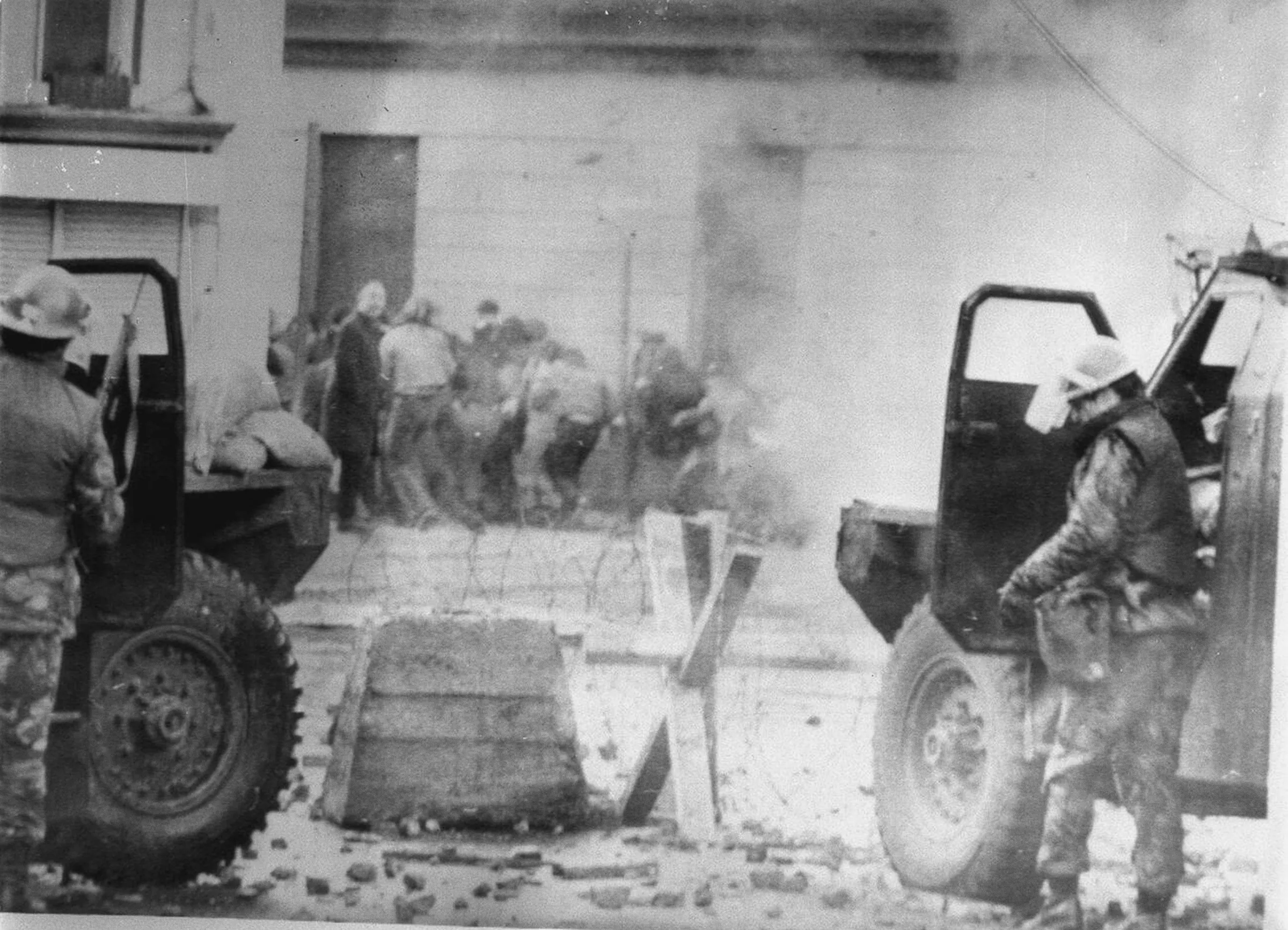
Lord Saville's report into Bloody Sunday, when British paratroopers shot dead thirteen people on a civil rights march in Derry/Londonderry on 30 January 1972. His twelve-year inquiry, the longest and most expensive public inquiry in British legal history, re-examined a shooting that an earlier tribunal had investigated in eleven weeks. It found that none of those shot was posing a threat, and rejected the soldiers' claims that they had fired at gunmen or bombers. This edition covers Volume I: the Tribunal's own conclusions and the background to the day.
Introduction by Reports that Matter. Only words in quotation marks are the report's own; every link opens them in context.
Background
On 30th January 1972 a civil rights march against internment without trial took place in Derry/Londonderry, in the north-west of Northern Ireland. British Army paratroopers of 1 PARA moved into the Bogside on an arrest operation; in the space of about ten minutes, soldiers shot dead thirteen people and wounded a similar number. A fourteenth man, John Johnston, wounded that day, died some months later and is often counted among Bloody Sunday's victims.
The first inquiry, led by Lord Widgery, the Lord Chief Justice of England, reported within eleven weeks and largely accepted the soldiers' evidence; it has long been regarded, including by the victims' families, as a whitewash. In 1998 the Prime Minister, Tony Blair, told the House of Commons that the weight of new material meant the events required re-examination, and set up the Bloody Sunday Inquiry under Lord Saville of Newdigate, sitting with two senior Commonwealth judges, William Hoyt and John Toohey. Over twelve years it heard from 921 witnesses, becoming the longest and most expensive public inquiry in British legal history. It reported in ten volumes on 15th June 2010. This edition covers Volume I only: the General Introduction, the Principal Conclusions and Overall Assessment, and the Background to Bloody Sunday. The other nine volumes, the detailed sector-by-sector evidence and findings, are not included here.
In the House of Commons on the day of publication, the Prime Minister, David Cameron, said the killings were "unjustified and unjustifiable" and apologised on the Government's behalf. The Public Prosecution Service later brought proceedings against one former soldier, tried as Soldier F for two of the killings in Glenfada Park North and five attempted murders; he was acquitted on all counts at Belfast Crown Court in October 2025.
What it found
-
The report's central conclusion is that none of those shot by soldiers of Support Company was posing a threat, and that no warning was given before the soldiers opened fire. p. 78 p. 100
“None of the casualties shot by soldiers of Support Company was armed with a firearm or (with the probable exception of Gerald Donaghey) a bomb of any description. None was posing any threat of causing death or serious injury. In no case was any warning given before soldiers opened fire.”
p. 78 · Read in context → -
The Tribunal found a serious and widespread loss of fire discipline among the soldiers of Support Company once they went into the Bogside; immediate responsibility for the deaths and injuries lies with them. p. 99 p. 90
“Our overall conclusion is that there was a serious and widespread loss of fire discipline among the soldiers of Support Company.”
p. 99 · Read in context → -
The soldiers who fired insisted that they had shot at gunmen or bombers. The Tribunal found that they had not, and rejected several of their accounts as knowingly untrue. p. 84 p. 79
“As to the further shooting in Rossville Street, which caused the deaths of William Nash, John Young and Michael McDaid, Corporal P claimed that he fired at a man with a pistol; Lance Corporal J claimed that he fired at a nail bomber; and Corporal E claimed that he fired at a man with a pistol in the Rossville Flats. We reject each of these claims as knowingly untrue.”
p. 84 · Read in context → -
No one threw or threatened to throw a nail or petrol bomb at the soldiers that day, contrary to the evidence some soldiers gave. p. 79
“Despite the contrary evidence given by soldiers, we have concluded that none of them fired in response to attacks or threatened attacks by nail or petrol bombers. No-one threw or threatened to throw a nail or petrol bomb at the soldiers on Bloody Sunday.”
p. 79 · Read in context → -
Lieutenant Colonel Derek Wilford, the commanding officer of 1 PARA, sent soldiers in vehicles into the Bogside without authority and in breach of the order Brigadier MacLellan had given him. p. 59 p. 95
-
The report finds no evidence for the allegation that what happened on Bloody Sunday was intended, planned or foreseen by the authorities, and finds that the United Kingdom Government was at the time making genuine and serious attempts to work towards a peaceful political settlement. p. 91 p. 91
-
Gerald Donaghey, a member of the IRA's youth wing, was probably carrying nail bombs when he was shot, but the report finds he was not preparing to throw one and was not shot because of them. p. 86 p. 88
Where to start reading
Short on time? These sections carry the report's argument. Each opens at the start of the section.
-
The overall assessment
p. 100 · Read →
The Tribunal's conclusion in six short paragraphs - how the shooting began, why it spread, and what it calls "a catastrophe for the people of Northern Ireland."
“The firing by soldiers of 1 PARA on Bloody Sunday caused the deaths of 13 people and injury to a similar number, none of whom was posing a threat of causing death or serious injury. What happened on Bloody Sunday strengthened the Provisional IRA, increased nationalist resentment and hostility towards the Army and exacerbated the violent conflict of the years that followed. Bloody Sunday was a tragedy for the bereaved and the wounded, and a catastrophe for the people of Northern Ireland.”
p. 100 · Read in context → -
Chapter 3: The events of the day
p. 53 · Read →
A reconstruction of the shootings, soldier by soldier and victim by victim, and the Tribunal's reasons for accepting or rejecting each soldier's account.
“Jackie Duddy was running away from the soldiers when he was shot. He probably had a stone in his hand at the time.”
p. 82 · Read in context → -
Chapter 4: The question of responsibility for the deaths and injuries on Bloody Sunday
p. 91 · Read →
Who, beyond the soldiers who fired, the Tribunal holds responsible for the deaths and injuries - and who it clears, including the generals and the Brigadier who gave the orders.
“Colonel Wilford should have ordered his soldiers to stay in and around William Street and the northern end of Rossville Street. Instead, he sent them into the Bogside, where they chased people down Rossville Street, into the car park of the Rossville Flats, into Glenfada Park North and as far as Abbey Park.”
p. 94 · Read in context → -
Chapter 2: Outline of events before the day
p. 49 · Read →
How a banned civil rights march became an arrest operation - the barriers, the changed route, and the decision to use 1 PARA.
“To that end General Ford ordered that 1st Battalion, The Parachute Regiment (1 PARA), which was stationed near Belfast, should travel to Londonderry and be used as the arrest force.”
p. 50 · Read in context → -
The period up to July 1971
p. 106 · Read →
The wider history the Tribunal thought necessary background - partition, the charge of gerrymandering in Londonderry's local government, and the civil rights marches of 1968-69.
“These events led to the establishment of the first ‘no go’ areas in Londonderry. Residents of the Bogside and other predominantly Catholic parts of the city erected barricades and organised vigilante patrols to prevent the RUC or loyalist crowds from entering their neighbourhoods.”
p. 122 · Read in context →
Contents
- General Introduction Read →
- Glossary Read →
- Principal Conclusions and Overall Assessment Read →
- Chapter 2: Outline of events before the day Read →
- Chapter 3: The events of the day Read →
- Chapter 4: The question of responsibility for the deaths and injuries on Bloody Sunday Read →
- Chapter 5: The overall assessment Read →
- The Background to Bloody Sunday Read →
- Chapter 6: Introduction Read →
- Chapter 7: The period up to July 1971 Read →
- Chapter 8: The period from August to December 1971 Read →
- Chapter 9: The weeks before Bloody Sunday Read →