Report · 2011
Deep Water: The Gulf Oil Disaster and the Future of Offshore Drilling
The presidential commission's account of the blowout of BP's Macondo well on 20 April 2010, which killed 11 men on the Deepwater Horizon rig and caused what it calls the largest accidental marine oil spill in US history. It finds the disaster avoidable, traces it to failures of management at BP, Halliburton and Transocean and to a regulator without the expertise to oversee them, and sets out what industry and government must change.
Introduction by Reports that Matter. Only words in quotation marks are the report's own; every link opens them in context.
Background
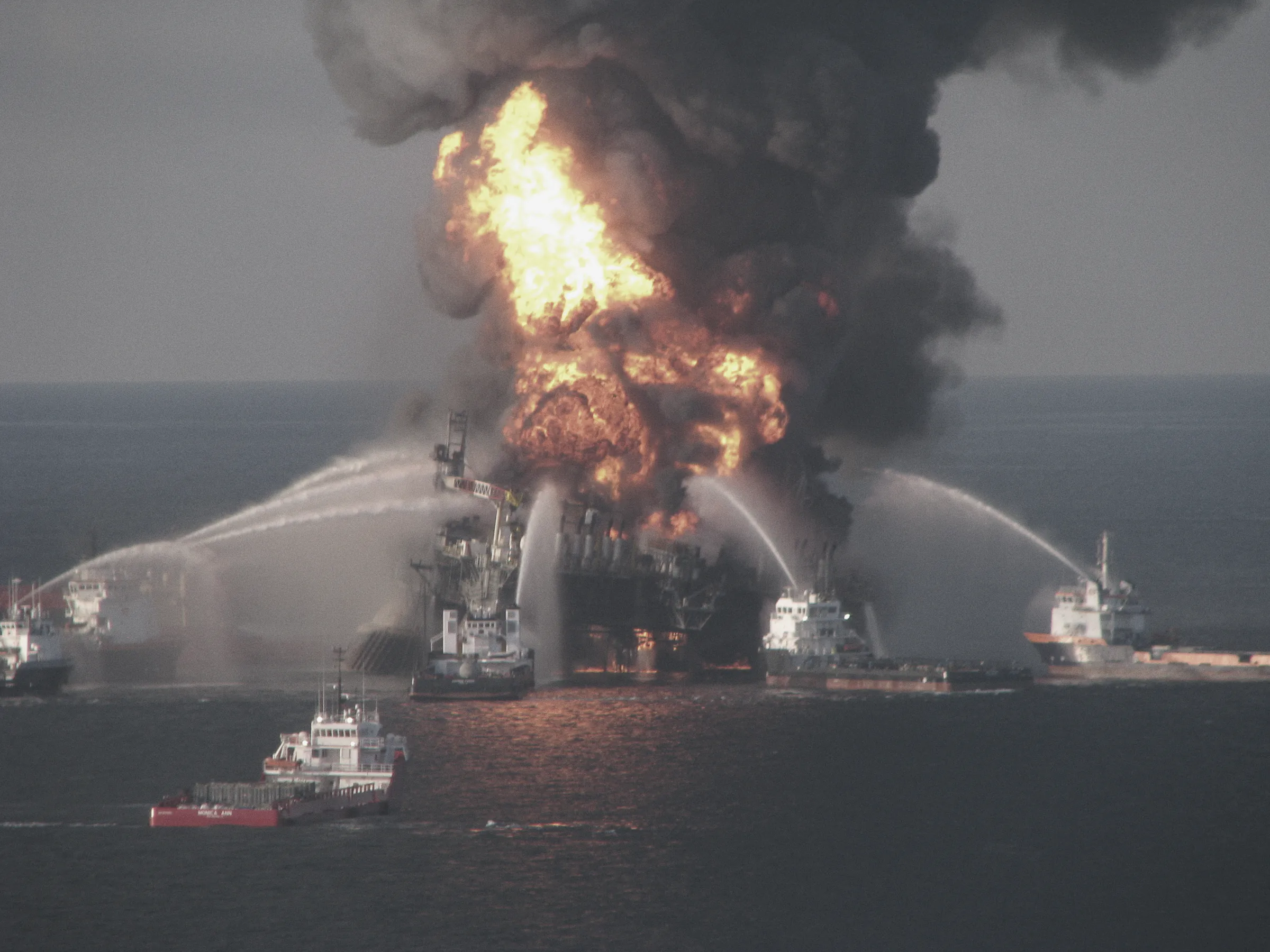
On the night of 20 April 2010, BP's Macondo well blew out beneath Transocean's drilling rig Deepwater Horizon, in nearly a mile of water in the Gulf of Mexico off Louisiana. Gas rising up the well reached the rig and exploded. Eleven of the 126 people on board were killed, and the rig sank two days later. Oil flowed for 87 days until the well was capped on 15 July; the government estimated that about 4.9 million barrels escaped.
President Barack Obama created the National Commission on the BP Deepwater Horizon Oil Spill and Offshore Drilling by executive order on 21 May 2010, to find the disaster's root causes and recommend how to guard against such spills. Its seven members were chaired by Bob Graham, a former governor of and senator for Florida, and William K. Reilly, a former administrator of the Environmental Protection Agency. After six months' work, without power to compel testimony, it reported on 11 January 2011. Its chief counsel, Fred Bartlit, published a fuller technical account on 17 February 2011. The report's findings are a policy commission's, not a court's.
The Interior Department completed its split of the Minerals Management Service into leasing, safety and revenue bodies on 1 October 2011. In 2012 Congress passed the RESTORE Act, sending 80 percent of the Clean Water Act penalties from the spill to restoring the Gulf, as the Commission had recommended; it did not raise the $75 million cap on liability for damages, which regulators lifted only for inflation, to about $134 million, in 2014. In January 2013 BP pleaded guilty to 14 criminal counts, including 11 of manslaughter, and agreed to pay $4 billion. In April 2016 a federal judge approved a $20.8 billion settlement of the civil claims of the United States and five Gulf states.
What it found
-
The Commission concludes that the blowout could have been prevented. It traces its immediate causes to identifiable mistakes by BP, Halliburton and Transocean, and by government officials who relied too much on industry's assurances of safety. ¶ p. 127
“The explosive loss of the Macondo well could have been prevented. The immediate causes of the Macondo well blowout can be traced to a series of identifiable mistakes made by BP, Halliburton, and Transocean that reveal such systematic failures in risk management that they place in doubt the safety culture of the entire industry.”
¶ · Read in context → -
Regulation did not keep pace as drilling moved into deep water. The report finds that the Minerals Management Service was torn between collecting revenue and enforcing safety, and lacked the resources, training and engineering expertise to oversee the wells it approved; the officials who approved Macondo's permits were neither required nor equipped to assess what mattered most to its safety. p. 85 p. 56 p. 77
-
On the evening of the blowout, the crew ran a negative-pressure test whose readings showed the well was not sealed. The report finds they explained the readings away, then missed further warning signs in the hour before the blowout. p. 119 p. 121
-
The Commission calls the root cause a failure of industry management. Many decisions that raised the risk at Macondo also saved time and money, and none was subject to formal risk analysis. The Commission says it cannot tell whether anyone knowingly chose a riskier option to save money. p. 122 p. 122 p. 125 p. 125
“The most significant failure at Macondo—and the clear root cause of the blowout—was a failure of industry management.”
p. 122 · Read in context → -
Neither industry nor government was ready for a deepwater spill. BP's response plan listed walruses as a species of concern and named a wildlife expert who had died; for four weeks the official estimate of the flow was 5,000 barrels a day, far below the true figure. ¶ p. 133 p. 133
“But it is impossible to argue that the industry or the country was prepared for a disaster of the magnitude of the Deepwater Horizon oil spill. Twenty years after the Exxon Valdez spill in Alaska, the same blunt response technologies—booms, dispersants, and skimmers—were used, to limited effect.”
¶ · Read in context → -
The spill struck a coast already in crisis. The report sets it against the loss of more than 2,300 square miles of Louisiana's wetlands since the 1927 flood, and calls for a restoration effort lasting decades. p. 173 p. 197
-
Government oversight alone will not be enough, the Commission says; the industry must transform its own safety culture, and should set up a self-policing safety institute modelled on the one the nuclear industry created after Three Mile Island, kept apart from its lobbying body, the American Petroleum Institute. p. 217 p. 241 p. 241
-
For government, it recommends an independent safety agency within the Interior Department, regulators funded by fees on industry, a much higher cap on liability for spills, and 80 percent of Clean Water Act penalties for restoring the Gulf. p. 256 p. 283 p. 279
“Congress and the Department of the Interior should create an independent agency within the Department of the Interior with enforcement authority to oversee all aspects of offshore drilling safety (operational and occupational), as well as the structural and operational integrity of all offshore energy production facilities, including both oil and gas production and renewable energy production.”
p. 256 · Read in context →
Where to start reading
Short on time? These sections carry the report's argument. Each opens at the start of the section.
-
Part I and Chapter 1: Sudden Death on the Gulf of Mexico
p. 1 · Read →
An hour-by-hour account of 20 April on the rig, from the cement job that morning to the explosion and the evacuation.
“Down in Ezell's cabin, he was still watching TV when his phone rang. It was assistant driller Steve Curtis calling, also from the rig floor. ‘We have a situation. …The well is blown out. . . . We have mud going to the crown.’”
p. 8 · Read in context → -
Part II and Chapter 4: The Macondo Well and the Blowout
p. 89 · Read →
The Commission's technical account of why the well failed, from the cement job to the warning signs missed in the last hour.
“It appears instead they started from the assumption that the well could not be flowing, and kept running tests and coming up with various explanations until they had convinced themselves their assumption was correct.”
p. 119 · Read in context → -
Part III and Chapter 8: Changing Business as Usual
p. 217 · Read →
The case for the industry to change its own safety culture, and how.
“The Deepwater Horizon blowout, explosion, and oil spill did not have to happen.”
p. 217 · Read in context → -
Chapter 9: The Need for a New, Independent Agency
p. 255 · Read →
Why renaming and splitting the old regulator was not enough, and the independent safety agency the Commission proposed instead.
“Although the proposed reorganization of Interior's offshore leasing, safety, and revenue management program represents a significant improvement, it does not adequately address the deeper problem of fully insulating the Department's safety and environmental protection functions from the pressures to increase production and maximize lease revenues.”
p. 255 · Read in context → -
Chapter 10: American Energy Policy and the Future of Offshore Drilling
p. 294 · Read →
The Commission on drilling in new frontiers such as the Arctic, and on rebuilding public trust.
“The extent to which offshore drilling contributes to augmenting that domestic supply depends importantly on rebuilding public faith in existing offshore energy exploration and production.”
p. 305 · Read in context →
Contents
- Front matter Read →
- Foreword Read →
- Part I: The Path to Tragedy Read →
- Chapter Two: "Each oil well has its own personality" The History of Offshore Oil and Gas in the United States Read →
- Chapter Three: "It was like pulling teeth." Oversight—and Oversights—in Regulating Deepwater Energy Exploration and Production in the Gulf of Mexico Read →
- Part II: Explosion and Aftermath: The Causes and Consequences of the Disaster Read →
- Chapter Five: "You're in it now, up to your neck!" Response and Containment Read →
- Chapter Six: "The worst environmental disaster America has ever faced." Oiling a Rich Environment: Impacts and Assessment Read →
- Chapter Seven: "People have plan fatigue . . . they've been planned to death" Recovery and Restoration Read →
- Part III: Lessons Learned: Industry, Government, Energy Policy Read →
- Chapter Nine: "Develop options for guarding against, and mitigating the impact of, oil spills associated with offshore drilling." Investing in Safety, Investing in Response, Investing in the Gulf Read →
- The Need for a New Approach to Risk Assessment and Management Read →
- The Need for a New, Independent Agency Read →
- Safeguarding the Environment Read →
- The Need for Greater Interagency Consultation Read →
- The Need for Improved Oil Spill Response Planning Read →
- The Need for a New Approach to Handling Spills of National Significance Read →
- The Need to Strengthen State and Local Involvement Read →
- The Need for Increased Research and Development to Improve Spill Response Read →
- The Need to Strengthen Industry's Spill Preparedness Read →
- The Need for a More Robust Well Design and Approval Process Read →
- The Need for Fair, Transparent Compensatory Restoration Based on Natural Resource Damage Assessments Read →
- The Need to Address Human Health Impacts, Especially Among Response Workers and in Affected Communities Read →
- The Need to Restore Consumer Confidence Read →
- The Need for Better Tools to Balance Economic and Environmental Interests Read →
- The Need to Increase Existing Limitations on Responsible Party Liability Read →
- The Need for Assessment of the Existing Claims Process Read →
- The Need for Congressional Awareness and Engagement Read →
- The Need for Adequate Funding for Safety Oversight and Environmental Review Read →
- Chapter Ten: American Energy Policy and the Future of Offshore Drilling Read →
- Appendix A: Commission Members Read →
- Appendix C: Executive Order-- National Commission on the BP Deepwater Horizon Oil Spill and Offshore Drilling Read →
- Appendix D: Commission Staff and Consultants Read →
- Index Read →