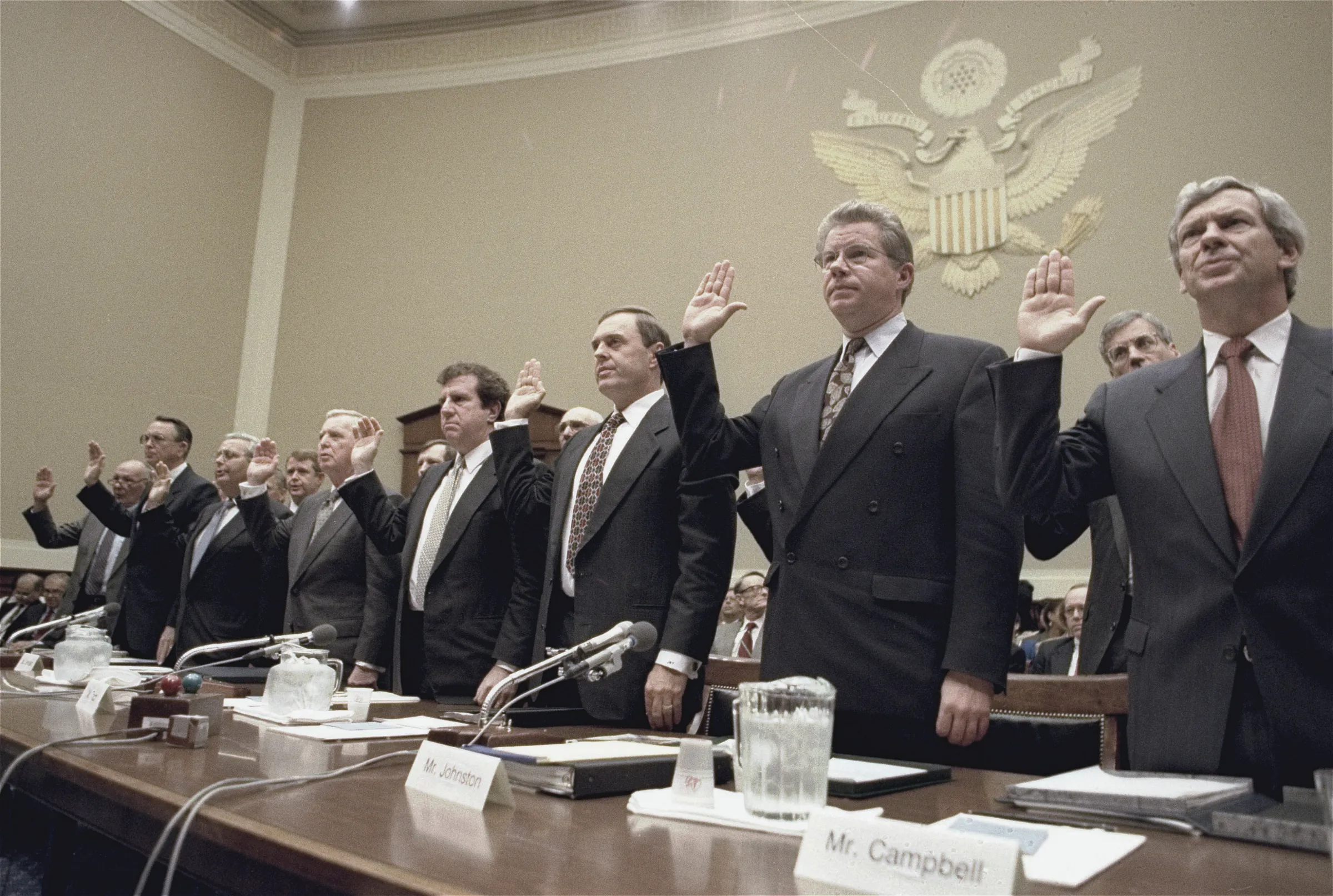
Report · 2006
United States v. Philip Morris USA Inc.: Amended Final Opinion
Judge Gladys Kessler's 2006 ruling that America's largest cigarette companies had deceived the public about smoking for some fifty years, in violation of the federal racketeering law. It is not an inquiry's view but a court's judgment, upheld on appeal. Built from a nine-month trial and the companies' own internal documents, it sets out what the industry knew about disease, addiction and "light" cigarettes, and what it said in public instead.
Introduction by Reports that Matter. Only words in quotation marks are the report's own; every link opens them in context.
Background
In December 1953, as new studies linked cigarettes to lung cancer, executives from most of the leading American tobacco companies met at the Plaza Hotel in New York. On 4 January 1954 they announced a joint research committee in "A Frank Statement to Cigarette Smokers", published in 448 newspapers, which held that smoking had not been proven to cause disease. In November 1998 the companies settled the states' lawsuits against them in the Master Settlement Agreement.
On 22 September 1999 the Justice Department sued nine cigarette makers and parent companies, among them Philip Morris and Altria, R.J. Reynolds, Brown & Williamson, Lorillard and Liggett, and two industry bodies, the Tobacco Institute and the Council for Tobacco Research, under the civil racketeering law, RICO. Its claim to $289 billion of past profits was ruled out in 2005, when the appeals court held that the law allows only remedies that prevent future violations. The trial ran for nine months from September 2004, with 84 witnesses. Judge Kessler signed her opinion, shown here in its amended form, on 17 August 2006. She found for the Government on most but not all of its claims, and held that Liggett had withdrawn from the conspiracy. The court rejected the companies' arguments that the 1998 settlement had already changed their conduct and that their statements were protected speech.
On 22 May 2009 the Court of Appeals for the D.C. Circuit unanimously upheld the finding of liability and most of the remedies; on 28 June 2010 the Supreme Court declined to hear the case. The companies contested the corrective statements for years more. They began running in newspapers and on prime-time network television on 26 November 2017, later appeared on cigarette packs and company websites, and from July 2023 were posted in nearly 200,000 shops.
What it found
-
The court found that the companies had conspired to violate RICO and had violated it, running a scheme to defraud smokers and potential smokers for financial gain that lasted some fifty years. p. 32 p. 1531 p. 33
“In short, Defendants have marketed and sold their lethal product with zeal, with deception, with a single-minded focus on their financial success, and without regard for the human tragedy or social costs that success exacted.”
p. 33 · Read in context → -
The court found that for at least 40 years the companies publicly denied that smoking causes disease, to keep up the appearance of an "open controversy", while their internal documents acknowledged the purpose of that strategy. p. 1538 p. 1537 p. 1535
“Similarly, an undated internal B&W document titled ‘Smoking and Health Proposal’ explained: ‘Doubt is our product since it is the best means of competing with the 'body of fact' that exists in the mind of the general public. It is also the means of establishing a controversy.’”
p. 1537 · Read in context → -
It found that the companies denied that nicotine is addictive, although they recognised it internally, and falsely denied that they controlled the nicotine their cigarettes deliver. p. 1538 p. 1539 p. 1543
“Defendants spent many millions of dollars and thousands of scientist hours over decades to ensure that smokers of all brands consumed sufficient nicotine to establish and maintain addiction.”
p. 1543 · Read in context → -
It found that the companies marketed "light" and "low tar" cigarettes to keep would-be quitters smoking, knowing for decades that they offered no meaningful reduction in risk. p. 1544 p. 1545 p. 1545
-
It found that the companies recognised new teenage smokers as essential to their profits, marketed to young people, and publicly denied doing so. p. 1548 p. 1549
“Defendants aggressively pursued the youth market, often not distinguishing those under 18 from those under 21, while publicly denying their activities. For example, Tobacco Institute spokesperson Brennan Dawson appeared on television and provided statements to newspapers, making such assertions as, ‘If a child never picks up another cigarette, it would be fine with the tobacco industry.’”
p. 1549 · Read in context → -
It found that the companies denied that secondhand smoke causes disease despite acknowledging its hazards internally, and that they suppressed, concealed and destroyed documents and research. The opinion singles out the central role of their lawyers. p. 1553 p. 1556 p. 34
-
The court did not find every allegation proved. It held that the Government had not shown that the companies deliberately chose to sabotage the marketing and production of less hazardous cigarettes. p. 768
-
Finding that the violations were likely to continue and that the 1998 settlement had not changed the companies' conduct enough, the court banned "light", "low tar" and similar descriptors and ordered corrective statements on five subjects. p. 1634 p. 1639 p. 1660 p. 1665
Where to start reading
Short on time? These sections carry the report's argument. Each opens at the start of the section.
-
Introduction
p. 32 · Read →
The whole judgment in four pages — what the Government alleged, what the court found, the remedies it could and could not order, and a word on the lawyers.
“At every stage, lawyers played an absolutely central role in the creation and perpetuation of the Enterprise and the implementation of its fraudulent schemes.”
p. 34 · Read in context → -
Creation of the Enterprise
p. 49 · Read →
Where it began — the December 1953 meeting at the Plaza Hotel, the public relations firm Hill & Knowlton, and the "Frank Statement" of January 1954.
-
Defendants Falsely Denied the Adverse Health Effects of Smoking
p. 1536 · Read →
The court's conclusions on the central deception, with the internal memos that set out the "open controversy" strategy.
“Using the sophisticated and well-organized machinery created to serve their agenda, Defendants fraudulently denied the adverse health effects of smoking for at least 40 years in order to sustain the appearance of an open controversy about the link between smoking and disease, and thereby maintain and enhance the cigarette market and their collective revenues.”
p. 1538 · Read in context → -
Defendants Falsely Denied that They Market to Youth
p. 1549 · Read →
The court's conclusions on marketing to young people, and on the companies' public denials.
“Defendants' fraudulent statements stem from their recognition, contained in internal documents written for decades, that new teenage smokers were essential to their continued profitability.”
p. 1548 · Read in context → -
Applicable Law
p. 1632 · Read →
Why the court concluded the companies had not changed — including what their senior executives said on the witness stand.
“For example, during live testimony in January 2005, more than forty years after the 1964 Surgeon General's Report, Reynolds American Executive Chairman Andrew Schindler refused to admit that smoking causes disease.”
p. 1634 · Read in context → -
Remedies: Banning "Light" and "Low Tar"
p. 1658 · Read →
The remedy the court ordered first — a ban on descriptors that imply a cigarette is less harmful.
“Accordingly, beginning January 1, 2007, Defendants are prohibited from using any descriptors indicating lower tar delivery -- including, but not limited to, ‘low tar,’ ‘light,’ ‘mild,’ ‘medium’ and ‘ultra light’ -- which create the false impression that such cigarettes are less harmful to smokers.”
p. 1660 · Read in context →
Contents
- UNITED STATES DISTRICT COURT FOR THE DISTRICT OF COLUMBIA Read →
- Overview Read →
- Preliminary Guidance for the Reader Read →
- PROCEDURAL HISTORY Read →
- CREATION, NATURE, AND OPERATION OF THE ENTERPRISE Read →
- Creation of the Enterprise Read →
- TIRC/CTR -- Tobacco Industry Research Committee/Council for Tobacco Research-USA Read →
- Selection and Approval of TIRC's Scientific Advisory Board Members and Scientific Director Read →
- Research Activities of TIRC/CTR Read →
- Public Relations Activities of TIRC/CTR Read →
- Publications and Public Statements of TIRC/CTR Read →
- Formation of the Tobacco Institute Read →
- Relationship Between the Tobacco Institute and TIRC/CTR Read →
- Tobacco Institute Press Releases, Public Statements, Advertisements, Brochures, and Other Publications Read →
- Tobacco Institute Committees Read →
- Tobacco Institute College of Tobacco Knowledge Read →
- Witness Development Read →
- CTR Special Projects Read →
- Lawyers' Special Accounts Read →
- Research Review Committee, Research Liaison Committee, and Industry Research Committee Read →
- Industry Technical Committee Read →
- Tobacco Working Group Read →
- Coordinated Smoking and Health Literature Collection and Retrieval Read →
- Defendants' Organizations Focused on ETS Issues Read →
- Overview Read →
- TMSC -- Tobacco Manufacturers' Standing Committee Read →
- TRC -- Tobacco Research Council Read →
- TAC -- Tobacco Advisory Council Read →
- ICOSI -- International Committee on Smoking Issues Read →
- INFOTAB -- International Tobacco Information Center Read →
- TDC -- Tobacco Documentation Centre Read →
- Tobacco Institute Interaction with Overseas and International Groups Read →
- CTR Read →
- THE DEFENDANTS ARE ENGAGED IN AND THEIR ACTIVITIES AFFECT INTERSTATE AND FOREIGN COMMERCE Read →
- Tobacco Institute Read →
- TIRC/CTR Read →
- Cigarette Smoking Causes Disease Read →
- Scientific Research on Lung Cancer up to December 1953 Read →
- Developments Between 1953 and 1964 Read →
- The 1964 Surgeon General Report Represented a Scientific Consensus that Smoking Causes Disease Read →
- Post-1964 Research on the Adverse Health Effects of Smoking and Defendants' Persistent Denials Thereof Read →
- As of 2005, Defendants Still Do Not Admit the Serious Health Effects of Smoking Which They Recognized Internally Decades Ago Read →
- Conclusions Read →
- Introduction Read →
- Cigarette Smoking Is Addictive and Nicotine Is the Primary Element of that Addiction Read →
- Defendants Were Well Aware that Smoking and Nicotine Are Addictive Read →
- Defendants Publicly Denied that Nicotine Is Addictive and Continue to Do So Read →
- Defendants Concealed and Suppressed Research Data and Other Evidence that Nicotine Is Addictive Read →
- Conclusions Read →
- Nicotine "Manipulation": Defendants Have Falsely Denied that They Can and Do Control the Level of Nicotine Delivered In Order to Create and Sustain Addiction Read →
- For Decades, Defendants Have Recognized that Controlling Nicotine Delivery, in Order to Create and Sustain Smokers' Addiction, Was Necessary to Ensure Commercial Success Read →
- Defendants Researched, Developed, and Utilized Various Designs and Methods of Nicotine Control to Ensure that All Cigarettes Delivered Doses of Nicotine Adequate to Create and Sustain Addiction Read →
- Defendants Have Made False and Misleading Public Statements Regarding Their Control of the Nicotine Content and Delivery of Their Products Read →
- Conclusions Read →
- Defendants Have Long Acknowledged Internally the Existence of a Market for a Genuinely Less Hazardous Cigarette Read →
- Defendants Received Conflicting Messages From the Government and the Public Health Community About Their Efforts to Create and Market Less Hazardous Cigarettes Read →
- As Part of the Effort to Make Less Hazardous Cigarettes, Defendants Experimented with General and Selective Reduction Read →
- Defendants' Efforts to Develop/Market Potentially Less Hazardous Non-Conventional Products Read →
- The Government Has Not Proven by a Preponderance of the Evidence that Defendant Had a "Gentleman's Agreement" Not to Develop a Less Hazardous Cigarette and Not to Do In-House Biological Research on the Hazards of Smoking Read →
- Conclusions Read →
- Defendants Falsely Marketed and Promoted Low Tar/Light Cigarettes as Less Harmful than Full-Flavor Cigarettes in Order to Keep People Smoking and Sustain Corporate Revenues Read →
- Low Tar/Light Cigarettes Offer No Clear Health Benefit over Regular Cigarettes Read →
- Based on Their Sophisticated Understanding of Compensation, Defendants Internally Recognized that Low Tar/Light Cigarettes Offer No Clear Health Benefit Read →
- Defendants Internally Recognized that Smokers Switch to Low Tar/Light Cigarettes, Rather than Quit Smoking, Because They Believe They Are Less Harmful Read →
- Despite Their Internal Knowledge, Defendants Publicly Denied that Compensation Is Nearly Complete and that the FTC Method is Flawed Read →
- Despite Their Internal Knowledge, Defendants' Marketing and Public Statements About Low Tar Cigarettes Continue to Suggest that They Are Less Harmful than Full-Flavor Cigarettes Read →
- The Defendants Need Youth as Replacement Smokers Read →
- Defendants' Marketing Is a Substantial Contributing Factor to Youth Smoking Initiation Read →
- Tracking Youth Behavior and Preferences Ensures that Marketing and Promotion Reach Youth Read →
- Defendants' Marketing Successfully Reaches Youth Read →
- Defendants' Youth Smoking Prevention Programs Are Not Designed to Effectively Prevent Youth Smoking Read →
- Conclusions Read →
- The Consensus of the Public Health Community Is that ETS Causes Disease in Nonsmokers Read →
- Internally, Defendants Recognized that ETS Is Hazardous to Nonsmokers Read →
- Internally, Defendants Expressed Concern that the Mounting Evidence on ETS Posed a Grave Threat to Their Industry Read →
- Defendants Made Public Promises to Support Independent Research on the Link Betwen ETS and Disease Read →
- Defendants Undertook Joint Efforts to Undermine and Discredit the Scientific Consensus that ETS Causes Disease Read →
- Defendants Made False and Misleading Public Statements Denying that ETS Is Hazardous to Nonsmokers Read →
- Defendants Continue to Obscure the Fact that ETS is Hazardous to Nonsmokers Read →
- Conclusions Read →
- Suppression and Concealment of Scientific Research Read →
- Document Destruction Policies Read →
- Improper use of Attorney-Client and Work Product Privileges Read →
- Liggett's Settlement Agreement with Various States Read →
- Provisions of the MSA Read →
- Enforcement of the MSA Read →
- Developments Since the MSA Read →
- CONCLUSIONS OF LAW Read →
- Defendants Engaged in a Scheme to Defraud Smokers and Potential Smokers Read →
- Defendants Falsely Denied the Adverse Health Effects of Smoking Read →
- Defendants Falsely Denied that Nicotine and Smoking Are Addictive Read →
- Defendants Falsely Denied that They Manipulated Cigarette Design and Composition so as to Assure Nicotine Delivery Levels Which Create and Sustain Addiction Read →
- Defendants Falsely Represented that Light and Low Tar Cigarettes Deliver Less Nicotine and Tar and, Therefore, Present Fewer Health Risks than Full-Flavor Cigarettes Read →
- Defendants Falsely Denied that They Market to Youth Read →
- Defendants Falsely Denied that ETS Causes Disease Read →
- Defendants Suppressed Documents, Information, and Research Read →
- Applicable Legal Standards Read →
- Defendants' Enterprise Had a Common Purpose Read →
- The Enterprise operated through both formal and informal organization Read →
- The Enterprise Has Functioned as a Continuous Unit Read →
- The Enterprise Engaged in and Its Activities Affected Interstate and Foreign Commerce Read →
- Each Defendant Is Associated with the Enterprise Read →
- Each Defendant Participated in the Conduct of the Enterprise Read →
- The Government Has Proven that Defendants Caused Mailings and Wire Transmissions, in Furtherance of the Scheme to Defraud, in Violation of 18 U.S.C. § § 1341 and/or 1343 Read →
- The First Amendment Does Not Protect Defendants' False and Misleading Public Statements Read →
- Defendants Engaged in a Pattern of Racketeering Activity in Furtherance of the Scheme to Defraud Read →
- Defendants Acted with the Specific Intent to Defraud or Deceive Read →
- Defendants' False and Fraudulent Statements, Representations, and Promises Were Material Read →
- Applicable Case Law Read →
- Liggett Withdrew from the Conspiracy Read →
- Applicable Law Read →
- The Enterprise's Scheme to Defraud Presents Continuing Opportunities for Defendants to Commit Violations of 18 U.S.C. 1962 (c) and (d) Read →
- The MSA Has Not Sufficiently Altered Defendants' Conduct to Justify Not Imposing Appropriate Remedies Read →
- CTR Read →
- The Tobacco Institute Read →
- Liggett Read →
- Legal Standards Governing Remedies Read →
- Prohibition of Brand Descriptors Read →
- Corrective Communications Read →
- Disclosure of Documents and Disaggregated Marketing Data Read →
- Youth Smoking Reduction Targets Read →
- Corporate Structural Changes Read →
- Public Education and Countermarketing Campaign Read →
- Notes not linked in the text Read →