Report · 1986
Investigation of the Challenger Accident
The US House of Representatives' own investigation of the Challenger disaster of 1986, written by the committee that authorised and funded NASA. It agrees with the Rogers Commission on what failed but not on why, placing the blame on years of poor technical decisions rather than poor communication, and it names Congress among those who pushed NASA to fly too often.
Introduction by Reports that Matter. Only words in quotation marks are the report's own; every link opens them in context.
Background
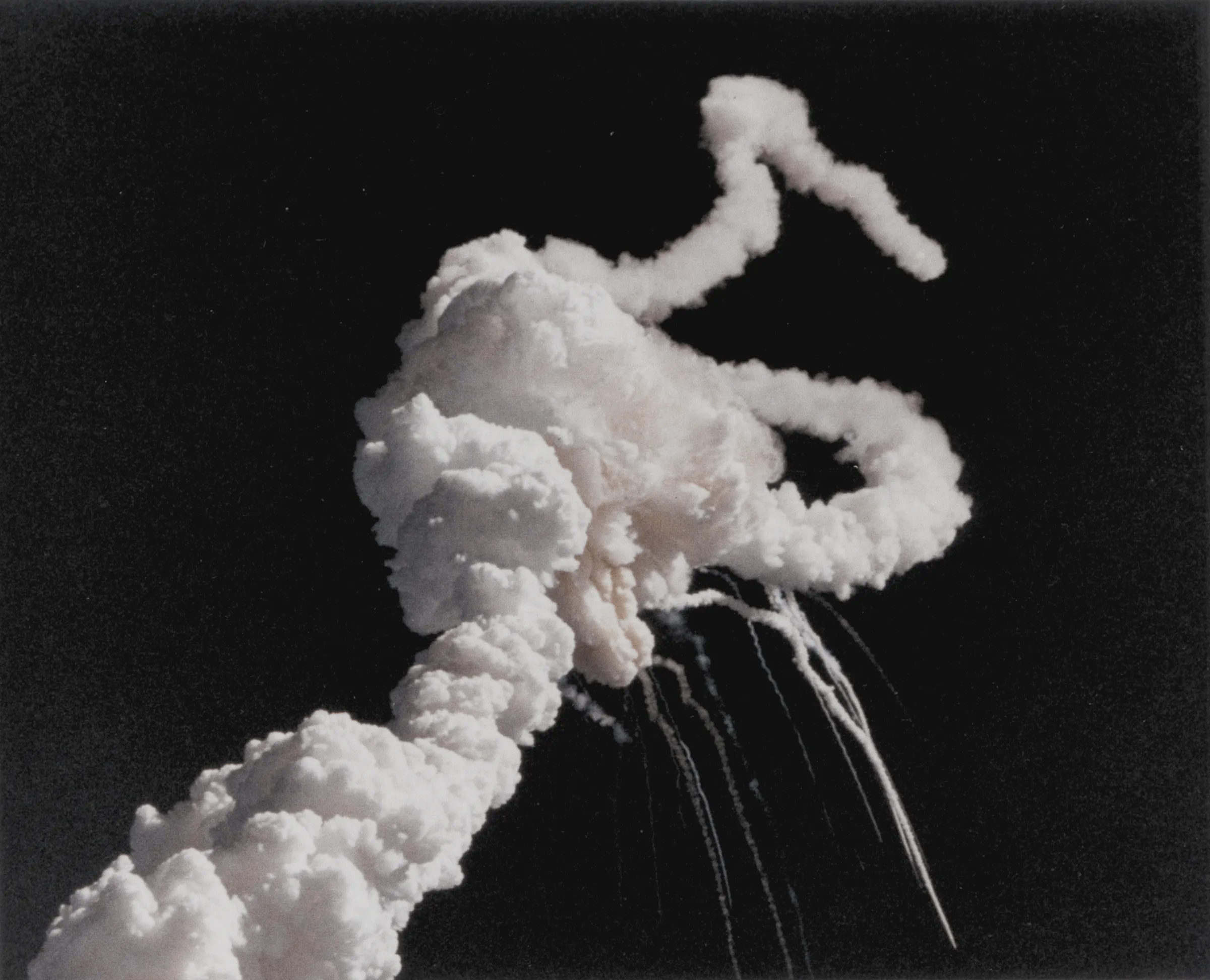
On 28 January 1986 the Space Shuttle Challenger broke apart 73 seconds after lifting off from Kennedy Space Center, killing its crew of seven, among them Christa McAuliffe, a schoolteacher flying under NASA's Teacher in Space Project. A seal in a joint of the right-hand solid rocket booster had failed after a night of freezing temperatures at the Cape.
That day the chairman of the House Committee on Science and Technology, Don Fuqua, told the House that the Committee would investigate. On 3 February President Reagan appointed a Presidential Commission under William P. Rogers, a former Secretary of State, whose members included Neil Armstrong, Sally Ride and Richard Feynman. The Committee chose not to duplicate that inquiry but to review it: once the Rogers Commission reported in June 1986, it held ten hearings with 60 witnesses, chaired by Robert A. Roe, and had full access to the Commission's database. The Committee approved this report on 7 October 1986, and it was published as House Report 99-1016 on 29 October. It is a congressional oversight report: it sets out findings and recommendations, and directed NASA to report back on each by 15 February 1987.
The Shuttle did not fly again for 32 months. Discovery returned it to flight on 29 September 1988, with a redesigned booster joint. After Columbia was lost in 2003, its investigation board devoted a chapter to comparing the two accidents, and found again a "reliance on past success as a substitute for sound engineering practices".
What it found
-
Like the Rogers Commission, the Committee concluded that the accident was caused by the failure of the aft field joint on the right-hand solid rocket motor, a faulty design that neither NASA nor its contractor, Morton Thiokol, fully understood. p. 4 p. 7
-
Where the Commission pointed to a flawed decision-making process, the Committee concludes that the underlying problem was not poor communication but poor technical decision-making, over several years, by top NASA and Thiokol managers. Information on the joint's flaws had been presented to every level of Shuttle management. p. 4 p. 5 p. 172
“Information on the flaws in the joint design and on the problems encountered in missions prior to 51-L was widely available and had been presented to all levels of Shuttle management. Despite the presence of significant amounts of information and the occurrence of at least one detailed briefing at Headquarters on the difficulties with the 0rings, the NASA and Thiokol technical managers failed to understand or fully accept the seriousness of the problem.”
p. 5 · Read in context → -
Seals had been eroding on flight after flight. The report finds that NASA came to treat this damage as "acceptable" and "within experience base", and chose to keep flying while a measured, 27-month fix proceeded. p. 62 p. 5 p. 146
“The Committee concurs with Dr. Feynman's analysis that NASA had no understanding of the O-ring erosion phenomenon, and their rationale for accepting it was not based on sound engineering principles.”
p. 146 · Read in context → -
On the eve of the launch, Thiokol engineers warned that the cold would impair the seals. The report finds that the response of Marshall managers led Thiokol's management to set aside their own engineers' judgement and recommend launch, and that the decision rested on faulty engineering analysis. p. 10 p. 219 p. 220
“The decision to launch STS 51-L was based on a faulty engineering analysis of the SRM field joint seal behavior.”
p. 10 · Read in context → -
The Committee found that NASA's drive for 24 flights a year created pressure that contributed directly to unsafe launch operations, and it acknowledges that the Committee itself, Congress and the Administration helped create that pressure. p. 2 p. 2 p. 123
“The Committee found that NASA's drive to achieve a launch schedule of 24 flights per year created pressure throughout the agency that directly contributed to unsafe launch operations.”
p. 2 · Read in context → -
The Committee confirms the Commission's finding that NASA's safety, reliability and quality assurance programmes were grossly inadequate, and finds nothing to show that NASA's safety staff ever evaluated the seal problem. p. 4 p. 218
-
It goes beyond the Commission on other hardware, raising concerns about the margins of the Shuttle's main engines and recommending a new specification for its landing gear, tyres and brakes. It also finds that NASA's management waived its own launch commit criteria on the morning of the launch without a valid technical reason. p. 5 p. 5 p. 11
Where to start reading
Short on time? These sections carry the report's argument. Each opens at the start of the section.
-
Conclusions
p. 4 · Read →
The Committee's verdict in a few pages, including where and why it parts company with the Rogers Commission, followed by a digest of every finding.
“NASA management and the Congress must remember the lessons learned from the Challenger accident and never again set unreasonable goals which stress the system beyond its safe functioning.”
p. 4 · Read in context → -
History
p. 51 · Read →
The joint problem from the 1973 contract to the night before launch, set out as a chronology of what NASA and Thiokol knew and when.
“At seven different times in the Shuttle Program, NASA and Thiokol managers made poor technical decisions that ultimately permitted continued flight of an unsafe Solid Rocket Motor design.”
p. 50 · Read in context → -
Summary of Casing Joint Design
p. 61 · Read →
How the booster joint worked, why it failed, and how erosion of its seals came to be treated as acceptable.
“But rather than identify this condition as a joint that didn't seal, that is, a joint that had already failed, NASA elected to regard a certain degree of erosion or blow-by as "acceptable."”
p. 62 · Read in context → -
Pressures on Shuttle Operations
p. 115 · Read →
Where the pressure to fly more often came from, and what it did to training, planning and safety.
“Without operating pressures the program might have been stopped months before the accident to redesign or at least understand the SRB joint. Without operating pressure the flight could have been stopped the night of January 27.”
p. 123 · Read in context → -
Technical Management
p. 139 · Read →
Why senior managers did not act on the seal problem, including a NASA manager's own account of how they talked themselves into it.
“When we recognized that it had design deficiency, we did not fix it. Then we continued to fly with it, and rationalized why it was safe, and eventually concluded and convinced ourselves that it was an acceptable risk.”
p. 161 · Read in context → -
The STS 51-L Launch Decision
p. 208 · Read →
The flight readiness reviews, the teleconference of 27 January, and the ice on the launch pad the next morning.
“Clearly evident is the fact that the Flight Readiness Review procedure cannot compensate for poor engineering analysis.”
p. 215 · Read in context →
Contents
- INVESTIGATION OF THE CHALLENGER ACCIDENT Read →
- INTRODUCTION Read →
- CONCLUSIONS Read →
- Hardware Development and Production Read →
- Technical Management Read →
- Organization and Policy Management Read →
- CHALLENGER INVESTIGATION HEARINGS Read →
- INTRODUCTION Read →
- I/ FORWARO SEGMENT PROPELLANT Read →
- PROCURE MATERIALS AND COMPONENTS, PRODU AND ASSEMBLE AN OPERATIONAL MOTOR IN Read →
- HISTORY Read →
- TEST AND CONTROL FEATURES Read →
- SUMMARY OF SIGNIFICANT OBSERVATIONS Read →
- SUMMARY OF CASING JOINT DESIGN Read →
- STACKING OPERATIONS Read →
- SUMMARY OF LAUNCH OPERATIONS Read →
- EXTERNAL Read →
- CREWSURVIVAL Read →
- HARDWARE DEVELOPMENT AND PRODUCTION Read →
- 2 . OPERATIONS Read →
- TECHNICAL MANAGEMENT Read →
- DOWNSTREAM (PROPER) POSIT ION )I; FIGUREVII-1 Read →
- THE STS 51-L LAUNCH DECISION Read →
- TABLE I1 PRINCIPAL PARTICIPANTS IN THE TELECONFERENCE Read →
- LAUNCH REDLINES Read →
- IX.DEFINITIONS OF TERMS AND ACRONYMS Read →
- XATIONAL AERONAUTICS AND SPACE ADMIYISTRATIOV Read →
- 3.0 APPROACH Read →
- I?. Kdler 1 El2 Read →
- O-RINGS AND PUTTY Read →
- SPACE SHUTTLE S O L I D ROCKET HWOR PNOJOCT OPERATIONAL FLIGHT Read →
- PANEL ON TECBRICAL EVALUATION OF RASA'S PPOPOSED BZDESICII Read →
- CRITICALITY POTENTIAL EFFECT OF FAILURE Read →
- 3.3 ANALYSIS REOUIREMENTS Read →
- ECLSS SUBSYSTEM Read →
- F A I L S HID-TRAVEL ERRONEOUS INDICATION LOSS OF OR PARTIAL OUTPUT F A I L S T O OPEN/UOSE RESTRICTED FLOU SHORTED Read →
- CAUSES CONTAMINATION TEMPERATURE (HIGH/LOU) INADVERTENT OPERATION/ACTIVATION MECHANICAL SHOCK THERHAL SHOCK VIBRATION VACUUM PRESSURE (HIGH/LOU) PROCEDURAL ERROR ACOUSTICS IONIZING RADIATION CHEMIUL REACTION OVERLOAD ' ACCELERATION LOSS OF/IMPROPER INPUT Read →
- 4.2 REVISIONS & SUBMITTALS Read →
- APPENDIX 8 Read →
- RUBBER PROPERTY-COMPRESSION SET' Read →
- Calculation 12. Procedure Read →
- 0 OMRSD Read →
- SHUTTLE W 0 3 E C T S FRR REQUIREUENTS Read →
- PERFORNANCE ACCEPTABLE NO Read →
- Notes not linked in the text Read →