Report · 2003
Columbia Accident Investigation Board Report, Volume I
The independent board's account of why the Space Shuttle Columbia broke apart in February 2003, killing its seven crew. It traces the loss to a piece of foam and then, at greater length, to the NASA that let foam strikes become routine and set aside its engineers' requests to photograph the damaged wing. Its account of how organisations come to accept danger is still read far beyond spaceflight.
Introduction by Reports that Matter. Only words in quotation marks are the report's own; every link opens them in context.
Background
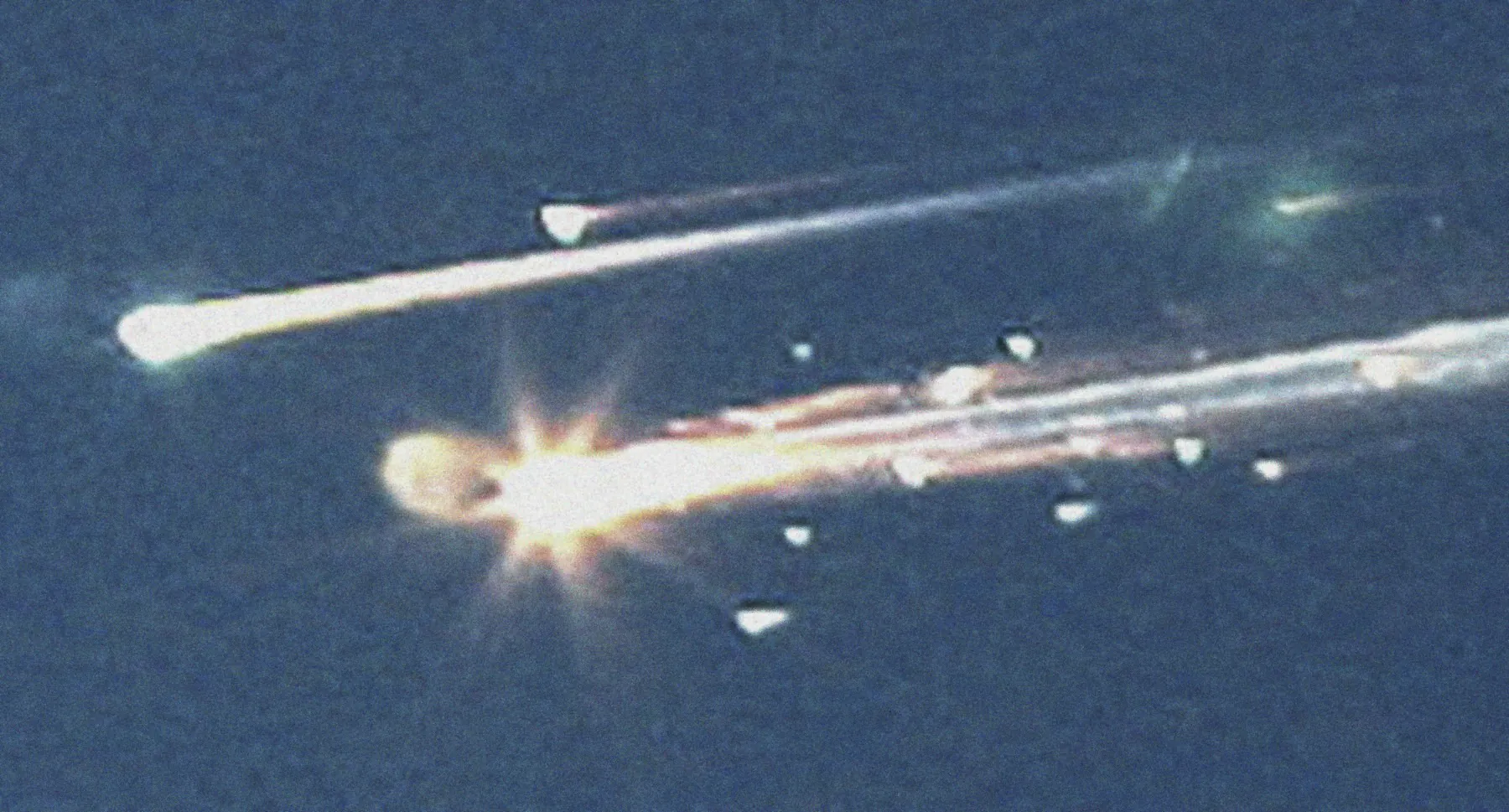
Columbia, the first Space Shuttle to fly in orbit, was launched on 16 January 2003 on STS-107, a 16-day science mission. On the morning of 1 February, as it returned to Earth, it broke apart over Texas about 16 minutes before it was due to land. All seven crew died, among them Ilan Ramon, Israel's first astronaut. It was the second Shuttle lost, 17 years after Challenger in January 1986.
NASA activated the Columbia Accident Investigation Board within hours, under procedures set up after Challenger. Chaired by Harold Gehman, a retired US Navy admiral, its 13 members broadened their inquiry from the physical cause to NASA's history, budgets and culture. The report says its investigators examined more than 30,000 documents and conducted more than 200 formal interviews, while more than 25,000 searchers recovered debris across the western United States. Volume I was published on 26 August 2003, with 29 recommendations, 15 of them to be met before the Shuttle flew again. It is an accident investigation, not a court: it names managers and describes their decisions, but argues that NASA's problems cannot be solved by resignations or transfers. Its chapter comparing Columbia with Challenger was written with the sociologist Diane Vaughan, whose work on Challenger gave it the phrase "normalization of deviance".
The Shuttle fleet was grounded for more than two years. Discovery returned to flight on STS-114 in July 2005, but a large piece of foam came off its tank and the fleet was grounded again until July 2006. In January 2004 President George W. Bush announced a new space policy under which the Shuttle would be retired once the International Space Station was complete; the last Shuttle flight, by Atlantis, was in July 2011.
What it found
-
The Board finds that a piece of insulating foam from the External Tank struck the leading edge of Columbia's left wing during launch and breached it. On re-entry, superheated air entered the wing and melted its structure until the Orbiter broke apart. p. 9 p. 49
“During re-entry this breach in the Thermal Protection System allowed superheated air to penetrate through the leading edge insulation and progressively melt the aluminum structure of the left wing, resulting in a weakening of the structure until increasing aerodynamic forces caused loss of control, failure of the wing, and breakup of the Orbiter. This breakup occurred in a flight regime in which, given the current design of the Orbiter, there was no possibility for the crew to survive.”
p. 9 · Read in context → -
Foam had been coming off the tank since the first flight in 1981, against the design requirements. The report finds that NASA came to treat each strike as a maintenance problem rather than a danger, as it had treated O-ring erosion before Challenger. p. 122 p. 196 p. 196
“Foam debris anomalies came to be categorized by the reassuring term ‘in-family,’ a formal classification indicating that new occurrences of an anomaly were within the engineering experience base. ‘In-family’ was a strange term indeed for a violation of system requirements.”
p. 196 · Read in context → -
The Board found the Shuttle Program under pressure to meet a fixed date, 19 February 2004, for launching a key part of the International Space Station, a deadline on which the White House and Congress had in effect put NASA on probation. p. 131 p. 117 p. 132
-
During the flight, engineers asked three times for images of the damaged wing. Managers turned the requests down, having already judged foam no threat, and, the report finds, required the engineers to prove the Orbiter was unsafe. p. 140 p. 169 p. 170
“Debris Assessment Team members had to prove unequivocally that a safety-of-flight issue existed before Shuttle Program management would move to obtain images of the left wing. The engineers found themselves in the unusual position of having to prove that the situation was unsafe – a reversal of the usual requirement to prove that a situation is safe.”
p. 169 · Read in context → -
A study NASA carried out for the Board concluded that, had the damage been found early in the mission, a rescue by the Shuttle Atlantis would have been challenging but feasible. p. 173 p. 174
“This rescue was considered challenging but feasible. To succeed, it required problem-free processing of Atlantis and a flawless launch countdown. If Program managers had understood the threat that the bipod foam strike posed and were able to unequivocally determine before Flight Day Seven that there was potentially catastrophic damage to the left wing, these repair and rescue plans would most likely have been developed, and a rescue would have been conceivable.”
p. 174 · Read in context → -
The Board concludes that NASA's organisation and culture were as much a cause as the foam. Its safety organisation lacked independence and stayed silent, and the Shuttle Program held authority over schedule, cost and safety at once. p. 9 p. 177 p. 192
-
The report finds "echoes" of Challenger throughout, and concludes that the organisational causes identified after 1986 had not been fixed. It holds the White House and Congress, as well as NASA, responsible for the pressures that produced them. p. 195 p. 197 p. 203
-
Beyond immediate fixes to foam, imaging and wing repair, the Board recommends separating technical authority from schedule and cost, an independent safety organisation, and replacing the Shuttle as soon as possible. p. 9 p. 208 p. 210
Where to start reading
Short on time? These sections carry the report's argument. Each opens at the start of the section.
-
Executive summary
p. 10 · Read →
The physical cause and the organisational causes in two pages, and how the report is laid out.
-
A history of foam anomalies
p. 122 · Read →
How foam came off the tank on flight after flight, and how NASA came to live with it.
“Photographic evidence of foam shedding exists for 65 of the 79 missions for which imagery is available.”
p. 122 · Read in context → -
Schedule pressure
p. 132 · Read →
The February 2004 deadline for the Space Station, and what it did to the people preparing the Shuttle.
“A screen saver (see Figure 6.2-3) was mailed to managers in NASAʼs human spaceflight program that depicted a clock counting down to February 19, 2004 – U.S. Core Complete.”
p. 132 · Read in context → -
Decision-making during the flight
p. 141 · Read →
The Board's summary of the 16 days in orbit, when engineers sought images of the wing and managers declined them.
“Managersʼ claims that they didnʼt hear the engineersʼ concerns were due in part to their not asking or listening.”
p. 170 · Read in context → -
Possibility of rescue or repair
p. 174 · Read →
What could have been done had the damage been found, from a repair with scavenged metal and ice to a rescue by Atlantis.
-
The normalisation of deviance
p. 197 · Read →
The chapter's core comparison of foam and the Challenger O-rings, and how warning signs became routine.
“Engineers and managers incorporated worsening anomalies into the engineering experience base, which functioned as an elastic waistband, expanding to hold larger deviations from the original design.”
p. 196 · Read in context →
Contents
- IN MEMORIAM Read →
- BOARD STATEMENT Read →
- EXECUTIVE SUMMARY Read →
- REPORT SYNOPSIS Read →
- Part One: The Accident Read →
- 1.1 Genesis of the Space Transportation System Read →
- 1.2 Merging Conflicting Interests Read →
- 1.3 Shuttle Development, Testing, and Qualification Read →
- 1.4 The Shuttle Becomes "Operational" Read →
- 1.5 The Challenger Accident Read →
- 2.1 Mission Objectives and Their Rationales Read →
- 2.2 Flight Preparation Read →
- 2.3 Launch Sequence Read →
- 2.4 On-Orbit Events Read →
- 2.5 Debris Strike Analysis and Requests for Imagery Read →
- 2.6 De-Orbit Burn and Re-Entry Events Read →
- 2.7 Events Immediately Following the Accident Read →
- 3.2 The External Tank and Foam Read →
- 3.3 WING LEADING EDGE STRUCTURAL SUBSYSTEM Read →
- 3.4 Image and Transport Analyses Read →
- 3.5 On-Orbit Debris Separation – The "Flight Day 2" Object Read →
- 3.6 De-Orbit/Re-Entry Read →
- 3.7 Debris Analysis Read →
- 3.8 Impact Analysis and Testing Read →
- 4.1 Fault Tree Read →
- 4.2 Remaining Factors Read →
- Part Two: Why The Accident Occurred Read →
- 5.1 The Challenger Accident and its Aftermath Read →
- 5.2 The NASA Human Space Flight Culture Read →
- 5.3 An Agency Trying to Do Too Much With Too Little Read →
- 5.4 Turbulence in NASA Hits the Space Shuttle Program Read →
- 5.5 When to Replace the Space Shuttle? Read →
- 5.6 A Change in NASA Leadership Read →
- 5.7 The Return of Schedule Pressure Read →
- 5.8 Conclusion Read →
- 6.1 A History of Foam Anomalies Read →
- 6.2 Schedule Pressure Read →
- 6.3 Decision-Making During the Flight of STS-107 Read →
- 6.4 Possibility of Rescue or Repair Read →
- Chapter 7: The Accidentʼs Organizational Causes Read →
- 7.1 Organizational Causes: Insights from History Read →
- 7.2 Organizational Causes: Insights from Theory Read →
- 7.3 Organizational Causes: Evaluating Best Safety Practices Read →
- 7.4 Organizational Causes: A Broken Safety Culture Read →
- 7.5 Organizational Causes: Impact of a Flawed Safety Culture on STS-107 Read →
- 7.6 Findings and Recommendations Read →
- 8.1 Echoes of Challenger Read →
- 8.2 Failures of Foresight: Two Decision Histories and the Normalization of Deviance Read →
- 8.3 System Effects: The Impact of History and Politics on Risky Work Read →
- 8.4 Organization, Culture, and Unintended Consequences Read →
- 8.5 History as Cause: Two Accidents Read →
- 8.6 Changing NASAʼs Organizational System Read →
- Part Three: A Look Ahead Read →
- Chapter 9: Implications for the Future of Human Space Flight Read →
- 9.2 Mid-Term: Continuing to Fly Read →
- 9.3 Long-Term: Future Directions for the U.S. in Space Read →
- 10.1 Public Safety Read →
- 10.2 Crew Escape and Survival Read →
- 10.4 Industrial Safety and Quality Assurance Read →
- 10.5 Maintenance Documentation Read →
- 10.6 Orbiter Maintenance Down Period/Orbiter Major Modification Read →
- 10.7 Orbiter Corrosion Read →
- 10.9 Hold-Down Post Cable Anomaly Read →
- Chapter 11: Recommendations Read →
- A.1 ACTIVATION OF THE COLUMBIA ACCIDENT INVESTIGATION BOARD Read →
- A.2 BOARD CHARTER AND ORGANIZATION Read →
- A.3 INVESTIGATION PROCESS AND SCOPE Read →
- A.4 BOARD POLICIES AND PROCEDURES Read →
- A.5 INVESTIGATION INTERFACE WITH NASA Read →
- A.6 BOARD DOCUMENTATION SYSTEM Read →
- A.7 LIST OF PUBLIC HEARINGS Read →
- Appendix B: Board Member Biographies Read →
- Appendix C: Board Staff Read →