Report · 2014
Committee Study of the Central Intelligence Agency's Detention and Interrogation Program
The Senate Intelligence Committee's study of the CIA's secret detention and interrogation programme after 11 September 2001, published in December 2014 as a declassified, redacted summary of a still-classified 6,700-page report. Drawn from more than six million pages of CIA records, it sets out what was done to 119 detainees, what the CIA told others about it, and the Committee's conclusions, with dissenting minority views.
Introduction by Reports that Matter. Only words in quotation marks are the report's own; every link opens them in context.
Background
After the attacks of 11 September 2001, a covert action memorandum signed by President George W. Bush on 17 September 2001 authorised the CIA to capture and detain terrorist suspects. From 2002 the CIA held detainees in secret sites abroad and, with legal opinions from the Justice Department's Office of Legal Counsel, subjected some of them to what it called "enhanced interrogation techniques", including waterboarding. President Obama closed the CIA's detention facilities and limited interrogation to the Army Field Manual by executive order on 22 January 2009.
The Senate Select Committee on Intelligence voted 14 to 1 in March 2009 to study the programme. Committee staff reviewed CIA records rather than interviewing witnesses, a choice the minority criticises. The Committee approved the full study, of more than 6,700 pages, by 9 votes to 6 on 13 December 2012. After the CIA's response in June 2013, it sent an updated executive summary and findings for declassification in April 2014, and this redacted version was ordered printed on 9 December 2014, with a foreword by the chairman, Senator Dianne Feinstein, and the additional and minority views of other members. The full study remains classified.
The report is a congressional committee's study, not a court's judgment. Its minority views, by Vice Chairman Saxby Chambliss and five other Republican senators, dispute its method and many of its conclusions, and the CIA contested a number of its findings. In November 2015 Congress limited the interrogation of anyone held by the US government in an armed conflict to the techniques of the Army Field Manual, in an amendment sponsored by Senators John McCain and Feinstein.
What it found
-
The Committee concludes that the CIA's enhanced interrogation techniques were not an effective way of obtaining accurate intelligence or gaining detainees' cooperation. ¶ 
“The Committee finds, based on a review of CIA interrogation records, that the use of the CIA's enhanced interrogation techniques was not an effective means of obtaining accurate information or gaining detainee cooperation.”
¶ · Read in context → -
It finds that the CIA's justification for the techniques rested on inaccurate claims of their effectiveness, and that the 20 most frequently cited examples of plots thwarted or terrorists captured were wrong in fundamental respects. ¶ 
“The Committee reviewed 20 of the most frequent and prominent examples of purported counter-terrorism successes that the CIA has attributed to the use of its enhanced interrogation techniques, and found them to be wrong in fundamental respects.”
¶ · Read in context → -
The Committee describes the interrogations as "brutal and far worse than the CIA represented to policymakers and others", setting out waterboarding, sleep deprivation of up to 180 hours, and the conditions in which detainees were held. ¶ ¶ 
“Sleep deprivation involved keeping detainees awake for up to 180 hours, usually standing or in stress positions, at times with their hands shackled above their heads.”
¶ · Read in context → -
It finds that the CIA gave inaccurate information about the programme to the Justice Department, the White House and the Congress, which impeded their legal analysis and oversight. ¶ ¶ 
-
Of the 119 detainees the Committee identifies, it finds that at least 26 were held wrongfully, and that the CIA never kept an accurate count of whom it held. ¶ 
-
It finds that two contract psychologists devised the techniques and helped run the programme, and that their company received $81 million before its contract ended in 2009. ¶ 
-
The minority views reject the study's methodology and many of its conclusions, arguing among other things that the Committee should have interviewed the CIA officers involved and that it largely ignored the CIA's response. p. 526
“First, the Committee's decision not to interview key witnesses led to significant analytical and factual errors in the original and subsequent updated versions of the Study.”
p. 526 · Read in context →
Where to start reading
Short on time? These sections carry the report's argument. Each opens at the start of the section.
-
Findings and Conclusions
p. 1 · Read →
The Committee's 20 findings, each with a short summary of the evidence; the place to start.
-
Foreword
Read →
Senator Feinstein's account of why the study was undertaken and what she concludes from it.
“While the Office of Legal Counsel found otherwise between 2002 and 2007, it is my personal conclusion that, under any common meaning of the term, CIA detainees were tortured.”
¶ · Read in context → -
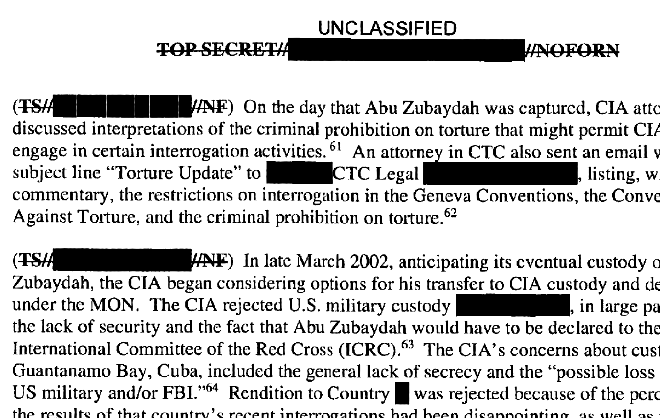
B. The Detention of Abu Zubaydah and the Development and Authorization of the CIA's Enhanced Interrogation Techniques
p. 18 · Read →
How the techniques were devised and first used, on the CIA's first detainee, Abu Zubaydah.
-
C. The Origins of CIA Representations Regarding the Effectiveness of the CIA's Enhanced Interrogation Techniques As Having "Saved Lives," "Thwarted Plots," and "Captured Terrorists"
p. 180 · Read →
Where the CIA's claims that the techniques saved lives came from, before the summary tests them case by case.
-
Minority Views of Vice Chairman Chambliss and Senators Burr, Risch, Coats, Rubio and Coburn
p. 521 · Read →
The minority's critique of the study's process, method and conclusions.
Contents
- REPORT Read →
- Foreword Read →
- Findings; and Conclusions Read →
- Executive Summary Read →
- I. Background on the Committee Study Read →
- A. September 17, 2001, Memorandum of Notification (MON) Authorizes the CIA to Capture and Detain a Specific Category of Individuals Read →
- B. The Detention of Abu Zubaydah and the Development and Authorization of the CIA's Enhanced Interrogation Techniques Read →
- D. The Detention and Interrogation of 'Abd al-Rahim al-Nashiri Read →
- E. Tensions with Country [Redacted] Relating to the CIA Detention Facility and the Arrival of New Detainees Read →
- F. The Detention and Interrogation of Ramzi Bin Al-Shibh Read →
- G. The Detention and Interrogation of Khalid Shaykh Muhammad Read →
- H. The Growth of the CIA's Detention and Interrogation Program Read →
- J. The CIA Seeks Reaffirmation of the CIA's Detention and Interrogation Program in 2003 Read →
- K. Additional Oversight and Outside Pressure in 2004: ICRC, Inspector General, Congress, and the U.S. Supreme Court Read →
- L. The Pace of CIA Operations Slows; Chief of Base Concerned About "Inexperienced, Marginal, Underperforming" CIA Personnel; Inspector General Describes Lack of Debriefers As "Ongoing Problem" Read →
- M. Legal and Operational Challenges in 2005 Read →
- N. The Final Disposition of CIA Detainees and the End of the CIA's Detention and Interrogation Program Read →
- A. Background on CIA Effectiveness Representations Read →
- B. Past Efforts to Review the Effectiveness of the CIA's Enhanced Interrogation Techniques Read →
- C. The Origins of CIA Representations Regarding the Effectiveness of the CIA's Enhanced Interrogation Techniques As Having "Saved Lives," "Thwarted Plots," and "Captured Terrorists" Read →
- D. CIA Representations About the Effectiveness of Its Enhanced Interrogation Techniques Against Specific CIA Detainees Read →
- E. CIA Effectiveness Claims Regarding a "High Volume of Critical Intelligence" Read →
- F. The Eight Primary CIA Effectiveness Representations—the Use of the CIA's Enhanced Interrogation Techniques "Enabled the CIA to Disrupt Terrorist Plots" and "Capture Additional Terrorists" Read →
- G. CIA Secondary Effectiveness Representations—Less Frequently Cited Disrupted Plots, Captures, and Intelligence that the CIA Has Provided As Evidence for the Effectiveness of the CIA's Enhanced Interrogation Techniques Read →
- A. The CIA Provides Information on the Still-Classified Detention and Interrogation Program to Journalists Who then Publish Classified Information; CIA Does Not File Crimes Reports in Connection with the Stories Read →
- B. Senior CIA Officials Discuss Need to "Put Out Our Story" to Shape Public and Congressional Opinion Prior to the Full Committee Being Briefed Read →
- D. The CIA Engages with Journalists and Conveys an Inaccurate Account of the Interrogation of Abu Zubaydah Read →
- A. August 1, 2002, OLC Memorandum Relies on Inaccurate Information Regarding Abu Zubaydah Read →
- B. The CIA Interprets the August 1, 2002, Memorandum to Apply to Other Detainees, Despite Language of the Memorandum; Interrogations of Abu Zubaydah and Other Detainees Diverge from the CIA's Representations to the OLC Read →
- C. Following Suspension of the Use of the CIA's Enhanced Interrogation Techniques, the CIA Obtains Approval from the OLC for the Intenogation of Three Individual Detainees Read →
- D. May 2005 OLC Memoranda Rely on Inaccurate Representations from the CIA Regarding the Interrogation Process, the CIA's Enhanced Interrogation Techniques, and the Effectiveness of the Techniques Read →
- E. After Passage of the Detainee Treatment Act, OLC Issues Opinion on CIA Conditions of Confinement, Withdraws Draft Opinion on the CIA's Enhanced Interrogation Techniques After (he U.S. Supreme Court Case of Hamdan v. Rumsfeld Read →
- F. July 2007 OLC Memorandum Relics on Inaccurate CIA Representations Regarding CIA Interrogations and the Effectiveness of the CIA's Enhanced Interrogation Techniques; CIA Misrepresents Congressional Views to the Department of Justice Read →
- B. The CIA Notifies Committee of the Detention of Abu Zubaydah, but Makes No Reference to Coercive Interrogation Techniques; the CIA Briefs Chairman and Vice Chairman After the Use of the CIA's Enhanced Interrogation Techniques; the CIA Discusses Strategy to Avoid the Chairman's Request for More Information Read →
- C. No Detailed Records Exist of CIA Briefings of Committee Leadership; the CIA Declines to Answer Questions from Committee Members or Provide Requested Materials Read →
- D. Vice Chairman Rockefeller Seeks Committee Investigation Read →
- E. In Response to Detainee Treatment Act, the CIA Briefs Senators Not on the Committee; Proposal from Senator Levin for an Independent Commission Prompts Renewed Calls Within the CIA to Destroy Interrogation Videotapes Read →
- F. CIA Director Goss Seeks Committee Support for the Program After the Detainee Treatment Act; CIA Declines to Answer Questions for the Rccord Read →
- G. Full Committee First Briefed on the CIA's Interrogation Program Hours Before It Is Publicly Acknowledged on September 6, 2006 Read →
- H. The CIA Provides Additional Information to the Full Committee and Staff, Much of It Inaccurate; Intelligence Authorization Act Passes Limiting CIA Interrogations to Techniques Authorized by the Army Field Manual Read →
- I. President Vetoes Legislation Based on Effectiveness Claims Provided by the CIA; CIA Declines to Answer Committee Questions for the Record About the CIA Interrogation Program Read →
- IX. Appendix 2: CIA Detainees from 2002 - 2008 Read →
- X. Appendix 3: Example of Inaccurate CIA Testimony to the Committee- April 12,2007 Read →
- Additional Views of Senator Rockefeller Read →
- ADDITIONAL VIEWS OF SENATOR WYDEN Read →
- ADDITIONAL VIEWS OF SEN. UDALL OF COLORADO Read →
- Additional Views of Senator Heinrich Read →
- Additional Views of Senator King Read →
- Additional Views of Senator Collins Read →
- MINORITY VIEWS OF VICE CHAIRMAN CHAMBLISS, SENATORS BURR, RISCH, COATS, RUBIO, AND COBURN* Read →
- CIA Detainees Subjected to EITs Validated CIA Sources Read →
- Acce.ss to Documents Read →
- Minority Views by Senator Coburn, Vice Chairman Saxby Chambliss, Senators Burr, Risch, Coats and Rubio Read →
- MINORITY VIEWS OF SENATORS RISCH, COATS, AND RUBIO Read →
- Notes not linked in the text Read →